

Does Dental Insurance Cover Fillings? What to Check Before Treatment
Learn what to verify about the tooth, filling material, replacement history, dentist network, and expected patient cost before relying on dental benefits.
Written and researched by Maria Dumitru.
Founder and Content Editor at Dental Coverage Hub
Last reviewed: November 2026
What You’ll Learn
Does dental insurance cover fillings? Many plans include filling benefits, but the answer for your treatment depends on the specific restoration and the terms of your coverage.
A benefits summary may list fillings without explaining how the plan handles different tooth surfaces, materials, replacement history, or related services. Those details can affect both eligibility and your expected bill.
This guide explains:
- How to identify the filling being recommended
- Why different fillings can receive different benefits
- Which costs and coverage restrictions to check
- What changes when an existing filling needs replacement
- When advance benefit information may help
- How to review the claim result after treatment
For the broader framework, start with Dental Insurance Coverage for Common Procedures.
Quick Answer
Many dental insurance plans provide benefits for fillings as restorative care. However, a listed filling benefit does not establish that every filling is immediately eligible or paid in full.
Confirm the proposed procedure, tooth and surfaces, material, replacement history, provider network, applicable deductible or member charge, and available benefits. Review any waiting period or other restriction before relying on an estimate.
Key Takeaways
- Check the specific restoration rather than relying only on a general filling benefit.
- The tooth, surfaces, material, and previous treatment can affect benefit review.
- A covered filling can still leave deductible, cost-sharing, or other permitted patient charges.
- Replacement fillings may require a separate review of prior treatment and plan limitations.
- Related services and several fillings should be itemized rather than treated as one guaranteed benefit.
- Compare the processed claim with the dental office statement before assuming the balance is final.
In This Guide
Are Fillings Considered Basic Dental Services?
Fillings restore tooth structure and may appear under basic services or basic restorative care in plan documents.
However, basic is a benefit category, not a universal promise about payment. Check the schedule for the actual procedure rather than assuming that every restoration receives the same benefit.
For a plan using percentage-based benefits, identify the applicable deductible and coinsurance. For a plan using a member copayment schedule, locate the proposed restoration in that schedule and review its conditions.
A benefit listed for one type of restoration should not automatically be applied to an inlay, onlay, crown, temporary restoration, or other procedure described differently on the treatment plan.
Ask the dental office to identify what is being proposed in plain language and provide the procedure information needed for benefit verification.
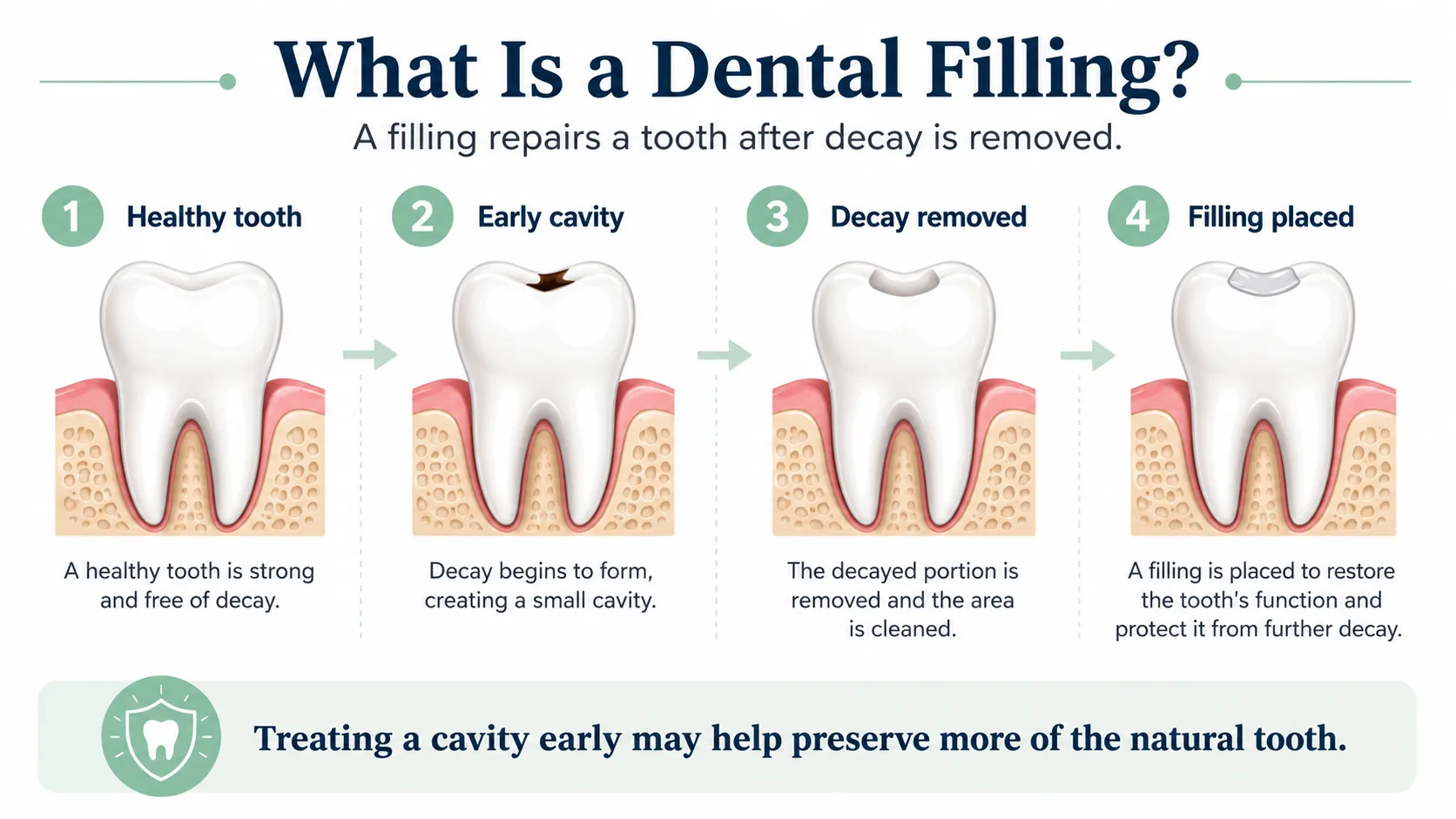
Start With the Exact Filling Being Recommended
A useful coverage inquiry begins with the treatment details.
Ask for an itemized estimate identifying:
| Treatment detail | What to confirm |
|---|---|
| Procedure | What restoration is proposed and how it will be reported |
| Tooth | Which tooth will receive treatment |
| Surfaces | Which parts of the tooth are involved |
| Material | Which restorative material is planned |
| Treatment history | Whether this is an initial restoration, repair, or replacement |
| Provider | Which dentist and office will provide care |
| Timing | When treatment is expected |
| Related care | Which additional services appear on the estimate |
The ADA’s claim-form guidance includes tooth numbers and tooth surfaces where applicable. These details help distinguish the services being reported. American Dental Association
You do not need to select a procedure code yourself. The dental office should describe and report the care accurately.
Why Tooth Surfaces Matter
A filling involving one surface is not necessarily the same procedure as a restoration involving several surfaces.
If your estimate lists different fillings, ask the office to explain the differences. This can help you understand why the charges or estimated benefits vary.
Also ask whether multiple entries involve the same tooth. Some plans may combine related restorations on the same tooth when calculating a benefit. Separate entries on an estimate therefore do not always establish separate plan payments. American Dental Association
How to Review Your Expected Filling Cost
Start with the written treatment estimate and ask how the expected patient amount was calculated.
For a plan using an allowance and coinsurance, distinguish the dentist’s submitted charge from the amount the plan recognizes for benefit calculation. Then check how any deductible, cost-sharing, and benefit limit affect the estimate.
For a copayment-based arrangement, confirm the scheduled member charge for the exact restoration and any additional permitted charges.
The ADA’s EOB guidance identifies the plan allowance, deductible, plan payment, patient responsibility, and explanatory remarks as separate items to review. American Dental Association
Questions About the Estimate
Ask the office or plan:
- Which benefit schedule was used?
- Does the estimate reflect my current deductible status?
- Was the exact provider network verified?
- Does the estimate account for a material-related benefit limitation?
- Were available benefits checked recently?
- Are any charges still uncertain?
Ask for uncertain items to be identified rather than included as confirmed insurance payments.
Check What the Estimate Includes
An appointment may involve an examination, imaging, or other care in addition to the filling. Ask which services are included in the quoted amount and which are listed separately.
Separate charges do not automatically establish separate insurance benefits. Ask how the plan handles each item and whether any service is included in another procedure’s allowance.
If your office requests payment before the claim is processed, ask how that amount will be reconciled afterward. Keep receipts so payments already made can be compared with the final office statement.
For the general cost framework, read Dental Insurance Costs Explained.
Verify the Dentist’s Exact Network
Confirm the dentist, office location, plan, and network before treatment.
A dental office saying that it accepts your insurance may mean it will submit a claim. Ask specifically whether the treating dentist participates in your exact network.
Useful questions include:
- Is this dentist participating at this location?
- Will another dentist provide the filling?
- Does my plan provide benefits outside the network?
- What fee information was used in the estimate?
- Who will submit the claim?
- What payment will the office request at the appointment?
If the office and insurer provide conflicting information, resolve the difference before treating the network status as confirmed.
For the detailed comparison, read In-Network vs Out-of-Network Dental Insurance.
Can Filling Material Affect Coverage?
Yes. Some plans calculate a benefit using an alternative covered restoration rather than the material selected for treatment.
For example, an alternate-benefit provision may affect the payment for a composite filling on a back tooth. This is a benefit calculation and should not be interpreted as a clinical instruction to use a different material. American Dental Association
Before treatment, ask:
- Which material is proposed?
- Does the plan calculate benefits for that material directly?
- Could an alternate benefit apply to this tooth?
- What additional patient charge, if any, is permitted?
Have the dental office explain the treatment options separately from the plan’s financial contribution.
For the detailed material comparison, read Composite vs Amalgam Fillings: How Dental Insurance May Calculate Benefits.
Are Replacement Fillings Covered?
They may be, but replacement requires more than confirming that fillings appear in the benefits schedule.
Ask whether the proposed service repairs existing work, replaces a previous restoration, or treats a different area of the tooth. Then verify the applicable provision.
A useful replacement inquiry identifies:
- The tooth and surfaces involved
- What previous treatment was performed
- When that treatment occurred, if known
- Why the dentist recommends the new service
- What records the plan requests
- Whether the restriction applies to the tooth, surfaces, provider, or another defined circumstance
Do not apply a universal replacement interval to every filling.
Likewise, do not assume that a new dentist or a new insurance card makes the prior restoration irrelevant.
If the Placement Date Is Unknown
Ask your current or previous dental office whether treatment records are available.
If the date cannot be confirmed, ask the plan what information it accepts and how an unknown history affects the review. Do not substitute an estimated date without explaining that it is uncertain.
Keep copies of relevant correspondence so the office and plan are working from the same information.
Replacement Mainly for Appearance
Ask the dentist to explain the reason for replacing the restoration and check whether the plan distinguishes functional treatment from services performed primarily for appearance.
The clinical recommendation and benefit eligibility remain separate questions.
For the broader framework, read Dental Insurance Replacement Rules Explained.
What If You Need Several Fillings?
Request an itemized estimate rather than one combined statement that several fillings are covered.
For each proposed restoration, identify the tooth, surfaces, material, replacement status, and estimated patient amount. Mark any line that still needs clarification.
This makes it easier to ask focused questions:
- Is one restoration affected by previous treatment?
- Does a material-related provision apply to only some teeth?
- Are any benefits still unconfirmed?
- Does the estimate include all planned appointments?
- Will additional services be billed separately?
If your plan has an annual maximum, ask how much remains and whether pending claims could change that figure. A benefit balance viewed today may not account for all care already received.
Do not multiply the estimated payment for one filling by the number of teeth without checking the individual services.
For the benefit-limit explanation, read Dental Insurance Annual Maximums Explained.
Discuss clinically appropriate timing with your dentist. A benefit-year boundary should not be treated as a treatment recommendation.
Can You Use New Coverage for a Cavity Already Diagnosed?
A cavity diagnosed before enrollment does not, by itself, establish whether a later filling will receive benefits.
First distinguish treatment that has only been recommended from treatment already started. Then ask which provisions apply to the actual situation.
Confirm:
- The coverage effective date
- Whether a waiting period applies to the restoration
- The service date the plan will use
- Any relevant exclusion or limitation
- Whether previous treatment changes the review
Active coverage and eligibility for a particular service are separate checks. Some dental arrangements have waiting periods for adult services, including separate Marketplace dental plans. HealthCare.gov
For the timing mechanism, read How Waiting Periods Work in Dental Coverage.
For a known problem before enrollment, use Dental Insurance and Existing Dental Problems.
If coverage is changing during care, consult Dental Insurance and Treatment Already in Progress.
What If a Filling Is Part of a Larger Treatment Plan?
Ask the office to distinguish the filling from any related procedure.
For example, root canal treatment and the restoration afterward raise separate benefit questions. A temporary restoration, definitive filling, buildup, or crown should not be assumed to receive the same treatment under the plan.
Ask:
- Which services are proposed now?
- Which are temporary or preparatory?
- What remains to be completed?
- Which charges are included together?
- What requires separate benefit verification?
If the recommendation changes after the dentist evaluates the tooth, ask for an updated explanation and estimate. An earlier estimate for a filling should not automatically be carried over to a different procedure.
For the endodontic part of care, see Does Dental Insurance Cover Root Canals?
Should You Request a Pretreatment Review?
Start by asking whether the plan requires any approval before the proposed service.
Then distinguish:
| Information or process | What to clarify |
|---|---|
| Dental office estimate | What the office expects you to pay and which assumptions it used |
| Predetermination | What advance benefit information the plan can provide |
| Preauthorization | Whether approval is required and what conditions apply |
An optional estimate does not replace a required approval process.
Advance review may be particularly useful when replacement history, material benefits, several restorations, or related treatment make the expected payment unclear.
Read the response for the procedures reviewed, conditions, validity period, and remaining uncertainties. Do not assume it reserves benefits or guarantees payment regardless of later changes. The effect of a response also depends on applicable plan terms and law.
For the complete explanation, read Dental Insurance Predetermination vs Preauthorization: What’s the Difference?
Before Treatment: Confirm the Details With the Right Source
Use the dental office for treatment information and the plan for benefit provisions. Some questions require input from both.
| Ask the dental office | Ask the dental plan |
|---|---|
| What restoration is recommended? | Is that proposed service eligible under my coverage? |
| Which tooth and surfaces are involved? | Which benefit category or member charge applies? |
| Is this a repair or replacement? | What prior-service rule or documentation applies? |
| Which material is planned? | Could an alternate benefit affect payment? |
| What related care is included? | How are those services evaluated? |
| What will I be asked to pay? | Which amounts and conditions support the benefit estimate? |
Keep the written estimate, relevant plan provisions, and any advance response together. Record the date and reference number when you contact the plan.
If the answers conflict, ask both parties to use the same procedure information. A general answer about fillings may not resolve a question about a particular replacement or material.
Where to Find the Rules
Look in your schedule of benefits or member copayment schedule, restorative-services section, exclusions, limitations, and network information.
For workplace coverage, use the documents for your employer’s actual plan. For purchased coverage, use the policy or certificate corresponding to the product you selected.
Check that the documents apply to your coverage period and covered member. A public brochure or another person’s benefit booklet may describe a different arrangement.
If you are comparing new plans for recommended care, use How to Compare Dental Plans for Treatment You Already Expect to Need.
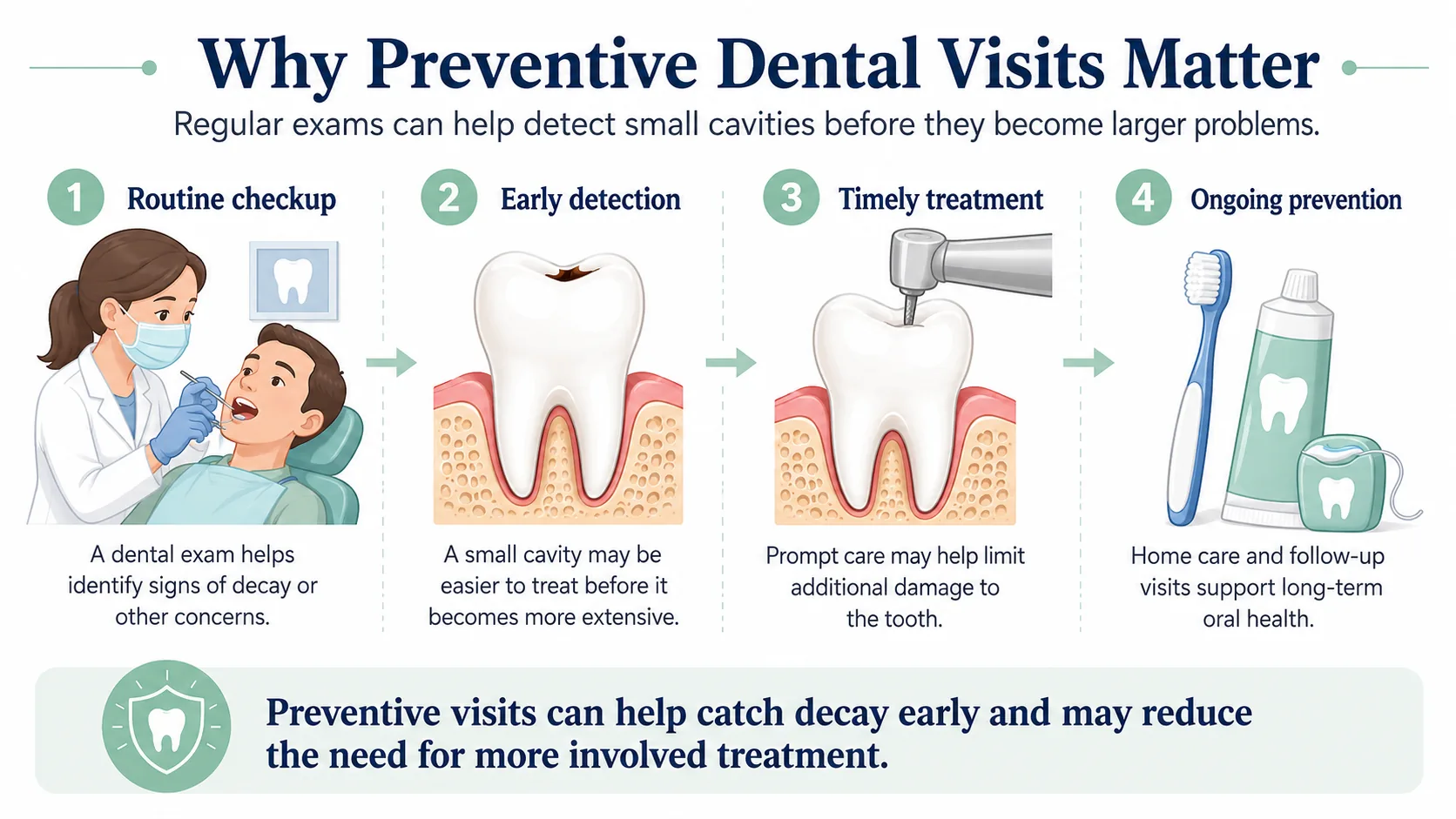
Preventive visits and restorative treatment involve separate benefit questions. Coverage for an examination or cleaning does not establish coverage for a filling identified during that visit. For the broader prevention topic, read Preventive Dental Care.
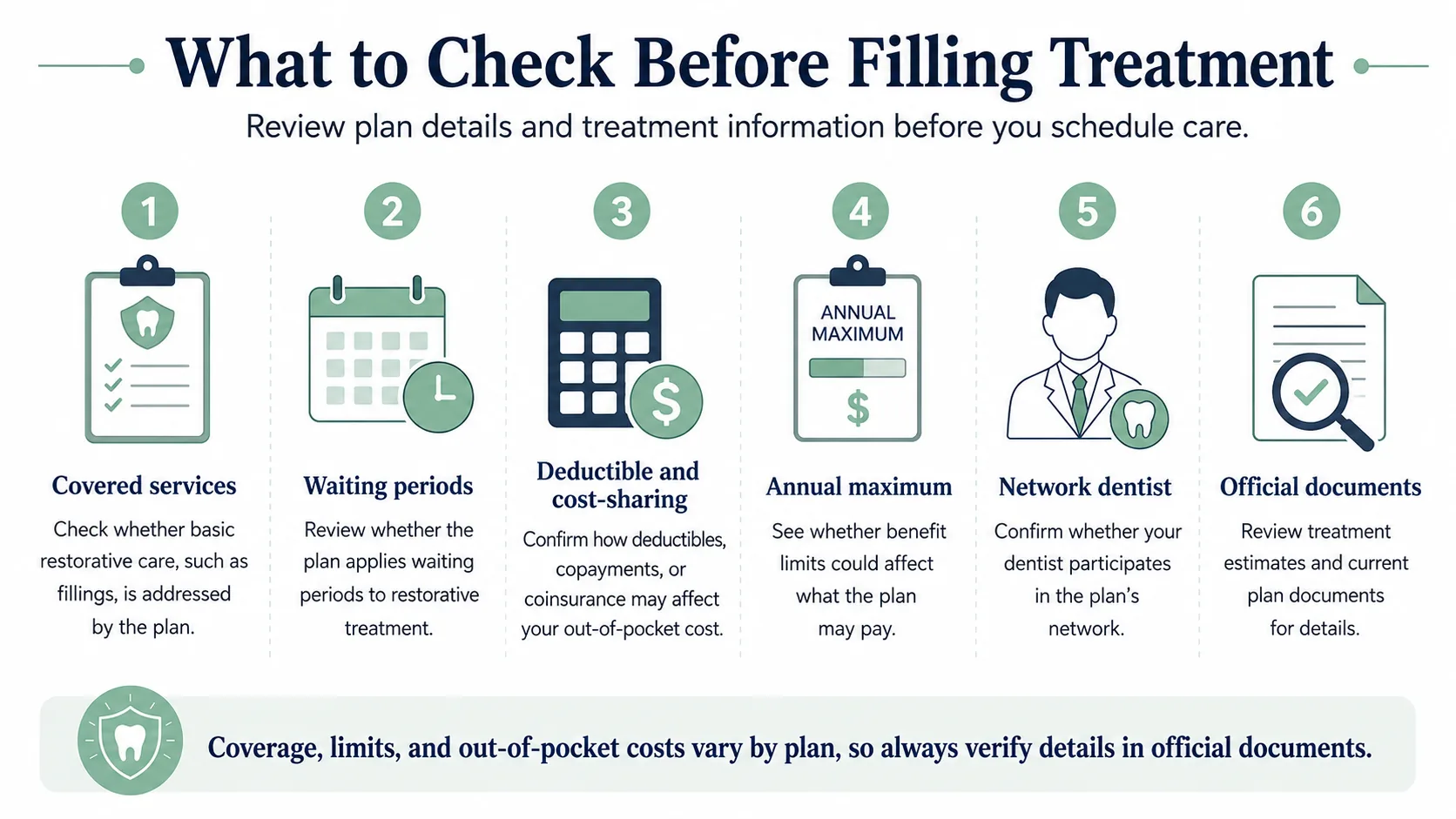
How to Interpret Filling Benefit Information
| Information you receive | What it establishes—and what still needs checking |
|---|---|
| Fillings appear in the benefit summary | Review the exact restoration and applicable restrictions |
| The dentist accepts your insurance | Confirm participation in the specific network |
| A restoration receives an alternate benefit | Ask what calculation was used and what patient charge is permitted |
| A replacement limitation is mentioned | Identify the prior service and exact provision |
| Several fillings appear on the estimate | Review each item and any combined benefit treatment |
| An advance estimate shows payment | Read its conditions and verify material changes before care |
| The claim shows no payment | Read the explanation before deciding what happened or what you owe |
The practical goal is to connect each estimate or decision to the particular restoration being reviewed.
After Treatment: Compare the Claim Result With the Bill
When an EOB is issued, compare it with your treatment estimate and office statement.
Review the reported services, provider, treatment date, tooth information, payment, adjustments, and remarks. Ask the office to explain any difference between the proposed treatment and the services actually provided.
An EOB is not a bill. Also check whether the office statement reflects payments you already made.
A reduced or unpaid benefit does not automatically mean the entire unpaid charge can be collected from you. Ask how the plan decision, provider agreement, and applicable rules affect the amount owed.
For detailed interpretation, read How to Read a Dental Insurance EOB.
If you disagree with a decision, identify the stated reason and check whether the next step is clarification, corrected information, supporting records, or an appeal. If a denial notice gives a deadline, do not assume an informal inquiry pauses it.
Use Dental Insurance Claim Denied? How to Review the Decision and Appeal for that process.
Our Recommendation
Begin with an itemized treatment estimate. Confirm the tooth, surfaces, material, and whether existing work is being repaired or replaced.
Next, match those details to the current plan documents and provider network. Ask for unresolved benefit questions to be identified before relying on the estimated patient cost.
Keep clinical decisions and benefit calculations distinct. Your dentist can explain the appropriate treatment; the plan can explain its financial contribution and restrictions.
Helpful Resources
- Dental Insurance Coverage for Common Procedures
- Composite vs Amalgam Fillings: How Dental Insurance May Calculate Benefits
- Dental Insurance Replacement Rules Explained
- Dental Insurance Costs Explained
- Dental Insurance Predetermination vs Preauthorization: What’s the Difference?
- How to Read a Dental Insurance EOB
Frequently Asked Questions
Does dental insurance usually cover fillings?
Many plans include filling benefits, but eligibility and payment depend on the proposed restoration and plan terms. Check the procedure, provider, timing, applicable member charges, and restrictions.
Are fillings considered basic dental services?
They may appear under basic or restorative services. Confirm the exact procedure in your benefit schedule because the category name alone does not establish payment.
Does dental insurance pay the full cost of a filling?
Not necessarily. Ask how the expected patient amount reflects the applicable fee, deductible, copay or coinsurance, available benefits, and other provisions.
Can several fillings receive benefits during the same treatment plan?
They may, but review each restoration separately. Different teeth, surfaces, materials, or treatment histories can raise different benefit questions.
Does dental insurance cover replacement fillings?
It may. Ask which replacement or frequency provision applies, what previous treatment information is needed, and whether the reason for replacement affects eligibility.
Can filling material change the insurance payment?
Yes. Some plans calculate a benefit using an alternative covered restoration. Ask how that provision affects the proposed material and any permitted patient charge.
Can a new plan cover a cavity diagnosed before enrollment?
Possibly. The diagnosis date alone does not determine the answer. Verify the effective date, waiting period, and other provisions relevant to the proposed treatment.
Does an advance benefit estimate guarantee payment?
Do not assume that it does. Read what the response confirms, its conditions, and what changes could affect the result. Also verify whether the plan requires a separate approval process.
Sources
About the Author
Maria Dumitru is the Founder and Content Editor of Dental Coverage Hub. She researches and edits educational content designed to help U.S. consumers understand dental insurance terms, compare plan features, and verify important information before enrolling.
Learn more about our standards in the Editorial Policy and How We Review Dental Plans.
Disclaimer
This article provides general educational information, not personalized dental, medical, insurance, financial, or legal advice. Benefits, eligibility, patient charges, and restrictions vary by plan and circumstances. Verify your coverage with the insurer or plan administrator and discuss treatment and estimates with your dental office. Clinical decisions should be made with a licensed dental professional. Dental Coverage Hub is an independent educational publisher, not an insurer, broker, agent, dental provider, or enrollment platform.

Review Coverage for the Rest of Your Treatment Plan
A filling may be only one part of the care you need. Explore the related procedure guides to identify the benefits and restrictions that require separate verification.