

🇺🇸 Built for U.S. Consumers
Provider-Neutral Guidance
🌿 Educational Comparison Framework

Compare Dental Plans: Costs, Coverage, Networks, and Benefits
Learn how to compare costs, covered services, provider networks, waiting periods, and benefit limits before reviewing available options.
Written and researched by Maria Dumitru.
Founder and Content Editor at Dental Coverage Hub
Last reviewed: August 2026
What You’ll Learn
Comparing dental plans requires more than checking which option has the lowest monthly premium. A useful comparison considers how each plan handles covered services, deductibles, provider networks, waiting periods, annual maximums, exclusions, and the dental care you or your family may reasonably expect.
The goal is not to find one plan that is best for everyone. It is to understand how the available options differ so you can decide which plan structure is more compatible with your providers, treatment needs, timing, and budget.
This guide explains how to compare dental plans using the same criteria for every option, where to verify important details, and which questions should be answered before enrolling.
Quick Answer
To compare dental plans effectively, review the complete cost and benefit structure rather than the premium alone.
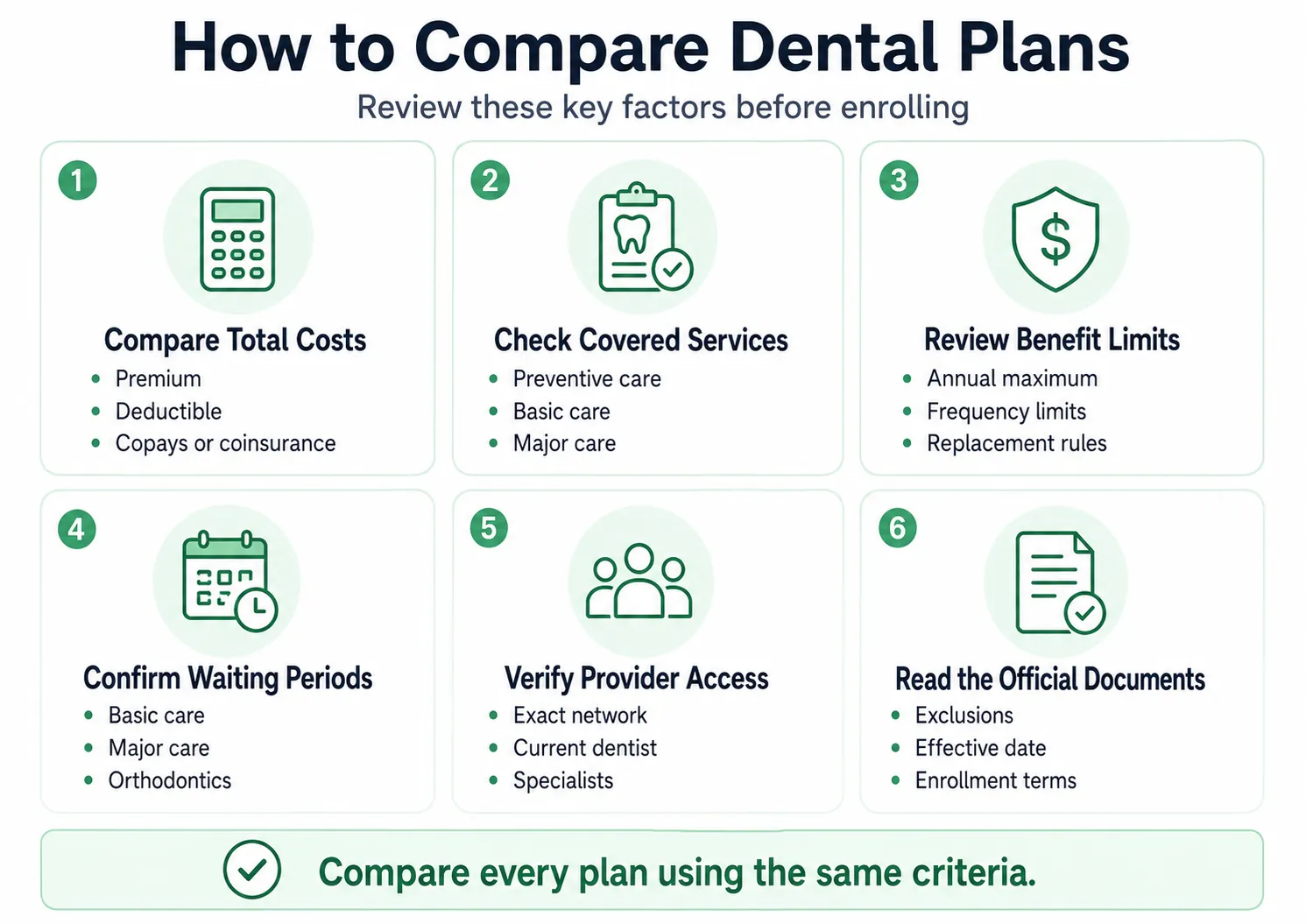
Compare:
- monthly and annual premiums;
- deductibles;
- copays or coinsurance;
- covered preventive, basic, and major services;
- annual maximums;
- waiting periods;
- exact provider networks;
- out-of-network rules;
- exclusions and limitations;
- family and orthodontic benefits;
- effective dates and enrollment conditions.
Use official plan documents whenever possible. A quote page or short benefit summary may introduce a plan, but it may not show every limitation that affects access or cost.
Key Takeaways
- A lower premium does not automatically mean lower total dental spending.
- “Covered” does not necessarily mean that a service is paid in full.
- Confirm the exact plan and provider network—not only the insurance company’s name.
- Annual maximums, waiting periods, exclusions, and replacement limits can materially change the practical value of coverage.
- Family members may have separate deductibles, annual maximums, eligibility rules, and treatment needs.
- Online quotes should be verified against official benefit documents before enrollment.
- Compare every plan using the same criteria and eliminate options that fail an essential requirement.
In This Guide
What Does It Mean to Compare Dental Plans?
A meaningful dental plan comparison looks at how several features interact. For example, a plan with a lower premium may also have:
- a higher deductible;
- greater cost-sharing for major services;
- a smaller provider network;
- longer waiting periods;
- a lower annual maximum;
- more restrictive exclusions.
A plan with a higher premium may appear more comprehensive, but that does not automatically make it more suitable. Its network may exclude your preferred dentist, or its strongest benefits may apply to services you are unlikely to use.
Comparing dental plans therefore means evaluating the complete structure of each option and testing it against your expected needs.
A quote summary can help narrow the available options, but the final comparison should also use the benefit schedule, policy or Evidence of Coverage, provider directory, exclusions, and enrollment terms.
The Main Factors to Compare
Premium and Total Estimated Cost
The premium is the fixed amount paid to keep coverage active. Record:
- monthly premium;
- annual premium;
- enrollment or administrative fees;
- billing frequency;
- premium for the correct household tier;
- employer contribution, when applicable.
Convert each monthly premium to an annual amount:
Monthly premium × number of covered months = annual premium
The annual premium does not represent your complete dental spending. Depending on the plan and care received, you may also pay:
- deductibles;
- copays;
- coinsurance;
- charges for excluded services;
- costs incurred during waiting periods;
- amounts above an out-of-network allowance;
- expenses after the annual maximum is reached.
Use the same assumptions for every plan rather than comparing one plan’s premium with another plan’s estimated total cost.
For a detailed explanation, read Dental Insurance Costs Explained.
Deductibles, Copays, and Coinsurance
A deductible is an amount the member may need to pay toward services subject to the deductible before plan cost-sharing begins.
A copay is generally a fixed member charge. Coinsurance is generally a percentage of an eligible or allowed amount.
Check:
- individual deductible;
- family deductible;
- in-network and out-of-network deductibles;
- services exempt from the deductible;
- preventive-care member cost;
- basic-care cost-sharing;
- major-care cost-sharing;
- orthodontic cost-sharing, when included.
A plan may advertise a favorable coverage percentage, but that percentage does not show the final patient cost by itself. The result may also depend on the plan’s allowed amount, provider-network contract, deductible, annual maximum, and procedure classification.
Covered Services and Benefit Categories
Dental plans often organize care into broad categories such as:
- preventive and diagnostic;
- basic;
- major;
- orthodontic.
The same procedure may not be classified identically by every plan.
| Benefit category | Examples to verify | Additional rules to review |
|---|---|---|
| Preventive and diagnostic | Exams, cleanings, X-rays | Frequency limits, age rules, deductible treatment |
| Basic care | Fillings, simple extractions, basic periodontal care | Waiting period, cost-sharing, procedure classification |
| Major care | Crowns, bridges, dentures, implants | Exclusions, replacement schedules, alternate benefits |
| Orthodontic care | Braces, clear aligners | Eligibility, age limits, waiting period, lifetime maximum |
Benefit categories are useful for comparison, but they do not replace procedure-specific verification. The same treatment may be classified differently by another plan, and related procedures may be evaluated separately.
For example, a root canal and the crown or filling needed afterward should not automatically be treated as one insurance benefit. An extraction and the later treatment used to replace the missing tooth should also be reviewed separately.
If one of these treatments matters to your comparison, review the specific guide for fillings, tooth extraction, root canal treatment, or dental bridges before relying on a general “basic” or “major” category.
A procedure listed as covered may still be subject to:
- a deductible;
- copay or coinsurance;
- annual maximum;
- waiting period;
- frequency limit;
- preauthorization;
- alternate-benefit provision;
- provider-network requirement.
Review specific procedures rather than relying only on the words “basic” or “major.”
For procedure-specific guidance, visit Dental Insurance Coverage for Common Procedures.
Annual Maximums
An annual maximum generally limits how much a dental plan pays toward services subject to that limit during a benefit period. It is not usually a limit on what the member may have to pay. Confirm:
- annual maximum amount;
- whether the maximum applies per person or per family;
- which services count toward it;
- whether preventive benefits reduce it;
- when the maximum resets;
- whether in-network and out-of-network claims share the same maximum;
- whether unused benefits can roll over;
- whether orthodontics has a separate lifetime maximum.
The American Dental Association notes that dental plans may use annual maximums on an individual or family basis.
A higher annual maximum can be useful, but it should not be evaluated independently from covered services, cost-sharing, network access, and waiting periods.
Read Dental Insurance Annual Maximums Explained for the full explanation.
Waiting Periods
A waiting period is the time that must pass before benefits become available for certain services. Check separately for:
- preventive care;
- basic services;
- major services;
- orthodontics;
- when the waiting period begins;
- whether prior coverage may qualify for a waiver;
- documentation required for a waiver;
- rules for newly added dependents;
- first-year or graded benefit limits.
A procedure may be listed as covered even though no benefits are available for it immediately after enrollment.
HealthCare.gov states that separate Marketplace dental plans may apply waiting periods before covering adult services.
Read How Waiting Periods Work in Dental Coverage before enrolling when treatment may be needed soon.
Provider Networks
Provider access can affect both convenience and cost.
Do not ask only whether a dental office “accepts” the insurance. Verify whether the individual dentist, at the correct office location, participates in the exact network connected to the plan. Record:
- exact network name;
- preferred dentist’s name;
- correct office location;
- whether the dentist accepts new patients;
- pediatric dentist access;
- orthodontist access;
- other specialist access;
- reasonable travel distance;
- appointment availability.
One insurer may operate several networks. A dentist may participate in one product but not another.
Confirm network status with both the dental plan and the dental office shortly before enrolling or scheduling care.
Out-of-Network Rules
Some PPO plans provide out-of-network benefits, but out-of-network care may still produce higher or less predictable costs.
Check:
- whether out-of-network care receives benefits;
- separate deductible;
- applicable coinsurance;
- how the allowed amount is determined;
- whether payment is required upfront;
- whether the dentist may charge above the plan allowance;
- who submits the claim;
- whether the plan pays the dentist or the member;
- whether a network exception may be available.
An out-of-network benefit does not necessarily require the dentist to accept the plan’s allowance as payment in full.
The ADA’s Explanation of Benefits guidance distinguishes plan calculations from the additional balance a patient may owe in some out-of-network situations.
For a deeper explanation, read In-Network vs Out-of-Network Dental Insurance.
Exclusions and Limitations
Exclusions and limitations may affect a plan more than its advertised coverage percentages. Review:
- procedures not covered;
- implant restrictions;
- missing-tooth provisions;
- treatment-in-progress rules;
- age restrictions;
- frequency limits;
- replacement schedules;
- alternate-benefit provisions;
- material-upgrade restrictions;
- preauthorization requirements;
- specialist-referral requirements;
- procedure-specific payment limits.
The ADA identifies annual maximums, frequency limitations, waiting periods, excluded services, and other cost-containment provisions among the restrictions that may appear in dental benefit plans.
Do not ask only: Is this service covered?
Also ask:
Under what conditions will the plan pay toward this service?
Family, Pediatric, and Orthodontic Benefits
Family coverage should not be evaluated as though every household member has identical needs. Check:
- eligible spouse or partner;
- dependent eligibility;
- dependent age limits;
- individual and family deductibles;
- annual maximum per member;
- shared family limits, when applicable;
- pediatric provider access;
- orthodontic eligibility;
- orthodontic waiting period;
- age restrictions;
- lifetime maximum;
- treatment-in-progress rules.
One family member may need only preventive care, while another may need restorative treatment or orthodontics. A plan that appears suitable for one person may be less practical for the household as a whole.
Read Individual vs Family Dental Plans for a detailed household comparison.
Effective Dates, Renewal, and Cancellation Rules
The application date, payment date, and coverage effective date may be different.
Before enrolling, verify:
- final effective date;
- first premium due date;
- when waiting periods begin;
- enrollment tier;
- household members included;
- automatic renewal rules;
- premium-change notices;
- cancellation procedure;
- effect of cancellation on pending claims;
- treatment-in-progress rules.
Do not schedule nonurgent dental treatment based only on the date an application is submitted.
For employer-sponsored coverage, review the official enrollment materials and Summary Plan Description. The Department of Labor describes the Summary Plan Description as an important document explaining what an employment-based plan provides, how it operates, eligibility rules, and benefit-claim procedures.
Compare Common Dental Plan Types
Plan labels provide a starting point, but the individual contract determines how coverage works.
| Plan structure | Provider access | Typical payment approach | Important questions |
|---|---|---|---|
| PPO | Network providers plus possible out-of-network benefits | Deductibles and coinsurance may apply | Which network is used? How are out-of-network benefits calculated? |
| DHMO | Usually requires participating providers | Scheduled copays may apply | Must a primary dentist be selected? Are referrals required? |
| Indemnity or fee-for-service | May offer broader provider choice | Member may pay the dentist and seek reimbursement | What allowance does the plan recognize? Who submits claims? |
| Dental savings or discount program | Participating discount network | Member pays the discounted charge | Is the product insurance or a membership program? |
PPO Plans
A PPO may offer flexibility to use both participating and nonparticipating providers. In-network dentists generally agree to contracted terms, while out-of-network costs may be less predictable.
Do not assume that every PPO uses the same network, deductible, reimbursement method, or annual maximum.
DHMO Plans
A DHMO commonly relies on a defined provider network and may require the member to select a primary dentist. Covered services may use scheduled copays rather than percentage-based coinsurance.
Provider availability and referral rules deserve close review.
Indemnity or Fee-for-Service Plans
An indemnity plan may allow broader provider choice, but the member may need to pay the dentist and submit or coordinate a claim.
Confirm the plan allowance, reimbursement process, and possible difference between the dentist’s fee and the plan payment.
Dental Savings or Discount Programs
Dental savings plans are generally membership programs, not insurance. Participating dentists agree to provide services at discounted rates, and the member usually pays the discounted charge directly.
Do not compare a discount membership fee with an insurance premium as though both products provide the same type of benefit.
For more detail, read PPO vs HMO Dental Plans and Dental Insurance vs Dental Savings Plans.
How to Compare Dental Plans Step by Step
1. Identify Essential Needs
Begin with requirements that a plan must meet. These may include:
- current dentist must be in-network;
- expected treatment must not be delayed by a waiting period;
- a necessary procedure must be covered;
- pediatric or orthodontic benefits must be available;
- the annual premium must fit the household budget.
Separate essential requirements from optional preferences.
2. Record the Exact Plan and Network
Write down:
- plan name;
- plan type;
- exact network;
- plan year;
- service area;
- enrollment tier.
This prevents information from different products offered by the same insurer from being mixed together.
3. Compare Fixed and Expected Costs
Calculate the annual premium and review:
- deductible;
- copays or coinsurance;
- annual maximum;
- likely non-covered expenses;
- possible out-of-network charges.
Use the same expected-care assumptions for every plan.
4. Review Coverage and Limitations
Check whether anticipated services are:
- covered;
- excluded;
- delayed by a waiting period;
- subject to frequency or replacement rules;
- subject to alternate benefits;
- counted toward the annual maximum.
5. Verify Provider Access
Confirm the exact dentist and location.
Also review alternatives and specialists rather than relying on one provider-directory result.
6. Read the Official Documents
Review comparable documents for every plan:
- benefit summary;
- schedule of benefits;
- policy or Evidence of Coverage;
- exclusions and limitations;
- provider directory;
- enrollment terms.
Do not compare one plan using its full policy and another using only an advertising page.
7. Use the Same Checklist
Record each option in the same worksheet.
The Dental Plan Comparison Checklist provides a structured side-by-side framework.
8. Confirm the Final Enrollment Information
Before paying, verify:
- exact plan;
- premium;
- enrollment tier;
- people included;
- network;
- effective date;
- first payment;
- confirmation number.
For the complete shopping process, read How to Compare Dental Plans Online.
Dental Plan Comparison Framework
Use this framework when reviewing each option.
| Comparison factor | What to review | Why it matters | Where to verify |
|---|---|---|---|
| Premium | Monthly and annual cost, fees | Shows fixed cost of maintaining coverage | Quote and enrollment application |
| Deductible | Individual, family, exempt services | Affects initial member spending | Benefit schedule |
| Cost-sharing | Copays or coinsurance by service | Influences cost when care is received | Copay schedule or benefit summary |
| Covered services | Preventive, basic, major, orthodontic | Determines which procedures may receive benefits | Policy and schedule of benefits |
| Annual maximum | Amount, reset date, per-person rules | Limits plan payments for many services | Benefit schedule |
| Waiting periods | Service categories and waiver rules | Determines when benefits begin | Policy and waiting-period notice |
| Provider network | Exact dentist, location, specialists | Affects access and contracted pricing | Provider directory and dental office |
| Out-of-network care | Allowance, balance billing, claims | Can create less predictable expenses | Policy and reimbursement terms |
| Exclusions | Missing-tooth, replacement, treatment-in-progress | May prevent or reduce payment | Exclusions and limitations |
| Enrollment | Effective date, tier, renewal, cancellation | Determines who is covered and when | Application and enrollment confirmation |
For a detailed Plan A, Plan B, and Plan C worksheet, use the Dental Plan Comparison Checklist.
Which Features Matter Most for Different Shoppers?
Individuals Expecting Mostly Preventive Care
Review:
- preventive-service frequency;
- whether the deductible applies;
- provider access;
- annual premium;
- whether preventive services count toward the annual maximum;
- benefits for unexpected basic care.
A low premium may appear attractive, but the plan should still provide access to participating dentists and understandable coverage if additional care becomes necessary.
Families With Different Dental Needs
Give closer attention to:
- family premium;
- individual and family deductibles;
- annual maximum for each member;
- pediatric provider network;
- dependent eligibility;
- orthodontic benefits;
- services needed by different household members.
Do not assume that the plan with the strongest benefit for one person provides the best overall household fit.
People Expecting Restorative, Endodontic, or Tooth-Replacement Treatment
If you already expect dental treatment, compare the plans against the exact procedures being considered rather than relying only on broad benefit categories.
Review:
- Coverage for the specific procedure
- How the plan classifies the treatment
- Any applicable waiting period
- Deductible and cost-sharing
- Remaining annual maximum
- Exact dentist or specialist network
- Whether related procedures are evaluated separately
- Replacement, missing-tooth, or alternate-benefit provisions when relevant
- Preauthorization or pre-treatment estimate options
For example, someone expecting a root canal may also need to verify the final crown or filling separately. Someone expecting an extraction should separately review any later bridge, implant, or denture treatment.
Start with Dental Insurance Coverage for Common Procedures and then open the guide for the specific treatment you expect.
Shoppers Who Want to Keep a Current Dentist
The exact network should be treated as an essential requirement.
Confirm:
- individual dentist;
- office location;
- network name;
- current participation;
- whether the dentist accepts new patients under that plan;
- specialist access.
A company name alone is not sufficient because one insurer may operate multiple networks.
Households Considering Orthodontic Treatment
Review:
- whether orthodontics is included;
- child and adult eligibility;
- age limits;
- waiting period;
- lifetime maximum;
- treatment-in-progress rules;
- participating orthodontists;
- payment schedule.
Orthodontic coverage should not be assumed from the presence of general family benefits.
Employees Comparing Workplace Options
Compare:
- payroll deduction;
- employer contribution;
- available PPO or DHMO choices;
- provider networks;
- deductibles;
- annual maximums;
- family tiers;
- orthodontic benefits;
- coordination-of-benefits rules;
- effective date.
Use the Summary Plan Description and official enrollment documents, not only an open-enrollment slide or short comparison chart.
What an Online Quote May Not Show
An online quote can help identify available plans and advertised premiums, but it may not clearly display:
- every exclusion;
- replacement schedules;
- missing-tooth provisions;
- exact provider-network product;
- first-year restrictions;
- out-of-network allowances;
- treatment-in-progress rules;
- renewal pricing;
- cancellation procedures;
- final effective date.
A quote, official plan document, and enrollment confirmation serve different purposes.
Before enrolling, verify that:
- the final premium matches the expected amount;
- the correct household members are included;
- the exact plan and network are identified;
- official documents have been reviewed;
- the effective date is confirmed.
Read Dental Insurance Quotes Online for the complete quote-verification process.
Start Comparing Dental Plans
Use the same criteria for every plan you review.
Begin by recording:
- exact plan and provider network;
- monthly and annual premium;
- deductible and member cost-sharing;
- covered services and exclusions;
- annual maximum;
- waiting periods;
- provider access;
- family or orthodontic benefits;
- effective date;
- unanswered questions.
Do not eliminate or select a plan based on one feature alone.
Use a Side-by-Side Worksheet
The Dental Plan Comparison Checklist provides a complete Plan A, Plan B, and Plan C worksheet.
Review Online Quotes Carefully
Use Dental Insurance Quotes Online to verify the seller, exact plan, premium, network, privacy terms, and enrollment confirmation.
Follow the Complete Comparison Process
Read How to Compare Dental Plans Online for the full research and verification sequence.
Red Flags When Comparing Dental Plans
Pause and request more information when:
- the exact plan name is missing;
- the provider-network name is unclear;
- “full coverage” appears without official benefit documents;
- the premium is shown without an enrollment tier;
- waiting periods are difficult to locate;
- the annual maximum structure is unclear;
- major exclusions appear only deep in the policy;
- provider-directory access is unavailable;
- out-of-network benefits are mentioned without explaining the allowance;
- orthodontic coverage has no eligibility or lifetime-limit information;
- two official documents contain conflicting information;
- the final application shows a different premium or plan;
- renewal or cancellation terms are unavailable;
- savings or coverage claims cannot be supported.
An unanswered question is important when it can materially affect cost, provider access, or benefit availability.
Our Recommendation
Begin by eliminating plans that fail an essential requirement.
A plan may be unsuitable when:
- your dentist is not in the exact network;
- a waiting period delays expected treatment;
- an important procedure is excluded;
- appropriate specialists are unavailable;
- family or orthodontic benefits do not match household needs;
- expected costs are not manageable;
- key documents or rules cannot be verified.
After removing unsuitable options, compare the remaining plans using the same categories and assumptions.
Do not select a plan solely because it has:
- the lowest premium;
- the highest annual maximum;
- the largest advertised network;
- no waiting period;
- the longest list of covered services.
Each feature must be evaluated within the complete plan structure.
Our goal is not to tell you which dental plan to choose. It is to help you understand the available options well enough to choose with confidence.
Helpful Resources
Continue your research with these Dental Coverage Hub guides:
- How to Compare Dental Plans Online — Follow the complete online comparison process.
- Dental Insurance Costs Explained — Understand premiums, deductibles, copays, coinsurance, and estimated costs.
- Individual vs Family Dental Plans — Compare coverage for one person with household enrollment.
- In-Network vs Out-of-Network Dental Insurance — Review networks, allowed amounts, claims, and possible balance billing.
- Dental Insurance Annual Maximums Explained — Learn how plan-payment limits work.
- Dental Plan Comparison Checklist — Compare Plan A, Plan B, and Plan C using the same criteria.
- Dental Insurance Quotes Online — Verify premiums, plan documents, networks, privacy terms, and enrollment details.
- PPO vs HMO Dental Plans — Understand common differences in provider access and plan structure.
- Dental Insurance vs Dental Savings Plans — Distinguish insurance benefits from discount memberships.
- Dental Plans Guide — Review the broader fundamentals of dental coverage.
- Dental Insurance Learning Center
Frequently Asked Questions
What should I compare when choosing a dental plan?
Compare:
premiums;
deductibles;
copays or coinsurance;
covered services;
annual maximums;
waiting periods;
provider networks;
out-of-network rules;
exclusions;
family and orthodontic benefits;
effective dates.
Use the same categories for every plan.
Is the lowest-premium dental plan usually the least expensive?
Not necessarily.
A lower-premium plan may have a higher deductible, greater cost-sharing, a lower annual maximum, longer waiting periods, or a provider network that does not meet your needs.
Compare the estimated total cost and complete benefit structure.
How do I compare dental plan networks?
Record the exact network attached to each plan.
Verify the individual dentist and office location with both the dental plan and the dental office. Also check specialist availability, travel distance, appointment access, and whether providers are accepting new patients.
What does a dental insurance annual maximum mean?
An annual maximum generally limits how much the plan pays toward services subject to the limit during a benefit period.
It does not usually limit the amount the patient may have to pay. Confirm which services count toward the maximum and when it resets.
Are waiting periods the same for every dental plan?
No.
Waiting periods can vary by plan and service category. Preventive, basic, major, and orthodontic benefits may begin at different times.
Is a PPO always better than a DHMO?
No.
A PPO may provide greater provider flexibility, while a DHMO may use a defined network and scheduled copays. The more suitable structure depends on provider access, costs, referral rules, and expected care.
How should families compare dental plans?
Families should review:
enrollment tiers;
dependent eligibility;
individual and family deductibles;
annual maximums for each member;
pediatric providers;
orthodontic eligibility;
each family member’s expected care.
A family plan should be tested against the needs of the entire household.
What documents should I review before enrolling?
Review:
Summary or Schedule of Benefits;
policy, certificate, or Evidence of Coverage;
provider directory;
exclusions and limitations;
waiting-period information;
copay or coinsurance schedule;
renewal and cancellation terms;
final enrollment confirmation.
Sources
American Dental Association — An Introduction to Dental Benefits
American Dental Association — Dental Plan Benefits and Limitations
American Dental Association — How to Read Your Explanation of Benefits Statement
American Dental Association — Pre-Authorizations
HealthCare.gov — Dental Coverage in the Marketplace
U.S. Department of Labor — Plan Information
National Association of Insurance Commissioners — Understanding Your Dental Insurance
This page is intended for general educational purposes. Dental plan premiums, benefits, provider networks, waiting periods, annual maximums, exclusions, and enrollment rules vary. Review the official documents for each plan before enrolling.
About the Author
Maria Dumitru is the Founder and Content Editor of Dental Coverage Hub. She researches and develops educational resources designed to help U.S. consumers understand dental insurance plans, coverage rules, costs, provider networks, and comparison factors.
Learn more about our standards in the Editorial Policy and How We Review Dental Plans.
Dental Coverage Hub provides general educational information and does not provide medical, legal, financial, or personalized insurance advice.

Compare Dental Plans With the Details That Matter
Review costs, provider access, benefit limits, waiting periods, and official plan documents before deciding whether an option fits your needs.