🇺🇸 Built for U.S. Consumers
📋 Dental Plan Comparison
🌿 Provider-Neutral Information

Dental Plan Comparison Checklist: What to Verify Before Enrolling
Use the same documents and questions for every option to compare costs, eligible services, provider networks, benefit limits, waiting periods, enrollment rules, and estimated patient responsibility.
Written and researched by Maria Dumitru.
Founder and Content Editor at Dental Coverage Hub
Last reviewed: August 2026
What You’ll Learn
A dental plan comparison checklist helps you review every option using the same people, providers, procedures, benefit period, and cost categories.
The purpose is not to identify one plan that is best for everyone. It is to make the differences visible enough for the consumer to understand what each option may and may not provide.
A useful comparison should identify:
- The exact plan and provider network
- The people who will be enrolled
- The fixed cost of maintaining coverage
- The expected dental procedures
- The deductible and member cost-sharing rules
- The plan allowance used for expected treatment
- Annual, procedure-specific, and lifetime maximums
- Waiting periods and effective dates
- Provider and specialist access
- Out-of-network rules
- Exclusions and other limitations
- Estimated plan payment and patient responsibility
- Enrollment, claim, and appeal procedures
Use comparable official documents for every option.
A short marketing page or enrollment summary may help introduce a plan, but it may not display every exclusion, provider requirement, timing rule, payment limit, or claim provision.
This guide provides a structured process, a comparison worksheet, and a final verification check that can be used for individually purchased, family, Marketplace, or applicable employer-sponsored dental coverage.
For a detailed explanation of the complete comparison process, review How to Compare Dental Plans Online.
Quick Answer
Before comparing dental plans, define the same comparison scenario for every option.
Use:
- The same people enrolling
- The same enrollment period
- The same expected procedures
- The same dentists and specialists
- The same proposed service dates
- The same network assumptions
- The same cost categories
For each plan, verify:
- The complete plan name and plan type
- The exact provider-network name
- Premiums, payroll deductions, and other fixed charges
- Individual and family deductibles
- Copays, coinsurance, or scheduled member charges
- The plan allowance for expected procedures
- General annual, procedure-specific, and lifetime maximums
- Covered procedures, exclusions, and alternate-benefit provisions
- Waiting periods, frequency limits, and replacement rules
- Dentist and specialist participation
- Out-of-network eligibility and reimbursement procedures
- Enrollment, claim, appeal, and coordination-of-benefits rules
Do not rank plans from one feature alone.
A lower premium, higher annual maximum, larger directory, or absence of a waiting period does not establish the complete cost or usefulness of the coverage.
The final comparison should show:
- What must be paid to maintain coverage
- What procedures may qualify for benefits
- How the plan may calculate payment
- Which rules may reduce or prevent payment
- What could remain the patient’s responsibility
- Which information remains uncertain
Key Takeaways
- Compare every plan using the same covered people, providers, procedures, service dates, and benefit period
- Use the complete plan and network names rather than only the insurance company’s name
- Review official plan documents rather than relying only on marketing pages or short summaries
- The premium is only the fixed cost of maintaining coverage
- Copays, coinsurance, deductibles, plan allowances, and patient responsibility are different amounts
- A procedure described as covered may still be affected by exclusions, waiting periods, annual maximums, frequency rules, or provider requirements
- Preventive, basic, and major are not universal procedure classifications
- Dentist participation must be confirmed for the individual provider, office location, plan, network, and service date
- Out-of-network benefits are not available or calculated identically under every plan
- Adult, pediatric, family, and orthodontic benefits may use different eligibility and payment rules
- Preauthorization and predetermination are distinct processes and do not guarantee final payment
- Estimates should be used to compare plans consistently rather than predict an exact future bill
- Save the documents and confirmations used for the comparison
In This Guide
How to Use This Dental Plan Comparison Checklist
Complete the comparison in six stages.
Stage 1: Define the Comparison Scenario
Record:
- Who will be enrolled
- The enrollment tier
- The comparison period
- The coverage source
- Current dentists and specialists
- Expected procedures
- Proposed treatment dates
- Other dental coverage
Use the same scenario for every plan.
Changing the people, procedures, providers, or period between columns can produce a misleading comparison.
Stage 2: Collect Comparable Documents
Use equivalent documents for every option whenever possible.
Do not compare one plan from a short advertisement and another from its complete official documents.
Stage 3: Record the Contract Terms
Enter the:
- Premium
- Deductible
- Copays or coinsurance
- Plan allowances when available
- Annual and other maximums
- Waiting periods
- Exclusions
- Frequency and replacement rules
- Provider requirements
- Enrollment and claim terms
Record unclear or missing information rather than guessing.
Stage 4: Verify Providers and Expected Procedures
Confirm:
- Every treating dentist
- Every specialist
- Every office location
- The exact provider network
- The expected procedures
- Related procedures
- The proposed service dates
A general statement that the office accepts the insurer is not sufficient.
Stage 5: Estimate the Plan and Patient Amounts
Use the same assumptions for every plan.
Separate:
- Fixed coverage costs
- Estimated plan payments
- Estimated patient responsibility
- Excluded or limited treatment
- Out-of-network amounts
- Important uncertainties
Do not present the estimate as a guaranteed final bill.
Stage 6: Save the Evidence
Keep:
- The documents reviewed
- Provider-directory results
- Written provider confirmations
- Customer-service responses
- Treatment estimates
- Preauthorization or predetermination responses
- Enrollment confirmation
Record the date on which each item was obtained.
Gather Comparable Documents for Every Plan
The document names can differ among insurers, employers, and plan administrators.
Collect the closest available equivalent for every option.
| Document or information | What to review |
|---|---|
| Policy, certificate, Evidence of Coverage, or controlling plan document | Covered people, benefits, exclusions, limitations, definitions, and claim provisions |
| Applicable amendments or riders | Changes that modify the main document |
| Schedule or Summary of Benefits | Overview of deductibles, cost sharing, maximums, and service categories |
| Copay or member-charge schedule | Fixed member charges associated with specified procedures |
| Provider-network information | Exact network name and participating-provider requirements |
| Provider directory | Individual dentists, specialists, locations, and contact information |
| Exclusions and limitations | Excluded procedures, waiting periods, frequency limits, replacement rules, age restrictions, and alternate benefits |
| Enrollment materials | Enrollment tier, effective date, premium, billing, dependents, renewal, and cancellation |
| Out-of-network provisions | Eligibility, plan allowance, deductible, coinsurance, claim submission, and payment recipient |
| Orthodontic provisions | Eligible people, waiting periods, lifetime maximum, payment schedule, and treatment-in-progress rules |
| Coordination-of-benefits provisions | Primary and secondary plan processing rules |
| Claims and appeal instructions | Filing requirements, deadlines, documentation, adverse decisions, and appeals |
| Summary Plan Description, when applicable | Information for an applicable ERISA-covered employer plan |
For each document, record:
- The exact plan name
- The exact network name
- The document title
- The version or effective date
- The benefit period
- The date accessed
- The source
- Questions that remain unanswered
A marketing page or short enrollment presentation should not be used as the only source for an important coverage decision.
1. Identify the Exact Plan Structure and Provider Network
Begin with the complete identity of the plan.
Record:
- Insurance company or plan administrator
- Complete plan name
- Plan type
- Exact provider-network name
- Policy or group identifier when applicable
- Coverage source
- Benefit period
- Whether a primary dental office must be selected
- Whether referrals are required
- Whether preauthorization is required
- Whether out-of-network benefits exist
- Who normally submits the claim
- Who may receive the plan payment
Do Not Rely Only on the Plan Label
A plan may be described as:
- PPO
- DHMO or capitation plan
- EPO
- Indemnity or fee-for-service
- Point-of-service
- Direct reimbursement
- Scheduled-allowance plan
- Another plan-defined structure
The label does not establish every benefit rule.
Dental Savings or Discount Plans
A dental savings or discount plan is not dental insurance.
It generally provides access to participating dentists who agree to specified discounted charges, while the member remains responsible for paying the treatment cost.
Do not compare a discount plan with insurance without clearly identifying the product type.
Questions to Record
Ask:
- Must treatment be received from participating providers?
- Is a primary dentist required?
- Are specialist referrals required?
- Are out-of-network benefits available?
- Which deductible applies at each network level?
- Which fee or allowance is used?
- Does the plan use copays, coinsurance, or scheduled charges?
- Who submits claims?
- Who receives reimbursement?
- Are emergency or out-of-area provisions available?
For a fuller explanation of PPO and DHMO structures, review PPO vs HMO Dental Plans.
2. Compare the Complete Cost Structure
Do not compare plans only by the monthly premium.
Separate the cost review into three groups.
Fixed Cost to Maintain Coverage
Record:
- Monthly or annual premium
- Employee payroll deduction
- Spouse or dependent premium
- Employer contribution when applicable
- Enrollment or administrative charges
- Payment frequency
- Coverage tier
- Renewal-rate information when available
The premium or payroll deduction does not show the complete cost of receiving dental care.
Estimated Cost When Care Is Received
Record:
- Individual deductible
- Family deductible
- Copays
- Coinsurance
- Scheduled member charges
- Plan allowance
- Out-of-network amounts
- Costs for excluded procedures
- Costs after applicable benefit limits are reached
- Charges for related procedures evaluated separately
Rules That Can Change the Available Benefit
Record:
- Effective date
- Waiting periods
- Annual maximum
- Procedure-specific maximums
- Lifetime maximums
- Frequency limits
- Replacement intervals
- Alternate-benefit provisions
- Treatment-in-progress provisions
- Documentation and authorization requirements
Compare Expected Procedures
For each expected procedure, record:
- Procedure name
- CDT code when available
- Treating provider
- Office location
- Proposed service date
- Dental office charge
- Plan allowance when available
- Deductible
- Copay or coinsurance
- Estimated plan payment
- Estimated patient responsibility
- Important limitations
- Important uncertainties
Do not apply a displayed percentage automatically to the dental office’s complete charge.
For a complete explanation of these amounts, review Dental Insurance Costs Explained.
3. Review Every Applicable Benefit Maximum
A general annual maximum usually limits how much the plan may pay toward services subject to that limit during the applicable benefit period.
It does not normally limit the complete amount the patient may owe.
Record:
- General annual maximum
- Benefit-period dates
- Maximum for each covered person
- Any family-level maximum
- Benefits already paid
- Claims still pending
- Maximum remaining
- Procedures that reduce the maximum
- Whether selected preventive payments reduce it
- Procedure-specific maximums
- Orthodontic lifetime maximum
- Rollover or carryover provisions
- Reset date
Do Not Treat the Maximum as Cash Available to the Member
The actual plan payment can also depend on:
- Procedure eligibility
- Plan allowance
- Deductible
- Copay or coinsurance
- Provider network
- Waiting period
- Frequency or replacement rule
- Alternate-benefit provision
- Other claims processed before treatment
A higher maximum does not establish that expected procedures are eligible or that the complete amount can be used.
For a detailed explanation, review Dental Insurance Annual Maximums Explained.
4. Verify Expected Procedures Individually
Do not rely only on broad categories such as preventive, basic, or major care.
Different plans may classify or evaluate the same procedure differently.
For every expected procedure, record:
- Procedure name
- CDT code when available
- Benefit category used by the plan
- Covered-service status
- Applicable network
- Provider requirements
- Deductible
- Copay or coinsurance
- Scheduled member charge
- Plan allowance
- Annual-maximum treatment
- Waiting period
- Frequency limit
- Replacement interval
- Age rule
- Documentation requirement
- Preauthorization requirement
- Predetermination availability
- Alternate-benefit provision
- Treatment-in-progress rule
Verify Related Procedures
A treatment plan may contain several separately evaluated services.
Examples can include:
- Examinations
- Diagnostic imaging
- Consultations
- Specialist services
- Extractions
- Temporary treatment
- Laboratory-related procedures
- Final restorations or appliances
- Adjustments
- Follow-up services
Coverage for one procedure does not establish coverage for every related service.
When a treatment plan involves multiple stages, verify each stage separately rather than treating the complete treatment plan as one insurance benefit.
For example:
- A filling may have tooth-surface, material, replacement, or alternate-benefit rules. See Does Dental Insurance Cover Fillings?
- An extraction and any later bridge, implant, or denture treatment should be reviewed separately. See Does Dental Insurance Cover Tooth Extraction?
- A root canal and the filling, core buildup, crown, or other restoration needed afterward may have separate benefits. See Does Dental Insurance Cover Root Canals?
- A dental bridge may involve supporting restorations, missing-tooth provisions, replacement rules, and other separately relevant plan terms. See Dental Insurance for Bridges.
Use Dental Insurance Coverage for Common Procedures when you need procedure-specific questions for another type of treatment.
Use the Written Treatment Plan
When treatment has already been recommended, request:
- The diagnosis
- Every proposed procedure
- CDT codes when available
- Treating providers
- Office locations
- Proposed service dates
- Complete charges
- Services included in another fee
- Services billed separately
For broader procedure-specific guidance, review Dental Insurance Coverage for Common Procedures.
5. Review Exclusions and Other Benefit Limitations
A procedure can appear within a general benefit category while remaining excluded, delayed, restricted, or evaluated under another contract provision.
For every expected procedure, check:
- Whether the procedure is specifically covered
- Whether it is specifically excluded
- Whether the plan requires a participating provider
- Whether a waiting period applies
- Whether a frequency limit applies
- Whether a replacement interval applies
- Whether an age restriction applies
- Whether a missing-tooth or initial-placement provision applies
- Whether treatment-in-progress rules apply
- Whether an alternate-benefit provision applies
- Whether preauthorization is required
- Whether additional clinical documentation is required
- Whether another procedure-specific maximum applies
Excluded Services
An excluded service is a procedure for which the contract does not provide a benefit.
Do not confuse an excluded service with:
- A covered procedure subject to a deductible
- A covered procedure affected by coinsurance
- A procedure receiving no additional payment because the annual maximum has been used
- A procedure pending additional documentation
- A procedure evaluated using an alternate benefit
- A procedure that has not yet satisfied a waiting period
Frequency and Replacement Limitations
A plan may limit how often a procedure or appliance qualifies for benefits.
These limitations may apply to:
- Examinations
- Cleanings
- Dental X-rays
- Periodontal services
- Fluoride treatment
- Sealants
- Crowns
- Bridges
- Dentures
- Other restorations or appliances
Record:
- The previous service date
- The required interval
- Whether the interval uses calendar years or elapsed time
- Whether an exception process exists
- Which documentation is required
Alternate-Benefit Provisions
A plan may calculate payment using another eligible procedure, material, or treatment option.
Confirm:
- Which procedure was proposed
- Which alternate procedure the plan may use
- The allowance assigned to the alternate procedure
- Whether the patient may still choose the original treatment
- What additional amount may remain for the patient
- Whether the provision applies to the exact clinical circumstances
The dental professional determines the clinically appropriate treatment. The plan determines how the benefit is calculated under the contract.
Treatment-in-Progress Provisions
Treatment started before enrollment, before a plan change, or before a provider-network change may follow separate rules.
Ask how the plan defines the beginning of treatment.
The relevant event may include:
- The diagnostic visit
- Preparation of the tooth
- Impressions or digital scans
- Appliance ordering
- Placement of an initial component
- Another event defined by the plan
Obtain the applicable definition in writing when possible.
Missing Information
Record any exclusion or limitation that cannot be confirmed.
Do not replace missing information with an assumption based on another plan offered by the same insurance company.
6. Confirm Effective Dates and Waiting Periods
An effective date identifies when enrollment begins.
A waiting period identifies how long a covered person must wait before selected services can become eligible for benefits.
These dates should be recorded separately.
Confirm the Effective Date
Record:
- Enrollment date
- Application-approval date when applicable
- First premium due date
- Coverage effective date
- Benefit-period start date
- Date every dependent becomes eligible
- Date shown in the final enrollment confirmation
Submitting an application does not by itself establish that coverage is active.
Confirm Waiting Periods by Procedure
Do not rely only on broad labels such as basic or major care.
For each expected procedure, record:
- Procedure name
- CDT code when available
- Applicable waiting period
- Date the waiting period begins
- Exact date the procedure may become eligible
- Whether another related procedure uses a different period
- Whether prior comparable coverage can affect the rule
- Documentation required for any waiver
- Rules for newly added dependents
- Rules after changing plans
Confirm What Still Applies After the Waiting Period
The end of a waiting period does not remove other plan provisions.
The procedure may still be affected by:
- Deductible
- Copay or coinsurance
- Plan allowance
- Annual maximum
- Provider-network rules
- Frequency or replacement limits
- Exclusions
- Alternate-benefit provisions
- Documentation requirements
- Treatment-in-progress provisions
Plans Advertised Without Waiting Periods
A plan advertised as having no waiting period can still include substantial costs and restrictions.
Confirm the exact procedure rather than relying only on the advertisement.
For a detailed explanation, review How Waiting Periods Work in Dental Coverage.
7. Verify Dentists, Specialists, and Office Locations
A provider directory is a starting point rather than the only confirmation of participation or practical access.
Verify every treating provider separately.
Record the Exact Network
Use:
- The complete plan name
- Exact provider-network name
- Policy or group information when applicable
- Covered person
- Proposed service date
Do not search only by the insurance company’s name.
Verify the Individual Provider
For each dentist or specialist, record:
- Full name
- Specialty
- Exact office address
- Network status
- New-patient availability
- Appointment availability
- Referral requirement
- Authorization requirement
- Whether treatment occurs at another location
Different dentists within the same practice may have different participation arrangements.
Confirm With Both Sources
Ask the dental office:
Is this individual dentist, at this exact office location, currently contracted with the network used by this plan?
Ask the insurer or plan administrator the same question.
Record:
- Date contacted
- Organization
- Representative
- Dentist and location confirmed
- Network name
- Information provided
- Reference number when available
A dental office accepting insurance information or submitting claims does not by itself confirm in-network participation.
Review Specialist Access
Verify separately any expected:
- Pediatric dentist
- Orthodontist
- Endodontist
- Periodontist
- Oral surgeon
- Prosthodontist
- Implant provider
- Other specialist
An in-network general dentist does not establish that every specialist participates.
Review Practical Access
Record:
- Distance
- Travel time
- Office hours
- Accessibility
- Language support
- Appointment availability
- Emergency access
- Locations relevant to dependents
- Providers accepting new patients
A directory with many listed providers does not necessarily establish that usable access is available.
Reconfirm Before Treatment
Provider participation can change.
Reconfirm before:
- Significant treatment
- Multistage treatment
- Specialist treatment
- Treatment performed at more than one location
For a complete explanation, review In-Network vs Out-of-Network Dental Insurance.
8. Compare Out-of-Network Eligibility and Reimbursement
Do not assume that every dental plan provides an out-of-network benefit.
When an out-of-network benefit exists, it may be calculated differently from in-network care.
Record:
- Whether out-of-network benefits are available
- Which procedures qualify
- Whether emergency care follows separate rules
- The out-of-network deductible
- Copay or coinsurance
- The plan allowance or reimbursement method
- The dentist’s complete charge
- Any permitted amount above the plan allowance
- Who submits the claim
- Who receives the plan payment
- Whether payment is required before reimbursement
- Claim-filing deadlines
- Documentation requirements
- Appeal procedures
Identify the Calculation Base
The plan may use:
- Maximum plan allowance
- Eligible expense
- Fee schedule
- Reimbursement amount
- Another contract-defined amount
A displayed percentage does not reveal the patient’s cost unless the calculation base is known.
Separate the Relevant Amounts
Record separately:
- Dentist’s complete charge
- Plan allowance
- Deductible
- Member coinsurance
- Estimated plan payment
- Possible amount above the plan allowance
- Estimated patient responsibility
Do not treat the plan allowance as the dentist’s complete charge.
Confirm Claim and Payment Procedures
Ask:
- Will the dental office submit the claim?
- Must the patient submit the claim?
- Is assignment of benefits accepted?
- Will payment be sent to the dentist or the patient?
- Must the patient pay the office before reimbursement?
- Which claim form is required?
- What is the filing deadline?
Submitting a claim or accepting assignment of benefits does not transform an out-of-network dentist into an in-network provider.
Closed-Network Plans
Some plan structures may provide little or no nonemergency benefit outside the participating network.
Confirm the rule from the exact contract rather than relying only on the plan label.
9. Review Family, Pediatric, Orthodontic, and Other Coverage Rules
Do not assume that every person enrolled under one policy receives identical benefits.
Create a separate review for every covered person.
Family and Dependent Eligibility
Record:
- People enrolling
- Enrollment tier
- Eligible spouse or partner
- Eligible dependent children
- Dependent-age rules
- Student or other dependent-status rules when applicable
- Date each person becomes eligible
- Rules for adding a dependent
- Rules following a qualifying life event
- Individual and family deductibles
- Annual maximum for each person
- Any family-level maximum
For a detailed household comparison, review Individual vs Family Dental Plans.
Pediatric Benefits
Record:
- Pediatric dentist network
- Diagnostic and preventive procedures
- Restorative procedures
- Specialist access
- Age and frequency limits
- Deductible and cost-sharing rules
- Annual benefit or applicable cost-sharing limits
- Referral and authorization requirements
- Whether pediatric and adult benefits use the same network
Marketplace dental benefits are treated differently for adults and children. Do not assume that adult rules automatically apply to pediatric coverage.
Orthodontic Benefits
Record:
- Whether orthodontic benefits are included
- Eligible children
- Eligible adults
- Covered appliances or treatment categories
- Waiting period
- Orthodontic deductible
- Lifetime maximum
- Previous orthodontic payments
- Remaining lifetime benefit
- Age restrictions
- Provider requirements
- Initial and continuing payment schedule
- Treatment-in-progress rules
- Continued-enrollment requirements
Dependent dental coverage does not automatically include orthodontic benefits.
Coordination of Benefits
When another dental plan may apply, record:
- Primary plan
- Secondary plan
- Processing order
- Coordination method
- Whether the primary EOB is required
- Who submits the secondary claim
- Whether either plan uses nonduplication rules
- Estimated payment from each plan
- Remaining patient responsibility
Do not add the two displayed coverage percentages or annual maximums together.
A secondary plan does not necessarily pay every amount left after the primary plan processes the claim.
10. Build a Practical Dental Cost Estimate
Delete the current formula.
Use:
A dental cost estimate is a comparison tool rather than a guaranteed future bill.
Use the same people, period, providers, procedures, and assumptions for every plan.
Step 1: Identify Fixed Coverage Costs
Record:
- Monthly or annual premium
- Employee payroll deduction
- Spouse or dependent premium
- Employer contribution when applicable
- Enrollment charges
- Administrative charges when applicable
- Number of months covered
Step 2: List Expected Procedures
For each covered person, record:
- Procedure name
- CDT code when available
- Provider
- Office location
- Proposed service date
- Dental office charge
- Related procedures
- Whether treatment has already started
Step 3: Apply the Plan Rules
For each procedure, record:
- Covered-service status
- Provider-network status
- Plan allowance
- Deductible
- Copay or coinsurance
- Scheduled member charge
- Annual-maximum effect
- Waiting period
- Frequency or replacement limit
- Alternate benefit
- Preauthorization requirement
- Important exclusions
Step 4: Include Costs the Plan May Not Pay
Record:
- Excluded procedures
- Amounts after benefit maximums are reached
- Permitted out-of-network amounts
- Treatment performed before eligibility
- Related procedures evaluated separately
- Specialist charges
- Material or laboratory charges when applicable
- Costs affected by replacement or frequency rules
Step 5: Separate the Results
For every plan, calculate or estimate:
- Fixed coverage cost
- Estimated plan payment
- Estimated patient responsibility
- Important limitations
- Important uncertainties
Do not combine an employee payroll deduction with the full premium of an individually purchased plan without accounting for the employer contribution.
Step 6: Review Advance Information
For significant treatment, ask whether the plan:
- Requires preauthorization
- Offers predetermination
- Offers another advance-estimate process
- Requires clinical documentation
Use the written response to improve the comparison, but do not treat it as guaranteed payment.
Step 7: Review Final Claim Documents
After treatment, compare:
- Advance benefit response
- Claim
- Explanation of Benefits
- Dental office statement
- Payments already made
- Final patient responsibility
An EOB explains the claim decision. It is not the dental office’s bill.
11. Confirm Enrollment, Effective Dates, Renewal, and Cancellation
Before submitting an enrollment request, record:
- Enrollment deadline
- Application date
- Complete plan name
- Exact network name
- Enrollment tier
- Every covered person
- Premium or payroll deduction
- First payment due date
- Effective date
- Waiting-period start date
- Benefit-period dates
- Confirmation number
- Contact information for corrections
Confirm When Coverage Becomes Active
Do not schedule nonurgent treatment based only on the application date.
Verify:
- Whether the application has been accepted
- Whether the first payment has been processed
- Whether an identification card or member number has been issued
- Whether the covered person appears as active
- Whether applicable waiting periods have ended
Review Renewal Terms
Record:
- Automatic-renewal rules
- Renewal date
- Premium changes
- Benefit changes
- Network changes
- Annual-maximum changes
- Waiting-period treatment
- Rollover treatment
- Required member action
Automatic renewal does not establish that the benefits and provider network remain unchanged.
Review Cancellation and Termination Rules
Record:
- Cancellation procedure
- Required notice
- Final coverage date
- Premium-refund rules when applicable
- Grace period
- Effect of missed payments
- Effect on treatment already in progress
- Effect on pending claims
- Effect on rollover or accumulated benefits
Marketplace Dental Coverage
For Marketplace coverage, confirm whether dental benefits are included in the health plan or purchased through a separate dental plan.
A separate Marketplace dental plan has a separate premium and generally can be purchased only when a Marketplace health plan is also being purchased.
12. Review Claims, Advance Review, Documents, and Appeals
Administrative tools do not compensate for unsuitable benefits, but they affect the ability to verify and use the plan.
Record whether the plan provides:
- Current official documents
- Searchable provider directory
- Online member portal
- Claim-submission instructions
- Claim tracking
- Annual-maximum information
- Deductible information
- Downloadable EOBs
- Written benefit responses
- Preauthorization instructions
- Predetermination instructions
- Appeal instructions
- Accessible customer support
Separate Preauthorization From Predetermination
Preauthorization may be a required review or authorization process.
Predetermination generally provides advance information about potential benefits for a proposed treatment plan.
They are separate processes and should not be used interchangeably.
Confirm the Advance-Review Requirements
Ask:
- Is preauthorization required?
- Is predetermination available?
- Who submits the request?
- Which procedures must be included?
- Which clinical records are required?
- How long is the response valid?
- Must a revised request be submitted if treatment changes?
Do Not Treat Advance Review as Guaranteed Payment
Final payment may change because of:
- Eligibility changes
- Provider-network changes
- Claims processed before treatment
- Maximums already used
- Different service dates
- Different procedure codes
- Treatment changes
- Missing documentation
- Other plan limitations
Review Claim Instructions
Record:
- Who submits the claim
- Claim form required
- Filing deadline
- Supporting documentation
- Payment recipient
- Claim-status contact
- Correction procedure
Review Appeal Rights
Record:
- How an adverse decision is explained
- Appeal deadline
- Required form
- Supporting records
- Submission address or portal
- Whether another review level exists
- How to request the relevant contract provision
Keep copies of all submitted documents and responses.
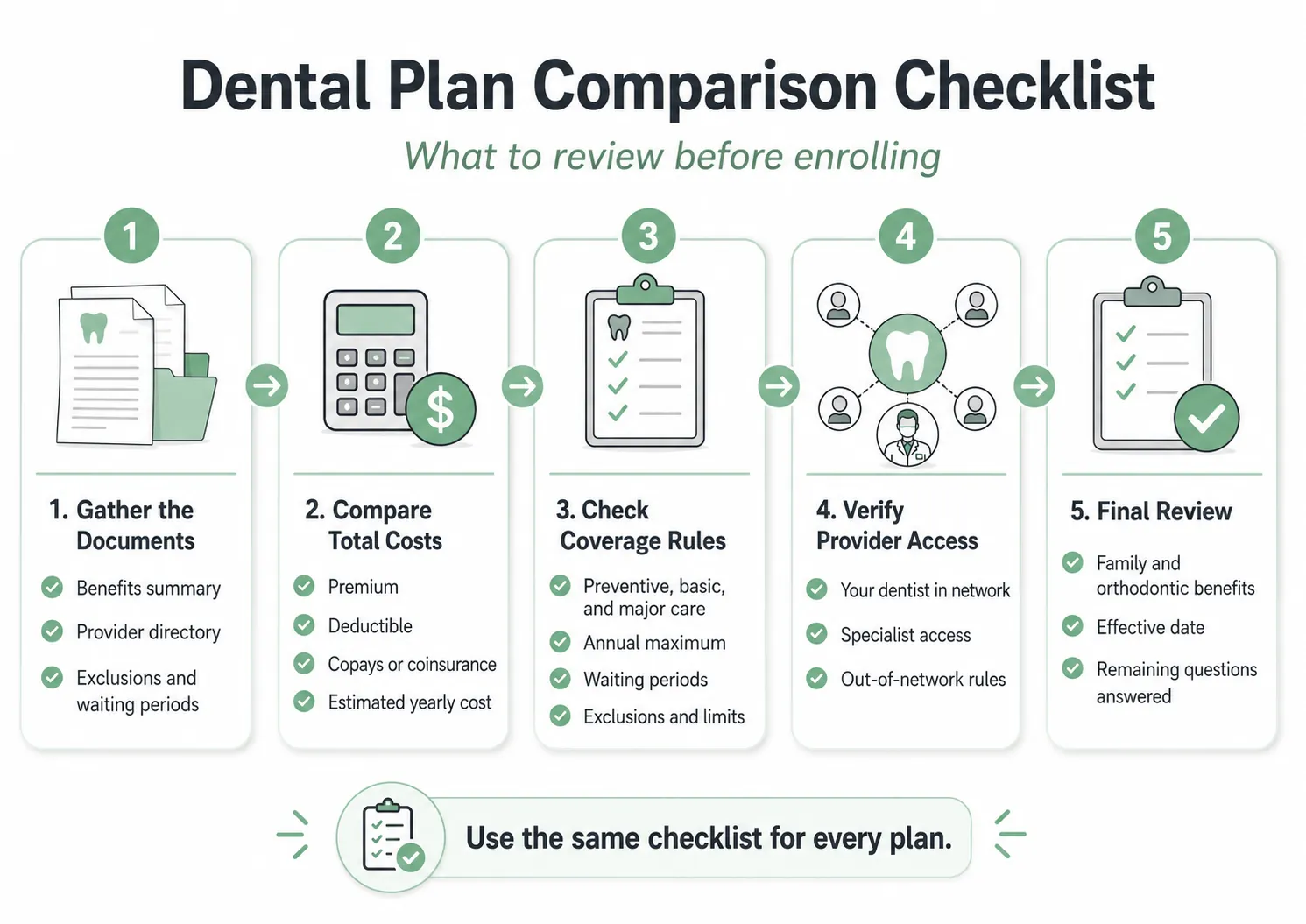
Dental Plan Comparison Checklist
A visual checklist for comparing dental plan documents, fixed costs, expected procedures, provider networks, benefit limits, waiting periods, claim rules, and estimated patient responsibility.
Important to Know:
- Use the same people, providers, procedures, and benefit period for every plan
- Review official documents rather than only marketing summaries
- Verify every dentist, specialist, and office location
- Compare plan allowances and patient responsibility, not only coverage percentages
- Separate preauthorization from predetermination
- Save documents and written confirmations used in the comparison
Dental Plan Comparison Worksheet
Use the same information for every plan. Write ”Not confirmed” when reliable information is unavailable rather than guessing.
| Comparison item | Plan A | Plan B | Plan C |
|---|---|---|---|
| Complete plan name | |||
| Plan type | |||
| Exact provider-network name | |||
| Coverage source | |||
| Benefit period | |||
| People enrolling | |||
| Enrollment tier | |||
| Premium or payroll deduction | |||
| Employer contribution | |||
| Other fixed charges | |||
| Individual deductible | |||
| Family deductible | |||
| Copays, coinsurance, or scheduled charges | |||
| General annual maximum | |||
| Maximum remaining | |||
| Pending claims | |||
| Procedure-specific maximums | |||
| Orthodontic lifetime maximum | |||
| Rollover provisions | |||
| Expected procedures | |||
| Related procedures reviewed separately | |||
| CDT codes when available | |||
| Plan allowance for expected procedures | |||
| Estimated plan payment | |||
| Estimated patient responsibility | |||
| Main exclusions | |||
| Waiting periods | |||
| Frequency and replacement limits | |||
| Alternate-benefit provisions | |||
| Treatment-in-progress provisions | |||
| Preferred dentist and location verified | |||
| Specialists verified | |||
| New-patient availability | |||
| Out-of-network benefits | |||
| Out-of-network allowance | |||
| Possible amount above allowance | |||
| Claim submitted by | |||
| Plan payment sent to | |||
| Preauthorization required | |||
| Predetermination available | |||
| Coordination of benefits | |||
| Effective date | |||
| Renewal and cancellation rules | |||
| Official documents saved | |||
| Important uncertainties | |||
| Questions remaining |
The worksheet records comparable information. It does not determine which plan a person should select or guarantee a final claim payment.
Final Verification Before Enrolling
Confirm each statement with ”Yes”, ”No”, or ”Not confirmed”.
| Final verification item | Plan A | Plan B | Plan C |
|---|---|---|---|
| Complete plan and network names are confirmed | |||
| Every person enrolling is eligible | |||
| Premiums and other fixed charges are confirmed | |||
| Expected procedures were reviewed individually | |||
| Related procedures were reviewed separately | |||
| Deductibles and cost-sharing rules are understood | |||
| Plan allowances were identified when available | |||
| Annual and other maximums were reviewed | |||
| Waiting periods fit the proposed treatment dates | |||
| Exclusions and important limitations were reviewed | |||
| Dentists, specialists, and locations were verified | |||
| Out-of-network rules were reviewed | |||
| Family, pediatric, and orthodontic rules were reviewed | |||
| Preauthorization requirements were reviewed | |||
| Predetermination availability was reviewed | |||
| Estimated plan payment was recorded | |||
| Estimated patient responsibility was recorded | |||
| Effective date was confirmed | |||
| Renewal and cancellation terms were reviewed | |||
| Official documents and confirmations were saved | |||
| Material questions were answered |
Do not convert ”Not confirmed” into ”Yes” merely because the information appears likely.
Request written clarification when an unanswered item could materially change coverage, provider access, timing, or estimated patient responsibility.
Information Gaps and Warning Signs
Pause and request clarification when:
- The complete plan name is missing
- The provider-network name is missing
Full coverageis used without a detailed benefit explanation- A procedure is described as covered without cost-sharing information
- The calculation base for coinsurance is not identified
- Annual or procedure-specific maximums are unclear
- Waiting periods are missing or inconsistent
- Provider-directory information cannot be confirmed
- Out-of-network benefits are mentioned without explaining the allowance
- Claim and reimbursement procedures are unclear
- Orthodontic eligibility or lifetime limits are missing
- Important exclusions appear only in a separate document that has not been provided
- Two official documents conflict
- The effective date is unclear
- Treatment-in-progress rules are unavailable
- Preauthorization and predetermination are treated as interchangeable
- An advance estimate is presented as guaranteed payment
- A discount membership is presented as dental insurance
- Renewal or cancellation terms are unavailable
- A representative will not identify the document supporting a material answer
An information gap is important when it could change plan payment, provider access, eligibility, treatment timing, or patient responsibility.
Additional Checks for Employer-Sponsored Dental Coverage
Employees comparing workplace options should also record:
- Complete plan name for every option
- Exact provider network
- Employee-only payroll deduction
- Spouse, child, and family deductions
- Employer contribution
- Optional buy-up cost
- Available plan structures
- Current dentist participation
- Specialist access
- Deductibles
- Annual maximums
- Waiting periods
- Family and orthodontic provisions
- Coordination-of-benefits rules
- Open-enrollment deadline
- Effective date
- Automatic-reenrollment rules
- Changes from the previous plan year
Compare Every Employer Option Separately
Do not assume that:
- Two plans from the same insurer use the same network
- A higher payroll deduction provides broader coverage
- A buy-up option changes every benefit
- Automatic reenrollment preserves the same providers and limitations
- Dependent benefits are identical to employee benefits
Review Official Employer-Plan Materials
For an applicable ERISA-covered plan, review:
- Summary Plan Description
- Schedule of benefits
- Provider-network information
- Enrollment materials
- Claims and appeal procedures
- Applicable amendments or summaries of material changes
Do not state that every workplace dental arrangement is governed by identical ERISA document requirements.
How to Interpret the Comparison
A dental plan comparison is useful only when every option is evaluated using the same people, providers, procedures, service dates, benefit period, and cost categories.
Begin by separating confirmed information from unanswered questions.
A comparison is sufficiently complete when:
- The complete plan and network names are known
- Every person enrolling has been identified
- Fixed premiums, payroll deductions, and other charges are confirmed
- Expected procedures have been reviewed individually
- Dentists, specialists, and office locations have been verified
- Deductibles, copays, coinsurance, and scheduled member charges are understood
- Relevant plan allowances have been identified when available
- Annual, procedure-specific, and lifetime maximums have been reviewed
- Waiting periods and effective dates fit the proposed treatment schedule
- Important exclusions and limitations are known
- Out-of-network eligibility and reimbursement rules are understood
- Estimated plan payment and patient responsibility have been recorded
- Material questions have been answered or clearly marked as not confirmed
A comparison remains incomplete when:
- One plan is reviewed from official documents and another only from a marketing page
- The exact provider network is unknown
- Provider participation has not been confirmed
- A displayed coverage percentage is used without knowing the calculation base
- Expected procedures are grouped only as preventive, basic, or major
- Related procedures have been omitted
- A higher annual maximum is treated as guaranteed available money
- A plan advertised without waiting periods is assumed to have no other restrictions
- An advance benefit response is treated as guaranteed payment
- A missing answer is replaced with a favorable assumption
Do not convert ”Not confirmed” into ”Yes” because the information appears likely.
An unanswered question can matter more than a small difference in premium, deductible, or annual maximum when it could change:
- Procedure eligibility
- Provider access
- Treatment timing
- Plan payment
- Patient responsibility
- Claim or reimbursement procedures
The checklist should not produce one universal winner.
Its purpose is to make each option understandable enough for the consumer to compare the relevant differences using documented information.
For the broader comparison process, review How to Compare Dental Plans Online.
Helpful Resources
Continue your research with these DentalCoverageHub guides:
- Compare Dental Plans
- How to Compare Dental Plans Online
- Dental Insurance Costs Explained
- Dental Insurance Annual Maximums Explained
- In-Network vs Out-of-Network Dental Insurance
- Individual vs Family Dental Plans
- PPO vs HMO Dental Plans
- How Waiting Periods Work in Dental Coverage
- Dental Insurance Coverage for Common Procedures
- Dental Insurance Quotes Online
- Dental Insurance vs Dental Savings Plans
- Dental Insurance Learning Center
Frequently Asked Questions
What is a dental plan comparison checklist?
A dental plan comparison checklist is a structured tool for reviewing several dental plans using the same people, providers, procedures, benefit period, and cost categories.
It helps separate confirmed plan information from unanswered questions and makes meaningful differences easier to identify.
What should I compare before choosing a dental plan?
Compare:
The complete plan and network names
Premiums and other fixed charges
Deductibles
Copays, coinsurance, or scheduled member charges
Plan allowances
Annual and other benefit maximums
Expected procedures
Exclusions and limitations
Waiting periods
Dentists and specialists
Out-of-network rules
Enrollment and claim procedures
Estimated plan payment and patient responsibility
Do not select a plan using one feature alone.
What documents should I review before enrolling?
Review the closest available equivalent of:
The policy, certificate of coverage, Evidence of Coverage, or controlling plan document
Applicable amendments
Schedule or Summary of Benefits
Copay or member-charge schedule
Provider-network information
Exclusions and limitations
Enrollment, renewal, and cancellation terms
Claims and appeal instructions
For an applicable ERISA-covered employer plan, also review the Summary Plan Description and other official documents supplied by the plan administrator.
How do I confirm that a dentist is in network?
Confirm:
The individual dentist’s full name
Specialty
Exact office location
Complete plan name
Exact provider network
Current participation
New-patient availability
Proposed service date
Verify the information with both the dental office and the insurer or plan administrator.
A dental office accepting insurance information or submitting claims does not establish in-network participation.
Does “covered” mean the dental plan will pay the full cost?
No.
A covered procedure may still be affected by:
A deductible
Copay or coinsurance
A plan allowance
An annual maximum
A waiting period
A frequency or replacement limit
Provider-network requirements
An alternate-benefit provision
Other contract limitations
Coverage also does not guarantee that every related procedure is eligible.
Is the plan with the lowest premium or highest annual maximum automatically better?
No.
A lower premium does not establish lower total patient costs.
A higher annual maximum does not establish that expected procedures are covered, that waiting periods have ended, or that the needed dentists and specialists participate.
Compare the complete benefit structure using the same treatment and provider assumptions.
What is the difference between preauthorization and predetermination?
Preauthorization may be a required review or authorization process before selected treatment begins.
Predetermination generally provides advance information about potential benefits for a proposed treatment plan.
They are distinct processes and should not be treated as interchangeable.
Neither necessarily guarantees final payment.
Can this checklist be used for employer-sponsored or Marketplace dental coverage?
Yes, but the comparison should reflect the coverage source.
For employer-sponsored coverage, include:
Employee payroll deductions
Employer contributions
Dependent costs
Available plan options
Open-enrollment deadlines
Applicable employer-plan documents
For Marketplace coverage, confirm whether dental benefits are included in a health plan or purchased through a separate dental plan. Adult and pediatric dental benefits should be reviewed separately.
HealthCare.gov confirms that separate Marketplace dental plans can have a distinct premium and adult waiting periods, while adult and child dental coverage are treated differently. The Department of Labor explains that participants in applicable ERISA-covered plans are entitled to an SPD describing plan operation, benefits and claim procedures.
Sources
- American Dental Association — Types of Dental Plans
- American Dental Association — An Introduction to Dental Benefits
- American Dental Association — Typical Dental Plan Benefits and Limitations
- American Dental Association — How to Read Your Explanation of Benefits Statement
- American Dental Association — Pre-Authorizations
- American Dental Association — Dental Plans: Coordination of Benefits
- HealthCare.gov — Dental Coverage in the Marketplace
- U.S. Department of Labor — Plan Information
About the Author
Maria Dumitru is the Founder and Content Editor of Dental Coverage Hub. She researches and edits educational content designed to help U.S. consumers understand dental insurance terms, compare plan features, and verify important information before enrolling.
Learn more about our standards in the Editorial Policy and How We Review Dental Plans.
This article provides general educational information and is not dental, medical, legal, tax, financial, employment-benefits, or personalized insurance advice. Plan types, premiums, payroll deductions, employer contributions, deductibles, copays, coinsurance, scheduled member charges, plan allowances, provider networks, annual maximums, waiting periods, exclusions, treatment-in-progress provisions, coordination-of-benefits rules, enrollment terms, claim decisions, and expected patient costs can vary by plan, employer, provider, treatment, service date, state, and individual circumstances. Review the controlling plan documents and consult the appropriate dental professional, insurer, plan administrator, employer, benefits administrator, licensed insurance professional, attorney, accountant, or other qualified professional for information specific to your situation.

Compare Dental Plans With the Same Checklist
Use the same covered people, providers, expected procedures, service dates, benefit period, and cost categories for every option. Review official documents, record material uncertainties, and verify important provider, benefit, and enrollment information before enrolling.