🦷 Dental Provider Networks
🇺🇸 Built for U.S. Consumers
✓ Cost and Claims Guidance

In-Network vs Out-of-Network Dental Insurance: How Costs and Claims Can Differ
Learn how network status may affect contracted fees, plan allowances, deductibles, coinsurance, claim submission, upfront payment, specialist access, and possible patient responsibility.
Written and researched by Maria Dumitru.
Founder and Content Editor at Dental Coverage Hub
Last reviewed: August 2026
What You’ll Learn
A dentist’s network status describes a contractual relationship with a specific dental plan or provider network.
The status may affect:
- The fee used to evaluate eligible covered services
- The deductible and cost-sharing rules
- Whether out-of-network benefits are available
- Whether the dentist may charge an amount above the plan allowance
- Who submits the claim
- Who receives the plan payment
- Whether the dental office requires payment before reimbursement
- Access to specialists
- Referral or authorization requirements
Network status must be confirmed for the individual dentist, office location, exact plan, exact network, and proposed service date.
A dental office may accept insurance information, submit claims, or accept an insurance payment without participating in the patient’s specific network.
Network participation also does not establish:
- That every procedure is covered
- That treatment is free
- That the plan will pay the dentist’s complete charge
- That an out-of-network benefit uses the same allowance as in-network care
- That the provider is clinically more or less appropriate
- That the provider’s status will remain unchanged throughout a multistage treatment
This guide explains how in-network and out-of-network arrangements may affect fees, claims, payment flow, provider access, and estimated patient responsibility.
For a broader explanation of dental-plan expenses, review Dental Insurance Costs Explained.
Key Takeaways
- Network status applies to a specific dentist, location, plan, and provider network
- Accepting insurance or submitting claims does not establish in-network participation
- In-network status does not mean that treatment is free or fully covered
- Out-of-network benefits are not available under every dental plan
- The plan may use different fee bases for in-network and out-of-network care
- A displayed benefit percentage may be applied to a plan allowance rather than the dentist’s complete charge
- An out-of-network dentist may be permitted to charge an amount above the plan allowance
- Assignment of benefits does not guarantee that the plan will pay the dental office directly
- Provider-network status does not measure professional qualifications or clinical quality
- Provider participation can change and should be reconfirmed before significant or multistage treatment
- Preauthorization and predetermination are distinct processes and do not guarantee final payment
- The official plan documents, provider confirmation, written treatment plan, and benefit estimate should be reviewed together
In This Guide
What In-Network Means for Dental Insurance
An in-network dentist has a participating-provider agreement with the exact network used by the patient’s dental plan.
The agreement may address:
- Which covered people the dentist may treat under network terms
- The fees applicable to eligible covered services
- Claim submission
- Payment procedures
- Contractual adjustments
- Provider responsibilities
- Plan-administration requirements
Verify the Individual Dentist and Location
Network status should not be confirmed only at the practice level.
Different dentists working in the same practice may have different participation arrangements.
A dentist may also participate at one office location but not another.
Confirm:
- The dentist’s full name
- The exact office address
- The specialty
- The plan name
- The network name
- Current participation
- New-patient availability
- The proposed service date
Contracted Fee
For an eligible covered service, the provider agreement may establish the fee used under the network contract.
The dental office’s standard charge may differ from that amount.
The patient may still owe:
- The deductible
- Copay or coinsurance
- A scheduled member charge
- Amounts for excluded procedures
- Costs after benefit limits are reached
- Charges for separately evaluated treatment components
The participating-provider agreement and applicable state law determine how amounts for noncovered or otherwise limited services may be handled.
Do not assume that every procedure listed on a treatment plan receives the in-network fee or a plan payment.
In-Network Does Not Mean Fully Covered
A service can be eligible and still be affected by:
- Deductibles
- Cost sharing
- Annual maximums
- Waiting periods
- Frequency limits
- Replacement intervals
- Age limits
- Alternate benefits
- Documentation requirements
- Treatment-in-progress provisions
- Exclusions
Network participation establishes a contractual relationship. It does not establish complete benefit eligibility for every proposed procedure.
What Out-of-Network Means for Dental Insurance
An out-of-network dentist does not have a participating-provider agreement with the specific network associated with the patient’s plan.
The dental office may still:
- Accept the patient’s insurance information
- Submit a claim
- Provide supporting documentation
- Accept a plan payment
- Help request advance benefit information
These actions do not make the dentist in network.
Confirm Whether the Plan Provides an Out-of-Network Benefit
A plan may:
- Provide out-of-network benefits
- Provide a lower benefit outside the network
- Use a separate deductible
- Use a separate plan allowance
- Require the patient to submit the claim
- Send reimbursement to the patient
- Provide no nonemergency out-of-network benefit
Do not schedule treatment based only on the assumption that a PPO always pays outside the network.
Confirm the Fee Used by the Plan
The plan may calculate an out-of-network benefit using:
- A maximum plan allowance
- An eligible expense
- A fee schedule
- A reimbursement amount
- Another contract-defined method
The amount recognized by the plan may differ from the dentist’s complete charge.
A benefit percentage should be interpreted together with the amount to which the percentage is applied.
Possible Amount Above the Plan Allowance
When permitted by the applicable contract and law, the patient may owe a difference between:
- The dentist’s charge
- The amount recognized by the plan
This possible amount is separate from the deductible and coinsurance.
Do not assume that federal medical surprise-billing protections apply to a stand-alone dental plan. Applicable state law and the exact plan structure must be reviewed separately.
Claims and Payment
Confirm:
- Whether the dental office submits the claim
- Whether the patient must submit the claim
- Whether assignment of benefits is accepted
- Whether the plan pays the dentist or patient
- Whether full or partial payment is required before reimbursement
- Which documentation must accompany the claim
- The claim-filing deadline
Claim submission and direct payment do not establish network participation.
In-Network and Out-of-Network Dental Care at a Glance
| Comparison item | In-network care | Out-of-network care |
|---|---|---|
| Contract with the exact network | The dentist has a participating-provider agreement | The dentist does not have that agreement |
| Fee used for eligible care | May use the fee established under the provider contract | May use a separate plan allowance or reimbursement method |
| Benefit availability | Depends on the covered-service and in-network provisions | Depends on whether the plan provides an out-of-network benefit |
| Amount above the plan allowance | Provider-contract terms may limit additional billing for eligible covered services | The patient may owe an additional permitted amount above the plan allowance |
| Deductible and cost sharing | In-network rules apply | Separate or less favorable rules may apply |
| Claim submission | Commonly handled by the dental office | May be handled by the office or patient |
| Recipient of plan payment | Commonly the participating dental office | May be the dentist or patient, depending on plan and applicable rules |
| Upfront payment | The office may collect estimated patient responsibility | The office may require partial or complete payment before reimbursement |
| Specialists | Must be verified separately within the network | Benefits depend on the plan’s out-of-network provisions |
| Clinical quality | Not determined by network status | Not determined by network status |
| Final patient responsibility | Depends on the procedure, deductible, cost sharing, benefit limits, and contract terms | May also include an amount above the plan allowance |
These are general comparison points rather than universal rules.
The official policy, provider agreement, applicable law, network status, claim decision, and dental office statement determine the final amounts.
How Network Status May Affect the Benefit Calculation
Step 1: Confirm That the Procedure Is Eligible
Before comparing network levels, verify:
- The exact procedure
- The CDT code when available
- The service date
- The covered person
- The effective date
- Waiting periods
- Frequency or replacement limits
- Exclusions
- Documentation requirements
A provider’s network status does not make an otherwise excluded procedure eligible.
Step 2: Confirm the Network Status on the Service Date
Verify:
- The individual dentist
- The exact office location
- The network
- The plan
- The date of service
A provider-directory listing from an earlier date may not establish participation when treatment occurs.
Step 3: Identify the Fee Used by the Plan
For in-network care, the calculation may use the amount established under the provider agreement.
For out-of-network care, the plan may use a separate allowance or reimbursement method.
Ask the plan to identify the actual amount used for the proposed procedure.
Step 4: Apply the Deductible and Cost Sharing
The plan may apply:
- A deductible
- A copay
- Coinsurance
- A scheduled member charge
- Separate network-level rules
Confirm whether in-network and out-of-network deductibles are combined or tracked separately.
Step 5: Apply Benefit Limits
The plan may review:
- The annual maximum
- Benefits already used
- Pending claims
- Lifetime maximums
- Frequency limits
- Replacement limits
- Alternate-benefit provisions
The annual maximum generally reflects plan payments rather than the dentist’s complete charge.
Step 6: Identify Possible Additional Patient Amounts
Patient responsibility may include:
- Deductible
- Copay or coinsurance
- Scheduled member charges
- Excluded procedures
- Amounts after benefit limits are reached
- Separately evaluated procedures
- Any permitted out-of-network amount above the plan allowance
There is no universal formula that predicts every out-of-network bill.
Step 7: Confirm Claim and Reimbursement Procedures
Ask:
- Who submits the claim
- Who receives payment
- Whether payment is required before reimbursement
- Which documents are required
- How long the filing deadline lasts
- How an adverse decision may be appealed
Step 8: Compare the Final Documents
After the claim is processed, compare:
- The Explanation of Benefits
- The plan allowance
- The deductible
- The plan payment
- Patient responsibility
- Remark or denial codes
- The dental office’s statement
- Payments already made
An Explanation of Benefits explains the claim decision. It is not the dental office’s bill.
For a complete explanation of these cost components, review Dental Insurance Costs Explained.
Accepts Insurance Does Not Mean In Network
A dental office may state that it:
- Accepts the insurance company
- Files insurance claims
- Works with the plan
- Accepts assignment of benefits
- Helps patients obtain reimbursement
None of these statements confirms that the dentist participates in the exact network.
Ask the dental office:
Is this individual dentist, at this office location, currently contracted with the exact network shown in my plan documents?
Ask the insurer or plan administrator:
Is this individual dentist, at this exact address, currently in network under my specific plan?
Also confirm:
- The network name
- The provider specialty
- New-patient availability
- Referral requirements
- Authorization requirements
- The planned procedure
- The proposed date of service
Keep a record of:
- The date
- The organization contacted
- The representative
- The confirmation number when available
- The information provided
Reconfirm network status before beginning significant or multistage treatment.
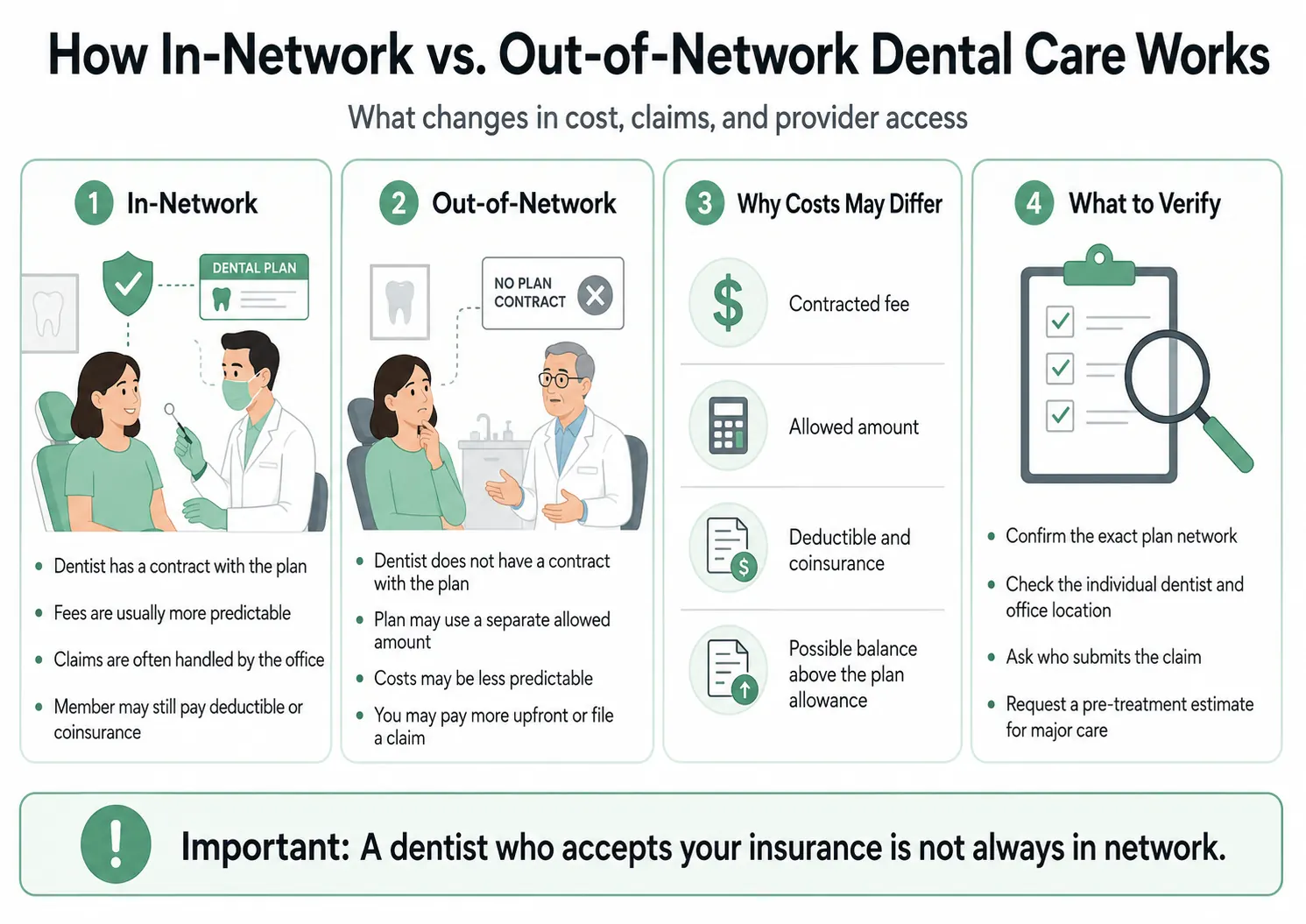
How Dental Provider Network Status Can Affect Costs and Claims
A visual comparison of provider contracts, plan allowances, deductibles, coinsurance, claim submission, payment recipients, specialist access, and possible patient responsibility.
Important to Know:
- Network status applies to the exact dentist, location, plan, and network
- Accepting insurance does not confirm in-network participation
- In-network care can still involve deductibles and other member costs
- Out-of-network benefits are not available under every plan
- A benefit percentage may be applied to a plan allowance
- Claims and reimbursement procedures may differ by network status
How to Verify a Dentist’s Network Status
Do not rely on only one directory listing, practice name, or general statement that the office accepts the insurance company.
Network participation should be confirmed for:
- The individual dentist
- The dentist’s specialty
- The exact office location
- The complete plan name
- The exact provider network
- The proposed service date
- The person receiving treatment
Step 1: Identify the Exact Plan and Network
Use the member card, policy, certificate of coverage, enrollment materials, or online member account to identify:
- The insurance company or plan administrator
- The complete plan name
- The network name
- The group or policy information
- The member identification information
- The customer-service contact
Do not search only by the insurance company’s name. The same company may administer several networks with different participating providers.
Step 2: Search the Plan’s Provider Directory
Search using:
- The dentist’s full name
- The exact office address
- The specialty
- The network name
- Distance from home or work
- New-patient availability when displayed
Save or print the relevant directory result when practical.
A directory listing is useful evidence, but it should not be treated as the only confirmation.
Step 3: Contact the Dental Office
Provide the complete plan and network information.
Ask:
Is this individual dentist, at this exact office location, currently contracted with this specific network?
Also ask:
- Is the dentist accepting new patients under this plan?
- Does the network contract apply to the proposed office location?
- Will another dentist or specialist perform any part of the treatment?
- Will the office submit the claim?
- Who is expected to receive the plan payment?
- Does the office require payment before reimbursement?
- Will related procedures be performed at another location?
Do not ask only whether the practice accepts the insurance company.
Step 4: Confirm With the Insurer or Plan Administrator
Ask the plan to verify:
- The dentist’s full name
- The office address
- The specialty
- The exact network
- Current participation
- The proposed service date
- Referral requirements
- Authorization requirements
- Whether another provider involved in treatment must be verified separately
Ask for a confirmation or reference number when available.
Step 5: Record the Confirmation
Keep:
- The date
- The organization contacted
- The representative’s name or identification
- The phone number or contact method
- The dentist and address confirmed
- The network name
- The information provided
- The reference number when available
- A screenshot or copy of the directory listing
A verbal confirmation may still be subject to the official contract and provider status on the actual service date.
Step 6: Reconfirm Before Significant or Multistage Treatment
Provider participation can change.
Reconfirm network participation before beginning significant or multistage treatment such as:
- Root canal treatment followed by a filling, core buildup, or crown
- Tooth extraction followed by a bridge, implant, or denture
- Dental bridge treatment involving supporting restorations or more than one provider
- Periodontal treatment
- Oral surgery
- Orthodontic treatment
- Implant-related care
- Denture treatment
- Another course of care completed over multiple appointments
Different stages of treatment may be performed by different dentists, specialists, laboratories, or office locations. Verify each treating provider separately rather than assuming that one in-network provider establishes network status for the complete treatment plan.
For treatment-specific coverage questions, use Dental Insurance Coverage for Common Procedures.
Step 7: Ask What Happens if the Dentist Leaves the Network
For treatment expected to continue across several visits, ask:
- How the plan determines network status for each service date
- Whether treatment-in-progress provisions apply
- Whether any continuity procedure exists
- Whether advance approval is required
- Whether another participating provider must be selected
- How remaining services would be evaluated
Do not assume that the network status confirmed at the first appointment automatically applies to every later service.
The plan documents and provider status on the relevant service date generally control how the claim is evaluated. ADA materials distinguish contracted providers from noncontracted providers and emphasize that benefit calculations depend on the exact plan arrangement.
How Dental Plan Structures May Handle Provider Access
Plan labels provide useful orientation, but the official contract determines the actual provider and reimbursement rules.
Confirm the exact terms rather than assuming that every plan with the same label operates identically.
Dental PPO Plans
A dental PPO generally combines insurance benefits with a network of contracted dentists.
Depending on the specific contract, the plan may provide:
- In-network benefits
- Out-of-network benefits
- Different deductibles by network level
- Different coinsurance
- Different plan allowances
- Different claim or payment procedures
Do not assume that every plan marketed as a PPO provides meaningful out-of-network benefits.
Confirm:
- Whether out-of-network benefits exist
- Which procedures qualify
- The plan allowance
- The deductible
- The member and plan percentages
- Any amount that may remain above the allowance
- Who submits the claim
- Who receives reimbursement
DHMO or Capitation Plans
A DHMO generally requires members to select or use contracted dental offices to receive ordinary plan benefits.
The arrangement may include:
- A designated primary dental office
- A schedule of member charges
- Referral requirements
- Specialist authorization
- Limited or no nonemergency out-of-network benefit
Confirm:
- The assigned or selected dental office
- Available general dentists
- Specialist access
- Referral procedures
- Emergency and out-of-area provisions
- The complete member-charge schedule
- Whether any out-of-network benefit exists
Do not assume that the plan will reimburse part of an out-of-network bill because the same procedure would have been eligible through a participating office.
Exclusive Provider Organization Plans
An EPO generally requires members to use participating providers to receive benefits for covered services.
An out-of-network dentist may result in no plan payment, except where the specific contract provides otherwise.
Confirm:
- The exact participating-provider requirements
- Emergency provisions
- Specialist access
- Referral or authorization rules
- Whether any exception process exists
- The member’s responsibility outside the network
Indemnity or Fee-for-Service Plans
An indemnity plan may allow members to obtain care from a broader range of dentists without relying on a traditional closed network.
The plan may still calculate benefits using:
- A fee schedule
- A stated allowance
- A UCR-based amount
- A fixed payment
- A percentage of another plan-defined amount
Broader provider choice does not establish that the plan will recognize or pay the dentist’s complete charge.
Point-of-Service Arrangements
A point-of-service arrangement may allow a member in a managed dental plan to receive care from a nonparticipating provider under different benefit rules.
Confirm:
- Whether the option is available
- The out-of-network allowance
- The benefit percentage
- Deductibles
- Authorization requirements
- Claim submission
- Possible amounts above the plan allowance
Compare the Contract, Not Only the Label
For every plan structure, verify:
- Provider-selection rules
- Network name
- Out-of-network eligibility
- General dentists and specialists
- Deductibles
- Cost sharing
- Fee or allowance used
- Claim procedures
- Payment recipient
- Annual maximums
- Emergency provisions
- Referral and authorization requirements
For a fuller comparison of PPO and DHMO structures, review PPO vs HMO Dental Plans.
ADA describes PPOs as indemnity coverage combined with a contracted network; DHMOs generally require care through contracted offices; EPOs generally require participating providers for reimbursement; indemnity plans may still use maximum allowances; and point-of-service arrangements may apply reduced benefits outside the network.
Advance Benefit Information Before Treatment
Plans may offer or require different processes for reviewing proposed treatment before it begins.
Do not treat all advance-review terms as interchangeable.
Preauthorization
Preauthorization is a plan process used to review or authorize proposed treatment under the applicable benefit rules.
Some plans may require preauthorization before:
- A specialist referral
- Selected procedures
- Treatment above a plan threshold
- Out-of-network treatment
- A requested network exception
- Another service identified by the contract
Confirm:
- Whether preauthorization is required
- Which procedures must be included
- Which provider must submit the request
- Which documentation is required
- Whether authorization must be obtained before treatment
- How long the authorization remains valid
Predetermination
Predetermination generally allows a treatment plan to be submitted before treatment so that the payer can provide information about potential benefits.
Some plans may refer to this as a pre-estimate.
A predetermination response may include:
- Current eligibility
- Procedures reviewed
- Potential covered services
- The amount recognized by the plan
- The deductible
- Estimated plan payment
- Estimated patient responsibility
- Annual-maximum information
- Missing documentation
- Contract limitations
These Processes Do Not Guarantee Final Payment
Preauthorization and predetermination are distinct processes.
Neither necessarily guarantees the final claim payment.
The result may change because of:
- Loss or change of eligibility
- A change in provider participation
- Claims processed before treatment
- Annual-maximum usage
- A different service date
- Changes in the treatment plan
- Different procedure codes
- Missing documentation
- Frequency or replacement provisions
- Coordination with another plan
- Other contract limitations
Network Confirmation Is a Separate Step
An advance benefit response does not automatically confirm that:
- The dentist remains in network on the service date
- Every office location participates
- Every specialist participates
- The dental office’s complete charge is recognized
- The member will owe only the displayed estimate
Verify network participation separately with the plan and dental office.
Information to Submit
For significant or multistage treatment, obtain:
- The written diagnosis
- The complete treatment plan
- Every proposed procedure
- CDT codes when available
- The treating dentists and specialists
- Office locations
- Proposed service dates
- Complete estimated charges
- Supporting X-rays, photographs, or clinical notes when required
Information to Keep
Keep copies of:
- The submitted request
- Clinical documentation
- The plan’s written response
- The date issued
- Procedures reviewed
- The estimated allowance
- Deductible and benefit information
- Limitations or conditions
- The response-validity period
- The claim and Explanation of Benefits after treatment
ADA explicitly states that preauthorization and predetermination are distinct processes and are not interchangeable. ADA also notes that advance information depends on continuing eligibility and available benefits at the time of service.
How to Compare Access, Cost, and Administration
Network status should be considered together with clinical access, location, communication, treatment continuity, benefit calculations, and claim procedures.
Neither network level is automatically appropriate for every situation.
Current Dentist and Continuity of Care
A person may want to continue with a dentist who already has:
- Previous records
- Diagnostic information
- Knowledge of ongoing treatment
- Familiarity with communication or accessibility needs
Before continuing outside the network, confirm:
- Whether the plan provides a benefit
- The out-of-network allowance
- Deductible and coinsurance
- Possible amounts above the plan allowance
- Upfront payment requirements
- Claim-submission procedures
- Treatment-in-progress rules
- Whether another participating provider is available
Continuity can be an important practical consideration, but it does not establish the insurance payment or the clinical superiority of one provider.
Treatment Already in Progress
For treatment begun before:
- A plan change
- A new effective date
- The provider leaving the network
- The previous coverage ending
- A dependent changing eligibility
ask:
- How the plan defines the beginning of treatment
- Which service dates control network status
- Whether each treatment stage is evaluated separately
- Whether treatment-in-progress provisions apply
- Whether prior approval is required
- Whether another provider must complete the treatment
- How the remaining procedures will be calculated
Obtain the answer in writing when possible.
Specialist Availability
A treatment plan may require:
- An endodontist
- Periodontist
- Oral surgeon
- Orthodontist
- Pediatric dentist
- Prosthodontist
- Implant provider
- Another specialist
Confirm whether an appropriate participating specialist is:
- Listed in the exact network
- Located within a reasonable travel area
- Accepting new patients
- Available within the treatment timeframe
- Authorized to receive the referral
When an appropriate participating specialist is not reasonably available, ask whether the plan has any network-access, authorization, or exception procedure. Do not assume that such a procedure exists or that approval will be granted.
Specialist network status can become especially important when treatment moves from a general dentist to another provider.
For example, a referral for root canal treatment does not automatically establish that the endodontist participates in the same network as the referring dentist. Similarly, an extraction performed by an oral surgeon should be verified using the surgeon’s individual network status and office location.
For procedure-specific guidance, see Does Dental Insurance Cover Root Canals? and Does Dental Insurance Cover Tooth Extraction?
Geographic Access
Review:
- Distance
- Travel time
- Office hours
- Appointment availability
- Public transportation
- Accessibility
- Emergency availability
- Dependents living in another location
- Remote or multistate household needs
A directory containing many dentists does not necessarily establish usable access for the household.
Language and Accessibility Needs
Provider access may also involve:
- Language availability
- Communication accommodations
- Disability access
- Scheduling needs
- Sensory accommodations
- Ability to manage a complex treatment plan
These considerations do not establish network benefit amounts or clinical quality.
Financial and Administrative Terms
Compare:
- The fee used by the plan
- Deductibles
- Copays or coinsurance
- Annual maximums
- Possible amounts above the allowance
- Upfront payment
- Claim filing
- Reimbursement timing
- Payment recipient
- Appeal procedures
Use the Same Treatment Plan for Both Calculations
When comparing an in-network and out-of-network dentist, use:
- The same procedures
- The same CDT codes
- The same service dates
- The same benefit period
- The same annual-maximum information
- Complete charges from both offices
- The exact plan allowance for each network level
Do not compare only the displayed benefit percentages.
How to Compare Provider Networks Before Enrollment
A provider network should be reviewed before buying or selecting a plan.
Do not wait until treatment has already been recommended.
Identify the Providers That May Be Needed
Create a list that may include:
- Current general dentists
- Nearby general dentists
- Pediatric dentists
- Orthodontists
- Endodontists
- Periodontists
- Oral surgeons
- Prosthodontists
- Implant providers
- Emergency dental offices
For every person enrolling, record the locations where care may reasonably be needed.
Verify Each Dentist Separately
For each provider, confirm:
- Full name
- Specialty
- Exact office address
- Exact network
- Current participation
- New-patient availability
- Referral requirements
- Whether treatment is performed at another location
Do not mark an entire dental practice as in network based on one participating dentist.
Compare Usable Geographic Access
Review:
- The number of confirmed providers
- Distance from home, work, or school
- Appointment availability
- Specialists
- Office hours
- Accessibility
- Language support
- Emergency access
Do not rely only on the total number of names shown in the directory.
Review Household and Dependent Access
For family coverage, consider:
- Adult dentists
- Pediatric dentists
- Orthodontists
- Specialists required by different household members
- Dependents attending school elsewhere
- Dependents living in another state
- Providers near multiple home or work locations
For more guidance about household enrollment, review Individual vs Family Dental Plans.
Review Out-of-Network Terms Even When the Network Appears Adequate
Out-of-network provisions may become relevant if:
- A provider leaves the network
- The member moves
- A dependent lives elsewhere
- A specialist is unavailable
- Treatment is already underway
- Emergency or travel circumstances arise
- The office location changes
Confirm:
- Whether benefits exist
- The allowance used
- Deductible and coinsurance
- Claim procedures
- Possible amounts above the allowance
- Upfront payment requirements
Compare the Network With the Complete Plan
A broad network does not establish that the plan has suitable:
- Covered services
- Deductibles
- Annual maximums
- Waiting periods
- Replacement rules
- Orthodontic benefits
- Premiums
- Claim procedures
Evaluate network access together with the complete benefit contract.
Provider Networks in Employer-Sponsored Dental Coverage
Employees should not assume that every option offered by an employer uses the same network.
An employer may offer:
- A PPO and a DHMO
- More than one PPO
- Different provider networks from the same insurer
- Different benefit levels using different provider lists
- Employee-only and dependent options with the same network but different costs
Compare Each Option Separately
For every option, confirm:
- The complete plan name
- The network name
- Current dentists
- Specialists
- Dependent access
- In-network benefits
- Out-of-network benefits
- Deductibles
- Cost sharing
- Annual maximums
- Referral rules
- Claim and reimbursement procedures
- Employee payroll deductions
- Dependent premiums
Do not assume that the option with the higher payroll deduction has broader or more usable provider access.
Review Changes at Annual Enrollment
Before reenrolling, check whether:
- The insurer changed
- The network changed
- A current dentist left the network
- The plan introduced a narrower network
- Specialist access changed
- Out-of-network provisions changed
- The employee contribution changed
- Dependent costs changed
- The benefit schedule changed
Automatic reenrollment does not establish that the previous provider and benefit terms remain unchanged.
Review the Official Employer-Plan Documents
For an applicable ERISA-covered plan, review:
- The Summary Plan Description
- The schedule of benefits
- Provider-network information
- Enrollment materials
- Claims and appeal procedures
- Any summary describing material changes
The Department of Labor explains that participants in an ERISA-covered health benefit plan are entitled to an SPD describing what the plan provides, how it operates, eligibility, and claims procedures. Do not state that every workplace dental arrangement is governed by exactly the same document requirements.
Provider Network Comparison Errors to Avoid
Asking Only Whether the Office Accepts the Insurance Company
Ask whether the individual dentist, exact office location, and exact network are contracted.
Checking the Practice but Not the Treating Dentist
Different dentists within the same practice may have different participation arrangements.
Searching Only by the Insurer’s Name
An insurer may administer several networks with different participating providers.
Relying Only on the Provider Directory
Confirm participation with both the dental office and the insurer or plan administrator.
Assuming a PPO Always Provides Out-of-Network Benefits
Review the actual policy. Some plans may limit or exclude nonemergency out-of-network care.
Assuming the Same Percentage Produces the Same Cost
The calculation may use different contracted fees or plan allowances.
Treating the Plan Allowance as the Dentist’s Complete Charge
The dentist’s charge, the amount recognized by the plan, and the plan payment are separate amounts.
Ignoring Possible Amounts Above the Out-of-Network Allowance
When permitted by the applicable contract and law, the patient may owe an additional amount above the plan’s calculation.
Assuming Assignment of Benefits Means Direct Payment Is Guaranteed
The plan may still send reimbursement to the patient, depending on the plan and applicable rules.
Treating Claim Submission as Proof of Network Participation
An out-of-network office may submit a claim without having a participating-provider agreement.
Checking Only the General Dentist
Verify every specialist and every office location involved in treatment.
Failing to Reconfirm Before Multistage Treatment
Network participation can change between the treatment discussion and later service dates.
Treating Predetermination as Proof of Network Status
Network confirmation and advance benefit information are separate steps.
Treating Advance Review as Guaranteed Payment
Eligibility, remaining benefits, provider participation, treatment details, and enrollment can change before the claim is processed.
Comparing the Network Without Reviewing the Benefit Contract
A usable provider network must still be evaluated with premiums, covered services, deductibles, annual maximums, waiting periods, exclusions, and claim procedures.
Questions to Ask Before Using a Dentist
| Question | Why It Matters |
|---|---|
| What is the complete name of my dental plan? | The same insurer may administer multiple plans with different benefit rules |
| What is the exact provider-network name? | Dentist participation can differ among networks administered by the same company |
| Is the individual dentist in network? | Practice-level participation does not confirm the status of every dentist |
| Is the dentist in network at this exact office location? | Participation may differ by location |
| Is the dentist accepting new patients under this plan? | Directory participation does not establish appointment availability |
| Will another dentist or specialist perform part of the treatment? | Every treating provider and location should be verified separately |
| Does the plan provide an out-of-network benefit for the proposed procedure? | Some plans provide limited or no nonemergency benefit outside the network |
| What fee or allowance will the plan use? | The amount recognized by the plan may differ from the dentist’s complete charge |
| Does a separate out-of-network deductible apply? | Network levels may use separate deductible rules |
| What copay or coinsurance applies? | The member percentage must be interpreted together with the amount used in the calculation |
| Could I owe an amount above the plan allowance? | An out-of-network dentist may not be bound by the plan’s participating-provider fee agreement |
| Does the annual maximum apply to both network levels? | Available benefits may be shared or calculated under plan-specific rules |
| Are related procedures evaluated separately? | Imaging, consultations, laboratory services, specialist care, and temporary treatment may create separate costs |
| Who will submit the claim? | The dental office may submit it, or the patient may need to file it |
| Who will receive the plan payment? | Assignment of benefits does not guarantee direct payment to an out-of-network dental office |
| Must I pay before the claim is processed? | The office may require partial or complete payment before reimbursement |
| What documents must be submitted with the claim? | Missing records can delay or prevent adjudication |
| What is the claim-filing deadline? | Late claims may be denied under the applicable plan rules |
| Is preauthorization required? | A mandatory plan review may need to occur before treatment |
| Is predetermination available? | Advance benefit information may assist with an estimate without guaranteeing payment |
| Does a treatment-in-progress rule apply? | Different stages of treatment may be evaluated under different dates or network terms |
| What happens if the dentist leaves the network? | Later services may be evaluated under the provider status applicable on each service date |
| Is a network-access or exception procedure available? | Some plans may have a review process when a participating specialist is unavailable |
| What is the complete estimated patient responsibility? | The estimate should include deductibles, cost sharing, excluded services, and possible amounts above the plan allowance |
Documents to Keep Before Treatment
Keep copies of:
- The insurance card
- The complete plan name
- The provider-network name
- The policy or certificate of coverage
- The schedule of benefits
- The provider-directory result
- Written or recorded provider-participation confirmation
- The individual dentist’s name
- The exact office address
- Specialist information
- Referral or authorization requirements
- The complete written treatment plan
- Every proposed procedure and CDT code
- The proposed service dates
- The dental office’s complete charges
- The plan allowance when available
- In-network and out-of-network deductible information
- Copay or coinsurance information
- Annual-maximum information
- Claim-submission instructions
- Assignment-of-benefits information
- Payment-recipient information
- The preauthorization or predetermination request
- The plan’s written advance-review response
- Treatment-in-progress provisions
- Network-access or exception information
- Claims
- Explanation of Benefits statements
- The dental office’s final statement
- Written answers received from the insurer, administrator, employer, or dental office
Record the date, representative, organization, contact method, dentist, location, network, and information provided during every important confirmation.
How to Interpret the Provider Network Comparison
A provider-network comparison should evaluate more than whether a dentist appears in an online directory.
The useful comparison identifies:
- Which individual dentists participate
- Which office locations participate
- Which specialists are available
- Which network applies to the plan
- Whether out-of-network benefits exist
- Which fee or allowance is used
- Which deductible and cost-sharing rules apply
- Who submits the claim
- Who receives the plan payment
- Whether upfront payment may be required
- Which rules apply to ongoing or multistage treatment
Neither network level is automatically appropriate for every person or treatment plan.
An in-network arrangement may be easier to evaluate when:
- The individual dentist and location are confirmed
- Needed specialists participate
- Provider-contract terms apply to eligible covered services
- Claim and payment procedures are clearly explained
- The member understands the deductible, copay, coinsurance, and benefit limits
- Important treatment can be completed within the participating network
An out-of-network arrangement may require closer review when:
- The plan provides an out-of-network benefit
- The dentist’s complete charge is known
- The plan allowance can be identified
- The applicable deductible and coinsurance are understood
- Any permitted amount above the allowance is included in the estimate
- The claim-submission procedure is clear
- The payment recipient is confirmed
- The patient can manage any required upfront payment
- Treatment continuity or specialist access is being considered
An out-of-network benefit has limited practical value when the plan:
- Provides no benefit for the proposed service
- Uses an allowance that is difficult to verify
- Applies a separate deductible
- Provides little additional payment
- Sends reimbursement only after the patient pays the dental office
- Requires procedures or documentation that have not been completed
- Does not provide access to the specialist or exception being considered
Network status should not be used as a measure of clinical quality.
The final comparison should separate:
- Provider access
- Benefit eligibility
- The fee recognized by the plan
- The dentist’s complete charge
- Plan payment
- Estimated patient responsibility
- Claim and reimbursement procedures
- Treatment-continuity considerations
For the complete enrollment process, review How to Compare Dental Plans Online.
Helpful Resources
- Compare Dental Plans
- How to Compare Dental Plans Online
- Dental Insurance Costs Explained
- PPO vs HMO Dental Plans
- Individual vs Family Dental Plans
- Dental Insurance Annual Maximums Explained
- How Waiting Periods Work in Dental Coverage
- Dental Insurance Coverage for Common Procedures
- Dental Plan Comparison Checklist
- Is Dental Insurance Worth It?
- Dental Insurance Learning Center
Frequently Asked Questions
What is the difference between an in-network and an out-of-network dentist?
An in-network dentist has a participating-provider agreement with the specific network associated with the dental plan.
An out-of-network dentist does not have that agreement.
The difference can affect the fee or allowance used by the plan, deductibles, cost sharing, claim submission, payment procedures, and possible patient responsibility.
Does accepting my dental insurance mean the dentist is in network?
No.
A dental office may accept insurance information, submit claims, or help patients obtain reimbursement without participating in the exact network.
Confirm the individual dentist, office location, plan, and network with both the dental office and the insurer or plan administrator.
Does every PPO provide out-of-network benefits?
No.
A PPO may provide out-of-network benefits, but the exact eligibility, deductible, coinsurance, plan allowance, claim procedure, and payment level depend on the contract.
Some dental plans marketed with network features may provide limited or no nonemergency out-of-network benefits.
Does the same coverage percentage mean the same cost in and out of network?
Not necessarily.
The percentages may be applied to different fee bases.
In-network care may use an amount established under the provider agreement, while out-of-network care may use a separate plan allowance or reimbursement method.
The dentist’s complete charge must also be considered.
Does out-of-network coverage prevent additional billing above the plan allowance?
Not necessarily.
When permitted by the applicable contract and law, an out-of-network dentist may charge an amount above the fee recognized by the plan.
The federal No Surprises Act balance-billing protections generally do not apply to dental-only insurance, although different rules may apply when dental benefits are included in a medical plan or when state law provides additional protections.
Does assignment of benefits guarantee that the dental office will receive payment?
No.
Assignment of benefits communicates a request for the plan payment to be sent to the dental office.
The group contract, plan rules, applicable federal law, and state law may affect whether the plan honors that request for an out-of-network dentist.
The payment may instead be sent to the patient.
Does preauthorization or predetermination guarantee final payment?
No.
Preauthorization and predetermination are different processes.
Eligibility, provider participation, remaining annual benefits, procedure details, service dates, documentation, and enrollment can change before the final claim is processed.
Can a dentist’s network status change during treatment?
Yes.
Provider participation may change during a course of care.
For treatment completed across several appointments, confirm the network status of every dentist, specialist, office location, and relevant service date. Ask the plan how later services will be evaluated if a provider leaves the network.
Sources
- American Dental Association — Types of Dental Plans
- American Dental Association — Explanation of Benefits Statement
- American Dental Association — Pre-Authorizations
- American Dental Association — Assignment of Benefits to Participating Dentists Only
- American Dental Association — Typical Dental Plan Benefits and Limitations
- American Dental Association — An Introduction to Dental Benefits
- Centers for Medicare & Medicaid Services — Know Your Rights
- U.S. Department of Labor — Plan Information
About the Author
Maria Dumitru is the Founder and Content Editor of Dental Coverage Hub. She researches and edits educational content designed to help U.S. consumers understand dental insurance terms, compare plan features, and verify important information before enrolling.
Learn more about our standards in the Editorial Policy and How We Review Dental Plans.
This article provides general educational information and is not dental, medical, legal, financial, or personalized insurance advice. Provider participation, office locations, provider networks, contracted fees, plan allowances, deductibles, copays, coinsurance, annual maximums, assignment-of-benefits rules, claim procedures, payment recipients, out-of-network benefits, treatment-in-progress provisions, state protections, and expected patient costs can vary by plan, provider, employer, treatment, service date, state, and individual circumstances. Review the official plan documents and consult the appropriate dental professional, insurer, plan administrator, employer, benefits administrator, licensed insurance professional, attorney, or other qualified professional for information specific to your situation.
Compare Dental Plans With Provider Access in Mind
Provider networks can affect access to dentists and specialists, the amount used to calculate benefits, claim procedures, payment recipients, upfront costs, and possible patient responsibility. Compare the exact dentist, location, plan, network, procedures, and service dates before enrolling or beginning treatment.