How Waiting Periods Work in Dental Coverage
🇺🇸 Built for U.S. Consumers
⚡ Waiting Period Basics
💰 Avoid Unexpected Costs
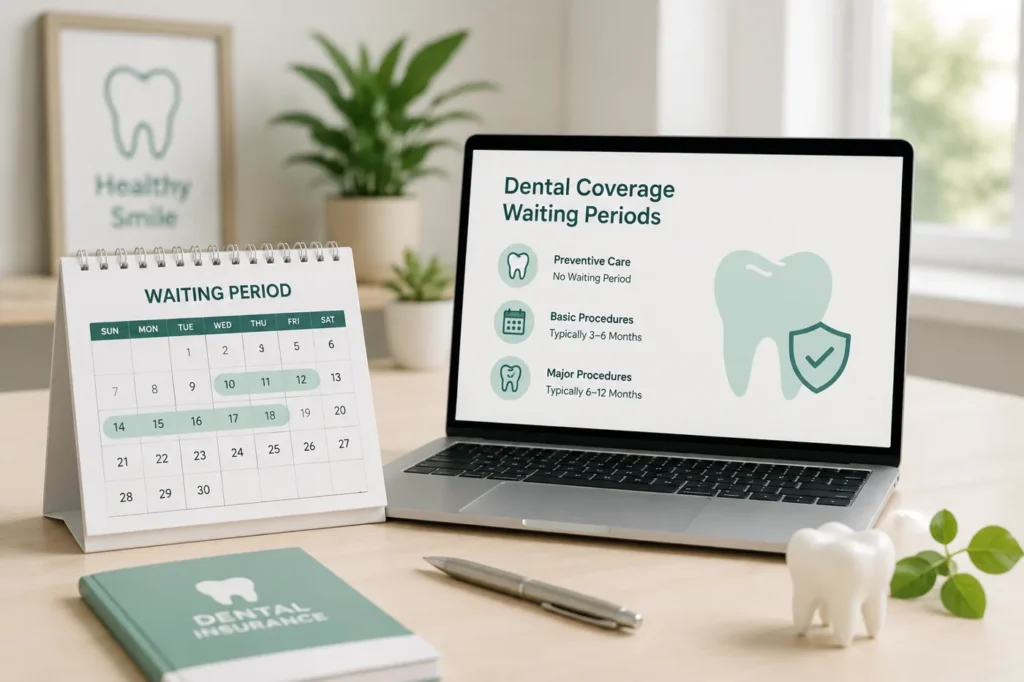
Written and researched by Maria Dumitru.
Founder and Content Editor at Dental Coverage Hub
Last reviewed: August 2026
What You’ll Learn
How waiting periods work in dental coverage depends on the plan, service category, and effective date. Some benefits may begin immediately, while others become available only after a defined period.
Some dental plans cover preventive care right away, while fillings, extractions, crowns, root canals, dentures, implants, or braces may have a waiting period. That means you may need to stay enrolled for a certain number of months before the plan helps pay for those services.
This can be frustrating if you already need dental treatment soon. You may be paying premiums, but your plan may not yet pay for the procedure you need.
This guide explains how dental coverage waiting periods work, which services are commonly affected, what costs may still apply after the waiting period ends, and what you can do if you need care before benefits become available.
If you are still learning how dental plans work, start with our Dental Plans guide to understand plan types, costs, coverage categories, provider networks and common limits before comparing waiting periods.
Quick Answer: What Is a Dental Insurance Waiting Period?
Dental insurance waiting periods can feel confusing, especially if you need dental care soon.
A dental insurance waiting period is the amount of time you may need to wait after your plan starts before certain dental benefits become available.
Preventive care, such as exams, cleanings and X-rays, may be available right away. Basic care, major services, orthodontics or implant-related services may have separate waiting periods, depending on the plan.
If you receive a service before the waiting period ends, the plan may not pay for that service, even if the plan is already active.
Key Takeaways
If treatment is recommended before benefits become available, confirm the eligibility date and discuss the clinical timing with your dentist. Do not delay urgent care solely because of an insurance limitation.
A dental plan can be active before every service becomes eligible for benefits.
A benefit waiting period applies after the plan becomes effective and delays eligibility for certain services. A job-based eligibility waiting period delays the date an employee or dependent can begin coverage.
Preventive, basic, major, orthodontic, implant-related, and specialist services may follow different waiting-period rules. The classification of a procedure can also vary by plan.
When a waiting period ends, the plan’s normal rules begin to apply. Deductibles, copays, coinsurance, annual maximums, frequency limits, exclusions, and network rules may still affect the amount paid.
Some plans may waive or reduce waiting periods based on recent comparable coverage, but the requirements and documentation are plan-specific.
HealthCare.gov distinguishes a job-based waiting period—before coverage becomes effective—from service-related waiting periods in stand-alone dental coverage.
In This Guide
What Is a Dental Coverage Waiting Period?
A dental coverage waiting period is a delay between the date your plan becomes active and the date certain dental benefits become available.
For example, your plan may begin on January 1. Your preventive benefits may be available immediately, but your plan may require a six-month wait for fillings and a twelve-month wait for crowns.
In that situation, your coverage is active, but not every service is eligible for payment right away.
Waiting periods differ by plan and service category. Preventive or diagnostic services may have no waiting period, while some restorative or major services may require a longer wait. Review the official plan documents for the exact service categories, eligibility dates, and limitations.
Waiting Period vs Effective Date
These concepts both involve timing, but they answer different questions.
Effective date: When does the dental coverage itself begin?
Waiting period: When may a particular benefit become available after coverage begins?
A dental plan can therefore be active while selected services are still subject to a waiting period.
For the separate coverage-start framework, read Dental Insurance Effective Date: When Does Coverage Start?
Covered Does Not Always Mean Payable Today
A dental service can be listed as covered in the plan documents, but that does not always mean the plan will pay for it immediately.
For example, a crown may be a covered major service, but if major services have a 12-month waiting period, the plan may not help pay until that waiting period is over.
Even after the waiting period ends, deductibles, coinsurance, annual maximums, replacement limits, and network rules may still apply.
Why Do Some Dental Plans Use Waiting Periods?
A waiting period is a plan limitation that delays eligibility for certain benefits.
Its practical effect is that a member may pay premiums while some service categories are not yet eligible for payment. Waiting periods, affected services, and eligibility dates depend on the specific plan.
A waiting period does not indicate whether treatment is clinically necessary or whether it should be delayed. If your dentist recommends treatment, ask how urgently it is needed and discuss the clinical consequences of postponing it.
Review the official plan documents to understand how the limitation applies to your coverage.
Which Dental Services Usually Have Waiting Periods?
| Service category | Examples that may fall within the category | General waiting-period pattern |
|---|---|---|
| Preventive and diagnostic care | Exams, cleanings, and routine X-rays | Often no waiting period, but the effective date and frequency limits should still be confirmed |
| Basic or restorative care | Fillings, some extractions, and certain endodontic or periodontal services | May have no waiting period or a shorter waiting period, depending on the plan |
| Major care | Crowns, bridges, dentures, and certain complex restorative services | May have a longer waiting period |
| Orthodontic care | Braces and clear aligners | Separate waiting periods, age limits, lifetime maximums, or other rules may apply |
| Implant-related care | Implant placement, abutments, and implant crowns | May be covered, limited, classified differently, or excluded entirely |
These are general patterns only. The same procedure may be classified differently by different plans. Waiting periods can also vary by policy, state, service category, and enrollment circumstances. Always review the official plan documents before enrolling.
If a specific treatment matters to you, verify the waiting period for that exact procedure rather than relying only on a general label such as “basic” or “major.”
For treatment-specific guidance, see Does Dental Insurance Cover Fillings?, Does Dental Insurance Cover Tooth Extraction?, Does Dental Insurance Cover Root Canals?, and Dental Insurance for Bridges.
For other treatments, review Dental Insurance Coverage for Common Procedures.
How Waiting Periods Work in Dental Coverage by Service Type
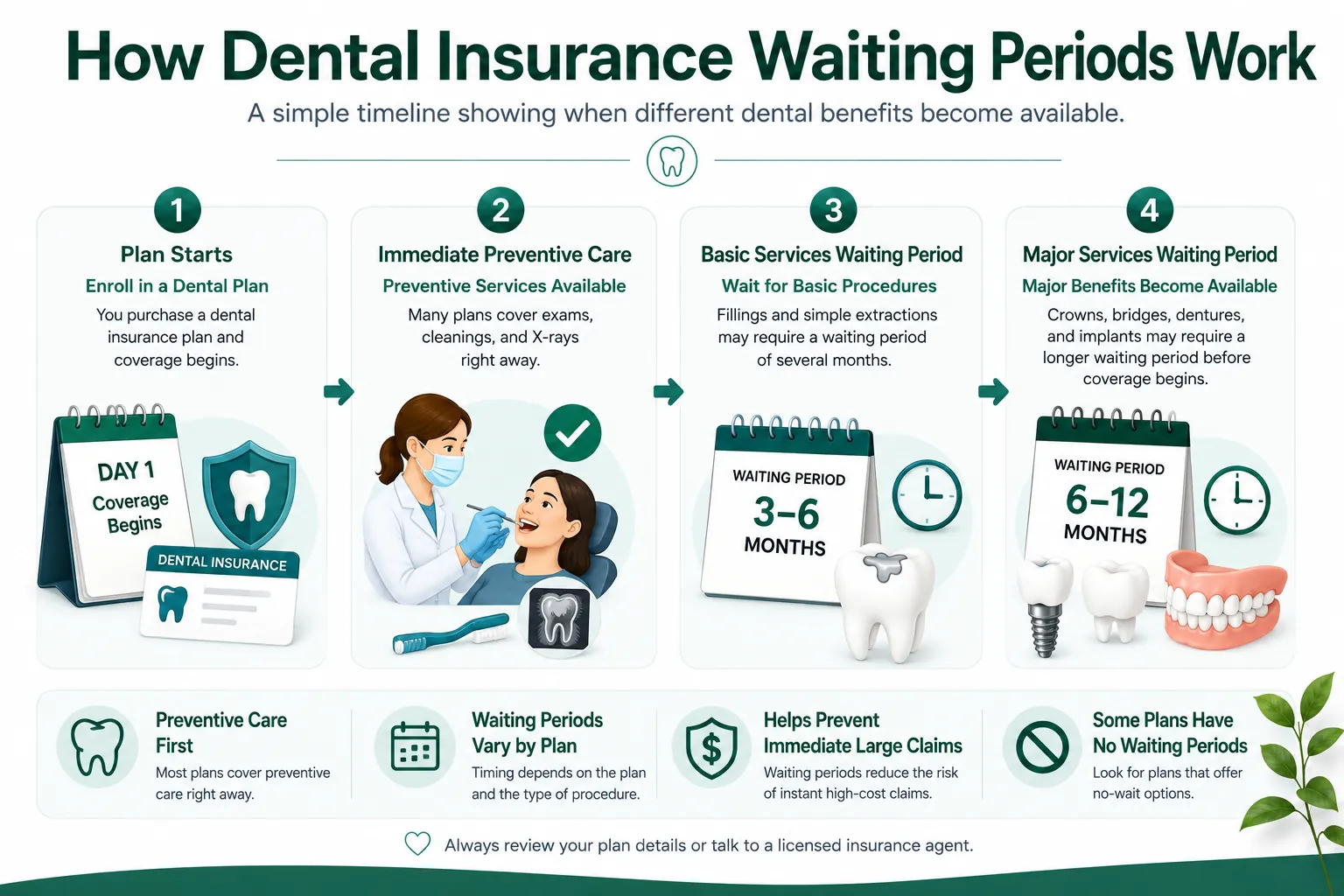
This visual overview shows how preventive, basic and major dental benefits may become available at different times, depending on the plan.
Waiting Periods Are Only One Part of the Benefit
Satisfying a waiting period does not guarantee that the dental plan will pay the full cost of treatment.
Once the service becomes eligible, other terms of the plan may still apply, including deductibles, cost sharing, annual maximums, network rules, exclusions, frequency limits, or replacement provisions.
Review those rules separately rather than assuming that the end of a waiting period determines the final payment.
For the broader plan framework, see the Dental Plans Guide.
What Happens If You Get Treatment During the Waiting Period?
You can still visit the dentist during a waiting period.
However, if the service is still under a waiting period, the plan may not pay for it. You may need to pay the full cost yourself or ask the dental office about other payment options.
Before scheduling treatment, ask your dentist for the procedure code and ask the plan whether that service is eligible for benefits yet.
Simple Example: Treatment Before and After a Waiting Period
Assume a filling is classified as a basic service under a particular plan.
If the treatment occurs before the plan’s waiting period for basic services ends, the plan may pay nothing toward that procedure.
If the treatment occurs after the waiting period ends, the plan may begin applying its normal benefit rules. You may still be responsible for a deductible, coinsurance, noncovered charges, or amounts affected by the plan’s annual maximum and network rules.
This is a hypothetical example. Actual service classifications, allowed amounts, payment rules, and out-of-pocket costs vary by plan.
Can Dental Waiting Periods Be Waived?
Sometimes.
Some plans may waive or reduce a waiting period when the member had recent comparable dental coverage. However, the required timing, similarity of benefits, acceptable coverage gap, and supporting documents vary by plan.
Do not assume that previous coverage automatically qualifies you for a waiver. Ask the new insurer to explain the requirements and confirm the decision in writing.
Delta Dental says that, in certain cases, a waiting period may be waived if a comparable dental insurance plan ended in the 30 to 60 days before the new plan’s effective date, and the prior plan had very similar coverage.
Prior Comparable Coverage
Prior comparable coverage generally means that you had dental coverage before joining the new plan and that the previous benefits meet the new plan’s waiver requirements.
The insurer may request documents such as:
- A certificate or letter showing the prior coverage dates.
- Employer benefits records.
- A termination notice from the previous plan.
- Information describing the benefits included in the previous coverage.
Ask which documents are required before you enroll. Providing proof of previous coverage does not guarantee that the waiting period will be waived.
Employer-Sponsored Plans
Employer-sponsored dental plans may have different eligibility and benefit rules from plans purchased directly by individuals or families.
Some employer plans have no service-specific benefit waiting periods. Others may apply waiting periods to selected services, late enrollees, or particular benefit categories.
Ask HR or the plan administrator for:
- The Summary Plan Description.
- The effective date of your coverage.
- The waiting-period schedule for each service category.
- Any rules that apply to new or late enrollment.
- The procedure for receiving credit for prior coverage.
Switching Plans Without a Coverage Gap
Do not assume that moving directly from one dental plan to another automatically removes the new plan’s waiting periods.
Before switching, ask the new insurer:
- Whether prior coverage can qualify for a waiver.
- What previous benefits are considered comparable.
- Whether a coverage gap is permitted.
- Which documents must be submitted.
- When the waiver decision will be confirmed.
Obtain the answer in writing whenever possible.
What If You Need Dental Care Before the Waiting Period Ends?
If treatment is recommended before a waiting period ends, begin by confirming exactly how the plan applies to the procedure.
Confirm the Procedure and Eligibility Date
Ask the dental office for:
- The procedure name.
- The dental procedure code.
- The estimated charge.
- The expected treatment date.
- Whether treatment will be provided by a general dentist or specialist.
Then ask the insurer whether that exact procedure is eligible for benefits and request the date on which the waiting period ends.
Request a Written Treatment Plan
A written treatment plan can help you compare the expected cost before and after the waiting period.
Ask the dental office to identify:
- Treatment that is clinically urgent.
- Treatment that may safely be scheduled later.
- Procedures that may be completed in stages.
- The estimated cost of each stage.
If the treatment plan contains more than one procedure, ask the plan about each stage separately.
For example:
- A root canal may be followed by a filling, core buildup, or crown.
- An extraction may later be followed by a bridge, implant, or denture.
- Bridge treatment may involve supporting restorations and other separately evaluated services.
The waiting period for one procedure does not automatically establish eligibility for the related treatment that comes before or after it.
Questions about whether treatment can safely be delayed or completed in stages should be discussed with the treating dental professional.
Only the treating dental professional can determine whether postponing or phasing treatment is clinically appropriate.
Ask About Credit for Previous Coverage
If you had recent dental coverage, ask whether the new plan can waive or reduce the waiting period.
Confirm:
- Whether the previous coverage is considered comparable.
- Whether a coverage gap is permitted.
- Which documents are required.
- When the insurer will confirm its decision.
Do not rely on a verbal assumption that prior coverage will qualify.
What If a Dental Plan Has No Waiting Period?
Some dental plans may have no waiting period for selected services.
That does not mean the dental coverage itself begins immediately, and it does not mean that all other plan limitations disappear.
A service may still be subject to other provisions of the dental plan once coverage becomes effective.
For the separate enrollment framework, read No Waiting Period Dental Insurance: What to Verify Before Enrolling.
How Waiting Periods May Differ by Coverage Source
Waiting-period rules can differ depending on how the dental coverage is obtained.
Individual or Family Dental Insurance
Plans purchased directly by an individual or family may apply separate waiting periods to preventive, basic, major, orthodontic, implant-related, or other service categories.
Review the policy or certificate of coverage before enrolling. Do not assume that two plans sold by the same insurer use identical waiting-period rules.
Employer-Sponsored Dental Coverage
Employer-sponsored coverage may involve two different timelines:
- An eligibility waiting period before an employee or dependent can join the plan.
- A benefit waiting period that applies to selected services after coverage begins.
Some workplace dental plans have no service-specific waiting periods, while others apply them to certain benefits or late enrollees.
Ask HR or the plan administrator for the Summary Plan Description, benefit booklet, certificate of coverage, or equivalent plan document.
Stand-Alone Marketplace Dental Plans
Some stand-alone Marketplace dental plans may have waiting periods before they cover services for adults.
A member may still need to pay the monthly premium while waiting for those services to become eligible. Review the waiting-period details directly with the insurance company before enrolling.
What to Check About a Waiting Period Before Enrolling
Before enrolling in a dental plan, focus on the waiting-period rules that could affect the services you may need.
You do not need to evaluate the entire plan in this section. The goal is to identify the timing rules that apply to benefits.
1. When Does the Dental Coverage Become Effective?
First confirm the plan’s effective date.
The effective date tells you when the dental coverage itself begins. It is separate from any waiting period that may apply to a specific benefit.
For the separate coverage-start framework, read Dental Insurance Effective Date: When Does Coverage Start?
2. Which Services Have a Waiting Period?
Do not assume that one waiting period applies to every dental service.
Check which benefit categories or procedures are subject to a waiting period under the plan and whether different services are treated differently.
3. When Does the Waiting Period End for the Service You Need?
If a waiting period applies, identify the actual date when the applicable restriction is expected to be satisfied.
Using a specific date is more reliable than estimating based on when you enrolled.
4. Can Recent Comparable Coverage Affect the Waiting Period?
Some dental plans may have provisions addressing previous comparable coverage.
If you recently had other dental insurance, ask whether that history can affect the waiting period and what documentation the plan requires.
Do not assume that prior coverage automatically removes a waiting period.
5. Where Is the Waiting-Period Rule Stated?
Review the official plan documents rather than relying only on a short marketing description or enrollment summary.
Look for the language that explains:
- Which services are affected
- How the waiting period is measured
- When the applicable period begins
- Whether prior coverage can affect the rule
- What documentation may be required
The most useful question is:
What waiting-period provision applies to the specific dental service I may need?
For the complete plan-comparison framework, use the Dental Plan Comparison Checklist or Compare Dental Plans.
How to Interpret Waiting-Period Information
A shorter waiting period does not automatically make one dental plan more suitable than another.
A plan with no waiting period may still have higher premiums, limited first-year benefits, a smaller provider network, exclusions, deductibles, coinsurance, or a lower annual maximum.
A plan with a waiting period may still deserve consideration when its overall benefits, employer contribution, provider network, cost sharing, and long-term terms are useful for the care you expect.
Compare:
- When the coverage becomes effective.
- When each service category becomes eligible.
- Whether previous coverage may qualify for a waiver.
- Which procedures are included or excluded.
- Which dentists participate.
- What costs remain after benefits become available.
The goal is not simply to find the shortest waiting period. It is to understand the complete plan and how its timing, benefits, limitations, and costs apply to your situation.
When you are ready, compare dental plans by reviewing waiting periods together with the other terms that affect access and out-of-pocket costs.
Questions to Ask Before Enrolling
| Question | Why It Matters |
|---|---|
| What is the policy effective date? | Waiting-period timing must be interpreted relative to the coverage start |
| Which services have waiting periods? | Rules may differ by service |
| When does each applicable waiting period end? | Exact dates are clearer than assumptions |
| How is the procedure I need classified? | Classification can affect which waiting period applies |
| Can previous coverage affect the waiting period? | A plan may have its own waiver rules |
| What documentation is required for a waiver? | Requirements can be plan-specific |
| Where can I review the complete waiting-period language? | Official documents control |
Frequently Asked Questions
What is a dental insurance waiting period?
A dental insurance waiting period is the time that may need to pass before selected dental services become eligible for plan benefits.
The plan may already be active while certain services remain subject to a waiting period.
Is a waiting period the same as an effective date?
No.
The effective date is the date coverage begins. A benefit waiting period may continue after that date and delay eligibility for specific services.
For job-based coverage, an eligibility waiting period may also apply before the employee or dependent can begin coverage.
Can I visit the dentist during a waiting period?
Yes.
A waiting period does not prevent you from receiving dental treatment. However, the plan may pay nothing toward a service that is not yet eligible, leaving you responsible for the applicable cost.
Are cleanings usually available without a waiting period?
Preventive and diagnostic services may have no waiting period under many plans, but this is not guaranteed.
Confirm the effective date, eligible services, network rules, frequency limits, and other plan terms.
How long is a dental waiting period?
There is no universal duration.
Waiting periods can vary by insurer, policy, service category, state, coverage source, and enrollment circumstances. Review the official plan documents for exact eligibility dates.
Can different procedures have different waiting periods?
Yes.
A plan may apply different rules to preventive, basic, major, orthodontic, implant-related, or specialist services. The classification of a particular procedure can also vary between plans.
Can a dental waiting period be waived?
Sometimes.
Some plans may waive or reduce a waiting period when the member had recent comparable dental coverage. The previous coverage requirements, permitted coverage gap, documentation, and decision process vary by plan.
Do employer dental plans have waiting periods?
Some do and some do not.
Employer coverage may have an eligibility waiting period before coverage begins, service-specific waiting periods after coverage begins, or both. Ask HR or the plan administrator for the official plan documents.
Is dental insurance with no waiting period automatically better?
No.
A plan without a waiting period may still have deductibles, copays, coinsurance, annual maximums, first-year limits, exclusions, network restrictions, or higher premiums.
Compare the complete terms rather than the waiting-period headline alone.
Can a dental savings plan help during an insurance waiting period?
A dental savings plan may provide access to discounted fees through participating dentists, but it is not insurance.
Confirm the activation date, exact provider participation, written fee schedule, exclusions, membership costs, and program terms. Do not assume that the discount can be combined with insurance for the same service.
Sources
- HealthCare.gov — Dental Coverage in the Marketplace
- HealthCare.gov — Waiting Period for Job-Based Coverage
- American Dental Association — Glossary of Dental Terms
- American Dental Association — Typical Dental Plan Benefits and Limitations
- U.S. Department of Labor — Plan Information
- U.S. Department of Labor — Filing a Claim for Your Health Benefits
About the Author
Maria Dumitru is the founder and content editor of Dental Coverage Hub. She researches and develops educational resources designed to help U.S. consumers understand dental insurance plans, coverage rules, costs, provider networks and comparison factors.
Learn more about our standards in the Editorial Policy and How We Review Dental Plans.
Dental Coverage Hub provides general educational information and does not provide medical, legal, financial or personalized insurance advice.

Ready to Compare Dental Plans?
Waiting periods can affect when your plan helps pay for care. Before enrolling, compare coverage timing, costs, plan limits and dentist access side by side.