

🟢 Beginner-Friendly
🇺🇸 Built for U.S. Consumers
🟢 Updated 2026

Dental Insurance by Life Stage and Work Situation
Find the dental coverage guide for your household, life stage, work situation, or budget, and learn what to verify before enrolling or changing coverage.
Written and researched by Maria Dumitru.
Founder and Content Editor at Dental Coverage Hub
Last reviewed: October 2026
What You’ll Learn
Dental coverage questions can change when you begin managing your own benefits, form or change a household, start college, change employment, or retire. Limited income can also affect which coverage and care options are practical.
This guide helps you:
- Find the detailed guide that matches your situation
- Identify coverage sources and eligibility questions to check
- Review coverage dates when an existing arrangement may end
- Compare benefits, provider access, and costs for the people who need coverage
- Recognize when reduced-cost care resources may also be useful
More than one guide may apply. Start with the situation creating your immediate question, then use related resources for the remaining checks.
Quick Answer: How Do Dental Coverage Priorities Change?
Start by identifying what your situation requires you to confirm: eligibility, available coverage sources, an approaching coverage change, or access to affordable treatment.
Families may need to compare benefits and dentists for several people. Young adults and students may need to check dependent, workplace, or school options. Changes involving employment, divorce, retirement, or dependent eligibility make coverage dates and enrollment requirements especially important.
Self-employed individuals and small business owners should identify who needs coverage and which arrangements are available. Older adults should compare benefits against their actual dental needs. People with limited income may need to investigate both coverage and reduced-cost care.
Across these situations, verify eligibility, relevant benefits, provider access, timing, and total patient costs. Use the guides below for the checks specific to your circumstances.
In This Guide
Explore Dental Coverage Guides by Situation
Start with the guide that most closely reflects your current situation.
Dental Insurance for Families
Families should compare benefits and provider access for each person who needs coverage. Review dependent eligibility, pediatric and adult benefits, household costs, and any orthodontic provisions rather than assuming the same benefits apply to everyone.
Read Dental Insurance for Families to identify the coverage details that matter for your household.
Dental Insurance After Divorce
Divorce may change eligibility for dental coverage through a spouse. Confirm the final covered date, review continuation and replacement options, and check children’s eligibility separately. Unfinished treatment and unresolved claims may also need follow-up.
Read Dental Insurance After Divorce: What Happens to Your Coverage? to understand what to verify before relying on continuation or replacement dental coverage.
Dental Insurance for Young Adults
Choosing dental coverage on your own does not automatically mean buying an individual policy. Check existing benefits and other eligible coverage sources, then compare dentist access, coverage dates, costs, and rules affecting expected treatment.
Read Dental Insurance for Young Adults: What to Check When Choosing Coverage on Your Own to organize your options before enrolling.
Dental Insurance When Turning 26
Turning 26 does not automatically establish when coverage through a parent’s dental plan ends. Confirm the plan’s dependent eligibility rules and final coverage date, then compare replacement options, dentist access, and any provisions affecting unfinished treatment.
Read Dental Insurance When Turning 26: What to Check Before Parent Coverage Ends to understand what to verify before moving from parent coverage to your next dental plan.
Dental Insurance for College Students
College students may have dental coverage through a parent, school, employer, or another eligible source. Compare dentist access near campus and home, confirm the coverage period, and check what happens during breaks, transfers, or graduation.
Read Dental Insurance for College Students: What Coverage Options Should You Check? to understand which sources to review and how to compare the available arrangements.
Dental Coverage Options for Low-Income Adults
When income is limited, check existing coverage and potential eligibility for public benefits, then verify the dental services and participating providers available to you. Community health centers, dental schools, and local programs may offer reduced-cost care when coverage is unavailable or insufficient.
Read Dental Coverage Options for Low-Income Adults: What to Check to review coverage sources, dentist access, and reduced-cost care options.
Dental Insurance for Seniors
For older adults, useful comparison points depend on current oral health, expected treatment, and preferred dentists. Review benefits for relevant procedures, annual maximums, waiting periods, and replacement limits rather than choosing coverage based on age alone.
Read Dental Insurance for Seniors to compare benefits and restrictions for your expected care.
Dental Insurance for Retirees
Retirement can change how you obtain dental coverage. Confirm when employment-based benefits end, identify available replacement arrangements, and review their effective dates, dentist access, and treatment provisions. Check dental benefits separately from medical coverage.
Read Dental Insurance for Retirees to review coverage sources and transition questions before relying on your next arrangement.
Dental Insurance for Self-Employed Individuals
Freelancers, independent contractors, and sole proprietors may need to arrange dental coverage for themselves or their households. Check available coverage sources, then compare premiums, treatment costs, provider access, and benefit restrictions.
Read Dental Insurance for Self-Employed Individuals to organize your options before enrolling.
Dental Insurance for Small Business Owners
Start by identifying whether coverage is intended for the owner, the household, employees, or a combination of these groups. Then review available arrangements, eligibility requirements, employer contributions, enrollment responsibilities, and benefits.
Read Dental Insurance for Small Business Owners to understand what to check when considering personal coverage or employee dental benefits.
Employer Dental Insurance vs Individual Dental Insurance
If you have access to dental coverage through work and are also considering an individual policy, compare your personal premium, available plans, dentist access, household needs, and how coverage depends on employment.
Read Employer Dental Insurance vs Individual Dental Insurance: What to Compare to understand which differences come from the coverage source and which depend on the specific plan.
Dental Insurance for Part-Time Workers
Part-time status alone does not determine eligibility for employer dental benefits. Confirm whether you can enroll, what you would pay, and what must remain true to keep coverage. If benefits are limited or unavailable, compare other eligible coverage sources.
Read Dental Insurance for Part-Time Workers: What to Check If Employer Benefits Are Limited or Unavailable to understand which workplace rules and alternatives to review.
Dental Insurance When Changing Jobs
Moving from one employer dental plan to another can change your dentist network, benefit limits, and how planned or unfinished treatment is handled—even when there is no gap between coverage dates.
Read Dental Insurance When Changing Jobs: What to Check Between Employer Plans to understand what to verify before relying on the new coverage.
Dental Insurance After Losing a Job
Losing a job may also mean losing access to employer-sponsored dental coverage. Depending on the situation, you may need to review COBRA continuation coverage, coverage available through a spouse or partner, a new employer plan, or an individual dental plan.
Learn what to check when employment-based coverage ends in Dental Insurance After Losing a Job: COBRA and Other Coverage Options.
When COBRA Dental Coverage Ends
If your COBRA dental coverage is approaching its end or has already ended, confirm the final covered date and review your next coverage options. Pending claims and unfinished treatment may also need separate follow-up.
Read When COBRA Dental Coverage Ends: What to Check Next to understand what to verify under the former coverage and your next dental plan.
Quick Comparison by Life Stage and Work Situation
Use this overview to identify the checks most relevant to your situation, then follow the corresponding guide above.
| Situation | Main focus | What to verify |
|---|---|---|
| Families | Coverage for multiple household members | Dependent eligibility, adult and pediatric benefits, household costs, and each person’s dentists |
| After divorce | Changes to dependent coverage | Final covered date, continuation or replacement options, and children’s eligibility |
| Young adults | Choosing and managing coverage independently | Existing benefits, available coverage sources, enrollment requirements, and expected costs |
| Turning 26 | Possible loss of parent dental coverage | Actual dependent age rules, termination date, and replacement coverage timing |
| College students | Coverage while studying and living away from home | Providers near school and home, coverage periods, and eligibility after school-status changes |
| Low-income adults | Affordable coverage and access to care | Program eligibility, usable dental benefits, participating providers, and reduced-cost care resources |
| Seniors | Benefits suited to current and expected dental needs | Relevant treatment benefits, provider access, annual maximums, and service restrictions |
| Retirees | Coverage after leaving employment | Existing benefit end dates, replacement sources, dental benefits, and total costs |
| Self-employed individuals | Coverage for yourself or your household | Available sources, enrollment terms, provider access, and costs beyond the premium |
| Small business owners | Coverage for owners, households, or employees | Group eligibility, contribution and participation requirements, and enrollment responsibilities |
| Employer vs individual coverage | Comparing available coverage sources | Employer contribution, personal premium, benefits, networks, and dependence on employment |
| Part-time workers | Access to workplace dental benefits | Employment eligibility rules, enrollment opportunities, required contributions, and alternatives |
| Changing jobs | Moving between employer dental plans | Old and new coverage dates, network changes, benefit limits, and unfinished treatment |
| After job loss | Continuation or replacement of employment-based coverage | Termination date, continuation eligibility and deadlines, replacement enrollment, and costs |
| COBRA coverage ending | Moving beyond continuation coverage | Final covered date, next coverage effective date, outstanding claims, and treatment underway |
More than one situation may apply to you. Coverage sources, eligibility, benefits, provider access, and care-program availability vary by location and arrangement. Confirm the details with the applicable plan, employer, public program, or care provider.
What to Verify Across Different Situations
Once you identify a possible coverage source, check how it would work for the people and care involved. The relevant provisions depend on the arrangement; not every plan uses the same costs or limits.
| Area | What to verify |
|---|---|
| Eligibility and enrollment | Who can enroll, what documentation is required, and which deadlines apply |
| Coverage dates | When existing benefits end and when the next arrangement begins |
| Covered services | Whether the specific procedures you expect are included |
| Provider access | Whether the exact dentists and specialists participate and are accepting patients |
| Total costs | Required premiums or contributions, applicable deductibles, cost-sharing, and noncovered charges |
| Benefit limits | Any annual, lifetime, frequency, or replacement limits relevant to expected care |
| Treatment timing | Waiting periods, approval requirements, and provisions affecting unfinished treatment |
| Continued eligibility | What happens when employment, dependent status, residence, or other relevant circumstances change |
Use current plan documents and confirm unclear details with the responsible administrator. A general benefit summary may not answer a question about a specific person, procedure, or coverage change.
For a detailed comparison of available plans, use How to Compare Dental Plans Online.
Which Guide Applies When Situations Overlap?
More than one guide may be relevant. Choose the starting point based on the question you need to resolve.
Family Needs vs Individual or Family Enrollment
The family guide focuses on benefits and provider access for different household members. Comparing individual and family enrollment addresses how those people could be covered together or through separate arrangements.
If you are deciding between enrollment structures, read Individual vs Family Dental Plans.
Young Adults vs Turning 26 vs College Students
The young-adult guide helps readers organize coverage choices and manage benefits independently.
The turning-26 guide focuses on checking whether parent dental eligibility is ending and planning the transition.
The college-student guide addresses coverage sources, provider access near school and home, and changes involving enrollment, breaks, or graduation.
Start with the guide that addresses your immediate eligibility or access question.
Seniors vs Retirees
The senior guide focuses on comparing benefits against current and expected dental needs. The retiree guide addresses obtaining or replacing coverage after leaving employment.
An older adult who is still working may primarily need the senior guide. Someone retiring and losing workplace benefits may need both.
Self-Employed Individuals vs Small Business Owners
Begin by identifying who needs coverage.
Someone arranging benefits for themselves or their household can start with the self-employed guide. An owner considering employee benefits should also review the small-business guide for eligibility, contribution, participation, and administration questions.
Changing Jobs vs Job Loss vs COBRA Ending
The changing-jobs guide focuses on moving between employer dental plans, including transitions without a coverage gap.
The job-loss guide addresses continuation and replacement options after employment-based coverage ends.
The COBRA-ending guide focuses on the next arrangement when continuation coverage approaches its end or has already ended.
Use the guide matching your current transition, then check any procedure-specific questions separately.
Dental Insurance vs Dental Savings Plans
Dental insurance may provide benefits for eligible services under its contract. The applicable costs, provider rules, and limitations depend on the plan.
A dental savings or discount plan is a membership arrangement that offers specified discounts through participating providers. It does not pay insurance claim benefits; the member generally pays the dentist at the applicable discounted rate.
Compare membership charges, provider participation, and written procedure fees before relying on a discount arrangement.
Read Dental Insurance vs Dental Savings Plans for the full comparison.
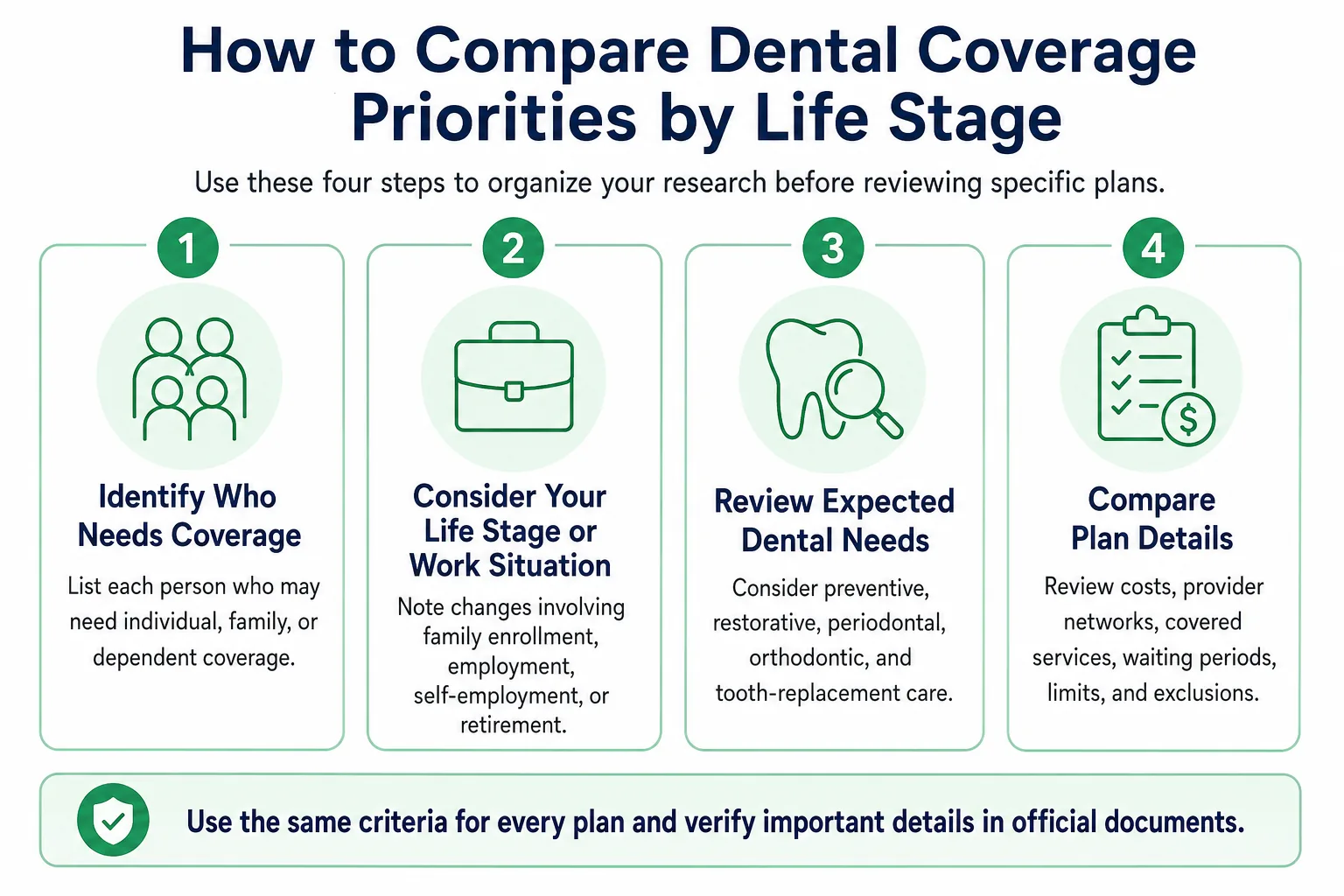
How to Use These Dental Coverage Guides
1. Identify Who Needs Coverage
List the people involved, any existing benefits, and the dentists or locations they need access to.
2. Choose the Relevant Situation Guide
Start with the circumstance creating your question, such as changing employment, losing dependent eligibility, retiring, or having difficulty affording care.
If coverage may end soon, prioritize confirming dates and enrollment deadlines.
3. Review Expected Dental Needs
Use recommended treatment, ongoing care, and provider preferences to identify the benefits and restrictions that matter. If treatment has started, keep the procedure dates and ask how a coverage change affects the unfinished work.
4. Compare Available Arrangements
Once you know which options are available, compare them using the same people, treatment needs, and coverage period.
If coverage does not provide affordable access to care, investigate applicable reduced-cost resources alongside the insurance review.
Our Recommendation
Begin with the question your situation creates. Establish who needs coverage, which arrangements are available, and whether any eligibility or coverage date is changing.
Then verify the benefits, providers, and costs relevant to your expected care. Keep important documents and written responses, especially when replacing coverage or continuing unfinished treatment.
When you are ready to compare available insurance options, use our Compare Dental Plans guide.
Helpful Resources
Frequently Asked Questions
Which Guide Should I Start With If Several Situations Apply?
Start with the situation creating your immediate coverage question. For example, a college student approaching the end of parent coverage should first confirm dependent eligibility and coverage dates, then review provider access near school. Use additional guides for questions that remain.
Is Family Dental Coverage Always Cheaper Than Separate Plans?
No. Compare the complete household premium, employer contributions, benefits, and expected patient costs. Also verify providers and eligibility for each person. One enrollment arrangement may be convenient without being the most suitable option for everyone.
Does Turning 26 Automatically End Parent Dental Coverage?
Do not assume that it does. Confirm the dental plan’s dependent eligibility rules and actual termination date. Medical coverage rules do not automatically establish the same requirements for every dental arrangement.
Does Part-Time or Self-Employed Status Determine My Dental Coverage Options?
Employment status alone does not identify every available option. Part-time workers should confirm workplace dental eligibility, while self-employed people should check available individual, household, and other eligible coverage sources. Compare the arrangements you can actually access.
What Should I Check First When Employment or Family Circumstances Change?
Confirm whether the change affects eligibility and obtain any final coverage date. Then review enrollment opportunities, deadlines, and the effective date of the next arrangement. Check provider access and unfinished-treatment provisions separately.
Do Seniors and Retirees Have the Same Coverage Priorities?
Not necessarily. A senior-focused comparison considers current and expected dental needs. Retirement introduces questions about obtaining or replacing coverage after leaving work. Some people need both reviews, but age and retirement status do not establish the same coverage situation.
Is Routine Dental Care Automatically Covered by Medicare?
Original Medicare generally does not cover routine dental care. Certain dental services connected to covered medical treatment may qualify under specific rules. Confirm the dental benefits and limitations of your actual coverage rather than relying on Medicare enrollment alone.
What If Available Dental Coverage Is Still Unaffordable or Insufficient?
Identify whether the problem is the premium, remaining treatment costs, excluded services, or lack of an available dentist. Check applicable public benefits and reduced-cost care resources. Coverage eligibility, usable benefits, and access to treatment require separate verification.
Sources
About the Author
Maria Dumitru is the Founder and Content Editor of Dental Coverage Hub. She researches and develops educational resources designed to help U.S. consumers understand dental insurance plans, coverage rules, costs, provider networks, and comparison factors.
Learn more about our standards in the Editorial Policy and How We Review Dental Plans.
This guide provides general educational information and does not determine eligibility, recommend a specific plan, or guarantee coverage or payment. Rules, benefits, provider participation, costs, and care-program availability vary by arrangement and location. Confirm details with the applicable plan, employer, public program, or care provider. This information does not replace professional medical, legal, financial, or personalized insurance advice.

Find the Dental Coverage Guide for Your Situation
Start with the guide that addresses your current question, whether you are arranging household coverage, managing an employment change, reviewing dependent eligibility, retiring, or seeking more affordable care. Confirm the options available to you, then compare coverage dates, provider access, benefits, and patient costs.