
Dental Insurance After Losing a Job: COBRA and Other Coverage Options

Learn what may happen to employer dental coverage after job loss, how COBRA differs from starting a new plan, and what to verify before choosing your next coverage path.
Written and researched by Maria Dumitru.
Founder and Content Editor at Dental Coverage Hub
Last reviewed: October 2026
Losing a job can also mean losing employer-sponsored dental insurance.
But dental coverage does not necessarily end on your final day of work, and COBRA is not the only possible next step.
Depending on your circumstances, you may be able to continue existing dental coverage through COBRA, enroll in another employer plan for which you are eligible, purchase individual dental insurance, or consider other coverage arrangements.
The first question is whether you are continuing your existing dental plan or starting a new coverage arrangement.
That distinction can affect your dentist network, deductible history, remaining annual benefits, waiting periods, effective date, and treatment already underway.
Before comparing options, confirm exactly when your current dental coverage ends and identify any dental care that is already planned or in progress.
What You’ll Learn
This guide explains:
- What may happen to dental insurance after losing a job
- When COBRA may include dental benefits
- How COBRA continuation differs from starting a new plan
- What COBRA deadlines may matter
- How existing deductible and annual-benefit usage can affect continuation coverage
- What to check when dental treatment is already underway
- What other dental coverage paths may be available
- How to compare your options before choosing your next coverage arrangement
Quick Answer
After losing a job, you may be able to continue existing employer dental coverage through COBRA or move to another coverage arrangement.
COBRA generally continues an existing eligible group plan. A new dental plan creates a new coverage arrangement.
That distinction can affect:
- Network participation
- Deductible status
- Remaining annual benefits
- Waiting periods
- Effective date
- Treatment already in progress
- Other plan limitations
Start by confirming the exact date your employer dental coverage ends.
Then identify the options available to you and compare what would remain the same or change under each one.
Do not compare premium alone. Compare the coverage with the dental care you already expect to need.
Key Takeaways
- Employer dental coverage does not necessarily end on your final day of work.
- Confirm the exact termination date before evaluating replacement coverage.
- Federal COBRA can include dental benefits when the group plan and qualifying event meet applicable requirements.
- COBRA generally continues existing coverage rather than creating a new dental policy.
- Electing COBRA does not automatically create a new deductible or fresh annual maximum.
- A new dental plan can introduce a different network, effective date, waiting periods, and benefit rules.
- Treatment already underway deserves special attention when coverage changes.
- The most useful option depends on both coverage terms and the dental care you expect to need.
In This Guide
When Does Dental Insurance End After Losing a Job?
Do not assume your dental insurance automatically ends on your final day of employment.
The termination date depends on the employer plan.
Coverage may end on your employment termination date, at the end of the month, or on another date defined by the plan.
Confirm the date with:
- Your employer or HR department
- The benefits administrator
- The dental plan
- Your official plan documents
Also confirm whether medical and dental benefits end on the same date. They do not need to follow identical arrangements.
If you are moving to another plan, the end date of the old coverage and the effective date of the new coverage should be considered separately.
For the broader timing framework, read Dental Insurance Effective Date: When Coverage Starts.
Does COBRA Include Dental Insurance?
It can.
Federal COBRA applies to certain employer-sponsored group health plans, and dental care can be included within covered group health benefits.
Federal COBRA generally applies to private-sector group health plans maintained by employers that meet the federal employee-count requirement and to many state and local government plans.
Some state continuation laws may also apply in circumstances where federal COBRA does not.
Job loss does not automatically mean that every former employee qualifies for COBRA dental coverage.
Review your election materials and confirm:
- Whether dental coverage is included
- Whether you are a qualified beneficiary
- Which benefits you may elect
- What premium applies
- What election deadline applies
Do not assume the dental election is identical to your medical election.
What COBRA Continuation Means for Dental Benefits
When COBRA applies, continuation coverage generally provides the same coverage available to similarly situated active employees under that plan.
That can mean continuing the existing:
- Benefit structure
- Network
- Deductible rules
- Coverage limits
- Claims process
- Appeal process
- Other plan provisions
Plan changes that apply to similarly situated active employees can also affect people receiving COBRA continuation coverage.
COBRA continuation does not automatically reset your dental benefits on the day active employment coverage ends.
If you already satisfied part of a deductible or used part of an annual maximum during the current plan period, that history can continue to matter.
If the plan later reaches its normal benefit-period reset while you remain covered through COBRA, review the same plan rules that apply to similarly situated active employees.
For the detailed annual-limit framework, read Dental Insurance Annual Maximums Explained.
What Does COBRA Dental Coverage Cost?
Continuity can come with a higher premium because the employer may no longer subsidize the coverage.
Under federal COBRA, qualified beneficiaries can generally be required to pay up to 102% of the applicable total plan cost, which can include the amount previously paid by both the employee and employer plus an administrative amount.
Before electing COBRA, confirm:
- Your actual dental premium
- What annual benefits remain
- Your deductible status
- Whether your current dentist remains in-network
- Whether planned treatment can continue under the existing plan
A familiar plan is not automatically the most useful option if the cost and remaining benefits no longer fit your situation.
What COBRA Deadlines Matter After Job Loss?
If federal COBRA applies, the election period is generally at least 60 days from the later of the date coverage would otherwise end or the date the election notice is provided.
After COBRA is elected, the initial premium generally cannot be required earlier than 45 days after the election.
For termination of employment or reduction in hours, federal COBRA continuation is generally available for up to 18 months, although certain circumstances can involve different or extended periods.
Use the dates in your actual COBRA materials rather than calculating deadlines from your final workday.
Confirm:
- The date active coverage ends
- The COBRA election deadline
- The initial payment deadline
- The date continuation coverage would begin
What If You Need Dental Care During the COBRA Election Period?
A gap can appear administratively between the end of active coverage and completion of a COBRA election and payment.
When COBRA is properly elected and paid, continuation coverage can generally reach back to the date prior coverage was lost.
However, claim processing may not appear normal while the election is still being completed.
If dental care is needed during this period, ask the plan administrator:
- What coverage date would apply after election
- What payment must be completed
- How an interim dental claim should be handled
- Whether a claim may need to be resubmitted
- What documentation you should keep
Do not assume how the dental office or plan will process an interim claim without confirming the applicable procedures.
COBRA vs New Dental Coverage
COBRA and a new dental plan solve the transition differently.
| Question | COBRA continuation | New dental coverage |
|---|---|---|
| Coverage arrangement | Generally continues an eligible existing employer plan | Creates another coverage arrangement |
| Network | Existing network generally continues, subject to plan changes | May use a different network |
| Deductible history | Existing plan history can continue to matter | New plan applies its own rules |
| Annual benefits | Do not assume COBRA creates a fresh annual maximum | New plan uses its own maximum and benefit period |
| Waiting periods | Election of COBRA does not itself create a new plan | A new plan may have waiting periods |
| Treatment underway | Existing coverage may provide greater continuity | New plan provisions may affect unfinished treatment |
| Main question | What remains available under the existing plan? | What changes under the new plan? |
Continuing coverage and replacing coverage are different insurance events.
A new plan can provide a new coverage path, but it can also introduce new eligibility, timing, network, and treatment questions.
What If Dental Treatment Has Already Started?
Coverage transitions deserve extra attention when treatment began under the employer plan but is expected to continue after that coverage ends.
The issue can arise with treatment involving several appointments or stages, including restorative, surgical, prosthetic, periodontal, implant, endodontic, or orthodontic care.
Identify:
- What treatment has already been completed
- What treatment remains
- Which provider is performing each stage
- When the remaining services are expected
- Which plan is expected to be active at that time
COBRA may reduce some transition issues by continuing an existing plan, but that does not mean every remaining service is automatically eligible for a benefit.
If you move to a new plan, treatment already underway can create additional eligibility questions.
Read Dental Insurance and Treatment Already in Progress: What to Check When Coverage Changes.
What Other Dental Coverage Options Can You Check?
COBRA is one possible route, not the only route.
The options available depend on your household, employment situation, location, income, and eligibility.
Another Employer Dental Plan
You may be eligible for dental coverage through a spouse or through a new employer. If you are moving from your former employer’s plan to a new employer’s plan, read Dental Insurance When Changing Jobs: What to Check Between Employer Plans for the transition checks.
Confirm:
- Whether you are eligible to enroll
- What enrollment deadline applies
- When dental coverage begins
- Whether your current dentist is in-network
- Whether waiting periods apply
- How unfinished treatment may be evaluated
Do not assume that medical and dental enrollment rules are identical.
If your new job is part-time, confirm whether your employee classification qualifies for dental benefits before treating that option as available. Read Dental Insurance for Part-Time Workers: What to Check If Employer Benefits Are Limited or Unavailable for the eligibility, premium contribution, and alternative coverage checks to review.
If the household coverage structure is changing, read Individual vs Family Dental Plans.
If another employer-sponsored dental plan is available to you, compare your required premium contribution, dentist access, and benefits with any individual policy you are considering. Read Employer Dental Insurance vs Individual Dental Insurance: What to Compare for the differences between these coverage sources.
Individual Dental Insurance
You may also consider dental insurance purchased outside an employer.
Because this is a new plan, compare:
- Effective date
- Waiting periods
- Network
- Annual maximum
- Deductible and cost-sharing
- Relevant exclusions and limitations
- Treatment already planned
For the broader comparison framework, read How to Compare Dental Plans Online.
If losing your job also means moving into independent work, read Dental Insurance for Self-Employed.
Marketplace Dental Coverage
Marketplace dental coverage works differently from Marketplace health coverage.
On HealthCare.gov, dental benefits may be included in a Marketplace health plan or offered through a separate dental plan. A separate Marketplace dental plan is purchased while enrolling in a Marketplace health plan rather than as a stand-alone Marketplace enrollment by itself.
Loss of job-based health coverage can qualify someone for a Marketplace Special Enrollment Period.
Do not assume that losing dental coverage alone creates the same enrollment right.
If Marketplace coverage may be relevant, verify current eligibility directly through the Marketplace.
Medicaid or CHIP
A change in employment can also change household income, which may make Medicaid or CHIP worth checking.
Adult Medicaid dental benefits vary by state, so do not assume the same adult dental coverage exists nationwide.
CHIP includes dental coverage for eligible children, with program details determined within applicable federal and state rules.
Verify eligibility and dental benefits through the appropriate state program.
If your income has fallen and adult dental care is difficult to afford, read Dental Coverage Options for Low-Income Adults: What to Check to review coverage sources, participating providers, and reduced-cost care options.
Dental Savings or Discount Plans
A dental savings or discount plan is not dental insurance.
Instead of paying insurance claims, these programs generally provide access to negotiated or discounted fees through participating providers.
If you are considering one during a coverage transition, compare it as a different type of arrangement.
Read Dental Insurance vs Dental Savings Plans.
How to Compare Your Options After Losing a Job
Start with the situation you actually have rather than comparing plan labels.
| Situation | Main question |
|---|---|
| Current employer dental coverage is ending | What is the exact termination date? |
| COBRA is available | What coverage, limits, and plan history continue? |
| Treatment is underway | How will remaining services be evaluated? |
| Another employer plan is available | When does coverage start and what changes? |
| Individual coverage is being considered | What new network, timing, and benefit rules apply? |
| Marketplace or public coverage may apply | Am I eligible and what dental benefits are actually available? |
| A discount program is being considered | Am I comparing insurance with a non-insurance arrangement? |
The central distinction is whether you are continuing existing coverage or entering a new coverage arrangement.
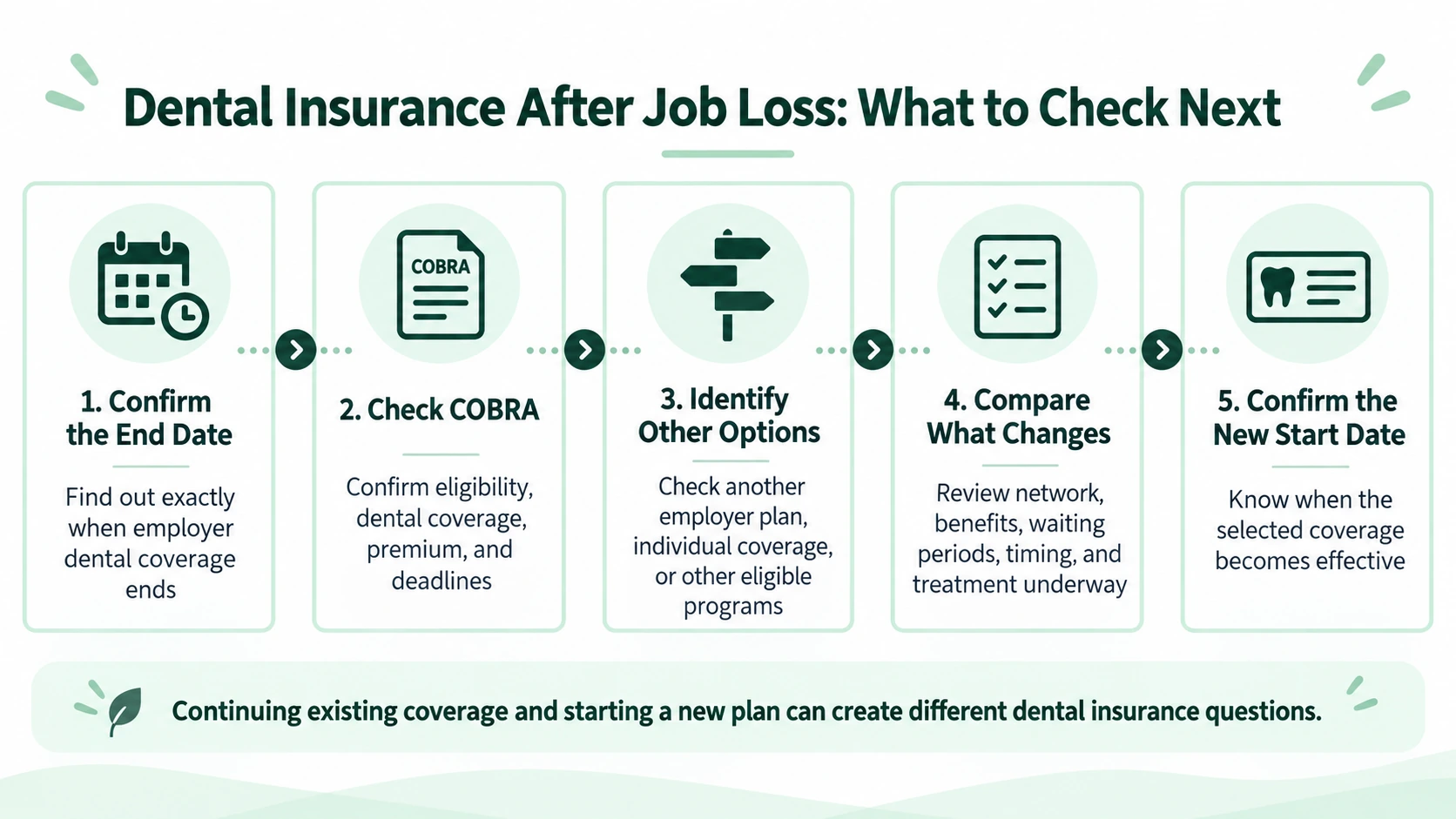
What to Check Before Choosing Your Next Dental Coverage
Use this process before choosing a coverage path.
1. Confirm the Current Coverage End Date
Get the exact date from the employer, benefits administrator, dental plan, or official documents.
Do not assume your last workday is automatically your last covered day.
2. Determine Whether COBRA Is Available
Review the election materials and confirm:
- Whether dental coverage is included
- What you can elect
- What premium applies
- What deadlines apply
3. Check What Would Continue Under COBRA
If you are considering continuation coverage, confirm:
- Remaining annual benefits
- Deductible status
- Current network participation
- Treatment already underway
- Other applicable limitations
4. Identify Dental Care You Already Expect to Need
Known or ongoing treatment can materially change how useful a coverage option is.
Do not compare plans only in the abstract.
5. Compare Effective Dates and Waiting Periods
For new coverage, verify when the plan becomes effective and when the specific benefits you expect to use become available.
An effective plan does not necessarily mean every benefit is immediately available.
For the detailed framework, read How Waiting Periods Work in Dental Coverage.
6. Verify the Dentist Under Each Option
If keeping your current dentist matters, verify participation in the exact plan being considered.
Do not rely only on whether the dental office recognizes the insurance company name.
For the complete framework, read In-Network vs Out-of-Network Dental Insurance.
7. Compare More Than the Premium
Consider:
- Coverage continuity
- Premium
- Remaining benefits
- Deductible status
- Effective date
- Waiting periods
- Network
- Treatment already underway
- Known dental needs
- Relevant exclusions or limitations
The lowest monthly premium does not automatically create the most useful dental coverage for your situation.
Common Dental Insurance Mistakes After Losing a Job
Assuming Coverage Ends on Your Last Workday
Confirm the actual termination date.
Assuming COBRA Is Automatic
COBRA has eligibility, election, and payment requirements.
Assuming COBRA Creates Fresh Dental Benefits
Continuation of the plan does not itself restart your deductible or annual maximum.
Comparing Only the Premium
Network, treatment needs, benefit availability, and timing can materially change the value of an option.
Assuming the New Plan Uses the Same Dentist Network
Verify participation in the exact new plan.
Ignoring Treatment Already Underway
Multi-stage treatment can create additional questions when coverage changes.
Assuming Dental Loss Alone Creates a Marketplace Health Enrollment Right
Marketplace Special Enrollment rules should be verified based on the qualifying health-coverage event.
Waiting Until the Last Day to Review Options
Election and enrollment deadlines can affect which coverage paths remain available.
Our Recommendation
After losing a job, organize the decision in this order:
First, confirm exactly when employer dental coverage ends.
Second, determine whether COBRA continuation is available and what existing benefits would continue.
Third, identify any other coverage arrangements for which you may be eligible.
Fourth, compare each option against the dental treatment you already expect to need.
COBRA can preserve continuity, but it can also preserve deductible history, remaining annual benefits, and other existing plan rules.
A new plan may create a fresh coverage arrangement, but it can also introduce a new network, waiting periods, effective-date questions, and different treatment rules.
The goal is not to identify one universally better option. It is to understand what continues, what changes, and what must be verified before your employer dental coverage ends.
Helpful Resources
- Dental Insurance by Life Stage and Work Situation
- Dental Insurance Effective Date: When Coverage Starts
- Dental Insurance and Treatment Already in Progress: What to Check When Coverage Changes
- Dental Insurance Annual Maximums Explained
- How Waiting Periods Work in Dental Coverage
- In-Network vs Out-of-Network Dental Insurance
Frequently Asked Questions
Can I Keep Dental Insurance After Losing My Job?
Possibly. If your dental benefits are part of a COBRA-covered group plan and you meet the applicable requirements, COBRA may allow temporary continuation. Other employer or individual coverage arrangements may also be available.
Does COBRA Include Dental Insurance?
It can. Dental care can be included in a group health plan subject to federal COBRA. Confirm that dental coverage appears in your election materials and that you meet the applicable requirements.
How Long Do I Have to Elect COBRA After Losing My Job?
Under federal COBRA, the election period is generally at least 60 days from the later of the date coverage would otherwise end or the date the election notice is provided. Use the deadline shown in your actual COBRA materials.
Does COBRA Give Me a New Dental Annual Maximum or Deductible?
Do not assume so. COBRA generally continues the existing plan, so deductible progress and benefits already used during the current benefit period can continue to matter.
Can I Continue Only Dental Coverage Through COBRA?
It depends on how the employer benefits and COBRA elections are structured. Review the election notice or ask the plan administrator whether dental benefits can be elected separately in your situation.
Is COBRA Useful If Dental Treatment Has Already Started?
It may provide valuable continuity because it generally continues existing coverage, but unfinished treatment still needs to be checked under the plan. Compare remaining benefits, provider participation, premium, and how another plan would evaluate the remaining treatment.
Can I Get Marketplace Dental Coverage After Losing My Job?
Marketplace dental coverage may be available when enrolling in Marketplace health coverage. Losing job-based health coverage can create a Special Enrollment Period, but do not assume that losing dental coverage alone creates the same enrollment right.
What Should I Compare Between COBRA and a New Dental Plan?
Compare continuity, premium, remaining annual benefits, deductible status, effective date, waiting periods, provider network, treatment already underway, and the dental care you expect to need.
Sources
- U.S. Department of Labor — A Worker’s Guide to Health Benefits Under COBRA
- U.S. Department of Labor — FAQs on COBRA Continuation Health Coverage for Workers
- HealthCare.gov — If You Lose Job-Based Health Insurance
- HealthCare.gov — Dental Coverage in the Marketplace
- Medicaid.gov — Dental Care
- Medicaid.gov — CHIP Benefits
About the Author
Maria Dumitru is the founder and content editor of DentalCoverageHub. She creates consumer-focused educational content designed to help readers understand dental insurance benefits, limitations, and plan rules before making coverage decisions.
Learn more about our standards in the Editorial Policy and How We Review Dental Plans.
This article is for general educational purposes only. COBRA eligibility, dental-plan termination dates, premiums, continuation rights, networks, waiting periods, annual benefits, deductibles, Marketplace eligibility, Medicaid or CHIP eligibility, and other coverage provisions can vary by plan, employer, state, and individual circumstances. Review the official plan documents and contact the appropriate benefits administrator, dental plan, Marketplace, or state program for information about your situation.

Explore Dental Insurance by Life Stage and Work Situation
Dental coverage needs can change when employment, family circumstances, or other life events change. Use our life-stage and work-situation guides to understand which dental insurance questions deserve attention during those transitions.