
Dental Insurance Effective Date: When Does Coverage Start?
Learn when dental coverage becomes active, why enrollment and effective dates may differ, and why an active plan does not automatically make every dental benefit immediately available.
Written and researched by Maria Dumitru.
Founder and Content Editor at Dental Coverage Hub
Last reviewed: October 2026
Enrolling in dental insurance and being able to use every benefit in the plan are not necessarily the same thing.
Your dental insurance effective date tells you when your coverage begins. But it does not automatically mean that every dental service is eligible for benefits from that date.
A dental plan can be active while a particular service is still affected by a waiting period, frequency limitation, exclusion, replacement rule, missing-tooth provision, network requirement, or another plan condition.
That creates an important distinction:
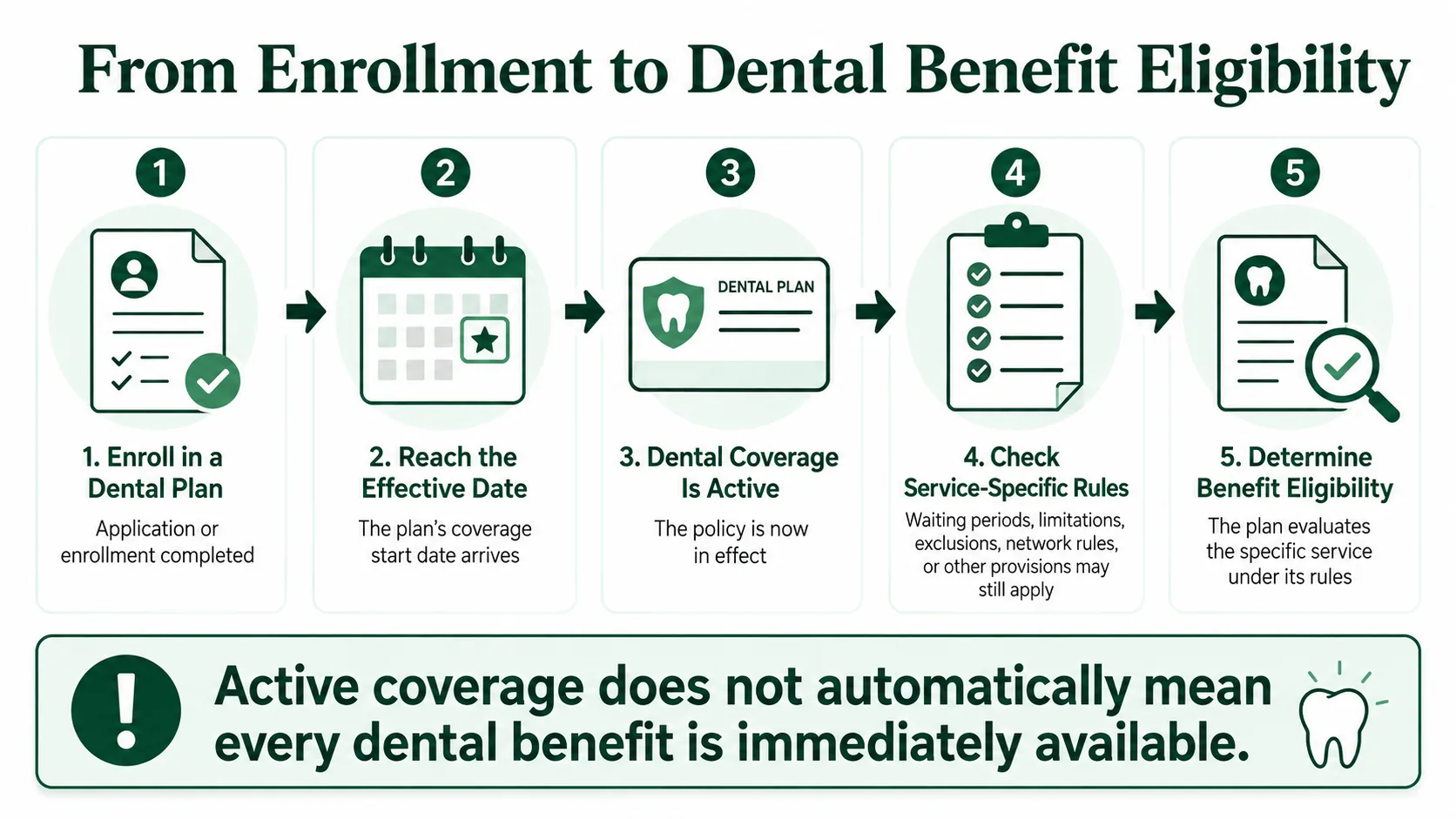
The effective date tells you when the dental plan starts. Service-specific benefit eligibility tells you whether the plan may provide a benefit for the dental service you need at that time.
Before relying on new dental coverage for treatment, confirm both.
What You’ll Learn
This guide explains:
- What a dental insurance effective date means
- Why enrollment and effective dates may be different
- Why active coverage does not make every benefit immediately available
- How an effective date differs from a waiting period
- How effective dates relate to benefit years and treatment dates
- Where to verify the effective date for your actual coverage
For a broader introduction to plan types, costs, and benefit rules, start with Dental Insurance Basics.
Quick Answer
The dental insurance effective date is the date your dental coverage becomes active under the terms of the plan.
It is not necessarily:
- The day you applied
- The day you selected the plan
- The day you completed enrollment
- The day you received your dental insurance card
- The day every dental benefit becomes available
Once coverage becomes effective, the plan can still apply its rules to each service.
For example, a particular benefit may still be subject to a waiting period even though the dental policy itself is already active.
The practical approach is:
Confirm your effective date first. Then check whether the specific dental service you need is eligible for benefits under the plan on the relevant treatment date.
Key Takeaways
- The effective date is when dental coverage becomes active under the plan
- Your enrollment date and effective date are not necessarily the same
- Active dental coverage does not automatically make every service immediately eligible for benefits
- A waiting period is separate from the policy effective date
- The relevant treatment date can matter when a plan determines benefits
- Before treatment, verify both when coverage starts and which plan rules apply to the specific service
In This Guide
What Is a Dental Insurance Effective Date?
The effective date is the date your dental coverage begins under the terms of the plan.
The American Dental Association uses the related term eligibility date for the date when an individual or dependent becomes eligible for benefits under a dental benefit contract and notes that it is often referred to as the effective date.
For consumers, the effective date establishes an important coverage boundary.
Before the effective date: The new dental plan has not yet reached its stated coverage start date.
On or after the effective date: The plan is active, but its other benefit rules still apply.
That second point is important.
Being enrolled in an active dental plan does not automatically mean that every dental procedure will receive a benefit.
Enrollment Date vs Effective Date
Your enrollment date and effective date answer different questions.
Enrollment Date
The enrollment date generally reflects when you applied for, selected, or completed enrollment in the dental plan according to the applicable enrollment process.
It tells you that you took steps to obtain coverage.
It does not necessarily establish when coverage begins.
Effective Date
The effective date tells you when the dental plan actually becomes active.
That is the date to verify before assuming that new dental coverage applies to treatment.
The time between enrollment and the effective date can depend on the specific policy or employer benefit arrangement.
Do not calculate your effective date from a general rule you found online.
Use the date stated in the documents for your actual coverage.
How to Interpret Important Dental Insurance Dates
Dental insurance can involve several dates that serve different purposes.
| Date or Term | What It Tells You | What It Does Not Automatically Tell You |
|---|---|---|
| Application or enrollment date | When you applied for or selected coverage | When dental coverage officially begins |
| Effective date | When your dental plan becomes active | That every service is immediately eligible for benefits |
| Date of service | When dental treatment was provided or reported | That the service qualifies for a benefit simply because coverage was active |
| Waiting-period completion date | That a service-specific timing restriction may have been satisfied | That final claim payment is guaranteed |
| Benefit year | The period the plan uses for certain benefits, limits, or accumulations | That your personal coverage began at the start of that period |
| Termination date | When your eligibility or coverage ends | How treatment spanning multiple dates will automatically be handled |
When dental insurance timing becomes confusing, identify the date first.
Then ask:
What does this particular date control under my dental plan?
How Is a Dental Insurance Effective Date Determined?
There is no single effective-date rule that should be applied to every dental plan.
The way the start date is established can depend on how the coverage is obtained and on the terms of the specific plan.
Individual Dental Coverage
For individually purchased dental insurance, the start date can depend on the policy, enrollment process, payment requirements, and other enrollment conditions.
Do not assume that every individual dental policy begins according to the same schedule.
Review:
- Enrollment confirmation
- Policy or coverage documents
- Member account or portal
- Other official enrollment materials
The goal is not to predict the effective date.
It is to confirm it.
Employer-Sponsored Dental Coverage
Employer-sponsored dental coverage can use its own eligibility and enrollment rules.
The effective date may depend on factors such as:
- When you become eligible for workplace benefits
- When enrollment is completed
- Open-enrollment rules
- A qualifying enrollment event
- Employer benefit procedures
Starting a new job does not automatically establish that dental coverage begins on the same day.
If you are moving from one employer dental plan to another, read Dental Insurance When Changing Jobs: What to Check Between Employer Plans for the enrollment, coverage dates, and benefit changes to verify during the transition.
For an ERISA-covered employer benefit plan, the Summary Plan Description can be an important source for understanding when employees become eligible to participate and how the plan operates.
Check the employer benefits materials, benefits portal, applicable plan documents, or plan administrator for the actual coverage date.
If your employer-sponsored dental coverage is ending after a job loss, confirm both when the old coverage ends and when any continuation or replacement coverage becomes effective. See Dental Insurance After Losing a Job: COBRA and Other Coverage Options for the coverage options and transition questions to review after employment ends.
Replacement Coverage After Parent Dental Eligibility Ends
If dental coverage through a parent is ending, confirm its final coverage date separately from the effective date of your replacement plan. Compare the two dates to identify any uncovered period.
Turning 26 does not, by itself, establish either date. Read Dental Insurance When Turning 26: What to Check Before Parent Coverage Ends for the dependent eligibility and replacement coverage checks to complete.
Replacement Coverage After Divorce
If divorce affects dental coverage through a spouse, confirm the final covered date separately from the effective date of any continuation or replacement coverage. Compare the dates to identify whether an uncovered period remains.
Read Dental Insurance After Divorce: What Happens to Your Coverage? for the spouse eligibility, notice, and coverage options to review during this transition.
Effective Date vs Benefit Eligibility: Why the Difference Matters
This is the central distinction of this guide.
Your effective date answers:
When does my dental plan become active?
It does not automatically answer:
Will the plan provide a benefit for this particular service today?
Once the plan is active, service-specific benefit eligibility can still depend on the contract.
Relevant provisions may include:
- Waiting periods
- Frequency limitations
- Replacement limitations
- Exclusions
- Missing-tooth provisions
- Available benefits
- Provider-network rules
- Other service-specific conditions
This means a service can belong to a covered benefit category without being payable in every situation.
A useful way to think about it is:
Active coverage tells you the plan has started.
Benefit eligibility tells you whether the specific service satisfies the plan rules that apply to it.
From Enrollment to Dental Benefit Eligibility
Effective Date vs Waiting Period
An effective date and a waiting period both involve timing, but they answer different questions.
Effective Date
Answers:
When does my dental coverage begin?
Waiting Period
Answers:
When may a particular benefit become available under the plan?
A dental plan can therefore already be active while a particular service remains subject to a waiting period.
Those two statements are not contradictory.
For the separate waiting-period mechanism, read How Waiting Periods Work in Dental Coverage.
Does “No Waiting Period” Mean Coverage Starts Immediately?
Not necessarily.
No waiting period means the applicable benefit does not have that additional waiting-period restriction. It does not establish when the dental policy itself becomes effective.
First confirm the policy effective date.
Then verify whether the specific service has any additional timing or benefit restrictions under the plan.
The two questions are separate:
When does my dental coverage become effective?
and:
Does the benefit I need have an additional waiting period after coverage begins?
For the separate no-waiting-period framework, read No Waiting Period Dental Insurance: What to Verify Before Enrolling.
Does the Effective Date Mean Every Dental Benefit Is Immediately Available?
No.
The effective date establishes the beginning of the dental plan.
It does not remove the rest of the contract.
A service can still be subject to the plan provisions that apply to it even when coverage is active.
This is why:
Plan active
does not necessarily mean:
Every covered service is payable today.
If a service later receives reduced or no payment, the reason may involve a rule other than the policy effective date.
Effective Date vs Benefit Year
Your effective date and your dental plan’s benefit year are also different concepts.
Effective Date
The effective date tells you when your coverage begins.
Benefit Year
The benefit year describes the period the plan uses for certain benefits, limits, deductibles, or accumulations.
You can become covered after the plan’s benefit year has already begun.
That does not automatically create a new personal benefit year beginning on your effective date.
Similarly, do not assume that a deductible or annual maximum resets on your individual coverage anniversary unless the plan documents say that it does.
For a detailed explanation of annual benefit limits, read Dental Insurance Annual Maximums Explained.
What If Treatment Happens Near the Effective Date?
Treatment close to the beginning of new dental coverage can raise additional timing questions.
The effective date establishes when the new plan begins, but it may not answer every question about treatment occurring around that date.
Treatment Before the Effective Date
Do not assume that applying for dental insurance or completing enrollment makes the new plan responsible for treatment that already occurred.
Treatment provided before the new coverage reaches its applicable effective date should not automatically be expected to receive benefits under the new plan unless the plan specifically provides otherwise.
That means:
Enrollment completed does not automatically mean coverage was already active.
Treatment That Starts Before Coverage and Continues Afterward
Treatment that begins before new coverage and continues after the effective date may require a separate review.
Multi-stage dental procedures can involve plan-defined treatment dates that are not necessarily the same as the date the final service is completed.
For that issue, see Dental Insurance and Treatment Already in Progress: What to Check When Coverage Changes.
A Tooth Missing Before the Effective Date
A tooth that was already missing before new coverage began may raise a separate question under the plan’s missing-tooth language.
The effective date can be relevant, but the applicable missing-tooth provision determines how the plan treats the situation.
Read Missing Tooth Clauses in Dental Insurance: What to Check Before Enrolling for the separate framework.
Where Can You Verify Your Dental Insurance Effective Date?
Do not rely on memory or a general online article when the exact date matters.
Use sources connected to your actual coverage.
Enrollment Confirmation
Review the confirmation you received when enrollment was completed.
Look for language identifying the coverage start date, effective date, or eligibility date.
Official Plan Documents
Depending on the type of coverage, relevant materials may include:
- Certificate of coverage
- Evidence of Coverage
- Summary Plan Description
- Benefits booklet
- Other official enrollment or plan documents
For an ERISA-covered employer benefit plan, the Summary Plan Description can explain important plan rules, including when employees become eligible to participate.
Member Portal
Your dental plan’s online member account may display current eligibility or coverage information.
Check that the information shown applies to the correct member or dependent.
Employer Benefits Information
For workplace dental coverage, check the employer benefits portal, benefits materials, or plan administrator.
Do not assume that your employment start date and dental coverage effective date are identical.
Dental Plan Member Services
If the information is unclear, contact the dental plan directly and ask:
“What effective date do you show for my dental coverage?”
If dependents are enrolled, confirm their eligibility information as well rather than assuming everyone necessarily has the same coverage history.
What to Confirm Before Scheduling Dental Treatment
Knowing the effective date is the first step.
Before relying on new coverage for a particular treatment, confirm four additional points.
Confirm the Effective Date
Make sure the dental plan is active on the relevant treatment date.
Identify the Relevant Treatment Date
For a straightforward service, this may be the date of service.
Treatment involving multiple stages may require a closer review of the plan’s procedure-specific timing rules.
Check for an Additional Timing Rule
A dental plan can be active while a particular benefit remains subject to an additional timing requirement, such as a waiting period.
Confirm the Service-Specific Plan Requirements
Check the provisions that apply to the treatment you are considering rather than relying only on the fact that the policy is active.
Depending on the service, separate rules may address coverage limitations, replacement provisions, missing-tooth language, available benefits, or provider-network requirements.
For more extensive treatment, a pretreatment review may provide additional information about potential benefits, but it should not automatically be treated as a guarantee of final payment.
See Dental Insurance Predetermination vs Preauthorization: What’s the Difference? for the separate pretreatment-review framework.
What If the Plan Says You Were Not Eligible on the Date of Service?
Start with the dates.
Check:
- The effective date shown in your enrollment records
- The date of service on the claim
- Any termination date
- Whether the correct member or dependent was enrolled
Then compare that information with the plan’s records.
A useful question is:
“What effective or termination date are you using for this claim?”
If the date used by the plan does not match your records, ask what information supports the eligibility determination.
Do not assume immediately that the benefit decision is correct or incorrect.
First determine whether the disagreement involves:
- An enrollment record
- An effective or termination date
- Incorrect member information
- Another coverage-status issue
If the dates and enrollment information have been reviewed and a final unfavorable claim decision remains, see Dental Insurance Claim Denied? How to Review the Decision and Appeal for the separate claim-review process.
Common Effective-Date Mistakes to Avoid
Several assumptions can create confusion when new dental coverage begins.
- Assuming enrollment means coverage has started. Confirm the actual effective date.
- Assuming “no waiting period” means same-day coverage. Waiting periods and policy effective dates are separate concepts.
- Assuming an insurance card means every benefit is available. The plan’s service-specific rules still apply.
- Assuming your effective date and benefit year are the same. The plan may use a separate benefit period.
- Assuming new coverage applies retroactively. Treatment before the coverage start date should not automatically be expected to receive benefits under the new plan.
- Assuming active coverage guarantees payment for a specific service. Coverage status is only one part of a benefit determination.
Our Recommendation
When new dental insurance is involved, begin with one question:
When does my coverage actually become effective?
Then ask a second:
Is the specific dental service I need eligible for benefits under the plan at that time?
Confirm the effective date, identify the relevant treatment date, and review the plan provisions that apply to that service.
Most importantly:
Coverage starting and a particular dental benefit becoming available are not necessarily the same event.
Understanding that distinction can help you avoid assuming that a procedure will receive a benefit simply because the dental policy is active.
For the broader framework behind dental plan benefits, costs, waiting periods, networks, and other limitations, continue with the Dental Plans Guide.
Helpful Resources
- Dental Insurance Basics
- How Waiting Periods Work in Dental Coverage
- No Waiting Period Dental Insurance: What to Verify Before Enrolling
- Dental Insurance and Treatment Already in Progress
- Dental Insurance Exclusions and Limitations
- Dental Plan Comparison Checklist
Frequently Asked Questions
What Is the Effective Date of Dental Insurance?
The effective date is the date your dental coverage becomes active under the terms of the plan.
It establishes when the coverage begins, but it does not automatically mean that every specific dental benefit is immediately available.
Is My Dental Insurance Effective Date the Same as My Enrollment Date?
Not necessarily.
Enrollment reflects when you applied for, selected, or completed enrollment in coverage. The effective date establishes when the dental plan actually begins.
Use the effective date shown in the records for your actual coverage rather than assuming the two dates are the same.
Does Dental Insurance Start as Soon as I Enroll?
Not necessarily.
The start date depends on the enrollment and eligibility rules for the specific plan.
Check the effective date shown in your enrollment confirmation, official coverage documents, member portal, or employer benefits information when applicable.
Is the Effective Date the Same as a Waiting Period?
No.
The effective date tells you when the dental plan starts. A waiting period is a separate timing restriction that may delay when a particular benefit becomes available.
Can My Dental Plan Be Active While a Waiting Period Still Applies?
Yes.
Dental coverage can be active while a particular service remains subject to a waiting period.
Coverage status and service-specific benefit eligibility are separate questions.
Is the Effective Date the Same as the Benefit Year?
Not necessarily.
Your effective date is when your coverage begins. The benefit year is the period the dental plan uses for certain benefits, limits, deductibles, or accumulations.
Do not assume your personal effective date automatically starts a new benefit year.
Where Can I Verify My Dental Insurance Effective Date?
Check your enrollment confirmation, official plan documents, member portal, employer benefits information when applicable, or contact the dental plan directly.
Use information connected to your actual coverage rather than relying on a general online rule about when dental insurance usually starts.
Sources
About the Author
Maria Dumitru is the founder and content editor of Dental Coverage Hub. She researches and develops educational resources designed to help U.S. consumers understand dental insurance plans, coverage rules, costs, provider networks and comparison factors.
Learn more about our standards in the Editorial Policy and How We Review Dental Plans.
Dental Coverage Hub provides general educational information and does not provide medical, legal, financial or personalized insurance advice.
This article is for general educational purposes only. Dental insurance effective dates, eligibility rules, waiting periods, benefit periods, treatment-date provisions, and other coverage requirements can vary by plan. Review the official documents for your coverage and contact the dental plan or benefits administrator for information about the dates and benefit rules that apply to your situation.

Confirm When Coverage Starts Before You Rely on It
Your dental insurance effective date tells you when the plan begins, but it does not answer every question about a specific treatment. Confirm the coverage start date first, then review the timing and benefit rules for the service you need.