

Dental Insurance Replacement Rules Explained: What to Check Before Replacing Dental Work
Learn how dental insurance may evaluate replacement of existing dental work, why the prior placement date can matter, and why changing plans does not necessarily reset treatment history.
Written and researched by Maria Dumitru.
Founder and Content Editor at Dental Coverage Hub
Last reviewed: September 2026
Dental insurance may provide benefits for crowns, bridges, dentures, and other dental work without providing another benefit every time existing dental work is replaced.
That is where dental insurance replacement rules come in.
A replacement rule is a plan limitation that can affect whether dental work that already exists qualifies for another benefit.
The rule may involve the history of the existing restoration or prosthesis, including when it was originally placed. Depending on the plan, other conditions or documentation requirements may also matter.
That makes three questions especially important:
Is this initial placement or replacement?
When was the existing dental work originally placed?
What does the current dental plan require before another replacement benefit may be available?
Do not rely on a universal replacement schedule.
Replacement provisions can vary by plan, procedure, prior treatment history, documentation, and the circumstances surrounding the replacement.
What You’ll Learn
This guide explains:
- What a dental insurance replacement rule means
- Why initial placement and replacement are different benefit questions
- Why the prior placement date can matter
- Why timing alone may not answer every replacement question
- Why changing dental plans does not necessarily reset prior treatment history
- How replacement rules differ from other dental insurance timing rules
- What to verify before relying on benefits for replacement dental work
Quick Answer
A dental insurance replacement rule is a plan provision that can affect whether another benefit is available for dental work that already exists.
The analysis usually starts with three questions:
What dental work already exists?
When was it originally placed?
What replacement provision applies under the current plan?
A plan may use prior-placement history when evaluating a replacement and may also require additional information or conditions to be satisfied.
That means:
Enough time passing does not automatically guarantee another replacement benefit.
It also means that changing dental insurance should not be assumed to erase the history of existing dental work.
Before relying on replacement coverage, review the actual plan rather than using a generic timetable for crowns, bridges, dentures, or other dental work.
Key Takeaways
- Replacement rules affect benefits for dental work that already exists
- Initial placement and replacement are different insurance questions
- The prior placement date can be important when replacement eligibility is evaluated
- There is no universal replacement interval that should be applied to every dental plan
- Time may be important without being the only requirement under a replacement provision
- Changing dental plans does not necessarily reset the prior-placement history
In This Guide
What Is a Dental Insurance Replacement Rule?
A dental insurance replacement rule is a limitation that can affect whether a plan provides another benefit for replacing dental work that already exists.
The important distinction is:
A procedure being generally covered is not the same as an existing restoration or prosthesis automatically qualifying for another replacement benefit.
For example, a dental plan may provide benefits for crowns.
That does not mean every replacement crown automatically qualifies for another benefit.
If an existing crown is being replaced, the plan may review the history of that crown and apply the replacement provision in the current coverage.
Similar questions can arise when existing fixed or removable prostheses, such as bridges or dentures, are replaced.
The exact replacement requirements come from the individual dental plan.
Initial Placement vs Replacement
Before looking at replacement timing, determine whether the proposed treatment involves an initial placement or a replacement.
They are not the same insurance question.
Initial Placement
Initial placement generally means the relevant restoration or prosthesis is being placed without an existing one of that type being replaced.
The insurance question is:
Does the plan provide a benefit for the initial placement of this treatment?
Other provisions may then become relevant depending on the circumstances.
For example, replacing a natural tooth that was already missing before coverage began may raise a separate missing-tooth question.
In insurance terminology, replacing a missing natural tooth for the first time is not necessarily the same question as replacing an existing dental prosthesis.
For that separate issue, read Missing Tooth Clauses in Dental Insurance: What to Check Before Enrolling.
Replacement
Replacement means existing dental work is being replaced with new dental work.
The insurance question becomes:
Does the current plan provide another benefit for replacing the existing restoration or prosthesis?
That is when prior-placement history can become particularly important.
Do not assume that the same benefit provision applies to initial placement and replacement.
Why the Prior Placement Date Matters
Dental plans may need to know when existing dental work was originally placed before determining whether another replacement benefit is available.
The ADA Dental Claim Form includes a field for reporting a Date of Prior Placement when applicable to replacement of existing crowns and fixed or removable prostheses.
That historical date can matter because the current dental plan may compare it with its own replacement provision.
The important question is therefore:
When was the dental work that is now being replaced originally placed?
Possible sources of that history may include:
- Previous dental records
- Prior claim information
- Treatment history
- Information available from a current or former dental office
The prior placement date and your current dental insurance effective date answer different questions.
Your effective date tells you when the current coverage began.
It does not automatically establish when the dental work being replaced was originally placed.
For the separate coverage-start issue, see Dental Insurance Effective Date: When Does Coverage Start?
How to Interpret a Dental Insurance Replacement Provision
When reviewing plan language, benefit information, or an EOB, identify what the plan is actually evaluating.
| What You See | What It May Mean | What to Check |
|---|---|---|
| Replacement limitation | Another benefit is subject to replacement conditions | Exact plan provision |
| Date of prior placement requested | Existing-work history matters | When the current dental work was originally placed |
| Replacement not yet eligible | The plan says a replacement requirement has not been satisfied | Prior placement history and applicable replacement language |
| Additional documentation requested | The plan needs more information to evaluate the replacement | What information is specifically requested |
| Initial placement | The treatment may not involve replacing existing dental work | Whether another plan provision applies |
| Dental work predates current coverage | Earlier treatment history may still be relevant | How the current plan treats prior placement |
The goal is not to memorize a standard timetable.
It is to determine:
Which requirement does the current dental plan say applies to this replacement?
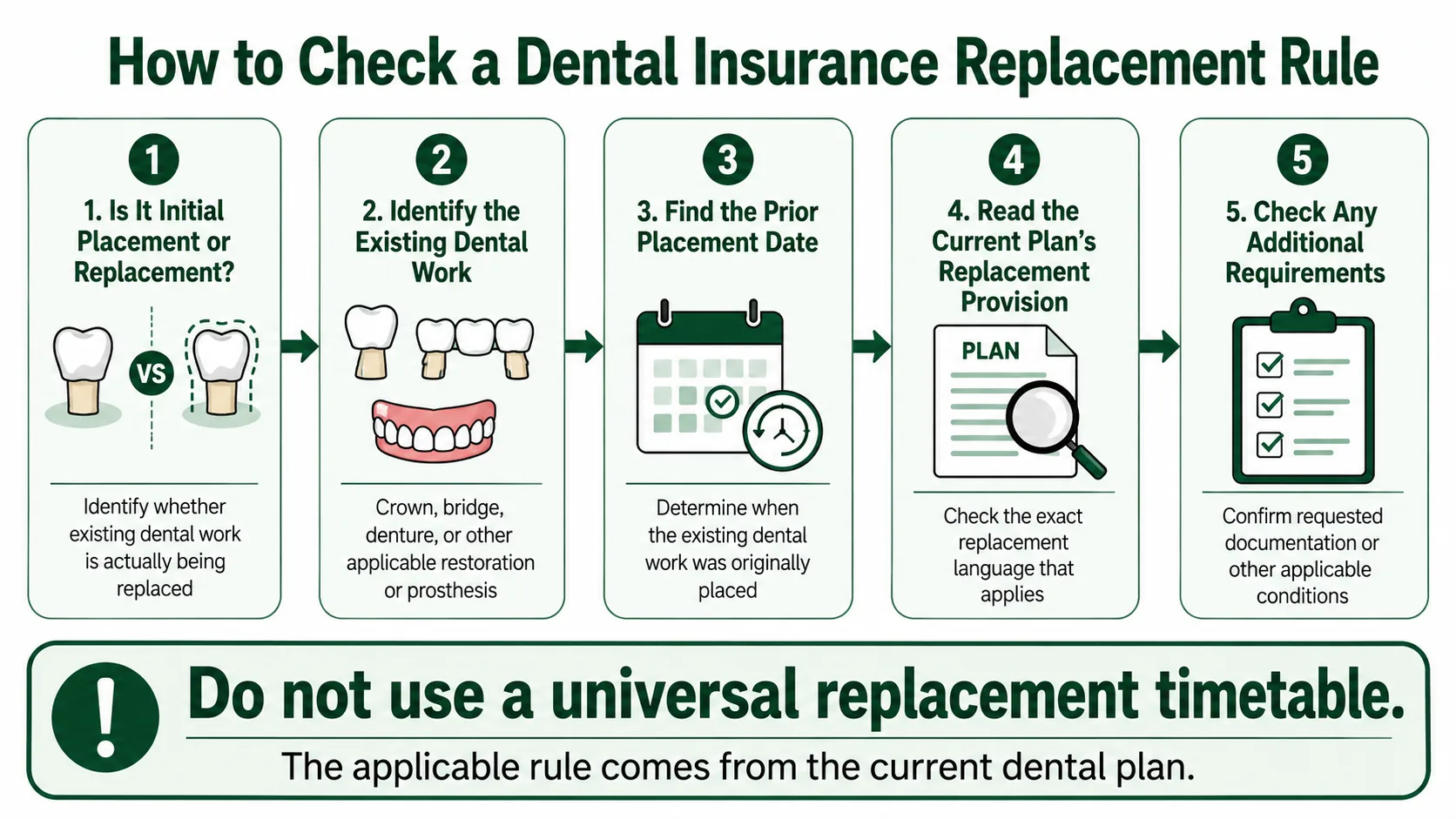
How to Check a Dental Insurance Replacement Rule
Can Replacement Eligibility Depend on More Than Time?
It can, depending on the dental plan.
Some replacement provisions may consider the age of the existing dental work or the amount of time since prior placement.
Other plan provisions or claim-review requirements may also require additional information.
For example, the plan may request information related to the existing dental work, the reason replacement is being proposed, or the clinical documentation supporting the treatment.
Do not turn those possibilities into one universal rule.
Instead, review the complete replacement provision and any documentation requirements that apply to the proposed treatment.
A useful principle is:
Time may matter, but time alone should not be assumed to answer the entire replacement question.
The clinical and insurance questions should also remain separate.
A dentist may determine that existing dental work should be replaced based on the patient’s clinical needs.
That recommendation does not, by itself, establish what benefit the dental insurance contract will provide.
Which Types of Dental Work May Have Replacement Provisions?
Replacement provisions commonly arise with existing crowns and fixed or removable prostheses such as bridges and dentures.
The ADA Dental Claim Form distinguishes initial placement from replacement for these types of dental treatment and provides for reporting the prior placement date when replacement is involved.
Other dental services may be subject to different repeat-treatment, component, or coverage provisions.
Do not assume that a replacement rule applying to one type of dental work automatically applies in the same way to another.
For procedure-specific coverage questions, read Does Dental Insurance Cover Crowns? and Does Dental Insurance Cover Dentures?
Does Changing Dental Insurance Reset the Replacement Timeline?
Do not assume so.
This is especially important when you change employers, switch dental plans, or obtain new dental coverage after existing dental work was already placed.
A new dental insurance effective date tells you when the new coverage begins.
It does not automatically establish a new date for the dental work that already exists.
For example, an existing crown, bridge, or denture may have been placed:
- Under another dental plan
- Through a different employer
- Before the current insurer covered you
- Before you had the current dental coverage at all
The current plan may still ask when that dental work was actually placed.
That is why:
A new dental insurance effective date does not automatically create a new prior-placement date.
Before relying on replacement coverage after changing plans, ask:
- Does this plan consider dental work placed before my current coverage began?
- What prior placement date is being used?
- What information does the plan require to establish that prior-placement history?
For the separate question of when new coverage itself starts, read Dental Insurance Effective Date: When Does Coverage Start?
What If You Do Not Know the Prior Placement Date?
This can happen when dental work is old, previous records are difficult to locate, or you have changed dentists.
Do not invent or estimate a date if the plan says prior placement materially affects replacement eligibility.
Instead, ask the dental plan what information it accepts.
Possible sources may include:
- Previous dental records
- Prior claim information
- Treatment-history documentation
- Other information accepted by the plan
If the current dental office does not have the prior history, ask whether earlier records can be obtained.
The plan may also have its own process for handling incomplete prior-placement information.
The important step is to determine what information the current plan requires rather than assuming your current coverage date can substitute for the actual history of the dental work.
Replacement Rules vs Other Dental Insurance Rules
Several dental insurance provisions can involve timing, but they do not answer the same question.
Understanding the difference helps you identify which rule actually matters.
Replacement Rule vs Frequency Limit
A frequency limit generally addresses how often a recurring or repeat service may receive a benefit.
A replacement rule addresses dental work that already exists and whether another benefit may be available to replace it.
A replacement provision can involve timing, but it should not automatically be treated as an ordinary frequency limit.
For the separate repeat-service framework, see Dental Insurance Frequency Limits Explained: What to Check Before Treatment.
A waiting period concerns when a particular benefit may become available after enrollment or coverage begins.
Replacement Rule vs Waiting Period
A replacement rule concerns existing dental work and whether another replacement benefit may be available.
A dental plan can therefore be active and a waiting period can already be satisfied while a separate replacement provision still affects the treatment.
For the waiting-period mechanism, read How Waiting Periods Work in Dental Coverage.
Replacement Rule vs Missing Tooth Clause
These provisions are particularly easy to confuse.
A missing-tooth provision generally concerns a tooth that was already missing before the applicable coverage began and how that history affects a tooth-replacement benefit.
A replacement limitation concerns dental work that already exists and is now being replaced.
A simple way to distinguish them is:
Replacing an already-missing natural tooth for the first time may raise a missing-tooth question.
Replacing an existing bridge or denture may raise a replacement-rule question.
The concepts can interact in some circumstances, but they should not be treated as interchangeable.
For the separate pre-enrollment issue, read Missing Tooth Clauses in Dental Insurance: What to Check Before Enrolling.
Repair vs Replacement
Repairing existing dental work and replacing it entirely may be treated differently under some dental plan provisions.
If the plan refers to repairability, serviceability, or another condition of the existing restoration or prosthesis, check the exact language and ask how that provision applies to the proposed treatment.
The insurance classification does not determine which treatment is clinically appropriate.
The clinical treatment decision and the insurance benefit determination remain separate questions.
What Other Plan Rules Can Still Affect the Benefit?
Satisfying a replacement provision does not guarantee a particular final payment.
Other terms of the dental plan can still affect the benefit, including available benefits, cost-sharing, exclusions, network provisions, or other limitations.
Review those rules separately after determining whether the replacement provision itself has been satisfied.
This distinction matters because:
Replacement eligibility and final benefit calculation are not the same question.
What If Replacement Treatment Crosses a Change in Coverage?
If replacement treatment begins under one dental plan and continues after coverage changes, the issue may involve more than the replacement provision.
The relevant treatment dates and the rules of the old and new plans may also matter.
Do not assume that the new dental plan automatically becomes responsible simply because its effective date arrives while treatment is underway.
For that separate framework, see Dental Insurance and Treatment Already in Progress: What to Check When Coverage Changes.
Can Pretreatment Review Help Before Replacing Dental Work?
Pretreatment review may help clarify how a dental plan currently expects to apply its benefits to proposed replacement treatment.
It can be useful when prior-placement information or a replacement provision needs to be reviewed before significant dental work begins.
However, a predetermination or preauthorization should not automatically be treated as a guarantee of final payment.
For the separate pretreatment-review framework, see Dental Insurance Predetermination vs Preauthorization: What’s the Difference?
What Documentation May Be Needed?
Documentation requirements depend on the procedure, dental plan, and issue being evaluated.
Depending on the situation, requested information may include:
- Prior-placement information
- Relevant treatment history
- Radiographs
- A provider narrative
- Photographs
- Other clinical or administrative information requested for review
The patient does not need to recreate clinical documentation independently.
When clinical evidence is required, the treating dental office is generally the appropriate source for clinical records and supporting information.
A useful principle is:
Match the documentation to the replacement question the plan is asking.
Do not collect unrelated records simply to make a submission larger.
What to Check Before Replacing Existing Dental Work
Before relying on dental insurance for replacement treatment, work through the issue in order.
1. Identify What Is Being Replaced
Determine exactly what existing dental work is involved.
Is the proposed treatment replacing an existing crown, bridge, denture, or another restoration or prosthesis?
2. Confirm Whether It Is Initial Placement or Replacement
Do not assume the same benefit provision applies to both situations.
Determine how the current plan is classifying the proposed treatment.
3. Determine the Prior Placement Date
Find out when the existing dental work was originally placed and what prior-placement date the plan will use.
If the date is unknown, ask what information the plan accepts.
4. Read the Exact Replacement Provision
Do not rely on a generic online timetable.
Look for the replacement language in the documents for the dental plan that currently covers you.
5. Check for Additional Information or Documentation Requirements
Determine whether timing is the only issue or whether the plan is also requesting additional information before evaluating the replacement.
6. Separate Replacement Eligibility From Final Benefit Calculation
After reviewing the replacement provision, check any other plan terms that may affect the final benefit.
Do not assume that satisfying the replacement rule guarantees a particular payment amount.
Questions to Ask Your Dental Plan
Specific questions can help you understand the replacement provision more clearly.
Ask:
- Is this treatment being evaluated as initial placement or replacement?
- What prior placement date are you using?
- What exact replacement provision applies?
- Does the plan consider dental work placed before my current coverage began?
- What documentation is required?
- Can the proposed treatment be submitted for pretreatment review?
These questions are more useful than asking only:
“How old does my crown have to be before insurance replaces it?”
The answer depends on the dental plan.
What If a Replacement Claim Receives Reduced or No Benefit?
Start with the EOB or claim explanation.
Do not immediately assume:
“My dental insurance never covers replacements.”
Check:
- Which procedure was processed
- Which replacement provision was applied
- What prior placement date the plan used
- Whether additional documentation was requested
- Whether another plan rule actually caused the reduced or zero benefit
The payment amount alone does not explain the reason.
For detailed EOB interpretation, see How to Read a Dental Insurance EOB: Payments, Adjustments, and Patient Responsibility.
If the prior-placement information appears incorrect or you believe the replacement provision was applied incorrectly, see Dental Insurance Claim Denied? How to Review the Decision and Appeal for the separate claim-review framework.
Common Replacement-Rule Mistakes
Several assumptions can create confusion when existing dental work needs to be replaced.
- Relying on a universal replacement schedule. Replacement provisions can vary by dental plan.
- Looking only at the age of the existing dental work. Timing may be important without being the only requirement.
- Assuming the replacement timeline starts when you enroll. The actual prior-placement date may still matter.
- Assuming new dental insurance resets the history. A new effective date does not automatically create a new prior-placement date.
- Confusing initial placement with replacement. These can involve different benefit provisions.
- Confusing replacement rules with waiting periods or routine frequency limits. They answer different insurance questions.
Our Recommendation
When existing dental work needs replacement, do not begin with a generic rule about how old it should be.
Begin with your actual dental work and your actual dental plan.
Ask:
Is this initial placement or replacement?
When was the existing dental work originally placed?
What replacement provision applies under my current coverage?
Does the plan require any additional information or documentation?
Most importantly:
Do not assume that changing dental insurance resets the replacement timeline.
The current plan may still consider treatment history that began before the current coverage existed.
And do not use a universal replacement timetable for crowns, bridges, dentures, or other dental work.
The more reliable approach is to identify the prior-placement history and then review the replacement language in the plan that currently covers you.
For the broader framework behind dental plan benefits, timing rules, limitations, networks, and claims, continue with the Dental Plans guide.
Helpful Resources
- Dental Plans Guide
- Dental Insurance Frequency Limits Explained: What to Check Before Treatment
- Missing Tooth Clauses in Dental Insurance: What to Check Before Enrolling
- Dental Insurance Effective Date: When Does Coverage Start?
- Dental Insurance and Treatment Already in Progress: What to Check When Coverage Changes
Frequently Asked Questions
What Is a Dental Insurance Replacement Rule?
A dental insurance replacement rule is a plan limitation that can affect whether another benefit is available for replacing dental work that already exists.
The provision may consider prior-placement history and other plan-specific requirements.
Do All Dental Plans Use the Same Replacement Rules?
No.
Replacement provisions can vary by plan, procedure, prior treatment history, documentation requirements, and other contract terms.
Do not apply a universal replacement schedule to every dental plan.
Do All Types of Dental Work Have the Same Replacement Rule?
No.
Replacement and repeat-treatment provisions can vary by procedure and dental plan.
Do not assume that a rule applying to one type of restoration or prosthesis applies identically to another.
Does Old Dental Work Automatically Qualify for Replacement?
No.
The age of existing dental work should not be treated as a guarantee of another insurance benefit.
The applicable replacement provision and any other requirements still need to be reviewed.
What Is a Prior Placement Date?
The prior placement date is the date the existing restoration or prosthesis being replaced was originally placed.
A dental plan may use that treatment history when evaluating whether another replacement benefit is available.
What If I Do Not Know the Prior Placement Date?
Ask the dental plan what information it accepts.
Previous dental records, prior claim information, or other treatment-history documentation may help establish the prior-placement history.
Do not assume that your current insurance effective date substitutes for the actual prior placement date.
Does Changing Dental Insurance Reset the Replacement Period?
Do not assume so.
A current dental plan may consider the actual prior placement date even when the dental work was completed before the current coverage began or under another dental plan.
Is a Replacement Rule the Same as a Frequency Limit or Waiting Period?
No.
A frequency limit generally addresses how often a recurring or repeat service may receive benefits. A waiting period concerns when a benefit may become available after coverage begins.
A replacement rule addresses dental work that already exists and whether another replacement benefit may be available.
Sources
- American Dental Association — ADA Dental Claim Form Completion Instructions
- American Dental Association — Claim Submissions: Crowns and Core Buildups
- American Dental Association — Typical Dental Plan Benefits and Limitations
- American Dental Association — Pre-Authorizations
- American Dental Association — Explanation of Benefits Statement
About the Author
Maria Dumitru is the founder and content editor of Dental Coverage Hub. She researches and develops educational resources designed to help U.S. consumers understand dental insurance plans, coverage rules, costs, provider networks and comparison factors.
Learn more about our standards in the Editorial Policy and How We Review Dental Plans.
This article is for general educational purposes only. Dental replacement provisions, prior-placement requirements, documentation requirements, waiting periods, frequency limitations, and other coverage rules can vary by dental plan. Review the official documents for your coverage and contact the dental plan for information about the provisions that apply to specific dental work.

Understand the Replacement Rule Before Treatment
Replacing existing dental work involves more than asking whether the procedure is generally covered. Confirm whether the treatment is initial placement or replacement, identify the prior-placement history, and review the exact replacement provision before relying on another dental benefit.