🦷 Dental Crown Coverage
🇺🇸 Built for U.S. Consumers
✓ Procedure-Guidance

Does Dental Insurance Cover Crowns? What to Verify Before Treatment
Learn how dental plans may evaluate crown treatment, including related procedures, provider networks, waiting periods, annual maximums, replacement rules, materials, and expected patient costs.
Written and researched by Maria Dumitru.
Founder and Content Editor at Dental Coverage Hub
Last reviewed: August 2026
What You’ll Learn
Dental insurance may provide benefits for a dental crown, but coverage depends on the exact procedure, tooth, provider, treatment reason, and contract terms.
The word “crown” may be used informally for the complete treatment. The dental plan may instead evaluate several separately reported services, such as diagnostic imaging, removal of an existing crown, core buildup, post and core, a provisional restoration, the final crown, or related root canal treatment.
Each service can have its own:
- Procedure code
- Benefit classification
- Deductible
- Copay or coinsurance
- Plan allowance
- Waiting period
- Provider requirement
- Documentation requirement
- Replacement limitation
- Exclusion
A dentist’s clinical recommendation and a dental plan’s benefit decision are separate. The dentist determines whether the crown is appropriate for the tooth. The plan determines whether the reported procedures qualify for benefits under the contract.
This guide explains how to identify every proposed service, verify procedure-specific benefits, review crown-material and replacement provisions, and estimate the remaining patient responsibility before treatment begins.
For a broader explanation of how dental plans evaluate different procedures, review Dental Insurance Coverage for Common Procedures.
Quick Answer
Dental insurance may provide benefits for a crown when the procedure is eligible under the specific plan.
Coverage is not established only by the general statement that crowns are included.
A plan may:
- Cover the final crown but evaluate related procedures separately
- Apply a deductible
- Require a copay or coinsurance
- Use a scheduled member charge
- Base payment on a plan allowance
- Apply a waiting period
- Reduce the available benefit through an annual maximum
- Require an in-network dentist
- Request X-rays, photographs, chart notes, or a clinical narrative
- Apply material-specific payment rules
- Apply an alternate benefit
- Limit replacement of an existing crown
- Exclude treatment started before eligibility
- Require preauthorization or offer predetermination
Before treatment begins, ask the dental office for a written treatment plan that identifies:
- The tooth involved
- Every procedure
- The CDT codes
- The treating provider
- The proposed treatment date
- The crown material
- Related procedures
- The complete estimated charges
Then verify every procedure separately through the plan documents and insurer or plan administrator.
A general response that “crowns are covered” does not establish the plan’s complete payment or the patient’s final responsibility.
Key Takeaways
- Dental crown treatment may involve several separately reported procedures
- Coverage for the final crown does not automatically include a core buildup, post and core, root canal, provisional crown, imaging, or removal of an existing restoration
- The dentist determines whether the crown is clinically appropriate, while the plan determines benefit eligibility under the contract
- A crown can be listed as a covered service and still be affected by deductibles, cost sharing, plan allowances, annual maximums, waiting periods, and network rules
- Crown materials may follow different clinical and benefit considerations
- Replacement crowns may be subject to timing, documentation, damage, decay, repair, or prior-placement provisions
- Preauthorization and predetermination are distinct processes and do not necessarily guarantee final payment
- The procedure codes, provider, tooth, material, treatment date, documentation, and remaining benefits should be verified before treatment begins
In This Guide
What Is a Dental Crown?
A dental crown is an indirect restoration designed to cover part or all of the visible portion of a tooth.
A crown may be recommended for reasons such as:
- Restoring a tooth with substantial loss of structure
- Protecting a cracked or weakened tooth
- Restoring a broken or severely worn tooth
- Restoring a tooth after selected root canal treatment
- Replacing an existing crown that can no longer function adequately
- Serving as part of a dental bridge
- Providing the visible restoration over a dental implant
The recommendation depends on the individual tooth, remaining structure, bite, oral health, treatment history, expected function, material properties, and available alternatives.
Crown Material
Possible crown materials can include:
- Ceramic
- Zirconia
- Metal alloys
- Metal-ceramic materials
- Resin-based materials
- Other indirect restorative systems
The dentist should determine which materials are clinically appropriate for the individual case.
The insurance plan may separately determine:
- Whether the proposed crown procedure is eligible
- Whether a material limitation applies
- Which plan allowance is used
- Whether an alternate benefit applies
- Whether an additional amount remains the patient’s responsibility
The plan’s payment method does not establish that one material is clinically more appropriate than another.
How Crown Treatment May Be Structured
A visual summary of possible crown-treatment stages, including evaluation, imaging, tooth preparation, related buildup procedures, a provisional restoration, laboratory or digital fabrication, and final crown placement.
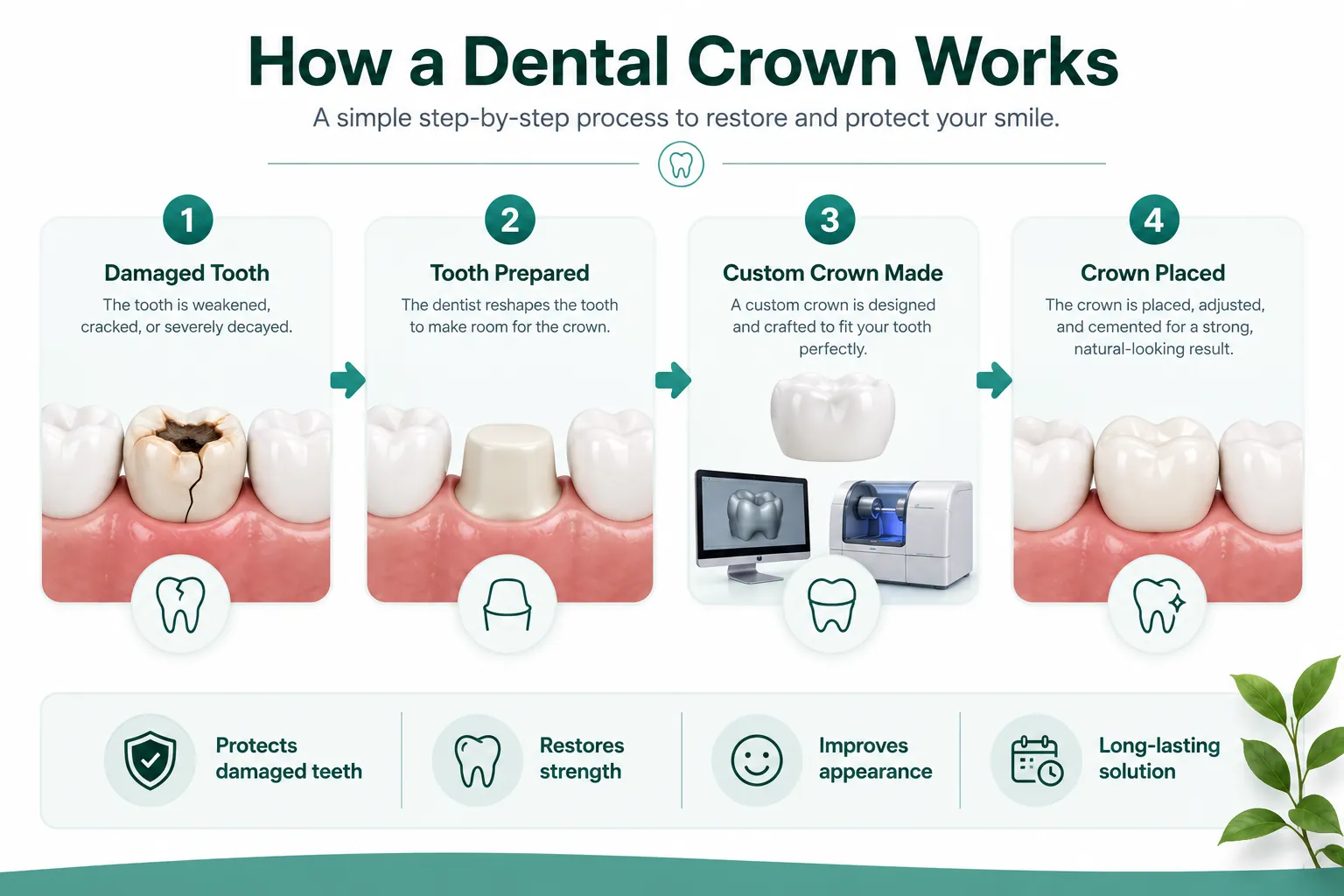
The exact treatment stages depend on the condition of the tooth and the dentist’s clinical recommendation.
Not every patient requires every stage. Dental insurance may evaluate each reported procedure separately.
How Dental Plans May Evaluate Crown Treatment
Dental plans may evaluate a crown through a restorative benefit category, a scheduled member-charge system, or another contract structure.
Do not assume that every plan classifies or pays for crowns in the same way.
Verify the Exact Crown Procedure
Ask the dental office to identify:
- The tooth number
- The crown procedure
- The CDT code
- The proposed material
- Whether the crown is new or a replacement
- Whether the crown is tooth-supported or implant-supported
- The treating provider
- The proposed treatment date
A procedure code identifies the reported service. It does not guarantee that the plan will pay for it.
Verify Related Procedures Separately
Ask whether the treatment plan includes:
- Examination or consultation
- Diagnostic imaging
- Removal of an existing crown
- Core buildup
- Post and core
- Root canal treatment
- Provisional restoration
- Final crown
- Crown recementation
- Crown repair
- Implant abutment
- Implant crown
- Follow-up services
One procedure may be eligible while another is limited or excluded.
Root canal treatment, core buildup, and the final crown may be evaluated separately. Coverage for one procedure does not automatically establish coverage for the others.
If root canal treatment is part of the treatment plan, review Does Dental Insurance Cover Root Canals? to understand why the endodontic procedure, provider network, and final restoration should be checked separately.
For a broader view of how dental plans may evaluate related treatments, visit Dental Procedure Coverage.
Review the Benefit Method
Confirm whether the plan uses:
- Deductible and coinsurance
- A copay
- A scheduled member charge
- A plan allowance
- An alternate benefit
- An annual maximum
- Another payment method
A displayed coverage percentage may be applied to the plan allowance rather than the dental office’s complete charge.
Review Documentation Requirements
The plan may request:
- X-rays
- Photographs
- Tooth-condition documentation
- Chart notes
- A clinical narrative
- The date of an existing crown
- The reason replacement is required
- The complete treatment plan
- Other supporting records
The dental office should submit the requested documentation, but the patient should still verify the applicable benefit directly with the insurer or plan administrator.
Crown-Related Services to Verify Separately
| Treatment component | General purpose | Benefit questions to verify |
|---|---|---|
| Examination or consultation | Evaluates the tooth and treatment options | Provider network, evaluation type, frequency rules, referral requirements, and member cost |
| Diagnostic imaging | Supports diagnosis and treatment planning | Image type, frequency limits, documentation rules, and cost sharing |
| Removal of an existing crown | Allows access to the tooth or replacement treatment | Whether removal is included in another service, separately reported, limited, or noncovered |
| Core buildup | Rebuilds missing tooth structure when required for the restoration | Separate procedure eligibility, documentation, deductible, and whether it is bundled or excluded |
| Post and core | Provides additional internal support in selected treated teeth | Procedure eligibility, documentation, relationship to root canal treatment, and separate member cost |
| Root canal treatment | Treats the internal tissues of the tooth | Separate procedure code, provider network, waiting period, deductible, and annual-maximum effect |
| Provisional crown | Temporarily protects the prepared tooth | Whether it is included in the final crown fee, separately covered, limited, or excluded |
| Final tooth-supported crown | Restores the prepared natural tooth | Crown procedure, material rules, plan allowance, cost sharing, waiting period, and annual maximum |
| Implant crown | Provides the visible restoration over a dental implant | Implant-specific eligibility, abutment treatment, provider rules, exclusions, and benefit limits |
| Crown repair or recementation | Repairs or reattaches an existing crown | Repair eligibility, frequency limits, provider rules, and relationship to replacement coverage |
| Replacement crown | Replaces an existing restoration | Original placement date, replacement interval, reason for replacement, documentation, and exclusions |
The presence of a valid procedure code does not guarantee payment. The covered-service provisions, exclusions, provider rules, documentation, remaining benefits, and other contract terms determine whether a benefit is available.
Plan Rules That May Affect Crown Benefits
A dental plan may provide benefits for a crown while still limiting the amount paid or excluding selected related procedures.
Review every rule against the exact tooth, procedure, material, provider, and treatment date.
Benefit Classification
A plan may classify the crown as:
- Restorative care
- Major restorative care
- Prosthodontic care
- A scheduled-charge service
- Another category defined by the contract
Do not assume that every policy places crowns in the same category.
The classification can affect:
- The deductible
- Copay or coinsurance
- Waiting period
- Plan allowance
- Annual maximum
- Documentation
- Provider requirements
Deductible and Member Cost Sharing
Confirm whether the plan uses:
- A deductible
- Coinsurance
- A fixed copay
- A scheduled member charge
- Another payment arrangement
A displayed coverage percentage may be applied to the plan allowance rather than to the dental office’s complete charge.
Ask the insurer or plan administrator to identify:
- The recognized or allowed amount
- The deductible applied
- The expected plan payment
- The estimated patient responsibility
- Any amount the dental office may charge above the plan allowance
Annual Maximum
Confirm:
- The annual maximum
- How much has already been used
- How much remains
- Which crown-related procedures reduce it
- When the maximum resets
- Whether related treatment will occur in another benefit period
- Whether continued enrollment is required for later payments
A crown may be an eligible service while the plan pays little or nothing because the annual maximum has already been reached.
For a detailed explanation, review Dental Insurance Annual Maximums Explained.
Waiting Period
Confirm:
- The policy effective date
- The crown benefit category
- Whether that category has a waiting period
- The exact eligibility date
- Whether previous comparable coverage may affect the waiting period
- Which supporting documents are required
- Whether related procedures use different waiting periods
The policy may be active while the crown or another related procedure remains ineligible.
For more detail, review How Waiting Periods Work in Dental Coverage.
Provider-Network Rules
Confirm the exact:
- Dentist
- Specialist
- Office location
- Policy
- Provider network
- Current participation
- New-patient availability
Root canal treatment, crown preparation, implant treatment, or another related service may involve more than one provider.
Do not assume that an in-network general dentist means that an endodontist, oral surgeon, or other specialist also participates.
Using an out-of-network provider may affect:
- The plan allowance
- Coinsurance
- Balance billing
- Claim submission
- Whether any benefit is available
For more detail, review In-Network vs Out-of-Network Dental Insurance.
Crown-Material Provisions
The dentist should identify which materials are clinically appropriate for the individual tooth.
The plan may separately apply:
- A material limitation
- A plan allowance
- A scheduled member charge
- An alternate benefit
- An additional patient charge
- A tooth-location rule
- Another contract provision
Ask:
- Whether the proposed material is eligible
- Whether another material is used to calculate the plan payment
- Whether the material changes the procedure code
- Whether a separate charge applies
- Whether the payment method differs for anterior and posterior teeth
The material used to calculate the plan benefit does not establish which material is clinically appropriate.
Alternate-Benefit Provisions
A plan may calculate payment using another covered procedure or material.
Confirm:
- Whether an alternate benefit applies
- Which procedure or material is used
- How the plan calculates the payment
- Whether the patient may still receive the treatment recommended by the dentist
- What additional amount remains the patient’s responsibility
An alternate benefit is a payment rule. It does not determine the appropriate clinical treatment.
Cosmetic-Service Exclusions
A plan may exclude treatment performed only to change appearance.
However, avoid reducing the decision to a simple choice between “cosmetic” and “medically necessary.”
Ask the insurer:
- Which covered-service definition applies
- Which documentation is required
- Whether the procedure is excluded
- Whether part of the treatment is eligible
- Which contract provision supports the decision
The dental professional determines the clinical purpose of treatment. The plan applies its own written coverage provisions.
Replacement-Crown Provisions
A replacement crown may be subject to additional conditions.
Confirm:
- The original placement date
- The minimum replacement interval
- The reason replacement is proposed
- Whether the existing crown is fractured, decayed, loose, leaking, or otherwise compromised
- Whether repair or recementation was considered
- Which documentation is required
- Whether the original crown was placed before enrollment
- Whether an exception applies
- Whether treatment-in-progress rules affect the claim
Do not assume that a damaged crown is automatically eligible for replacement benefits.
For the separate replacement-benefit framework, read Dental Insurance Replacement Rules Explained: What to Check Before Replacing Dental Work.
Treatment-in-Progress Provisions
A plan may limit treatment that began before the policy effective date or before the crown became eligible.
Ask how the contract defines the beginning of treatment.
The relevant event may include:
- The diagnostic visit
- Removal of an existing restoration
- Tooth preparation
- Core buildup
- Post placement
- Digital scanning or impression
- Provisional-crown placement
- Laboratory fabrication
- Another event defined by the contract
Obtain the applicable definition in writing whenever possible.
For the separate framework for unfinished treatment when coverage changes, read Dental Insurance and Treatment Already in Progress.
Root Canal and Crown Benefits
Root canal treatment and crown treatment are separate procedures for insurance purposes.
A treatment plan may include:
- Root canal treatment
- Diagnostic imaging
- Core buildup
- Post and core
- A provisional restoration
- The final crown
- Specialist treatment
- Follow-up services
Each procedure may have its own benefit classification, deductible, waiting-period rule, provider requirement, documentation requirement, annual-maximum effect, or exclusion.
A referral from an in-network general dentist also does not automatically confirm that an endodontist participates in the same network.
Most importantly:
Coverage for the root canal does not guarantee coverage for the crown, and coverage for the crown does not guarantee coverage for every related procedure.
If endodontic treatment is part of the plan, read Does Dental Insurance Cover Root Canals? before assuming the complete treatment will be handled as one benefit.
For a broader comparison of the root canal pathway and the extraction pathway, including how a final restoration may affect expected insurance costs, read Root Canal vs Tooth Extraction: Insurance and Cost Considerations.
Crowns Used as Part of a Dental Bridge
A crown may also serve as a supporting restoration within a dental bridge.
When a crown is part of bridge treatment, do not assume that ordinary crown coverage alone determines how the complete bridge will be handled.
The dental plan may need to evaluate:
- The supporting teeth
- Abutment crowns or retainers
- One or more pontics replacing missing teeth
- The bridge benefit itself
- Any applicable waiting period
- Missing-tooth provisions
- Replacement limitations
- Alternate-benefit provisions
- Remaining annual benefits
Bridge treatment can therefore involve several insurance questions beyond the crown itself.
For bridge-specific coverage information, read Dental Insurance for Bridges.
Medicare and Dental Crown Treatment
Original Medicare
Original Medicare does not provide a general benefit for ordinary dental crown treatment.
In most cases, Medicare does not cover routine dental services such as fillings, extractions, dentures, implants, or other care performed primarily for oral health.
Limited coverage may apply when specific dental services are directly connected to certain Medicare-covered medical treatment or qualifying inpatient circumstances.
This limited medical connection does not create ordinary crown coverage.
Before relying on Medicare, confirm:
- The Medicare-covered medical treatment involved
- Why the dental service is required for that treatment
- Whether the dental service itself qualifies
- The provider and facility requirements
- Whether Part A or Part B applies
- Which related dental services remain noncovered
- The estimated patient responsibility
Medicare Advantage
A Medicare Advantage plan may offer supplemental dental benefits, but the benefit differs by plan.
Confirm:
- Whether crowns are included
- The dental provider network
- Prior-authorization requirements
- Copays or coinsurance
- The annual dental allowance or maximum
- Material provisions
- Replacement rules
- Whether root canal treatment and crown treatment are evaluated separately
- Whether another dental administrator manages the benefit
Do not assume that a plan advertising dental benefits provides crown coverage.
How to Verify Crown Benefits Step by Step
Step 1: Obtain the Written Treatment Plan
Ask the dental office to identify:
- The tooth number
- The diagnosis
- Every proposed procedure
- The CDT codes
- The proposed crown material
- Whether the crown is new or a replacement
- The treating providers
- The office locations
- The proposed treatment dates
- The complete charges
- Services included in another fee
- Services billed separately
For treatment involving a root canal, implant, bridge, or crown replacement, request a separate line for every procedure.
Step 2: Identify the Exact Policy and Network
Confirm:
- The complete policy name
- The dental network
- The policy effective date
- The benefit period
- The member information
- The participation of every treating provider
Verify participation with both the insurer and dental office.
Step 3: Verify Every Procedure Separately
For each proposed procedure, ask:
- Is it a covered service?
- Is it specifically excluded?
- How is it classified?
- Does a deductible apply?
- What copay or coinsurance applies?
- What plan allowance is used?
- Does it reduce the annual maximum?
- Does a waiting period apply?
- Does a replacement rule apply?
- Does a treatment-in-progress rule apply?
- Does an alternate benefit apply?
- Is documentation required?
- Is advance review required?
Do not accept only a general answer that crowns are covered.
Step 4: Confirm the Available Benefit
Ask:
- What annual maximum applies?
- How much has already been used?
- How much remains?
- When does the maximum reset?
- Are related procedures subject to the same limit?
- Is another claim currently pending?
- Could treatment crossing into another benefit period change the estimate?
Request written confirmation when possible.
Step 5: Use the Correct Advance-Review Process
Ask whether the plan:
- Requires preauthorization
- Offers predetermination
- Offers a pretreatment estimate
- Requires clinical documentation
- Requires photographs or X-rays
- Requires the crown-placement history
- Requires a clinical narrative
- Requires the complete treatment plan
Preauthorization and predetermination are distinct processes.
Review the written response for:
- Covered procedures
- Excluded procedures
- Plan allowances
- Deductibles
- Expected payment
- Annual-maximum treatment
- Material provisions
- Replacement limitations
- Missing documentation
- Provider-network requirements
Neither process necessarily guarantees final payment.
Eligibility, remaining benefits, provider status, treatment details, and enrollment can change before the claim is processed.
For the full pretreatment-review framework, read Dental Insurance Predetermination vs Preauthorization: What’s the Difference?
Step 6: Estimate the Patient Responsibility
Ask the dental office to identify:
- The complete charge
- The plan allowance
- Deductible
- Copay or coinsurance
- Expected plan payment
- Noncovered procedures
- Material-related charges
- Amounts above the annual maximum
- Out-of-network charges
- Estimated patient responsibility
The result remains an estimate rather than a guaranteed final bill.
Step 7: Keep the Records
Keep copies of:
- The policy or certificate of coverage
- The schedule of benefits
- The exclusions and limitations
- Provider-directory information
- Written provider confirmation
- The treatment plan
- Procedure codes
- X-rays or other documentation submitted
- The preauthorization or predetermination response
- The dental office estimate
- Claims
- Explanation of Benefits statements
- Written insurer responses
- Payment agreements
Record the date, representative, contact method, and information provided during every important conversation.
Step 8: Review the Explanation of Benefits
After the claim is processed, compare the Explanation of Benefits with the dental office statement.
Review:
- The submitted procedure
- The allowed amount
- The deductible
- Copay or coinsurance
- The plan payment
- Patient responsibility
- Denial or remark codes
- Annual maximum remaining
- Appeal instructions
An Explanation of Benefits is not the dental office’s bill.
ADA explains that an EOB should identify the allowed amount, deductible, plan payment, patient responsibility, and reasons for claim decisions.
Other Ways to Manage Crown Treatment Costs
If dental insurance is expected to cover only part of the proposed crown treatment, ask the dental office for a complete itemized estimate showing the crown, related procedures, proposed material, and expected patient responsibility.
If more than one clinically appropriate crown material is available, discuss the options with the dentist first. Insurance payment rules should not determine which material is clinically appropriate for the tooth.
Other payment options may include a dental-office payment arrangement, third-party financing, eligible health spending accounts, a dental savings plan, or care through a dental school or community health center when available. These options are separate from dental insurance and can have their own eligibility, cost, provider, and payment rules.
If treatment may be completed in stages, ask the dental professional whether phasing is clinically appropriate before making decisions based on insurance benefit periods.
For the broader insurance-cost framework, read Dental Insurance Costs Explained.
For the difference between insurance and a discount membership, read Dental Insurance vs Dental Savings Plans.
If a processed crown claim is reduced or receives no benefit, review the plan explanation first. For the separate review and appeal framework, read Dental Insurance Claim Denied? How to Review the Decision and Appeal.
A payment or financing method can change how treatment is paid for, but it does not change whether the dental plan considers the crown or related procedures eligible for benefits.
Comparison Errors to Avoid
Asking Only Whether Crowns Are Covered
Verify the exact tooth, procedure, material, provider, treatment date, and related services.
Assuming the Crown Fee Includes Every Procedure
Core buildup, post and core, root canal treatment, provisional restorations, imaging, and implant components may be billed and evaluated separately.
Treating Clinical Recommendation as Guaranteed Coverage
The dentist determines the appropriate treatment. The plan applies its own covered-service and limitation rules.
Looking Only at the Coverage Percentage
The percentage may be applied to the plan allowance rather than the dental office’s complete charge.
Ignoring the Annual Maximum
The plan may recognize the crown as covered while paying little or nothing because the available maximum has been used.
Assuming All Crown Materials Receive the Same Benefit
Material provisions, alternate benefits, scheduled charges, or plan allowances may affect payment.
Ignoring Replacement Rules
A replacement crown may be limited by the original placement date, replacement interval, documentation, or treatment-in-progress provisions.
Treating Preauthorization as Guaranteed Payment
Eligibility, provider status, remaining benefits, treatment details, and enrollment can change before the final claim is processed.
Checking Only the General Dentist
Root canal treatment, implant restoration, or another related service may involve a different provider or network.
Delaying Treatment Only for Insurance Reasons
Ask the dentist about the clinical consequences before delaying care because of a waiting period or future benefit year.
Questions to Ask Before Crown Treatment
| Question | Why It Matters |
|---|---|
| Which tooth and crown procedure are listed in the treatment plan? | Benefits can depend on the tooth, restoration type, procedure code, and treatment reason |
| Which related procedures will be billed separately? | Imaging, core buildup, post and core, root canal treatment, provisional restorations, and removal of an existing crown may be evaluated separately |
| Is the proposed crown procedure covered? | A general statement that crowns are covered does not confirm eligibility for the exact procedure |
| Is the dentist in the exact network? | Network participation can affect plan allowances, cost sharing, claim procedures, and balance billing |
| Does a waiting period apply? | The policy may be active while crown treatment remains ineligible |
| What deductible and member cost sharing apply? | The patient may owe a deductible, copay, coinsurance, or scheduled member charge |
| What plan allowance is used? | A benefit percentage may be applied to the plan allowance rather than the dental office’s complete charge |
| How much annual maximum remains? | A covered crown may receive little or no payment when the available maximum has been used |
| Does the crown material affect the benefit? | A material limitation, alternate benefit, or additional patient charge may apply |
| Is this a replacement crown? | The original placement date, replacement interval, damage, decay, and documentation may affect eligibility |
| Does a treatment-in-progress rule apply? | Tooth preparation, scanning, impression-taking, provisional placement, or another event may establish the treatment-start date |
| Is preauthorization required? | A mandatory review may need to occur before treatment begins |
| Is predetermination available? | An advance estimate may clarify potential benefits without guaranteeing final payment |
| What is the estimated patient responsibility? | The comparison should include every covered and noncovered treatment component |
Documents to Keep Before Treatment
Keep copies of:
- The diagnosis
- The complete written treatment plan
- The tooth number
- Every procedure name and CDT code
- The proposed crown material
- The original crown-placement date when replacement is proposed
- The proposed treatment dates
- The complete dental office estimate
- The policy or certificate of coverage
- The schedule of benefits
- The exclusions and limitations
- Provider-directory information
- Written confirmation of provider participation
- Waiting-period provisions
- Annual-maximum information
- Crown-material and alternate-benefit provisions
- Replacement-crown rules
- Treatment-in-progress provisions
- The preauthorization or predetermination response
- Clinical documents submitted to the plan
- Claims and Explanation of Benefits statements
- Written answers received from the insurer or plan administrator
Record the date, representative, contact method, and source of every important benefit confirmation.
How to Interpret the Crown Coverage Comparison
Dental insurance does not provide one universal answer for crown treatment.
The useful comparison is whether a specific plan provides meaningful benefits for the exact tooth, procedures, material, provider, and treatment dates involved.
A plan may deserve closer consideration when:
- The proposed crown procedure is specifically eligible
- Related procedures are addressed clearly
- The dentist and any specialists participate in the required network
- The waiting period fits the treatment schedule
- The annual maximum has sufficient benefits remaining
- Crown-material provisions are understood
- Replacement rules do not create an unexpected limitation
- Treatment-in-progress provisions do not exclude the proposed care
- Documentation requirements can be completed
- The expected payment reasonably justifies the premium and restrictions
A plan may deserve less consideration when:
- Crown treatment is excluded
- Important related procedures are not eligible
- The preferred dentist or specialist does not participate
- The waiting period extends beyond the proposed treatment date
- The remaining annual maximum provides limited assistance
- The proposed material creates a substantial additional charge
- A replacement interval prevents benefits
- Treatment has already begun under the plan’s definition
- An alternate-benefit provision substantially reduces the expected payment
Compare the complete treatment plan rather than only the crown procedure.
The dentist determines which treatments and materials are clinically appropriate. The plan determines how eligible services are evaluated under the contract.
When you are ready, compare dental plans using the same tooth, procedures, provider, material, treatment dates, benefit limits, and cost categories for every option.
Helpful Resources
- Dental Plans Guide
- Dental Insurance Coverage for Common Procedures
- Does Dental Insurance Cover Root Canals?
- Dental Insurance for Bridges
- Does Dental Insurance Cover Fillings?
- Dental Insurance Costs Explained
- Dental Insurance Annual Maximums Explained
- How Waiting Periods Work in Dental Coverage
- In-Network vs Out-of-Network Dental Insurance
- Dental Plan Comparison Checklist
- Compare Dental Plans
- Dental Insurance Learning Center
Frequently Asked Questions
Does dental insurance cover crowns?
Some dental plans provide benefits for eligible crown procedures, while others apply exclusions, waiting periods, material rules, replacement limits, or other restrictions.
Coverage must be verified for the exact tooth, procedure, provider, material, and treatment date.
How much does dental insurance pay for a crown?
The amount depends on the plan’s deductible, copay or coinsurance, scheduled charge, plan allowance, annual maximum, provider network, and other contract terms.
A displayed benefit percentage may be applied to the plan allowance rather than the dental office’s complete charge.
Are a root canal and crown covered together?
Not necessarily.
Root canal treatment, core buildup, post and core, provisional restorations, and the final crown may be reported and evaluated separately.
Coverage for one procedure does not guarantee coverage for the others. For the endodontic side of the treatment plan, see Does Dental Insurance Cover Root Canals?.
Is a core buildup included with the crown?
Not automatically.
A core buildup can be a separately reported procedure. The plan may cover it, exclude it, bundle it for benefit purposes, or request additional documentation.
Does insurance cover a replacement crown?
It depends on the contract.
The plan may review the original placement date, required replacement interval, condition of the existing crown, reason for replacement, supporting documentation, and treatment-in-progress provisions.
Does the crown material affect coverage?
It can.
The plan may apply material limitations, plan allowances, scheduled charges, or an alternate benefit. The dentist should determine which materials are clinically appropriate for the individual case.
Does preauthorization guarantee payment?
No.
Preauthorization and predetermination are distinct processes. Eligibility, provider participation, remaining benefits, treatment details, and enrollment can change before the final claim is processed.
Does Original Medicare cover dental crowns?
Original Medicare does not provide a general benefit for ordinary crown treatment.
Limited coverage may apply only when selected dental services are directly connected to specified Medicare-covered medical treatment or qualifying inpatient circumstances.
Sources
- American Dental Association — Typical Dental Plan Benefits and Limitations
- American Dental Association — Pre-Authorizations
- American Dental Association — CDT Code D2950: Core Buildup
- American Dental Association — Materials for Indirect Restorations
- American Dental Association — Explanation of Benefits Statement
- Medicare.gov — Dental Service Coverage
- Internal Revenue Service — Publication 502: Medical and Dental Expenses
About the Author
Maria Dumitru is the Founder and Content Editor of Dental Coverage Hub. She researches and edits educational content designed to help U.S. consumers understand dental insurance terms, compare plan features, and verify important information before enrolling.
Learn more about our standards in the Editorial Policy and How We Review Dental Plans.
This article provides general educational information and is not dental, medical, legal, tax, financial, or personalized insurance advice. Clinical recommendations, crown procedures, materials, provider networks, effective dates, waiting periods, plan allowances, annual maximums, replacement rules, treatment-in-progress provisions, alternate benefits, Medicare Advantage benefits, documentation requirements, and expected costs can vary by plan, provider, tooth, treatment, and location. Review the official documents and consult the appropriate dental professional, insurer, plan administrator, Medicare plan, account administrator, tax professional, or other qualified professional for information specific to your situation.

Explore Dental Coverage for Common Procedures
Crown treatment may involve the final restoration and several separately evaluated services, each with its own benefit rules. Use our broader procedure coverage guide to understand how dental insurance may evaluate common types of dental treatment and what to verify before care begins.