
Dental Insurance Predetermination vs Preauthorization: What’s the Difference?
Learn how dental predetermination and preauthorization differ, what a pretreatment response can tell you, and why it should not automatically be treated as a guarantee of final payment.
Written and researched by Maria Dumitru.
Founder and Content Editor at Dental Coverage Hub
Last reviewed: August 2026
Dental plans may use pretreatment processes to review proposed dental care before treatment is completed.
Two terms you may encounter are predetermination and preauthorization.
They are related, but they do not necessarily answer the same question.
A predetermination generally provides advance benefit information about proposed treatment.
A preauthorization generally refers to a prior-approval process that a dental plan may require for certain services.
However, terminology and requirements can vary by plan.
That is why the most useful questions are:
Is this pretreatment process required?
What does the dental plan’s response actually confirm?
What can still change before the final claim is processed?
Most importantly:
A favorable pretreatment response should not automatically be treated as a guarantee of final claim payment.
This guide explains how to interpret these processes before relying on them when planning dental treatment.
What You’ll Learn
This guide explains:
- What a dental predetermination is
- What dental preauthorization can mean
- The practical difference between predetermination and preauthorization
- Why dental plans may use pretreatment terminology differently
- What a pretreatment response can tell you
- What a pretreatment response does not guarantee
- How to interpret common pretreatment language
- When advance review may be optional or required
- What can happen if required preauthorization is not obtained
- How pretreatment review differs from benefit verification and an EOB
- What to check before relying on a pretreatment response
Quick Answer
A predetermination generally provides advance benefit information about proposed dental treatment.
A preauthorization generally refers to a prior-approval process that a dental plan may require before certain services.
The terminology can vary by plan, so do not rely on the label alone.
Instead, verify:
- Whether the process is optional or required
- What treatment was reviewed
- What the response actually confirms
- What assumptions or conditions apply
- What can still change before final claim processing
The key distinction is:
Predetermination generally provides advance benefit information. Preauthorization generally addresses required prior approval.
But neither process should automatically be treated as a guarantee of final payment.
Eligibility, available benefits, the treatment actually performed, provider information, and other applicable plan provisions can still affect the final claim.
Key Takeaways
- Predetermination and preauthorization are both pretreatment processes, but they can serve different purposes
- Predetermination generally provides advance benefit information
- Preauthorization generally involves prior approval when the dental plan requires it
- Dental plans may use pretreatment terminology differently
- The important question is what the process requires and what the written response actually establishes
- A pretreatment response can provide useful information without guaranteeing final claim payment
- Eligibility, available benefits, treatment, provider information, and other plan provisions can still change
- Benefit verification, pretreatment review, and an EOB occur at different stages and answer different questions
- Clinical treatment decisions and dental insurance benefit decisions should remain separate
In This Guide
Predetermination vs Preauthorization at a Glance
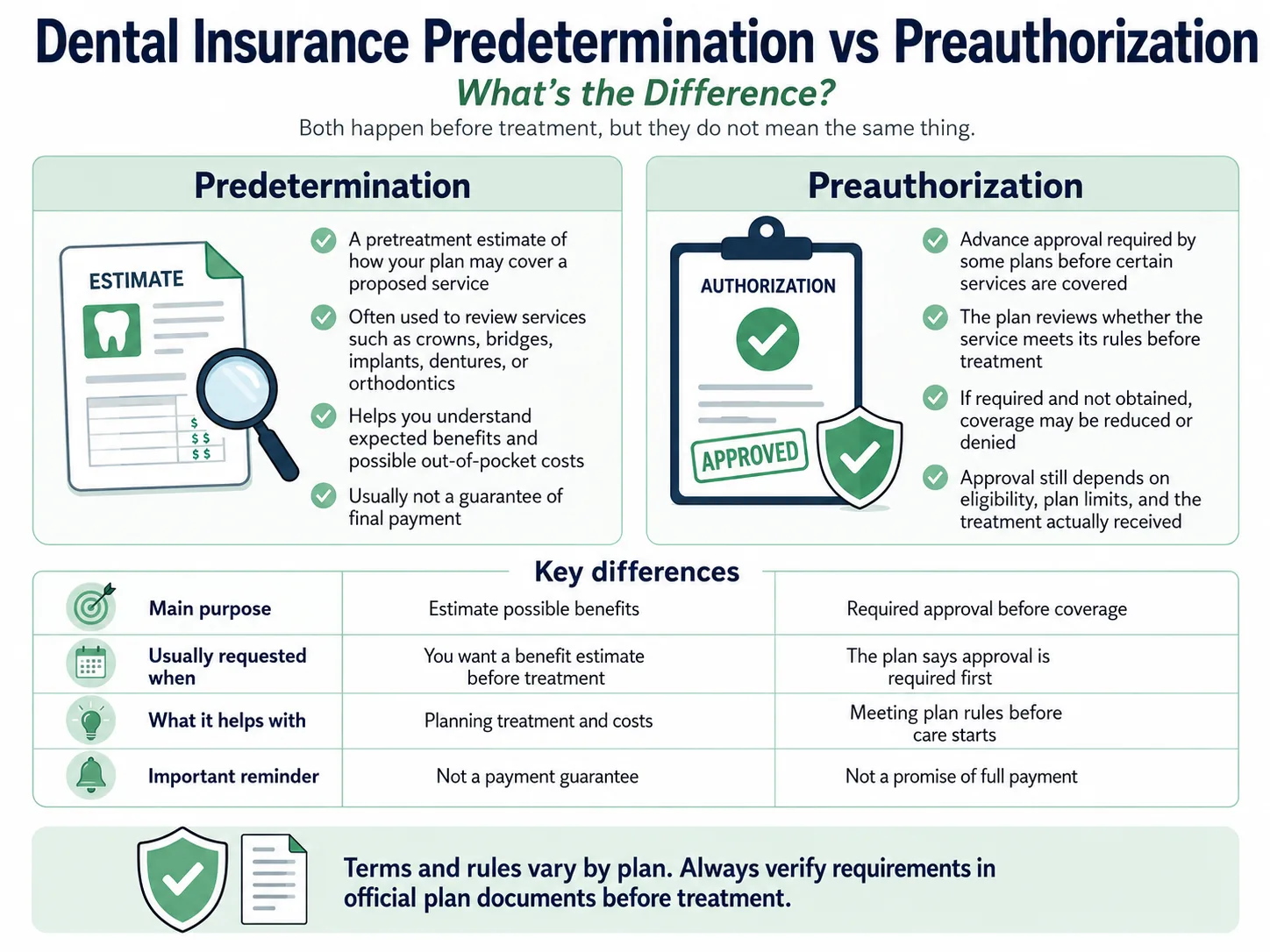
Predetermination and preauthorization both happen before dental treatment, but they serve different purposes. This infographic highlights the main differences and the plan details to verify before relying on either response.
What Is a Dental Predetermination?
A dental predetermination is a pretreatment benefit review based on the proposed dental treatment and the information submitted to the dental plan before the treatment is completed.
It may help show how the plan currently expects to apply its benefits to the proposed treatment.
Depending on the plan and the information submitted, a predetermination may help clarify:
- Whether the proposed service appears to be a covered benefit
- How the plan currently expects to apply relevant limitations or benefit rules
- The estimated plan benefit
- The estimated patient responsibility
- Whether additional information may be needed
However, a predetermination should not automatically be treated as a guarantee of final claim payment.
The final benefit can depend on factors such as:
- Eligibility when the service is provided
- The treatment actually performed
- The claim information submitted
- Available benefits at the time of claim processing
- Other applicable plan provisions
The key distinction is:
Predetermination provides pretreatment benefit information. It does not create a guaranteed final payment.
If the treatment changes after the predetermination is issued, or if eligibility or plan benefits change before the claim is processed, the final result may differ from the earlier response.
What Is Dental Preauthorization?
Dental preauthorization generally refers to a pretreatment review or approval process that a dental plan may require before certain services are provided.
The exact meaning and requirements can vary by plan.
Depending on the dental plan, preauthorization may be used to determine whether:
- A proposed service meets the plan’s requirements for prior approval
- Required clinical or administrative information has been submitted
- Specific benefit conditions have been addressed before treatment
- Additional documentation is needed before the plan completes its review
The important question is not only whether the process is called preauthorization.
Ask:
Does this dental plan require prior approval for this service, and what does that approval actually establish?
Even when preauthorization is granted, it should not automatically be treated as a guarantee of final claim payment.
Final benefits may still depend on factors such as:
- Eligibility when the service is provided
- The treatment actually performed
- The claim information submitted
- Available benefits
- Other applicable plan terms
The key distinction is:
Preauthorization may satisfy a required pretreatment approval step, but it does not eliminate the conditions that apply when the final claim is processed.
Predetermination vs Preauthorization: The Key Difference
| Question | Predetermination | Preauthorization |
|---|---|---|
| Main purpose | Provides advance benefit information about proposed treatment | Provides prior approval when the dental plan requires it |
| Is it always required? | Not necessarily | It may be required for certain services or under certain plans |
| What does the response mean? | Shows how the plan currently expects to apply benefits based on the information submitted | Shows whether the plan has approved the service under its pretreatment requirements |
| Does it guarantee final payment? | No | No |
| Can final benefits still change? | Yes | Yes |
| What should you verify? | What was estimated or explained and which assumptions were used | What was approved, which conditions apply, and whether anything else is required |
The terminology can vary by dental plan.
The most important question is not only what the process is called, but:
What does this specific pretreatment response actually establish under this plan?
Neither predetermination nor preauthorization should automatically be treated as a guarantee of final claim payment.
Why Dental Plans May Use Pretreatment Terms Differently
Dental-benefit documents may use several terms for processes that occur before treatment.
You may encounter:
- Predetermination
- Preauthorization
- Prior authorization
- Precertification
- Pre-treatment estimate
- Another plan-specific term
Do not assume that every payer uses these terms in exactly the same way.
Instead, verify three things.
Is the Process Required?
Do not assume that a pretreatment process is optional or required based only on whether the plan calls it a predetermination, preauthorization, or another similar term.
Requirements can vary by dental plan and by service.
Before treatment, verify:
- Whether pretreatment review is required
- Which services are subject to the requirement
- What must be submitted
- Whether approval must be obtained before treatment begins
- What happens under the plan if the required process is not completed
The key question is:
Does this specific plan require a pretreatment review for this service, and what must be completed before treatment?
Use the actual plan requirements rather than relying on the terminology alone.
What Does the Response Actually Determine?
Read the pretreatment response carefully to determine what the dental plan actually decided or estimated.
Depending on the process and plan, the response may address:
- Whether the proposed service appears eligible under current plan terms
- Whether a required prior-approval condition has been satisfied
- How the plan currently expects to calculate a benefit
- Whether additional information or documentation is needed
- Conditions that still apply before final claim payment
Do not interpret more into the response than it actually says.
The key question is:
What does this document confirm, and what does it leave unresolved?
A pretreatment response may provide useful information or satisfy a plan requirement without guaranteeing the final amount paid after treatment and claim processing.
What Can Still Change?
A pretreatment response is based on the information and coverage circumstances available when the dental plan reviews the proposed treatment.
Before the final claim is processed, some of those circumstances can change.
Examples can include:
- The patient’s eligibility
- Available dental benefits
- The treatment actually performed
- The information submitted with the final claim
- Other plan provisions relevant at the time of claim processing
That is why a favorable pretreatment response should not automatically be treated as a fixed promise of final payment.
The key distinction is:
A pretreatment response reflects the plan’s review at that point in time. Final claim payment depends on the circumstances and plan terms that apply when the claim is processed.
If something changes between pretreatment review and treatment, verify whether the earlier response still reflects the current situation.
What Can a Pretreatment Response Tell You?
A pretreatment response can provide useful information about how the dental plan currently expects to evaluate proposed treatment based on the information submitted.
Depending on the plan and the type of review, the response may help clarify:
- Whether the proposed service appears eligible under current plan terms
- Whether a required pretreatment step has been completed
- Which benefit category or plan provision the plan expects to apply
- How the plan currently estimates its benefit
- The estimated patient responsibility
- Whether an alternate-benefit provision may affect the calculation
- Whether additional documentation or information is needed
- Which assumptions or conditions the response is based on
The most useful approach is to read the response as a current pretreatment assessment, not as a final claim decision.
Ask:
What does this response actually tell me about the proposed treatment under my current coverage?
Then identify any conditions, assumptions, or unresolved questions before treatment begins.
A pretreatment response can reduce uncertainty, but its value depends on understanding exactly what the plan reviewed and what the response actually says.
What Does a Pretreatment Response Not Guarantee?
A predetermination or preauthorization should not automatically be treated as an unconditional guarantee of the final claim result.
Several things can change between advance review and claim processing.
Eligibility Can Change
A pretreatment response is based on the patient’s eligibility at the time the dental plan reviews the proposed treatment.
Eligibility can change before the service is provided or before the final claim is processed.
For example, coverage may end, employment status may change, or the patient may move to another dental plan.
The key distinction is:
Eligibility at pretreatment review does not guarantee eligibility when treatment is provided or the claim is processed.
If treatment will occur later, verify that coverage is still active and that the applicable eligibility requirements are still satisfied.
Available Benefits Can Change
A pretreatment response may estimate benefits based on the amount available when the plan reviews the proposed treatment.
That amount can change before the final claim is processed.
Other dental services may use part of the available benefit, or a new benefit period may begin.
The key distinction is:
An estimated benefit is based on the circumstances available at the time of review. It does not reserve the quoted amount for the future claim.
Before treatment, verify whether the available benefit information is still current.
The Treatment Can Change
The final treatment may differ from what was originally submitted for pretreatment review.
A different procedure, additional treatment, revised materials, or another change in the clinical plan can affect how the dental plan evaluates the final claim.
The key question is:
Does the treatment actually performed match the treatment the dental plan reviewed?
If the proposed treatment changes materially before it is completed, verify whether the dental plan needs updated information or another pretreatment review.
A response for one proposed treatment should not automatically be assumed to apply to a different final procedure.
Provider Information Can Change
A pretreatment response may be based on the provider information available when the dental plan reviews the proposed treatment.
That information can change before the service is completed or the final claim is processed.
For example, the treating dentist or specialist may change, or the provider’s network status under the plan may be different when treatment occurs.
The key question is:
Does the provider information used for the pretreatment review still match the provider who will perform the service?
If the provider changes, verify whether the earlier response still reflects the current situation.
A favorable pretreatment response should not automatically be assumed to apply unchanged when the provider information is different.
Other Plan Provisions Can Still Apply
A pretreatment response does not remove other dental plan rules that may affect the final benefit.
Depending on the procedure and the plan, those rules may involve:
- Waiting periods
- Frequency or replacement limitations
- Exclusions or other limitations
- Network or referral requirements
- Available benefits
- Other eligibility or benefit conditions
The key distinction is:
Pretreatment review answers the questions addressed by that review. It does not override other plan provisions.
Do not treat a favorable response as evidence that every other eligibility, limitation, or payment rule has been satisfied.
If another plan provision may affect the treatment, evaluate that rule separately.
How to Interpret Common Pretreatment Language
Read the wording of the response carefully rather than relying only on whether the document appears favorable.
| Wording you may see | What it may indicate | What it does not automatically mean |
|---|---|---|
| Eligible | The patient or service appears to meet the applicable eligibility conditions based on the information reviewed | Eligibility cannot change before treatment or final claim processing |
| Covered service | The proposed procedure appears to be a covered benefit under the current plan terms reviewed | The full dental-office charge will be paid or every other plan requirement has been satisfied |
| Estimated plan payment | The plan currently estimates a benefit for the proposed treatment based on the information reviewed | That exact amount is guaranteed when the final claim is processed |
| Estimated patient responsibility | The patient’s expected cost has been estimated using the information available at the time of review | The final dental-office bill or patient responsibility cannot change |
| Benefits remaining | Applicable benefits appear to be available at the time of the pretreatment review | Those benefits are reserved for this treatment or will still be available when the final claim is processed |
| Preauthorized | A required prior-approval process appears to have been completed under the applicable plan requirements | Every condition affecting the later claim has been permanently satisfied or final payment is guaranteed |
| Additional information required | More information or documentation is needed before the plan can complete its pretreatment review | The proposed treatment is automatically excluded, denied, or ineligible |
| Not covered | Based on the plan provisions applied to the request, the plan does not currently expect to provide a benefit for the proposed service or circumstance | The treatment is clinically unnecessary or should not be performed |
Read pretreatment wording in context rather than interpreting a single favorable or unfavorable term by itself.
Terms such as eligible, covered, estimated, preauthorized, or not covered describe specific parts of the plan’s review. They should not automatically be interpreted as a guarantee of final payment or as a clinical judgment about the treatment.
If a term is unclear, ask:
What does this wording mean under my specific dental plan, and what conditions still apply before the final claim is processed?
Is Advance Review Always Required?
No.
A dental plan may offer pretreatment review as an optional way to obtain benefit information before treatment, while another plan may require prior approval for certain services.
The requirement can depend on:
- The dental plan
- The service being proposed
- The type of pretreatment process
- Other conditions stated in the plan documents
Do not assume that a process is optional simply because it is described as a predetermination.
Likewise, do not assume that every service requires preauthorization.
Before treatment, verify:
- Whether advance review is optional or required
- Which services are subject to the requirement
- What must be submitted
- When the review must be completed
- What the plan says may happen if a required step is not completed
The key question is:
Does this specific dental plan require pretreatment approval for this service, or is the review being used only to provide advance benefit information?
Use the actual plan documents and written response rather than relying on the terminology alone.
What If Required Preauthorization Is Not Obtained?
If a dental plan requires preauthorization for a service and that step is not completed, do not assume that the result will be the same under every plan.
The consequences depend on the actual plan terms.
Depending on the coverage, failure to obtain required preauthorization may affect:
- Whether the service qualifies for a benefit
- How the claim is processed
- Whether additional review or documentation is required
- Whether the plan applies another limitation or condition
The key question is:
What does this specific dental plan say happens when required preauthorization is not obtained before treatment?
If treatment has not yet started, confirm the requirement with the dental plan before proceeding and determine what information must be submitted.
If treatment has already been provided, do not assume that preauthorization can simply be obtained retroactively or that the claim is automatically lost.
Instead, verify:
- Whether preauthorization was actually required for the service
- What provision the plan applied
- Whether the plan allows any additional or retrospective review
- What documentation may still be submitted
- How the final claim decision explains the effect of the missing preauthorization
Do not confuse failure to complete a required pretreatment step with a universal exclusion of the dental service itself.
The plan language controls.
If a final claim decision is unfavorable and you believe the plan requirement was applied incorrectly, use Dental Insurance Claim Denied? How to Review the Decision and Appeal for the separate review and appeal framework.
Predetermination vs Benefit Verification vs EOB
These processes occur at different stages and answer different questions.
| Process | When it generally occurs | What it helps explain |
|---|---|---|
| Benefit verification | Before treatment | Current eligibility and general benefit information |
| Predetermination | Before treatment | How current benefit information may apply to specific proposed treatment |
| Preauthorization | Before treatment | Whether a required prior-approval process has been completed under the applicable plan |
| Explanation of Benefits (EOB) | After a claim is processed | How the dental plan evaluated the actual submitted claim |
Benefit Verification
Benefit verification generally checks current information about a patient’s dental coverage.
Depending on the plan and the information requested, it may help confirm:
- Whether coverage appears active
- Whether the patient appears eligible
- Whether a particular benefit category exists
- Whether applicable benefits appear available
- Whether certain plan requirements or limitations may be relevant
Benefit verification does not automatically determine how the dental plan will process a specific proposed treatment.
The key distinction is:
Benefit verification checks current coverage information. It is not the same as a pretreatment review of a specific proposed procedure.
Eligibility and benefit information can also change before treatment or final claim processing.
Predetermination
Predetermination is a pretreatment review of a specific proposed dental treatment.
It may provide advance information about how the dental plan currently expects to apply its benefits to the treatment and information submitted.
Depending on the plan, the response may include an estimated plan benefit, estimated patient responsibility, or information about applicable benefit provisions.
The key distinction is:
Predetermination evaluates proposed treatment before the final claim is processed.
It should not automatically be treated as a guarantee of final payment.
Preauthorization
Preauthorization generally refers to a prior-approval process that a dental plan may require for certain services.
It answers a different practical question from ordinary benefit verification:
Has the plan’s required pretreatment approval process been completed for this service?
The exact meaning and requirements depend on the dental plan.
Even when preauthorization is granted, eligibility, available benefits, treatment performed, and other applicable plan provisions can still affect the final claim.
Preauthorization therefore should not automatically be interpreted as guaranteed payment.
Explanation of Benefits
An Explanation of Benefits, or EOB, comes after a dental claim has been processed.
It explains how the plan handled the submitted claim, including information such as:
- The service submitted
- The amount considered by the plan
- Plan payment
- Adjustments
- Patient responsibility
- Reasons or remarks associated with the claim decision
The key distinction is:
Predetermination and preauthorization occur before treatment or final claim processing. An EOB explains what happened after a claim was processed.
An EOB is not a pretreatment estimate and should not be interpreted as one.
For the full post-claim framework, read How to Read a Dental Insurance EOB: Payments, Adjustments, and Patient Responsibility.
For the broader process from treatment through claim submission, processing, and the EOB, read How Dental Insurance Claims Work: From Treatment to Your EOB.
Other Plan Rules That Can Affect Pretreatment Review
Predetermination and preauthorization do not operate separately from the rest of the dental plan.
Other provisions may still affect the information shown in the response or the later claim.
Eligibility and Benefits Remaining
A pretreatment response is based on the eligibility and benefit information available when the dental plan reviews the proposed treatment.
That information can change before treatment or final claim processing.
The key distinction is:
A favorable pretreatment response does not reserve eligibility or available benefits for a future claim.
Before treatment, verify that coverage remains active and that the applicable benefit information is still current.
Waiting Periods
A pretreatment response does not automatically override a waiting period.
A proposed service may appear to be part of the plan while the applicable benefit is not yet available because the waiting period has not been satisfied.
The key distinction is:
Pretreatment review evaluates the proposed treatment. A waiting period determines when an applicable benefit becomes available after coverage begins.
Verify the waiting-period rule separately.
For the full timing framework, read How Waiting Periods Work in Dental Coverage.
Exclusions and Limitations
Pretreatment review does not remove exclusions or limitations that apply under the dental plan.
A response may reflect one part of the benefit analysis while another exclusion, limitation, or condition still affects the final result.
The key principle is:
A pretreatment response should be read together with the plan provisions that apply to the proposed service.
For the broader restriction framework, read Dental Insurance Exclusions and Limitations: What to Check Before Enrolling.
Provider Network
A pretreatment response may be based on the provider information available when the plan reviews the request.
If the treating dentist or specialist changes, or if network status changes before treatment, the earlier estimate may no longer reflect the same benefit calculation.
The key question is:
Does the provider information used in the pretreatment review still match the provider who will perform the service?
For the full network framework, read In-Network vs Out-of-Network Dental Insurance.
Deductible and Cost Sharing
A pretreatment response may estimate patient responsibility using the cost-sharing information available at the time of review.
That estimate should not automatically be treated as the final amount the patient will owe.
Deductibles, copays, coinsurance, available benefits, provider status, and the treatment actually performed can affect the final calculation.
The key distinction is:
Pretreatment cost information is an estimate based on current assumptions, not a guaranteed final bill.
For the broader cost framework, read Dental Insurance Costs Explained.
What If Treatment or Coverage Changes?
A pretreatment response applies to the information that was submitted and reviewed.
If important circumstances change afterward, verify whether the earlier response still applies.
If the Treatment Changes
A pretreatment response is based on the treatment that was originally submitted for review.
If the proposed treatment changes before it is completed, the earlier response may no longer describe the treatment that will actually be provided.
Examples can include:
- A different procedure being recommended
- Additional treatment becoming necessary
- A change in the treatment plan
- Different materials or restorative options being selected
- Another clinically appropriate procedure replacing the one originally submitted
The key question is:
Does the treatment that will actually be performed still match the treatment reviewed by the dental plan?
If the treatment changes materially, ask whether updated information or a new pretreatment review should be submitted.
Do not assume that a favorable response for one proposed procedure automatically applies to a different final treatment.
If Dental Coverage Changes
A pretreatment response issued under one dental plan should not automatically be assumed to remain valid after coverage changes.
If new dental coverage begins before treatment is completed, verify:
- Which plan issued the earlier response
- Whether the treatment has already started
- What treatment remains unfinished
- When the old coverage ends
- When the new coverage becomes effective
- Whether the new plan requires its own pretreatment review
- Which plan provisions apply to the unfinished procedure
The key distinction is:
An earlier pretreatment response and eligibility under new dental coverage are separate questions.
Do not assume that a predetermination or preauthorization transfers automatically from one dental plan to another.
Coverage changes during unfinished dental care raise a separate set of questions about procedure dates, eligibility, and treatment already underway. Those issues are addressed in Dental Insurance and Treatment Already in Progress.
For the separate question of when the new coverage itself begins, read Dental Insurance Effective Date: When Does Coverage Start?
Pretreatment Review and Clinical Treatment Are Different Questions
A predetermination or preauthorization addresses how the dental plan evaluates proposed treatment under its benefit terms.
It does not determine whether the treatment is clinically appropriate.
The treating dental professional answers the clinical question:
What treatment is appropriate for the patient’s oral-health needs?
The dental plan answers a different question:
What benefit, if any, may the plan provide for that proposed treatment under its terms?
These decisions should remain separate.
A dental professional may recommend treatment even when the plan estimates a limited benefit or no benefit.
Likewise, a favorable pretreatment response does not determine which treatment is clinically preferable.
The key distinction is:
Clinical treatment decision = what care is appropriate. Pretreatment benefit review = how the dental plan may evaluate that care under its contract.
Questions to Ask Before Relying on a Pretreatment Response
Before relying on a predetermination, preauthorization, or other pretreatment response, confirm what the dental plan actually reviewed.
Ask the Dental Plan
Before relying on a pretreatment response, confirm exactly what the dental plan reviewed and what the response means.
Ask:
- Is this process optional or required for the proposed service?
- What treatment or procedure was reviewed?
- What does the response actually confirm?
- Is the amount shown an estimate or another type of benefit determination?
- What eligibility assumptions were used?
- What benefit information was current when the response was issued?
- Are any exclusions, limitations, waiting periods, or provider requirements still relevant?
- Could the response change if the treatment, provider, eligibility, or available benefits change?
- Does anything else need to be completed before treatment begins?
- Where in the official plan documents are these rules explained?
The most useful question is:
What does this pretreatment response establish, and what conditions still have to be satisfied before final claim payment can be determined?
Do not rely only on a favorable estimated amount or the word approved without understanding the conditions attached to the response.
Ask the Dental Office
The dental office can help confirm whether the treatment information submitted for review still matches the treatment currently planned.
Ask:
- What procedure or procedures were submitted for pretreatment review?
- Does the current treatment plan still match what was submitted?
- Has the treatment changed since the response was issued?
- Were any additional procedures, materials, or treatment stages added?
- Which provider is expected to perform the treatment?
- Has the dental plan requested additional clinical records or documentation?
- If the treatment changes, will updated information need to be submitted?
The key question is:
Does the treatment that will actually be performed still match the treatment the dental plan reviewed?
The dental office can confirm treatment details and records, but it should not be treated as the final authority on what the dental plan will pay.
The dental plan determines how its own benefit provisions apply.
How to Interpret a Pretreatment Response
A useful pretreatment review should help you separate what the dental plan actually reviewed, what the response confirms, what can still change, and what remains uncertain.
Review the response procedure by procedure rather than relying only on the total estimated amount.
The goal is not to turn a pretreatment response into a guarantee.
The goal is to understand exactly what information it provides before treatment.
1. What Was Reviewed?
Start by identifying exactly what the dental plan evaluated.
Confirm:
- Which procedure or procedures were submitted
- Which provider information was included
- What clinical or administrative documentation was reviewed
- Whether the treatment description still matches the current treatment plan
- Which coverage and benefit information was used
The key question is:
What specific treatment and information did the dental plan use to prepare this response?
Do not assume that the response applies to procedures, providers, or treatment changes that were not part of the original review.
If the pretreatment response includes several procedures from one treatment plan, read Does Dental Insurance Cover Major Dental Work? What to Check When Several Procedures Are Needed to see how those services can be reviewed individually and then considered together across providers, timing, and plan benefits.
2. What Does the Response Confirm?
Next, identify what the written response actually states.
Depending on the type of review, it may confirm or estimate information such as:
- Current eligibility
- Whether the proposed service appears covered
- An estimated plan benefit
- An estimated patient responsibility
- Whether a required preauthorization step has been completed
- Whether additional information is needed
- Which conditions or plan provisions were considered
Read the wording carefully.
The key question is:
What does this response explicitly confirm, and what am I adding only by assumption?
Do not interpret words such as eligible, covered, estimated, or preauthorized more broadly than the written response supports.
3. What Can Still Change?
A pretreatment response reflects the information and coverage circumstances available when the review was completed.
Before the final claim is processed, factors such as these may change:
- Eligibility
- Available benefits
- The treatment actually performed
- The treating provider
- Information submitted with the final claim
- Other applicable plan provisions
The key distinction is:
Pretreatment information describes the plan’s review at that point in time. It does not freeze every condition that may affect the later claim.
If an important circumstance changes before treatment, verify whether the earlier response still reflects the current situation.
4. What Is Not Confirmed?
Finally, identify the questions the pretreatment response does not resolve.
Depending on the situation, items that may remain unconfirmed include:
- Final claim payment
- Final patient responsibility
- Future eligibility
- Benefits that will still be available when the claim is processed
- The effect of treatment changes
- The effect of a provider change
- How another applicable plan provision may affect the final benefit
Mark unresolved items as Not confirmed rather than assuming the more favorable interpretation.
The central principle is:
Separate what was reviewed, what was confirmed, what can still change, and what remains unconfirmed.
A pretreatment response is most useful when it reduces uncertainty without being mistaken for a final claim decision.
Helpful Resources
- Dental Plans Guide
- How Dental Insurance Claims Work: From Treatment to Your EOB
- How to Read a Dental Insurance EOB: Payments, Adjustments, and Patient Responsibility
- Dental Insurance Claim Denied? How to Review the Decision and Appeal
- Dental Insurance and Treatment Already in Progress
- Dental Insurance Exclusions and Limitations: What to Check Before Enrolling
Frequently Asked Questions
What Is the Difference Between Dental Predetermination and Preauthorization?
A predetermination generally provides advance benefit information about proposed dental treatment.
Preauthorization generally refers to a prior-approval process that a dental plan may require for certain services.
However, terminology can vary by plan.
The most important question is:
What does this specific pretreatment process require, and what does the response actually establish under this plan?
Does a Dental Predetermination Guarantee Payment?
No.
A predetermination provides pretreatment benefit information based on the coverage, treatment, and other information reviewed at that time.
Final claim payment can still depend on eligibility, available benefits, the treatment actually performed, provider information, and other applicable plan provisions.
Does Preauthorization Guarantee That the Claim Will Be Paid?
No.
Preauthorization may satisfy a required prior-approval step, but it should not automatically be treated as a guarantee of final payment.
Other conditions can still affect the final claim.
Is Predetermination or Preauthorization Always Required?
No.
Some plans may offer pretreatment review as an optional way to obtain advance benefit information, while other plans may require prior approval for certain services.
Verify the requirement for the specific dental plan and proposed service rather than relying only on the terminology.
Can a Pretreatment Response Change Before Treatment Is Completed?
The earlier response itself may remain on record, but the circumstances affecting the eventual benefit can change.
For example, eligibility, available benefits, treatment, provider information, or other plan provisions may be different by the time the final claim is processed.
If an important circumstance changes, verify whether the earlier response still reflects the current situation.
What Happens If Required Preauthorization Was Not Obtained?
Do not assume that the result is the same under every dental plan.
Review the actual plan terms to determine:
Whether preauthorization was required
What consequence the plan applies when it is missing
Whether additional or retrospective review is available
What documentation may still be submitted
If a final claim decision is unfavorable and you believe the requirement was applied incorrectly, use Dental Insurance Claim Denied? How to Review the Decision and Appeal for the separate review framework.
How Is a Pretreatment Response Different From an EOB?
A pretreatment response is issued before treatment or final claim processing and provides information about proposed treatment.
An Explanation of Benefits, or EOB, is issued after a claim has been processed and explains how the dental plan handled the submitted claim.
The key distinction is:
Pretreatment response = advance information or approval. EOB = post-claim explanation.
For the full EOB framework, read How to Read a Dental Insurance EOB: Payments, Adjustments, and Patient Responsibility.
Sources
About the Author
Maria Dumitru is the Founder and Content Editor of Dental Coverage Hub. She researches and edits educational content designed to help U.S. consumers understand dental insurance terminology, benefit rules, pretreatment processes, and the information they may need to verify before dental care.
Learn more about our standards in the Editorial Policy and How We Review Dental Plans.
This article is for general educational purposes only. Predetermination, preauthorization, eligibility requirements, benefit estimates, and other pretreatment rules can vary by dental plan. Review the official documents for your coverage and contact the dental plan for information about the requirements that apply to specific treatment.

Understand What the Pretreatment Response Actually Means
A pretreatment response can reduce uncertainty before dental care, but it should not be treated as a guarantee of final payment. Understand what was reviewed, what the response confirms, what can still change, and what remains unresolved before relying on the estimated benefit.