
Dental Insurance Claim Denied? How to Review the Decision and Appeal

Learn how to review a denied, reduced, or unpaid dental claim, identify the reason, and determine whether the next step is correction, documentation, clarification, or a formal appeal.
Written and researched by Maria Dumitru.
Founder and Content Editor at Dental Coverage Hub
Last reviewed: August 2026
When a dental insurance claim is denied, reduced, or unpaid, the first question should not automatically be:
“How do I appeal?”
An unfavorable claim result can have different causes.
The dental plan may still need information. The claim may contain information that needs correction. A deductible or benefit limitation may have affected payment. A waiting period, exclusion, provider-network rule, or another plan provision may apply. In other situations, the plan may have completed its review and issued a final benefit decision that you believe should be reconsidered.
The most useful approach is:
Review first. Appeal second.
Before challenging the decision, determine:
- What happened to the claim
- Whether processing is complete
- The exact reason given by the dental plan
- Which plan provision or claim issue is involved
- Whether information is missing or incorrect
- Whether the next step is correction, documentation, clarification, or a formal appeal
If a formal appeal is appropriate, follow the procedure, submission method, documentation requirements, and deadline stated in your denial notice and controlling plan documents rather than relying on a generic online appeal process.
What You’ll Learn
This guide explains:
- How to determine whether a dental claim is actually ready for appeal
- How to identify the reason for an unfavorable benefit decision
- When a claim correction may be more appropriate than an appeal
- When additional documentation may still be needed
- When a formal dental insurance appeal may be appropriate
- How to respond to the specific reason given by the dental plan
- What documents may help support your request
- Which clinical information may need to come from the dentist or specialist
- How to follow the appeal procedure for your dental plan
- Why appeal procedures can vary by type of dental coverage
- What to check if the initial appeal does not change the decision
For the broader framework behind dental claims, benefits, limitations, and coverage rules, review the Dental Plans Guide.
Quick Answer
If your dental insurance claim was denied, reduced, or unpaid, do not appeal blindly.
Start with the EOB, denial notice, or other claim communication from the dental plan.
Identify the specific reason for the result and determine whether the claim has completed processing.
The issue may involve:
- Incorrect or incomplete claim information
- Missing documentation
- Eligibility or coverage timing
- A waiting period
- An annual benefit limit
- A frequency or replacement limitation
- An exclusion
- Provider-network information
- An alternate benefit or other processing rule
- Treatment timing
- Another dental plan
- A final unfavorable benefit decision
Different problems can require different responses.
An incorrect claim may need correction.
Missing records may need to be submitted before the dental plan completes its review.
A contractual limitation requires you to check the actual plan language and how it was applied.
A final benefit decision that you believe was applied incorrectly may require a formal appeal.
If a formal appeal is appropriate, use the deadline, submission method, documentation requirements, and review procedure stated in your denial notice and controlling plan documents rather than relying on a universal dental insurance appeal rule.
Key Takeaways
- A zero or unpaid dental claim does not automatically require a formal appeal
- First determine whether the dental plan has completed its review
- A returned or incomplete claim may require correction rather than an appeal
- A request for additional information may mean the claim is still pending
- Deductibles and annual benefit limits can reduce payment without making the treatment excluded
- Waiting periods, exclusions, frequency limitations, network rules, and other provisions are different types of claim issues
- Appeal the reason for the decision rather than only the amount the plan did not pay
- Supporting evidence should directly address the reason given by the dental plan
- Administrative records can often be gathered by the patient, while clinical documentation may need to come from the dentist or specialist
- A phone call may clarify the claim but should not automatically be treated as a substitute for the plan’s formal appeal procedure
- Do not assume every dental plan uses the same appeal deadline or number of review levels
- Filing an appeal does not guarantee that the original benefit decision will change
In This Guide
What to Do After a Dental Insurance Claim Denial
An unfavorable dental claim result does not always require the same response. Use this overview to identify whether the next step may involve claim correction, additional documentation, clarification, or a formal appeal.
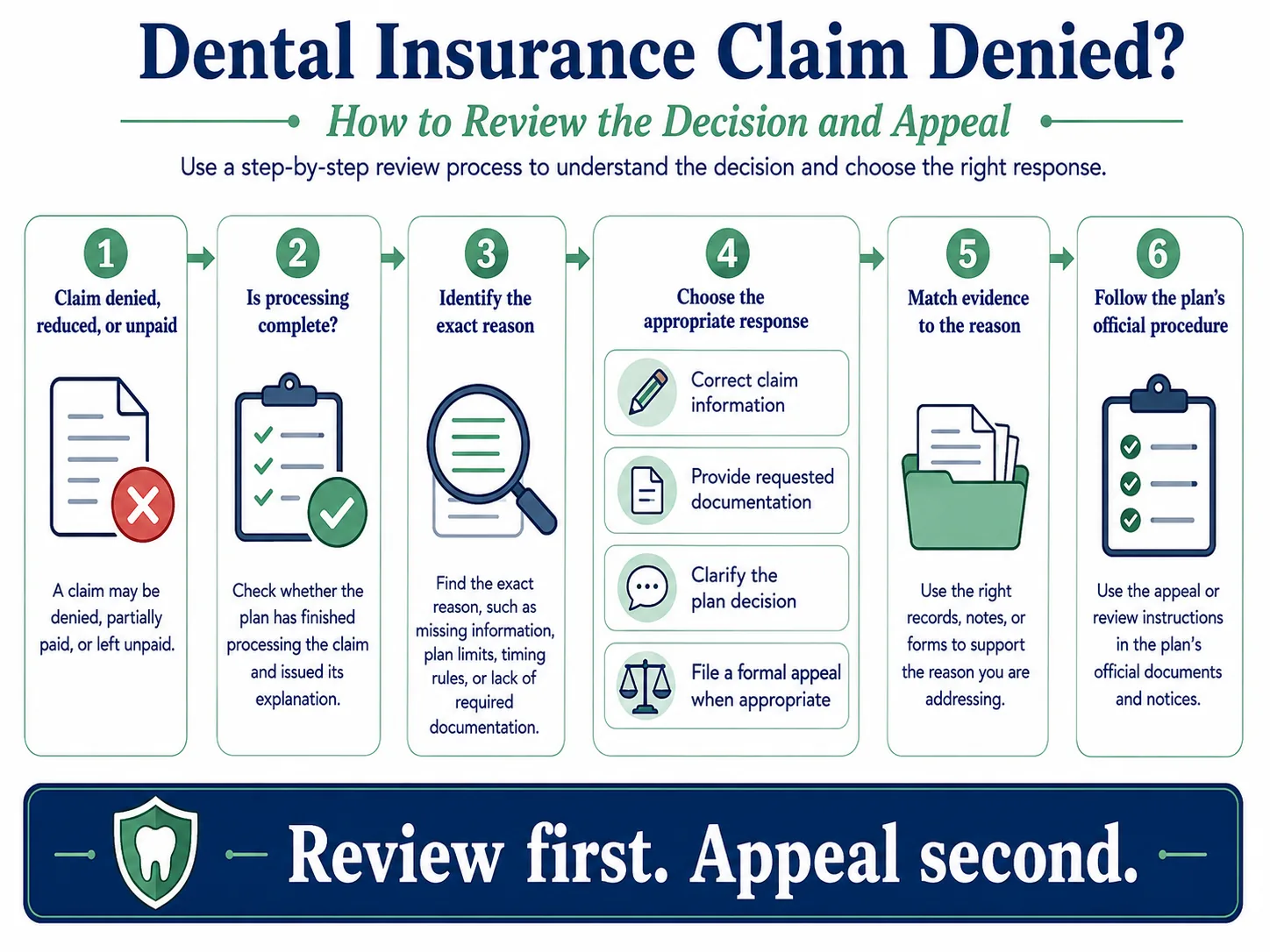
What Does a Dental Insurance Claim Denial Mean?
A dental insurance claim denial generally means the dental plan did not provide some or all of the benefit requested for one or more reported services under the information and plan provisions it applied.
But the word denied does not explain the reason by itself.
An unfavorable claim result may involve:
- Eligibility
- A waiting period
- An annual benefit limit
- A frequency or replacement limitation
- An exclusion
- Provider-network status
- Missing or incomplete documentation
- An alternate-benefit or other processing rule
- Another active dental plan
- Treatment timing
- Another applicable plan provision
In some situations, the dental plan may not yet have made a final benefit decision.
That is why the first question should be:
“What exactly happened to this claim?”
rather than:
“How do I appeal?”
If you are still trying to understand the amounts, remarks, or patient-responsibility information on the document itself, review How to Read a Dental Insurance EOB: Payments, Adjustments, and Patient Responsibility before deciding whether an appeal is necessary.
Is the Claim Actually Ready for an Appeal?
Not every unfavorable claim result represents a final decision.
Dental plans may use different terminology, so do not rely only on the status label.
Read the explanation associated with the claim and determine what stage the review has actually reached.
| Claim status | What it may mean | What to ask next |
|---|---|---|
| Returned or incomplete | Claim information may need correction or completion | Does the dental office need to submit a corrected or completed claim? |
| Additional information required | The dental plan may not have completed its review | What information is missing and who should provide it? |
| Reduced or partially paid | A plan provision affected the benefit | Which provision explains the reduction? |
| No benefit / unfavorable decision | The plan may have completed its review and provided no benefit under the stated rule | Is the decision final, and what review or appeal process applies? |
The distinction matters because a formal appeal may be unnecessary when the claim still needs to be corrected, completed, or supported with additional information.
Before preparing an appeal, determine whether the dental plan has actually issued a final benefit decision.
How to Interpret a Dental Claim Denial Before You Appeal
Do not decide whether to appeal from the payment amount alone.
Start with the reason given by the dental plan.
Different claim problems require different evidence and different next steps.
| What the EOB or notice indicates | What it may mean | What to verify before deciding what to do |
|---|---|---|
| Additional information needed | Claim review may not be complete | What information is missing, who must provide it, and whether the claim remains pending |
| Eligibility issue | The plan believes coverage was not active | Effective date, termination date, member information, and relevant service date |
| Waiting period | The benefit may not yet have been available | Effective date, treatment date, and exact waiting-period provision |
| Annual maximum reached | Available benefits may have been used | Applicable maximum, benefit period, and benefits already applied |
| Frequency limitation | The service may not meet a plan timing rule | Previous service dates and exact limitation |
| Replacement limitation | Earlier treatment may affect the current benefit | Treatment history, relevant dates, and applicable replacement provision |
| Non-covered or excluded service | The contract may not provide a benefit for the service | Exact exclusion, procedure classification, and any stated exception |
| Alternate benefit | The plan calculated benefits using another covered treatment option | Alternate-benefit provision and explanation on the claim |
| Bundling or downcoding | Benefit processing differs from the procedures reported | Submitted claim lines, EOB explanation, and applicable plan or processing rule |
| Provider-network issue | Provider status affected processing or payment | Exact provider, office location, network, and relevant service date |
| Treatment already in progress | Coverage timing may affect eligibility | Treatment stage, relevant dates, and applicable old/new plan provisions |
| Incorrect claim information | Administrative information may need correction | Whether a corrected claim rather than a formal appeal is required |
| Other insurance involved | Another dental plan may need to process first | Coordination-of-benefits instructions and current claim status |
Use the denial reason to determine what happens next.
Ask:
- What is the exact claim status?
- What reason did the dental plan provide?
- Which plan provision or information is involved?
- Is the claim still correctable or incomplete?
- What evidence directly addresses the stated reason?
- Is a formal appeal actually the next required step?
If an important fact cannot be verified, treat it as Not confirmed rather than assuming the more favorable interpretation applies.
The central principle is:
Review the reason first. Appeal only when the claim status and plan procedure make an appeal the appropriate next step.
Start With the EOB or Denial Notice
Before preparing an appeal, read the explanation associated with the affected claim or procedure.
Do not focus only on:
Plan payment: $0 or: Denied
Instead, identify:
- The affected procedure or claim line
- The current claim status
- Any remark or reference code
- The written explanation
- Any plan provision referenced
- Whether additional information is requested
- Whether the decision appears final
- Instructions for correction, reconsideration, or appeal
- Submission requirements
- The applicable deadline
- Contact information
The explanation matters because two claims with the same payment amount can require completely different responses.
If you are unsure what the amounts, adjustments, remarks, or patient-responsibility fields mean, review How to Read a Dental Insurance EOB: Payments, Adjustments, and Patient Responsibility before deciding what to do next.
Does the Claim Need Correction Instead of an Appeal?
Some unfavorable claim results are caused by inaccurate or incomplete claim information rather than by a disagreement over the dental plan’s benefit decision.
Examples may involve:
- Incorrect member information
- Incorrect provider information
- Incorrect date of service
- Missing required claim fields
- Missing tooth or treatment-area information when required
- Other administrative information that does not match the treatment or coverage
In those situations, the appropriate next step may be a corrected or completed claim rather than a formal appeal.
Ask the dental office or dental plan:
“Does this claim need to be corrected, completed, or formally appealed?”
Do not attempt to select or change CDT procedure codes yourself.
The dental provider is responsible for accurately reporting the treatment performed.
Your role as the patient is to notice information that appears inconsistent and ask the appropriate party to clarify or correct it.
Could Additional Documentation Resolve the Issue?
Some claims cannot be fully reviewed using the information initially submitted.
Depending on the treatment and the reason given by the dental plan, additional documentation may be requested.
Clinical information may include:
- Radiographs
- Clinical notes
- Periodontal charting
- Treatment history
- Replacement history
- Provider narrative
- Specialist records
- Other documentation relevant to the plan’s stated concern
If additional information is requested, first determine:
- What specific information is missing
- Why the information is being requested
- Who needs to provide it
- Where it should be submitted
- Whether the dental office has already responded
- Whether the claim remains pending
- Whether the plan will continue or repeat its review after receiving the information
Do not send unrelated records simply to make the submission larger.
The documentation should address the reason the dental plan actually identified.
A request for additional information does not automatically mean that a final claim denial has been issued.
When May a Formal Dental Insurance Appeal Be Appropriate?
A formal appeal may be appropriate when the dental plan has completed its benefit review and you believe the decision should be reconsidered under the applicable plan terms.
Examples may include situations in which you believe the plan:
- Used incorrect eligibility information
- Applied the wrong coverage or service date
- Used incorrect treatment or service history
- Applied a limitation incorrectly
- Used incorrect provider-network information
- Did not consider relevant documentation
- Classified the service incorrectly under the plan
- Applied an exclusion or another plan provision incorrectly
- Reached a benefit decision that does not appear consistent with the applicable plan language or available information
An appeal asks the dental plan to review its decision again.
It does not guarantee that the original decision will be reversed.
Before appealing, identify both:
“What specific decision am I challenging?”
and:
“Why do I believe that decision should be reviewed?”
Match Your Response to the Reason for the Decision
A useful response addresses the specific reason given by the dental plan.
Do not use the same argument or supporting evidence for every dental claim problem.
If Information Is Missing
Determine exactly what information is required and arrange for the appropriate person or dental office to provide it.
If the claim is still pending, a formal appeal may not yet be the necessary step.
If the Issue Is Eligibility or Coverage Timing
Verify:
- Coverage effective date
- Coverage termination date when relevant
- Member information
- Relevant service date
- Records showing active coverage when appropriate
The question is whether the correct eligibility and timing information was applied to the claim.
If the Issue Is a Waiting Period
Compare:
- Coverage effective date
- Relevant treatment date
- Exact waiting-period provision
The key question is whether the timing rule was applied correctly.
For the full explanation of these rules, review How Waiting Periods Work in Dental Coverage.
If the Issue Is the Annual Maximum
Verify:
- The applicable annual maximum
- The relevant benefit period
- Benefits already applied during that period
- Whether the claim was processed against the correct benefit period
Clinical evidence generally does not resolve an annual-maximum issue.
The relevant question is whether the available benefit was calculated correctly.
For the full mechanism, review Dental Insurance Annual Maximums Explained.
If the Issue Is Provider-Network Status
Verify:
- Treating dentist
- Specialist when applicable
- Exact office location
- Exact dental plan
- Exact provider network
- Provider status on the relevant service date
Do not rely only on a statement that the office “accepts” insurance from the same company.
For the broader network framework, review In-Network vs Out-of-Network Dental Insurance.
If the Issue Is an Exclusion or Limitation
Read the actual plan provision.
Determine:
- Whether the provision applies to the submitted service
- Whether the service was classified correctly
- Whether the relevant dates were applied correctly
- Whether the plan language contains an exception
- Whether the provision appears to have been applied as written
Clinical necessity does not automatically create insurance coverage when a contract clearly excludes a service.
However, whether the exclusion or limitation was applied correctly can still be reviewed.
For the broader framework, review Dental Insurance Exclusions and Limitations: What to Check Before Enrolling.
If the Issue Is a Benefit-Processing Rule
If the EOB refers to an alternate benefit, bundling, downcoding, or another processing rule, first identify exactly what the dental plan says it did.
Then determine whether your disagreement concerns:
- The applicable plan provision
- The procedure reported
- The information used by the plan
- The way the processing rule was applied
- Relevant clinical documentation
These benefit-processing decisions should not automatically be interpreted as judgments that the treatment was clinically inappropriate.
The central principle is:
Match the evidence to the reason for the decision.
What If the Decision Involves Clinical Documentation?
Some unfavorable benefit decisions involve clinical documentation or treatment criteria applied to the records submitted with the claim.
In those situations, the treating dentist or specialist may be important to the review.
The dental professional may be able to provide information addressing:
- Diagnosis
- Clinical findings
- Condition of the tooth or surrounding structures
- Treatment rationale
- Relevant treatment history
- Procedure details
- The specific concern identified by the dental plan
The patient should not be expected to create a clinical narrative independently.
When the plan’s concern involves clinical evidence, the treating dental professional is generally better positioned to provide the appropriate records or explanation.
Ask what specific documentation the dental plan needs before sending additional clinical information.
What Evidence Can Support an Appeal?
The goal is not to create the largest possible appeal packet.
The goal is to provide information that directly addresses the decision being challenged.
Documents You May Gather
Depending on the reason for the appeal, useful administrative or insurance records may include:
- EOB
- Denial notice
- Relevant dental-plan documents
- Claim information
- Dental-office statement
- Coverage information when eligibility is disputed
- A previous predetermination or preauthorization response when relevant
- Relevant correspondence with the dental plan
- Reference numbers or notes from relevant communications
Do not collect documents simply because they are available.
Ask:
“How does this document address the reason the dental plan gave?”
If it does not help answer that reason, it may not be useful to the appeal.
Information the Dental Office May Provide
When clinical or treatment information is relevant, the dental office may provide:
- Clinical notes
- Radiographs
- Intraoral images when relevant
- Periodontal charting
- Treatment history
- Procedure information
- Provider narrative
- Specialist records
- Other documentation requested by the dental plan
Again, the evidence should answer the specific issue.
If the disagreement concerns an annual maximum calculation, additional radiographs generally do not address that question.
If the dental plan says required clinical documentation is missing, clinical records may be directly relevant.
Match the evidence to the denial reason.
How to File a Dental Insurance Appeal
There is no single appeal procedure that should be applied to every dental plan.
Your denial notice and controlling plan documents should be the primary instructions.
Follow the Plan’s Appeal Instructions
Look for:
- Where the appeal should be submitted
- Whether the plan requires a specific form
- Whether an online portal or written submission method is provided
- What supporting documentation should be included
- The applicable deadline
- Whether another review level may be available
- How the plan will communicate its decision
Do not rely on a generic dental insurance appeal deadline found online.
Use the deadline and procedure stated for your specific coverage.
Identify the Decision You Are Challenging
Make it clear which claim and benefit decision you want the dental plan to review.
Follow the plan’s requirements for identifying the claim.
Depending on the plan, the requested information may include:
- Member information
- Claim number
- Date of service
- Dental provider
- Procedure involved
- Reason for the benefit decision
Provide only the identifying information the dental plan requires and use the plan’s designated submission method.
State What You Want Reviewed
Clearly identify the benefit decision you are asking the dental plan to reconsider.
Then explain why you believe that decision should be reviewed.
Connect the explanation to:
- The reason stated by the dental plan
- Relevant plan language
- Correct factual information
- Relevant supporting evidence
Include Relevant Supporting Evidence
Provide information that directly supports the issue being reviewed.
Avoid including unrelated records simply to make the submission appear more comprehensive.
Keep Records
Keep copies of:
- Appeal request
- Supporting documents submitted
- Submission confirmation
- Tracking or reference numbers
- Relevant correspondence
- Subsequent appeal decisions
These records can be useful if another review step becomes necessary.
Can a Phone Call Replace a Formal Appeal?
Do not assume that a phone call replaces the dental plan’s formal appeal procedure.
Calling the plan can still be useful for clarification.
You can ask:
- Is the claim fully processed?
- Is additional information still required?
- Does the claim need correction?
- Which plan provision was applied?
- Is this considered a final benefit decision?
- What formal review or appeal procedure applies?
- Where can I find the applicable deadline and submission instructions?
A customer-service conversation may help you understand the issue.
But if you intend to challenge a final benefit decision, follow the formal procedure stated in the denial notice and controlling plan documents.
Keep any reference number or relevant notes from the conversation.
Can Your Dentist Help With the Appeal?
Yes, the dental office may be able to help with parts of the claim review or appeal process.
Depending on the plan and issue, the dentist or office may be able to:
- Correct claim information
- Submit requested documentation
- Provide clinical records
- Provide a treatment narrative when appropriate
- Clarify the procedure reported
- Request reconsideration
- Assist with an appeal
- Act as an authorized representative when the dental plan permits it
The exact role can vary.
Ask the dental plan whether:
- The provider can submit information directly
- The provider can request reconsideration
- The provider can file or assist with an appeal
- You must authorize the dentist to act on your behalf
Even when you remain responsible for the formal member appeal, the dental professional may be the appropriate source for clinical evidence.
Keep the roles separate:
You can organize the claim decision, plan information, and administrative records.
The dental professional can provide clinical documentation when the denial reason requires it.
What If You Had a Predetermination or Preauthorization?
An earlier predetermination or preauthorization can be relevant when you review an unfavorable final claim result.
Compare:
- The treatment submitted for advance review
- The procedures the earlier response addressed
- What the response actually stated
- The treatment that was ultimately performed
- Eligibility when the service occurred
- Benefits available when the claim was processed
- Provider-network information
- Any other plan provision identified in the final claim decision
Do not treat the earlier response as an automatic guarantee of final payment.
A useful question is:
“What changed between the pretreatment response and the final claim decision?”
For the complete explanation of advance dental benefit review, see Dental Insurance Predetermination vs Preauthorization: What’s the Difference?
Other Denial Reasons That Need Separate Review
Some dental claim denials involve an underlying coverage rule that should be understood before you decide what belongs in an appeal.
If Coverage Changed During Treatment
If the claim involves dental treatment that began under one plan and continued after coverage changed, the dispute may depend on:
- Which procedure or treatment stage is involved
- Relevant treatment dates
- Eligibility
- The date each plan recognizes for the procedure
- Treatment-in-progress provisions
- Rules under the old and new plans
Do not assume that the new plan automatically takes responsibility for unfinished treatment or that the old plan automatically remains responsible.
For the complete framework, review Dental Insurance and Treatment Already in Progress: What to Check When Coverage Changes.
If an Existing Dental Problem Is Involved
If the claim decision refers to a condition, missing tooth, previous dental work, or another situation that existed before enrollment, review the exact plan language and relevant dates.
Do not assume that a general label such as “pre-existing condition” explains the decision by itself.
For the broader framework, review Dental Insurance and Existing Dental Problems: What to Check Before Enrolling.
If an Exclusion or Limitation Is Involved
Break the issue into three questions.
Does the rule actually apply?
Confirm that the exclusion or limitation appears in the applicable plan documents and relates to the service involved.
Was the rule applied correctly?
Check whether the plan used the correct:
- Procedure
- Relevant dates
- Treatment or replacement history
- Benefit period
- Provider information
- Eligibility information
Does the provision contain an applicable exception?
Read the actual plan language rather than assuming that a general limitation applies identically in every situation.
For the broader framework, review Dental Insurance Exclusions and Limitations: What to Check Before Enrolling.
If the EOB Shows an Alternate Benefit, Bundling, or Downcoding
These terms describe ways a dental plan may process or calculate benefits.
Before challenging the result, identify:
- What procedure the dental provider reported
- How the plan processed the claim
- What explanation appears on the EOB
- Which plan or processing provision was applied
- Whether relevant information appears incorrect or incomplete
Do not automatically interpret alternate benefits, bundling, or downcoding as statements that the dental treatment itself was inappropriate.
For detailed EOB interpretation, review How to Read a Dental Insurance EOB: Payments, Adjustments, and Patient Responsibility.
Clinical Treatment and Insurance Coverage Are Different Questions
A dental insurance appeal may involve both clinical information and insurance-contract rules, but those questions should remain separate.
The treating dental professional determines what care is clinically appropriate.
The dental plan determines how the applicable benefit contract applies to the claim.
A plan may provide reduced or no benefit because of:
- An exclusion
- A limitation
- A waiting period
- An annual maximum
- Provider-network rules
- Eligibility
- Another contractual provision
That does not automatically mean the treatment was clinically unnecessary.
At the same time, showing that treatment was clinically appropriate does not automatically create an insurance benefit when the applicable contract clearly excludes or limits the service.
If the disagreement involves a clinical criterion or documentation requirement, information from the dentist or specialist may be important.
If the disagreement involves a contractual benefit rule, the plan language and how the rule was applied may be more important.
The appeal should respond to the issue the dental plan actually identified.
Does the Appeal Process Depend on the Type of Dental Coverage?
It can.
Dental coverage can be structured in different ways, and the claims or appeal procedure that applies should be taken from the documents governing your actual coverage.
Do not assume that one appeal process, deadline, or number of review levels applies to every dental plan.
The denial notice and controlling plan documents should identify the procedure relevant to your coverage.
Employer-Sponsored Dental Coverage
If your dental coverage comes through an employer, review the claims and appeal procedure that applies to that specific plan.
Certain private-sector employer-sponsored plans may be subject to federal ERISA claims-review requirements.
Relevant documents may include:
- Summary Plan Description
- Benefits booklet
- EOB or denial notice
- Claims and appeal procedure
- Plan administrator information
Do not assume that every employer-sponsored dental arrangement follows exactly the same rules.
If you are unsure which claims procedure applies, contact the plan administrator or the entity identified in the governing plan documents.
Use those documents to verify:
- Appeal rights
- Submission requirements
- Applicable deadlines
- Available review levels
Individual or Family Dental Coverage
If you purchased dental insurance directly for yourself or your family, start with the dental policy, EOB or denial notice, and the insurer’s stated review procedure.
Do not assume that appeal rights associated with major medical insurance automatically apply in the same way to a separate dental policy.
Review sections dealing with:
- Claims
- Benefit determinations
- Reconsideration
- Appeals
- Complaints
- Grievances
Procedures can vary by policy, insurer, coverage structure, and applicable state requirements.
If dental benefits are part of another health plan rather than a separate dental policy, verify which claims and appeal procedure governs the dental benefit.
Use the process stated for your actual coverage rather than relying on a generic dental insurance appeal procedure.
What If the Appeal Is Denied Again?
If the dental plan upholds its original decision, read the new notice carefully.
Determine whether it identifies:
- Another internal review level
- A voluntary reconsideration process
- An external review option
- A complaint or grievance procedure
- Another escalation route
Do not assume that every dental plan provides the same number of appeal levels.
Do not assume that external review is available for every dental claim.
Instead, use the appeal decision and controlling plan documents to determine which options, if any, apply to your coverage.
If another review is available, compare the new decision with the original denial and determine whether the plan addressed the information or argument you submitted.
When May a State Insurance Department Be Relevant?
For certain state-regulated dental insurance policies, a state department of insurance or insurance commissioner may provide a consumer complaint process involving an insurer.
This is not the universal next step after every dental claim denial.
Before contacting a state insurance regulator, verify:
- Whether the coverage is regulated by the state
- Whether the issue falls within the regulator’s authority
- Whether the insurer’s applicable review process should be completed first
- Which claim and appeal documents are relevant
- What complaint process the state provides
Some employer-sponsored benefit arrangements may be governed primarily by federal rather than state insurance rules.
The National Association of Insurance Commissioners provides a directory of state insurance departments that can help you identify the appropriate state regulator.
What Not to Do After a Dental Claim Denial
Avoid several common mistakes.
Do Not Assume Every Unpaid Claim Needs an Appeal
The claim may need correction, additional information, or further processing instead.
Do Not Assume Every Denial Is an Error
Some unfavorable decisions correctly apply the dental contract.
Do Not Assume Every Denial Is Final
The claim may still be pending or waiting for information.
Do Not Appeal Without Reading the Reason
Evidence that does not address the stated reason may not help.
Do Not Rely on a Generic Online Deadline
Use the deadline stated in your denial notice and controlling plan documents.
Do Not Assume a Phone Call Is the Formal Appeal
Clarification and formal review are different steps.
Do Not Send Unrelated Clinical Records
Documentation should address the specific issue being reviewed.
Do Not Assume Clinical Necessity Overrides Every Contract Rule
Insurance coverage and clinical treatment are separate questions.
Do Not Assume an Appeal Guarantees Payment
An appeal asks the dental plan to reconsider its decision. It does not guarantee a different result.
How to Decide What to Do After a Dental Claim Denial
When a dental claim is denied, reduced, or unpaid, work through the issue in order.
1. Read the Claim Explanation
Identify the affected service, claim status, and reason given by the dental plan.
2. Determine Whether the Decision Is Final
Find out whether the claim is:
- Pending
- Waiting for information
- In need of correction
- Fully processed
- Subject to a final unfavorable benefit decision
3. Identify the Rule or Information Involved
Determine whether the issue involves:
- Eligibility
- Documentation
- Waiting period
- Annual maximum
- Provider-network status
- Exclusion or limitation
- Treatment timing
- Another processing or benefit rule
4. Decide What Type of Response Is Needed
The appropriate next step may be:
- Corrected claim
- Additional documentation
- Clarification
- Reconsideration
- Formal appeal
Do not treat these as interchangeable.
5. Match the Evidence to the Reason
Use administrative records when the issue concerns dates, eligibility, plan language, provider information, or claim details.
Use clinical documentation from the treating dental professional when the plan’s concern involves clinical evidence.
6. Follow the Official Procedure
If a formal appeal is appropriate, use the:
- Submission method
- Required form when applicable
- Deadline
- Documentation instructions
- Review procedure
stated for your dental coverage.
The central principle is:
Review first. Appeal second.
Understand the decision before deciding how to challenge it.
Helpful Resources
- Dental Plans Guide
- How Dental Insurance Claims Work: From Treatment to Your EOB
- How to Read a Dental Insurance EOB: Payments, Adjustments, and Patient Responsibility
- Dental Insurance Predetermination vs Preauthorization: What’s the Difference?
- Dental Insurance Exclusions and Limitations: What to Check Before Enrolling
- Dental Insurance and Existing Dental Problems: What to Check Before Enrolling
- Dental Insurance and Treatment Already in Progress: What to Check When Coverage Changes
- Dental Insurance Annual Maximums Explained
Frequently Asked Questions
Why was my dental insurance claim denied?
A dental plan may provide reduced or no benefit for different reasons, including eligibility, missing documentation, exclusions, limitations, provider-network rules, benefit timing, or another plan provision.
Start with the specific explanation on the EOB or denial notice rather than assuming that every unfavorable claim has the same cause.
Does zero dental insurance payment always mean the claim was denied?
No.
A zero payment may occur because:
The claim is still waiting for information
A deductible or benefit limit affected payment
Another dental plan is involved
A limitation or exclusion applies
Another plan provision resulted in no payment
Confirm the claim status and read the explanation before deciding whether a formal appeal is appropriate.
Should I appeal every dental insurance denial?
No.
Some claims need:
Correction
Additional documentation
Clarification
Further processing
Formal appeal
Confirm what happened to the claim and whether the benefit decision is final before choosing the next step.
How do I appeal a dental insurance denial?
Follow the appeal instructions in your denial notice and controlling plan documents.
Identify the decision being challenged, address the specific reason given by the dental plan, provide relevant supporting evidence, and use the submission method and deadline stated for your coverage.
How long do I have to appeal a dental insurance claim?
Do not rely on one universal dental insurance appeal deadline.
Review your:
Denial notice
Dental policy or benefits documents
Summary Plan Description when applicable
Official claims and appeal procedure
Use the deadline stated for your specific coverage.
Can my dentist help with a dental insurance appeal?
Yes, depending on the dental plan and issue.
The dental office may be able to:
Correct claim information
Provide clinical documentation
Submit requested records
Request reconsideration
Assist with an appeal
Act as an authorized representative when permitted
Ask the plan what the provider may submit and whether your authorization is required.
What documents should I include in a dental insurance appeal?
Include documents that directly address the reason for the decision.
Depending on the issue, relevant records may include:
EOB
Denial notice
Plan documents
Claim information
Coverage records
Previous predetermination or preauthorization
Relevant correspondence
Clinical documentation such as radiographs, treatment notes, or provider narratives may need to come from the treating dental professional when the denial reason involves clinical evidence.
What happens if my dental insurance appeal is denied?
Read the appeal decision and controlling plan documents to determine whether another review, complaint, or escalation option applies.
Depending on the coverage, there may be another internal review, a voluntary process, an external review option, a complaint or grievance procedure, or another available route.
Do not assume that every dental plan provides the same appeal levels or external review rights.
Sources
- American Dental Association — Dental Insurance Frequently Asked Questions
- American Dental Association — Explanation of Benefits Statement
- American Dental Association — ADA Position on Explanation of Benefits
- U.S. Department of Labor — Filing a Claim for Your Health Benefits
- National Association of Insurance Commissioners — How to File a Complaint
- National Association of Insurance Commissioners — State Insurance Departments
About the Author
Maria Dumitru is the Founder and Content Editor of Dental Coverage Hub. She researches and edits educational content designed to help U.S. consumers understand dental insurance claim decisions, appeal procedures, benefit limitations, and the information they may need to review when a dental claim is reduced or denied.
Learn more about our standards in the Editorial Policy and How We Review Dental Plans.
This article provides general educational information and is not dental, medical, legal, financial, employment-benefits, or personalized insurance advice. Dental claim procedures, denial reasons, eligibility rules, benefit limitations, provider networks, documentation requirements, appeal rights, appeal deadlines, review levels, complaint procedures, state regulatory authority, and expected patient costs can vary by plan, coverage type, provider, procedure, service date, state, and individual circumstances. Review the controlling plan documents, denial notice, and official appeal procedure for your specific coverage.
This article does not determine whether dental treatment is clinically appropriate, necessary, correctly diagnosed, or properly performed. Questions about diagnosis, treatment options, urgency, or clinical care should be discussed with a qualified dental professional.

Understand the Decision Before You Appeal
A dental claim denial can involve a correctable claim issue, missing documentation, a benefit limitation, or a final decision that may be eligible for formal review. Start with the claim status and the exact reason given by the dental plan, then match your response and supporting evidence to that issue.