

How Dental Insurance Claims Work: From Treatment to Your EOB
Learn how a dental claim moves from treatment and submission through plan review, benefit decisions, and the Explanation of Benefits, or EOB.
Written and researched by Maria Dumitru.
Founder and Content Editor at Dental Coverage Hub
Last reviewed: August 2026
Understanding how dental insurance claims work can make it easier to follow what happens after treatment and why the final benefit may differ from what you expected.
After dental treatment, a dental plan does not simply look at the dentist’s charge and automatically pay a percentage of it.
The treatment must first be reported through a dental claim, and the plan then reviews that claim under the applicable benefit rules.
The basic process is:
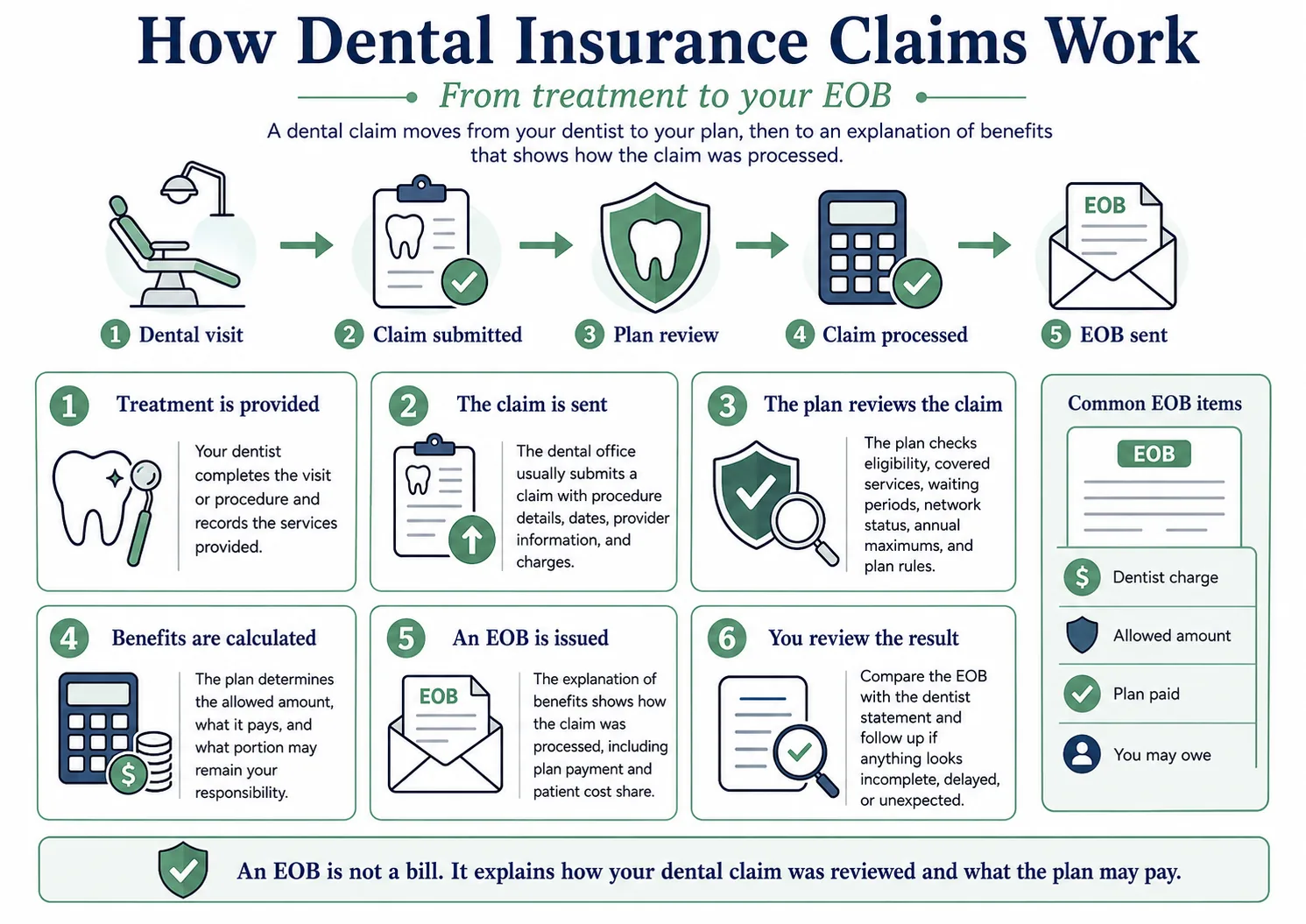
Treatment → Claim Submission → Plan Review → Benefit Decision → EOB
The dental office, or in some situations the patient, submits information about the services that were provided. The plan reviews the reported treatment, applies the applicable benefit provisions, and determines what benefit, if any, is payable.
After the claim is processed, the plan generally provides an Explanation of Benefits, or EOB, explaining how the submitted services were handled.
Understanding this process can help explain why:
- A claim can be submitted without being approved yet
- The dentist’s charge may differ from the amount used to calculate benefits
- Additional information may be required before processing is complete
- A covered service can still leave patient responsibility
- A reduced or unpaid benefit should be interpreted by its reason
- An EOB is not the same as a dental bill
This guide follows the claim from the treatment you received through the benefit decision shown on the EOB.
What You’ll Learn
In this guide, you’ll learn:
- What a dental insurance claim is and what information it may contain
- How a claim moves from treatment and submission through plan review
- What dental claim adjudication means
- What the dental plan may review before reaching a benefit decision
- Why a submitted claim does not automatically mean a service is approved
- What it means when a claim is pending or more information is requested
- How the EOB fits into the claim process
- How to distinguish a reduced benefit, no benefit, and a final adverse decision
- What to check if something on the claim appears incorrect
Quick Answer
A dental insurance claim is a request for a dental plan to process benefits for services that were provided.
The claim generally includes information about the patient, dental provider, procedures, dates of service, charges, and other details needed for review.
After the claim is submitted, the dental plan evaluates it under the applicable coverage and benefit provisions. This review is often called claim adjudication.
The plan may pay a benefit, apply cost-sharing or other plan rules, request additional information, reduce the benefit, or determine that no benefit applies.
After processing, the plan typically issues an Explanation of Benefits, or EOB, explaining how the claim was handled.
The key distinction is:
The claim requests benefit processing. The dental plan adjudicates the claim. The EOB explains the result.
A submitted claim does not by itself guarantee payment or coverage.
Key Takeaways
- A dental claim reports actual dental services and requests benefit processing from the dental plan.
- Claim submission does not mean that the service has been approved or that a benefit is guaranteed.
- During adjudication, the plan may review eligibility, procedures, plan provisions, provider information, benefit limits, and supporting documentation.
- A claim may remain pending if the plan needs additional information before completing its review.
- A reduced benefit does not necessarily mean that the entire claim was denied.
- The EOB explains how the dental plan processed the claim; it is not the same as a bill from the dental office.
- If claim information appears incorrect, verify what was submitted before assuming the benefit decision itself is wrong.
- A final adverse decision should be distinguished from a pending claim or request for additional information.
In This Guide
How a Dental Insurance Claim Moves From Treatment to EOB
A dental claim moves through several stages after treatment. This infographic shows the basic path from claim submission and plan review to the benefit decision and Explanation of Benefits.
What Is a Dental Insurance Claim?
A dental insurance claim is a request submitted to a dental plan so the plan can evaluate dental services under the applicable coverage.
A claim generally identifies the patient, dental provider, services performed, relevant treatment dates, charges, and other information the plan may need to process the request.
Depending on the treatment and the dental plan, additional clinical or administrative documentation may also be required.
The claim does not determine the benefit by itself.
Instead, it gives the dental plan information it uses to evaluate questions such as:
- Was the patient eligible for coverage?
- Is the submitted service addressed by the plan?
- Do any exclusions, limitations, or other benefit rules apply?
- What amount, if any, is payable under the plan?
- What amount may remain the patient’s responsibility?
The key distinction is:
The claim is the request for benefit processing. The EOB explains how the dental plan processed that request.
A submitted claim should therefore not be confused with an approval, payment guarantee, or final benefit decision.
What Information Can Be Included in a Dental Claim?
A dental claim contains information the dental plan uses to identify the patient, provider, services performed, and circumstances relevant to benefit processing.
Depending on the claim and the dental plan, information may include:
- Patient and subscriber information
- Dental provider information
- Dates of service
- The dental procedures performed
- CDT procedure codes
- Tooth numbers, surfaces, or other procedure-specific details when applicable
- Fees charged for the submitted services
- Information about other dental coverage when relevant
- Prior treatment or placement information when required
- Supporting clinical or administrative documentation
Additional documentation may be needed for some services.
Examples can include:
- Radiographs or other diagnostic images
- Clinical notes
- Periodontal charting
- Treatment narratives
- Information about prior dental work
- Other records requested by the dental plan
The exact information required depends on the procedure and the plan.
The key principle is:
The dental plan can process the claim only from the information submitted and the records available to support it.
If required information is missing or unclear, the claim may require additional review before a final benefit decision can be made.
That does not automatically mean the service is excluded or that the claim has been permanently denied.
What Are CDT Codes?
CDT codes are standardized dental procedure codes used to identify dental services on claims and other dental records.
They help communicate what procedure was reported to the dental plan.
A CDT code can help the plan identify the service being submitted, but the code alone does not determine whether the service will receive a benefit.
The dental plan may still evaluate:
- Whether the patient was eligible
- Whether the service is addressed by the plan
- The date the service was performed
- Applicable exclusions or limitations
- Frequency or replacement provisions
- Supporting documentation
- Other benefit conditions
The key distinction is:
CDT code = identifies the dental procedure submitted. Coverage decision = how the dental plan applies its benefit terms to that procedure and claim.
If a claim appears to contain an incorrect procedure or coding issue, confirm the submitted information with the dental office rather than trying to select or change a CDT code yourself.
For consumers, the important question is:
Does the claim accurately reflect the dental service that was actually performed?
How the Dental Insurance Claim Process Works
The easiest way to understand a dental insurance claim is to follow the process from treatment through the plan’s benefit decision.
A simplified sequence is:
Treatment → Claim Preparation → Claim Submission → Plan Review → Benefit Decision → EOB
Each stage answers a different question.
A claim being prepared or submitted does not mean that the dental plan has approved the service or determined the final benefit.
Step 1 — Treatment Is Provided and Documented
The claim process begins with the dental services that were actually provided.
The dental office documents information relevant to the treatment, which may include:
- Procedures performed
- Dates of service
- Teeth or surfaces involved when applicable
- Clinical findings
- Provider information
- Supporting records relevant to the procedure
The claim should reflect the treatment that actually occurred.
The key principle is:
Treatment facts come first. Claim information should accurately represent those facts.
This becomes especially important when treatment changes from what was originally planned or when several procedures are part of the same course of care.
Step 2 — The Claim Is Prepared
After treatment, the dental claim is prepared using the information needed for benefit processing.
Depending on the procedure and plan, the claim may include:
- Patient and subscriber information
- Dental provider information
- Dates of service
- Procedures and CDT codes
- Fees
- Procedure-specific information
- Other dental coverage when relevant
- Supporting documentation when required
The goal is to give the dental plan enough accurate information to evaluate the submitted services under the applicable coverage.
Preparing the claim is an administrative step.
It does not determine whether the plan will provide a benefit.
One Course of Treatment Can Involve More Than One Claim
A patient may think of several procedures as one course of dental treatment, but insurance claims may report those procedures separately.
For example, clinically related care can involve:
- Different procedures
- Different dates of service
- Different CDT codes
- Separate claim submissions
- Separate benefit decisions
The key distinction is:
One clinical treatment plan does not necessarily equal one insurance claim.
This is especially important with multi-stage care or when separate procedures occur on different dates.
Review each submitted procedure and claim on its own rather than assuming that one insurance decision automatically applies to the entire course of treatment.
Step 3 — The Claim Is Submitted
Once prepared, the claim is submitted to the dental plan for processing.
Depending on the situation, submission may be handled by the dental office or through another process permitted by the plan.
At this point, the dental plan receives the request and the information supplied with it.
The important distinction is:
Submission starts the plan’s review. It is not the benefit decision itself.
If required information is missing, the claim may need additional documentation or follow-up before processing can be completed.
Claim Submitted Does Not Mean Claim Approved
A submitted claim is a request for the dental plan to evaluate benefits.
It does not mean that:
- The service has been approved
- The submitted charge will be paid in full
- A benefit is guaranteed
- Every plan requirement has been satisfied
- The patient responsibility is already final
The dental plan still has to review the claim under the applicable coverage.
The key distinction is:
Submitted = received for processing. Approved or payable = determined only after the plan completes its review.
Do not treat a claim confirmation or submission status as a final benefit decision.
Step 4 — The Dental Plan Reviews the Claim
The dental plan evaluates the submitted claim under the applicable coverage and benefit provisions.
Depending on the claim, the review may consider information such as:
- Patient eligibility
- Procedures submitted
- Dates of service
- Applicable benefits
- Exclusions or limitations
- Frequency or replacement provisions
- Provider or network information
- Available benefits
- Supporting documentation
- Other relevant plan conditions
If additional information is needed, the plan may request more documentation before completing its review.
The key principle is:
The plan applies its benefit rules to the actual claim information submitted.
A request for additional information should not automatically be interpreted as a final denial.
Step 5 — The Plan Makes a Benefit Decision
After reviewing the claim, the dental plan determines how the submitted services are processed under the applicable coverage.
The result may include:
- A plan payment
- Patient responsibility
- Adjustments
- Reduced or no benefit for a submitted service
- A request or indication that additional information is needed
- Reasons or remarks explaining how the claim was processed
The plan then communicates the claim-processing result, typically through an Explanation of Benefits.
The key distinction is:
Claim processing produces the benefit decision. The EOB explains that decision.
This article focuses on how the claim reaches that point.
For the separate framework on interpreting the resulting document, read How to Read a Dental Insurance EOB: Payments, Adjustments, and Patient Responsibility.
What Does Dental Claim Adjudication Mean?
Dental claim adjudication is the process in which a dental plan reviews a submitted claim and applies its coverage and benefit rules to determine the claim result.
During adjudication, the plan may evaluate information such as:
- Patient eligibility
- Procedures and dates of service
- Applicable benefits
- Exclusions or limitations
- Provider or network information
- Available benefits
- Supporting documentation
- Other relevant plan provisions
The result of adjudication may include a plan payment, patient responsibility, an adjustment, a request for additional information, or reduced or no benefit for a submitted service.
The key distinction is:
Claim adjudication = the plan’s review and benefit determination. The EOB = the document that explains the result of that adjudication.
Adjudication does not mean that every submitted service will receive a benefit.
It means the dental plan has evaluated the claim under the applicable coverage terms.
What the Dental Plan May Review
Different claims can require different types of review.
The following are common areas that may affect how a dental claim is processed.
Eligibility
The dental plan may review whether the patient was eligible for coverage on the relevant date of service.
Eligibility can depend on the plan, coverage period, and other applicable enrollment or benefit conditions.
The key question is:
Was the patient eligible under the applicable dental coverage when the submitted service occurred?
Eligibility is only one part of claim adjudication.
A patient can be eligible for coverage while a specific submitted service is still affected by another plan provision.
Reported Procedures and Applicable Benefits
The dental plan reviews the procedures reported on the claim and determines how they relate to the benefits available under the plan.
This may include reviewing:
- The procedures and CDT codes submitted
- Dates of service
- Procedure-specific information
- The benefit category that may apply
- Relevant exclusions or limitations
- Frequency, replacement, or other service-specific provisions when applicable
The key distinction is:
The claim reports what was performed. The dental plan determines how its benefit terms apply to the reported service.
A submitted procedure code does not by itself guarantee a benefit.
Deductible, Cost Sharing, and Benefit Limits
After determining how the submitted service is treated under the plan, the dental plan may apply financial provisions that affect the benefit calculation.
Depending on the coverage, these can include:
- Deductibles
- Copays
- Coinsurance
- Annual maximums or other benefit limits
- Other applicable cost-sharing provisions
The key distinction is:
Eligibility and coverage determine whether a benefit may apply. Cost-sharing and benefit limits help determine how that benefit is calculated.
Do not use an available annual maximum or favorable coinsurance percentage as evidence that the submitted service is automatically eligible.
Provider and Network Information
The dental plan may also review information about the dentist or specialist associated with the claim.
Depending on the plan, provider or network status can affect:
- The amount the plan recognizes for the service
- Cost-sharing
- Whether referral or provider requirements apply
- How the claim is processed
The key question is:
How does this plan treat the submitted service when it is provided by this dentist or specialist?
Provider status is separate from whether the dental service itself is generally addressed by the plan.
For the full network framework, read In-Network vs Out-of-Network Dental Insurance.
Documentation and Other Plan Provisions
Some claims require additional information before the dental plan can complete its review.
Depending on the service and the plan, the dental plan may consider:
- Clinical notes
- Radiographs or other diagnostic images
- Treatment narratives
- Prior treatment or placement information
- Other documentation relevant to the submitted service
- Additional plan provisions that affect benefit eligibility or payment
A request for documentation does not automatically mean that the claim has been denied.
The key principle is:
The plan needs enough information to apply the relevant benefit provisions to the actual claim.
If additional information is requested, identify what is missing and whether the dental office or another source can provide it.
What Happens After the Claim Is Processed?
After the dental plan completes its review, it communicates the claim result.
That result may include:
- A plan payment
- Patient responsibility
- Adjustments
- Reduced or no benefit for a submitted service
- A request for additional information
- Reasons or remarks explaining how the claim was processed
The dental plan typically communicates this information through an Explanation of Benefits, or EOB.
The key distinction is:
Claim processing produces the benefit result. The EOB explains that result.
The EOB can help you see:
- What service was submitted
- How the plan evaluated it
- What amount the plan paid, if any
- What amount may be assigned to the patient
- Whether a plan rule affected the result
This article focuses on how the claim reaches that stage.
For the full framework on interpreting the EOB itself, read How to Read a Dental Insurance EOB: Payments, Adjustments, and Patient Responsibility.
An EOB Is Not a Bill
An Explanation of Benefits, or EOB, is not the same as a bill from the dental office.
The EOB explains how the dental plan processed the submitted claim.
It may show information such as:
- The service submitted
- The amount considered by the plan
- Plan payment
- Adjustments
- Patient responsibility
- Reasons or remarks associated with the claim result
The dental office may send a separate statement or bill.
The amount on that bill should be reviewed in the context of the EOB, provider agreement, payments already made, and any other applicable adjustments.
The key distinction is:
EOB = explanation of claim processing. Dental bill = amount the dental office says remains due.
Do not assume that every amount shown as patient responsibility on an EOB is automatically the final amount you should pay without comparing it with the dental office’s statement.
For the full EOB interpretation framework, read How to Read a Dental Insurance EOB: Payments, Adjustments, and Patient Responsibility.
Predetermination vs Claim vs EOB
| Stage | When it occurs | Main purpose |
|---|---|---|
| Predetermination or preauthorization | Generally before treatment | Reviews proposed treatment under applicable plan rules before the actual claim is processed |
| Dental claim | Generally after services are provided | Reports actual services and requests benefit processing under the dental plan |
| Explanation of Benefits | After claim processing | Explains how the dental plan processed the actual claim |
These stages answer different questions.
Predetermination or preauthorization looks ahead to proposed treatment. A claim reports treatment that was actually provided. The EOB explains how the dental plan processed that claim.
A pretreatment response should not be treated as the same thing as a final claim decision.
For a detailed explanation of pretreatment review, read Dental Insurance Predetermination vs Preauthorization: What’s the Difference?
What If the Plan Needs More Information?
Sometimes a dental plan cannot complete claim processing with the information initially submitted.
The plan may request additional documentation or clarification before making a final benefit decision.
Depending on the claim, the requested information may include:
- Clinical notes
- Radiographs or other diagnostic images
- Treatment narratives
- Procedure-specific details
- Prior treatment or placement information
- Information about other dental coverage
- Clarification of submitted claim information
A request for additional information does not automatically mean that the claim has been denied.
The claim may remain pending while the plan waits for the information needed to continue its review.
The key distinction is:
Additional information requested = claim processing is not complete. Final adverse decision = the plan has completed its review and determined that no benefit or a reduced benefit applies.
If additional information is requested, identify exactly what the plan is asking for and whether the dental office, patient, or another source is expected to provide it.
What If the Claim Is Reduced or Receives No Benefit?
A claim that does not result in the expected payment can have different meanings.
Before treating the result as a denial, identify whether the claim is still being processed, whether more information is needed, whether a plan rule reduced the benefit, or whether the plan has reached a final adverse decision.
The key question is:
Is the claim still in process, or has the dental plan completed its review?
Claim Still Pending
A pending claim has not yet reached a final benefit decision.
The dental plan may still be reviewing the submitted information, waiting for additional documentation, or completing another step in claim processing.
A pending status should not automatically be interpreted as:
- An approval
- A denial
- A final patient responsibility amount
- A completed benefit determination
The key distinction is:
Pending = claim processing is not complete.
Before taking further action, confirm what the current status means and whether anything is still required.
Additional Information Requested
A dental plan may need more information before it can complete claim processing.
The request may involve clinical records, radiographs, treatment details, prior placement information, other coverage information, or clarification of something already submitted.
The key distinction is:
Additional information requested = the plan needs more information to continue or complete its review.
This is not automatically the same as a final denial.
Identify what information is being requested and who is expected to provide it.
Benefit Reduced by a Plan Rule
A claim can be processed successfully while the benefit is still lower than expected.
A plan rule may affect the amount payable even when the submitted service is recognized under the coverage.
Examples may include:
- Deductibles
- Coinsurance or copays
- Annual maximums or other benefit limits
- Frequency provisions
- Replacement provisions
- Network-related rules
- Other exclusions or limitations
The key distinction is:
A reduced benefit does not necessarily mean that the claim itself was rejected.
Review the reason associated with the reduction before deciding what the result means.
No Benefit or Final Adverse Decision
In some cases, the dental plan completes its review and determines that no benefit applies to a submitted service, or reaches another unfavorable final decision.
The explanation should be reviewed carefully to identify:
- What service was affected
- What reason or plan provision was cited
- Whether the information on the claim appears correct
- Whether additional clarification or documentation may be relevant
- What review or appeal information the plan provides
The key distinction is:
A final adverse decision is different from a claim that is still pending or waiting for more information.
Do not assume that every unfavorable result has the same cause or requires the same next step.
If the dental plan has made a final unfavorable decision, read Dental Insurance Claim Denied? How to Review the Decision and Appeal for the separate review and appeal framework.
Benefit Decisions and Clinical Treatment Are Different Questions
A dental plan’s benefit decision and a dentist’s clinical treatment recommendation answer different questions.
The dental plan evaluates whether and how a submitted service is addressed under the applicable coverage.
The treating dentist evaluates the patient’s oral health, diagnosis, treatment options, and clinical needs.
The key distinction is:
Insurance benefit decision = how the plan applies its coverage terms. Clinical treatment decision = what the dental professional recommends based on the patient’s care needs.
A service can be clinically recommended even when the dental plan provides a reduced benefit or no benefit for that service.
Likewise, a service receiving a benefit does not by itself determine whether that treatment is clinically necessary or appropriate for a particular patient.
When reviewing a claim result, keep the insurance question and the clinical question separate.
What If Something on the Claim Looks Wrong?
If information on a dental claim appears incorrect, identify the specific item before assuming that the dental plan made an incorrect benefit decision.
Review information such as:
- Patient or subscriber details
- Dental provider information
- Dates of service
- Procedures reported
- Tooth numbers or surfaces when applicable
- Charges
- Other coverage information
If the issue appears to involve information submitted by the dental office, contact the office and ask whether the claim accurately reflects the treatment that was provided.
If the claim information is correct but the plan result still appears inconsistent with the coverage, review the explanation associated with the claim decision.
The key distinction is:
Incorrect claim information is a submission issue. Disagreement with how correct information was processed is a benefit-decision issue.
Correcting inaccurate claim information and challenging a benefit decision are not necessarily the same process.
If the dental plan has issued an unfavorable final decision and the claim information appears accurate, see Dental Insurance Claim Denied? How to Review the Decision and Appeal.
Special Situations That Can Affect Claim Processing
Some circumstances add another layer to the basic dental claim process.
More Than One Dental Plan
If a patient has more than one dental plan, claim processing may involve coordination between the plans.
One plan may process the claim first and another may evaluate whether any additional benefit is available under its own rules.
The key distinction is:
Having two dental plans does not automatically mean that both plans will pay the same claim or that every remaining balance will be covered.
The order of benefit processing and the method used by the plans can affect the final result.
For the full framework, read Can You Have Two Dental Insurance Plans? Coordination of Benefits Explained.
Coverage Changes During Treatment
Claim processing can become more complex when dental coverage changes before a course of treatment is complete.
Different procedures or treatment stages may occur under different coverage periods, and the relevant claim may depend on the actual dates and services involved.
The key distinction is:
A change in dental coverage does not necessarily mean that the new plan will evaluate every part of an unfinished treatment the same way.
Review the treatment stages, dates of service, and the plan provisions that apply to each remaining procedure.
For the full framework, read Dental Insurance and Treatment Already in Progress.
How to Interpret a Dental Claim Result
A dental claim result is easier to understand when you review it in a consistent order.
Start with the services that were submitted, then identify the claim status, review the reason for the result, and determine whether anything needs clarification.
The goal is not to assume what happened from the payment amount alone.
Instead, work through these four questions.
1. What Was Submitted?
Start by confirming what the dental plan actually received for processing.
Review information such as:
- The dental service or procedure
- Date of service
- Provider
- CDT code when shown
- Tooth or surface information when applicable
- Submitted charge
Compare the claim information with the treatment that was actually provided.
The key question is:
Does the claim accurately represent the dental service that occurred?
If something appears incorrect, clarify the submitted information before assuming the benefit decision itself is wrong.
2. What Is the Claim Status?
Next, determine whether claim processing is complete.
The claim may be:
- Still pending
- Waiting for additional information
- Processed with a benefit
- Processed with a reduced benefit
- Processed with no benefit
- Subject to another final claim result
The key distinction is:
Do not interpret an incomplete claim as though it were a final decision.
If the claim is still pending or more information has been requested, identify what must happen before processing can be completed.
3. Why Did the Plan Reach That Result?
Once the claim status is clear, identify the reason the dental plan gives for the result.
Depending on the claim, the explanation may involve:
- Eligibility
- Applicable benefits
- Deductible or cost sharing
- Annual maximums or other benefit limits
- Frequency provisions
- Replacement provisions
- Provider or network rules
- Exclusions or limitations
- Missing documentation
- Another applicable plan provision
The key question is:
Which specific plan rule or claim-processing reason affected this result?
Avoid assuming that a reduced payment or no payment always means the same thing.
Different claim results can arise from very different plan provisions.
4. Does Anything Need Clarification?
After reviewing the submitted information, claim status, and stated reason, identify anything that still does not make sense.
Clarification may be needed if:
- The claim information appears inaccurate
- A requested document appears to be missing
- The stated reason does not match the plan language you reviewed
- The claim is still pending without a clear next step
- The patient responsibility appears inconsistent with the available information
- You do not understand the explanation provided by the dental plan
Depending on the issue, clarification may come from the dental office, the dental plan, or both.
The key principle is:
First identify what needs clarification. Then determine whether the issue involves claim information, claim processing, or the plan’s benefit decision.
If the plan has issued an unfavorable final decision and the claim information appears accurate, see Dental Insurance Claim Denied? How to Review the Decision and Appeal.
If the main question is how to interpret payments, adjustments, or patient responsibility on the EOB, read How to Read a Dental Insurance EOB: Payments, Adjustments, and Patient Responsibility.
Helpful Resources
- How to Read a Dental Insurance EOB: Payments, Adjustments, and Patient Responsibility
- Dental Insurance Claim Denied? How to Review the Decision and Appeal
- Dental Insurance Predetermination vs Preauthorization: What’s the Difference?
- Can You Have Two Dental Insurance Plans? Coordination of Benefits Explained
- Dental Insurance and Treatment Already in Progress
- Dental Insurance Exclusions and Limitations: What to Check Before Enrolling
- Dental Plans Guide
Frequently Asked Questions
What is a dental insurance claim?
A dental insurance claim is a request submitted to a dental plan so the plan can evaluate dental services under the applicable coverage.
The claim generally includes information about the patient, provider, procedures, dates of service, charges, and other details needed for benefit processing.
Submitting a claim does not guarantee that the dental plan will provide a benefit.
Who submits a dental insurance claim?
In many situations, the dental office submits the claim to the dental plan on the patient’s behalf.
However, the exact submission process can depend on the provider, plan, and circumstances.
If you are unsure whether a claim has been submitted, confirm with the dental office and the dental plan.
How long does it take a dental insurance claim to be processed?
Dental claim processing times can vary by plan, claim type, procedure, documentation, and whether additional information is required.
If a claim remains pending, check the current claim status and whether the dental plan is waiting for information from the dental office, the patient, or another source.
Does a submitted dental claim mean the service is approved ?
No.
A submitted claim means the dental plan has received a request for benefit processing.
The plan still needs to review the claim and apply the applicable coverage and benefit provisions before reaching a final result.
What does it mean when a dental claim is pending?
A pending claim has not yet reached a final benefit decision.
The plan may still be reviewing the information submitted, waiting for additional documentation, or completing another processing step.
A pending status is not the same as an approval or a denial.
Why would a dental plan ask for more information?
A dental plan may request additional information when the original claim does not contain everything needed to complete benefit review.
Depending on the service, the plan may request clinical notes, radiographs, treatment details, prior treatment information, other coverage information, or clarification of submitted claim data.
A request for more information does not automatically mean the claim has been denied.
What is dental claim adjudication?
Dental claim adjudication is the process in which a dental plan reviews a submitted claim and applies its coverage and benefit rules to determine the claim result.
The result may include a plan payment, patient responsibility, an adjustment, a request for more information, or reduced or no benefit for a submitted service.
Is an EOB the same as a dental bill?
No.
An Explanation of Benefits explains how the dental plan processed the claim.
A dental bill or statement comes from the dental office and shows what the office says remains due.
For a detailed explanation of EOB payments, adjustments, and patient responsibility, read How to Read a Dental Insurance EOB: Payments, Adjustments, and Patient Responsibility.
What should I do if something on the dental claim looks wrong?
First identify the specific information that appears incorrect, such as the date of service, procedure, provider information, tooth information, or charge.
If the issue appears to involve information submitted by the dental office, ask the office whether the claim accurately reflects the treatment that was provided.
Correcting inaccurate claim information is not necessarily the same as appealing a benefit decision.
What should I do if a dental claim receives no benefit?
First determine whether the claim is still pending, whether additional information has been requested, or whether the dental plan has completed its review.
If the plan has issued a final unfavorable decision, review the reason provided and the plan language that may apply.
For a step-by-step review framework, read Dental Insurance Claim Denied? How to Review the Decision and Appeal.
Sources
- American Dental Association — ADA Dental Claim Form
- American Dental Association — CDT Code
- American Dental Association — Explanation of Benefits Statement
- American Dental Association — Eligibility Verification
- American Dental Association — Glossary of Dental Terms
About the Author
Maria Dumitru is the Founder and Content Editor of Dental Coverage Hub. She researches and edits educational content designed to help U.S. consumers understand dental insurance terminology, claim processes, benefit decisions, and the information they may need to review after dental treatment.
Learn more about our standards in the Editorial Policy and How We Review Dental Plans.
This article provides general educational information and is not dental, medical, legal, financial, or personalized insurance advice. Dental claim procedures, eligibility rules, covered services, deductibles, copays, coinsurance, annual maximums, provider networks, exclusions, limitations, documentation requirements, coordination-of-benefits rules, claim decisions, appeal rights, and expected patient costs can vary by plan, provider, procedure, service date, state, and individual circumstances. Review the controlling plan documents and contact the applicable dental plan or plan administrator for information about your specific coverage.
This article does not determine whether dental treatment is clinically appropriate, necessary, correctly diagnosed, or properly performed. Questions about diagnosis, treatment options, urgency, or clinical care should be discussed with a qualified dental professional.

Understand the Rules Behind Dental Claim Processing
Dental claims are easier to understand when you separate treatment, claim submission, plan review, and the final benefit result. Before relying on a claim outcome, confirm what was submitted, whether processing is complete, and which plan provisions affected the result.