
How to Read a Dental Insurance EOB: Payments, Adjustments, and Patient Responsibility
Learning how to read a dental insurance EOB can make it easier to understand what the plan paid, what was adjusted, and what amount was assigned to patient responsibility.
Written and researched by Maria Dumitru.
Founder and Content Editor at Dental Coverage Hub
Last reviewed: September 2026
A dental Explanation of Benefits, or EOB, can be confusing when several amounts and explanations appear on the same claim.
You may see the dentist’s submitted charge, a different amount recognized by the dental plan, a deductible, an adjustment, a plan payment, patient responsibility, and remarks explaining how the claim was processed.
The most important point to understand first is:
A dental EOB is not a bill.
It is a statement from the dental plan explaining how a claim was processed after the reported services were reviewed.
The patient-responsibility amount shown on the EOB should therefore be read in the context of the entire claim decision and compared with the dental-office statement before you assume that a balance is final.
It is also important not to interpret every reduced or zero plan payment the same way.
A claim line can show little or no plan payment for different reasons, including cost sharing, available benefit limits, additional information requirements, another dental plan, an exclusion or limitation, or another applicable plan provision.
The payment amount tells you what happened financially.
The explanation helps tell you why.
This guide shows you how to read those pieces together.
What You’ll Learn
In this guide, you’ll learn:
- What a dental insurance EOB is and what it is designed to explain
- Why an EOB is different from a bill from the dental office
- How to review an EOB line by line
- What submitted or billed amounts may represent
- What allowed or plan amounts may mean
- How deductibles and other cost-sharing may appear
- How to identify the amount paid by the dental plan
- How to interpret patient responsibility
- Why adjustments can affect the amounts shown
- How remark or reference codes can help explain a claim result
- What to check when an EOB does not match what you expected
Quick Answer
A dental insurance Explanation of Benefits, or EOB, is a document that explains how a dental plan processed a claim.
It can show the services submitted, amounts charged, amounts recognized by the plan, adjustments, deductible or cost-sharing amounts, plan payment, patient responsibility, and reasons associated with the claim result.
An EOB is not the same as a bill from the dental office.
The key distinction is:
The claim tells the dental plan what was submitted for processing. The EOB explains how the plan processed that claim. The dental bill shows what the provider says remains due.
Read the EOB by comparing each service line, the amounts shown, the plan’s payment, the stated patient responsibility, and any remarks or explanations before deciding what the result means.
Key Takeaways
- An EOB explains how a dental plan processed a claim; it is not a bill.
- Review each service line rather than relying only on the total amount shown.
- The submitted or billed amount and the amount recognized by the dental plan may be different.
- Deductibles, copays, coinsurance, benefit limits, network provisions, or other plan rules can affect the claim result.
- Plan payment and patient responsibility should be interpreted together with adjustments and the applicable plan terms.
- A zero or reduced plan payment does not always mean the same thing; review the stated reason before drawing a conclusion.
- Remark or reference codes can help explain why a service was processed in a particular way.
- Compare the EOB with the dental office’s statement before assuming that the EOB patient-responsibility amount is the final amount you owe.
- If the claim information appears correct but the final benefit decision still seems inconsistent with the plan, review the stated reason before considering further action.
In This Guide
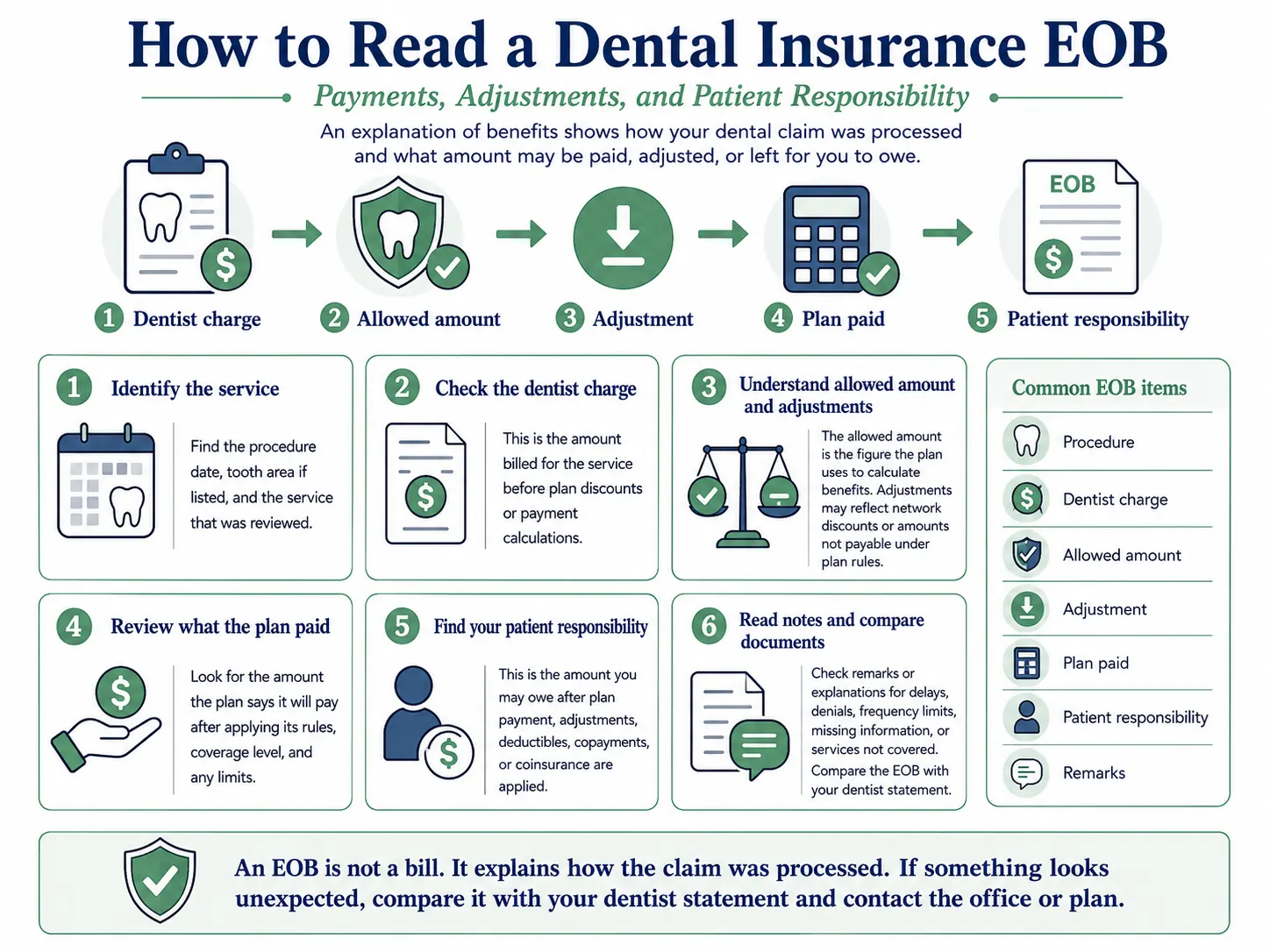
How to Read a Dental Insurance EOB at a Glance
A dental EOB combines several parts of a processed claim. Use this overview to identify the submitted charge, plan allowance, deductible, plan payment, patient responsibility, and the remarks that help explain the result.
What Is a Dental Insurance EOB?
A dental insurance Explanation of Benefits, or EOB, is a document that explains how a dental plan processed a submitted claim.
Depending on the plan and claim, the EOB may show:
- The patient and dental provider
- The services or procedures submitted
- Dates of service
- The amount billed or submitted
- The amount recognized by the dental plan
- Adjustments
- Deductible or other cost-sharing amounts
- The amount paid by the dental plan
- Patient responsibility
- Remarks, reference codes, or explanations related to the claim result
The EOB helps you understand how the dental plan applied its benefit terms to the submitted claim.
The key distinction is:
The EOB explains the dental plan’s claim-processing result. It does not, by itself, function as a bill from the dental office.
An EOB can also help you identify whether a claim was paid, reduced, affected by a plan rule, or processed with no benefit.
Because EOB formats vary by dental plan, focus on the meaning of each field and service line rather than expecting every EOB to use identical labels.
Why an EOB Is Not a Dental Bill
A dental EOB and a dental bill can refer to the same treatment, but they serve different purposes.
The EOB explains how the dental plan processed the claim.
The bill or statement comes from the dental provider and reflects what the provider says remains due after payments, adjustments, and other applicable amounts are considered.
The key distinction is:
EOB = explanation from the dental plan. Bill = payment request or account statement from the dental provider.
The EOB Comes From the Dental Plan
The Explanation of Benefits is issued by the dental plan after claim processing.
It may show:
- Services submitted
- Amounts billed or submitted
- Amounts recognized by the plan
- Adjustments
- Deductible or cost-sharing amounts
- Plan payment
- Patient responsibility
- Remarks or reasons associated with the claim result
The EOB helps explain how the plan applied its coverage terms to the claim.
It is not a request for payment from the dental plan.
The Bill Comes From the Dental Provider
A dental bill or account statement comes from the dental office or other dental provider.
It may reflect:
- The provider’s charges
- Payments already received
- Plan payments
- Contractual or other adjustments
- Amounts previously paid by the patient
- Any remaining balance the provider says is due
The amount on the provider’s bill may not always match the patient-responsibility amount shown on an EOB at the moment you first receive it.
Timing, later adjustments, corrected claims, additional plan processing, or provider posting can affect what appears on each document.
The key principle is:
Compare the EOB and the provider statement before assuming that either document alone tells the full payment story.
How to Read a Dental Insurance EOB Line by Line
| EOB field | What it may tell you | What not to assume |
|---|---|---|
| Procedure / date of service | What service was reported and when it was reported as provided | The procedure description alone determines whether a benefit applies |
| Submitted or billed amount | The charge reported by the dental provider for the service | The dental plan necessarily calculates benefits from the full submitted charge |
| Allowed amount / plan allowance | The amount the plan recognizes or uses when applying its benefit and cost-sharing rules | It must equal the dental provider’s submitted charge |
| Adjustment | An amount that was treated differently because of a plan, network, benefit, or claim-processing rule | Every adjustment automatically becomes patient responsibility |
| Deductible applied | The portion of an applicable amount assigned to the deductible under the plan | The procedure was denied or received no benefit |
| Plan payment | The amount the dental plan paid or assigned as its benefit for that claim line | A zero plan payment automatically means the claim was finally denied |
| Patient responsibility | The amount the EOB assigns to the patient after that claim was processed | The EOB amount is automatically the final amount the dental office will bill |
| Remark / reference code | Information that helps explain why the claim line was processed in a particular way | The explanation can be ignored if the payment amount looks reasonable |
EOB labels and layouts can vary by dental plan, but the same basic reading principle applies: review each service line, understand what each amount represents, and read the associated remarks before interpreting the result.
Do not rely on a single number—especially plan payment or patient responsibility—without considering the other fields on the same claim line.
What Does the Submitted or Billed Amount Mean?
The submitted or billed amount is the charge the dental provider reports for a service on the claim.
It is the provider’s reported charge for that service before the dental plan applies its own benefit, network, cost-sharing, or other claim-processing rules.
The submitted amount does not automatically tell you:
- What amount the dental plan will recognize for benefit purposes
- What the dental plan will pay
- What amount will be assigned to the patient
- Whether the service is covered under the plan
The key distinction is:
Submitted or billed amount = the provider’s reported charge. It is not automatically the amount used to calculate the dental benefit.
When reading an EOB, compare the submitted amount with the allowed or plan amount, any adjustments, the plan payment, and the stated patient responsibility.
A difference between the submitted amount and another amount on the EOB does not, by itself, tell you whether the claim was processed incorrectly.
What Does the Allowed or Plan Amount Mean?
An allowed amount, plan amount, plan allowance, or similarly labeled amount generally refers to the amount the dental plan recognizes when applying its benefit and cost-sharing rules to a submitted service.
This amount may be different from the dental provider’s submitted or billed charge.
Depending on the plan and provider relationship, the amount may be influenced by:
- Network agreements
- The plan’s fee or allowance methodology
- The type of dental service
- Other applicable plan provisions
The key distinction is:
Submitted amount = what the provider reported. Allowed or plan amount = the amount the dental plan recognizes or uses when applying its benefit rules.
The difference between these amounts does not automatically become patient responsibility.
To understand what the patient may actually owe, review the allowed amount together with:
- Adjustments
- Deductible
- Copay or coinsurance
- Plan payment
- Patient responsibility
- Any remarks or explanation codes
Because terminology and calculation methods can vary by dental plan, use the definitions and explanations provided with the actual EOB and plan documents.
What Does Deductible Applied Mean?
“Deductible applied” generally means that part of the amount recognized by the dental plan was assigned to the patient’s deductible under the plan.
A deductible is an amount the patient may need to satisfy before certain plan benefits are paid, depending on the terms of the coverage.
If an amount is applied to the deductible, the EOB may show that the dental plan paid less for that service or did not issue a payment for that portion.
The key distinction is:
Deductible applied = part of the claim amount was assigned to the deductible. It does not automatically mean the service was denied.
When reviewing this field, look at:
- The amount applied to the deductible
- Whether other cost-sharing also applies
- The plan payment
- Patient responsibility
- Any remarks or explanations associated with the claim line
The exact deductible rules can vary by plan, including which services are subject to the deductible and how the deductible is applied.
Do not assume that a zero plan payment means the claim was denied if the EOB shows that the amount was assigned to the deductible or affected by another plan provision.
What Does Plan Payment Mean?
Plan payment is the amount the dental plan pays or assigns as its benefit for a submitted claim line after applying the relevant coverage and benefit rules.
The amount may be affected by factors such as:
- The allowed or plan amount
- Deductible
- Copay or coinsurance
- Annual maximums or other benefit limits
- Network provisions
- Frequency or replacement provisions
- Other applicable exclusions or limitations
The key distinction is:
Plan payment = the amount the dental plan pays for the processed claim line. It does not, by itself, explain why that amount was reached.
A zero plan payment does not automatically mean the claim was finally denied.
For example, the EOB may show that:
- The deductible applied
- The claim is still pending
- Additional information is needed
- A benefit limit affected the result
- Another plan provision reduced or eliminated payment
Always review the payment amount together with the patient responsibility, adjustments, and any associated remarks or explanation codes.
What Does Patient Responsibility Mean?
Patient responsibility is the amount the EOB assigns to the patient after the dental plan processes the claim.
Depending on the claim and plan, patient responsibility may include amounts related to:
- Deductible
- Copays
- Coinsurance
- Noncovered services
- Benefit limits
- Network-related rules
- Other applicable plan provisions
The key distinction is:
Patient responsibility on the EOB is the amount assigned to the patient through that claim adjudication. It is not automatically the same as the final dental-office bill.
Before assuming the amount is final, compare the EOB with the dental provider’s statement and review:
- Plan payment
- Adjustments
- Amounts already paid by the patient
- Any later claim corrections or reprocessing
- Network or contractual adjustments when applicable
If the dental office’s bill and the EOB do not appear to match, identify which line or amount differs before deciding that either document is incorrect.
How to Read Remark and Reference Codes
Remark codes, reference codes, and explanatory messages can help show why a dental claim line was processed in a particular way.
They may point to cost sharing, benefit limits, missing information, exclusions or limitations, network provisions, or other claim-processing rules.
Because the wording and coding systems can vary by dental plan, do not interpret the code by itself.
Use the following steps to understand what the explanation means in the context of the actual claim.
1. Find the Code or Reference
Start with the exact remark, reference code, or explanatory message associated with the claim line you are reviewing.
Make sure the code belongs to the correct:
- Procedure
- Date of service
- Provider
- Claim line
The key question is:
Which explanation is attached to this specific service or amount?
Do not assume that a remark shown elsewhere on the EOB applies to every procedure on the claim.
2. Find the Full Explanation
Next, locate the full explanation associated with the code or reference.
The definition may appear:
- On the same page as the claim
- In a separate remarks section
- In a footnote or reference section
- In accompanying EOB information
Read the complete explanation rather than relying on the short code alone.
The key principle is:
The code identifies the explanation; the full wording tells you what the plan is communicating.
3. Identify the Rule Being Applied
Once you understand the explanation, identify what type of plan or claim-processing rule affected the result.
The explanation may relate to:
- Deductible or cost sharing
- Annual maximums or other benefit limits
- Frequency provisions
- Replacement provisions
- Exclusions or limitations
- Network-related rules
- Additional information requirements
- Another applicable plan provision
The key question is:
What specific rule or processing reason changed the amount or result shown on this claim line?
A reduced or zero payment can have different causes, so the stated reason matters.
4. Compare the Explanation With the Plan Documents
If the remark points to a coverage rule, compare the explanation with the relevant language in the dental plan documents.
Look for the provision that addresses the service or limitation involved.
Depending on the issue, this may include:
- Covered services
- Exclusions and limitations
- Frequency or replacement provisions
- Network rules
- Deductibles or cost sharing
- Benefit limits
The key distinction is:
The EOB explains how the claim was processed. The plan documents provide the underlying benefit terms that may support that result.
Do not rely on the remark code alone if the meaning depends on a specific plan provision.
5. Ask for Clarification When Needed
If the explanation is still unclear after reviewing the EOB and plan documents, ask the dental plan to clarify how the code or remark applies to the specific claim line.
It can help to have:
- The claim or reference number
- The procedure and date of service
- The exact remark or reference code
- The wording from the EOB
- The relevant plan provision you reviewed
If the issue appears to involve information submitted by the dental office, the office may also need to confirm what was reported on the claim.
The key principle is:
Clarify the reason first before assuming that the claim was processed incorrectly or that an appeal is required.
If the dental plan has issued a final unfavorable decision and the claim information appears accurate, see Dental Insurance Claim Denied? How to Review the Decision and Appeal.
Why Zero Plan Payment Can Mean Different Things
A zero plan payment does not always mean that the dental plan denied the claim.
The same payment amount can result from different coverage or claim-processing circumstances.
For example, zero payment may appear when:
- A deductible applies
- A benefit limit has been reached
- A plan provision affects the service
- Additional information is required
- Network-related rules affect processing
- The plan determines that no benefit applies
The key principle is:
Do not interpret a zero payment by itself. Read the reason, patient responsibility, adjustments, and associated remarks on the same claim line.
The explanation attached to the result is what helps distinguish one situation from another.
Annual Maximums Can Affect the Result
A dental plan may limit the total amount it will pay toward certain covered dental benefits during a benefit period.
If the applicable annual maximum or another benefit limit has been reached, an otherwise covered service may result in reduced or no additional plan payment.
The key distinction is:
No additional plan payment because a benefit limit has been reached is not the same as saying the dental service is excluded from the plan.
Review the EOB for the reason given and, when necessary, compare it with the plan’s benefit-limit provisions.
For the full framework, read Dental Insurance Annual Maximums Explained.
Network Status Can Affect the Amounts Shown
Provider network status can affect the amounts that appear on a dental EOB.
Depending on the plan, network status may influence:
- The amount recognized by the dental plan
- Applicable cost sharing
- Adjustments
- Plan payment
- The amount that may remain the patient’s responsibility
The key distinction is:
A difference in the amounts shown on the EOB may reflect network rules rather than a simple covered-versus-not-covered decision.
Review the provider’s network status together with the plan’s network provisions before interpreting the result.
For the full framework, read In-Network vs Out-of-Network Dental Insurance.
No Payment, Not Covered, or Reduced Benefit: What’s the Difference?
An EOB can show little or no plan payment for several different reasons.
Before assuming that a claim was denied, identify exactly what the dental plan says happened.
The key question is:
Is the payment result caused by cost sharing, a plan provision, incomplete processing, or a final benefit decision?
These situations should be interpreted separately.
No Plan Payment
No plan payment means that the EOB shows no payment from the dental plan for the claim line being reviewed.
That fact alone does not explain why.
Zero payment may result from a deductible, benefit limit, additional information request, exclusion or limitation, another plan provision, or a final adverse decision.
The key distinction is:
Zero payment is an amount. It is not, by itself, the reason for the claim result.
Read the associated remark or explanation before deciding what happened.
Non-Covered Service
A non-covered service generally means that the dental plan does not provide a benefit for that service under the applicable coverage or circumstances.
Review the EOB explanation and the relevant plan documents to identify the provision being applied.
The key distinction is:
A non-covered service is different from a covered service that receives reduced payment because of a deductible, benefit limit, or other cost-sharing rule.
Do not assume that every service with no plan payment is classified as non-covered.
Reduced Benefit
A reduced benefit means that the dental plan provides some benefit or recognizes the service but another provision affects the amount paid.
Depending on the plan, the result may be affected by:
- Deductible
- Copay or coinsurance
- Benefit limits
- Frequency or replacement provisions
- Network rules
- Other applicable plan provisions
The key distinction is:
Reduced benefit does not automatically mean the service was excluded or that the entire claim was denied.
Review the stated reason to understand what changed the benefit amount.
Additional Information Required
An EOB or claim notice may indicate that additional information is needed before processing can be completed.
This means the dental plan may still need documentation or clarification relating to the submitted claim.
The key distinction is:
Additional information required = processing may still be incomplete. It is not automatically a final adverse decision.
Identify what information is requested and who is expected to provide it.
Final Adverse Benefit Decision
A final adverse benefit decision means that the dental plan has completed its review and reached an unfavorable determination for all or part of the submitted claim.
Review:
- The service affected
- The reason provided
- The plan provision cited
- Whether the claim information appears accurate
- Any review or appeal information provided by the plan
The key distinction is:
A final adverse decision is different from a claim that is still pending or waiting for additional information.
For the detailed next-step framework, read Dental Insurance Claim Denied? How to Review the Decision and Appeal.
What Does “Additional Information Required” Mean?
“Additional information required” generally means that the dental plan needs more information before it can complete its review of the claim or claim line.
Depending on the service, the requested information may include:
- Clinical notes
- Radiographs or other diagnostic images
- Treatment narratives
- Procedure-specific information
- Prior treatment or placement information
- Information about other dental coverage
- Clarification of information already submitted
The EOB or accompanying notice may indicate what information is missing and whether the dental office, patient, or another source is expected to provide it.
The key distinction is:
Additional information required usually means that more information is needed for processing. It should not automatically be interpreted as a final denial.
When you see this message:
- Identify the exact claim line involved.
- Read the full explanation or remark associated with the request.
- Identify what information is missing.
- Determine who is expected to provide it.
- Check the claim status again after the requested information has been addressed.
If the plan later issues a final unfavorable decision, evaluate that decision separately from the earlier request for information.
Alternate Benefits, Bundling, and Downcoding
Some dental EOBs show that a submitted service was processed differently from what a patient expected.
Terms such as alternate benefit, bundling, or downcoding may appear in the explanation or may be reflected in the way the claim was processed.
These terms do not all mean the same thing.
The key principle is:
Identify what the plan says it did before deciding what the result means for coverage, payment, or patient responsibility.
Review the explanation on the EOB together with the applicable plan language.
Alternate Benefit
An alternate benefit provision may allow a dental plan to calculate benefits based on a different covered treatment option than the one that was actually provided.
The submitted treatment may still be clinically appropriate, but the plan may base its benefit on another service described in the plan terms.
The key distinction is:
Alternate benefit = the plan may calculate its benefit using a different covered treatment option. It does not mean that the dentist actually performed that alternate treatment.
Review the EOB explanation and the plan language to identify:
- What treatment was submitted
- What alternate benefit the plan used
- How the benefit amount was affected
- What amount was assigned to the patient
Do not assume that an alternate benefit decision determines which treatment is clinically appropriate.
For a procedure-specific example of how an alternate benefit may affect a composite filling claim, read Composite vs Amalgam Fillings: How Dental Insurance May Calculate Benefits.
Bundling
Bundling generally means that the dental plan treats certain submitted procedures as part of another service for benefit-processing purposes rather than providing a separate benefit for each reported item.
The EOB may therefore show no separate payment for one of the submitted procedures.
The key distinction is:
No separate benefit for a bundled procedure does not necessarily mean that the plan ignored the service or that the entire claim was denied.
Review the associated remark or explanation to see how the plan grouped the submitted services under its benefit rules.
Downcoding
Downcoding generally refers to a situation in which the dental plan processes a submitted service using a different procedure level or benefit basis than the one reported on the claim.
This can affect the amount recognized or paid by the plan.
The key distinction is:
The procedure reported by the dental office and the basis the dental plan uses for benefit processing are not always the same thing.
If the EOB appears to show a different procedure or benefit basis, review the explanation carefully and compare it with the plan documents.
If the issue is unclear, ask the dental plan how the claim line was processed rather than trying to determine or change the dental code yourself.
Benefit Decisions and Clinical Treatment Are Different Questions
An EOB explains how a dental plan processed a claim under its coverage terms.
It does not determine what dental treatment is clinically appropriate for a particular patient.
The treating dentist evaluates diagnosis, oral health, treatment options, and clinical needs.
The dental plan evaluates whether and how the submitted service receives a benefit under the applicable coverage.
The key distinction is:
EOB result = insurance benefit decision. Treatment recommendation = clinical decision.
A service may be clinically recommended even if the EOB shows reduced or no plan payment.
Likewise, a service receiving a plan benefit does not, by itself, establish that the treatment is clinically necessary or appropriate for every patient.
When interpreting an EOB, keep the insurance question separate from the clinical treatment question.
Predetermination vs Claim vs EOB vs Dental Bill
| Document or stage | When it generally applies | What it helps explain | What not to assume |
|---|---|---|---|
| Predetermination or preauthorization | Generally before treatment | How proposed treatment may be reviewed under the plan before the actual claim is processed | It guarantees the final claim result |
| Dental claim | Generally after services are provided | What services were submitted to the dental plan for benefit processing | Submission means approval or payment |
| Explanation of Benefits (EOB) | After claim processing | How the dental plan processed the submitted claim | It is the same as the dental-office bill |
| Dental bill or statement | Issued by the dental provider | What the provider says remains due on the patient account | Every amount must automatically match the EOB at the same moment |
These documents and stages answer different questions.
Predetermination or preauthorization looks ahead to proposed treatment. The claim reports actual services. The EOB explains how the dental plan processed that claim. The dental bill shows what the provider says remains due.
Do not treat one document as a substitute for another.
For the detailed pretreatment framework, read Dental Insurance Predetermination vs Preauthorization: What’s the Difference?
For the claim-processing framework, read How Dental Insurance Claims Work: From Treatment to Your EOB.
What to Check Before Paying a Dental Bill
Before relying on the patient-responsibility amount shown on an EOB or paying a dental bill, compare the documents carefully.
The goal is to confirm that the EOB and provider statement refer to the same patient, provider, services, and claim result.
Review the information in a consistent order rather than focusing only on the final balance.
Confirm the Patient
Make sure the EOB belongs to the correct patient.
This is especially important when several family members are covered under the same dental plan.
Confirm the patient name or other identifying information shown on the EOB before reviewing the claim details.
Confirm the Provider
Check that the dental provider shown on the EOB matches the dentist, specialist, or facility associated with the treatment.
If the name looks unfamiliar, remember that an EOB may sometimes display a billing entity or other provider information differently from what appears on the dental-office statement.
Clarify any unexplained difference before assuming the wrong claim was processed.
Confirm the Date of Service
Compare the date of service on the EOB with the date shown on the dental-office statement and your treatment records.
The date can help you identify which procedure or claim line you are reviewing.
This is especially useful when several services were provided on different dates.
Review the Procedure
Confirm that the procedure or service shown on the EOB appears consistent with the treatment that was provided.
Review the procedure description, CDT code when shown, tooth or surface information when applicable, and any related remarks.
The key question is:
Does the EOB appear to describe the same dental service that was actually performed?
If something looks incorrect, clarify the submitted information before interpreting the financial result.
Compare the Submitted and Plan Amounts
Review the provider’s submitted or billed charge and the amount the dental plan recognizes or uses for benefit processing.
These amounts may be different.
A difference does not automatically mean that the remaining amount becomes patient responsibility.
Review any adjustments, network-related provisions, and other explanations associated with the claim line.
Review the Deductible and Cost Sharing
Check whether any amount was assigned to the deductible, copay, coinsurance, or another cost-sharing provision.
These amounts can affect patient responsibility even when the dental plan recognizes the submitted service.
Do not interpret deductible or cost-sharing amounts as evidence that the procedure itself was denied.
Review the Plan Payment
Identify the amount the dental plan paid for the claim line.
If the payment is lower than expected or zero, read the associated explanation before drawing a conclusion.
The payment amount alone does not tell you whether the result was caused by cost sharing, a benefit limit, a plan provision, missing information, or a final adverse decision.
Review Patient Responsibility
Check the amount the EOB assigns to the patient and identify what contributes to it.
Depending on the claim, patient responsibility may reflect deductible, copay, coinsurance, noncovered amounts, benefit limits, network-related rules, or other plan provisions.
Compare this amount with the provider’s statement rather than assuming the EOB amount is automatically the final bill.
Read the Remarks or Explanations
Finally, read any remark codes, reference codes, footnotes, or explanatory messages connected with the claim line.
These explanations may tell you why the payment or patient-responsibility amount differs from what you expected.
The key principle is:
Do not interpret the final amount without reading the explanation that accompanies it.
What If the Dental Bill and EOB Do Not Match?
A dental bill and EOB may not always show identical amounts at the same time.
Differences can occur because of:
- Timing of claim processing and provider billing
- Plan payments that have not yet been posted to the dental-office account
- Adjustments
- Corrected or reprocessed claims
- Additional information still being reviewed
- Network or contractual provisions
- Payments already made by the patient
- Other account or claim-processing changes
Start by identifying the exact line or amount that does not match.
Compare:
- Procedure
- Date of service
- Submitted charge
- Allowed or plan amount
- Adjustment
- Plan payment
- Patient responsibility
- Payments already credited by the dental office
The key distinction is:
A mismatch is something to reconcile, not automatic proof that either the EOB or the dental bill is wrong.
If the difference remains unexplained, ask the dental office how the balance was calculated and ask the dental plan how the corresponding claim line was processed.
If two dental plans are involved, review Can You Have Two Dental Insurance Plans? Coordination of Benefits Explained for the separate primary-and-secondary coverage framework.
What If Something on the EOB Looks Wrong?
If something on the EOB appears incorrect, first identify exactly what looks wrong.
Review:
- Patient information
- Provider information
- Date of service
- Procedure or CDT code
- Tooth or surface information when applicable
- Submitted amount
- Plan amount
- Plan payment
- Patient responsibility
- Remarks or explanations
If the issue appears to involve information originally submitted on the claim, ask the dental office whether the claim accurately reflects the treatment that was provided.
If the claim information appears correct but the benefit result still seems inconsistent with the plan, review the explanation and the relevant plan language.
The key distinction is:
Incorrect claim information and disagreement with a benefit decision are different issues and may require different next steps.
Do not assume that every unexpected EOB result requires an appeal.
First determine whether the issue involves inaccurate information, incomplete processing, an unclear explanation, or a final unfavorable benefit decision.
If the dental plan has issued a final adverse decision and the underlying claim information appears accurate, see Dental Insurance Claim Denied? How to Review the Decision and Appeal.
How to Interpret Your Dental EOB Before Paying a Bill
Before using an EOB to evaluate a dental bill, review the claim result as a whole rather than focusing on a single amount.
Confirm that the EOB refers to the correct patient, provider, date of service, and procedure. Then compare the submitted amount, plan amount, adjustments, deductible or cost sharing, plan payment, patient responsibility, and any remarks associated with the claim line.
The key principle is:
Understand how the claim was processed before deciding what the EOB means for the dental bill.
If an amount looks unexpected, identify the reason before assuming that the EOB or provider statement is incorrect.
A useful review should answer three questions:
- What service was processed?
- How did the dental plan calculate the result?
- Does the provider’s bill reflect the same payments and adjustments?
Helpful Resources
- Dental Plans Guide
- How Dental Insurance Claims Work: From Treatment to Your EOB
- Dental Insurance Claim Denied? How to Review the Decision and Appeal
- Dental Insurance Predetermination vs Preauthorization: What’s the Difference?
- Dental Insurance Annual Maximums Explained
- In-Network vs Out-of-Network Dental Insurance
Frequently Asked Questions
What is a dental insurance EOB?
A dental insurance Explanation of Benefits, or EOB, is a document that explains how a dental plan processed a submitted claim.
It may show the services submitted, amounts considered by the plan, adjustments, cost sharing, plan payment, patient responsibility, and explanations related to the claim result.
Is a dental EOB the same as a bill?
No. An EOB comes from the dental plan and explains how a claim was processed.
A dental bill or statement comes from the dental provider and shows what the provider says remains due on the patient account.
What is the difference between the billed amount and the allowed amount?
The billed or submitted amount is the charge reported by the dental provider.
The allowed or plan amount generally refers to the amount the dental plan recognizes or uses when applying its benefit and cost-sharing rules.
The two amounts do not have to be the same.
Does zero plan payment mean my dental claim was denied?
Not necessarily.
Zero plan payment can result from different circumstances, including a deductible, benefit limit, additional information request, exclusion or limitation, network rule, or a final adverse decision.
Review the explanation associated with the claim line before deciding what zero payment means.
What does patient responsibility mean on a dental EOB?
Patient responsibility is the amount the EOB assigns to the patient after the claim is processed.
It may reflect deductible, copay, coinsurance, benefit limits, noncovered amounts, network-related provisions, or other plan rules.
It should be compared with the dental provider’s statement before assuming it is the final amount due.
What does additional information required mean on an EOB?
It generally means the dental plan needs more information before it can complete claim processing.
The requested information may include clinical records, radiographs, treatment details, prior treatment information, or clarification of submitted claim information.
This should not automatically be interpreted as a final denial.
Why does my dental bill not match my EOB?
Differences can occur because of timing, payments that have not yet been posted, adjustments, corrected or reprocessed claims, network provisions, patient payments, or other account changes.
Compare the same procedure and date of service on both documents before deciding that either one is incorrect.
What should I do if something on my dental EOB looks wrong?
First identify the specific information or amount that appears incorrect.
If the issue appears to involve claim information submitted by the dental office, ask the office to confirm what was reported.
If the claim information appears correct but the final benefit decision still seems inconsistent with the plan, review the stated reason and applicable plan language.
For an unfavorable final decision, see Dental Insurance Claim Denied? How to Review the Decision and Appeal.
Should I pay a dental bill based only on the EOB?
An EOB should be reviewed together with the dental provider’s bill or statement.
Compare the procedures, dates, plan payments, adjustments, patient responsibility, and any payments already posted to the provider account before deciding whether the documents are consistent.
Sources
- American Dental Association — Explanation of Benefits Statement
- American Dental Association — ADA Dental Claim Form
- American Dental Association — Typical Dental Plan Benefits and Limitations
- American Dental Association — Eligibility Verification
- American Dental Association — CDT Code
About the Author
Maria Dumitru is the Founder and Content Editor of Dental Coverage Hub. She researches and edits educational content designed to help U.S. consumers understand dental insurance terminology, Explanation of Benefits statements, claim results, patient responsibility, and the information they may need to verify after dental care.
Learn more about our standards in the Editorial Policy and How We Review Dental Plans.
This article provides general educational information and is not dental, medical, legal, financial, or personalized insurance advice. Dental EOB terminology, claim adjustments, plan allowances, deductibles, copays, coinsurance, patient responsibility, provider networks, annual maximums, exclusions, limitations, alternate-benefit provisions, documentation requirements, claim decisions, review or appeal rights, and expected patient costs can vary by plan, provider, procedure, service date, state, and individual circumstances. Review the controlling plan documents and contact the applicable dental plan or plan administrator for information about your specific coverage.
This article does not determine whether dental treatment is clinically appropriate, necessary, correctly diagnosed, or properly performed. Questions about diagnosis, treatment options, urgency, or clinical care should be discussed with a qualified dental professional.

Understand Your Dental EOB Before You Pay
A dental EOB is easier to understand when you review the service, plan amounts, adjustments, payment, patient responsibility, and explanations together. Before relying on a single number, confirm what the dental plan processed and compare the result with your provider’s statement.