💵 Dental Benefit Limits
🇺🇸 Built for U.S. Consumers
✓ Annual Maximum Guidance

Dental Insurance Annual Maximums Explained: How Benefit Limits Work
Understand what a dental insurance annual maximum limits, which plan payments may reduce it, how it differs from deductibles and out-of-pocket limits, and which related rules to verify.
Written and researched by Maria Dumitru.
Founder and Content Editor at Dental Coverage Hub
Last reviewed: August 2026
What You’ll Learn
A dental insurance annual maximum generally limits how much the plan may pay toward specified covered services during a defined benefit period.
It does not normally represent:
- The complete value of dental treatment a person may receive
- The dentist’s complete charge
- The plan allowance for one procedure
- The deductible
- The member’s coinsurance
- A medical-style out-of-pocket maximum
- A guarantee that every eligible procedure can use the complete maximum
The amount remaining can depend on:
- Which plan payments reduce the maximum
- Benefits already paid
- Claims still being processed
- Whether preventive or diagnostic payments are included
- Whether each covered person has a separate maximum
- Whether another family-level limit applies
- Procedure-specific limits
- Orthodontic lifetime maximums
- Rollover provisions
- Provider-network rules
- The dates defining the benefit period
A procedure may remain a covered service even when the plan pays little or nothing because the available annual maximum has been used.
This guide explains how to distinguish the annual maximum from other dental-plan amounts, identify which payments may reduce it, and review the complete benefit structure before enrolling or beginning treatment.
For a broader explanation of premiums, deductibles, cost sharing, and patient responsibility, review Dental Insurance Costs Explained.
Quick Answer
A dental insurance annual maximum is generally the most the plan may pay toward services subject to that limit during a defined benefit period.
The maximum usually applies to plan payments rather than:
- The dentist’s complete charge
- The complete plan allowance
- The member’s deductible
- The member’s copay or coinsurance
- Amounts for excluded services
- Possible out-of-network amounts
- Other amounts assigned to the patient
When the available maximum has been used, the plan may provide no additional payment for services subject to that limit until the next applicable benefit period.
This does not automatically mean that:
- The procedure has become an excluded service
- The dentist must stop treatment
- Every plan benefit has ended
- Provider-contract terms no longer apply
- Orthodontic or procedure-specific benefits are exhausted
- The benefit resets on January 1
The result depends on the controlling plan documents, service dates, provider status, applicable limits, and other contract provisions.
Key Takeaways
- The annual maximum generally limits plan payments rather than the complete cost of dental treatment
- The dentist’s charge, plan allowance, plan payment, and patient responsibility are different amounts
- The deductible, copay, and coinsurance are generally member costs rather than plan payments
- A covered procedure may receive no additional plan payment after the available maximum has been used
- A service excluded from coverage is different from a covered service for which no benefit remains available
- Plan payments for preventive and diagnostic services may or may not reduce the maximum
- Each family member may have a separate maximum, but the exact structure must be verified
- A general annual maximum can exist alongside procedure-specific, family-level, or lifetime limits
- Orthodontic benefits may use a separate lifetime maximum and separate eligibility rules
- A higher annual maximum does not establish that expected procedures are covered
- A plan without a general annual maximum can still include significant costs and restrictions
- The benefit period may be a calendar year, policy year, contract year, or another period defined by the plan
- Adult and pediatric dental benefits may follow different maximum and cost-sharing rules
- The controlling policy, certificate, plan document, and applicable amendments should be reviewed together
In This Guide
What a Dental Insurance Annual Maximum Does—and Does Not—Mean
The word “maximum” can refer to several different limits in insurance documents.
Do not assume that every maximum controls the same amount.
Annual Benefit Maximum
An annual benefit maximum generally limits how much the dental plan may pay toward specified covered services during the applicable benefit period.
The plan may describe it as:
- Annual maximum
- Annual benefit maximum
- Maximum annual benefit
- Annual plan maximum
- Another contract-defined term
Confirm the exact definition used in the plan documents.
Plan Allowance
A plan allowance is the amount recognized by the dental plan when calculating a benefit for an individual procedure.
It may also be described as:
- Allowed amount
- Maximum plan allowance
- Eligible expense
- Payment allowance
- Negotiated amount
- Another plan-defined term
The plan allowance is not the same as the annual maximum.
Dentist’s Complete Charge
The dentist’s complete or submitted charge is the fee reported for the procedure.
It may differ from:
- The contracted in-network fee
- The out-of-network allowance
- The plan payment
- The patient responsibility
The annual maximum is not automatically reduced by the dentist’s complete charge.
Deductible
A deductible is an amount the member may need to pay before the plan shares costs for specified covered services.
The deductible generally represents member responsibility rather than a payment made by the plan.
Copay and Coinsurance
A copay is generally a fixed member amount associated with a covered service.
Coinsurance generally divides an eligible amount between the plan and member by percentage.
Confirm:
- Whether the displayed percentage represents the plan’s share or the member’s share
- Which amount is used for the calculation
- Whether the deductible applies first
- Which provider-network level applies
Out-of-Pocket Maximum
An out-of-pocket maximum limits specified eligible member costs under plans that include such a feature.
It should not be confused with a dental annual benefit maximum, which generally limits plan payments.
Do not assume that adult stand-alone dental coverage has a medical-style out-of-pocket maximum.
Pediatric dental benefits and Marketplace-certified stand-alone dental plans may follow different cost-sharing rules, so adult and child benefits should be reviewed separately.
Dental Plan Amounts That Should Not Be Confused
| Term | General meaning | What to verify |
|---|---|---|
| Dentist’s submitted charge | The complete fee reported by the dental office for the procedure | Procedure, provider, office location, network status, and services included |
| Contracted fee | An amount established under a participating-provider agreement | Exact network, eligible service, contractual adjustment, and patient charge |
| Plan allowance | The amount recognized by the plan when calculating a benefit | Calculation method, network level, deductible, covered percentage, and EOB terminology |
| Plan payment | The amount paid or assigned by the dental plan after claim rules are applied | Procedure, deductible, coinsurance, annual-maximum reduction, and payment recipient |
| Deductible | An amount the member may need to pay before selected benefits apply | Covered services, individual or family rules, network level, and reset date |
| Copay | A fixed member amount associated with a covered service under some plans | Exact procedure, provider requirements, specialist charges, and related services |
| Coinsurance | A percentage assigned to the member or plan for an eligible amount | Whose percentage is displayed, calculation base, deductible order, and network |
| Annual benefit maximum | The general plan-payment limit for services subject to it during a benefit period | Amount remaining, services included, reset date, covered person, and rollover rules |
| Procedure-specific maximum | A separate dollar or service limit for selected treatment | Procedure category, time period, amount already used, and relationship to the general maximum |
| Lifetime maximum | A payment limit that may apply across multiple benefit periods | Covered person, treatment category, previous payments, and continued-enrollment rules |
| Out-of-pocket maximum | A limit on specified eligible member costs when the plan includes one | Services included, network restrictions, exclusions, and whether the rule applies to adult or pediatric benefits |
| Patient responsibility | The amount assigned to the patient after the plan evaluates the claim | Deductible, copay, coinsurance, excluded amounts, network-related charges, and EOB remark codes |
The terminology used by a specific dental plan may differ.
Review the controlling policy, certificate of coverage, plan document, applicable amendments, schedule of benefits, and Explanation of Benefits rather than relying only on a general definition or marketing summary.
What May Reduce the Annual Maximum
The plan documents determine which payments reduce the available annual maximum.
In many plan structures, the amount paid by the plan toward an eligible covered procedure reduces the benefit remaining.
Amounts That May Reduce the Maximum
Depending on the contract, the maximum may be reduced by plan payments for:
- Diagnostic services
- Preventive services
- Basic or restorative procedures
- Periodontal treatment
- Endodontic treatment
- Oral surgery
- Crowns, dentures, or bridges
- Other eligible services subject to the general limit
Do not rely only on category labels such as preventive, basic, or major. Confirm the exact procedure and contract provision.
Amounts That Generally Represent Member Responsibility
These may include:
- Deductible
- Copay
- Coinsurance
- Scheduled member charge
- Amounts for excluded procedures
- Permitted out-of-network amounts above the plan allowance
- Costs after the available maximum has been used
These amounts generally do not reduce the annual maximum in the same way as a plan payment.
Amounts That Require Additional Verification
Ask the plan how it handles:
- Contractual adjustments
- Preventive payments excluded from the maximum
- Coordination-of-benefits payments
- Claims later adjusted or reversed
- Overpayments or recoveries
- Pending claims
- Rollover balances
- Procedure-specific maximums
- Orthodontic payments
- Pediatric benefits
- Services crossing two benefit periods
The EOB should be reviewed to identify the plan allowance, deductible, plan payment, patient responsibility, and relevant remark codes.
Do Preventive Plan Payments Reduce the Annual Maximum?
They may or may not.
Some plans exclude payments for selected preventive or diagnostic services from the annual maximum calculation.
Other plans subtract those payments from the available benefit.
Confirm the rule for each relevant procedure, including:
- Routine examinations
- Periodic examinations
- Cleanings
- Dental X-rays
- Fluoride treatment
- Sealants
- Periodontal maintenance
- Other diagnostic or preventive services
Ask:
- Does the plan payment for this procedure reduce the annual maximum?
- Is the exemption limited to in-network care?
- Does the rule differ for adults and children?
- Does the procedure remain subject to frequency limits?
- Does the procedure remain subject to age rules?
- Does the service require a participating provider?
- Is the procedure classified differently under this plan?
- Does the EOB show how the maximum was adjusted?
Do not assume that a procedure is excluded from the annual maximum merely because it is described as preventive or because no deductible applies.
How a Dental Insurance Annual Maximum Works
A visual explanation of the annual benefit maximum, plan allowance, plan payment, deductible, coinsurance, benefits remaining, and patient responsibility.
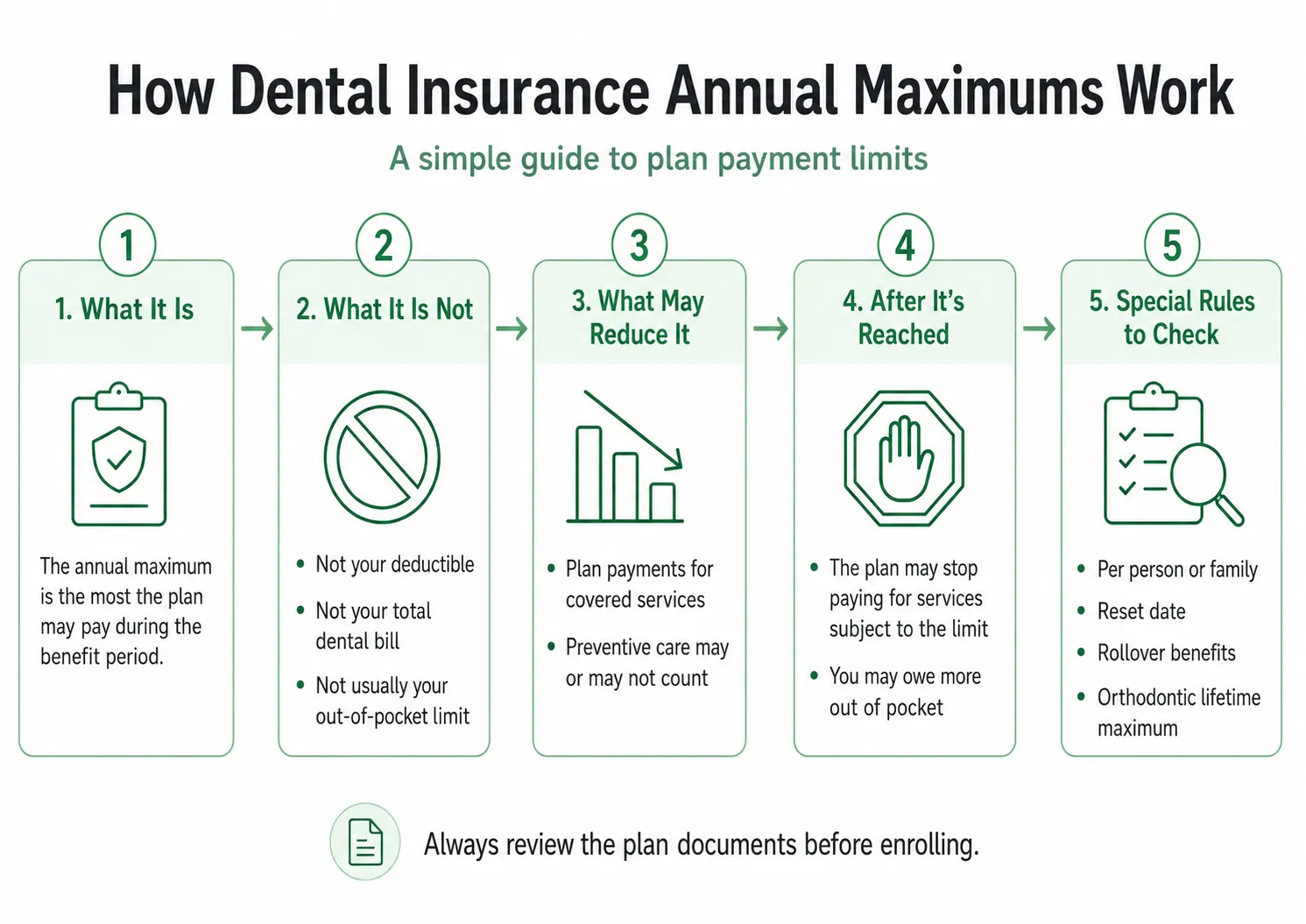
Important to Know:
- The annual maximum generally limits plan payments
- The dentist’s charge does not automatically reduce the maximum
- The complete plan allowance does not necessarily reduce the maximum
- Deductibles, copays, and coinsurance are generally member costs
- Preventive plan payments may or may not count
- A covered service can receive no additional payment after the maximum is used
- Procedure-specific and lifetime limits may apply separately
What May Happen After the Annual Maximum Is Reached
After the available annual maximum has been used, the plan may provide no additional payment for services subject to that limit during the remaining benefit period.
The treatment itself does not automatically become:
- Clinically unnecessary
- Prohibited
- An excluded service
- Subject to the same result under every plan
- Eligible for payment from another benefit category
The dentist determines whether treatment is clinically appropriate. The plan determines whether an additional benefit is available under the contract.
Confirm Which Benefits Have Been Exhausted
Ask whether the limit applies to:
- The general dental benefit
- One covered person
- The complete family
- A specific treatment category
- Orthodontic treatment
- Another separately administered benefit
A general annual maximum may be exhausted while another separately defined benefit remains available.
Confirm Whether the Claim Will Still Be Processed
Ask the insurer or plan administrator:
- Whether the dental office should continue submitting claims
- Whether an Explanation of Benefits will be issued
- Whether the plan allowance will still be identified
- Whether provider-contract terms continue to apply
- How patient responsibility will be calculated
- Which remark or denial code will appear
- Whether another benefit limit applies
Do not assume that every plan processes claims in the same way after the maximum has been reached.
Confirm the Dental Office’s Charges
Ask the dental office for:
- The complete charge
- The applicable in-network fee when relevant
- The amount already paid
- The remaining balance
- Charges for related procedures
- Payment-plan terms when offered
- The expected treatment schedule
An annual maximum limits plan payment. It does not establish the dental office’s complete charge or the final amount owed by the patient.
Do Not Delay Necessary Care Without Clinical Guidance
Before delaying treatment until another benefit period, ask the dentist:
- Whether treatment can safely wait
- The clinical risks of delay
- Whether temporary treatment is appropriate
- Whether delay may change the proposed procedure
- Whether additional treatment could become necessary
- Whether the complete cost could change
Insurance timing should not replace an individualized clinical recommendation.
Treatment Across Two Benefit Periods
When treatment may cross from one benefit period into another, confirm:
- Which service date controls each claim
- Whether every procedure is billed separately
- Whether treatment-in-progress provisions apply
- Whether a new deductible applies
- Whether the annual maximum resets
- Whether waiting periods or replacement rules change
- Whether continued enrollment is required
- Whether the provider remains in network
This can matter when related procedures occur on different dates. For example, a root canal may be completed during one part of the benefit period and the final crown later, or an extraction may occur before a later tooth-replacement procedure. Verify which service date and annual maximum apply to each procedure under the specific plan.
Do not assume that dividing treatment between two periods automatically produces additional benefits.
When the Annual Maximum May Reset
The annual maximum resets according to the benefit period defined by the plan.
The period may be:
- A calendar year
- A policy year
- A contract year
- An employer-plan year
- Another period stated in the controlling documents
Do not assume that every maximum resets on January 1.
Confirm the Benefit-Period Dates
Ask:
- When does the current benefit period begin?
- When does it end?
- On which date does the maximum reset?
- Does the deductible reset on the same date?
- Do frequency limits use the same period?
- Do orthodontic benefits follow another schedule?
- Does a rollover balance follow separate rules?
Service Date and Claim-Processing Date
Ask whether the plan assigns the benefit to:
- The date the service was performed
- The date an appliance was delivered
- The date treatment was completed
- Another date defined by the contract
The date on which the claim is processed may not be the date that determines the applicable benefit period.
Pending Claims
A displayed remaining balance may not include every claim that has been submitted but not yet processed.
Before relying on the amount shown, ask:
- Are any claims pending?
- Are any claims being corrected or appealed?
- Could another family member’s claim affect a shared maximum?
- Has any payment been reversed?
- Is a predetermination being mistaken for an actual payment?
- When was the online balance last updated?
Renewal and Plan Changes
A new plan year does not guarantee that the same benefit structure will continue.
At renewal, verify:
- The annual maximum
- The deductible
- Provider network
- Covered services
- Waiting periods
- Procedure-specific limits
- Rollover provisions
- Orthodontic benefits
- Premium or payroll deduction
- Effective dates
Changing to another plan may also affect prior accumulations, treatment-in-progress rules, waiting periods, and provider participation.
How Annual Maximums May Apply to Individuals and Families
A family dental plan does not necessarily use one shared maximum for the entire household.
The plan may use:
- A separate annual maximum for each covered person
- A family-level maximum
- Both individual and family limits
- Separate maximums for selected benefits
- Different rules for adults and children
Separate Maximums for Covered People
When each covered person has a separate maximum, one person’s plan payments may not reduce another person’s individual benefit.
Confirm:
- The maximum for each person
- Payments already made for each person
- Pending claims
- Whether any household-level limit also applies
- Whether orthodontic benefits are tracked separately
Family-Level Limits
When a family-level limit exists, ask:
- Whether it replaces individual maximums
- Whether it applies in addition to individual maximums
- Which services reduce it
- Whether one person can use most of the available amount
- How the remaining balance is displayed
- Whether pediatric benefits are treated separately
Different Treatment Needs
Prepare a separate review for every covered person, including:
- Expected procedures
- Dentists and specialists
- Waiting periods
- Deductibles
- Annual maximum
- Orthodontic eligibility
- Other dental coverage
- Current treatment already in progress
For a fuller household comparison, review Individual vs Family Dental Plans.
Employer-Sponsored Coverage
For workplace coverage, confirm:
- Whether the maximum applies separately to each covered person
- Whether plan options use different maximums
- Whether an employer buy-up option changes the limit
- Whether preventive plan payments reduce it
- Whether orthodontic benefits use another maximum
- Whether the plan year differs from the calendar year
- Whether enrollment in a new option resets or preserves any accumulation
For an applicable ERISA-covered employer plan, review the Summary Plan Description and the other official documents supplied by the plan administrator.
Do not state that every workplace dental arrangement follows identical federal document requirements.
Marketplace Adult and Child Benefits
Adult and pediatric dental benefits should be reviewed separately.
Marketplace dental coverage is treated differently for adults and children, and a plan may use different benefit or cost-sharing structures for each group.
Confirm:
- Which people receive adult benefits
- Which people receive pediatric benefits
- Whether a general annual benefit maximum applies
- Whether a pediatric cost-sharing limit applies instead
- Which services and providers are included
- Whether the dental benefit is embedded in a health plan or provided through a separate dental plan
How to Compare Plans With Different Annual Maximums
A higher annual maximum means that the plan may have the capacity to make more payments for services subject to that limit.
It does not establish that the plan will provide more useful coverage for the individual comparison.
Verify What Is Eligible
Confirm whether the expected procedures are:
- Covered
- Excluded
- Subject to a waiting period
- Limited by frequency
- Limited by replacement rules
- Evaluated using an alternate benefit
- Subject to a separate maximum
- Affected by treatment-in-progress provisions
A larger maximum has limited value when the expected treatment is excluded or otherwise ineligible.
Compare the Complete Cost Structure
Review:
- Premium or payroll deduction
- Deductible
- Copay or coinsurance
- Scheduled member charges
- Plan allowance
- Provider network
- Annual maximum
- Procedure-specific limits
- Waiting periods
- Exclusions
A plan with a larger maximum can still leave a greater patient responsibility if other terms are less favorable for the expected care.
Estimate the Usable Benefit
Ask:
- Which expected procedures reduce the maximum?
- What percentage or member charge applies?
- Which plan allowance is used?
- How much could the plan pay before the maximum becomes relevant?
- Are preventive payments included?
- Does another separate maximum apply?
- Can the preferred dentist be used at the applicable benefit level?
Compare the potential plan payment rather than treating the displayed maximum as cash available to the member.
For the complete cost comparison, review Dental Insurance Costs Explained.
General, Procedure-Specific, and Lifetime Maximums
A dental plan may contain more than one payment limit.
General Annual Maximum
The general annual maximum may apply to a broad group of covered dental services during one benefit period.
Not every procedure necessarily uses the complete amount.
Procedure-Specific Maximum
A plan may establish a separate maximum for:
- Dental implants
- Periodontal treatment
- Dentures
- Hearing-related or other supplemental benefits bundled with the plan
- Another category defined by the contract
Confirm whether the procedure-specific maximum:
- Is included within the general maximum
- Applies in addition to it
- Resets on the same date
- Applies per covered person
- Uses another benefit period
Orthodontic Lifetime Maximum
When orthodontic coverage is included, the plan may use a lifetime maximum rather than an annual maximum.
Confirm:
- Who is eligible
- Age restrictions
- The lifetime maximum
- Previous orthodontic payments
- The remaining amount
- Waiting periods
- Provider requirements
- Initial and continuing payments
- Treatment-in-progress provisions
- Continued-enrollment requirements
- What happens if the plan changes during treatment
Orthodontic coverage may be absent entirely.
Do not assume that a general annual maximum establishes the orthodontic benefit.
Staged Payments
A plan may divide orthodontic or other multistage benefits across treatment dates.
Ask:
- When the initial payment is made
- When continuing payments are made
- Whether active enrollment is required
- Which service dates control the payments
- Whether changing plans stops future payments
- Whether another plan will recognize treatment already in progress
For procedure-specific orthodontic guidance, review Best Dental Insurance for Braces.
How Rollover or Carryover Benefits May Work
Some dental plans may allow a portion of unused annual benefits to carry into a later benefit period.
The plan may describe this feature as:
- Rollover
- Carryover
- Maximum accumulation
- Benefit bank
- Another plan-defined term
A rollover feature is not automatic and does not operate identically under every plan.
Eligibility Conditions
The plan may require:
- Continuous enrollment
- Use of preventive services
- Staying below a benefit-usage threshold
- Using in-network providers
- Enrollment by a specified date
- Remaining in the same plan
- Compliance with other contract conditions
Accumulation Limits
Confirm:
- How much may be carried forward
- The maximum accumulated balance
- Whether the balance expires
- Whether the balance is used before or after the current annual maximum
- Whether it applies separately to each person
- Whether it can be used for orthodontics
- Whether it applies to out-of-network treatment
Loss of Accumulated Benefits
Ask what happens when the covered person:
- Changes plans
- Changes employers
- Ends coverage
- Moves to another insurer
- Misses a required preventive visit
- Uses benefits above the qualifying threshold
- Reenrolls after a break in coverage
Do not treat an advertised rollover amount as guaranteed future coverage.
The complete eligibility, accumulation, and forfeiture provisions should be reviewed before assigning value to the feature.
What a Plan With No General Annual Maximum May Still Limit
A plan described as having no annual maximum may not place one general dollar cap on all covered dental payments.
This does not mean unlimited dental coverage.
The plan may still use:
- Premiums
- Deductibles
- Copays
- Coinsurance
- Scheduled member charges
- Provider-network requirements
- Closed-panel provider rules
- Exclusions
- Waiting periods
- Frequency limits
- Replacement intervals
- Procedure-specific maximums
- Orthodontic lifetime maximums
- Age restrictions
- Referral requirements
- Preauthorization requirements
- Alternate-benefit provisions
- Treatment-in-progress provisions
Verify the Payment Structure
Plans without a general annual maximum may use:
- A schedule of member charges
- Fixed copays
- A managed-care network
- Procedure-specific payments
- Other benefit arrangements
Ask what the member pays for each expected procedure rather than relying only on the phrase no annual maximum.
Verify Provider Access
A plan may have no general maximum but require treatment through selected participating providers.
Confirm:
- The network
- The assigned dental office when applicable
- Specialist access
- Referral rules
- Out-of-network benefits
- Emergency provisions
- Current provider availability
Compare Complete Costs
Review:
- Fixed premiums
- Member charges
- Expected procedures
- Provider access
- Exclusions
- Timing rules
- Related procedures
- Complete estimated patient responsibility
The absence of one limit does not establish that the plan is more comprehensive or less expensive.
When More Than One Dental Plan Applies
When a person is enrolled in more than one dental plan, coordination-of-benefits rules may determine which plan processes the claim first.
Do not add the two annual maximums or displayed coverage percentages together and assume that the complete combined amount will be paid.
Confirm the Primary and Secondary Plans
Ask:
- Which plan is primary?
- Which plan is secondary?
- Which coordination method does each plan use?
- Does state or federal law affect the order?
- Is the primary plan’s EOB required?
- Who submits the secondary claim?
- Does either plan use a nonduplication provision?
Confirm How Each Maximum Is Reduced
Ask each plan:
- What amount was paid?
- What amount reduced its annual maximum?
- Does the secondary payment reduce the secondary maximum?
- Are the same procedures eligible under both plans?
- Does either plan apply a separate allowance?
- What patient responsibility remains after both claims are processed?
Keep Both EOBs
Compare:
- The dentist’s submitted charge
- Each plan allowance
- Each deductible
- Primary plan payment
- Secondary plan payment
- Each remaining annual maximum
- Final patient responsibility
- The dental office’s statement
A secondary plan does not necessarily pay everything left after the primary plan processes the claim.
How to Verify the Annual Maximum Before Treatment
Step 1: Identify the Exact Plan
Confirm:
- The complete plan name
- The covered person
- The policy or group information
- The benefit period
- The provider network
- The effective date
Step 2: Review the Controlling Documents
Review:
- The policy
- Certificate of coverage
- Plan document
- Applicable amendments
- Schedule of benefits
- Exclusions and limitations
- Rollover provisions
- Orthodontic provisions
A marketing summary should not be used as the only source.
Step 3: Confirm Every Applicable Maximum
Ask about:
- General annual maximum
- Individual maximum
- Family maximum
- Procedure-specific maximum
- Orthodontic lifetime maximum
- Rollover balance
- Pediatric cost-sharing provisions
- Other applicable limits
Step 4: Confirm What Has Already Been Paid
Ask the plan to identify:
- Plan payments already made
- Claims still pending
- Reversed or adjusted claims
- Payments under appeal
- Maximum remaining
- The date and time the balance was calculated
Do not rely only on an old EOB or an earlier online balance.
Step 5: Obtain the Complete Treatment Plan
Ask the dental office for:
- Every proposed procedure
- CDT codes when available
- Treating providers
- Office locations
- Proposed service dates
- Complete charges
- Related procedures
- Treatment already completed or started
When treatment involves more than one procedure, ask how each procedure may affect the remaining annual maximum rather than treating the complete treatment plan as a single benefit.
For example, root canal treatment and the filling, core buildup, or crown needed afterward may generate separate plan payments. An extraction and a later bridge, implant, or denture may also be evaluated separately.
If these procedures are part of the treatment plan, review the applicable guides:
- Does Dental Insurance Cover Root Canals?
- Does Dental Insurance Cover Fillings?
- Does Dental Insurance Cover Tooth Extraction?
- Dental Insurance for Bridges
The important question is not only whether enough annual benefit remains for the first procedure, but how earlier plan payments may affect benefits available for later treatment.
Step 6: Verify Each Procedure
For every procedure, ask:
- Is it covered?
- Is it subject to the general annual maximum?
- Does another maximum apply?
- What plan allowance is used?
- What deductible applies?
- What copay or coinsurance applies?
- Does a waiting period apply?
- Does a frequency or replacement limit apply?
- Is preauthorization required?
- Is predetermination available?
If your treatment plan includes several procedures, read Does Dental Insurance Cover Major Dental Work? What to Check When Several Procedures Are Needed to see how individual services may interact with shared annual benefits, provider status, timing, and other plan rules.
Step 7: Request Advance Benefit Information
For complex or costly treatment, ask whether the plan:
- Requires preauthorization
- Offers predetermination
- Offers another pretreatment estimate process
- Requires X-rays, photographs, or clinical notes
- Requires treatment dates or procedure codes
Review the written response, but do not treat it as a guarantee of final payment.
The available maximum can change when other claims are processed before the proposed treatment.
Step 8: Review the Final EOB
After claim processing, verify:
- Procedure submitted
- Plan allowance
- Deductible
- Copay or coinsurance
- Plan payment
- Patient responsibility
- Annual maximum remaining
- Remark or denial codes
- Appeal instructions
An EOB explains the benefit decision. It is not the dental office’s bill.
For a structured enrollment review, use the Dental Plan Comparison Checklist.
Annual Maximum Comparison Errors to Avoid
Treating the Annual Maximum as Money Paid to the Member
The maximum is generally a limit on qualifying plan payments, not a personal account or guaranteed payment.
Confusing the Maximum With the Plan Allowance
The plan allowance applies to the calculation for an individual procedure. The annual maximum limits qualifying payments across a benefit period.
Assuming the Dentist’s Complete Charge Reduces the Maximum
The plan generally tracks its own benefit payments according to the contract.
Treating the Annual Maximum as an Out-of-Pocket Maximum
The annual benefit maximum generally limits plan payments, not the patient’s complete spending.
Calling a Service Excluded Because the Maximum Was Reached
A covered service can receive no additional plan payment after the available maximum has been used.
Assuming Every Maximum Resets on January 1
Verify the calendar, policy, employer-plan, or contract year.
Ignoring Pending Claims
An online balance may change after previously submitted claims are processed.
Assuming Preventive Plan Payments Never Count
Confirm the rule for every relevant preventive or diagnostic procedure.
Assuming Every Family Member Shares One Maximum
The plan may use separate individual limits, a family limit, or both.
Assuming a Higher Maximum Guarantees Better Coverage
Expected procedures may still be excluded, delayed, limited, or subject to unfavorable cost sharing.
Assuming a Plan Without a General Maximum Is Unlimited
Provider restrictions, copays, exclusions, frequency limits, and procedure-specific maximums may still apply.
Ignoring Orthodontic Lifetime Maximums
The orthodontic benefit may be separate from the general annual maximum or may not exist.
Treating Rollover Benefits as Guaranteed
Eligibility, usage thresholds, continuous enrollment, and accumulation caps may apply.
Adding Two Plans’ Maximums Together
Coordination-of-benefits provisions determine how primary and secondary plans process the claim.
Treating Predetermination as Guaranteed Payment
Other claims, eligibility changes, provider changes, and different treatment details may alter the final payment.
Delaying Treatment Only to Reach a New Benefit Period
Ask the dentist about the clinical consequences before postponing necessary treatment.
Questions to Ask Before Choosing a Plan
| Question | Why It Matters |
|---|---|
| What is the annual maximum? | It identifies the general plan-payment limit for services subject to it during the benefit period |
| Which benefit period applies? | The maximum may follow a calendar year, policy year, employer-plan year, or another contract period |
| Does each covered person have a separate maximum? | Family enrollment does not automatically mean that every person shares one benefit limit |
| Does a family-level maximum also apply? | A household limit may apply instead of or in addition to individual maximums |
| How much has the plan already paid? | Previous claims reduce the amount available for later treatment when they are subject to the same maximum |
| Are any claims still pending? | The displayed remaining balance may change after submitted claims are processed |
| Which procedures reduce the annual maximum? | The rule can differ by service and plan |
| Do preventive and diagnostic payments reduce it? | Some plans include these payments, while others exclude selected services from the calculation |
| Are any procedures subject to a separate maximum? | Implant, periodontal, prosthodontic, or other benefits may have separate limits |
| Is there an orthodontic lifetime maximum? | Orthodontic benefits may use a separate limit that does not renew annually |
| Is orthodontic coverage available for every covered person? | Age, dependent status, treatment stage, and other eligibility rules may apply |
| What plan allowance is used for expected treatment? | The allowance used for an individual procedure is different from the annual maximum |
| What deductible applies? | The member may need to satisfy a deductible before the plan calculates selected benefits |
| What copay or coinsurance applies? | The plan may pay only part of the recognized amount even when annual benefits remain |
| Does the dentist participate in the exact network? | Provider status can affect the fee used for the benefit calculation and possible patient responsibility |
| Does a waiting period apply? | A maximum may be available while the proposed procedure remains temporarily ineligible |
| Do frequency or replacement limitations apply? | A procedure may be covered generally but unavailable because the timing requirement has not been satisfied |
| Does an alternate-benefit provision apply? | The plan may calculate payment using another covered procedure or material |
| Does treatment-in-progress affect eligibility? | Treatment started before enrollment or before a new benefit period may follow separate rules |
| Is a rollover feature available? | Unused benefits do not automatically carry forward |
| What conditions must be met for rollover? | Preventive visits, usage thresholds, network participation, or continuous enrollment may be required |
| What happens to rollover benefits after a plan or employer change? | Accumulated benefits may be reduced or forfeited |
| Does another dental plan apply? | Coordination-of-benefits rules determine processing order and possible secondary payment |
| Is preauthorization required? | A mandatory advance-review process may need to occur before selected treatment |
| Is predetermination available? | Advance benefit information may assist with an estimate without guaranteeing final payment |
| What is the estimated patient responsibility? | The estimate should include deductibles, cost sharing, excluded services, network-related amounts, and costs after limits are reached |
| Which official documents control the benefit? | Marketing pages and short summaries may omit important exclusions and limitations |
Documents to Keep Before Treatment
Keep copies of:
- The insurance card
- The complete plan name
- The covered person’s information
- The policy or certificate of coverage
- The controlling plan document
- Applicable amendments
- The schedule of benefits
- The exclusions and limitations
- The applicable benefit-period dates
- Annual-maximum provisions
- Individual and family-maximum provisions
- Procedure-specific maximums
- Orthodontic lifetime-maximum provisions
- Rollover or carryover provisions
- Waiting-period provisions
- Frequency and replacement limitations
- Alternate-benefit provisions
- Treatment-in-progress provisions
- Coordination-of-benefits provisions
- Provider-network information
- Written provider-participation confirmation
- The Summary Plan Description for an applicable ERISA-covered plan
- The complete written treatment plan
- Every proposed procedure and CDT code
- The proposed service dates
- The dental office’s complete charges
- The predetermination or preauthorization request
- The plan’s written advance-review response
- Claims
- Explanation of Benefits statements
- The dental office’s final statement
- Written answers received from the insurer, plan administrator, employer, or dental office
Record the date, representative, organization, contact method, benefit balance, pending-claim information, and source of every important confirmation.
How to Interpret Annual Maximums When Comparing Plans
A dental insurance annual maximum should be evaluated as one part of the complete benefit structure.
A higher annual maximum does not automatically establish that a plan will provide more useful benefits. A lower annual maximum does not automatically establish that the plan will provide less value for every person.
A plan may deserve closer consideration when:
- The expected procedures are eligible
- The annual maximum applies to those procedures
- The remaining maximum is known
- Pending claims have been considered
- The deductible and cost-sharing rules are understood
- The plan allowance for expected procedures can be identified
- Current dentists and specialists participate at the applicable benefit level
- Waiting periods fit the proposed treatment schedule
- Frequency and replacement limitations are understood
- Procedure-specific and lifetime maximums are identified
- Rollover conditions are clear
- The expected plan payments reasonably justify the premium and restrictions
A plan may deserve less consideration when:
- Important procedures are excluded
- The waiting period extends beyond the expected treatment date
- The preferred dentist or specialist is not available at the expected benefit level
- The remaining maximum provides little assistance
- A separate procedure-specific maximum limits the expected treatment
- Orthodontic benefits are absent or subject to restrictive rules
- Preventive payments reduce the available maximum in a way that changes the comparison
- Rollover benefits depend on conditions that may not be satisfied
- Important related procedures have been omitted from the estimate
- The comparison treats the displayed annual maximum as guaranteed cash available to the member
For family coverage, confirm whether every covered person has a separate annual maximum or whether another household-level limit also applies.
When more than one dental plan applies, review each plan’s coordination method. Do not add the displayed maximums or benefit percentages together and assume that the combined amount will be paid.
The final comparison should identify:
- The annual maximum
- The applicable benefit period
- Benefits already paid
- Pending claims
- Maximum remaining
- Expected eligible procedures
- Plan allowances
- Estimated plan payments
- Other procedure-specific or lifetime limits
- Estimated patient responsibility
- Important uncertainties
When you are ready, compare dental plans using the same covered people, providers, procedures, service dates, and benefit period for every option.
Helpful Resources
- Compare Dental Plans
- Dental Insurance Costs Explained
- How to Compare Dental Plans Online
- Dental Plan Comparison Checklist
- Individual vs Family Dental Plans
- In-Network vs Out-of-Network Dental Insurance
- How Waiting Periods Work in Dental Coverage
- Dental Insurance Coverage for Common Procedures
- Is Dental Insurance Worth It?
- Dental Insurance vs Dental Savings Plans
- Dental Insurance Learning Center
Frequently Asked Questions
What is a dental insurance annual maximum?
A dental insurance annual maximum is generally the most the plan may pay toward services subject to that limit during a defined benefit period.
It normally limits qualifying plan payments rather than the dentist’s complete charge or the total amount the patient may owe.
What is the difference between an annual maximum and a deductible?
The annual maximum generally limits how much the plan may pay.
A deductible is an amount the member may need to pay before the plan shares costs for specified covered services.
They affect different parts of the benefit calculation.
What reduces the annual maximum?
The plan documents determine which payments reduce it.
In many plans, qualifying amounts paid by the plan toward covered procedures reduce the available maximum.
Deductibles, copays, coinsurance, excluded charges, and other amounts assigned to the member generally do not reduce it in the same way as a plan payment.
Do preventive services count toward the annual maximum?
They may or may not.
Some plans exclude payments for selected diagnostic or preventive services from the annual-maximum calculation. Other plans subtract those payments from the available benefit.
Confirm the rule for the exact procedure and plan.
What happens when the annual maximum is reached?
The plan may provide no additional payment for services subject to the exhausted maximum during the remainder of the benefit period.
The procedure does not automatically become an excluded service, and another separately defined benefit may still be available.
Confirm how claims, network terms, and patient responsibility will be handled under the specific contract.
When does the annual maximum reset?
It resets according to the benefit period defined by the plan.
The period may follow a calendar year, policy year, employer-plan year, or another schedule.
The claim-processing date does not necessarily determine which benefit period applies.
Is a higher annual maximum or no annual maximum always better?
No.
A higher maximum does not establish that the expected procedures are covered, that waiting periods have ended, or that provider access and cost sharing are favorable.
A plan with no general annual maximum can still use copays, deductibles, provider restrictions, exclusions, frequency limits, replacement rules, and procedure-specific maximums.
Does predetermination reserve the remaining annual maximum?
No.
Predetermination can provide advance information about potential benefits, but it does not reserve the amount available.
Other claims, eligibility changes, service dates, provider changes, or treatment-plan changes can affect the final payment and maximum remaining when the claim is processed.
Sources
- American Dental Association — Typical Dental Plan Benefits and Limitations
- American Dental Association — Explanation of Benefits Statement
- American Dental Association — Pre-Authorizations
- American Dental Association — Dental Plans: Coordination of Benefits
- American Dental Association — Dental Benefit Trends
- American Dental Association — An Introduction to Dental Benefits
- HealthCare.gov — Dental Coverage in the Marketplace
- U.S. Department of Labor — Plan Information
About the Author
Maria Dumitru is the Founder and Content Editor of Dental Coverage Hub. She researches and edits educational content designed to help U.S. consumers understand dental insurance terms, compare plan features, and verify important information before enrolling.
Learn more about our standards in the Editorial Policy and How We Review Dental Plans.
This article provides general educational information and is not dental, medical, legal, financial, employment-benefits, tax, or personalized insurance advice. Annual maximums, benefit periods, plan allowances, deductibles, copays, coinsurance, provider networks, waiting periods, exclusions, procedure-specific limits, orthodontic lifetime maximums, rollover provisions, coordination-of-benefits rules, claim decisions, and expected patient costs can vary by plan, employer, provider, treatment, service date, state, and individual circumstances. Review the controlling plan documents and consult the appropriate dental professional, insurer, plan administrator, employer, benefits administrator, licensed insurance professional, attorney, accountant, or other qualified professional for information specific to your situation.

Compare Dental Plans Beyond the Annual Maximum
An annual maximum is only one part of a dental plan. Compare eligible procedures, premiums, deductibles, cost sharing, plan allowances, provider networks, waiting periods, procedure-specific limits, rollover conditions, and expected patient responsibility before enrolling.