
Does Dental Insurance Cover Tooth Extraction? What to Check Before Treatment
Learn how dental insurance may handle tooth extraction, including simple and surgical procedures, provider networks, related services, waiting periods, benefit limits, and treatment after the tooth is removed.
Written and researched by Maria Dumitru.
Founder and Content Editor at Dental Coverage Hub
Last reviewed: September 2026
What You’ll Learn
Dental insurance may provide benefits for a tooth extraction, but seeing “extractions covered” in a plan summary does not explain how a specific procedure will be evaluated.
The benefit can depend on the extraction being performed and the plan rules that apply to it.
Important details may include:
- The exact extraction procedure
- Whether the tooth is erupted or impacted
- Whether additional surgical steps are required
- The dentist or oral surgeon performing the procedure
- The provider’s network status
- The plan allowance
- The deductible and cost sharing
- Any applicable waiting period
- The annual benefit remaining
- Imaging, sedation, anesthesia, or other separately evaluated services
- Whether treatment to replace the missing tooth is planned later
This guide focuses specifically on tooth-extraction benefits and the related services that may affect the claim.
For a broader explanation of how dental insurance may apply to different procedures, review Dental Insurance Coverage for Common Procedures.
Quick Answer
Many dental insurance plans provide benefits for tooth extractions, but the exact benefit depends on the specific plan and procedure.
A simple extraction, surgical extraction, and removal of an impacted tooth should not automatically be expected to receive the same benefit.
A covered extraction may still leave the patient responsible for part of the cost because of:
- A deductible
- Copay or coinsurance
- The plan allowance
- Provider-network rules
- A waiting period
- The remaining annual maximum
- Other procedure-specific limitations
Imaging, sedation, anesthesia, bone grafting, or other services associated with the treatment may also be evaluated separately.
Coverage for removing the tooth does not automatically establish coverage for replacing it afterward.
Key Takeaways
- Dental insurance may provide benefits for tooth extraction, but plan rules vary
- The exact extraction procedure matters more than the general label “tooth removal”
- Simple, surgical, and impacted-tooth removal procedures should not automatically be treated as equivalent
- The type of provider does not by itself determine how the extraction is reported
- A covered extraction may still involve a deductible, copay, coinsurance, or other patient responsibility
- Verify the individual dentist or oral surgeon, exact office location, plan, and provider network
- Imaging, sedation, anesthesia, bone grafting, and other related services may have separate benefit rules
- Several extractions may involve different procedures and separately evaluated services
- A waiting period or remaining annual maximum can affect the available benefit
- Medical insurance should not be assumed to cover an ordinary dental extraction
- Coverage for extraction and coverage for later tooth replacement are separate benefit questions
- Advance benefit information can be useful but does not necessarily guarantee final payment
In This Guide
Does Dental Insurance Cover Tooth Extraction?
Many dental plans provide benefits for tooth extraction, but there is no single rule that applies to every plan or every procedure.
The most useful question is not simply whether the plan lists extractions as covered.
Confirm:
- The exact extraction procedure
- The tooth being removed
- Whether the tooth is erupted or impacted
- Whether additional surgical steps are expected
- The provider performing the procedure
- The provider’s network status
- The deductible and cost sharing
- Any waiting period
- The annual benefit remaining
- Any separately evaluated related services
A procedure can be recognized as a covered service without being paid in full.
Two extractions can also receive different benefit results when the procedures or applicable plan provisions differ.
Simple vs Surgical Tooth Extraction: Why the Exact Procedure Matters
Dental plans may evaluate different extraction procedures differently.
Do not assume that every procedure commonly described as a tooth extraction uses the same benefit rules.
Simple Extraction
A relatively straightforward removal of an erupted tooth may be reported differently from an extraction that requires additional surgical steps.
Confirm:
- The exact procedure
- The applicable benefit category
- Whether the deductible applies
- The applicable cost sharing
- Provider-network status
- Any waiting period
- Available benefits
The fact that a procedure is described generally as a simple extraction does not establish the exact payment the plan will make.
Surgical Extraction
Some extractions involve additional procedural steps because of the tooth’s clinical presentation or the treatment required to remove it.
The dental office should identify the procedure that is expected to be performed rather than relying only on the general description “surgical extraction.”
Confirm:
- The exact procedure
- Whether the tooth is erupted or impacted
- Which provider will perform the treatment
- Whether related services will be billed separately
- What plan rules apply to each service
A surgical extraction can also involve separately evaluated services, which may not automatically receive the same benefit as the extraction itself.
Provider Type Does Not Define the Procedure
A general dentist or an oral surgeon may be involved depending on the treatment.
The provider’s specialty does not by itself establish which extraction procedure will be reported.
Ask the dental office which procedure is being proposed and verify that procedure with the plan.
The useful insurance question is therefore not simply whether the treatment will be performed by a general dentist or an oral surgeon.
It is:
Which extraction procedure is expected to be performed, and how does the plan evaluate that procedure?
What Can Affect the Benefit for a Tooth Extraction?
Several treatment and plan details can affect the benefit for an extraction.
| Extraction detail | What to verify |
|---|---|
| Exact extraction procedure | Which procedure the dentist or oral surgeon expects to perform |
| Tooth status | Whether the tooth is erupted, partially erupted, impacted, broken, or otherwise requires a different procedure |
| Provider | The individual dentist or oral surgeon and exact office location |
| Provider network | Participation in the exact network used by the plan |
| Plan allowance | The amount the plan uses when calculating the benefit |
| Deductible | Whether an applicable deductible must be satisfied |
| Copay or coinsurance | What member cost sharing applies |
| Waiting period | Whether the proposed extraction is currently eligible |
| Annual maximum | Whether sufficient benefit remains for services subject to the limit |
| Imaging | Whether diagnostic services are evaluated separately |
| Sedation or anesthesia | Whether separate benefit requirements or limitations apply |
| Bone grafting or other services | Whether another procedure is being billed and evaluated separately |
| Multiple extractions | Whether different teeth require different extraction procedures |
| Later tooth replacement | Whether an implant, denture, bridge, or other restoration will be evaluated separately |
No single item determines the final benefit by itself.
Review the exact proposed procedure together with the applicable plan provisions.
How Dental Plan Costs Can Affect an Extraction
The dental office’s complete charge is not necessarily the amount the plan uses to calculate a benefit.
Depending on the plan, the claim may involve:
- A plan allowance
- An applicable deductible
- Copay or coinsurance
- Plan payment
- Estimated patient responsibility
A useful way to separate these amounts is:
Dental office charge → plan allowance → applicable deductible or cost sharing → plan payment → estimated patient responsibility
The exact calculation depends on the plan.
Do not apply a displayed coverage percentage automatically to the dental office’s complete charge.
For the complete explanation of these amounts, review Dental Insurance Costs Explained.
Are Related Services Covered With a Tooth Extraction?
Coverage for the extraction itself does not automatically establish coverage for every other service performed before, during, or after the procedure.
A treatment plan can include several separately evaluated services.
Ask the dental office to identify each proposed service separately and, when available, provide the procedure information used for the treatment estimate.
Imaging
Dental X-rays or other diagnostic imaging may be needed to evaluate the tooth and plan treatment.
From an insurance perspective, imaging may be evaluated separately from the extraction.
Confirm:
- Which imaging is being proposed
- Whether it is eligible for benefits
- Whether a frequency limitation applies
- Whether similar imaging was completed earlier in the benefit period
- Whether the dentist or specialist requires additional imaging
- Whether deductible or cost sharing applies
Do not assume that coverage for the extraction automatically includes every diagnostic service associated with it.
For the separate diagnostic-imaging framework, read Does Dental Insurance Cover Dental X-Rays? What to Check Before Your Visit.
Sedation or Anesthesia
Some extractions may involve sedation or anesthesia in addition to local anesthesia.
When these services appear separately on the treatment plan, verify them separately.
Ask:
- What type of sedation or anesthesia is being proposed?
- Will it be billed separately?
- Is it eligible under the dental plan?
- Does the extraction procedure affect eligibility?
- Does the plan require specific documentation?
- Must the service be provided by a particular type of provider?
- Does a separate deductible, copay, or coinsurance apply?
Coverage for the extraction does not establish that every form of sedation or anesthesia receives a dental benefit.
For the dedicated anesthesia and sedation coverage framework, read Does Dental Insurance Cover Dental Anesthesia or Sedation? What to Check Before Treatment.
Bone Grafting
A bone graft or another bone-related procedure may sometimes be recommended around the time a tooth is removed.
From an insurance perspective, the graft should not automatically be treated as part of the extraction benefit.
Confirm:
- Why the graft is being recommended
- Whether it appears separately on the treatment plan
- Whether the dental plan provides a benefit for it
- Whether a separate plan allowance applies
- Whether the annual maximum affects the available benefit
- Whether documentation is required
- Whether later restorative treatment affects how the service is evaluated
The central insurance principle is:
Services performed during the same treatment episode can have different benefit rules.
For the dedicated bone-graft coverage framework, read Does Dental Insurance Cover Bone Grafts? What to Check Before Treatment.
Verify the Oral Surgeon Separately
A referral from an in-network dentist does not establish that the oral surgeon receiving the referral participates in the same provider network.
When specialist care is involved, verify:
- The oral surgeon’s full name
- The exact office location where treatment will occur
- The complete dental plan name
- The exact provider-network name
- Current participation
- New-patient availability when relevant
- The proposed service date
- Any referral requirement
- Any authorization requirement
Do not ask only whether the oral surgeon’s office “accepts” the insurance company.
Different providers and office locations can have different participation arrangements.
For the complete explanation of provider-network rules, review In-Network vs Out-of-Network Dental Insurance.
For the broader surgical-coverage framework, read Does Dental Insurance Cover Oral Surgery? What to Check Before Treatment.
What About Wisdom Tooth Extraction?
Wisdom-tooth removal is a type of tooth extraction, but the phrase wisdom tooth removal does not identify the exact procedure that will be performed.
One wisdom tooth may require a different extraction procedure from another.
Before checking the benefit, confirm:
- Which tooth or teeth are being removed
- Whether the tooth is erupted, partially erupted, or impacted
- Which extraction procedure is expected
- Who will perform the treatment
- Whether the provider participates in the exact network
- Whether additional imaging is required
- Whether sedation or anesthesia will be billed separately
- Whether other procedures will be performed during the same treatment episode
Do not rely only on a general statement that the plan covers wisdom-tooth removal.
Ask how the plan evaluates the specific extraction procedure and related services being proposed.
For the dedicated third-molar coverage framework, read Does Dental Insurance Cover Wisdom Teeth Removal? What to Check Before Treatment.
Can a Waiting Period Apply to Tooth Extraction?
It can.
A dental plan may require a waiting period before a particular extraction or oral-surgery benefit becomes available.
If coverage began recently, confirm:
- The coverage effective date
- Whether the specific extraction is subject to a waiting period
- When the waiting period begins
- The date the procedure becomes eligible
- Whether related services follow the same rule
- Whether prior comparable coverage can affect the waiting period
- Whether documentation is required for any available exception or waiver
The end of a waiting period does not eliminate other plan provisions.
The extraction may still be affected by:
- A deductible
- Copay or coinsurance
- Provider-network requirements
- The annual maximum
- Related-service limitations
- Other contract provisions
For the complete explanation of timing rules, review How Waiting Periods Work in Dental Coverage.
Multiple Extractions and Your Remaining Benefits
When more than one tooth needs to be removed, do not assume that every extraction will be reported or evaluated identically.
Different teeth can require:
- Different extraction procedures
- Different providers
- Different surgical steps
- Different imaging
- Different anesthesia or sedation services
- Other separately evaluated procedures
Ask the dental office to identify the proposed treatment for each tooth separately.
Useful questions include:
- Which teeth are being removed?
- What extraction procedure is expected for each tooth?
- Are any teeth impacted?
- Will the same provider perform every extraction?
- Are related services being billed separately?
- Will sedation or anesthesia apply to the complete treatment episode or to separately reported services?
- Is additional treatment expected later?
Effect on the Annual Maximum
When extraction-related plan payments are subject to an annual maximum, several qualifying payments may reduce the benefit remaining for other dental treatment during the same benefit period.
This does not mean that every extraction receives the same benefit.
It means the combined plan payments can affect the amount remaining.
Before significant treatment, confirm:
- The current annual maximum
- Benefits already paid
- Claims still pending
- The amount currently remaining
- Whether every proposed extraction is subject to that maximum
- Whether related services reduce the same maximum
For the complete explanation of benefit limits, review Dental Insurance Annual Maximums Explained.
What If the Tooth Needs to Be Removed Urgently?
Pain, infection, swelling, trauma, severe damage, or another dental problem may lead a dentist or oral surgeon to recommend prompt treatment.
Clinical urgency and insurance eligibility are separate questions.
An urgent need for treatment does not automatically remove plan provisions such as:
- Deductibles
- Provider-network requirements
- Waiting periods
- Annual maximums
- Authorization requirements
- Other benefit limitations
At the same time, insurance rules should not determine whether delaying treatment is clinically appropriate.
If treatment timing is uncertain, ask the treating dental professional about the clinical implications of waiting.
Then separately ask the dental plan how the proposed treatment will be evaluated.
The dentist determines the clinical treatment need. The dental plan determines the benefit available under the contract.
For the broader urgent-care coverage framework, read Does Dental Insurance Cover Emergency Dental Care? What to Check Before Treatment.
When Medical Insurance May Also Need to Be Checked
An ordinary dental extraction should not automatically be assumed to qualify for benefits under medical insurance.
Dental and medical plans use different coverage rules, provider networks, authorization requirements, and claim procedures.
However, medical coverage may be worth checking when the dental or oral treatment is connected to a broader medical situation, such as:
- Significant facial or oral trauma
- Treatment associated with another covered medical condition
- Certain medically integrated surgical care
- Hospital-based treatment involving additional medical services
- Another situation in which dental treatment is directly connected to covered medical care
The fact that an extraction is described as surgical does not by itself establish medical-insurance coverage.
Likewise, describing dental treatment as medically necessary does not by itself guarantee payment by a medical plan.
When medical coverage may be relevant, ask the medical plan:
- Is this dental or oral service eligible under my medical coverage?
- What medical circumstances must be present?
- Is prior authorization required?
- Which provider network applies?
- Does the provider need to submit a medical claim?
- Which documentation is required?
- Are the dental and medical portions of treatment billed separately?
Do not assume that a dental plan’s decision predicts how a medical plan will evaluate the same treatment.
The two plans should be checked separately.
What Happens After the Extraction?
Coverage for removing a tooth and coverage for treatment used to replace the missing tooth are separate benefit questions.
An extraction benefit does not automatically include:
- A dental implant
- A bridge
- A complete or partial denture
- Bone grafting performed in preparation for later treatment
- Another restorative procedure
Not every extracted tooth requires the same replacement approach, and the appropriate treatment should be discussed with the dentist.
When replacement is planned, verify the later procedure separately.
Dental Implant
An implant is a separate procedure from the extraction.
Implant treatment can have its own:
- Eligibility rules
- Provider requirements
- Deductible and cost sharing
- Waiting periods
- Annual or procedure-specific limits
- Documentation requirements
- Related procedures
- Treatment-in-progress provisions
Coverage for removing the tooth does not establish that an implant will receive a benefit.
For the separate implant coverage framework, read Does Dental Insurance Cover Implants? What to Verify Before Treatment.
Denture or Partial Denture
A complete or partial denture is also a separate benefit.
The plan may apply its own:
- Eligibility requirements
- Waiting periods
- Deductible or cost sharing
- Annual maximum
- Replacement rules
- Provider requirements
- Missing-tooth or initial-placement provisions when applicable
Do not assume that coverage for the extraction establishes coverage for a later denture.
For the separate denture coverage framework, read Does Dental Insurance Cover Dentures? What to Verify Before Treatment.
Dental Bridge
A dental bridge is another possible form of tooth replacement after an extraction.
The extraction and bridge are separate procedures for insurance purposes. A plan may provide benefits for removing the tooth without necessarily providing the same benefit for the later bridge.
Bridge coverage can also depend on:
- Whether the missing tooth is eligible for replacement
- Any applicable waiting period
- Missing-tooth provisions
- Supporting crowns or retainers
- Provider network
- Annual maximum
- Replacement limitations
- Alternate-benefit provisions
If a bridge is being considered after the extraction, review the bridge benefit separately rather than assuming that extraction coverage establishes replacement coverage.
For the separate bridge coverage framework, read Dental Insurance for Bridges: What to Check Before Treatment.
If root canal treatment is also a clinically reasonable option, read Root Canal vs Tooth Extraction: Insurance and Cost Considerations to compare the broader insurance pathways, including what may follow each procedure.
Where to Check Your Extraction Benefit
A short plan summary may state that extractions or oral-surgery services are covered, but additional documents may be needed to understand how the benefit works.
Review the documents applicable to the exact plan, which may include:
- Policy or certificate of coverage
- Evidence of Coverage or controlling plan document
- Schedule or Summary of Benefits
- Copay or member-charge schedule
- Provider-network information
- Exclusions and limitations
- Waiting-period provisions
- Oral-surgery provisions
- Sedation or anesthesia provisions
- Annual-maximum information
- Preauthorization requirements
- Predetermination information
- Claims and appeal instructions
Look specifically for language concerning:
- Tooth extraction
- Surgical extraction
- Impacted teeth
- Oral surgery
- Specialist services
- Imaging
- Sedation or anesthesia
- Related procedures
A short benefit summary may indicate that an extraction can receive benefits.
The more detailed documents help explain which procedure, provider, related services, and limitations apply.
When Advance Benefit Information May Be Useful
Advance benefit information can be useful when an extraction involves several procedures or when the expected benefit is unclear.
It may be particularly useful when:
- A surgical extraction is planned
- Several teeth are being removed
- An oral surgeon is involved
- The provider is outside the network
- Sedation or anesthesia is proposed
- Bone grafting is planned
- Several services appear separately on the treatment estimate
- The annual benefit remaining is limited or uncertain
- A waiting period or another limitation may apply
- Estimated patient responsibility is unclear
Dental plans may use processes such as preauthorization or predetermination.
These terms should not automatically be treated as interchangeable.
Ask the plan:
- Is preauthorization required for this procedure?
- Is predetermination available?
- Which procedure codes or treatment details must be submitted?
- Who submits the request?
- Is imaging or other clinical documentation required?
- Which providers must be identified?
- Which services are being reviewed?
- Does the response show an estimated plan allowance?
- Does it identify a deductible or estimated plan payment?
- Does it identify plan limitations?
- How long is the response valid?
- What could cause the final payment to change?
Advance benefit information can improve a treatment-cost estimate, but it should not automatically be treated as a guarantee of final payment.
Eligibility, provider participation, benefits remaining, service dates, treatment changes, documentation, and other contract provisions can affect the final claim.
For the full pretreatment-review framework, read Dental Insurance Predetermination vs Preauthorization: What’s the Difference?
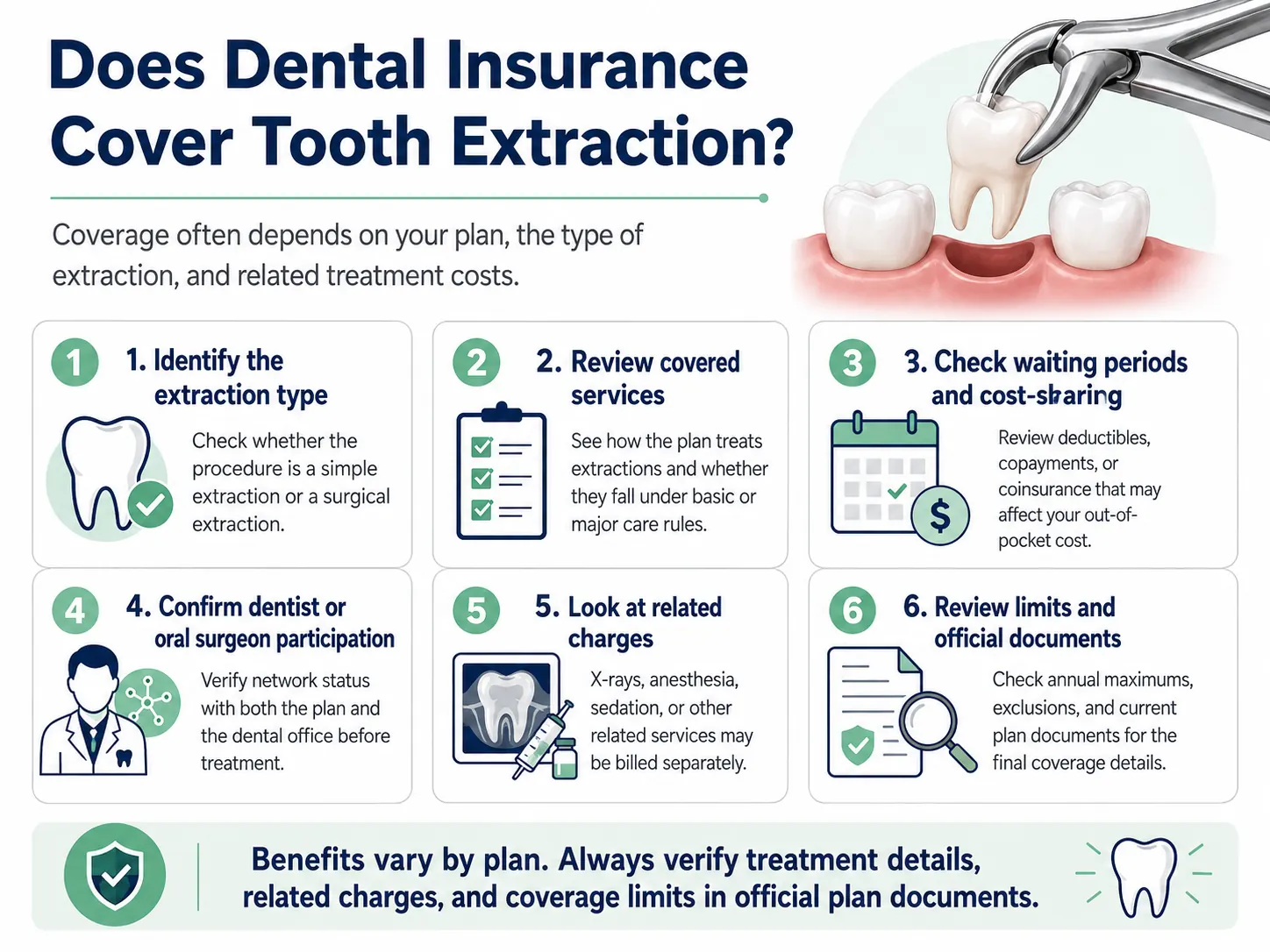
What to Check Before a Tooth Extraction
Once the extraction has been recommended, focus on the exact treatment rather than asking only whether the plan generally covers extractions.
Ask the Dental Office
Confirm:
- Which tooth or teeth are being removed
- The exact extraction procedure expected for each tooth
- Whether the tooth is erupted or impacted
- Whether additional surgical steps are expected
- Who will perform the extraction
- Whether an oral surgeon is involved
- Where the procedure will be performed
- Which imaging is needed
- Whether sedation or anesthesia is proposed
- Whether bone grafting or another procedure is recommended
- Which services will be billed separately
- Whether later tooth replacement is being considered
- Whether the office can submit an advance-benefit request when appropriate
Ask the Dental Plan
Confirm:
- Whether the exact extraction procedure is eligible
- How the procedure is classified
- Which plan allowance applies
- Whether the deductible applies
- Which copay or coinsurance applies
- Whether the provider participates in the exact network
- Whether a waiting period applies
- Whether imaging receives a separate benefit
- Whether sedation or anesthesia is evaluated separately
- Whether bone grafting or another related service is eligible
- Whether the annual maximum affects the available benefit
- Whether preauthorization is required
- Whether predetermination is available
Review the Treatment Estimate
Ask for an itemized estimate that identifies, when available:
- Each extraction
- Related procedures
- Provider
- Office location
- Dental office charge
- Estimated plan allowance
- Estimated plan payment
- Estimated patient responsibility
- Information that has not yet been confirmed
Do not rely only on a statement such as:
“The plan covers a percentage of oral surgery.”
A percentage alone does not identify:
- The amount to which it will be applied
- The deductible
- The provider-network level
- Related procedures
- Remaining benefits
- Other plan limitations
After the Extraction: Review the EOB and Dental Office Statement
After the claim is processed, review the Explanation of Benefits and the dental office statement together.
When several services were provided, pay particular attention to whether they appear as separate claim lines.
These may include:
- Extraction
- Imaging
- Sedation
- Anesthesia
- Bone grafting
- Other related procedures
Depending on the plan, the EOB may identify:
- Procedure submitted
- Dental office charge
- Plan allowance
- Deductible applied
- Plan payment
- Patient responsibility
- Benefit limitations
- Remark or explanation information
An EOB explains how the plan evaluated the claim. It is not the dental office’s bill.
Compare the EOB with the dental office statement and payments already made.
If an amount does not appear to match the expected benefit, ask the dental office and dental plan to explain:
- Which procedure was submitted
- Which plan rule was applied
- How the patient responsibility was calculated
- Whether documentation is missing
- Whether another claim is pending
- Whether a correction or appeal process is available
Do not assume that either document is incorrect until the difference has been explained.
For detailed interpretation of the processed claim result, read How to Read a Dental Insurance EOB: Payments, Adjustments, and Patient Responsibility.
Dental Coverage and Clinical Treatment Are Different Questions
Dental insurance determines benefits according to the terms of a plan.
It does not determine whether a tooth should be removed, which extraction procedure is clinically appropriate, whether treatment is urgent, or which replacement treatment should follow.
A plan providing little or no payment does not establish that the recommended extraction is unnecessary.
Likewise, the fact that an extraction is eligible for insurance benefits does not establish that removing the tooth is appropriate for every patient.
Clinical decisions belong in the dentist-patient discussion.
Insurance determines how the applicable plan may contribute financially.
How to Interpret Your Tooth Extraction Coverage
After reviewing the proposed treatment and plan documents, separate what has been confirmed from what remains uncertain.
A useful extraction-coverage review should identify:
- The exact extraction procedure being proposed
- The tooth or teeth being removed
- The dentist or oral surgeon performing the procedure
- The exact provider network
- The applicable plan allowance
- Any deductible, copay, or coinsurance
- Whether a waiting period applies
- The annual benefit remaining
- Which related services will be evaluated separately
- Whether preauthorization is required or predetermination is available
- Whether additional treatment is expected after the extraction
Then interpret each part of the treatment separately.
For example:
- Extraction eligible for benefits does not mean the procedure will be paid in full
- Oral surgeon eligible for benefits does not automatically mean the surgeon is in network
- Extraction covered does not automatically include imaging, sedation, anesthesia, or bone grafting
- Waiting period completed does not remove deductibles, cost sharing, annual maximums, or other limitations
- Advance benefit information received does not guarantee the final claim payment
- Extraction covered does not establish coverage for an implant, bridge, denture, or other later tooth replacement
If an important detail cannot be verified, record it as Not confirmed rather than assuming that the more favorable rule applies.
The goal is not to predict the final claim from one coverage percentage or one statement in a benefits summary.
It is to understand which parts of the proposed treatment may receive benefits, which plan rules may affect those benefits, and which costs or services still need clarification before treatment.
When you are ready, compare dental plans guide.
Helpful Resources
- Dental Procedure Coverage
- Dental Insurance for Bridges
- Does Dental Insurance Cover Implants?
- Does Dental Insurance Cover Dentures?
- Dental Insurance Costs Explained
- In-Network vs Out-of-Network Dental Insurance
- Dental Insurance Annual Maximums Explained
- How Waiting Periods Work in Dental Coverage
- Compare Dental Plans
- Dental Insurance Learning Center
Frequently Asked Questions
Does dental insurance cover tooth extraction?
Many dental insurance plans provide benefits for tooth extraction, but the exact benefit depends on the specific plan and procedure.
The result can be affected by:
The extraction procedure
The provider and provider network
The plan allowance
The deductible
Copay or coinsurance
A waiting period
The annual maximum
Separately evaluated related services
Other plan limitations
A statement that extractions are covered does not establish how much the plan will pay or what the patient will owe.
Is a surgical tooth extraction covered by dental insurance?
It may be.
Different extraction procedures can be evaluated differently under a dental plan.
Do not rely only on a general description such as simple extraction or surgical extraction. Ask the dental office which procedure is expected to be performed and verify how the plan handles that procedure.
The provider performing the treatment does not by itself determine which extraction procedure will be reported.
Does a deductible apply to tooth extraction?
It can.
Some dental plans apply a deductible before providing benefits for an extraction or other oral-surgery service.
Confirm:
Whether the deductible applies to the proposed extraction
How much of the deductible remains
Whether related services are subject to the same deductible
What cost sharing applies after the deductible
Do not assume that the deductible rules for another type of dental service also apply to the extraction.
Does dental insurance cover an oral surgeon?
A dental plan may provide benefits for treatment performed by an oral surgeon, but the exact procedure and the surgeon’s provider-network status should be verified separately.
A referral from an in-network general dentist does not establish that the oral surgeon is also in network.
Confirm:
The individual oral surgeon
Exact office location
Complete dental plan
Exact provider network
Current participation
Proposed procedure
Any referral or authorization requirement
Are imaging, sedation, or anesthesia covered with a tooth extraction?
They may receive benefits, but they should not automatically be treated as part of the extraction benefit.
Imaging, sedation, anesthesia, and other related services may be reported or evaluated separately.
Ask which services will appear separately on the treatment estimate and verify each one with the dental plan.
Coverage for the extraction does not guarantee coverage for every service performed during the same treatment episode.
Can a waiting period apply to tooth extraction?
Yes. Some dental plans can apply waiting periods before certain services become eligible for benefits.
If coverage recently started, confirm whether the specific extraction is subject to a waiting period and the date the benefit becomes available.
Even after a waiting period ends, the procedure may still be affected by deductibles, cost sharing, provider-network requirements, annual maximums, and other limitations.
Can medical insurance ever cover a tooth extraction?
Medical insurance may be relevant in limited circumstances, but an ordinary dental extraction should not automatically be treated as a medical-insurance benefit.
Medical coverage may need to be checked when dental or oral treatment is connected to a broader covered medical situation, such as significant trauma or certain medically integrated care.
The fact that an extraction is surgical or described as medically necessary does not by itself establish medical coverage.
When medical insurance may be relevant, check the medical plan separately from the dental plan.
Does insurance cover replacing a tooth after extraction?
Not automatically.
The extraction and the treatment used to replace the missing tooth are separate procedures with separate insurance rules.
Depending on the treatment being considered, review:
Dental Insurance for Bridges
Does Dental Insurance Cover Implants?
Does Dental Insurance Cover Dentures?
Coverage for removing the tooth does not guarantee coverage for a bridge, implant, denture, or other replacement.
Sources
- American Dental Association — Frequent General Questions Regarding Dental Procedure Codes
- American Dental Association — D7230 and D7240: Guidance on Coding for Impacted Teeth Removal Procedure
- American Dental Association — Glossary of Dental Terms
- American Dental Association — Typical Dental Plan Benefits and Limitations
- American Dental Association — How to Read Your Explanation of Benefits Statement
- American Dental Association — Pre-Authorizations
- HealthCare.gov — Dental Coverage in the Health Insurance Marketplace
- Centers for Medicare & Medicaid Services — Medicare Dental Coverage
About the Author
Maria Dumitru is the Founder and Content Editor of Dental Coverage Hub. She researches and edits educational content designed to help U.S. consumers understand dental insurance terms, procedure-specific benefit rules, provider-network considerations, and the information they may need to verify before dental treatment.
Learn more about our standards in the Editorial Policy and How We Review Dental Plans.
This article provides general educational information and is not dental, medical, legal, financial, or personalized insurance advice. Dental benefits, covered procedures, deductibles, copays, coinsurance, plan allowances, provider networks, waiting periods, annual maximums, exclusions, related-service benefits, authorization requirements, claim decisions, and expected patient costs can vary by plan, provider, procedure, service date, state, and individual circumstances. Review the controlling plan documents and consult the appropriate dentist, oral surgeon, insurer, plan administrator, medical plan, licensed insurance professional, or other qualified professional for information specific to your situation.
This article does not determine whether a tooth should be removed, whether treatment is urgent, which extraction procedure is clinically appropriate, or whether treatment can safely be delayed. Questions about diagnosis, treatment, or timing should be discussed with a qualified dental professional.

Explore Dental Coverage for Common Procedures
Tooth extraction may involve the extraction itself and separately evaluated services such as imaging, anesthesia, bone grafting, or later tooth-replacement treatment. Use our broader procedure coverage guide to understand how dental insurance may evaluate common types of treatment and what to verify before care begins.