
Does Dental Insurance Cover Oral Surgery? What to Check Before Treatment
Learn how oral-surgery benefits may work, why the exact procedure matters, and what to verify before treatment begins.
Written and researched by Maria Dumitru.
Founder and Content Editor at Dental Coverage Hub
Last reviewed: October 2026
Does dental insurance cover oral surgery? Dental insurance may provide benefits for oral-surgical procedures, but oral surgery is not one single insurance benefit.
The term can describe different procedures, and the benefit can depend on the exact service being performed, why it is needed, the provider, related services, and the terms of the dental plan.
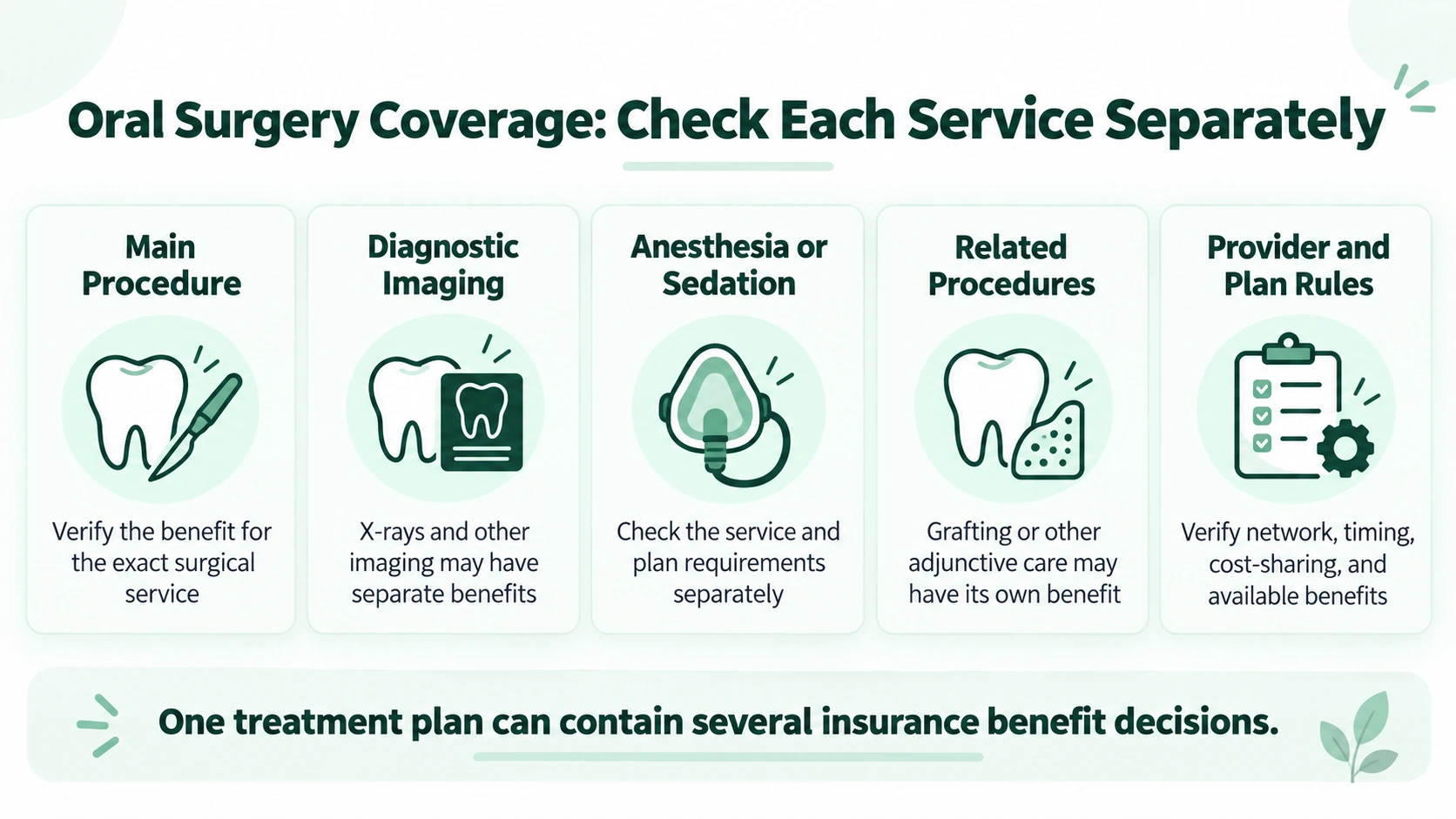
One treatment plan may also contain several separately evaluated services, such as diagnostic imaging, the surgical procedure itself, anesthesia or sedation, and another related procedure.
The most useful starting point is to identify the exact surgical procedure and then verify the benefit for that service.
The dental or medical professional determines what treatment is clinically appropriate. The insurance plan separately determines what financial benefit its contract provides.
What You’ll Learn
This guide explains:
- How dental insurance may cover oral surgery
- Why the exact surgical procedure matters
- Why oral surgery is not one single dental benefit
- When medical insurance may also be worth checking
- Why imaging, anesthesia, and related procedures may have separate benefits
- How specialist network status can affect coverage
- How waiting periods, cost-sharing, annual maximums, and limitations may matter
- What to verify before treatment begins
Quick Answer
Dental insurance may provide benefits for certain oral-surgical procedures, but coverage depends on the exact procedure and the specific dental plan.
Before treatment, verify:
- The surgical procedure being performed
- How the dental plan classifies that procedure
- Whether another insurance plan should also be checked
- Which provider will perform the procedure
- Whether related services will be billed separately
- Any waiting period or eligibility provision
- Applicable deductible and cost-sharing
- Available annual benefits
- Whether advance benefit information is available
Oral surgery coverage should be checked procedure by procedure rather than treated as one broad insurance benefit.
Key Takeaways
- Oral surgery is not one single dental insurance benefit.
- The exact surgical procedure determines which benefit should be checked.
- Being treated by an oral surgeon does not automatically mean medical insurance applies.
- Clinical need does not automatically establish insurance payment.
- Imaging, anesthesia or sedation, grafting, and other related services may be evaluated separately.
- A covered main procedure does not automatically mean every part of the treatment plan is covered.
- Specialist network status can affect patient responsibility.
- Waiting periods, cost-sharing, annual maximums, exclusions, and other plan provisions may still affect payment.
- Predetermination or preauthorization can provide useful information without guaranteeing final payment.
In This Guide
Does Dental Insurance Cover Oral Surgery?
Dental plans may provide benefits for certain oral-surgical procedures.
However, there is no single coverage rule that applies to everything described as oral surgery.
The plan may consider:
- The exact procedure
- How the service is classified
- Whether it is included under the plan
- Supporting information
- Provider network
- Waiting-period or eligibility provisions
- Cost-sharing
- Available annual benefits
- Exclusions and limitations
A dental plan can provide oral-surgery benefits without covering every procedure performed by an oral surgeon in the same way.
Identify the procedure before trying to predict the benefit.
What Counts as Oral Surgery for Insurance Purposes?
Oral and maxillofacial surgery is a dental specialty that includes a broad range of surgical procedures involving the mouth, teeth, jaws, and related structures.
For insurance purposes, however, the specialty name alone is not enough.
What matters is the actual service being performed.
Examples can include:
- Surgical tooth removal
- Wisdom tooth removal
- Bone grafting
- Implant-related surgery
- Periodontal surgery
- Other oral and maxillofacial procedures
Different procedures can have different benefit provisions.
Being treated by an oral surgeon does not, by itself, determine how the claim will be covered.
Why the Exact Surgical Procedure Matters
A general oral-surgery benefit description cannot reliably predict coverage for every procedure.
Tooth Extraction
A surgical extraction has its own procedure-specific coverage question.
The word surgical does not automatically convert an extraction into a medical-insurance benefit.
For the extraction framework, read Does Dental Insurance Cover Tooth Extraction? What to Check Before Treatment.
Wisdom Tooth Removal
Wisdom tooth removal is a specific oral-surgery situation.
The exact procedure and plan provisions should be verified separately rather than assuming all wisdom-tooth treatment receives the same benefit.
For the dedicated third-molar coverage framework, read Does Dental Insurance Cover Wisdom Teeth Removal? What to Check Before Treatment.
Bone Grafting
Bone grafting may be performed in connection with another dental procedure, but the graft can be evaluated separately.
Coverage for an extraction or another main procedure does not automatically establish a bone-graft benefit.
A dedicated Bone Grafts guide will own that coverage question.
For the dedicated bone-graft coverage framework, read Does Dental Insurance Cover Bone Grafts? What to Check Before Treatment.
Implant-Related Surgery
Dental implant treatment can include surgical components, but a general oral-surgery benefit does not answer the implant coverage question.
For the implant-specific framework, read Does Dental Insurance Cover Implants? What to Verify Before Treatment.
Periodontal Surgery
Surgical periodontal care belongs to the broader periodontal-treatment pathway.
For that broader framework, read Does Dental Insurance Cover Gum Disease Treatment? What to Check Before Care.
Oral Surgery Is Not One Insurance Benefit
One oral-surgery treatment plan can contain several separately evaluated services.
For example:
| Treatment component | What to verify |
|---|---|
| Main surgical procedure | Benefit for the exact procedure |
| Dental imaging | Separate diagnostic benefit |
| Anesthesia or sedation | Separate coverage requirements |
| Bone graft or another related procedure | Procedure-specific benefit |
| Additional provider or facility services | Separate billing and coverage when applicable |
Coverage for the main surgery does not automatically establish coverage for every service associated with the treatment plan.
This distinction is especially important when comparing an estimate with the eventual EOB.
Clinical Need and Insurance Benefit Are Different Questions
The treating dentist, oral surgeon, or other clinician determines whether a procedure is appropriate for the patient’s clinical situation.
The insurance plan applies its contract to determine what financial benefit is available.
The plan may consider:
- Whether the procedure is an included benefit
- Supporting documentation
- Eligibility
- Network provisions
- Timing requirements
- Other contractual limitations
A clinically appropriate procedure does not automatically guarantee an insurance benefit.
Likewise, reduced or no insurance payment does not by itself establish that the treatment was clinically inappropriate.
Can Dental and Medical Insurance Both Matter for Oral Surgery?
Sometimes.
The word surgery alone does not determine whether dental insurance, medical insurance, or both should be reviewed.
The answer can depend on factors such as:
- The exact procedure
- The reason for treatment
- The structures involved
- The treatment setting
- The provisions in the dental and medical plans
Some oral and maxillofacial treatment may raise medical-benefit questions, particularly when circumstances extend beyond routine tooth-based dental treatment.
However, that possibility should be verified rather than assumed.
Do not conclude that medical insurance applies simply because the procedure is surgical or because an oral surgeon performs it.
If medical insurance may be relevant, verify the exact procedure directly under the medical plan as well as under the dental coverage when appropriate.
Does the Oral Surgeon’s Network Status Matter?
Yes.
An oral surgeon can be in-network under one plan and out-of-network under another.
If dental coverage is expected to apply, verify participation under the specific dental plan.
If medical insurance may also be involved, medical-network participation may need to be checked separately.
Do not rely only on whether the office accepts the insurance.
Accepting insurance and participating in a particular network are different questions.
For the broader framework, read In-Network vs Out-of-Network Dental Insurance.
Do Dental X-Rays Have a Separate Benefit?
They may.
Diagnostic imaging used to evaluate or plan oral surgery can be a separate dental service.
The fact that the surgical procedure receives a benefit does not automatically determine how the imaging will be processed.
For the separate imaging framework, read Does Dental Insurance Cover Dental X-Rays? What to Check Before Your Visit.
Is Anesthesia or Sedation Covered Separately?
It may be.
Anesthesia or sedation can be reported and evaluated separately from the surgical procedure.
Coverage can depend on the:
- Type of anesthesia or sedation
- Surgical procedure
- Clinical circumstances
- Provider
- Treatment setting
- Plan provisions
A benefit for the surgery does not automatically establish a benefit for anesthesia or sedation.
For the dedicated anesthesia and sedation coverage framework, read Does Dental Insurance Cover Dental Anesthesia or Sedation? What to Check Before Treatment.
What Can Affect Oral Surgery Coverage?
Several dental-plan provisions can affect the final benefit.
Exact Procedure
Always begin with the specific procedure rather than the general label oral surgery.
How the Plan Classifies the Service
Different surgical procedures can appear under different benefit categories.
Check the specific plan rather than assuming every oral-surgical service is classified the same way.
Supporting Documentation
Some surgical claims may require supporting information.
Depending on the procedure and plan, this can include:
- Diagnostic imaging
- Treatment plan
- Clinical notes
- Diagnosis
- Other requested records
Documentation requirements can vary.
Waiting Period
Some dental plans may apply a waiting period to the applicable service.
A waiting period concerns when a benefit becomes available after coverage begins.
For the separate framework, read How Waiting Periods Work in Dental Coverage.
Deductible and Cost-Sharing
Deductible, copay, coinsurance, or another form of patient responsibility may apply depending on the procedure and plan.
Annual Maximum
Even when an oral-surgery service qualifies for benefits, the amount of annual benefits still available can affect how much the dental plan pays.
For that mechanism, read Dental Insurance Annual Maximums Explained.
Exclusions and Limitations
A procedure can also be affected by an exclusion, limitation, service-specific rule, or other contractual provision.
Review the actual plan language rather than relying only on a summary of oral-surgery benefits.
What If Several Services Are Planned Together?
An oral-surgery treatment plan may include more than one separately reported service.
Before treatment, ask for an itemized estimate when practical.
It may identify:
- The main surgical procedure
- Imaging
- Anesthesia or sedation
- Bone grafting or another adjunctive procedure
- Additional professional or facility services when applicable
Then identify which significant services require a separate benefit check.
An itemized estimate helps identify what needs to be verified. It does not guarantee final insurance payment.
When Advance Benefit Information May Be Useful
Advance benefit information may be useful when oral surgery involves a higher expected cost, several related services, supporting documentation, or uncertainty about plan requirements.
Depending on the plan, predetermination or preauthorization may help clarify how the plan currently expects to apply its benefits.
However, eligibility, available benefits, changes in treatment, or other provisions can still affect the final claim.
For the complete framework, read Dental Insurance Predetermination vs Preauthorization: What’s the Difference?
Where to Check Oral Surgery Coverage in Your Plan
Schedule of Benefits
Look for the specific surgical procedure rather than relying only on an oral-surgery heading.
Oral Surgery or Procedure-Specific Benefits
Review how the plan describes the service and how it is classified.
Exclusions and Limitations
Check for restrictions that may affect the particular procedure or related services.
Provider Network Information
Verify the oral surgeon and any other significant participating provider under the applicable plan.
Advance-Review Requirements
Check whether the plan requires or offers predetermination, preauthorization, referral, or another advance step for the procedure.
How to Verify Oral Surgery Benefits Before Treatment
Step 1: Confirm the Exact Procedure
Ask the dental office or surgeon for the specific procedure being recommended.
If several services are planned, identify each significant component.
Step 2: Confirm Which Coverage Should Be Checked
Determine whether dental insurance is expected to review the procedure and whether there is a specific reason medical insurance should also be contacted.
Step 3: Review the Procedure Benefit
Check whether the exact surgical service is included and which limitations apply.
Step 4: Confirm Provider Network
Verify the oral surgeon under the appropriate insurance plan.
When another provider or facility is involved, check that participation separately when relevant.
Step 5: Identify Related Services
Ask whether imaging, anesthesia or sedation, grafting, or another separately reported service is expected.
Step 6: Check Timing and Eligibility
Confirm coverage is active and review any applicable waiting period or other eligibility provision.
Step 7: Review Cost-Sharing and Available Benefits
Consider deductible, copay or coinsurance, annual maximum, and other plan provisions.
Step 8: Ask About Advance Benefit Information
Determine whether predetermination or preauthorization would help clarify the expected benefit before surgery.
Step 9: Review an Itemized Estimate
Compare the major components of the proposed treatment with the benefits you verified.
How to Interpret Common Oral Surgery Benefit Language
| Plan language or result | What it may mean | What not to assume |
|---|---|---|
| Oral surgery covered | The plan recognizes benefits for certain surgical dental procedures | Do not assume every oral-surgical procedure receives a benefit |
| Surgical extraction covered | The plan recognizes the submitted extraction service under applicable provisions | Do not assume related grafting or anesthesia is included |
| Specialist benefit applies | Specialist treatment may be covered under plan provisions | Do not assume every oral surgeon is in-network |
| Preauthorization required | An advance plan process must be completed | Do not assume completion guarantees final payment |
| Related service processed separately | Another component has its own benefit determination | Do not assume the main procedure controls the entire treatment plan |
| No benefit available | A plan provision affected the submitted service | Do not automatically conclude that all oral surgery is excluded |
After Treatment: Review the EOB
After the claim is processed, review the Explanation of Benefits before deciding why an amount was paid or not paid.
Check:
- The procedure submitted
- The date of service
- The plan allowance
- Any deductible or cost-sharing
- The plan payment
- Patient responsibility
- Any remarks explaining an adjustment or limitation
If several services were submitted, review each component separately.
For the complete EOB framework, read How to Read a Dental Insurance EOB: Payments, Adjustments, and Patient Responsibility.
If a final unfavorable decision remains after the reason has been identified, Dental Insurance Claim Denied? How to Review the Decision and Appeal explains the separate review and appeal framework.
Common Oral Surgery Coverage Mistakes
Asking Only Whether Oral Surgery Is Covered
Different surgical procedures can have different benefits.
Identify the exact service.
Assuming Surgery Automatically Means Medical Insurance
The procedure and applicable plan provisions matter more than the word surgery.
Assuming Clinical Need Guarantees Insurance Payment
Clinical appropriateness and insurance benefit eligibility are separate questions.
Assuming the Main Surgery Includes Every Related Service
Imaging, anesthesia, grafting, and other services may require separate benefit checks.
Checking Only the Surgeon’s Network Status
Other separately involved providers or facilities may have different network status.
Ignoring Waiting Periods or Available Annual Benefits
An included surgical service can still be affected by other plan provisions.
Treating Advance Benefit Information as Guaranteed Payment
Predetermination or preauthorization can be useful without guaranteeing the final claim outcome.
Our Recommendation
Before oral surgery, identify the exact procedure and the significant related services expected as part of the treatment plan.
Confirm:
- Which surgical procedure is being performed
- Which insurance coverage should review it
- Whether the oral surgeon is in-network
- Whether imaging, anesthesia, grafting, or another service will be evaluated separately
- Whether a waiting period or other limitation applies
- How cost-sharing and available annual benefits may affect patient responsibility
- Whether advance benefit information would be useful
- Whether the estimate clearly separates significant treatment components
Oral surgery is best understood as a category containing different procedures and potentially separate insurance benefits, not as one blanket coverage decision.
Coverage for the main procedure does not automatically establish coverage for the entire treatment plan.
Helpful Resources
- Dental Insurance Coverage for Common Procedures
- Does Dental Insurance Cover Tooth Extraction? What to Check Before Treatment
- Does Dental Insurance Cover Dental X-Rays? What to Check Before Your Visit
- Does Dental Insurance Cover Gum Disease Treatment? What to Check Before Care
- Does Dental Insurance Cover Implants? What to Verify Before Treatment
- How Waiting Periods Work in Dental Coverage
- In-Network vs Out-of-Network Dental Insurance
Frequently Asked Questions
Does Dental Insurance Cover Oral Surgery?
Dental insurance may provide benefits for certain oral-surgical procedures. The exact benefit depends on the procedure, plan provisions, network status, eligibility, cost-sharing, available benefits, and other limitations.
Is Oral Surgery Covered by Dental or Medical Insurance?
It depends on the exact procedure and circumstances. Dental insurance may apply to many oral-surgical services, while some situations may also raise medical-benefit questions. Verify the specific procedure under the applicable plans rather than relying only on the fact that it is surgery.
Does Dental Insurance Cover Surgical Tooth Extraction?
It may. The exact extraction procedure and plan provisions determine the applicable dental benefit. Surgical extraction should not automatically be assumed to fall under medical insurance.
Does Dental Insurance Cover an Oral Surgeon?
A dental plan may provide benefits for treatment performed by an oral surgeon, but network participation and procedure-specific coverage should be checked under the exact plan.
Are Dental X-Rays Covered Separately From Oral Surgery?
They may be. Diagnostic imaging and the surgical procedure can be separately reported services with different benefit provisions.
Is Anesthesia or Sedation Covered With Oral Surgery?
It may be, depending on the procedure, type of anesthesia or sedation, provider, treatment setting, and plan provisions. Do not assume that coverage for the surgery automatically establishes coverage for anesthesia.
Does a Waiting Period Apply to Oral Surgery?
It may, depending on the dental plan and procedure. Review the applicable benefit and waiting-period provisions before relying on coverage.
Why Might Dental Insurance Not Pay for an Oral Surgery Procedure?
Possible reasons can include the exact procedure, an exclusion or limitation, eligibility, waiting period, network status, cost-sharing, available annual benefits, documentation requirements, or another plan provision. Review the EOB for the specific explanation.
Sources
- American Dental Association — Glossary of Dental Terms
- American Dental Association — Pre-Authorizations
- American Dental Association — Explanation of Benefits Statement
- American Association of Oral and Maxillofacial Surgeons — Oral and Maxillofacial Surgery Procedures
- American Association of Oral and Maxillofacial Surgeons — Anesthesia Coding and Billing Guidance
About the Author
Maria Dumitru is the founder and content editor of DentalCoverageHub. She creates consumer-focused educational content designed to help readers understand dental insurance benefits, limitations, and plan rules before making coverage decisions.
Learn more about our standards in the Editorial Policy and How We Review Dental Plans.
This article is for general educational purposes. Oral-surgery benefits, dental and medical coverage, network requirements, waiting periods, cost-sharing, anesthesia coverage, supporting documentation, and other plan provisions can vary. Clinical treatment decisions should be made by the treating dental or medical professional.

Explore Dental Coverage for Common Procedures
Oral surgery can involve several separately evaluated dental services, and the benefit for one service does not automatically determine coverage for another. Use our broader procedure coverage guide to understand what to verify when researching other types of dental treatment.