🦷 Implant Coverage Guide
🇺🇸 Information for U.S. Consumers
✓ Procedure-Specific Benefit Guidance

Does Dental Insurance Cover Implants? What to Verify Before Treatment
Learn how dental plans may evaluate implant placement, abutments, implant crowns, bone grafting, imaging, provider networks, waiting periods, benefit limits, and exclusions.
Written and researched by Maria Dumitru.
Founder and Content Editor at Dental Coverage Hub
Last reviewed: September 2026
What You’ll Learn
Dental insurance may provide benefits for selected parts of dental implant treatment, but coverage depends on the specific procedures and contract terms.
The word “implant” is commonly used for the complete treatment. A dental plan may instead evaluate several separate services, including implant placement, an abutment, an implant crown, extractions, bone grafting, diagnostic imaging, temporary restorations, and follow-up care.
Each service can have its own procedure code, benefit classification, deductible, cost sharing, provider requirement, waiting period, limitation, or exclusion.
This guide explains how to identify every part of the proposed treatment, verify procedure-specific benefits, review provider networks and plan limitations, and distinguish the dental professional’s clinical recommendation from insurance eligibility.
For a broader explanation of how plans classify and evaluate different procedures, review Dental Insurance Coverage for Common Procedures.
Quick Answer
Dental insurance may cover some dental implant services, but implant coverage is not included automatically in every plan.
A policy may:
- Cover selected implant-related procedures
- Cover the implant crown but exclude implant placement
- Cover an extraction or diagnostic imaging separately
- Apply an alternate benefit based on another covered tooth-replacement option
- Apply a waiting period
- Apply a deductible or cost sharing
- Limit payment through an annual maximum
- Restrict treatment for teeth missing before enrollment
- Exclude treatment already started
- Require participating providers
- Require preauthorization or offer a predetermination process
Before treatment begins, obtain a written treatment plan with the procedure names, CDT codes, providers, estimated charges, and proposed treatment dates.
Then confirm every service separately through the official plan documents and insurer or plan administrator.
A general statement that “implants are covered” does not establish that the complete treatment will qualify or that the plan will pay the dental office’s complete charge.
Key Takeaways
- Dental implant treatment commonly involves several separately coded services
- Implant placement, an abutment, an implant crown, bone grafting, extraction, imaging, and follow-up care may follow different benefit rules
- Coverage of one implant-related procedure does not guarantee coverage of every treatment stage
- A covered service can still be affected by deductibles, copays or coinsurance, plan allowances, annual maximums, provider networks, and waiting periods
- Missing-tooth, preexisting-condition, treatment-in-progress, replacement, frequency, and alternate-benefit provisions may affect payment
- Clinical appropriateness does not automatically establish insurance eligibility
- Preauthorization and predetermination are distinct processes and do not necessarily guarantee final payment
- Verify the exact procedures, providers, treatment dates, and remaining benefits before treatment begins
In This Guide
What Is a Dental Implant System?
A dental implant system is used to support one or more replacement teeth.
The system can include:
- An implant body placed surgically into the jawbone
- An abutment connected to the implant body
- A fixation screw, depending on the system
- A crown, bridge, denture, or another restoration supported by the implant
The implant body is sometimes called the implant post in consumer explanations.
The visible replacement tooth is not the implant body itself. For example, an implant crown is a separate restorative component attached through an abutment.
This distinction matters because a dental plan may classify and evaluate the surgical and restorative stages separately.
Clinical Treatment and Insurance Benefits Are Different
The dental professional determines whether implant treatment is clinically appropriate based on the patient’s oral health, overall health, bone support, treatment goals, risks, and available alternatives.
The dental plan determines whether individual services qualify for benefits under the contract.
A clinical recommendation does not guarantee insurance payment, and an insurance limitation does not determine whether a treatment is clinically appropriate.
FDA advises patients to discuss potential benefits, risks, healing, overall health and the specific implant system with their dental provider before treatment.
How a Dental Implant Works
A visual summary of the possible stages of implant treatment, including evaluation, imaging, extraction when needed, implant-body placement, healing, abutment placement, and the final restoration.
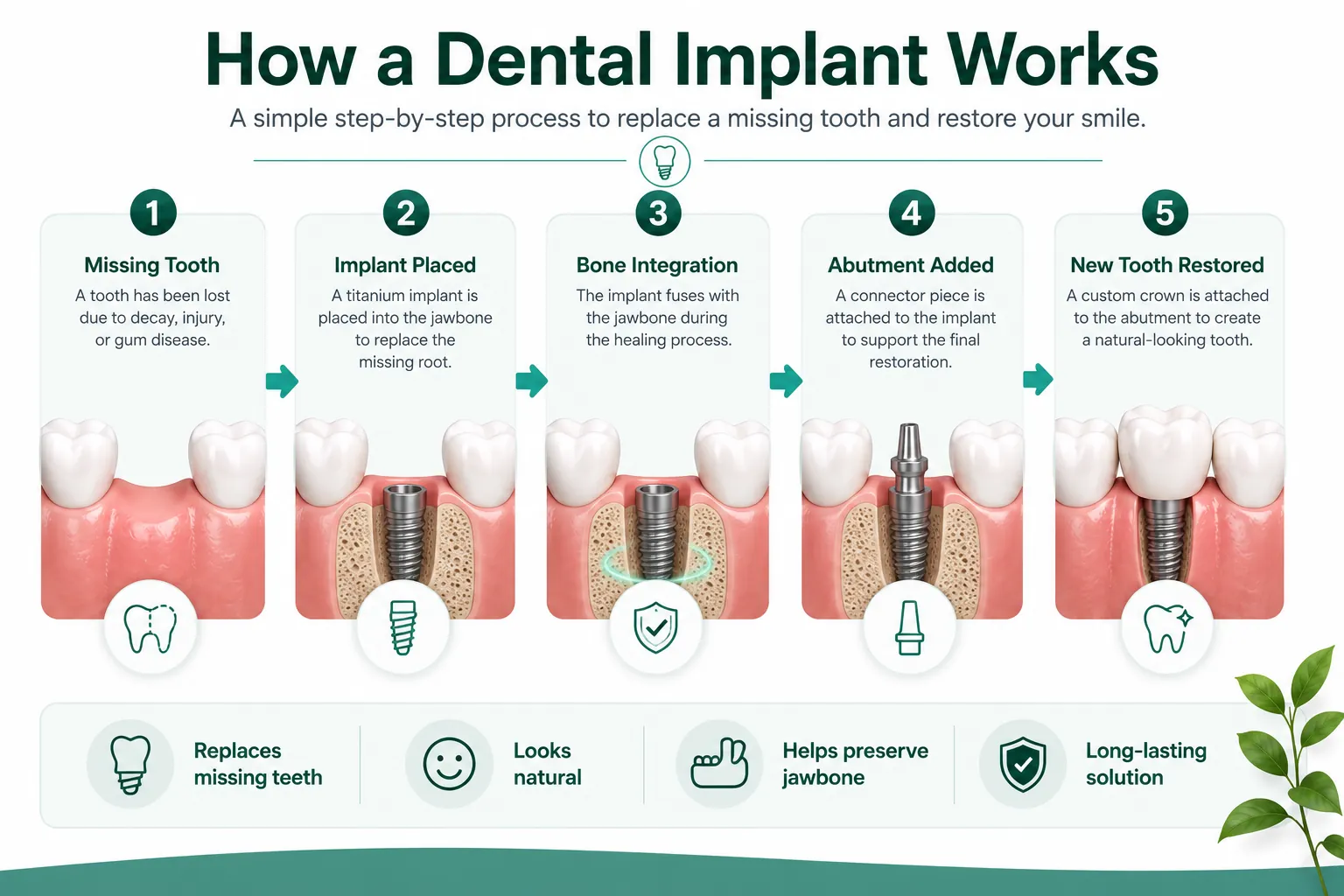
The exact sequence, timing, providers, and procedures depend on the individual treatment plan. Not every patient requires every stage, and insurance may evaluate each service separately.
Parts of Implant Treatment to Verify Separately
| Treatment component | General purpose | Benefit questions to verify |
|---|---|---|
| Examination or consultation | Evaluates the patient and proposed treatment | Evaluation type, provider network, frequency rules, referral requirements, and cost sharing |
| Diagnostic imaging | Supports diagnosis and treatment planning | Image type, frequency limits, authorization rules, provider requirements, and benefit classification |
| Extraction | Removes a tooth when clinically required | Surgical or basic classification, deductible, network, waiting period, and treatment-in-progress rules |
| Bone grafting | Rebuilds or adds bone when clinically required | Coverage or exclusion, procedure code, timing, provider network, and connection to implant treatment |
| Implant-body placement | Places the implant component into the jawbone | Implant-specific benefit, exclusion, waiting period, provider network, cost sharing, and annual maximum |
| Abutment | Connects the implant body to the restoration | Separate procedure code, benefit classification, deductible, and whether it is included with another service |
| Implant crown | Provides the visible replacement tooth | Crown benefit, implant-specific exclusions, replacement limits, alternate benefits, and annual maximum |
| Implant-supported bridge or denture | Replaces multiple teeth using implant support | Coverage of the appliance, implant components, number of implants, replacement rules, and exclusions |
| Temporary restoration | Provides a temporary tooth or appliance during treatment | Whether it is included in another fee, separately covered, limited, or excluded |
| Follow-up or maintenance | Monitors healing, function, and the final restoration | Included visits, separate procedure codes, network requirements, frequency limits, and member charges |
| Repair or replacement | Addresses damage, wear, failure, or replacement needs | Replacement interval, prior placement date, documentation, benefit limit, and exclusions |
A valid procedure code does not guarantee payment. The plan’s covered-service provisions, exclusions, provider rules, remaining benefits, and other contract terms determine whether a benefit is available. ADA explains that correctly reported dental procedures can still be excluded or limited by the benefit contract.
Implant Post
The implant post is the part placed into the jawbone. Some dental plans exclude implant placement, even if they cover other major services. Other plans may cover implant placement only under certain conditions.
Ask whether the implant post is covered specifically.
Abutment
The abutment connects the implant post to the replacement tooth. Some plans treat the abutment as a separate service. That means coverage for the implant post does not automatically mean the abutment is covered.
Implant Crown
The implant crown is the visible replacement tooth.
A plan may cover the crown differently from the implant post. Some plans may cover crowns but exclude implant placement. Others may cover an implant crown only if the implant itself is also covered.
For a detailed explanation of crown benefits and limitations, review Does Dental Insurance Cover Crowns?
Extraction
If a damaged tooth needs to be removed before implant treatment, the extraction may be billed and evaluated separately.
Coverage for the extraction does not automatically establish coverage for implant placement, bone grafting, the abutment, or the final restoration. Likewise, limited or excluded implant benefits do not automatically mean an otherwise eligible extraction receives no dental benefit.
Verify the exact extraction procedure, treating provider, provider-network status, waiting-period rules, deductible or cost-sharing, and any separately billed related services.
For extraction-specific coverage information, read Does Dental Insurance Cover Tooth Extraction?
Bone Graft
A bone graft may be needed when there is not enough bone to support an implant.
Bone grafting may be covered, excluded, or reviewed under a separate surgical or periodontal benefit. Ask before treatment begins.
For the dedicated bone-graft coverage framework, read Does Dental Insurance Cover Bone Grafts? What to Check Before Treatment.
Imaging and Consultations
X-rays, scans, exams, and consultations may be part of implant planning.
These services may have different coverage rules from the implant itself. Ask whether diagnostic imaging is covered and whether any special imaging requires prior review.
For the separate diagnostic-imaging framework, read Does Dental Insurance Cover Dental X-Rays? What to Check Before Your Visit.
How Dental Plans May Evaluate Implant Treatment
Dental plans may evaluate implant treatment procedure by procedure rather than as one complete service.
A policy may provide benefits for selected parts of the treatment while excluding or limiting others.
Implant-Specific Coverage
Begin by checking whether the policy contains language specifically addressing:
- Dental implants
- Implant-body placement
- Abutments
- Implant crowns
- Implant-supported bridges
- Implant-supported dentures
- Bone grafting
- Surgical guides
- Temporary restorations
- Implant repairs or replacements
Do not assume that a general major-care benefit automatically includes implant placement.
A plan may cover traditional crowns, bridges, or dentures while excluding implant-related procedures.
For the broader framework behind exclusions and other plan restrictions, read Dental Insurance Exclusions and Limitations: What to Check Before Enrolling.
Procedure-by-Procedure Evaluation
Ask the dental office for the procedure name and CDT code for every proposed service.
The plan may evaluate separately:
- The examination
- Diagnostic imaging
- Extraction
- Bone grafting
- Implant-body placement
- Abutment placement
- Implant crown
- Temporary restoration
- Final restoration
- Follow-up services
- Repair or replacement
A valid procedure code allows the service to be reported accurately. It does not guarantee that the benefit contract covers or pays for that procedure.
Deductibles and Member Cost Sharing
A covered implant-related service may still be subject to:
- A deductible
- A copay
- Coinsurance
- A scheduled member charge
- A plan allowance
- Out-of-network charges
- Charges for noncovered services
When a plan displays a coverage percentage, that percentage may be applied to the plan’s recognized or allowed amount rather than the dental office’s complete charge.
Ask for the expected plan allowance and member responsibility for every procedure.
Annual Maximums and Other Benefit Limits
Implant treatment can involve several procedures completed over more than one visit or benefit period.
Confirm:
- The annual maximum
- How much of the maximum remains
- Which implant-related services reduce it
- Whether the maximum resets during treatment
- Whether any separate implant or prosthodontic limit applies
- Whether future payments require continued enrollment
- Whether treatment performed in different benefit periods is evaluated differently
A plan may recognize a procedure as covered but pay nothing after the applicable annual maximum has been exhausted.
For a fuller explanation, review Dental Insurance Annual Maximums Explained.
Missing-Tooth and Preexisting-Condition Provisions
Some dental plans may restrict benefits for replacing a tooth that was missing before the person enrolled.
The contract may describe this as:
- A missing-tooth provision
- A preexisting-condition exclusion
- A limitation on replacement of teeth missing before the effective date
- Another plan-specific term
Confirm:
- The date the tooth was lost or removed
- The policy effective date
- Whether the restriction applies to implants, bridges, dentures, or all replacement options
- Whether previous dental coverage affects the restriction
- Which documentation is required
- How long the restriction applies
Do not assume that every policy uses the same definition or rule.
For the separate missing-tooth framework, read Missing Tooth Clauses in Dental Insurance: What to Check Before Enrolling.
Treatment-in-Progress Provisions
A plan may limit or exclude treatment that began before the policy effective date or before the applicable benefit became eligible.
Ask how the plan defines the beginning of implant treatment.
Possible dates may include:
- The diagnostic or treatment-planning appointment
- The extraction
- Bone graft placement
- Implant-body placement
- Submission or acceptance of the treatment plan
- Preparation for the final restoration
- Another event defined by the contract
Obtain the answer in writing whenever possible.
For the separate framework for unfinished treatment when coverage changes, read Dental Insurance and Treatment Already in Progress.
Alternate-Benefit Provisions
A dental plan may calculate its benefit using a less costly covered treatment alternative, such as a conventional bridge or removable denture.
This does not establish that the alternative is clinically more appropriate.
If the plan bases an implant benefit on a conventional bridge, verify the bridge used for benefit-calculation purposes separately. A bridge can have its own eligibility rules, missing-tooth provisions, supporting restorations, replacement limitations, and other benefit terms.
For a detailed explanation, see Dental Insurance for Bridges.
The dental professional determines which treatments are clinically reasonable. The plan determines how much it will pay according to the contract.
Ask:
- Whether an alternate benefit applies
- Which alternative the plan uses
- How the plan calculates its payment
- Whether the patient may still choose the implant
- What amount remains the patient’s responsibility
Waiting Periods
Implant placement, crowns, bone grafting, oral surgery, or prosthodontic services may follow different waiting-period rules.
Confirm:
- The policy effective date
- The category assigned to each procedure
- The waiting period for that category
- The exact eligibility date
- Whether prior comparable coverage may affect the waiting period
- Which supporting documents are required
A policy can be active while selected implant-related services remain ineligible.
For a broader explanation, review How Waiting Periods Work in Dental Coverage.
Provider-Network Rules
Implant treatment may involve more than one provider, including:
- A general dentist
- An oral surgeon
- A periodontist
- A prosthodontist
- A radiology or imaging provider
- Another dental specialist
Confirm the exact provider, office location, plan, and network for every stage.
Do not assume that an in-network general dentist means that the surgeon or restorative specialist also participates.
Using an out-of-network provider may affect the plan allowance, cost sharing, balance billing, or whether any benefit is available.
For more detail, review In-Network vs Out-of-Network Dental Insurance.
Preauthorization and Predetermination
Preauthorization and predetermination are distinct processes and should not be treated as interchangeable terms.
A plan may require preauthorization before selected treatment begins. A predetermination or pretreatment estimate may provide an advance estimate of potential benefits.
Ask:
- Which process applies
- Whether it is required or optional
- Which clinical records must be submitted
- Whether imaging, photographs, narratives, procedure codes, or treatment plans are required
- How long the response remains valid
- Whether a new review is needed when the treatment plan changes
Neither process necessarily guarantees final payment.
Eligibility, provider status, remaining benefits, annual maximums, treatment details, and continued enrollment can change before the claim is processed.
ADA confirms that dental benefits may be restricted by annual maximums, preexisting-condition provisions and other contract limitations. It also distinguishes preauthorization from predetermination and warns that an advance response is not necessarily a payment guarantee.
For the full pretreatment-review framework, read Dental Insurance Predetermination vs Preauthorization: What’s the Difference?
Dental Coverage and Medical Coverage for Implant Treatment
Routine dental implant treatment is generally evaluated through dental benefits rather than ordinary medical coverage.
Medical coverage may become relevant in limited circumstances when dental services are directly connected to a covered medical condition or treatment, such as:
- Significant facial or jaw trauma
- A congenital craniofacial condition
- Reconstructive treatment after covered disease or surgery
- A covered jaw procedure
- Another medical circumstance specifically recognized by the medical plan
The implant itself is not automatically covered merely because the dental professional considers the treatment clinically appropriate.
Dental and medical plans may use different:
- Diagnosis and procedure codes
- Provider networks
- Authorization processes
- Documentation requirements
- Definitions of covered services
- Claim-submission procedures
When a broader medical condition is involved, ask the dental professional and relevant medical clinician to identify the diagnoses, services, providers, and documentation involved.
Then contact both plans before treatment begins.
Do not submit the same charge to two plans without following their applicable claim and coordination rules.
Medicare and Dental Implant Treatment
Original Medicare
Original Medicare does not cover routine dental services or items such as dental implants in most cases.
Medicare may cover selected dental services when they are directly connected to certain covered medical treatments or when particular inpatient circumstances apply.
This limited medical connection does not mean that Medicare provides a general dental implant benefit.
Before relying on Medicare, confirm:
- The covered medical service involved
- Whether the dental service is integral to that medical treatment
- The required provider and facility
- Whether the service is covered under Part A or Part B
- Which related dental services remain excluded
- The expected patient responsibility
Medicare Advantage
A Medicare Advantage plan may offer supplemental dental benefits, but these differ among plans.
Confirm:
- Whether implant placement is included
- Whether implant crowns or related restorations are included
- The dental network
- Prior-authorization requirements
- Copays or coinsurance
- Annual dental allowances or maximums
- Frequency or replacement limitations
- Whether benefits are administered by another dental company
- Whether related surgical and restorative procedures follow different rules
Do not assume that a plan advertising dental benefits covers implant treatment.
For broader guidance, review Best Dental Insurance for Seniors: What to Compare Before You Enroll.
Medicaid and Dental Implant Treatment
Dental benefits for adults enrolled in Medicaid are determined by each state.
Federal Medicaid rules do not require states to provide a minimum adult dental benefit. A state may offer comprehensive, limited, emergency-only, or another level of adult dental coverage.
Do not assume that adult implant treatment is included merely because the person has Medicaid.
Confirm with the state Medicaid agency or managed-care plan:
- Whether adult dental benefits are available
- Whether implant placement is covered or excluded
- Whether implant crowns or other restorations are covered
- Medical-necessity criteria
- Prior-authorization requirements
- Participating providers
- Referral requirements
- Benefit limits
- Treatment-in-progress rules
- Appeal rights
For children and young adults enrolled in Medicaid, dental services are provided through the Early and Periodic Screening, Diagnostic and Treatment framework. States determine the applicable medical-necessity standards and authorization processes.
The existence of EPSDT does not mean that every implant treatment is automatically eligible.
Medicaid confirms that states must provide dental benefits to enrolled children, while states decide whether and what dental benefits to provide to adults.
Implants, Bridges, and Dentures: Clinical Options and Benefit Rules
Dental implants, bridges, and dentures can be used to replace missing teeth, but they are different treatments with different clinical requirements, maintenance needs, risks, and insurance rules.
The dental professional should first identify which options are clinically appropriate.
Insurance coverage should then be reviewed separately.
Implant-Supported Treatment
Implant treatment may support:
- One implant crown
- An implant-supported bridge
- An implant-supported removable denture
- An implant-supported fixed restoration
Confirm every surgical, restorative, and maintenance component separately.
Conventional Dental Bridges
A conventional dental bridge and an implant-supported restoration are different treatments with different insurance considerations.
A tooth-supported bridge may involve:
- One or more pontics replacing missing teeth
- Natural teeth used as abutments
- Supporting crowns or retainers
- Related restorative treatment
When reviewing the insurance benefit, confirm:
- Which teeth are being replaced
- Which teeth will support the bridge
- Which bridge components appear separately on the treatment plan
- Whether the missing tooth is eligible for replacement
- Whether a missing-tooth provision applies
- Whether a waiting period applies
- Whether supporting crowns are evaluated separately
- Whether a replacement limitation applies
- Whether the plan uses a conventional bridge as an alternate benefit for implant treatment
Do not assume that a plan providing benefits for a conventional bridge will provide the same benefits for implant treatment—or that implant coverage establishes coverage for a bridge.
For bridge-specific coverage information, read Dental Insurance for Bridges.
Removable Dentures
A removable partial or complete denture may replace several teeth or a complete arch.
Confirm:
- The appliance type
- Initial-placement rules
- Missing-tooth provisions
- Repairs and adjustments
- Relines or rebases
- Replacement limits
- Laboratory-related charges
- Provider-network requirements
For more detail, review Does Dental Insurance Cover Dentures?
Keep the Clinical and Benefit Decisions Separate
A plan may provide a larger benefit for one option than another.
That does not establish that the option receiving the larger benefit is clinically more appropriate for the patient.
Ask the dental professional to explain:
- Which options are clinically reasonable
- The advantages and limitations of each
- The expected treatment stages
- Maintenance requirements
- Possible future treatment
- The complete written cost of each option
Then ask the insurer how each clinically appropriate option is evaluated.
Do not choose or reject a treatment solely because of the insurance benefit.
How to Verify Implant Benefits Step by Step
Step 1: Obtain the Written Treatment Plan
Ask the dental office to identify:
- The diagnosis
- Every proposed procedure
- The CDT codes
- Each treating provider
- The office locations
- Estimated charges
- Proposed treatment dates
- Treatment already completed
- Services included in another fee
- Services billed separately
For phased or multistage treatment, request a separate line for every procedure.
Step 2: Identify the Policy and Network
Confirm:
- The complete policy name
- The dental network
- The effective date
- The benefit period
- The member identification information
- Whether every treating provider participates
Contact both the insurer and the dental offices.
Step 3: Verify Every Procedure Separately
For each procedure, ask:
- Is it a covered service?
- Is it specifically excluded?
- How is it classified?
- Does a deductible apply?
- What copay or coinsurance applies?
- What plan allowance is used?
- Does it reduce the annual maximum?
- Does a waiting period apply?
- Does a missing-tooth or preexisting-condition provision apply?
- Does a treatment-in-progress rule apply?
- Does an alternate benefit apply?
- Is authorization required?
Do not accept only a general answer that the plan covers implants.
Step 4: Confirm the Available Benefit
Ask:
- What annual maximum applies?
- How much has already been used?
- How much remains?
- When does the maximum reset?
- Are future payments dependent on continued enrollment?
- Are there separate limits for implants, prosthodontics, or oral surgery?
Request the information in writing when possible.
Step 5: Use the Correct Advance-Review Process
Ask whether the plan requires preauthorization or offers predetermination.
Provide the requested:
- Procedure codes
- Treatment plan
- Clinical narrative
- Imaging
- Photographs
- Provider information
- Treatment dates
- Supporting medical information when relevant
Review the written response carefully. Check whether it identifies exclusions, alternate benefits, maximums, network rules, or missing documentation.
Step 6: Request an Estimated Patient Responsibility
Ask the dental office to compare the treatment estimate with the insurer’s written response.
The estimate should identify:
- The dental office’s complete charge
- The plan allowance
- Deductible
- Copay or coinsurance
- Expected plan payment
- Noncovered services
- Amounts above the annual maximum
- Out-of-network amounts
- Estimated patient responsibility
The result remains an estimate, not a guaranteed final payment.
Step 7: Keep All Records
Keep copies of:
- The policy and benefit schedule
- Provider-directory information
- Written provider confirmation
- Treatment plan
- Procedure codes
- Imaging and clinical documentation
- Preauthorization or predetermination
- Written benefit verification
- Cost estimate
- Payment agreement
- Claims
- Explanation of Benefits statements
- Written insurer responses
Record the date, representative, contact method, and information provided during every important conversation.
Step 8: Review the Explanation of Benefits
After a claim is processed, compare the Explanation of Benefits with the dental office statement.
Review:
- The submitted procedure
- The plan allowance
- The deductible
- The plan payment
- Patient responsibility
- Remark or denial codes
- Remaining annual maximum
- Appeal or reconsideration instructions
An Explanation of Benefits is not a dental office bill.
ADA explains that an EOB should identify the allowed amount, deductible, plan payment, patient responsibility and reasons for claim decisions.
For detailed interpretation of the processed claim result, read How to Read a Dental Insurance EOB: Payments, Adjustments, and Patient Responsibility.
Other Ways to Manage Implant Treatment Costs
If dental insurance is expected to cover only part of implant treatment, ask the dental office for a complete itemized estimate showing every surgical, restorative, diagnostic, and follow-up procedure, along with the estimated patient responsibility.
Other payment options may include a dental-office payment arrangement, third-party financing, eligible health spending accounts, a dental savings plan, or care through a dental school or health center when available. These options are separate from dental insurance and can have their own eligibility, provider, cost, and payment rules.
If implant treatment may be completed in stages, ask the dental professional whether phasing is clinically appropriate before making decisions based on insurance benefit periods.
For the broader insurance-cost framework, read Dental Insurance Costs Explained.
For the difference between insurance and a discount membership, read Dental Insurance vs Dental Savings Plans.
If a processed implant claim is reduced or receives no benefit, review the plan explanation first. For the separate review and appeal framework, read Dental Insurance Claim Denied? How to Review the Decision and Appeal.
A payment or financing method can change how implant treatment is paid for, but it does not change whether the dental plan considers the individual procedures eligible for benefits.
Comparison Errors to Avoid
Asking Only Whether Implants Are Covered
The word “implant” can refer to several different procedures.
Verify every stage separately.
Assuming Major Care Includes Implant Placement
A plan may cover other major restorative services while excluding implants.
Review implant-specific language.
Comparing the Annual Maximum With the Complete Treatment Price
The annual maximum is only one part of the calculation.
Also review premiums, deductibles, cost sharing, provider fees, plan allowances, exclusions, and multiyear treatment timing.
Assuming Clinical Need Guarantees Payment
A dental professional’s clinical recommendation does not override the benefit contract.
Separate clinical appropriateness from insurance eligibility.
Checking Only One Provider
Implant treatment may involve several providers.
Confirm the network status of every dentist and specialist.
Beginning Treatment Before Verifying the Rules
An effective date, waiting period, treatment-in-progress provision, missing-tooth provision, or authorization requirement can affect benefits.
Complete the benefit review before nonurgent treatment begins when possible.
Treating Preauthorization as a Payment Guarantee
Preauthorization and predetermination may help estimate benefits, but eligibility and remaining benefits can change.
Review the final claim and Explanation of Benefits.
Assuming Medicare Advantage or Medicaid Includes Implants
Benefits depend on the specific Medicare Advantage plan or state Medicaid program.
Obtain the applicable written benefit terms.
Choosing Treatment Only by Insurance Payment
Insurance may calculate benefits using an alternate treatment.
The clinical decision should remain with the patient and qualified dental professional.
Questions to Ask Before Implant Treatment
| Question | Why It Matters |
|---|---|
| Which procedures are included in the written treatment plan? | Implant treatment may involve several separately coded surgical, restorative, and diagnostic services |
| Is implant-body placement covered? | A plan may cover related services while excluding implant placement |
| Are the abutment and final restoration covered separately? | Coverage for one component does not establish coverage for the others |
| Are extraction, imaging, or bone grafting evaluated separately? | These procedures may use different benefit classifications and limitations |
| Does a missing-tooth or preexisting-condition provision apply? | Replacement of a tooth missing before enrollment may be restricted |
| How does the plan define treatment in progress? | Treatment started before the applicable date may be limited or excluded |
| What waiting period applies to each procedure? | Different surgical and restorative services may have different eligibility dates |
| What deductible and cost sharing apply? | Each procedure may create a separate member responsibility |
| What plan allowance is used? | The recognized amount may differ from the dental office’s complete charge |
| How much annual maximum remains? | The plan may recognize a service but provide no further payment after the limit is reached |
| Does an alternate-benefit provision apply? | Payment may be calculated using another covered replacement option |
| Are all treating providers in the exact network? | The surgeon and restorative dentist may have different network status |
| Is preauthorization required? | A mandatory review may need to be completed before treatment begins |
| Is predetermination available? | An advance estimate may clarify potential benefits without guaranteeing final payment |
| What is the estimated patient responsibility? | The comparison should include every covered and noncovered treatment component |
Documents to Keep Before Treatment
Keep copies of:
- The dental professional’s diagnosis
- The complete written treatment plan
- Every procedure name and CDT code
- The proposed treatment dates
- The complete dental office estimate
- The policy or certificate of coverage
- The schedule of benefits
- The exclusions and limitations
- The provider-directory information used
- Written confirmation of each provider’s network participation
- The missing-tooth and treatment-in-progress provisions
- The waiting-period rules
- The remaining annual-maximum confirmation
- The preauthorization or predetermination response
- Any alternate-benefit explanation
- The office payment agreement
- Financing or discount-program terms
- Claims and Explanation of Benefits statements
- Written answers received from the insurer or plan administrator
Record the date, representative, contact method, and source of every important benefit confirmation.
How to Interpret the Implant Coverage Comparison
Dental insurance does not provide one universal answer for dental implant treatment.
The useful comparison is whether a specific plan provides meaningful benefits for the exact procedures, providers, and treatment dates involved.
A plan may deserve closer consideration when:
- Implant-related procedures are specifically included
- The implant body, abutment, and final restoration are evaluated clearly
- Every dentist and specialist participates in the required network
- The effective date and waiting periods fit the treatment schedule
- Missing-tooth and treatment-in-progress provisions do not create unexpected exclusions
- Deductibles, cost sharing, plan allowances, and annual maximums are understood
- The expected plan payment reasonably justifies the premium and restrictions
- The required preauthorization or predetermination process can be completed before treatment
A plan may deserve less consideration when:
- Implant placement is specifically excluded
- Only a small part of the proposed treatment qualifies
- Important providers are outside the network
- A missing-tooth provision restricts benefits
- Treatment has already begun under the plan’s definition
- The waiting period extends beyond the planned treatment date
- The remaining annual maximum provides limited assistance
- An alternate-benefit provision substantially reduces the expected payment
The comparison should include every procedure, not only the general word “implant.”
Keep the clinical and insurance decisions separate. The dental professional determines which treatments are clinically appropriate. The dental plan determines how eligible services are evaluated under the contract.
When you are ready, compare dental plans using the same procedures, providers, treatment dates, benefit limits, and cost categories for every option.
Helpful Resources
- Dental Plans Guide
- Dental Insurance Coverage for Common Procedures
- Dental Insurance for Bridges
- Does Dental Insurance Cover Tooth Extraction?
- Does Dental Insurance Cover Crowns?
- Does Dental Insurance Cover Dentures?
- How Waiting Periods Work in Dental Coverage
- In-Network vs Out-of-Network Dental Insurance
- Dental Insurance Annual Maximums Explained
- Dental Plan Comparison Checklist
- Compare Dental Plans
- Dental Insurance Learning Center
Frequently Asked Questions
Does dental insurance cover dental implants?
Some dental plans provide benefits for selected implant-related procedures, while others exclude implant placement completely.
Coverage must be verified separately for the implant body, abutment, final restoration, bone grafting, imaging, extraction, and other proposed services.
Does coverage for the implant body include the abutment and crown?
Not necessarily.
The implant body, abutment, and implant crown can be reported and evaluated as separate procedures. Coverage of one component does not guarantee coverage of the others.
What is a missing-tooth provision?
A missing-tooth provision may restrict benefits for replacing a tooth that was missing before the policy became effective.
The terminology, duration, affected procedures, and exceptions depend on the specific contract.
Does medical necessity guarantee implant coverage?
No.
A dental professional’s clinical recommendation does not override an exclusion or other benefit limitation. Clinical appropriateness and insurance eligibility are separate determinations.
Does Original Medicare cover dental implants?
Original Medicare does not cover routine dental services or dental implants in most cases.
Limited coverage may apply to selected dental services that are directly connected to certain covered medical treatments. This is not a general dental implant benefit.
Does Medicaid cover dental implants?
Adult dental benefits are determined by each state and may be comprehensive, limited, emergency-only, or unavailable for a particular procedure.
Implant treatment should be confirmed with the state Medicaid agency or managed-care plan. Federal rules require dental benefits for enrolled children, while states determine adult dental benefits.
Does preauthorization guarantee that the plan will pay?
Not necessarily.
Preauthorization and predetermination are distinct processes. Eligibility, remaining benefits, provider status, annual maximums, continued enrollment, and treatment details can change before the claim is processed.
What should I verify first?
Begin with the dental professional’s written treatment plan.
Then verify every procedure, provider, treatment date, waiting period, exclusion, deductible, plan allowance, annual maximum, advance-review requirement, and estimated patient responsibility.
Sources
- U.S. Food and Drug Administration — Dental Implants: What You Should Know
- American Dental Association — Typical Dental Plan Benefits and Limitations
- American Dental Association — Pre-Authorizations
- American Dental Association — Explanation of Benefits Statement
- American Dental Association — Frequent General Questions Regarding Dental Procedure Codes
- Medicare.gov — Dental Service Coverage
- Medicaid.gov — Dental Care
- Internal Revenue Service — Publication 502: Medical and Dental Expenses
- Federal Trade Commission — Spot Health Insurance Scams
- Health Resources and Services Administration — Find a Health Center
About the Author
Maria Dumitru is the Founder and Content Editor of Dental Coverage Hub. She researches and edits educational content designed to help U.S. consumers understand dental insurance terms, compare plan features, and verify important information before enrolling.
Learn more about our standards in the Editorial Policy and How We Review Dental Plans.
This article provides general educational information and is not dental, medical, legal, tax, financial, or personalized insurance advice. Clinical recommendations, provider networks, implant benefits, waiting periods, plan allowances, annual maximums, missing-tooth provisions, treatment-in-progress rules, alternate benefits, Medicare Advantage benefits, Medicaid coverage, and availability can vary by plan, state, provider, and treatment. Review the official documents and consult the appropriate dental professional, insurer, plan administrator, Medicare or Medicaid plan, account administrator, or other qualified professional for information specific to your situation.

Explore Dental Coverage for Common Procedures
Implant treatment can involve several separately evaluated surgical, restorative, and diagnostic services, each with its own benefit rules. Use our broader procedure coverage guide to understand how dental insurance may evaluate common types of treatment and what to verify before care begins.