
Dental Insurance Costs Explained
Understand how premiums, payroll deductions, deductibles, copays, coinsurance, plan allowances, annual maximums, provider networks, exclusions, and treatment needs can affect what you pay.
Written and researched by Maria Dumitru.
Founder and Content Editor at Dental Coverage Hub
Last reviewed: October 2026
What You’ll Learn
Dental insurance costs include more than the premium shown on a plan page.
You may pay a recurring amount to maintain coverage and additional amounts when you receive care. The treatment cost depends on the procedure, provider, payment rules, and benefits available when the service is provided.
This guide explains:
- Premiums, payroll deductions, deductibles, copays, and coinsurance
- Why a plan allowance may differ from the dentist’s charge
- How networks and benefit limits affect patient costs
- How to estimate personal spending without double counting
- What to compare when an estimate and the final bill differ
For the broader framework, start with Compare Dental Plans.
Quick Answer
Your estimated personal dental spending consists of the amount you pay to maintain coverage plus the amount you expect to pay for care during the same period.
Treatment costs may include a deductible, copays or coinsurance, permitted charges above the plan allowance, and services for which benefits are unavailable.
A lower premium does not automatically produce a lower total cost. Compare the same people, providers, expected procedures, and coverage period under each option.
Key Takeaways
- A premium or payroll deduction maintains coverage; it does not include every treatment cost
- Do not add the full premium to an employee contribution that already represents your share of that premium
- A benefit percentage may apply to the plan allowance rather than the dentist’s full charge
- An annual benefit maximum limits plan payments, not necessarily your spending
- Estimated patient responsibility may already include the deductible and other member charges
- Advance estimates should be checked against the final EOB and dental-office statement
In This Guide
The Main Dental Insurance Cost Terms
| Term | What it means | What to check |
|---|---|---|
| Premium | Recurring payment for coverage | Your share, payment frequency, and people included |
| Payroll deduction | Coverage payment taken from an employee’s pay | Whether it already reflects the employer contribution |
| Deductible | Amount you may owe before benefits apply to specified services | Applicable services, amount remaining, and individual or family rules |
| Copay or scheduled member charge | A listed member amount for a particular service | Exact procedure, provider requirements, and additional services |
| Coinsurance | A percentage allocated to the member or plan | Whose share is displayed and which amount the percentage uses |
| Plan allowance | Amount recognized when calculating a benefit | How it relates to the dentist’s charge and network agreement |
| Annual benefit maximum | Limit on specified plan payments during a benefit period | Benefits available for the proposed treatment dates |
| Patient responsibility | Amount assigned to the patient through the benefit calculation | Included charges, adjustments, and payments already made |
Terminology and payment arrangements vary. Use the definitions and schedules for the exact plan rather than assuming every policy follows the same structure.
What You Pay to Maintain Coverage
Individual and Household Premiums
For directly purchased insurance, record the premium for everyone included in the comparison. Confirm the billing frequency and any separate enrollment or administrative fee.
Do not add a dependent premium again if it is already included in the quoted household amount.
Use the same comparison period for every option. A monthly premium, annual payment, and partial-year cost should be converted to a consistent period before comparing them.
Employer Contributions and Payroll Deductions
Workplace materials may show the full plan premium, the employer contribution, and the amount deducted from your pay.
For a personal cost comparison, use the amount you actually pay.
If the payroll deduction already reflects the employer contribution, do not subtract that contribution again. Similarly, do not add the full plan premium to your payroll deduction.
Check how often the deduction occurs and whether dependent or optional coverage creates an additional charge.
When reviewing the next coverage period, use the upcoming contribution schedule. Read Dental Insurance Renewal: What to Compare Before Keeping or Changing Your Plan for the changes to verify.
Family Coverage
One household premium does not mean every deductible or benefit limit is shared.
Review treatment costs for each person, then combine them with the household coverage cost. Apply individual and family provisions according to the plan rather than assuming everyone uses one combined benefit amount.
For enrollment structures, read Individual vs Family Dental Plans.
What You May Pay When Receiving Care
Deductibles
A deductible may apply to selected services before the plan shares their cost.
For an existing plan, use the amount still remaining for the relevant period. Do not automatically add the full deductible to every procedure or every treatment estimate.
For a new period or new plan, verify the applicable deductible and whether previous payments receive any credit.
Copays and Scheduled Member Charges
Some plans list a member charge for a specific procedure. Check that the proposed service matches the schedule and that required provider or referral conditions are satisfied.
A listed charge may not include every part of a treatment course. Related procedures, specialist services, or permitted material charges may need separate review.
Coinsurance and the Plan Allowance
Before using a coverage percentage, identify:
- Whether it represents the plan’s share or your share
- The amount to which it applies
- Any deductible applied first
- The benefit limits or restrictions affecting payment
The dentist’s submitted charge and the plan allowance may differ. A favorable percentage therefore does not establish the final amount you will owe.
Charges Outside the Expected Benefit
Additional patient costs may arise when a procedure is excluded, is not yet eligible, exceeds an applicable benefit limit, or receives a lower benefit under another provision.
Ask for the reason behind the unpaid amount. An excluded procedure, an exhausted annual maximum, and a claim awaiting information are different situations.
If an amount remains uncertain, record it as an unresolved cost rather than assuming the plan will pay it.
How Provider Networks Affect the Calculation
Network status can affect the recognized fee, cost sharing, and whether additional amounts above the allowance may be charged.
An in-network arrangement may include a contractual fee adjustment. Do not count an adjustment the dentist must accept as an amount you owe.
Out of network, the plan may use another allowance or payment structure, or provide no benefit for the service. When permitted, the difference between the dentist’s charge and the recognized amount may become an additional patient cost.
For each expected procedure, establish:
- The treating dentist and office location
- Participation in the exact network
- The fee used in the estimate
- Any additional amount the dentist may bill
Specialists should be checked separately. Participation by your general dentist does not establish the status of another provider.
Use In-Network vs Out-of-Network Dental Insurance for the detailed network comparison.
How Benefit Limits and Timing Affect Costs
These provisions are not necessarily charges themselves. They change whether or how much the plan may pay.
| Provision | Possible effect on your estimate |
|---|---|
| Annual benefit maximum | Limits the plan payment available during the relevant period |
| Lifetime maximum | Restricts cumulative payments for selected benefits |
| Waiting period | May leave a service without benefits until the required period has passed |
| Frequency or replacement rule | May prevent another benefit based on previous services or placement history |
| Exclusion | Removes a benefit for a service or circumstance described in the contract |
| Alternate-benefit provision | May base payment on another covered treatment or material |
| Treatment-in-progress provision | May affect unfinished care when coverage changes |
For current-period treatment, verify remaining benefits and whether pending claims could change them. For treatment after renewal, use the upcoming terms. For a new policy, check its benefit period and any initial limits.
An annual benefit maximum should not be treated as a cap on your own spending. For that distinction, read Dental Insurance Annual Maximums Explained.
Coverage can also be active before a particular benefit becomes available. Read How Waiting Periods Work in Dental Coverage.
Discuss treatment timing with the treating professional; an insurance limit does not determine when care is clinically appropriate.
How to Estimate Your Personal Dental Spending
Use this organizing relationship:
Estimated personal spending = coverage payments you personally make + estimated patient costs for care during the same period
This is a budgeting framework, not a universal claim-payment formula.
Step 1: Establish the Period and Coverage Cost
Choose the same period and household for each option.
Calculate your premiums or payroll deductions for that period, plus any separate applicable fees. Count each payment once.
If comparing whether to keep or change coverage, distinguish future costs from amounts already paid.
Step 2: Obtain an Itemized Treatment Estimate
Use the dental office’s written recommendations rather than guessing which procedures will occur.
Identify the procedure, provider, proposed date, charge, and related services. For example, a root canal and the restoration afterward may require separate benefit calculations.
For treatment recommended but not started, use How to Compare Dental Plans for Treatment You Already Expect to Need.
For unfinished care, first review Dental Insurance and Treatment Already in Progress.
Step 3: Establish Estimated Patient Responsibility
For each procedure, confirm eligibility and the calculation used.
Check the applicable fee, deductible, copay or coinsurance, benefit limits, and any additional charges. Ask whether the estimated patient amount already includes these components.
If it does, do not add them again.
Also determine whether the quoted figure is the complete patient responsibility or only the balance remaining after a deposit. Those figures serve different purposes.
Step 4: Combine Costs and Identify Uncertainty
Add the personal coverage cost to the total estimated patient costs for the same period.
Keep uncertain items visible:
- An allowance that has not been confirmed
- A provider whose participation is unresolved
- Pending claims that may reduce benefits
- A procedure whose eligibility needs clarification
- Possible changes to treatment or timing
Do not assign a zero cost to an unresolved item. If important costs remain unknown, the comparison is incomplete.
Use the Dental Plan Comparison Checklist to organize the final information.
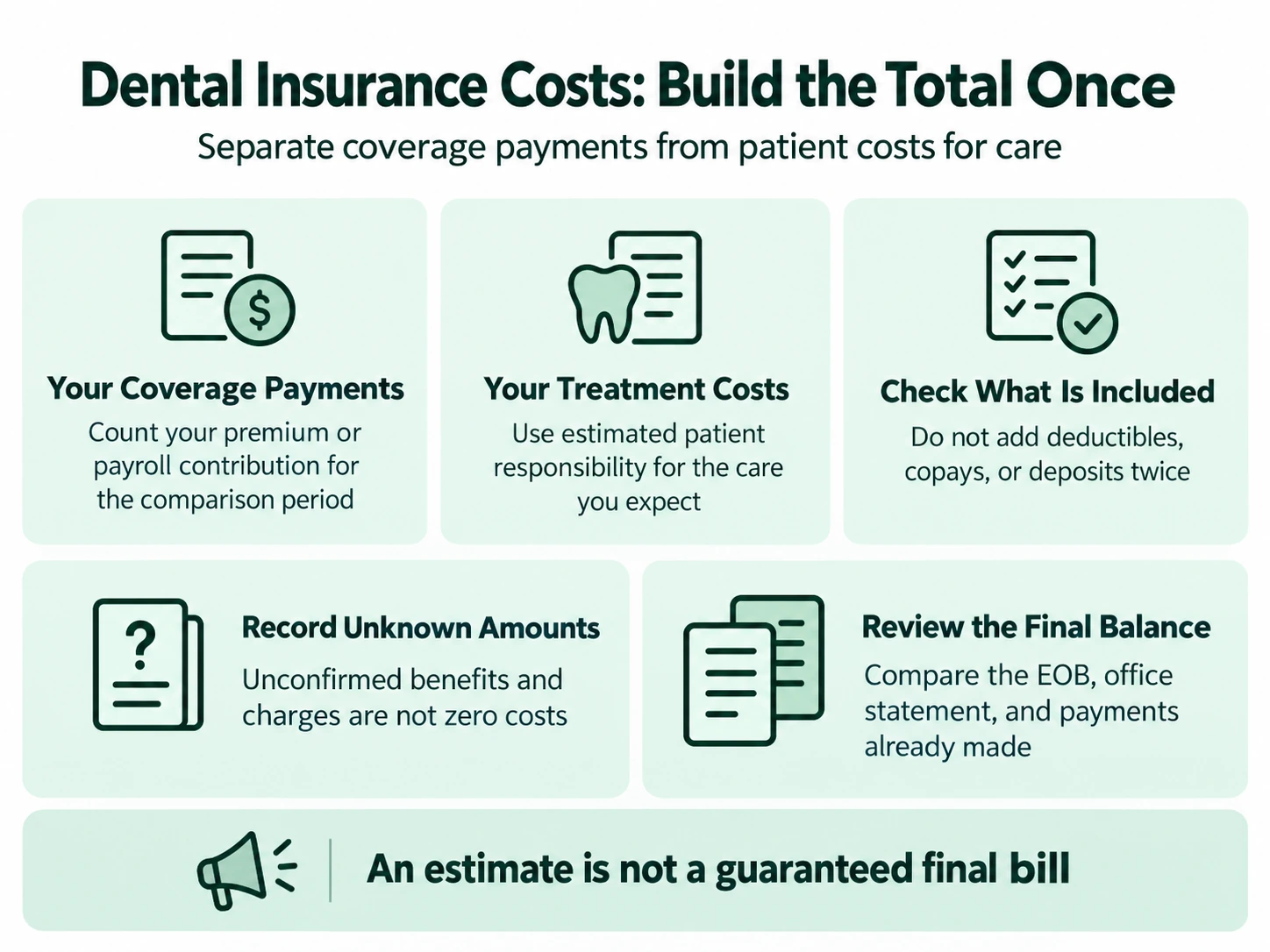
Avoid Counting the Same Cost Twice
| Common error | Better approach |
|---|---|
| Adding the full premium and the employee payroll deduction | Use the personal contribution for a personal-spending comparison |
| Subtracting the employer contribution from an already reduced employee amount | Confirm what the displayed deduction represents |
| Adding the deductible to an estimate that already includes it | Ask which components are included in patient responsibility |
| Adding full dentist charges to estimated patient responsibility | Use the patient amount after applicable benefits and adjustments |
| Subtracting insurance payment again from a net patient estimate | Check whether the estimate is already after insurance |
| Adding a deposit on top of the complete patient responsibility | Treat the deposit as a payment toward that amount |
Premium payments and treatment payments should remain separate in your records. Deposits and installments change when you pay; they do not automatically create additional treatment costs.
When Estimates and Final Bills Differ
An advance estimate uses the information available before the claim is processed.
Ask whether predetermination is available and whether preauthorization is required. These processes are distinct, and their responses may include conditions relating to eligibility, dates, remaining benefits, or treatment details.
Read Dental Insurance Predetermination vs Preauthorization: What’s the Difference?
After treatment, compare the EOB with the dental-office statement. Check procedure details, plan payments, adjustments, and payments you have already made.
An EOB is not a bill. If the amounts do not match, ask the plan about its benefit calculation and the dental office about its account balance.
Use How to Read a Dental Insurance EOB for the detailed review.
What If You Have Two Dental Plans?
Do not add the displayed coverage percentages or assume the secondary plan pays every remaining amount.
Confirm the processing order and each plan’s coordination method. The secondary plan may need the primary plan’s claim information before determining its benefit.
Your estimate should reflect the expected combined result without counting either plan’s payment twice.
Read Can You Have Two Dental Insurance Plans? Coordination of Benefits Explained.
How to Interpret the Cost Comparison
A useful comparison shows both the expected personal cost and how reliable that estimate is.
A lower estimated total deserves closer review when it depends on unconfirmed benefits, unavailable providers, or missing procedures. A higher premium may or may not be justified by the treatment benefits and access you expect to use.
Compare:
- Personal coverage payments for the same period
- Estimated patient costs for the same care
- Provider access you can realistically use
- Important restrictions and unresolved amounts
- The timing of payments you may need to make
Expected spending is not a guaranteed maximum. Unplanned care and treatment changes can create costs outside the estimate.
Our Recommendation
Begin with your actual premium or payroll contribution and an itemized estimate for care you reasonably expect.
Confirm benefit eligibility before calculating payment. Then check which costs are already included, which remain uncertain, and whether the same assumptions are being used for every option.
Keep the estimate, benefit information, and later claim documents together so you can explain how the expected amount became the final balance.
Helpful Resources
- Compare Dental Plans
- Dental Plan Comparison Checklist
- Dental Insurance Annual Maximums Explained
- In-Network vs Out-of-Network Dental Insurance
- How to Compare Dental Plans for Treatment You Already Expect to Need
- How to Read a Dental Insurance EOB
Frequently Asked Questions
Is the premium the total cost of dental insurance?
No. The premium maintains coverage. Deductibles, copays, coinsurance, and other patient charges may apply when you receive care.
Is a payroll deduction an additional cost on top of the premium?
It may be the way your share of the premium is collected. Confirm whether the deduction already includes your employee and dependent coverage costs before adding other amounts.
What is the difference between a deductible, copay, and coinsurance?
A deductible is an amount that may apply before benefits for specified services. A copay is generally a fixed member charge. Coinsurance assigns a percentage of an eligible amount to the plan or member.
Why might the plan allowance differ from the dentist’s charge?
The plan uses its applicable fee or allowance rules to calculate benefits. Network agreements and out-of-network provisions affect how that amount relates to the dentist’s charge and what you may owe.
Does the annual maximum limit my spending?
Not automatically. An annual benefit maximum generally limits plan payments. Patient costs can continue after the available benefit has been used.
How do I avoid adding the deductible twice?
Ask whether the estimated patient responsibility already includes it. If it does, use that total rather than adding the deductible again.
Does predetermination guarantee the final cost?
No. The response may depend on eligibility, benefits available, provider status, and treatment details when services are provided. Compare the final claim result with the earlier estimate.
Will a second dental plan pay the remaining balance?
Not necessarily. Its payment depends on coordination rules and its own benefits. Confirm the expected combined result rather than adding the plans’ percentages together.
Sources
- American Dental Association — Explanation of Benefits Statement
- American Dental Association — Typical Dental Plan Benefits and Limitations
- American Dental Association — Types of Dental Plans
- American Dental Association — Pre-Authorizations
- American Dental Association — Coordination of Benefits
About the Author
Maria Dumitru is the Founder and Content Editor of Dental Coverage Hub. She researches and edits educational content about dental insurance terms, costs, provider access, and coverage rules.
Learn more in our Editorial Policy and How We Review Dental Plans.
Disclaimer
This article provides general educational information, not medical, legal, tax, financial, or personalized insurance advice. Costs and benefits depend on the applicable plan, provider, services, and circumstances. Verify estimates and coverage details with the dental office and insurer or plan administrator. Estimates do not guarantee final payment or patient responsibility.

Compare Dental Plans Using Complete Cost Information
Bring together your coverage payments, estimated treatment costs, and unresolved questions. Use the same people, providers, procedures, and period when reviewing available options.