
PPO vs HMO Dental Plans: What to Compare Before Enrolling
Understand how PPO and DHMO dental plans differ in dentist access, specialist referrals, patient charges, and benefit limits before choosing coverage.
Written and researched by Maria Dumitru.
Founder and Content Editor at Dental Coverage Hub
Last reviewed: October 2026
Comparing PPO vs HMO dental plans starts with understanding how each arrangement provides access to care and handles treatment costs.
A plan’s name does not establish whether your dentist participates, whether a specialist is available, or how much a particular procedure will cost.
This guide uses DHMO to describe HMO-style dental coverage. Product names can vary, so confirm the structure in the documents for the exact option available to you.
What You’ll Learn
- How PPO and DHMO dental plans work
- What changes in dentist selection and specialist access
- How coinsurance and scheduled member charges differ
- Why annual maximums and other restrictions matter
- What to verify for recommended treatment
- How to interpret the differences between available options
For an introduction to common coverage terms, start with Dental Insurance Basics.
Quick Answer
A PPO dental plan uses a network of contracted dentists. It commonly calculates benefits using deductibles, coinsurance, plan allowances, and annual maximums. Out-of-network benefits may be available, but their terms need separate review.
A DHMO generally requires care through participating offices and may require selection or assignment of a primary dentist. Covered services commonly have scheduled patient charges, and specialist care may require a referral or authorization.
Neither structure automatically provides better access or lower total costs. Compare the actual dentists, treatment benefits, patient charges, and restrictions of the plans you can enroll in.
Key Takeaways
- Verify the individual dentist and office location under the exact network
- Check specialist access separately from general-dentist participation
- A PPO benefit percentage does not establish the final patient cost
- A DHMO copay schedule must be read alongside covered-service and referral rules
- No traditional annual maximum does not mean unlimited free care
- Compare the same expected treatment and coverage period under each option
In This Guide
What Is a PPO Dental Plan?
A Preferred Provider Organization dental plan combines dental benefits with a contracted provider network.
Participating dentists agree to applicable fee and billing arrangements. Members may still owe deductibles, copays or coinsurance, and charges for services that do not qualify for benefits.
Many PPO arrangements also provide benefits for care outside the network. Confirm how the plan handles that care rather than assuming the in-network terms carry over.
In-Network and Out-of-Network Costs
For in-network care, contracted fees can affect the amount used to calculate patient charges and plan benefits.
For out-of-network care, the dentist’s charge may exceed the allowance used by the plan. Depending on the applicable rules, the patient may owe that difference as well as ordinary cost sharing.
Check whether the product is actually a PPO, an EPO, or another arrangement. Similar insurer branding does not establish identical network rules.
For the detailed verification process, read In-Network vs Out-of-Network Dental Insurance.
What Is an HMO or DHMO Dental Plan?
A Dental Health Maintenance Organization generally provides benefits through contracted dental offices.
Members typically select or are assigned to a primary dentist. Under a capitation arrangement, the participating office receives a regular payment for assigned members and provides specified services under the contract.
The member may receive some listed services without an additional treatment charge and pay scheduled charges for others. Premiums and charges for noncovered care may still apply.
Dentist Selection and Specialist Care
Before enrolling, confirm:
- Which primary dentists are available
- Whether the office accepts new members of the exact plan
- When a dentist selection or change becomes effective
- Whether specialist care requires referral or authorization
- Which specialists can be used under that process
A directory entry alone does not establish that the office has appointments available.
DHMO benefits generally require participating providers. Check the contract for any emergency or other out-of-network exceptions.
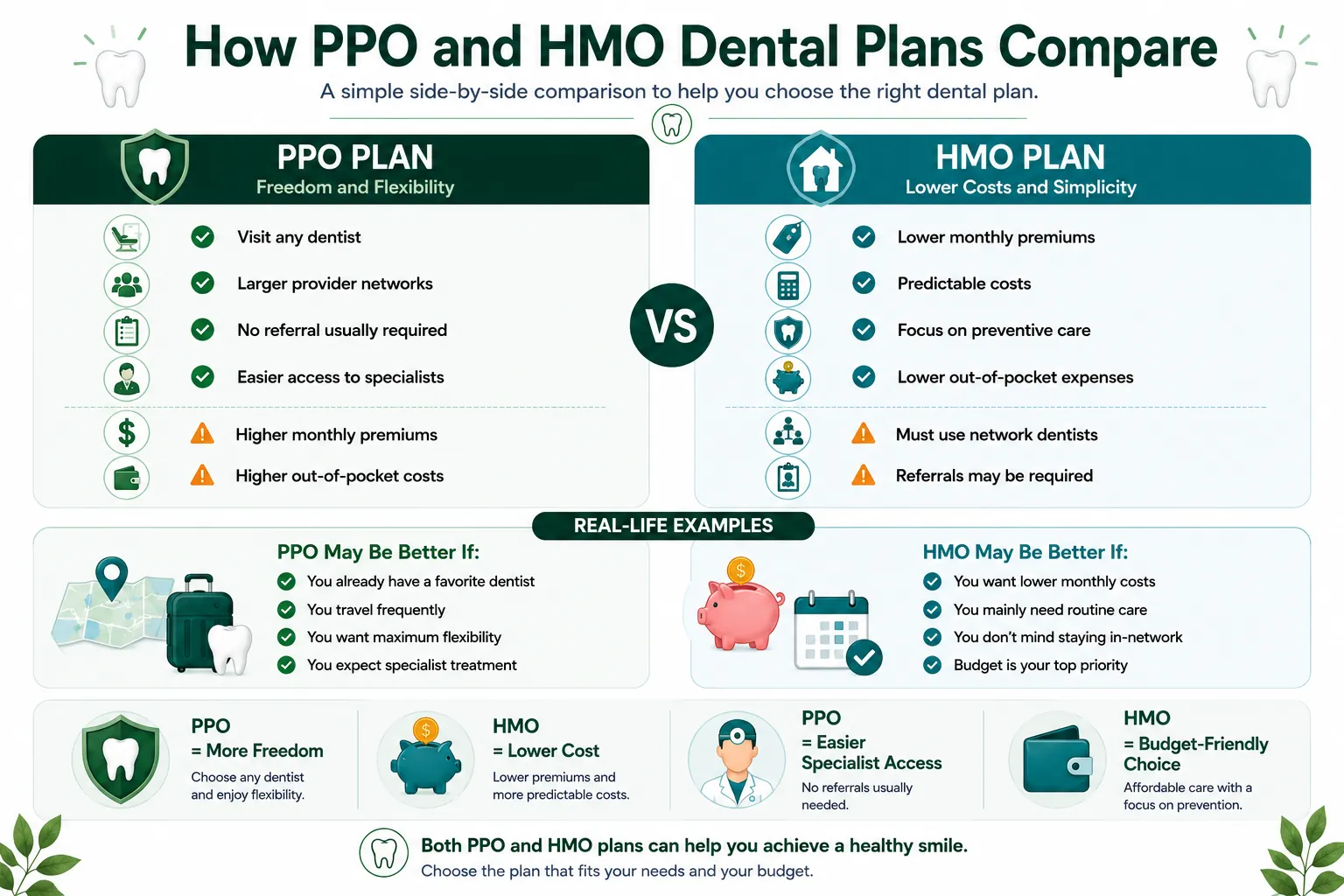
PPO vs HMO Dental Plans: Main Differences
| Comparison area | PPO dental plan | HMO or DHMO dental plan |
|---|---|---|
| Provider arrangement | Contracted network, with possible out-of-network benefits | Care generally provided through contracted offices |
| Primary dentist | Check whether selection is required | Selection or assignment is commonly required |
| Specialist access | Direct access may be available; verify requirements | Referral or authorization may be required |
| Patient charges | Commonly deductibles, coinsurance, and applicable fee allowances | Commonly a schedule of charges for listed services |
| Annual maximum | Common in many policies | Some plans have no traditional annual maximum |
| Out-of-network care | Verify benefits, allowances, and additional patient charges | Generally limited to exceptions described in the contract |
| Main practical check | How the network and benefit calculation affect your care | Whether suitable offices and required services are available under the plan |
These are general patterns. Read the exact contract, benefit schedule, and provider information before relying on them.
How PPO and DHMO Dental Costs Can Differ
Compare what you pay to maintain coverage and what you may pay when receiving treatment.
PPO: Review the Benefit Calculation
For expected care, check the applicable deductible, coinsurance, fee allowance, and remaining benefit limits.
A coverage percentage applies to the amount recognized under the plan’s rules. It does not necessarily apply to the dentist’s complete charge.
Also check whether related services are evaluated separately. An estimate for the main procedure may not include every service needed to complete treatment.
DHMO: Review the Member-Charge Schedule
Find the exact procedure in the schedule and confirm the conditions for the stated charge.
Ask whether the estimate includes all related services and whether different charges apply to specialist treatment. Noncovered services or other charges permitted under the contract can affect the total.
A referral is not itself a treatment-cost category. The important questions are whether the required process has been followed and which charges apply to the resulting care.
Compare Your Total Patient Cost Without Counting Charges Twice
Use the same household enrollment, expected treatment, and comparison period.
Include:
- Your premium or payroll contribution
- Estimated patient responsibility for the complete treatment
- Any separate required fees not already included
Patient responsibility may already include deductibles, copays, coinsurance, and noncovered charges. Do not add those amounts again or subtract the estimated insurance payment twice.
For workplace coverage, use the amount you personally pay. Do not subtract the employer contribution again if it is already reflected in your payroll deduction.
Read Dental Insurance Costs Explained for the complete cost framework.
Annual Maximums and Other Restrictions
Many PPO policies limit the amount the plan pays toward applicable services during a benefit period.
Some DHMO plans do not use a traditional annual maximum. That feature does not establish that every treatment is included or that patient charges are capped.
Both arrangements may have restrictions involving:
- Covered procedures
- Frequency or replacement limits
- Age eligibility
- Orthodontic benefits
- Treatment already underway
- Required providers or advance approval
Check each restriction where relevant to your expected care.
Use Dental Insurance Annual Maximums Explained for the distinction between a plan’s payment limit and your own spending.
Check Benefits for the Treatment You Expect
The PPO or DHMO label does not establish whether a particular procedure qualifies.
Ask the dental office for an itemized treatment plan with procedure names, available codes, treating providers, and estimated dates. Review the same proposed care under both options.
For a PPO, examine how each procedure is classified, the applicable allowance and cost sharing, and any benefit limit.
For a DHMO, examine whether the procedure appears in the covered-service schedule, which member charge applies, and whether the required provider or referral arrangements can be used.
Review Related Services Separately
A course of care may involve several benefit questions.
For example, root canal treatment and the restoration afterward may have separate charges and limitations. Tooth replacement may involve distinct surgical and restorative services.
For procedure-specific guidance, use Dental Insurance Coverage for Common Procedures.
If treatment has been recommended but has not started, read How to Compare Dental Plans for Treatment You Already Expect to Need.
Check Coverage Timing
Confirm when coverage begins and whether a waiting period applies to the proposed service. Do not infer either date from the PPO or DHMO label.
If prior coverage may affect a waiting period, ask what evidence and approval are required.
Read How Waiting Periods Work in Dental Coverage for the detailed timing rules.
If treatment has already begun, use Dental Insurance and Treatment Already in Progress before assuming a new plan will cover the remaining care.
Verify Practical Access Before Enrolling
A plan is difficult to use if suitable participating providers are unavailable where you need care.
Verify the dentist and office location with both the plan and the dental office. Ask about appointment availability and the exact product accepted.
For specialist care, confirm the referral process, participating specialist, location, and patient charges. A referral from an in-network general dentist does not by itself establish the specialist’s network status.
For family coverage, repeat these checks for the providers needed by each member. Access near one person’s home or workplace may not serve someone studying or living elsewhere.
If a plan would require changing dentists, record that as a separate treatment scenario. The new office may propose different services or fees, so the entire cost difference should not be attributed to insurance.
Advance Review and Official Documents
Before significant treatment, ask whether advance review is optional or required.
A predetermination generally provides information about potential benefits. Preauthorization may be a required approval process. Neither should be treated as an unconditional guarantee of final payment.
Confirm what the response covers, whether it has timing conditions, and what must still be verified when treatment occurs.
Read Dental Insurance Predetermination vs Preauthorization: What’s the Difference?
Use the policy or evidence of coverage, benefit or copay schedule, exclusions, and exact provider directory. For employer coverage, review the current enrollment materials and Summary Plan Description when applicable.
Record unresolved questions and ask the insurer or benefits administrator to reconcile conflicting information. Ask the dental office separately about treatment, fees, and clinical timing.
How to Interpret the Comparison
Use the findings to identify which arrangements are workable before comparing their estimated costs.
| What you find | What it means for the comparison |
|---|---|
| Your preferred dentist participates in one option | Verify the relevant treatment benefits and charges under that option |
| A PPO offers out-of-network benefits | Check whether the allowance and your additional charges make that access practical |
| A DHMO has suitable offices and relevant scheduled benefits | Confirm assignment, specialist access, and the complete treatment charges |
| A plan has no traditional annual maximum | Review covered services and patient charges before assuming broader protection |
| The required specialist is unavailable | Resolve access before relying on the plan for that treatment |
| An important restriction remains unclear | Mark the benefit as not confirmed rather than assuming it applies |
Neither structure is universally better. The useful comparison is between the actual options available to you.
For the broader method, use Compare Dental Plans.
Our Recommendation
Begin with usable dentist and specialist access. Then review benefits for the care you expect and calculate your estimated patient costs over the same period.
A PPO’s possible out-of-network benefit and a DHMO’s scheduled charges are features to investigate, not reasons to choose automatically.
Before enrolling, resolve questions that could change your decision and save the documents supporting your comparison.
Helpful Resources
- Dental Insurance Basics
- Dental Insurance Costs Explained
- In-Network vs Out-of-Network Dental Insurance
- How Waiting Periods Work in Dental Coverage
- Dental Insurance Annual Maximums Explained
- Dental Plan Comparison Checklist
Frequently Asked Questions
Is a PPO or DHMO dental plan automatically better?
No. Compare the available dentists, specialist access, benefits for expected procedures, patient charges, and restrictions. The plan label alone does not establish better access or lower total costs.
Is a DHMO the same as an HMO dental plan?
DHMO means Dental Health Maintenance Organization and commonly describes HMO-style dental coverage. You may also encounter names such as DMO or capitation plan. Verify the actual provider and payment arrangements in the documents.
Can I keep my current dentist?
Confirm the individual dentist and office location under the exact plan. A PPO may provide out-of-network benefits. With a DHMO, you generally need an available participating dentist under the plan’s selection or assignment rules.
Do PPO and DHMO plans cover out-of-network care?
PPO arrangements may provide benefits outside the network, with different allowances or patient charges. DHMO benefits generally require contracted providers, subject to exceptions described in the plan. Confirm the terms before scheduling care.
Are DHMO plans always cheaper?
No. Compare your premium contribution and charges for the complete expected treatment. A listed copay may not include related procedures or noncovered services. Provider availability and specialist requirements also matter.
Do both plan types have annual maximums?
Annual maximums are common in many PPO policies. Some DHMO plans do not use a traditional annual maximum. Either arrangement may still have separate limits, exclusions, frequency rules, or orthodontic restrictions.
Will I need a specialist referral?
It depends on the plan. DHMO arrangements commonly coordinate specialist care through a primary dentist. Confirm referral or authorization requirements, the specialist network, and patient charges before treatment.
Which plan type is more suitable for major dental work?
Evaluate the same complete treatment under each available option. Check procedure eligibility, providers, timing restrictions, benefit limits, and patient charges. Neither plan type guarantees suitable benefits for major treatment.
Sources
About the Author
Maria Dumitru is the Founder and Content Editor of Dental Coverage Hub. She researches and edits educational content designed to help U.S. consumers understand dental insurance terms, compare plan features, and verify important information before enrolling.
Learn more about our standards in the Editorial Policy and How We Review Dental Plans.
Disclaimer
This article provides general educational information for U.S. consumers and is not medical, legal, financial, or personalized insurance advice. Provider networks, benefits, member charges, referrals, limitations, and enrollment requirements vary by plan. Estimates and advance reviews do not guarantee payment. Confirm current terms with the insurer or plan administrator and discuss treatment decisions with your dental professional.

Compare the Plans Available to You
Use the same expected care, household members, and coverage period when reviewing PPO and DHMO options. Confirm provider access and important benefit conditions before relying on estimated costs.