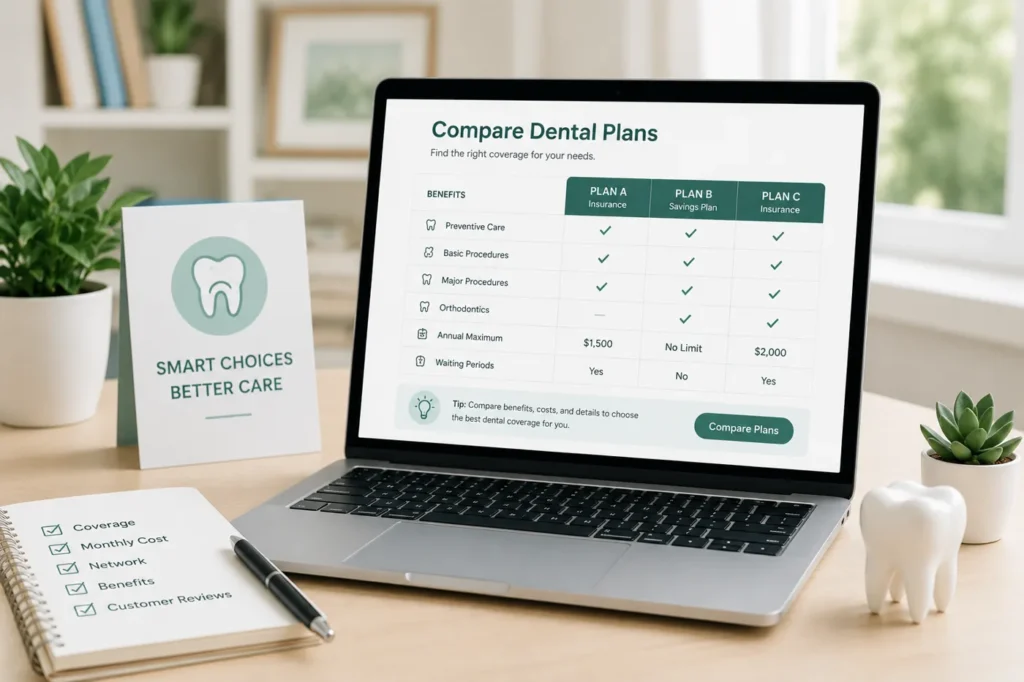
How to Compare Dental Plans for Treatment You Already Expect to Need
Use the same recommended treatment to compare coverage dates, dentist access, benefit restrictions, and estimated costs before enrolling.
Written and researched by Maria Dumitru.
Founder and Content Editor at Dental Coverage Hub
Last reviewed: October 2026
If your dentist has recommended treatment, a general benefits summary may not tell you enough to compare dental plans.
You need to understand how each available option would handle the actual services, providers, and treatment timing involved.
Start with a written treatment plan or estimate. Use the same proposed care when reviewing each insurance option, and record any differences that could affect eligibility or costs.
The treatment recommendation is your starting point. Each dental plan must be checked against it.
What You’ll Learn
- Which treatment details to collect before comparing plans
- How to check benefits for each proposed procedure
- Why coverage dates and provider access come before cost estimates
- How to compare premiums and expected treatment charges
- What advance benefit reviews can and cannot establish
- How to interpret incomplete or conflicting information
Quick Answer
To compare dental plans for planned treatment, first confirm that the options are available to you and can become effective in time. Then check the exact procedures, waiting periods, dentists, specialists, and relevant restrictions.
Compare patient charges only after reviewing those conditions. Include the complete proposed treatment and your premium contribution over the same comparison period.
A plan with a lower premium or higher annual maximum may still provide limited help for the treatment you need.
For the general comparison framework, start with Compare Dental Plans.
Key Takeaways
- Use the same proposed care for every comparison. Include related procedures, providers, and expected dates
- Separate recommended treatment from care already started. Unfinished treatment raises additional coverage questions
- Check eligibility before estimating payment. A listed benefit or available annual maximum does not establish eligibility
- Verify each treating provider. Network participation can differ between the general dentist and specialists
- Keep premiums and treatment charges visible. Compare both over the same period
- Label estimates and unknowns clearly. An advance response does not guarantee the final claim result
In This Guide
Confirm That Treatment Has Not Started
This guide focuses on recommended or reasonably expected treatment that has not begun.
A diagnosis or treatment recommendation alone does not establish whether a future procedure qualifies for benefits. Review the actual plan provisions rather than assuming that a known dental problem is automatically covered or excluded.
If your question is which restrictions may apply to an existing condition, read Dental Insurance and Existing Dental Problems.
If a tooth has already been prepared for a crown, orthodontic treatment is active, or another treatment stage has occurred, identify what is complete and what remains unfinished. Use Dental Insurance and Treatment Already in Progress for that additional review.
When you are unsure whether treatment has started for benefit purposes, describe the completed services to the dental office and plan before choosing a comparison approach.
Get a Written Treatment Plan
Ask the dental office for enough information to identify the care being proposed.
Useful details include:
- Procedure names and codes, when available
- The tooth or treatment area
- Each expected stage and related service
- The dentist or specialist responsible for each part
- Approximate treatment dates
- Itemized office fees
- Any alternatives the dentist has discussed
Procedure codes help identify services, but they do not establish insurance eligibility or guarantee payment.
Ask which services are currently recommended and which are only possible additions. Keep those separate so that every plan is evaluated against the same assumptions.
Include the Complete Course of Care
A familiar treatment name may describe only part of the expected work.
For example, root canal treatment and a later restoration may require separate benefit checks. Tooth replacement may involve several surgical or restorative services.
Do not assume that the office’s headline estimate includes every related procedure. Ask what is included and what remains uncertain.
For treatment-specific questions, use Dental Insurance Coverage for Common Dental Procedures.
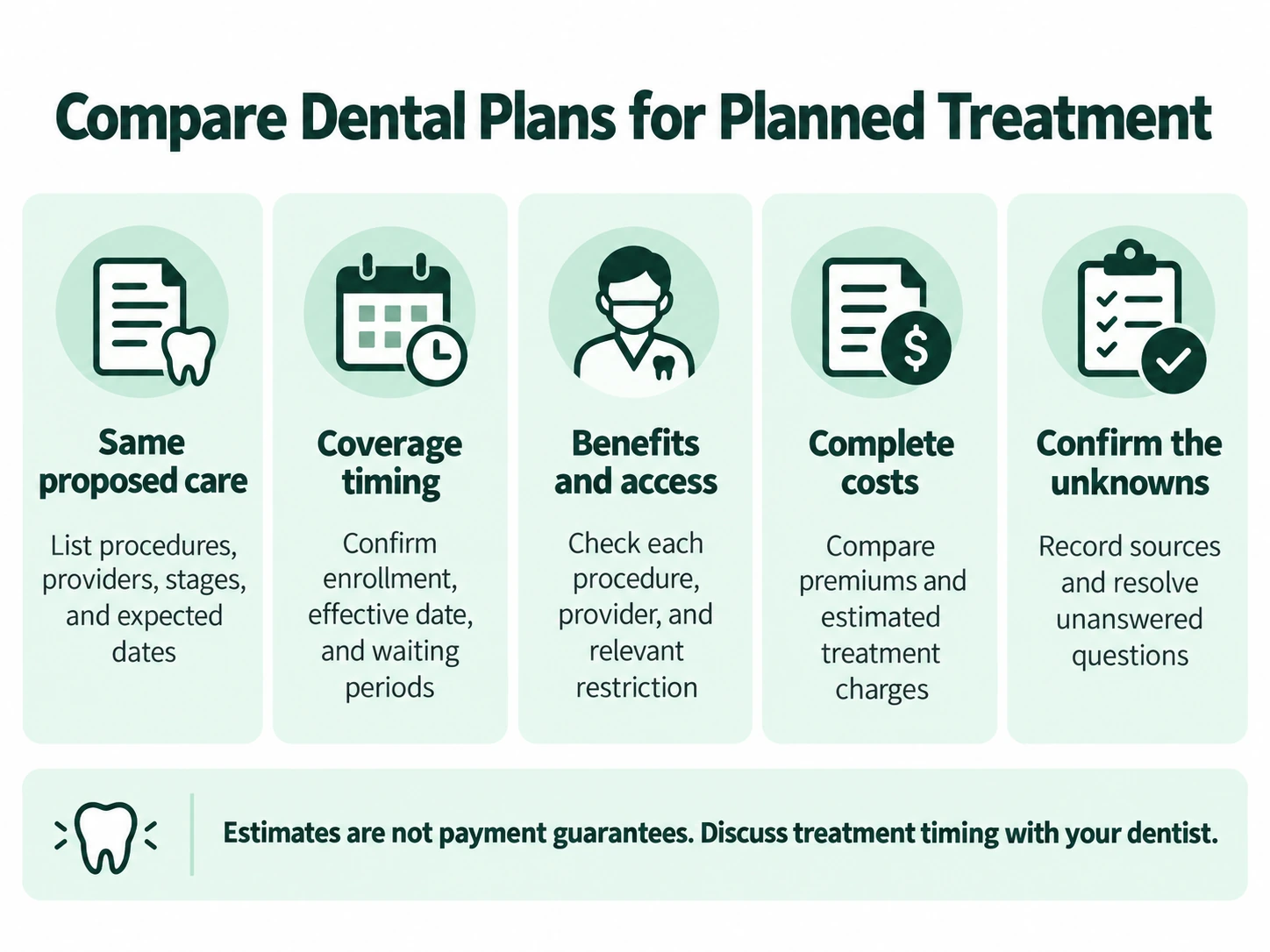
How to Compare Dental Plans for Planned Treatment
1. Confirm Enrollment Availability and Coverage Timing
Compare options you can actually enroll in.
For each plan, record the applicable enrollment requirements and earliest confirmed effective date. Compare that date with the treatment schedule provided by your dental professional.
Next, check whether a waiting period applies to any proposed service and when it would end. If previous coverage might qualify for a waiver, confirm the requirements and whether approval has been obtained.
Do not enter an assumed waiver as an established benefit.
The coverage start date and the availability of a particular benefit are separate checks. See Dental Insurance Effective Date: When Does Coverage Start?
For service-related timing restrictions, read How Waiting Periods Work in Dental Coverage.
Discuss treatment urgency with your dentist. Do not postpone care solely to reach an insurance date without understanding the clinical consequences.
2. Check Each Procedure and Its Restrictions
Use the same procedure list with every plan.
Ask whether each service is included, how it is classified, and which provisions could prevent or reduce a benefit. A general major-services percentage is not enough to evaluate a specific treatment.
Depending on the proposed care, check:
- Exclusions or documentation requirements
- Frequency limits for repeated services
- Replacement provisions for existing dental work
- Missing-tooth provisions
- Alternate-benefit provisions
- Required authorization or referral
Apply these checks only where relevant.
If a tooth is already missing, use Missing Tooth Clauses in Dental Insurance to identify the history and contract language to review.
An alternate-benefit provision may base payment on a different covered treatment. Ask how that affects the estimated payment for the treatment you and your dentist are considering. The benefit calculation does not replace the clinical discussion about appropriate care.
3. Verify the Dentist and Every Specialist
Check the individual provider, office location, and exact network associated with each option.
If the proposed treatment involves several providers, verify them separately. Also confirm appointment availability and any referral or assigned-dentist requirements.
An office accepting an insurance company does not establish participation in every plan offered by that company.
Read In-Network vs Out-of-Network Dental Insurance for the provider-access and payment questions to verify.
What if one option requires changing dentists?
Record it as a separate provider scenario. Obtain a treatment and fee estimate from the alternative office when feasible, and identify any differences in the proposed care.
Do not attribute the entire cost difference to insurance if the provider, treatment, or included services also change.
4. Review the Applicable Charges and Benefit Limits
For procedures that may qualify, record:
- Whether a deductible applies
- The copay or coinsurance
- The fee or allowance used to calculate benefits
- Any applicable annual or separate service limit
- Potential noncovered or additional patient charges
A percentage alone does not tell you the expected payment. For a plan using scheduled member charges, review the charge for each proposed service and any additional fees.
See Dental Insurance Costs Explained for the relationship between these amounts.
If comparing an existing plan with a new option, use the benefits applicable to the proposed treatment dates. For care during the current benefit period, check the existing plan’s remaining benefits. For care after renewal, verify the upcoming terms and limits. For a new option, confirm the benefit period and any initial or prorated limits.
If your coverage will renew before the proposed treatment, read Dental Insurance Renewal: What to Compare Before Keeping or Changing Your Plan to identify changes in costs, provider access, and benefits before comparing the renewed plan with alternatives.
If treatment spans benefit periods, ask which date or stage the plan recognizes for each procedure. Do not assume that separate appointments automatically produce separate annual benefits.
For the broader framework, read Dental Insurance Annual Maximums Explained.
5. Compare Premiums and Treatment Costs Over the Same Period
Keep two amounts visible:
- Your premium contribution for the period being compared
- Your estimated patient responsibility for the complete proposed treatment after any estimated plan payment
Include applicable deductibles, copays, coinsurance, and noncovered charges in the treatment estimate. Do not add them again if they are already included.
Add any separate enrollment or administrative fees where applicable. Use the same household enrollment and comparison period for every option.
For employer coverage, use your payroll contribution. If that amount already reflects employer support, do not subtract the employer contribution again.
Do not subtract an estimated insurance payment again if the dental office’s patient estimate already accounts for it.
Label amounts as confirmed, estimated, or unknown. If a material allowance or restriction cannot be verified, leave the affected total unresolved rather than treating the missing amount as zero.
6. Record the Source and Resolve Important Unknowns
Keep the plan name, document version, relevant provision, and date of each clarification.
Before relying on the comparison, identify questions that could materially change the result, such as an unconfirmed waiting-period waiver, missing specialist access, or an unresolved replacement restriction.
If a summary and detailed policy appear inconsistent, ask the insurer or plan administrator to reconcile them. Ask the dental office separately about the treatment description, fees, and clinical timing.
Compare the Same Treatment Side by Side
Use a separate column for each available plan. Record the treatment scenario once, then complete these fields for every option.
| Comparison field | What to record |
|---|---|
| Enrollment and start date | Whether enrollment is available and when coverage can begin |
| Proposed services | The same procedure list, with any differences clearly identified |
| Waiting periods | Applicable services, end dates, and waiver status |
| Provider access | Each dentist, specialist, location, and relevant referral requirement |
| Eligibility restrictions | Relevant exclusions, frequency, replacement, missing-tooth, or alternate-benefit provisions |
| Treatment charges | Applicable deductible, member charges, allowances, and noncovered costs |
| Benefit limits | Applicable or remaining limits and the benefit period |
| Total comparison | Premium contribution and estimated treatment responsibility over the same period |
| Unresolved information | What remains unknown, who must confirm it, and the supporting documents |
Mark each treatment component as potentially eligible, restricted or excluded under the reviewed terms, or not confirmed. These are working comparison notes, not final claim decisions.
Use the Dental Plan Comparison Checklist to organize the broader plan information.
Can You Get a Benefit Estimate Before Treatment?
The dental office’s estimate, the plan’s advance response, and a processed claim serve different purposes.
| Document or process | What it helps establish | What to remember |
|---|---|---|
| Dental-office estimate | Proposed procedures and office charges | Does not establish the insurance payment |
| Predetermination | Advance information about potential benefits | May depend on eligibility, remaining benefits, and other conditions |
| Preauthorization | Whether a required prior-approval process has been satisfied | Check the scope and conditions of the response |
| Processed claim and EOB | How reported services were evaluated | May differ from earlier estimates and can require clarification |
Before Enrollment
Use the policy, benefit schedule, provider information, and clarification from the insurer or benefits administrator.
Ask whether procedure-specific information is available to prospective members. Do not assume that a personalized predetermination will be issued before enrollment.
If the plan cannot answer a material question yet, preserve that uncertainty in your comparison.
After Enrollment and Before Treatment
Confirm whether advance review is available or required. Ask what information must be submitted, how long review may take, and whether the proposed treatment date is covered by the response.
Read Dental Insurance Predetermination vs Preauthorization: What’s the Difference?
Recheck relevant details if treatment, providers, dates, or available benefits change. Do not treat an earlier response as an unconditional promise of payment.
How to Interpret Your Comparison
First identify whether each option meets your essential requirements for timing, provider access, and the proposed care.
Then compare costs among the workable options.
| Finding | How to interpret it |
|---|---|
| A plan cannot provide the relevant benefit by the expected treatment date | It may offer little help for that service now; consider future coverage separately |
| The advertised maximum is high but the procedure is excluded | The maximum does not resolve the exclusion |
| A plan requires a different provider | Verify access and create a separate, clearly labeled treatment estimate |
| One option appears cheaper but excludes related services from its estimate | Complete the comparison before drawing a conclusion |
| A material provision remains unconfirmed | The available information is insufficient to rely on that benefit |
| No available option appears useful for the immediate treatment | Ask the dental office about direct-pay charges and care arrangements; evaluate insurance for future needs separately |
A clear comparison can reveal that a plan is useful for some services but not others. It can also show that the apparent advantage depends on an assumption that still needs verification.
Our Recommendation
Start with the written treatment plan and compare only the insurance options available to you.
Verify timing, procedure eligibility, and provider access before relying on a payment estimate. Keep uncertain information visible and compare the complete treatment over the same period.
If the proposed care changes or treatment begins before you enroll, update the comparison and check which additional provisions may apply.
Helpful Resources
- Compare Dental Plans
- Dental Plan Comparison Checklist
- Dental Insurance Costs Explained
- In-Network vs Out-of-Network Dental Insurance
- How Waiting Periods Work in Dental Coverage
- Dental Insurance Annual Maximums Explained
Frequently Asked Questions
Can I enroll after my dentist recommends treatment?
You may be able to enroll if you meet the plan’s availability and enrollment requirements. The recommendation alone does not establish or prevent benefits. Check the proposed procedures against the actual coverage terms.
What should I ask my dentist for before comparing plans?
Request an itemized treatment plan or estimate with procedure names, available codes, providers, expected stages, approximate dates, and fees. Ask which services are recommended now and which are only possible additions.
Should I choose the plan with the highest annual maximum?
Not automatically. First establish whether the proposed care may qualify within the expected timeframe. Then compare the applicable maximum with premiums, patient charges, network access, and restrictions.
What if my dentist is not in one plan’s network?
Confirm whether that option provides out-of-network benefits and how charges would be calculated. If you would change dentists, verify the alternative provider and obtain a separate estimate rather than assuming the original fees and treatment details remain unchanged.
Can I get a predetermination before enrolling?
Ask the plan what information it provides to prospective members. A personalized predetermination may require enrollment. Before joining, use the official documents and written clarification, and mark unanswered questions as not confirmed.
What if the recommended treatment changes?
Update the procedure list, dates, providers, and estimates for every option. Earlier benefit information may no longer describe the revised care, so ask whether a new advance review is needed.
What if treatment has already started?
Review completed and unfinished procedures separately. Coverage changes may introduce treatment-in-progress and procedure-date questions. Use Dental Insurance and Treatment Already in Progress for that review.
What if no available plan helps with the treatment I need soon?
Ask the dental office about written direct-pay estimates and available care or payment arrangements. Discuss clinical timing with your dentist. A plan may still offer future benefits, but that is a separate question from assistance with the immediate treatment.
Sources
- American Dental Association — Types of Dental Plans
- American Dental Association — Typical Dental Plan Benefits and Limitations
- American Dental Association — Pre-Authorizations
- American Dental Association — Least Expensive Alternative Treatment Clause
- HealthCare.gov — Dental Coverage in the Marketplace
About the Author
Maria Dumitru is the Founder and Content Editor of Dental Coverage Hub. She researches and develops educational resources to help U.S. consumers understand dental coverage, benefit rules, costs, and comparison factors.
Learn about our standards in the Editorial Policy and How We Review Dental Plans.
Disclaimer
This article provides general educational information for U.S. consumers and is not medical, legal, financial, or personalized insurance advice. Benefits, eligibility, enrollment rules, provider participation, and patient charges vary by plan and circumstances. Treatment estimates and advance benefit responses do not guarantee payment. Verify current terms with the insurer or plan administrator and discuss treatment decisions with your dental professional.
Dental Coverage Hub is an independent educational publisher, not an insurer or insurance broker.

Compare Plans Using Your Recommended Treatment
Keep your written treatment plan beside the documents for each insurance option. Check timing, provider access, and procedure restrictions before comparing estimated patient costs. Record unanswered questions and confirm important details before enrolling or relying on an estimated benefit.