Dental Insurance Renewal: What to Compare Before Keeping or Changing Your Plan
Compare upcoming premiums, dentist access, benefits, and enrollment requirements to decide whether your dental coverage still fits your needs.
Written and researched by Maria Dumitru.
Founder and Content Editor at Dental Coverage Hub
Last reviewed: October 2026
Dental insurance renewal is a time to check what your coverage will provide during the next period.
A familiar insurer or plan name does not establish that the premium, network, benefits, or enrollment requirements will remain unchanged. Your own circumstances may also be different, even when the plan changes very little.
Start with the upcoming version of your current coverage. Compare it with the terms you have now, then consider your household, preferred dentists, and expected care.
Keeping the plan may remain reasonable. Comparing alternatives may also be useful. The decision should reflect the coverage available for the next period, including any consequences of switching.
What You’ll Learn
- Which documents and deadlines to check before renewal
- How to compare current and upcoming costs, networks, and benefits
- Which benefit histories may continue across coverage periods
- How recommended or ongoing treatment affects the review
- What to verify before relying on an earlier benefit estimate
- How to confirm your decision and avoid an unintended coverage gap
Quick Answer
Before renewing dental insurance, confirm the decision deadline and whether coverage continues automatically or requires an active election.
Then compare the current and upcoming terms for premiums or payroll deductions, provider access, deductibles, benefit limits, relevant services, and dependent coverage.
Use your expected dental care to decide which differences matter. If you consider another plan, compare it with the renewed version of your current plan, using the same people, procedures, providers, and coverage period.
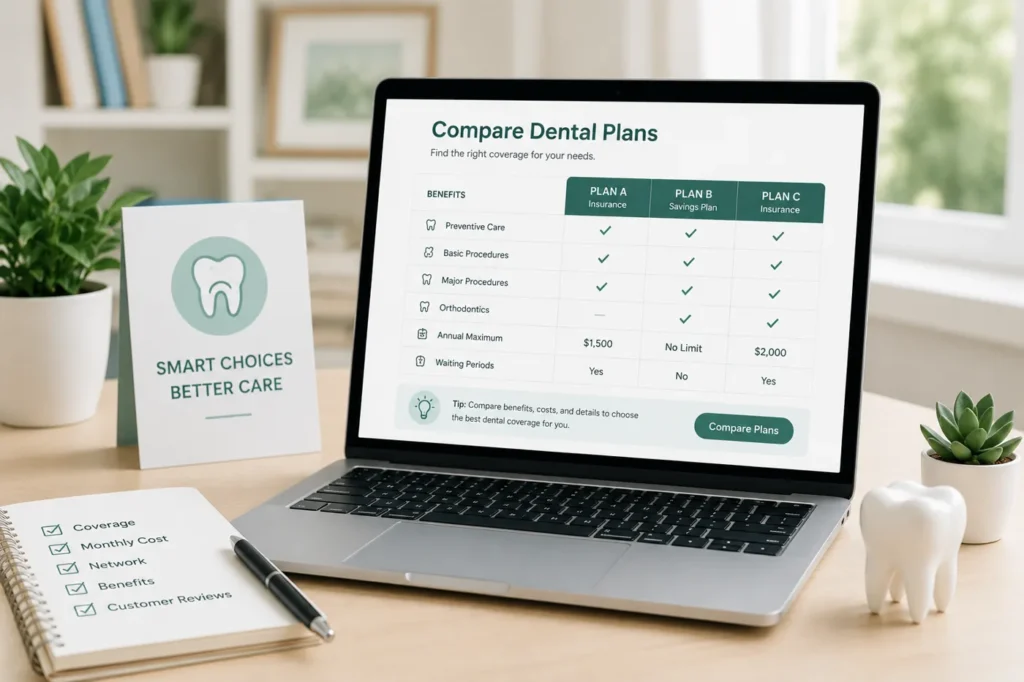
For the broader comparison framework, start with Compare Dental Plans.
Key Takeaways
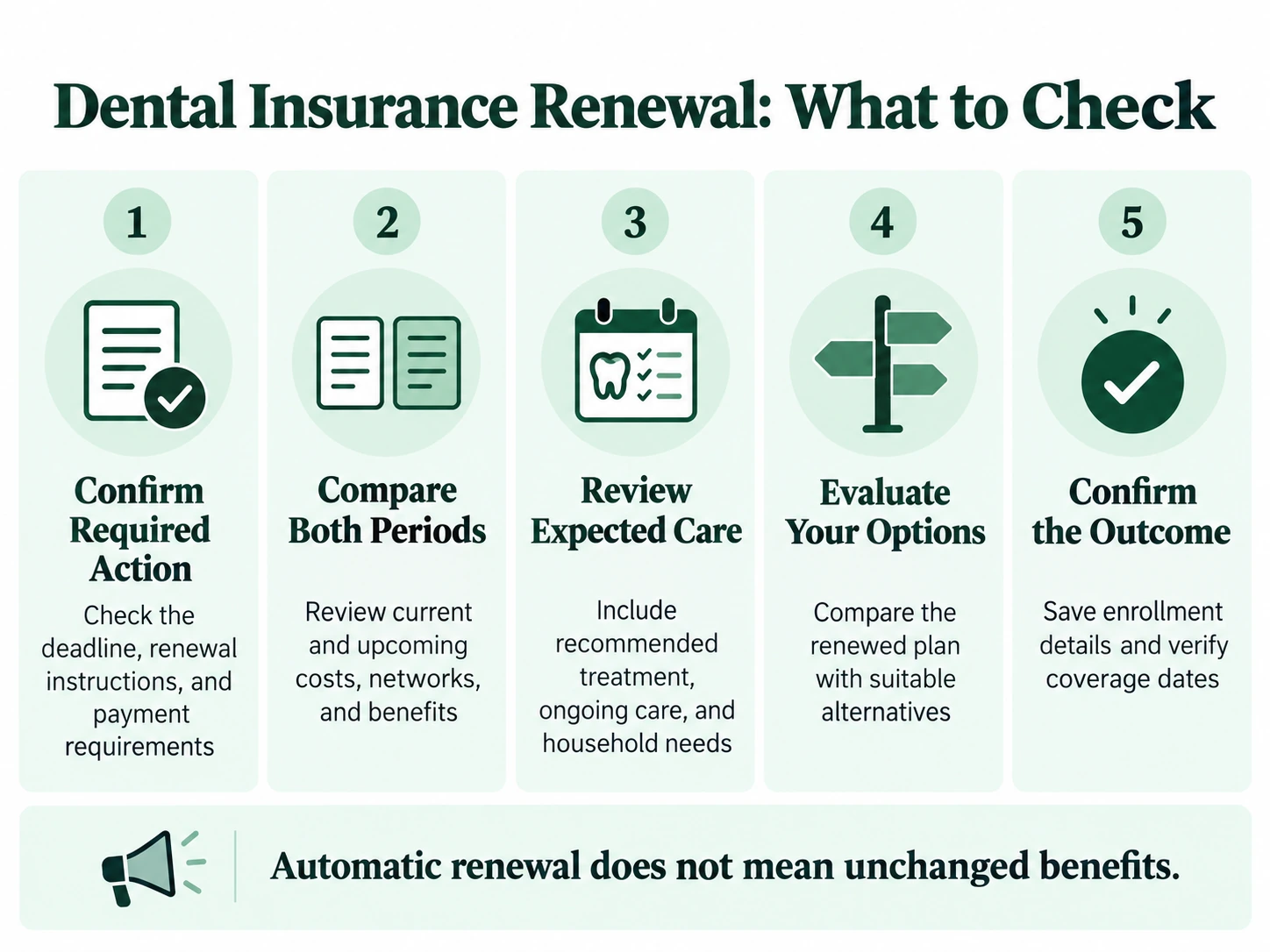
- Automatic renewal does not establish that all costs and benefits remain unchanged
- Compare the upcoming terms with current documents and your expected needs
- Separate the employer contribution from the amount your household pays
- Renewal, deductible resets, and benefit-period resets may follow different dates
- Recheck provider participation and earlier benefit information for upcoming treatment
- Confirm enrollment, payment, and coverage dates before ending an existing arrangement
In This Guide
Start With the Renewal Instructions and Decision Deadline
Before reviewing benefits, establish what action is required and when.
Confirm:
- Whether the plan remains available for the next period
- Whether coverage continues automatically or requires an election
- The deadline to keep, change, or decline coverage
- When any new terms or election take effect
- Whether a payment or updated payment authorization is required
- What happens if you take no action
Do not assume that every dental plan follows the same annual enrollment calendar.
Employer-Sponsored Dental Coverage
Use the employer’s current benefits materials and enrollment instructions.
Check which dental options will be offered, the employee contribution for your household tier, dependent eligibility, and the result of making no election. A default election should not be assumed to preserve every detail of the previous coverage.
For an ERISA-covered plan, review the Summary Plan Description and applicable amendments or summaries of material modifications alongside the enrollment materials.
Individually Purchased Dental Insurance
Review the insurer’s renewal notice, upcoming premium, policy changes, payment requirements, and cancellation instructions.
Automatic billing and automatic renewal are related administrative arrangements, but neither replaces a review of the upcoming coverage.
If dental benefits are connected to Marketplace health coverage, identify whether they are part of the health plan or provided through a separate dental plan. The arrangements have different rules for changing or removing dental coverage.
Gather Comparable Documents for Both Periods
Use documents that identify the exact plan, network, and period they cover.
Gather:
- Current and upcoming benefit schedules or summaries
- Renewal notices and notices of changes
- Premium or payroll contribution information
- Relevant policy, certificate, or employer-plan documents
- Provider-network information
- Enrollment and payment instructions
A notice highlighting selected changes may not answer every question about a procedure or provider.
Record the source and effective date of important information. If the documents conflict, ask the insurer or benefits administrator which terms apply to the upcoming period.
Mark unresolved details as not confirmed. Do not treat missing information as evidence that nothing changed.
Current Coverage vs Upcoming Coverage: What to Compare
Use the following table to organize the renewal review.
| Comparison area | What to check across both periods |
|---|---|
| Premium or payroll deduction | Your required payment for the same household tier and coverage period |
| Employer contribution | Whether employer support changes and how that affects your payment |
| Provider access | Exact network, individual dentists, office locations, and relevant specialists |
| Deductible and cost sharing | Applicable deductible, copays, coinsurance, or scheduled member charges |
| Benefit limits | Annual or other limits, reset dates, and any rollover provisions |
| Expected procedures | Classification, eligibility requirements, and relevant restrictions |
| Waiting-period status | Continued credit, newly added benefits or dependents, and any replacement-plan requirements |
| Household coverage | People covered, eligibility, dependent costs, and benefits relevant to each person |
| Enrollment requirements | Required action, deadline, effective date, and payment arrangements |
Compare the contractual terms separately from the benefits remaining today. A partially used current annual maximum is not directly comparable to the full limit shown for a future benefit period.
Use the Dental Plan Comparison Checklist if you also need to organize alternative plans side by side.
Review the Changes That Affect Your Costs and Access
Premiums and Employer Contributions
For workplace coverage, distinguish the total plan premium, the employer contribution, and your payroll deduction.
Your payment may increase because the employer contributes less, even if the underlying benefits remain similar. Conversely, a higher employer contribution does not establish that the plan has improved.
If the payroll deduction already reflects the employer contribution, do not subtract that contribution again.
For individual coverage, compare the upcoming premium and any applicable fees over the same period used for alternatives.
Then consider expected treatment charges. A lower premium alone does not establish a lower total cost.
Read Dental Insurance Costs Explained for the complete cost framework.
Dentists, Specialists, and Office Locations
Verify the exact upcoming network and the individual providers you expect to use.
Check the dentist’s office location and any relevant specialist separately. Participation with the insurer generally does not establish participation in every plan or network it administers.
If future participation cannot yet be confirmed, record that uncertainty and ask when updated information will be available. Reconfirm before significant treatment.
For the verification process, read In-Network vs Out-of-Network Dental Insurance.
Relevant Benefits and Restrictions
Focus on the procedures you reasonably expect to need.
Check whether the upcoming plan changes:
- The service classification
- Your copay, coinsurance, or scheduled charge
- Frequency or replacement restrictions
- Exclusions or alternate-benefit provisions
- Referral, authorization, or documentation requirements
A service can remain on the covered-services list while the conditions or amount of the benefit change.
For a broader explanation of benefit restrictions, read Dental Insurance Exclusions and Limitations: What to Check Before Enrolling.
Household Coverage
Review the people actually enrolled, rather than only the employee-only or individual premium.
Confirm continued dependent eligibility, the correct enrollment tier, and access to providers for each household member. Check pediatric and orthodontic benefits separately when relevant.
For shared or separate household arrangements, read Individual vs Family Dental Plans.
What Resets at Renewal—and What May Continue?
Renewal does not mean that every benefit starts over.
The renewal date, effective date of benefit changes, deductible reset, and annual-maximum reset may not be identical. Confirm each applicable date.
Also distinguish an annual benefit reset from other histories or restrictions.
For example:
- A lifetime benefit limit may continue across several periods
- A replacement rule may still depend on when existing dental work was placed
- A rolling frequency limit may still consider earlier services
- Rollover benefits may depend on continued eligibility and other conditions
- Pending claims may affect the benefits available under the relevant period
Ask the plan how services near the boundary between periods are assigned. Do not assume that the date a claim is processed determines the benefit period.
For the detailed limit framework, read Dental Insurance Annual Maximums Explained.
Does Renewal Restart Waiting Periods?
Do not assume that routine renewal automatically creates another waiting period.
Confirm how continued enrollment is treated, particularly if you change options, add a dependent, or obtain a newly available benefit.
If you switch plans, ask the replacement plan whether previous coverage can affect its waiting periods and what documentation is required. Do not assume that credit transfers automatically.
Read How Waiting Periods Work in Dental Coverage for the separate timing rules.
What Dental Care Do You Expect During the Next Coverage Period?
Review current recommendations, ongoing specialist care, and the needs of other covered household members.
You do not need to predict every future dental problem. Use the information already available, including written treatment recommendations and expected follow-up care.
A plan with few changes may no longer fit your circumstances. A changed plan may still provide suitable access and benefits.
Treatment Recommended but Not Started
Use the same written treatment plan when evaluating the renewed coverage and any alternatives.
Keep the proposed procedures, providers, related services, and expected dates consistent so that the comparison reflects differences between plans.
Read How to Compare Dental Plans for Treatment You Already Expect to Need for that method.
Treatment Already Underway
First determine whether you are continuing the same coverage with updated terms or moving to a different arrangement.
Routine renewal does not automatically mean that an old plan ends and a new plan takes over. However, benefit changes, provider changes, and services spanning coverage periods may still require clarification.
If coverage is being replaced or a relevant provision changes, ask how completed and unfinished procedures will be evaluated. For active orthodontic treatment, also verify continuing payment and eligibility requirements.
Use Dental Insurance and Treatment Already in Progress for the detailed review.
Discuss clinical timing with your dentist separately from insurance timing.
Will an Existing Benefit Estimate Still Apply After Renewal?
An earlier response may remain useful, but it should not be assumed to describe the benefits available when future services occur.
Predetermination generally provides advance benefit information. Preauthorization may be a required approval process. They are distinct, and the plan’s requirements matter.
Before treatment after renewal, confirm:
- Whether the patient remains eligible
- Whether the relevant benefits or available limits have changed
- Whether the provider participates in the applicable network
- Whether the response covers the proposed services and dates
- Whether a new or updated submission is required
Do not assume that every earlier authorization expires at renewal—or that it automatically remains sufficient. Ask the plan to confirm its scope and validity.
For the separate processes, read Dental Insurance Predetermination vs Preauthorization: What’s the Difference?
How to Interpret Your Renewal Comparison
Use the findings to identify the next practical step.
| What you find | What to do next |
|---|---|
| Upcoming terms and expected needs remain suitable | Confirm the action needed to continue coverage |
| Your payment increases | Review the household impact alongside benefits and provider access |
| A preferred provider may leave the network | Verify participation and compare available provider or plan options |
| A relevant benefit becomes more restricted | Evaluate the effect on the specific care you expect |
| Your needs change while the plan stays similar | Compare whether the renewed coverage still fits those needs |
| A potentially suitable alternative becomes available | Compare its full terms and transition requirements |
| Important information remains unresolved | Request clarification before the decision deadline |
You do not need to find a major plan change to justify comparing alternatives. Budget changes, difficult provider access, unresolved service problems, or different treatment needs can also make a comparison useful.
Evaluate alternatives against the upcoming version of your current plan. Use How to Compare Dental Plans Online for the broader research process.
Before Switching, Confirm the Coverage Transition
A suitable alternative must be available to you and begin when you need coverage.
For an individually purchased policy, confirm enrollment acceptance, the scheduled effective date, payment requirements, and cancellation instructions before arranging the end of your existing policy.
For employer-sponsored coverage, follow the employer’s election process. Confirm when the selected option begins, when the previous option ends, and whether any separate action is required.
Check:
- The final covered date under the existing arrangement
- The confirmed start date of the replacement coverage
- Whether a gap or overlap would occur
- Applicable waiting periods and any credit for previous coverage
- How unfinished treatment and earlier authorizations are handled
- Which plan should receive outstanding claims
Do not assume that enrolling elsewhere automatically cancels an individually purchased policy. Coordinate the dates using the applicable enrollment and cancellation procedures.
For coverage-start verification, read Dental Insurance Effective Date: When Does Coverage Start?
Confirm and Save Your Renewal Decision
After keeping or changing coverage, save the confirmation and upcoming plan documents.
Check that the record shows the intended:
- Plan and network
- Covered household members
- Premium or payroll deduction
- Effective date
- Payment or payroll arrangements
If you changed coverage, keep any termination confirmation too.
Once the new period begins, check that the enrollment and payment records match your election. Report discrepancies promptly to the insurer or benefits administrator, and give the dental office updated information when relevant.
Our Recommendation
Begin with the decision deadline and the documents for the upcoming coverage period.
Identify what changed in the plan and what changed in your own needs. Then evaluate the consequences for household costs, provider access, and expected treatment.
If you compare alternatives, use the same assumptions and include the transition requirements. Whether you stay or switch, confirm the final enrollment details and retain the documents supporting your decision.
Helpful Resources
- Compare Dental Plans
- Dental Plan Comparison Checklist
- Dental Insurance Costs Explained
- In-Network vs Out-of-Network Dental Insurance
- Dental Insurance Annual Maximums Explained
- How to Compare Dental Plans for Treatment You Already Expect to Need
Frequently Asked Questions
Does dental insurance renew automatically?
Some arrangements continue automatically, while others require an active election or other action. Check the renewal or employer enrollment instructions, including payment requirements and what happens if you do nothing.
Should I switch dental plans if my premium increases?
Not automatically. Compare the upcoming payment with provider access, relevant benefits, and expected treatment costs. For workplace coverage, check whether the employer contribution changed. An alternative with a lower premium may have different restrictions or transition requirements.
Can my dentist’s network status change at renewal?
Yes. Verify the individual dentist, office location, and relevant specialists under the exact upcoming network. If future participation is not yet confirmed, ask when updated information will be available and recheck before treatment.
Do deductibles and annual maximums reset on the renewal date?
Not necessarily. Confirm the dates used by the plan. An annual reset also does not establish that lifetime limits, replacement histories, rolling frequency limits, or other restrictions start over.
Will renewing the same dental plan create another waiting period?
Do not assume that renewal alone restarts waiting periods. Verify how continued enrollment is treated and whether changing options, adding dependents, or adding benefits affects the rules. A replacement plan requires a separate review.
What if treatment has been recommended or already started?
For recommended treatment that has not started, compare the same proposed care under the renewed plan and alternatives. For treatment already underway, verify whether coverage or relevant terms are changing and how unfinished procedures will be evaluated.
Does an earlier predetermination or preauthorization remain valid after renewal?
Ask the plan. Confirm the services and dates addressed, any validity conditions, and whether updated information is required. An earlier response should not be treated as a guarantee of payment under the upcoming benefits.
Should I cancel my current policy as soon as I select another plan?
No. First confirm enrollment acceptance, the replacement plan’s scheduled effective date, payment requirements, and the current policy’s cancellation procedure. Coordinate the dates before arranging the change. If you are changing workplace options, follow the employer’s election instructions and confirm when each option starts or ends.
Sources
- U.S. Department of Labor — Plan Information
- American Dental Association — Typical Dental Plan Benefits and Limitations
- American Dental Association — Eligibility Verification
- American Dental Association — Pre-Authorizations
- HealthCare.gov — Dental Coverage in the Marketplace
About the Author
Maria Dumitru is the Founder and Content Editor of Dental Coverage Hub. She researches and develops educational resources that help U.S. consumers understand dental insurance, compare plan details, and identify information to verify before enrolling.
Learn more in our Editorial Policy and How We Review Dental Plans.
Disclaimer
This article provides general educational information, not medical, legal, financial, or personalized insurance advice. Renewal procedures, eligibility, benefits, provider networks, and enrollment requirements vary by plan, employer, insurer, and state. Review the applicable documents and confirm details with the insurer or benefits administrator. Discuss treatment needs and clinical timing with your dental professional.

Review Your Dental Coverage Before Renewal
Use the upcoming plan documents to compare household costs, dentist access, and benefits for expected care. Record unresolved questions and confirm the required enrollment action before the deadline.