🦷 Dental Enrollment Options
🇺🇸 Built for U.S. Consumers
✓ Household Coverage Comparison

Individual vs Family Dental Plans: What to Compare Before Enrolling
Compare eligibility, household premiums, deductibles, benefit limits, provider networks, pediatric benefits, orthodontic rules, and total expected costs.
Written and researched by Maria Dumitru.
Founder and Content Editor at Dental Coverage Hub
Last reviewed: August 2026
What You’ll Learn
Individual and family dental coverage describe who is enrolled under a plan. They do not, by themselves, identify whether the plan is a PPO, DHMO, indemnity plan, or another type of dental product.
Single-person coverage generally includes one enrolled individual. Family coverage generally includes a primary enrollee and one or more eligible dependents, but eligibility definitions and enrollment tiers vary by employer, insurer, policy, and enrollment channel.
The important comparison is not simply one individual premium versus one family premium. A household should compare the complete cost and benefit structure of every available arrangement for all people who need coverage.
This guide explains how premiums, deductibles, benefit limits, provider networks, pediatric services, orthodontic rules, waiting periods, and dependent eligibility may differ when one person or several family members are enrolled.
For the complete online comparison process, review How to Compare Dental Plans Online.
Quick Answer
Individual enrollment generally covers one person. Family enrollment generally covers a primary enrollee and one or more eligible dependents.
These are enrollment categories, not separate dental-plan structures. Either category may be offered through a PPO, DHMO, indemnity plan, employer benefit, individual-market policy, or another available arrangement.
Before choosing an enrollment option, confirm:
- Who is eligible to enroll.
- Which enrollment tier applies.
- The complete household premium.
- Any employer contribution.
- Whether deductibles apply individually, at the family level, or through a combined structure.
- Whether annual maximums or other benefit limits apply separately to each person.
- Whether the provider network works for every enrolled member.
- Whether pediatric and adult benefits differ.
- Whether orthodontic benefits and age limits apply.
- What waiting periods, exclusions, and treatment-in-progress rules affect each person.
One family enrollment option is not automatically less expensive or more comprehensive than separate coverage arrangements.
Compare the official terms and total expected costs for every person who needs dental care.
Key Takeaways
- Individual and family coverage describe who is enrolled, not how the dental plan operates.
- Employee-only coverage is not necessarily the same as an individual-market dental policy.
- Family enrollment does not automatically create one shared deductible, annual maximum, or pool of benefits.
- Deductibles and benefit limits may apply individually, at the family level, or through another plan-specific structure.
- The provider network should be checked separately for every adult, child, general dentist, pediatric dentist, orthodontist, and specialist who may be needed.
- Children and adults can follow different eligibility, age, frequency, cost-sharing, and orthodontic rules under the same policy.
- One family plan may simplify administration, but convenience does not establish that it provides the most useful access or lowest total cost.
- Compare all available arrangements over the same period and use the official plan documents before enrolling.
In This Guide
What Do Individual and Family Dental Coverage Mean?
The words individual and family can refer to enrollment categories, but “individual plan” is also sometimes used for a policy purchased outside an employer group. The context therefore matters.
Individual or Single-Person Enrollment
Individual enrollment covers one person under the selected plan.
Examples can include:
- Employee-only enrollment through a workplace.
- A policy purchased directly for one adult.
- Coverage for one person through an available Marketplace arrangement.
- A person enrolled separately from a spouse or dependents.
The comparison should focus on that person’s eligibility, dentists, expected treatment, premium, deductible, cost sharing, benefit limits, waiting periods, and exclusions.
Employee-only coverage through a group plan should not automatically be described as an individual-market policy.
Family or Dependent Enrollment
Family coverage generally includes a primary enrollee and one or more eligible dependents.
Depending on the plan, enrollment tiers may include:
- Enrollee and spouse.
- Enrollee and child or children.
- Enrollee, spouse, and children.
- Another dependent category defined by the plan.
Do not assume that every spouse, partner, child, stepchild, foster child, adult child, or other household member qualifies.
Confirm:
- The plan’s definition of an eligible dependent.
- Any age or student-status rules.
- Required proof of relationship or eligibility.
- The effective date for each person.
- What happens when dependent eligibility ends.
- Whether special-enrollment rules apply after a qualifying event.
Family enrollment can place several people under one administrative account while still applying deductibles, benefit maximums, frequency limits, waiting periods, and exclusions separately to each member.
Individual vs Family Dental Coverage at a Glance
| Comparison area | Individual or single-person enrollment | Family or dependent enrollment |
|---|---|---|
| People enrolled | One covered person | Primary enrollee and eligible dependents |
| Enrollment source | May be employer-sponsored, directly purchased, Marketplace-related, or another arrangement | May be employer-sponsored, directly purchased, Marketplace-related, or another arrangement |
| Premium | Cost for one enrolled person | Cost based on the applicable dependent or household tier |
| Deductible | Applies according to the rules for one member | May use individual deductibles, a family deductible, both, or another structure |
| Benefit maximum | Applies according to the individual plan terms | May apply separately to each person, at the family level, or through another plan-specific structure |
| Provider network | Must provide practical access for one person | Must provide practical access for every enrolled adult, child, and expected specialist |
| Pediatric benefits | Relevant only when the covered person is eligible | Children and adults may follow different benefit and eligibility rules |
| Orthodontic benefits | Depend on the covered person’s eligibility and policy | May differ by age, dependent status, treatment type, waiting period, and lifetime limit |
| Administration | One benefit record and one covered person | Several covered people managed through one enrollment arrangement |
| Main comparison | Whether the plan fits one person’s providers, treatment, and costs | Whether the plan works appropriately for every intended family member |
These are general enrollment differences. The policy, certificate of coverage, Summary Plan Description, benefit schedule, eligibility rules, and provider directory determine how a particular plan operates.
Enrollment Category and Dental Plan Type Are Different
Enrollment category identifies who is covered.
Plan type describes how the product manages providers, costs, and benefits.
For example, either individual or family enrollment may be available through:
- A PPO dental plan.
- A DHMO or dental HMO.
- An indemnity or fee-for-service arrangement.
- Another network or benefit structure.
A PPO may provide in-network advantages and, under some contracts, out-of-network benefits. A DHMO generally requires care through participating dental offices and may use a schedule of member charges. An indemnity arrangement may use different provider and reimbursement rules.
These are general patterns. The exact contract controls.
For a detailed comparison of the main network structures, review PPO vs HMO Dental Plans.
How to Compare Individual and Family Enrollment
The comparison should include every person who needs coverage, even when the household is considering one family enrollment option.
Step 1: List Everyone Who Needs Coverage
For each person, record:
- Age and dependent status
- Current dentist and office location
- Pediatric dentist needs
- Expected specialist care
- Treatment already recommended
- Treatment already started
- Orthodontic needs
- Coverage available through an employer, spouse, parent, Marketplace, or another source
This list helps identify whether one network and benefit structure can reasonably serve everyone who may be enrolled.
If dental treatment has already been recommended for one or more family members, identify the exact procedures rather than recording only a broad category such as “basic” or “major” care.
Related procedures should also be reviewed separately. For example, a root canal may be followed by a filling or crown, while an extraction may later be followed by a bridge, implant, or denture.
Use Dental Insurance Coverage for Common Procedures to identify the coverage questions that apply to each person’s expected treatment.
Step 2: Compare the Complete Household Premium
Do not compare one single-person premium with the complete family premium.
Compare:
- The premium for one family enrollment arrangement
- The combined premiums for all separate coverage arrangements
- Employee payroll deductions
- Dependent premiums
- Employer contributions
- Enrollment or administrative fees
- The cost for the same benefit period
Use the amount the household would actually pay after any employer contribution.
A lower family premium does not establish that the plan provides better provider access or more useful benefits. A higher combined premium does not establish that separate arrangements provide better coverage.
For a complete explanation of premiums and other dental-plan expenses, review Dental Insurance Costs Explained.
Step 3: Review the Deductible Structure
Individual enrollment generally applies the deductible rules to one covered person.
Family enrollment may use:
- A separate deductible for each member
- A family deductible
- Both individual and family deductible requirements
- Another plan-specific structure
Confirm:
- The deductible for each member
- Whether a family deductible or family limit exists
- Which expenses count toward each deductible
- Whether selected services are treated differently
- When the deductible resets
- Whether separate rules apply to out-of-network care
- What happens after one member satisfies an individual deductible
- What happens after the household satisfies a family deductible
Do not assume that one person satisfying a deductible activates benefits for every enrolled family member.
Step 4: Review Annual and Other Benefit Limits
A dental annual maximum generally limits how much the plan will pay during a benefit period.
A family plan may apply:
- A separate annual maximum to each person
- A family-level maximum
- Individual maximums together with an additional family-level rule
- Another structure described in the contract
Confirm:
- The maximum available to each person
- Whether any maximum is shared
- Which services reduce the maximum
- Whether diagnostic or preventive services are treated differently
- Whether orthodontics uses a separate lifetime maximum
- Whether implant-related or other services use separate limits
- When the benefit period resets
- What happens when one member reaches the applicable limit
Reaching a plan maximum generally affects the amount the plan will pay. It does not limit the amount the dental office may charge for additional care.
For more detail, review Dental Insurance Annual Maximums Explained.
Step 5: Verify Providers for Every Family Member
Do not check the network only for the primary enrollee.
Depending on the household, confirm access to:
- General dentists
- Pediatric dentists
- Orthodontists
- Periodontists
- Endodontists
- Oral surgeons
- Prosthodontists
- Providers near home, school, work, or another relevant location
For every provider, verify:
- The provider’s name
- The exact office location
- The specific plan and network
- Current participation
- Whether the office accepts new patients through that plan
- Whether referrals or authorizations are required
- Whether specialists use a separate network
- How out-of-network care is handled
A dental office may accept insurance from a company without participating in every plan or network offered by that company.
Specialist verification can be particularly important when a family member needs treatment beyond routine general dentistry.
For example, a referral for root canal treatment does not automatically confirm that the endodontist participates in the same network as the referring dentist. An extraction performed by an oral surgeon should also be verified using the surgeon’s individual network status and office location.
For procedure-specific guidance, review Does Dental Insurance Cover Root Canals? and Does Dental Insurance Cover Tooth Extraction?
For a fuller explanation, review In-Network vs Out-of-Network Dental Insurance.
Step 6: Compare Adult and Pediatric Benefits Separately
Do not assume that children and adults receive identical benefits under one family policy.
Review separately:
- Diagnostic and preventive services
- Fluoride and sealant eligibility
- Pediatric dentist access
- Basic and restorative treatment
- Specialist services
- Emergency care
- Age and frequency limits
- Deductible treatment
- Annual maximums
- Orthodontic eligibility
- Exclusions and waiting periods
In the Health Insurance Marketplace, pediatric dental coverage must be available for children age 18 or younger, but families are not required to purchase it. Adult dental coverage is not an essential health benefit.
A separate Marketplace dental plan can generally be purchased only while purchasing a Marketplace health plan. Adult services under a separate dental plan may also be subject to waiting periods.
Availability of pediatric dental coverage does not guarantee that a particular plan includes every pediatric procedure or orthodontic treatment.
For a broader family-focused comparison, review Best Dental Insurance for Families: What to Compare Before Enrolling.
Step 7: Review Orthodontic Benefits
Family enrollment does not automatically include orthodontic coverage.
Confirm:
- Who is eligible
- Whether benefits apply to children, teenagers, adults, or selected dependents
- Age and dependent-status limits
- The orthodontic waiting period
- The orthodontist network
- Referral or authorization requirements
- The lifetime orthodontic maximum
- Whether previous orthodontic benefits reduce the amount available
- Treatment-in-progress provisions
- Whether traditional braces and clear aligners follow different rules
- How retainers, repairs, and replacement appliances are handled
For a complete orthodontic comparison, review Best Dental Insurance for Braces: What to Compare Before Enrolling.
Step 8: Review Effective Dates and Contract Limitations
Different family members may have different effective dates or eligibility circumstances, particularly when a dependent is added after the original enrollment.
Confirm:
- The effective date for every enrollee
- Waiting periods by service category
- Rules for newly added dependents
- Previous-coverage requirements
- Treatment-in-progress provisions
- Missing-tooth provisions
- Frequency limits
- Replacement limits
- Age restrictions
- Alternate-benefit provisions
- Excluded procedures
- What happens when dependent eligibility ends
A policy can be active while selected services remain ineligible because of a waiting period or another contract limitation.
For more detail, review How Waiting Periods Work in Dental Coverage.
Step 9: Review the Official Documents
Use:
- The policy or certificate of coverage
- The schedule of benefits
- The provider directory
- The exclusions and limitations
- The dependent-eligibility rules
- The orthodontic benefit schedule
- The enrollment materials
- The Summary Plan Description for an applicable employer plan
- Any Summary of Material Modifications or updated plan notice
Marketing summaries may omit important household, eligibility, network, and benefit rules.
Compare One Family Enrollment With Separate Coverage Arrangements
One family enrollment arrangement and multiple separate plans can each create advantages and limitations.
The comparison should use the same people, procedures, providers, and benefit period for every arrangement.
One Family Enrollment Arrangement
Review whether one family enrollment option provides:
- Eligibility for every intended member
- A usable network for adults and children
- Access to necessary specialists
- Appropriate pediatric benefits
- Applicable orthodontic benefits
- Understandable deductible rules
- Useful benefit limits for each person
- A competitive total household premium
- Suitable effective dates and waiting periods
- Acceptable exclusions and treatment-in-progress rules
One family arrangement may reduce the number of premiums, accounts, provider directories, and benefit documents the household manages.
Administrative convenience does not establish that the plan offers the most useful access or lowest total cost.
Separate Coverage Arrangements
Separate arrangements may involve:
- Two employee-only workplace plans
- One spouse enrolled through the other spouse’s employer
- Children enrolled through a different parent or coverage source
- Individual coverage for one household member
- Different plans for people living in different locations
- Separate coverage when one person needs a provider or specialist unavailable through the family option
Compare the possible benefit differences with:
- Multiple premiums
- Separate deductibles
- Different provider networks
- Different waiting periods
- Different annual maximums
- Additional enrollment requirements
- Multiple claim procedures
- More than one set of plan documents
Separate coverage does not automatically provide stronger benefits, greater flexibility, or lower costs.
Overlapping Coverage and Coordination of Benefits
A person may sometimes be enrolled under more than one dental plan.
Having two plans does not guarantee:
- Double benefits
- Payment of the entire dental bill
- Elimination of deductibles or coinsurance
- Two complete annual maximums for the same claim
- Coverage for a procedure excluded by both plans
Coordination-of-benefits provisions may determine:
- Which plan pays first
- Whether the second plan coordinates
- Which documents must be submitted
- How the secondary benefit is calculated
- Whether state law affects the process
- Whether individual and group policies follow different rules
Ask both plans for written coordination instructions before paying an additional premium for overlapping coverage.
Individual vs. Family Dental Plans: A Visual Summary
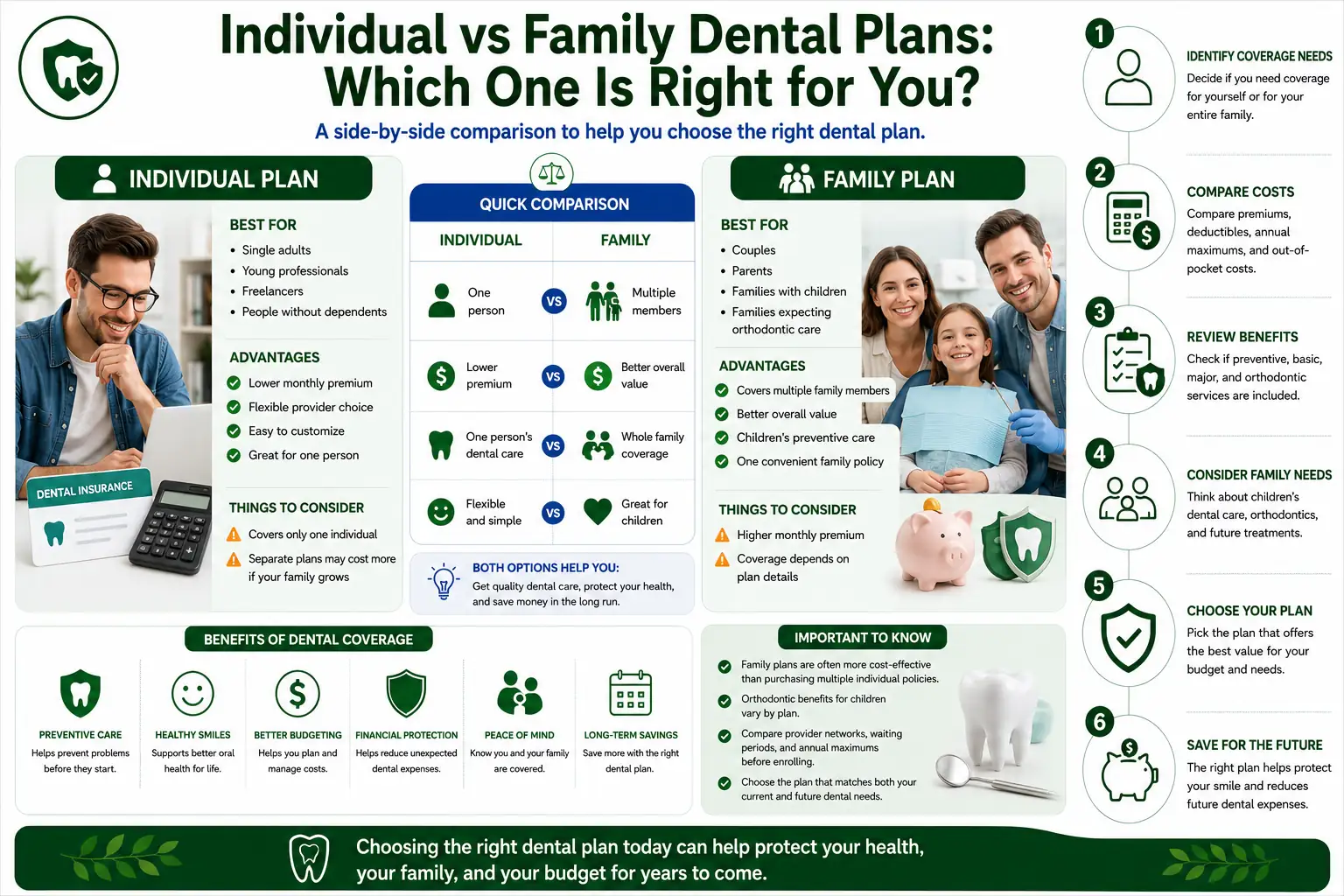
Important to Know:
- Individual and family coverage are enrollment categories.
- Family enrollment does not automatically mean that all benefits are shared.
- Deductibles and maximums may apply individually, at the family level, or through another structure.
- Compare every member’s eligibility, providers, expected treatment, benefits, and costs.
How the Household Structure Can Affect the Comparison
One Person
A person needing coverage for only themselves should compare single-person enrollment options available through:
- Their employer
- A directly purchased policy
- A spouse or another eligible source
- An available Marketplace arrangement
- Another coverage source
The comparison should focus on that person’s dentists, expected treatment, premium, deductible, benefit limits, waiting periods, and exclusions.
Two Adults
Two adults may compare:
- Two employee-only workplace plans
- One employee-plus-spouse tier
- One directly purchased family or couple arrangement
- Separate directly purchased policies
- Coverage through either person’s employer
- Overlapping coverage, when available
Compare the complete payroll deductions or premiums, employer contributions, provider networks, expected treatment, benefit limits, and coordination rules.
One shared plan may be simpler to administer. Separate plans may provide access to different providers. Neither arrangement is automatically more useful.
A Household With Children
Compare separately:
- Adult dental needs
- Pediatric dentist access
- Pediatric preventive and restorative benefits
- Orthodontic eligibility
- Dependent-age rules
- Deductible structures
- Benefit maximums for each person
- Waiting periods
- Specialist access
- Emergency-care rules
- Adults’ restorative or major-care needs
A plan that works for one adult does not necessarily provide suitable access or benefits for a child or another family member.
Family Members Living in Different Locations
When enrolled members live, study, or work in different areas, confirm:
- Provider availability in every location
- Whether the network operates across state lines
- Out-of-area rules
- Emergency coverage
- Specialist access
- Whether the available product changes by ZIP code
- How dependent eligibility is maintained
Do not rely on provider access near the primary enrollee’s address alone.
If a family member attends college away from home, check whether the dental plan provides practical access near campus as well as at home. Read Dental Insurance for College Students: What Coverage Options Should You Check? for the coverage sources, school enrollment changes, and location-specific checks to review.
Comparing Employer-Sponsored Enrollment Options
Employer-sponsored dental coverage may offer several enrollment tiers, such as:
- Employee only
- Employee and spouse
- Employee and child or children
- Employee and family
- Another dependent category defined by the employer plan
When two adults have access to workplace dental benefits, compare:
- Each payroll deduction
- Employer contributions
- Dependent enrollment costs
- Eligibility requirements
- Effective dates
- Provider and specialist networks
- Deductibles
- Copays or coinsurance
- Annual maximums
- Pediatric benefits
- Orthodontic benefits
- Waiting periods
- Treatment-in-progress rules
- Coordination-of-benefits provisions
- Changes from the previous plan year
- What happens when employment ends
An employer contribution can lower the amount paid by the employee. It does not guarantee that the plan has a more suitable network, broader benefits, or lower total household costs.
If your household is also considering an individually purchased policy, read Employer Dental Insurance vs Individual Dental Insurance: What to Compare to compare workplace coverage with options available outside an employer.
Use the current enrollment materials, Summary Plan Description, certificate of coverage, benefit schedule, and provider directory rather than relying only on a short presentation or payroll price.
Comparison Errors to Avoid
Comparing Unequal Household Costs
Do not compare one person’s premium with the premium required to cover several people.
Compare the complete cost of covering the same household members for the same benefit period.
Treating Every Family Benefit as Shared
One policy and one household premium do not establish that deductibles, annual maximums, waiting periods, or frequency limits are shared.
Confirm how every rule applies to each member.
Checking Providers Only for the Primary Enrollee
Verify the exact dentists, pediatric dentists, orthodontists, specialists, and office locations needed by every enrolled person.
Assuming Children and Adults Receive Identical Benefits
Age, service, frequency, orthodontic, deductible, network, and cost-sharing rules may differ within the same family policy.
Assuming Family Coverage Includes Orthodontics
Confirm the eligible family members, treatment types, age limits, waiting period, orthodontist network, treatment-in-progress provisions, and lifetime orthodontic maximum.
Ignoring Future Eligibility Changes
Review what happens when:
- A dependent reaches an age limit
- A student-status requirement ends
- Employment changes
- A marriage or divorce occurs
- A child moves to another location
- Another coverage source becomes available
If you are approaching age 26 and have dental coverage through a parent, confirm the dental plan’s actual eligibility rules and termination date. Read Dental Insurance When Turning 26: What to Check Before Parent Coverage Ends for the transition checks and replacement options to review.
If divorce may affect dental coverage through a spouse, confirm when spouse eligibility ends and check children’s coverage separately. Read Dental Insurance After Divorce: What Happens to Your Coverage? for the continuation and replacement coverage checks to complete.
Choosing Administrative Convenience Before Reviewing Benefits
Managing one plan may be easier, but convenience does not compensate for missing providers, excluded treatment, restrictive benefit limits, or high total costs.
Assuming Two Plans Will Pay More
Overlapping coverage may create an additional premium without producing a meaningful secondary benefit.
Review the coordination provisions before enrolling in both plans.
Questions to Ask Before Enrolling
| Question | Why It Matters |
|---|---|
| Who needs dental coverage? | The comparison must include every adult, child, and dependent who is expected to enroll |
| Which enrollment tier applies? | Employee-only, employee-plus-spouse, employee-plus-children, and family tiers may have different premiums and eligibility rules |
| Is every intended family member eligible? | Dependent definitions, age limits, relationship requirements, and documentation can vary |
| What is the complete household premium? | A fair comparison includes all premiums, payroll deductions, dependent costs, fees, and employer contributions |
| How are deductibles applied? | A family plan may use individual deductibles, a family deductible, both structures, or another plan-specific arrangement |
| How are annual maximums applied? | Maximums may be individual, family-based, combined, or subject to additional plan rules |
| Are the necessary dentists in the exact network? | Provider access must be verified separately for every family member and office location |
| Are pediatric dentists and specialists available? | A network suitable for one adult may not include the providers another family member needs |
| Do benefits differ between children and adults? | Pediatric and adult services may follow different eligibility, age, frequency, and cost-sharing rules |
| Does the plan include orthodontic benefits? | Family enrollment does not automatically provide benefits for braces or clear aligners |
| What effective date applies to each person? | A dependent added later may have a different effective date or eligibility timeline |
| Which services have waiting periods? | Diagnostic, preventive, basic, major, implant-related, and orthodontic services may follow different timing rules |
| Does treatment already recommended or started qualify? | Treatment-in-progress provisions may affect ongoing restorative, prosthetic, implant, or orthodontic care |
| Are there frequency or replacement limits? | Covered services may not be payable again within a specified period |
| Does a missing-tooth provision apply? | Benefits for replacing teeth missing before enrollment may be restricted |
| What happens when dependent eligibility ends? | Coverage may change when a dependent reaches an age limit or experiences another eligibility change |
| Will more than one plan cover the same person? | Additional coverage may require coordination of benefits and may not produce a meaningful secondary payment |
| Which plan pays first when coverage overlaps? | Primary and secondary status affects the order in which claims and Explanation of Benefits documents are submitted |
| Where can the complete rules be reviewed? | Marketing summaries may omit eligibility, network, deductible, maximum, and exclusion details |
| What is the expected total household cost? | The final comparison should include premiums and expected member costs for the same people and benefit period |
How to Interpret the Comparison
Individual enrollment is not automatically more flexible, and family enrollment is not automatically less expensive or more comprehensive.
The useful comparison is between the complete arrangements available to the household.
A family enrollment option may deserve closer consideration when:
- Every intended family member is eligible
- The provider network works for all enrolled adults and children
- Pediatric dentists and necessary specialists are available
- The deductible and benefit-limit structures are understood
- Pediatric, adult, and orthodontic benefits fit the expected needs
- Effective dates and waiting periods fit the treatment timelines
- The complete household premium is reasonable
- Managing one enrollment arrangement provides useful administrative convenience
Separate coverage arrangements may deserve closer consideration when:
- Household members have access to different employer plans
- One family member needs a provider or specialist outside the family option
- Adult and pediatric needs are better addressed through different networks
- Family members live in different locations
- One coverage source provides a benefit unavailable through another option
- A dependent is not eligible under the preferred family plan
- The combined premiums and member costs remain reasonable
Neither arrangement should be selected only because it is described as individual or family coverage.
Compare:
- The same household members
- The same benefit period
- The complete premiums
- Employer contributions
- Provider access
- Expected procedures
- Deductibles and cost sharing
- Annual and lifetime benefit limits
- Waiting periods
- Exclusions and treatment-in-progress rules
- Administrative requirements
- Expected total costs
When you are ready, compare dental plans using the same household, provider, benefit, and cost criteria for every option.
Documents to Keep Before Enrolling
Keep copies of:
- The final enrollment quote
- The policy or certificate of coverage
- The schedule of benefits
- The provider directory information used during the comparison
- Written confirmation of provider participation
- The dependent-eligibility rules
- The deductible and benefit-maximum provisions
- The orthodontic benefit schedule
- The exclusions and limitations
- The waiting-period rules
- Any previous-coverage documentation
- Coordination-of-benefits instructions
- The Summary Plan Description for applicable employer coverage
- Current employer enrollment materials
- Written answers received from the insurer or plan administrator
Record the date and source of important provider, eligibility, and benefit information.
For employer-sponsored coverage, the Summary Plan Description is an important document explaining how an applicable plan operates and describing participant rights, responsibilities, and benefits.
Helpful Resources
- Dental Plans Guide
- Compare Dental Plans
- How to Compare Dental Plans Online
- Dental Insurance Costs Explained
- In-Network vs Out-of-Network Dental Insurance
- How Waiting Periods Work in Dental Coverage
- Dental Insurance Annual Maximums Explained
- Best Dental Insurance for Families
- Does Dental Insurance Cover Braces?
- PPO vs. HMO Dental Plans
- Dental Insurance Coverage for Common Procedures
- Dental Plan Comparison Checklist
- Dental Insurance Learning Center
Frequently Asked Questions
What is the main difference between individual and family dental coverage?
Individual or single-person enrollment covers one person.
Family enrollment generally covers a primary enrollee and one or more eligible dependents.
These terms describe who is enrolled. They do not determine whether the dental plan is a PPO, DHMO, indemnity plan, or another product type.
Is employee-only dental coverage an individual dental policy?
Not necessarily.
Employee-only coverage is an enrollment tier within an employer-sponsored group plan. An individual-market dental policy is generally purchased directly for a person or household outside an employer group.
The benefits and consumer protections may differ according to the coverage source and contract.
Is a family dental plan always less expensive than separate plans?
No.
Compare the complete family premium with the combined premiums, payroll deductions, dependent costs, fees, and employer contributions for all separate arrangements.
The comparison should also include provider access, deductibles, benefit limits, waiting periods, and expected treatment costs.
Does family dental coverage have one deductible for everyone?
Not necessarily.
A plan may use:
Individual deductibles for each family member
A family deductible
Both individual and family deductible requirements
Another structure defined by the contract
Review which expenses count and what happens after an individual or family requirement is satisfied.
Does every family member share one annual maximum?
It depends on the plan.
Some plans apply a separate annual maximum to each enrolled person. Others may use a family-level maximum, a combined arrangement, or additional benefit rules.
Confirm the structure through the official documents.
Can one person use another family member’s unused annual maximum?
Usually not when the plan applies separate individual maximums.
Another structure may apply when the plan uses a family-level maximum or combined arrangement. Do not assume that unused benefits can be transferred between family members.
Can family members use different dentists?
Possibly.
Each dentist and office location must satisfy the exact plan’s network rules. Some plans allow members to choose different participating dentists, while closed-network arrangements may impose additional selection or referral requirements.
Verify every general dentist, pediatric dentist, orthodontist, and specialist separately.
Are children and adults covered in the same way?
Not necessarily.
Pediatric and adult services may have different eligibility, age limits, frequency rules, cost sharing, provider requirements, and exclusions.
Review the benefits separately for every enrolled person.
Is pediatric dental coverage required in the Marketplace?
Pediatric dental coverage must be available for children age 18 or younger through a Marketplace health plan or a separate dental plan.
Families are not required to purchase the pediatric dental coverage offered. Adult dental coverage is not an essential health benefit.
A Marketplace dental plan generally cannot be purchased unless a Marketplace health plan is being purchased at the same time.
Does family dental coverage automatically include braces?
No.
Orthodontic benefits may be excluded or limited according to age, dependent status, treatment type, waiting period, orthodontist network, lifetime maximum, and treatment-in-progress rules.
Review the orthodontic benefit separately before enrolling.
Can spouses remain enrolled in separate workplace dental plans?
Possibly.
Each person may be able to retain employee-only coverage through their own employer, or one person may be enrolled as a dependent under the other person’s plan.
Compare premiums, employer contributions, networks, treatment benefits, and eligibility rules before deciding.
Can one person have two dental plans?
Sometimes.
The plans may coordinate benefits, but two policies do not guarantee double payment or coverage of the complete bill.
Confirm which plan is primary, whether the second plan coordinates, the coordination method used, and which documents must be submitted.
ADA explains that the secondary plan commonly processes a claim after the primary plan and may require the primary Explanation of Benefits. The result depends on the applicable coordination provisions and other plan rules.
Does adding a dependent always take effect immediately?
No.
The effective date can depend on the enrollment period, qualifying event, documentation, employer procedures, insurer processing, and plan rules.
Confirm the effective date before receiving care.
What happens when a child is no longer eligible as a dependent?
Coverage may end or change according to the plan’s age, relationship, student-status, employment, or other eligibility provisions.
Review the termination date, continuation options, special-enrollment rights, and replacement coverage before eligibility ends.
What should a household compare first?
Begin with:
The people who need coverage
Their eligibility
Their dentists and specialists
Expected treatment
The complete household premium
Deductible and benefit-limit structures
Pediatric and orthodontic benefits
Effective dates and waiting periods
Then compare all available arrangements over the same benefit period.
Sources
- HealthCare.gov — Dental Coverage in the Marketplace
- American Dental Association — An Introduction to Dental Benefits
- American Dental Association — Typical Dental Plan Benefits and Limitations
- American Dental Association — Dental Plans: Coordination of Benefits
- American Dental Association — Guidance on Coordination of Benefits
- U.S. Department of Labor — Plan Information
- U.S. Department of Labor — Understanding Your Fiduciary Responsibilities Under a Group Health Plan
- Centers for Medicare & Medicaid Services — Stand-Alone Dental Plans
This article provides general educational information and is not dental, medical, legal, financial, or personalized insurance advice. Eligibility, enrollment tiers, premiums, employer contributions, provider networks, deductibles, benefit limits, waiting periods, dependent rules, coordination provisions, exclusions, and availability can vary by employer, policy, location, and enrollment channel. Review the official plan documents and confirm important information with the insurer, employer, plan administrator, and dental office before enrolling or receiving treatment.
About the Author
Maria Dumitru is the Founder and Content Editor of Dental Coverage Hub. She researches and edits educational content designed to help U.S. consumers understand dental insurance terms, compare plan features, and verify important information before enrolling.
Learn more about our standards in the Editorial Policy and How We Review Dental Plans.

Compare Household Dental Coverage With Confidence
Individual and family enrollment options can differ by eligibility, total premiums, provider networks, deductible structures, benefit limits, pediatric services, orthodontic rules, and waiting periods. Compare the official terms for every person who needs coverage and estimate the complete household cost before enrolling.