
Dental Insurance for College Students: What Coverage Options Should You Check?
Compare available dental coverage, confirm dentist access near campus and home, and understand what happens during breaks, transfers, and graduation.
Written and researched by Maria Dumitru.
Founder and Content Editor at Dental Coverage Hub
Last reviewed: October 2026
Dental insurance for college students can come from a parent, a school-sponsored option, an employer, an individual policy, or another eligible source.
The important question is which arrangement you can enroll in and use where you live and study. A parent’s plan may remain active while offering limited access near campus. A student health plan may include only restricted dental benefits. School-sponsored dental coverage may also have enrollment requirements and a coverage period that needs renewal.
Start by identifying your actual dental benefits. Then compare eligibility, coverage dates, provider access, and the rules affecting care you expect to need.
What You’ll Learn
- Which dental coverage sources to check
- How student health coverage differs from dental benefits
- What to verify under a parent or school-sponsored plan
- How to check access near campus and home
- What happens during summer, leave, transfer, and graduation
- How to compare insurance with discount plans and clinic care
Quick Answer
College students should first check existing parent dental coverage and any dental option offered by their school. Other possible sources include employer coverage, eligible spouse or partner coverage, individual dental insurance, Marketplace-related dental coverage, and Medicaid.
Confirm what each arrangement provides, whether you qualify, and where you can use it. Check the effective date, enrollment deadline, coverage period, and benefits for expected treatment.
Student health insurance does not automatically include routine dental coverage. Dental discount plans and access to campus clinics should also be evaluated separately from insurance.
Key Takeaways
- Student status does not identify your dental benefits or network
- Verify dental coverage separately from medical coverage
- Check participating dentists near campus and home
- A school-sponsored option is not automatically the most suitable arrangement
- Confirm coverage during breaks and after enrollment changes
- Compare expected costs and treatment rules alongside the premium
In This Guide
What Dental Coverage Sources Can College Students Check?
Begin with the arrangements you are actually eligible to use.
| Possible source | First question |
|---|---|
| Parent dental plan | Am I eligible, and can I use it near campus? |
| School-sponsored dental option | What is offered, and what enrollment and coverage dates apply? |
| Own employer dental plan | Does my employment qualify me for dental benefits? |
| Spouse or partner employer plan | Am I an eligible dependent under that dental arrangement? |
| Individual dental insurance | Does the policy work where I live and study? |
| Marketplace-related dental coverage | What dental options are available with my eligible health enrollment? |
| Medicaid | Am I eligible, and which dental benefits and providers apply? |
You can also check dental savings or discount plans. These are non-insurance arrangements and should not be treated as equivalent to an insurance policy.
Does Student Health Insurance Include Dental Coverage?
Sometimes, but you need to check the actual benefits.
A school may offer:
- A separate dental insurance option
- Dental benefits within another coverage arrangement
- Limited accident-related or emergency dental benefits
- Clinic access or reduced-fee care
- No routine dental benefit
These arrangements answer different questions.
A benefit limited to dental injuries, for example, does not establish that routine examinations, fillings, or crowns are covered.
Ask the school benefits office for the dental benefit schedule and applicable coverage documents. Identify covered services, restrictions, enrollment requirements, and the provider network.
A student health fee or health insurance enrollment does not, by itself, confirm that you have dental insurance.
Can You Use a Parent’s Dental Plan While in College?
A parent’s plan may be an available option, but confirm dental dependent eligibility directly.
Do not rely only on the parent medical plan’s rules. Certain separate dental arrangements are not subject to the same dependent coverage requirements.
Ask the insurer or benefits administrator:
- Am I an eligible dependent under this dental plan?
- Does student status affect eligibility?
- Is documentation required?
- When would eligibility end?
- Does the plan have usable providers near school?
For an age-related transition, read Dental Insurance When Turning 26: What to Check Before Parent Coverage Ends.
Compare the Cost of Remaining Enrolled
If your family is comparing existing parent coverage with another option, check the actual household premium difference.
Do not assume that removing one dependent will reduce the premium. Employer enrollment tiers or policy pricing may produce a different result.
If two coverage arrangements would overlap, ask about coordination of benefits before paying another premium. Two plans do not automatically double the benefits for a procedure.
For household enrollment comparisons, read Individual vs Family Dental Plans guide.
How to Evaluate a School-Sponsored Dental Option
Obtain the current materials for the specific dental arrangement.
Review:
- Eligible students and any dependent enrollment
- Required enrollment status
- Whether enrollment is automatic or optional
- Enrollment and renewal deadlines
- Premiums or other charges
- Effective and termination dates
- Provider access
- Relevant benefits and restrictions
Also ask whether school health-plan enrollment is required to purchase the dental option.
Do not assume that a medical insurance waiver also addresses dental enrollment. Confirm the school’s procedures for each benefit.
Compare It With Your Existing Coverage
A school option can be convenient, but convenience does not establish its value for your situation.
Check whether it provides practical access to dentists, covers the services you expect, and remains available for the period you need.
If the plan covers a different period from your current arrangement, compare both costs and dates before choosing.
Can You Use the Plan Near Campus and Home?
Provider access deserves particular attention when you spend the year in different locations.
Check the exact plan and network rather than the insurer’s name alone.
For each location, confirm:
- A participating general dentist
- Any specialist you already need
- Whether the office accepts new patients
- Appointment availability
- Whether you can realistically reach the office
- Referral or authorization requirements, when applicable
A nearby directory listing is a starting point. Confirm participation with the insurer or administrator and the dental office.
If You Attend College in Another State
Ask whether the exact network operates where you attend school and whether any service-area rules affect eligibility or benefits.
A nationally known insurer may offer products with different geographic networks.
Also check out-of-network and out-of-area provisions. Do not assume that care outside the home area is covered on the same terms.
For the detailed verification process, read In-Network vs Out-of-Network Dental Insurance guide.
If You Keep Your Dentist at Home
Routine appointments during breaks may be practical, but identify how you would obtain unexpected care near campus.
Ask about urgent appointments, after-hours arrangements, and applicable plan procedures. Do not assume every service performed during an urgent visit receives the same benefit treatment.
If care moves between offices, ask how treatment records and relevant images can be shared.
Does Coverage Continue During Summer or After Graduation?
School-based dental eligibility and coverage periods can vary.
Confirm the rules before an enrollment change or appointment.
| Student situation | What to ask |
|---|---|
| Summer or academic break | Does coverage remain active, and can I use it near home? |
| Renewal for the next academic year | Must I enroll again, and is there a gap between periods? |
| Reduced enrollment or leave | Does the change affect dental eligibility or the termination date? |
| Transfer or withdrawal | When does the current arrangement end, and what is available next? |
| Graduation | What is the last covered date, and when can replacement coverage begin? |
Do not calculate the termination date from the last class, tuition payment, or graduation ceremony alone.
Ask the school or administrator to confirm it. Then compare that date with any replacement plan’s effective date.
Read Dental Insurance Effective Date: When Does Coverage Start?
If graduation means you will be choosing and managing dental coverage yourself, read Dental Insurance for Young Adults: What to Check When Choosing Coverage on Your Own to review available coverage sources and compare the actual plans before enrolling.
What Other Dental Coverage Options Can You Check?
Parent and school arrangements are only part of the comparison.
Employer or Spouse and Partner Coverage
If you work while attending college, ask whether your position, hours, and employment category qualify for dental benefits.
Confirm the enrollment deadline, contribution, effective date, and network near school. Employment does not automatically establish benefit eligibility.
If your college job is part-time, read Dental Insurance for Part-Time Workers: What to Check If Employer Benefits Are Limited or Unavailable for the employee classification, continued eligibility, and premium contribution questions to ask before relying on workplace dental coverage.
Coverage through a spouse or domestic partner may also be available. Check dependent eligibility, documentation, cost, and enrollment rules directly.
Individual Dental Insurance
An individual policy may be an option when other arrangements are unavailable or impractical.
Check whether it can be issued for your circumstances and whether its service area and network work where you study.
Review the effective date, waiting periods, benefits for expected care, and relevant limitations before enrolling.
For the comparison process, read How to Compare Dental Plans Online.
Marketplace-Related Dental Coverage
On HealthCare.gov, dental benefits may be included in a health plan or offered through a separate dental plan.
A separate federal Marketplace dental plan must be purchased together with a Marketplace health plan. Do not assume that student status provides a separate dental-only enrollment route through HealthCare.gov.
If Marketplace health coverage is relevant, follow the application instructions about residence, household, and tax-dependent information. Then examine the dental benefits separately.
Check the rules of the Marketplace you use.
Medicaid
Being a student does not automatically establish Medicaid eligibility.
Ask the applicable state program about eligibility, the dental benefits available to your age group, and participating providers. Adult dental benefits vary by state; younger eligible enrollees may be subject to different benefit requirements.
If you attend college in another state, ask how residence and out-of-state care affect your arrangement. Do not assume that routine dental benefits can be used nationwide.
If limited income makes dental care difficult to afford, read Dental Coverage Options for Low-Income Adults: What to Check for coverage and reduced-cost care options to investigate near school or home.
Dental Savings or Discount Plans
These plans are not dental insurance.
They generally provide access to specified fees or discounts from participating providers. You pay for treatment under the arrangement rather than receiving an insurance claim benefit.
Before joining, check:
- Membership cost and terms
- Participating dentists near campus and home
- Fees for the services you expect
- Activation and cancellation provisions
- Whether your dentist will apply the arrangement
Compare the actual charges for your expected care, not only an advertised discount.
Campus Clinics and Dental Schools: Care Options, Not Coverage
A campus clinic, dental-school clinic, or community health center is a place to obtain care. Access does not automatically mean you have insurance.
Ask each clinic:
- Which patients it accepts
- What services are available
- Whether appointments or an initial assessment are required
- How fees are determined
- Whether your insurance or discount arrangement is accepted
- How follow-up and urgent needs are handled
Some clinics may offer reduced-fee care, but availability, charges, and treatment scope vary.
Also check scheduling. A clinic may be useful for planned care while having different procedures for urgent appointments or specialist treatment.
How to Compare Dental Insurance for College Students
Once you identify available options, compare them using the same expected care and coverage period.
| Plan detail | Why it matters |
|---|---|
| Premium or enrollment charge | Establishes the cost of keeping the arrangement active |
| Deductible and cost-sharing | Affect what you pay when eligible treatment occurs |
| Annual and other benefit limits | May restrict the amount available for expected services |
| Effective date and waiting periods | Can affect whether a needed benefit is available in time |
| Provider access | Determines whether care is practical near school and home |
| Relevant exclusions and limitations | Can affect the specific procedure you need |
| Coverage end and renewal rules | Determine whether the arrangement continues through school changes |
A low premium does not guarantee a low total cost. Include expected treatment charges and any practical travel costs when evaluating the available arrangements.
For timing restrictions, read How Waiting Periods Work in Dental Coverage.
For the annual-limit framework, read Dental Insurance Annual Maximums Explained.
If You Already Need Treatment
Include care already recommended or scheduled in the comparison.
Give the plan enough information to identify the procedure and ask about current eligibility, waiting periods, provider status, and applicable limitations.
A general statement that a category of treatment is covered does not establish the benefit for your specific service.
If Treatment Has Already Started
A change from parent, school, or employer coverage can affect unfinished treatment.
Document completed procedures, remaining stages, and relevant dates. Ask each plan which procedure date or treatment stage it recognizes and how its treatment-in-progress provisions apply.
Do not assume that a new plan continues the previous plan’s decision.
Read Dental Insurance and Treatment Already in Progress: What to Check When Coverage Changes.
Discuss clinical timing with your dental professional. Insurance dates should not replace the dentist’s assessment of when care is needed.
A Note for International Students
If your student health policy lists dental benefits, check the scope directly.
The benefit may be limited to injuries, emergencies, or another defined circumstance. It may not provide routine or restorative dental coverage.
Ask the school which optional dental arrangements are available to you and verify their eligibility, dates, providers, and services.
For school insurance requirements, follow the international student office’s guidance. This article does not interpret immigration or visa requirements.
How to Interpret Your Options
| Your situation | Priority |
|---|---|
| Parent coverage remains available | Confirm dental eligibility and access near campus |
| The school offers dental benefits | Identify the arrangement and its coverage period |
| You live far from home | Verify usable providers in both locations |
| You already expect treatment | Check the exact service, timing, provider, and benefit rules |
| You are transferring or graduating | Confirm the termination date and available next coverage |
| Insurance options are limited | Evaluate clinic access and non-insurance arrangements separately |
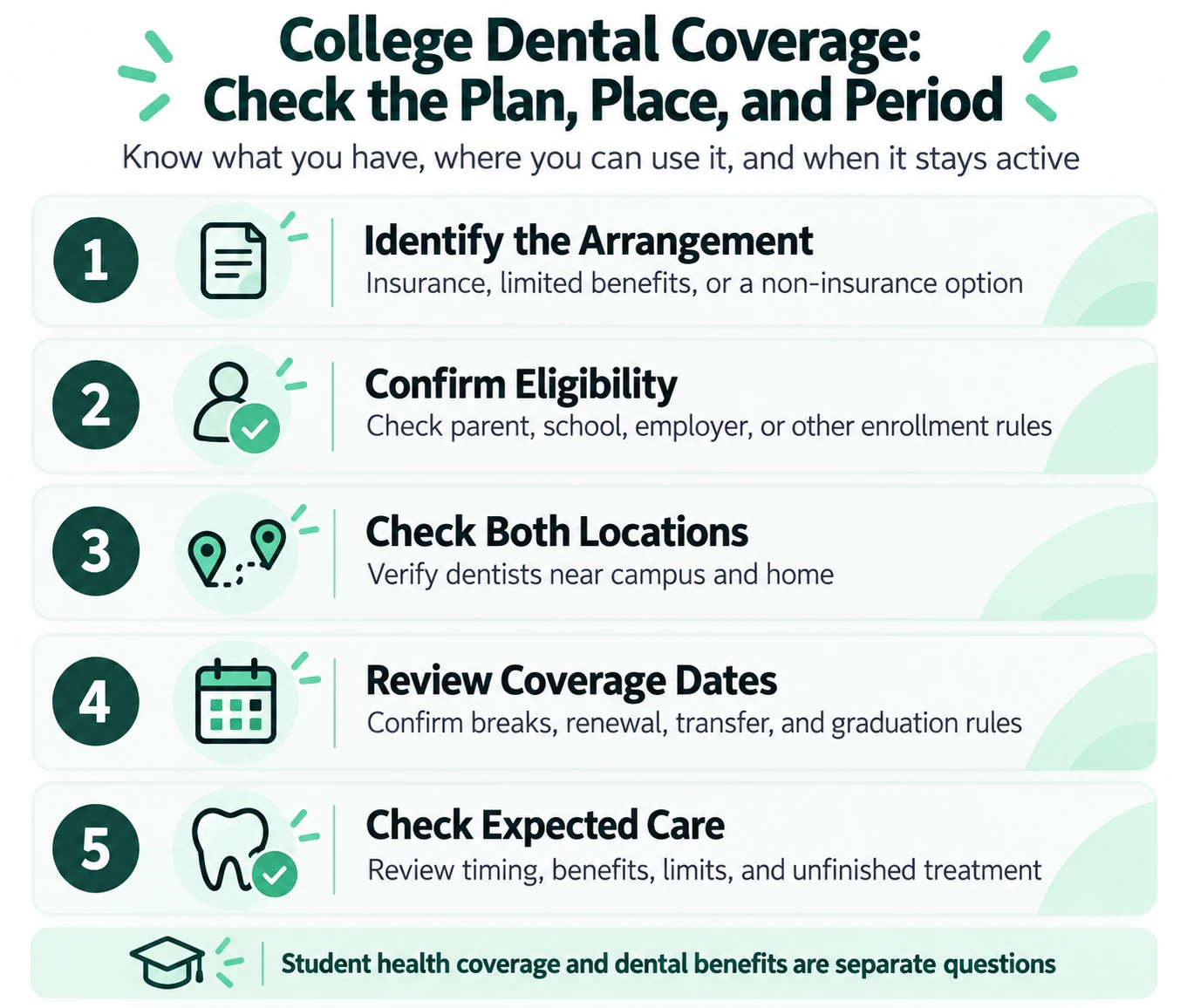
An arrangement is useful only when you understand what it provides, where you can use it, and how long it remains available.
Before You Rely on Your Coverage
Keep a short record of:
- The exact plan or arrangement
- Confirmed eligibility
- Enrollment, effective, renewal, and termination dates
- Dentists and specialists you can use
- Known treatment and applicable restrictions
- Costs, benefit limits, and payment procedures
- Contact details for the school, plan, and dental office
Save the current coverage documents and important written responses. Review the record when you move, change enrollment, or switch plans.
Common Mistakes to Avoid
- Assuming student health insurance includes routine dental benefits
- Using parent medical eligibility as the answer for separate dental eligibility
- Checking only the insurer’s brand name
- Choosing coverage without finding an available dentist near campus
- Assuming school coverage continues automatically through every break
- Confusing a clinic or discount plan with insurance
- Comparing only the premium
- Waiting until treatment is needed to verify benefits
Our Recommendation
Start with the coverage you already have and the options you can enroll in.
Then check dental access in the places where you spend the year, confirm the coverage period, and compare benefits for expected care.
Review the arrangement before summer, a transfer, leave, or graduation. If eligibility is ending, establish the next coverage dates before relying on another plan.
Helpful Resources
- Dental Insurance by Life Stage and Work Situation
- Dental Insurance When Turning 26: What to Check Before Parent Coverage Ends
- In-Network vs Out-of-Network Dental Insurance
- Dental Insurance Effective Date: When Does Coverage Start?
- How to Compare Dental Plans Online
- Dental Plan Comparison Checklist
Frequently Asked Questions
Can a College Student Stay on a Parent’s Dental Plan?
Possibly. Confirm dependent eligibility under the dental arrangement and check providers near campus. Do not rely only on the rules for the parent’s medical coverage.
Does Student Health Insurance Automatically Include Dental Coverage?
No. Review the benefit documents to determine whether dental insurance, limited dental benefits, a separate optional plan, or no dental benefit is provided.
Can I Use My Dental Plan in Another State?
That depends on the exact plan, network, and applicable geographic rules. Verify dentists near school and ask about out-of-area and out-of-network provisions.
Can I Keep My Dentist at Home?
You may be able to continue routine care at home if appointments and benefits are practical. Also identify how you would obtain unexpected care near campus.
Does School Dental Coverage Continue During Summer?
Check the specific coverage period and eligibility rules. Confirm whether breaks are included, continuing enrollment is required, or renewal must be completed.
What Happens When I Transfer or Graduate?
School-based eligibility may change. Obtain the final covered date and compare it with the effective date of any next arrangement.
Can a College Student Qualify for Medicaid Dental Benefits?
Possibly, depending on applicable eligibility rules. Check the state program, benefits for your age group, and providers where you need care.
Is a Campus Dental Clinic or Discount Plan the Same as Insurance?
No. A clinic provides care, while a discount plan offers a non-insurance fee arrangement. Ask what services, charges, participation rules, and follow-up arrangements apply.
Sources
- HealthCare.gov: Health Care Coverage Options for College Students
- HealthCare.gov: Dental Coverage in the Marketplace
- U.S. Department of Labor: An Employer’s Guide to Group Health Continuation Coverage Under COBRA
- American Dental Association: Types of Dental Plans
- Medicaid.gov: Dental Care
About the Author
Maria Dumitru is the founder and content editor of DentalCoverageHub. She creates consumer-focused educational content designed to help readers understand dental insurance benefits, limitations, and plan rules before making coverage decisions.
Learn more about our standards in the Editorial Policy and How We Review Dental Plans.
This article provides general educational information about dental coverage in the United States. It does not provide medical, legal, tax, or individualized insurance advice. Eligibility, school requirements, coverage dates, networks, benefits, and costs vary by arrangement and circumstances. Confirm details with the school, insurer, benefits administrator, Marketplace, or Medicaid program as applicable. Discuss treatment decisions with your dental professional. Dental Coverage Hub does not sell insurance or determine eligibility or claim payments.

Make Sure Your Dental Coverage Works Where College Takes You
Confirm what dental benefits you have, where you can use them, and when they begin and end.