
Dental Insurance When Turning 26: What to Check Before Parent Coverage Ends
Confirm your dental eligibility, compare your next coverage options, and check how a plan change may affect your dentist and unfinished treatment.
Written and researched by Maria Dumitru.
Founder and Content Editor at Dental Coverage Hub
Last reviewed: October 2026
Turning 26 can bring changes to coverage through a parent. However, the familiar age-26 rule for dependent health insurance does not establish the eligibility rules or termination date for every dental plan.
Before purchasing replacement coverage, confirm whether your current dental benefits are ending and obtain the actual final date. Then compare your available options using their effective dates, dentist networks, benefits, and rules for any treatment already underway.
This guide explains what to check before leaving a parent’s dental coverage and how to evaluate your next arrangement.
What You’ll Learn
- Why medical and dental dependent eligibility may differ
- How to confirm when your current dental coverage ends
- Which replacement options may be available
- What to verify for unfinished treatment and unresolved claims
- How to compare your next plan beyond its monthly premium
Quick Answer
Turning 26 does not automatically end every parent-sponsored dental plan. Check the specific dental plan’s dependent eligibility rules and obtain the confirmed termination date from the insurer or benefits administrator.
If coverage is ending, compare your available employer, individual, dependent, or continuation options. Verify when the next coverage starts, whether your dentist participates, and whether waiting periods or treatment-in-progress provisions affect care you expect to need.
Key Takeaways
- Confirm dental eligibility separately from medical eligibility
- Use the plan’s actual termination date rather than assuming coverage ends on your birthday
- Check enrollment deadlines before the current coverage ends
- A new effective date does not guarantee that every procedure is immediately eligible
- Prior estimates, deductible payments, and available benefits do not automatically transfer to a new plan
- Keep old claims separate from benefits for future treatment
In This Guide
Does Dental Insurance Automatically End When You Turn 26?
Not necessarily.
Federal rules generally require health plans that offer dependent child coverage to make that coverage available until age 26. Certain dental arrangements, including stand-alone dental coverage that qualifies as excepted benefits, are not subject to the same requirement.
Your dental plan may use a dependent age limit, termination schedule, or eligibility conditions that differ from the medical plan. Applicable state requirements can also affect the arrangement.
The question is whether you remain eligible under your specific dental coverage—not simply whether you have reached your 26th birthday.
Check the dental certificate of coverage, applicable plan documents, and current benefits materials. If the answer is unclear, ask the insurer or employer benefits administrator to confirm it in writing.
Why Medical and Dental Coverage Can End Differently
A parent may obtain medical and dental benefits through the same employer while the benefits remain separate coverage arrangements.
Do not assume that:
- The medical plan’s age limit also applies to dental coverage
- Both benefits terminate on the same date
- The same enrollment or continuation process applies to both
- A medical coverage notice answers the dental eligibility question
If dental benefits are included within a medical plan, ask how that arrangement affects dependent eligibility. If dental coverage is separate, review its own terms.
How to Confirm When Your Parent’s Dental Coverage Ends
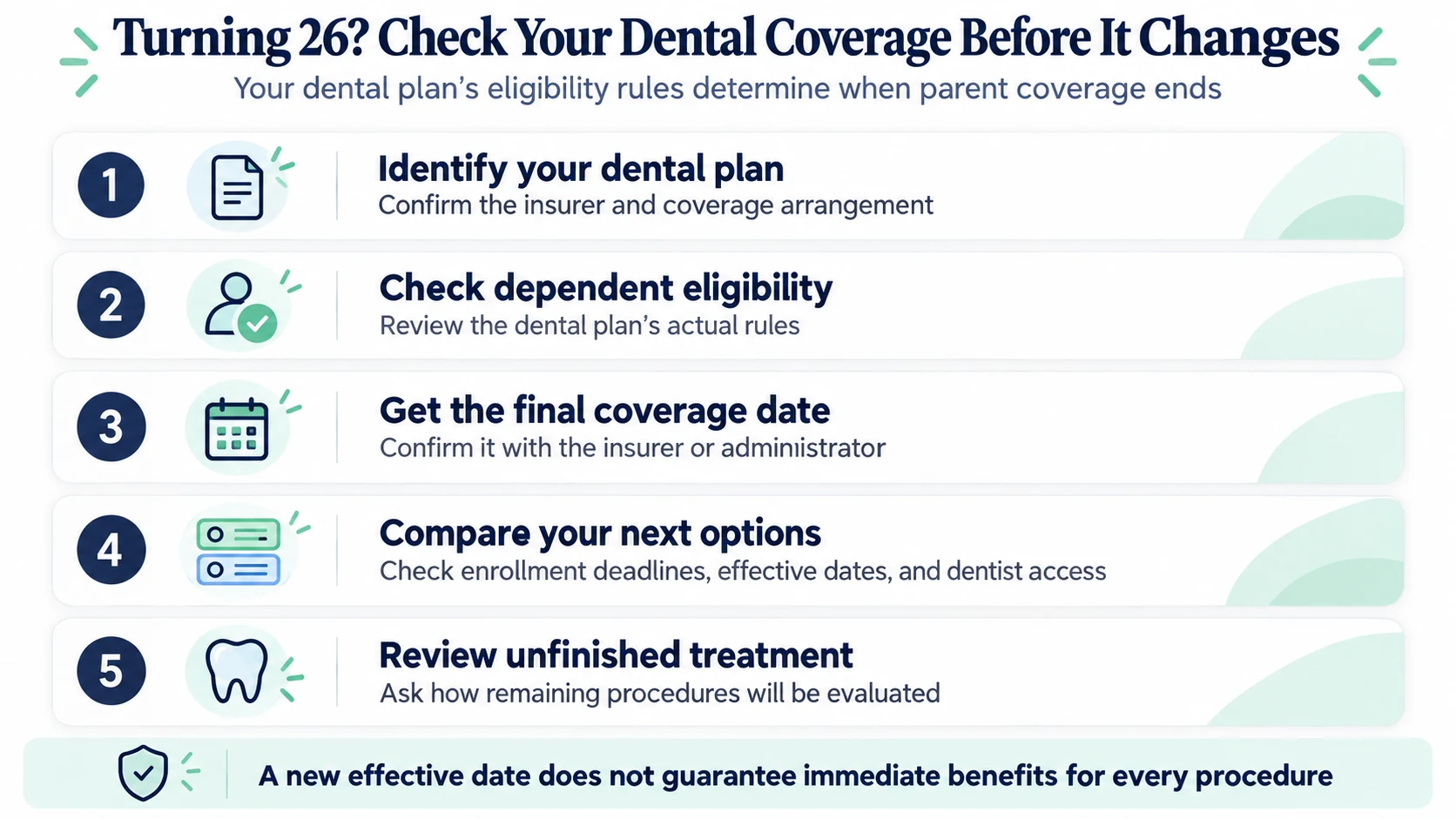
Obtain three pieces of information before comparing replacement plans.
Identify the Dental Coverage Arrangement
Confirm the insurer, exact plan, and source of coverage.
For example, the benefits may come through a parent’s employer or through an individually purchased policy. The medical insurance card alone may not identify the dental arrangement.
Keep the dental member information and the relevant contact details.
Confirm the Dependent Eligibility Rule
Ask which rule applies to your continued enrollment.
Check whether eligibility depends on age or another condition and whether any applicable exception or extension exists. Do not assume that a rule used by another insurer, employer, or family member applies to your plan.
If you receive conflicting answers, request the relevant plan provision.
Obtain the Final Coverage Date
Ask for the last date on which you remain eligible for dental benefits.
Record:
- The confirmed termination date
- Who provided the confirmation
- Any required notice or enrollment action
- Where the rule appears in the plan documents
Then compare that date with the proposed start date of your next coverage.
For the coverage-start framework, read Dental Insurance Effective Date: When Does Coverage Start?
Your Transition at a Glance
| What to confirm | Why it matters |
|---|---|
| Current dependent eligibility | Your birthday alone may not determine whether dental coverage ends |
| Final coverage date | Establishes when the current arrangement stops providing eligibility |
| Replacement enrollment deadline | Missing a deadline can limit available options |
| New effective date | Shows whether the coverage dates leave an uncovered period |
| Dentist participation | The same dentist may have a different status under the next plan |
| Expected treatment | Waiting periods, limitations, and unfinished-treatment rules can affect benefits |
What Dental Coverage Options Can You Check?
The available options depend on your employment, household circumstances, location, and plan eligibility.
Compare the options you can actually enroll in rather than assuming that every coverage source is available.
Your Own Employer Dental Plan
If you have access to workplace dental benefits, check whether losing dependent coverage allows enrollment under that plan’s rules.
Confirm:
- Your eligibility
- The required enrollment process and deadline
- The payroll contribution
- The effective date
- Dentist and specialist participation
- Benefits for procedures you expect to need
Do not assume that medical and dental special enrollment rules are identical, particularly when dental coverage is offered separately.
If enrollment is available, review the current benefits materials and applicable plan documents before selecting coverage.
Coverage Through a Spouse or Domestic Partner
Another person’s employer plan may offer dependent dental enrollment.
Check whether you qualify as an eligible spouse or domestic partner, what documentation is required, and whether the current circumstances allow enrollment.
Compare the dependent premium, effective date, provider network, and treatment provisions. Eligibility for one benefit does not establish eligibility for every benefit offered by the employer.
If your household is considering shared or separate enrollment arrangements, read Individual vs Family Dental Plans guide.
School-Sponsored Dental Coverage
If you are attending college, check whether your school offers a dental insurance option and whether you are eligible to enroll. Confirm the enrollment deadline, effective date, coverage period, and dentist access near campus and home.
Read Dental Insurance for College Students: What Coverage Options Should You Check? for the school-based options and student-specific checks to review.
Individual Dental Insurance
An individually purchased dental policy may be an option when workplace or dependent coverage is unavailable or unsuitable.
Before enrolling, check:
- When coverage can begin
- Whether enrollment and payment requirements have been completed
- Whether your dentist participates in the exact plan
- Waiting periods for relevant services
- Deductibles and cost-sharing
- Annual benefit limits
- Exclusions and treatment-in-progress provisions
A policy with an affordable premium may still provide limited help for treatment you need soon.
Compare the benefits for your expected procedures rather than relying only on the plan’s general description.
Marketplace Dental Coverage
Marketplace arrangements can include dental benefits within a health plan or offer separate dental plans.
On HealthCare.gov, a separate dental plan must be purchased together with a Marketplace health plan. Do not assume that you can use the federal Marketplace to purchase only dental coverage.
Also distinguish loss of qualifying health coverage from loss of dental coverage alone. Ending dental coverage by itself generally does not establish a Marketplace health insurance Special Enrollment Period.
Check the enrollment rules for the Marketplace you use and confirm whether adult dental benefits are included in the selected arrangement.
COBRA or Other Continuation Coverage
Losing dependent status can be a COBRA qualifying event when the plan and circumstances meet the applicable requirements.
If continuation is available, it may allow you to keep eligible existing group dental coverage temporarily. Confirm whether you were covered before the event, which benefits can continue, and what premium applies.
Do not assume that continuation is automatic. For loss of dependent status, the employee or qualified beneficiary generally has a responsibility to notify the plan under its procedures.
Check the required notice, election, and payment deadlines promptly. State continuation provisions may also be relevant, depending on the arrangement and jurisdiction.
Medicaid or Other Assistance
Depending on your income and state eligibility rules, Medicaid may be worth checking.
Adult dental benefits vary by state. Confirm both eligibility and the dental services available under the applicable program, including provider access.
If insurance is unavailable or leaves substantial costs, ask local clinics or dental schools about care options and charges. These arrangements should be evaluated separately from insurance benefits.
What If Dental Treatment Has Already Started?
A coverage change can affect how unfinished treatment is evaluated.
Before the current plan ends, ask your dental office to separate:
- Procedures already completed
- Procedures completed but not yet submitted
- Treatment that has started and remains unfinished
- Treatment that has only been recommended
For a procedure involving multiple appointments, ask the plan which procedure date or treatment stage it recognizes for benefit purposes. Do not assume that the first or last appointment controls every claim.
Then ask the prospective plan specifically how it evaluates treatment that began before its effective date.
A general statement that crowns, implants, or orthodontics are covered does not answer whether your unfinished treatment is eligible.
For the detailed framework, read Dental Insurance and Treatment in Progress.
Check Orthodontic Treatment Separately
If orthodontic treatment is active, ask about any treatment-in-progress or takeover provision.
Provide the treatment start date, current status, prior insurance payments, and expected remaining treatment. Check any age restriction, lifetime maximum, payment schedule, or remaining-benefit calculation that applies.
Do not assume that a new plan will continue the previous plan’s orthodontic payments.
Keep Clinical Timing With Your Dentist
Discuss appointment timing with your dentist.
An insurance termination date or waiting period does not determine whether delaying or accelerating treatment is clinically appropriate. Ask the dental office to explain both the care considerations and the estimated costs under the available coverage arrangements.
Keep Old Claims and Advance Reviews Separate
Changing coverage creates different questions for previous services and future treatment.
| Item | What to check |
|---|---|
| Unresolved claim for prior treatment | Which plan is responsible under the applicable procedure-date and coverage rules |
| Completed service not yet submitted | Submission requirements and the old plan’s filing deadline |
| Earlier predetermination or preauthorization | Whether a new review is needed and which requirements apply under the next plan |
| Future procedure | Current eligibility, benefits, provider status, and applicable limitations |
| Unused deductible or annual benefits | Whether any credit or transfer provision exists; do not assume one applies |
Ending dependent coverage does not automatically move an old claim to the new insurer.
Keep claim reference numbers, procedure dates, dental-office statements, and Explanations of Benefits. Follow up with the plan responsible for the service.
An EOB explains how a claim was processed under that coverage. It does not establish benefits for future treatment under another plan.
For help reviewing claim information, read How to Read a Dental Insurance EOB.
An advance review from the previous plan also does not confirm benefits under the next coverage. Ask whether the new plan requires a submission before the proposed service.
Read Dental Insurance Predetermination vs Preauthorization guide.
How to Compare Your Next Dental Plan
Start with coverage timing, then review access and benefits.
Confirm When Benefits Become Available
Obtain the actual effective date.
Then check whether a waiting period applies to any service you expect to need. An active policy can still have a waiting period for particular benefits.
For that distinction, read How Waiting Periods Work in Dental Coverage.
Verify Your Dentist and Specialists
Check participation in the exact plan and network being considered.
Ask about the location and provider who will perform the service. Participation with an insurer does not necessarily mean participation in every product that insurer offers.
Also review the plan’s out-of-network provisions if you want to keep a provider who does not participate.
Compare Expected Costs
Review more than the premium.
Compare deductibles, copays or coinsurance, annual maximums, applicable frequency limits, and benefits for the procedures you expect.
Do not assume that amounts paid or benefits used under your parent’s plan transfer to a new arrangement. Ask whether any applicable credit or transfer provision exists.
For the broader payment framework, read Dental Insurance Costs Explained.
Review the Official Documents
Use the current benefit schedule, policy or certificate of coverage, applicable employer plan documents, and provider directory.
If a provision is unclear, ask the insurer or administrator about the specific situation. Keep written responses with your enrollment records.
Common Mistakes to Avoid
- Assuming dental coverage ends on your 26th birthday
- Using a medical termination notice as the only confirmation of dental eligibility
- Missing a notice or enrollment deadline
- Choosing a policy without checking its effective date and waiting periods
- Assuming the same dentist has the same network status
- Treating an old estimate as confirmation of new benefits
- Assuming unused annual benefits make unfinished treatment eligible
- Waiting until coverage ends to identify available replacement options
Our Recommendation
Begin with the current dental plan, not a replacement policy.
Confirm whether coverage is ending, obtain the final date, and identify your enrollment options. Then compare the available arrangements using your dentist, expected treatment, coverage timing, and total costs.
If treatment is underway, ask procedure-specific questions before relying on the next plan. Update the dental office when the coverage changes and keep the old records until outstanding claims are resolved.
Once you have confirmed the parent plan’s termination date and your enrollment options, read Dental Insurance for Young Adults: What to Check When Choosing Coverage on Your Own for help comparing and managing the coverage arrangements available to you.
Helpful Resources
- Dental Insurance by Life Stage
- Individual vs Family Dental Plans
- Dental Insurance Effective Date: When Does Coverage Start?
- How Waiting Periods Work in Dental Coverage
- Dental Insurance and Treatment in Progress
- Dental Plan Comparison Checklist
Frequently Asked Questions
Does my parent’s dental insurance have to cover me until age 26?
Not every dental arrangement is subject to the federal dependent health coverage requirement. Check the dental plan’s eligibility rules and any applicable state requirements rather than assuming that the medical rule applies.
Does dental coverage end on my birthday?
It may, but you should not assume that it does. Ask the insurer or benefits administrator for the actual termination date and the provision that establishes it.
Can I remain on my parent’s dental plan after turning 26?
Possibly, depending on the plan and applicable requirements. Confirm continued dependent eligibility. If it ends, ask whether continuation coverage is available.
Can I enroll in my employer’s dental plan when parent coverage ends?
Check your employer plan’s eligibility and enrollment rules. Confirm the deadline, required documentation, and effective date. Medical and separate dental enrollment rules may differ.
Can I buy only dental insurance through HealthCare.gov?
HealthCare.gov requires a separate Marketplace dental plan to be purchased together with a health plan. Individually purchased dental insurance outside the Marketplace may offer another enrollment route.
Will a new plan cover dental treatment that has already started?
That depends on its provisions and the specific procedure. Ask how it evaluates treatment begun before the effective date, then check any relevant waiting period, exclusion, or benefit limit.
Does an old predetermination remain valid under my new plan?
Do not treat it as confirmation of benefits under another plan. Ask the new insurer which review process applies and whether a new submission is required.
What happens to claims that are still pending?
Continue following up with the plan responsible under the applicable procedure-date and coverage rules. Keep the claim details and observe filing or appeal deadlines even after dependent coverage ends.
Sources
- U.S. Department of Labor: Young Adults and the Affordable Care Act
- U.S. Department of Labor: An Employer’s Guide to Group Health Continuation Coverage Under COBRA
- HealthCare.gov: Health Insurance Coverage for Children Under 26
- HealthCare.gov: Dental Coverage in the Marketplace
- HealthCare.gov: Special Enrollment Periods
- American Dental Association: Pre-Authorizations
About the Author
Maria Dumitru is the founder and content editor of DentalCoverageHub. She creates consumer-focused educational content designed to help readers understand dental insurance benefits, limitations, and plan rules before making coverage decisions.
Learn more about our standards in the Editorial Policy and How We Review Dental Plans.
This article provides general educational information about dental insurance in the United States. It does not provide legal, medical, or individualized insurance advice. Dependent eligibility, coverage end dates, enrollment rights, and benefits vary by plan and applicable law. Confirm your situation with the insurer or plan administrator and discuss treatment decisions with your dental professional. Dental Coverage Hub does not sell insurance or determine eligibility or claim payments.

Compare Your Next Dental Coverage With Confidence
Before your current coverage ends, confirm the final date, identify your enrollment options, and check your dentist and expected treatment under each available plan.