
Dental Insurance and Existing Dental Problems: What to Check Before Enrolling
Learn how to evaluate dental insurance when you already know you have a dental problem, recommended treatment, missing tooth, existing dental work, or care already in progress.
Written and researched by Maria Dumitru.
Founder and Content Editor at Dental Coverage Hub
Last reviewed: August 2026
If you already know you have a dental problem, enrolling in dental insurance can raise an important question:
Will a new dental plan provide benefits for treatment I already know I may need?
There is no single answer that applies to every dental plan.
An existing dental problem does not automatically mean future treatment will be covered, excluded, delayed, or limited. At the same time, enrolling after a problem has been identified does not guarantee that a new plan will immediately provide benefits for the recommended care.
Several different plan provisions may become relevant depending on the situation, including timing rules, exclusions or limitations, missing-tooth provisions, replacement rules, and treatment-in-progress provisions.
Not every rule applies to every existing dental problem.
The first step is to identify the situation you already have and then determine which plan provision actually applies.
The more useful question is therefore not simply:
“Does dental insurance cover pre-existing conditions?”
Instead, ask:
“Which plan rules apply to the dental problem or treatment I already know about?”
What You’ll Learn
This guide explains:
- Why an existing dental problem does not automatically determine coverage
- Why enrollment eligibility and treatment eligibility are separate questions
- How to distinguish a known dental problem from treatment already recommended or started
- Why an already-missing tooth may require a separate review
- Why existing dental work may involve replacement rules
- How waiting periods relate to existing dental problems without being the same issue
- What to verify in the plan documents before enrolling
- Which questions to ask when you already know dental care may be needed
Quick Answer
Having an existing dental problem does not automatically tell you whether treatment will be covered or excluded under a new dental plan.
Enrollment eligibility and eligibility for a specific dental benefit are separate questions.
If you already know dental care may be needed, first identify which situation applies:
- A dental problem exists, but treatment has not started
- A dentist has already recommended treatment
- A natural tooth was already missing
- Existing dental work may need repair or replacement
- Dental treatment has already begun
Then review the plan provision that matches that situation.
The most important principle is:
Do not assume that an existing dental problem is automatically covered or automatically excluded. Identify the specific plan rule that applies.
Key Takeaways
- An existing dental problem is not automatically the same as a pre-existing-condition exclusion
- Enrollment eligibility and treatment eligibility are separate questions
- A known problem, recommended treatment, missing tooth, existing restoration, and treatment already in progress can raise different insurance questions
- A waiting period is separate from rules addressing circumstances that existed before coverage began
- A missing tooth may involve a missing-tooth provision, while existing dental work that needs replacement may involve a replacement rule
- Treatment that has already started should be reviewed separately from treatment that has only been recommended
- Procedure coverage still needs to be checked separately after identifying the rule connected to the existing dental situation
- Official plan documents are more useful than broad statements such as “pre-existing conditions covered”
In This Guide
What Does an Existing Dental Problem Mean for Insurance?
An existing dental problem can describe several different situations.
You may:
- Know you have decay or another dental problem
- Have pain, sensitivity, or a damaged tooth
- Have an existing periodontal problem
- Have a filling, crown, bridge, denture, or other restoration that needs evaluation
- Already know that a tooth needs extraction
- Have been told that you need root canal treatment
- Already have a missing tooth
- Have a dentist’s recommendation for a bridge, denture, implant, or another procedure
- Have dental treatment that has already started
These situations should not automatically be treated as identical.
The fact that a dental condition existed before enrollment does not, by itself, explain how a particular plan will handle future treatment.
The relevant question is whether the plan contains a rule that affects the situation or the procedure being proposed.
That rule might involve:
- Eligibility
- Effective date
- An exclusion
- A limitation
- A waiting period
- A missing-tooth provision
- Treatment already underway
- Replacement of previous dental work
- Another procedure-specific provision
Use the exact plan language rather than assuming that every dental problem present before enrollment receives the same treatment.
Dental Insurance and Existing Dental Problems: What to Check
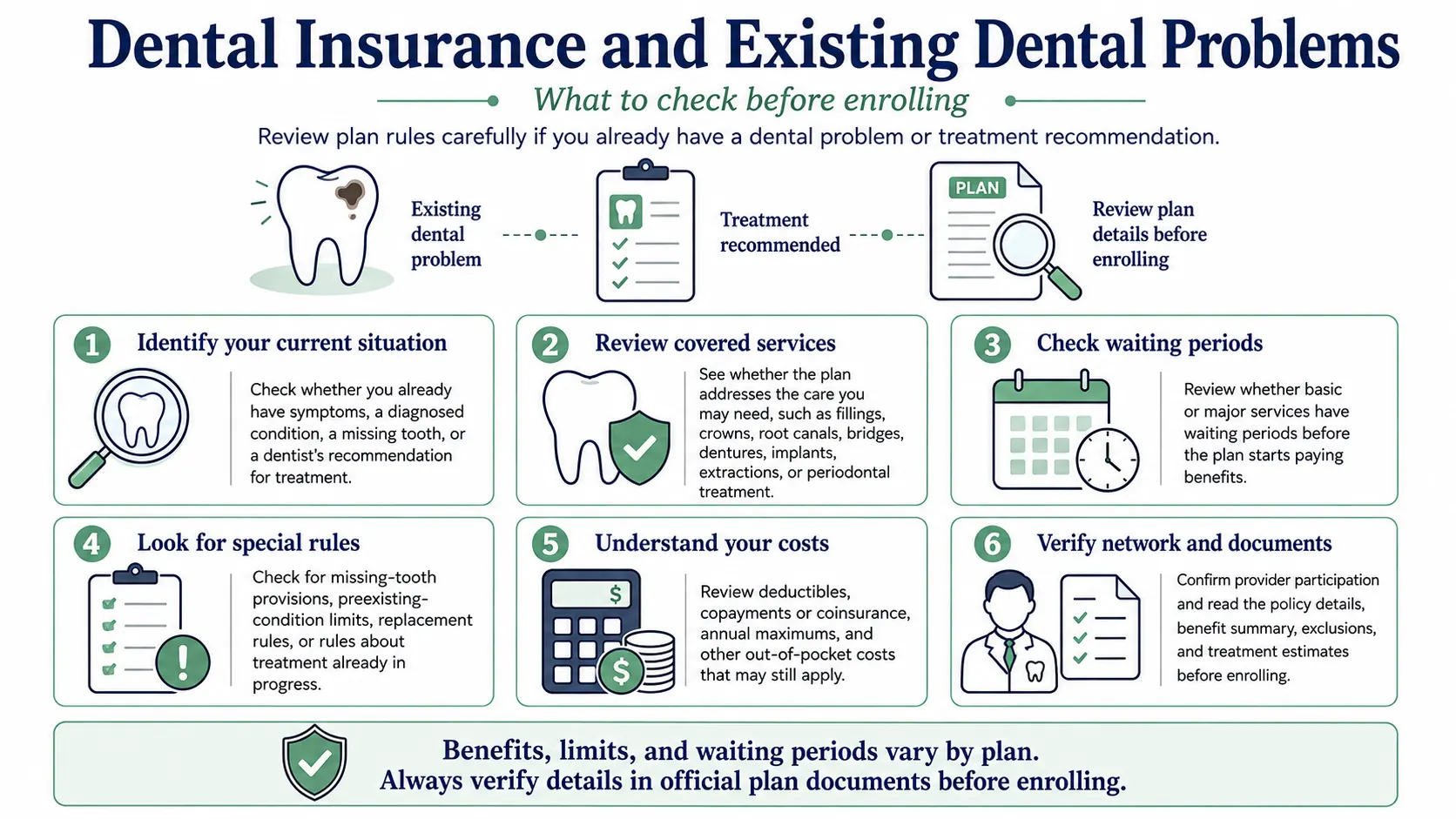
Enrollment Eligibility and Treatment Eligibility Are Different Questions
When you already have a dental problem, separate two questions.
Can You Enroll in the Plan?
This is an enrollment and eligibility question.
The answer depends on the eligibility requirements of the particular plan available to you.
Will the Plan Provide a Benefit for the Treatment You Need?
This is a separate benefit question.
The answer can depend on:
- The exact procedure
- Coverage effective date
- Applicable waiting period
- Exclusions or limitations
- Missing-tooth provisions
- Whether treatment has already started
- Replacement or frequency provisions
- Provider requirements
- Other plan terms
Being enrolled does not automatically make every dental procedure immediately eligible for benefits.
Likewise, knowing that you need dental care does not, by itself, establish that the treatment is excluded.
When you are enrolling because dental care is already expected, verify both questions separately.
Four Existing-Dental Situations to Separate Before Enrolling
One of the most useful steps is identifying which situation actually applies to you.
1. A Dental Problem Already Exists
You know or suspect that something is wrong, but the treatment has not necessarily been determined.
Examples can include:
- Decay
- Pain or sensitivity
- A damaged tooth
- Gum problems
- An existing restoration that needs evaluation
At this stage, the insurance question is not simply whether the condition existed before enrollment.
Once the dental problem has been evaluated, identify the actual treatment being recommended and verify the benefit for that procedure.
2. Treatment Has Already Been Recommended
A dentist has already told you that you need a specific procedure, but treatment has not started.
Examples may include:
- A filling
- A crown
- Root canal treatment
- Tooth extraction
- A dental bridge
- A denture
- A dental implant
- Periodontal treatment
- Another dental procedure
This situation deserves careful review before enrolling.
Do not assume that purchasing a dental plan now guarantees benefits for the treatment.
At the same time, do not assume that the treatment is automatically excluded simply because it was recommended before the coverage effective date.
Check the plan provisions that apply to the exact treatment.
3. A Tooth Was Already Missing
If a tooth was already missing before the new coverage becomes effective, a missing-tooth, prior-missing-tooth, initial-placement, pre-existing-condition, or similar provision may become relevant.
The exact wording varies by plan.
This situation is different from having a damaged tooth that is still present.
It is also different from a waiting period.
A plan may have a waiting period, a provision affecting replacement of a previously missing tooth, both, or neither.
The exact plan language controls.
4. Treatment Has Already Started
Treatment already underway is different from treatment that has only been recommended.
A plan may contain provisions addressing:
- When treatment is considered started
- Which service date controls eligibility
- When a procedure is considered completed
- Whether later stages may qualify for benefits
- How the coverage effective date affects the treatment
Do not assume that enrolling in a new plan automatically transfers responsibility for unfinished treatment to that plan.
This article keeps treatment already in progress brief because the timing and benefit questions can differ from treatment that has only been recommended.
Existing Dental Problems vs Pre-Existing-Condition Exclusions
An existing dental problem describes a circumstance involving your oral health.
An exclusion is a plan rule describing a service or circumstance for which the plan does not provide a benefit under the applicable terms.
These are not automatically the same thing.
Some dental plans may contain provisions affecting circumstances that existed before coverage began.
However, do not conclude that every dental problem identified before enrollment is automatically excluded.
Instead, look for the actual wording that applies to:
- The condition
- The treatment
- The date coverage begins
- A previously missing tooth
- Previous dental work
- Treatment already underway
The distinction matters because a service can also be affected by a limitation without being completely excluded.
For a broader explanation of true exclusions, benefit limitations, and other plan rules, read Dental Insurance Exclusions and Limitations: What to Check Before Enrolling.
How to Interpret Your Situation Before Enrolling
Use your actual situation instead of relying only on the broad label “pre-existing condition.”
| Your situation | Do not automatically assume | What to check |
|---|---|---|
| A dental problem exists, but treatment has not started | Future treatment will automatically be covered or excluded | Effective date, actual procedure, applicable plan provisions |
| A dentist already recommended treatment | Buying insurance now guarantees benefits | Procedure benefit, waiting period, relevant exclusions or limitations |
| A tooth was already missing | Bridge, denture, or implant benefits automatically apply | Missing-tooth or initial-placement provision and tooth-replacement eligibility |
| Existing dental work needs repair or replacement | Future treatment involving it is automatically excluded | Replacement and frequency provisions |
| Treatment has already started | A new plan automatically pays for later stages | Effective date and treatment-in-progress language |
| A plan has no waiting period | Every known treatment qualifies immediately | Procedure eligibility and other exclusions or limitations |
| A procedure is listed as covered | The plan will pay the full cost | Benefit conditions and applicable patient responsibility |
The practical question is:
Which specific plan provision applies to my actual situation?
When an important detail cannot be verified, treat it as Not confirmed rather than assuming that the more favorable rule applies.
What If Your Dentist Already Recommended Treatment?
If a dentist has already recommended a specific treatment before you enroll in new dental coverage, do not assume that buying insurance now will automatically make that treatment eligible for benefits.
At the same time, do not assume that a recommendation made before enrollment automatically means the treatment is excluded.
Start with the treatment that has actually been recommended.
Identify the Specific Procedure
Find out which dental procedure is being proposed rather than relying only on a broad description such as “major dental work.”
Coverage can depend on the specific service and the rules that apply to it.
For procedure-specific coverage questions, use the Dental Procedure Coverage hub.
Confirm When the New Coverage Begins
Check the dental plan’s effective date.
The fact that treatment was recommended before enrollment and the date the new coverage begins are separate facts that may both matter when reviewing eligibility.
For the separate coverage-start framework, read Dental Insurance Effective Date: When Does Coverage Start?
Check Which Plan Provisions Apply to the Recommended Treatment
Review the plan for any provision that may affect the specific treatment, such as:
- A waiting period
- An exclusion or limitation
- A missing-tooth provision, when relevant
- A replacement rule for existing dental work
- A treatment-in-progress provision if treatment has already begun
Do not assume that all of these rules apply. The goal is to identify which provision actually matches your situation.
Verify Before Relying on the Benefit
If the treatment is significant, ask the dental plan what information can be confirmed before treatment and where the applicable rule appears in the official plan documents.
Pretreatment review may provide useful information, but it should not automatically be treated as a guarantee of final payment.
For that separate framework, read Dental Insurance Predetermination vs Preauthorization: What’s the Difference?
The key question is:
What plan provision applies to the treatment that was already recommended before my new coverage begins?
How Do Waiting Periods Affect Existing Dental Problems?
A waiting period and an existing dental problem are separate issues.
An existing dental problem describes the condition or treatment need that was already present before you enrolled in new coverage.
A waiting period is a plan timing rule that can delay when a particular benefit becomes available after coverage begins.
That means an existing dental problem is not automatically excluded simply because it existed before enrollment, but the treatment may still be affected by a waiting period or another plan provision.
Likewise, a plan with no waiting period does not automatically mean that every treatment you already need will receive a benefit immediately.
Other provisions may still matter depending on the situation, including:
- Exclusions or limitations
- Missing-tooth provisions
- Replacement rules for existing dental work
- Treatment-in-progress provisions
- Other service-specific requirements
The key distinction is:
No waiting period removes one timing restriction. It does not determine how every existing dental problem or previously recommended treatment will be handled.
For the full waiting-period mechanism, read How Waiting Periods Work in Dental Coverage.
If you are specifically evaluating a plan advertised as having no waiting period, read No Waiting Period Dental Insurance: What to Verify Before Enrolling.
What If the Tooth Was Already Missing?
If a natural tooth was already missing before new dental coverage began, the situation may involve a separate missing-tooth provision.
The important question is not simply whether the dental plan covers bridges, dentures, implants, or another tooth-replacement treatment in general.
The plan may also consider when the natural tooth was lost and how its missing-tooth language applies to the initial replacement of that tooth.
That is a different question from replacing dental work that already exists.
The key distinction is:
A tooth that was already missing may raise an initial tooth-replacement question under a missing-tooth provision.
Do not assume that every dental plan treats this history the same way.
For the detailed framework, read Missing Tooth Clauses in Dental Insurance: What to Check Before Enrolling.
What If Existing Dental Work Needs Repair or Replacement?
If you already have a filling, crown, bridge, denture, or other dental work that may need repair or replacement, the plan may apply provisions that are different from those used for initial treatment.
For replacement treatment, the history of the existing dental work can matter.
The plan may need to determine:
- Whether the proposed treatment is a repair or a replacement
- Whether existing dental work is actually being replaced
- When the existing restoration or prosthesis was originally placed
- Which replacement provision applies under the current coverage
Do not assume that enrolling in a new dental plan resets the history of existing dental work.
A new insurance effective date does not automatically create a new prior-placement date.
The key distinction is:
An existing restoration that needs replacement raises a replacement-rule question, not the same question as replacing a natural tooth that was already missing.
For the detailed framework, read Dental Insurance Replacement Rules Explained: What to Check Before Replacing Dental Work.
What If Treatment Has Already Started?
If dental treatment began before new coverage became effective and continues afterward, the issue may involve more than an existing dental problem.
The dental plan may consider the timing of treatment, the stage of the procedure, and the provisions that apply when coverage changes during ongoing care.
Do not assume that a new dental plan automatically becomes responsible for treatment simply because coverage begins before the treatment is completed.
The key distinction is:
Existing dental problems describe a condition or treatment need that was already present. Treatment in progress involves care that has already begun.
For the detailed framework, read Dental Insurance and Treatment Already in Progress.
Coverage Eligibility and Plan Payment Are Different Questions
Even when treatment related to an existing dental problem is eligible for a benefit, that does not determine how much the dental plan will pay.
These are separate questions:
Benefit eligibility asks whether the service can receive a benefit under the plan.
Benefit calculation determines how the plan and patient may share the cost.
Deductibles, cost sharing, annual benefit limits, network provisions, and other payment rules may still affect the final amount.
Do not interpret a smaller plan payment as proof that the existing dental problem itself was excluded.
For the detailed cost framework, read Dental Insurance Costs Explained.
For the separate annual-benefit mechanism, read Dental Insurance Annual Maximums Explained.
Why Procedure Coverage Still Needs to Be Checked Separately
How a dental plan treats an existing dental circumstance is one question.
How the plan covers the specific treatment being recommended is another.
For example, knowing that an existing dental problem is not automatically excluded does not tell you what benefit the plan provides for the procedure used to treat it.
Likewise, resolving a missing-tooth or replacement-rule question does not automatically establish coverage for the bridge, denture, crown, or other treatment being proposed.
The key distinction is:
First determine whether a rule related to the existing dental situation affects eligibility. Then check how the plan covers the actual procedure separately.
Do not use this article as a substitute for reviewing procedure-specific benefits.
For treatment-specific guidance, use the Dental Procedure Coverage hub.
Dental Care Decisions and Insurance Timing Are Different Questions
Do not delay evaluation of pain, swelling, damage, infection, or another dental concern solely to try to change how future insurance may treat the condition.
Clinical care and insurance benefit eligibility are separate questions.
A dental professional determines whether a problem needs evaluation or treatment based on the clinical situation.
Separately, the dental plan determines how its benefit rules apply.
The key distinction is:
Insurance timing can affect benefits. It should not determine whether a dental problem needs professional evaluation.
Review the insurance rules separately from decisions about diagnosis, urgency, or treatment timing.
Where to Find These Rules in Your Plan Documents
When you already know dental care may be needed, do not rely only on a marketing page or short benefit summary.
Review the official plan documents for the provisions that match your actual situation.
Relevant sections may include:
- Coverage effective date
- Covered services or schedule of benefits
- Exclusions and limitations
- Waiting-period provisions
- Missing-tooth or initial-placement language
- Treatment-in-progress provisions
- Frequency or replacement limitations
- Provider-network requirements
- Pretreatment-review provisions
You do not need every section to apply to your situation.
The goal is to identify the provision that answers the specific question you have about the treatment or dental circumstance that already exists.
A useful question is:
Which section of the official plan documents explains how this situation is handled?
If you are comparing several plans, use the Dental Plan Comparison Checklist to record the answers consistently.
Questions to Ask When You Already Know You Need Dental Work
If you already know that dental treatment may be needed, focus on the questions that help identify which plan provisions apply to your situation.
Ask:
- When does the new dental coverage become effective?
- What specific procedure has been recommended?
- Does the service have a waiting period?
- Does an exclusion or limitation apply to this situation?
- Was the natural tooth already missing before coverage began?
- Is existing dental work being repaired or replaced?
- Has treatment already started?
- Where can I find the applicable rule in the official plan documents?
The goal is not to assume that every limitation applies.
It is to identify which provision actually matches the dental circumstance that already exists.
The most useful question is:
Which plan rule applies to the treatment or dental situation I already know about before enrolling?
How to Evaluate a Dental Plan When You Already Need Treatment
If you already know that dental treatment may be needed, do not compare plans only by asking whether they “cover” the procedure.
Start with the dental situation that already exists and identify the plan provisions that could affect it.
1. Identify the Treatment You Expect to Need
Use the specific procedure or treatment recommendation rather than a broad label such as “major dental work.”
2. Confirm When Coverage Begins
Check the effective date of the new dental plan.
For the separate coverage-start framework, read Dental Insurance Effective Date: When Does Coverage Start?
3. Identify Any Rule Connected to the Existing Situation
Depending on the circumstances, this may involve:
- A waiting period
- An exclusion or limitation
- A missing-tooth provision
- A replacement rule
- A treatment-in-progress provision
Do not assume all of these rules apply.
4. Verify the Applicable Language
Use the official plan documents to confirm how the relevant provision is written and what information is required.
5. Compare the Rest of the Plan Separately
Once you understand how the plan may treat the dental situation that already exists, compare premiums, cost sharing, networks, annual maximums, and other plan features separately.
For that broader comparison process, use the Dental Plan Comparison Checklist or Compare Dental Plans.
The key distinction is:
First evaluate how the plan may treat the existing dental situation. Then compare the rest of the plan.
Our Recommendation
If you already know that dental care may be needed, start with the dental situation you already have rather than with a broad promise such as “pre-existing conditions covered.”
First determine:
- Whether a problem exists but treatment has not started
- Whether treatment has already been recommended
- Whether a natural tooth was already missing
- Whether existing dental work may need replacement
- Whether treatment has already begun
Then identify the plan provision that matches that situation.
Most importantly:
Do not assume that an existing dental problem is automatically covered or automatically excluded. Find the specific plan language that applies to your circumstances.
Once that question is clear, evaluate procedure coverage and the rest of the dental plan separately.
For the broader framework behind dental plan benefits and limitations, continue with the Dental Plans Guide.
Helpful Resources
- Dental Plans Guide
- Dental Insurance Effective Date: When Does Coverage Start?
- How Waiting Periods Work in Dental Coverage
- Dental Insurance Exclusions and Limitations: What to Check Before Enrolling
- Missing Tooth Clauses in Dental Insurance: What to Check Before Enrolling
- Dental Insurance Replacement Rules Explained: What to Check Before Replacing Dental Work
- Dental Insurance and Treatment Already in Progress
Frequently Asked Questions
Can Dental Insurance Cover a Problem I Already Had Before Enrolling?
Possibly.
Having a dental problem before enrollment does not, by itself, tell you whether treatment will receive a benefit under a new dental plan.
The result depends on the specific treatment and the provisions that apply under the plan, such as waiting periods, exclusions, missing-tooth provisions, replacement rules, or treatment-in-progress rules.
Review the actual plan language rather than assuming that every existing dental problem is automatically covered or excluded.
What If My Dentist Recommended Treatment Before I Enrolled?
A treatment recommendation made before enrollment does not automatically determine how a new dental plan will handle the service.
Identify the specific procedure, confirm when the new coverage becomes effective, and check which plan provision applies to the treatment you already know you may need.
Does No Waiting Period Mean an Existing Dental Problem Is Automatically Covered?
No.
No waiting period removes one timing restriction. It does not remove exclusions, missing-tooth provisions, replacement rules, treatment-in-progress provisions, or other plan requirements.
For that separate enrollment framework, read No Waiting Period Dental Insurance: What to Verify Before Enrolling.
What If a Tooth Was Already Missing Before Coverage Began?
A tooth that was already missing may involve a separate missing-tooth provision.
The plan may consider the history of the missing natural tooth when evaluating an initial tooth-replacement benefit.
For the detailed framework, read Missing Tooth Clauses in Dental Insurance: What to Check Before Enrolling.
What If Existing Dental Work Needs to Be Replaced?
Existing crowns, bridges, dentures, or other dental work may be subject to a replacement provision.
The plan may consider whether the treatment is a replacement, when the existing dental work was originally placed, and which replacement rule applies under the current coverage.
For the detailed framework, read Dental Insurance Replacement Rules Explained: What to Check Before Replacing Dental Work.
What If Dental Treatment Already Started Before My New Coverage Began?
Treatment that began before new coverage became effective may involve a separate treatment-in-progress analysis.
The timing and stage of treatment can matter under the applicable plan provisions.
For the detailed framework, read Dental Insurance and Treatment Already in Progress.
What Should I Check Before Enrolling If I Already Know I Need Dental Work?
Start with the treatment or dental situation you already know about.
Confirm:
What specific treatment may be needed
When the new coverage becomes effective
Which plan provision applies to the existing situation
Where that provision appears in the official plan documents
Then evaluate the rest of the dental plan separately.
The goal is to understand how the plan may treat the dental situation that already exists before you rely on the coverage.
Sources
About the Author
Maria Dumitru is the Founder and Content Editor of Dental Coverage Hub. She researches and edits educational content designed to help U.S. consumers understand dental insurance terms, enrollment considerations, benefit limitations, and the information they may need to verify before choosing or using dental coverage.
Learn more about our standards in the Editorial Policy and How We Review Dental Plans.
This article provides general educational information and is not dental, medical, legal, financial, or personalized insurance advice. Dental-plan eligibility, effective dates, covered procedures, exclusions, limitations, waiting periods, missing-tooth provisions, treatment-in-progress rules, replacement limitations, deductibles, copays, coinsurance, provider networks, annual maximums, authorization requirements, claim decisions, and expected patient costs can vary by plan, provider, procedure, service date, state, and individual circumstances. Review the controlling plan documents and consult the appropriate dentist, dental plan, plan administrator, licensed insurance professional, or other qualified professional for information specific to your situation.
This article does not determine whether dental treatment is clinically necessary or when treatment should occur. Questions about diagnosis, urgency, treatment options, or clinical timing should be discussed with a qualified dental professional.

Understand How the Plan Treats Your Existing Dental Situation
When you already know dental care may be needed, begin with the situation that already exists. Identify the relevant plan provision, verify the language in the official documents, and then review how the plan covers the treatment you may need.