

Dental Insurance for Bridges: What to Check Before Treatment
Learn how bridge components, missing-tooth provisions, replacement rules, and related services can affect benefits and estimated patient costs.
Written and researched by Maria Dumitru.
Founder and Content Editor at Dental Coverage Hub
Last reviewed: November 2026
Dental insurance for bridges can involve more than checking whether a benefits summary lists major dental services.
The plan may need to evaluate the missing tooth, the proposed bridge, its supporting restorations, and any related treatment. Waiting periods, replacement restrictions, provider arrangements, and available benefits can also affect the result.
Start with the exact bridge treatment plan, then verify which benefits and limitations apply to it.
What You’ll Learn
- How dental insurance may evaluate bridge treatment
- Which bridge components and related services to identify
- Why missing-tooth provisions and waiting periods require separate checks
- How replacement and alternate-benefit rules may affect payment
- What to confirm about providers, treatment dates, and patient costs
- How to use an advance benefit response without treating it as a payment guarantee
Quick Answer
Dental insurance may provide benefits for a bridge when the proposed treatment meets the plan’s requirements.
However, coverage for a bridge does not automatically establish coverage for every supporting restoration or related procedure. The amount paid can also depend on the plan allowance, deductible, cost sharing, applicable limits, and benefits remaining.
A tooth that was missing before enrollment may require a separate eligibility review. Completing a waiting period does not automatically resolve that issue.
Key Takeaways
- Verify the specific bridge design and components on the treatment plan
- Separate billing does not guarantee separate insurance payment
- Missing-tooth provisions and waiting periods address different questions
- Traditional and implant-supported bridges may involve different benefits
- Replacement eligibility depends on the applicable plan provisions
- An alternate benefit may change payment without determining the treatment you must choose
- Review estimated patient costs alongside the plan’s written explanation
In This Guide
Understand the Bridge Being Proposed
A dental bridge is a fixed replacement for one or more missing teeth. Depending on its design, it may be supported by natural teeth or dental implants.
These terms can help you read the treatment estimate:
| Term | What it identifies |
|---|---|
| Pontic | An artificial tooth replacing a missing tooth within the bridge |
| Abutment | A supporting tooth or implant-related support |
| Retainer | The part that attaches the bridge to its support |
| Supporting crown | A crown-shaped retainer used in some bridge designs |
| Provisional restoration | A temporary restoration used during treatment |
A bridge may appear in plan documents under fixed partial denture, prosthodontics, or another plan-defined category.
Those labels help locate the relevant provisions, but they do not establish a standard payment percentage or patient cost.
How a Traditional Tooth-Supported Bridge Works
In a traditional design, crowns on neighboring teeth can support the replacement tooth between them.
The illustration below shows one example of this arrangement. Other bridge designs use different supports or attachments.
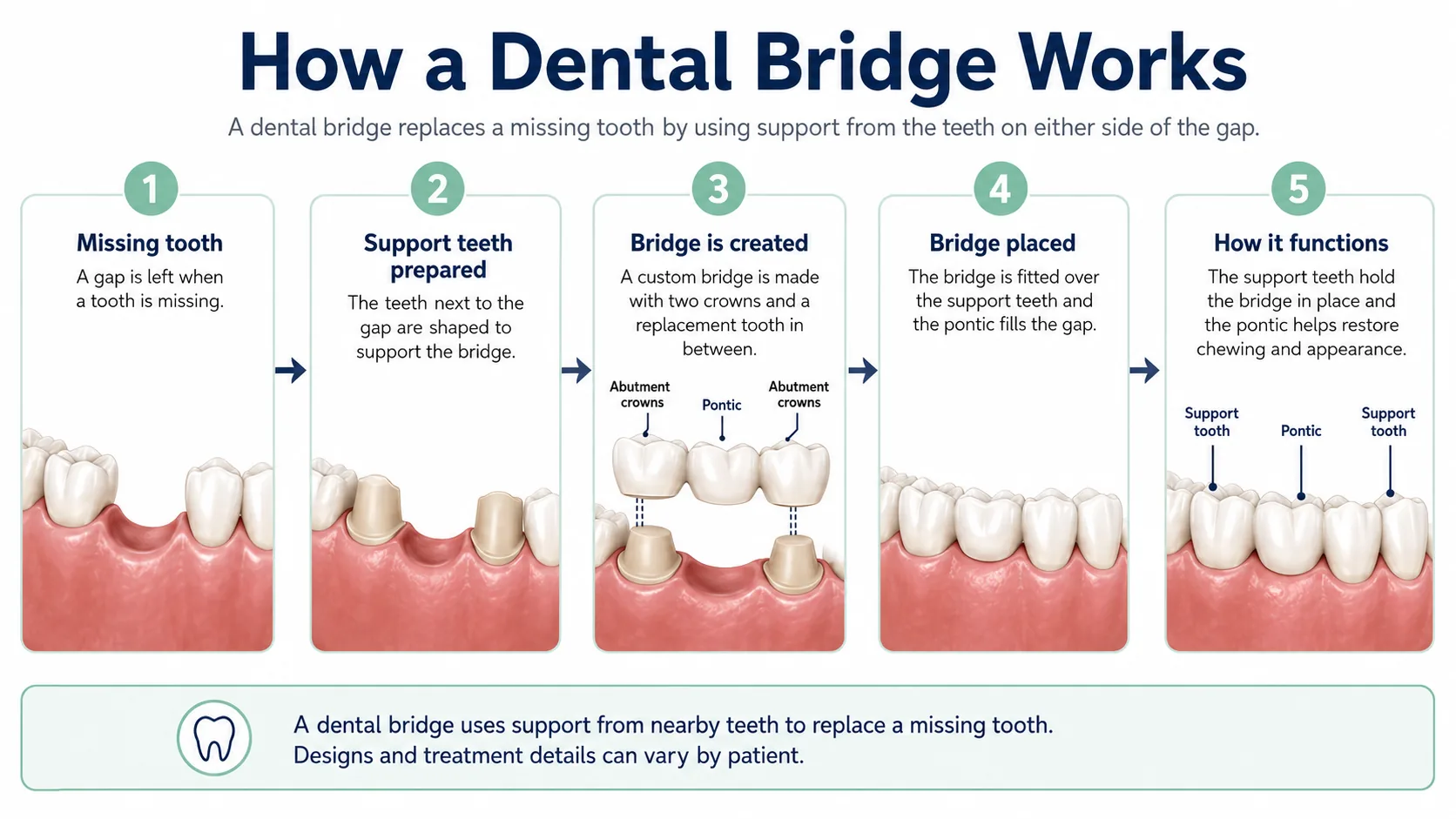
Illustration: A traditional tooth-supported bridge replacing one missing tooth. Bridge designs, supporting structures, and treatment stages vary by patient.
Six Checks for Dental Insurance for Bridges
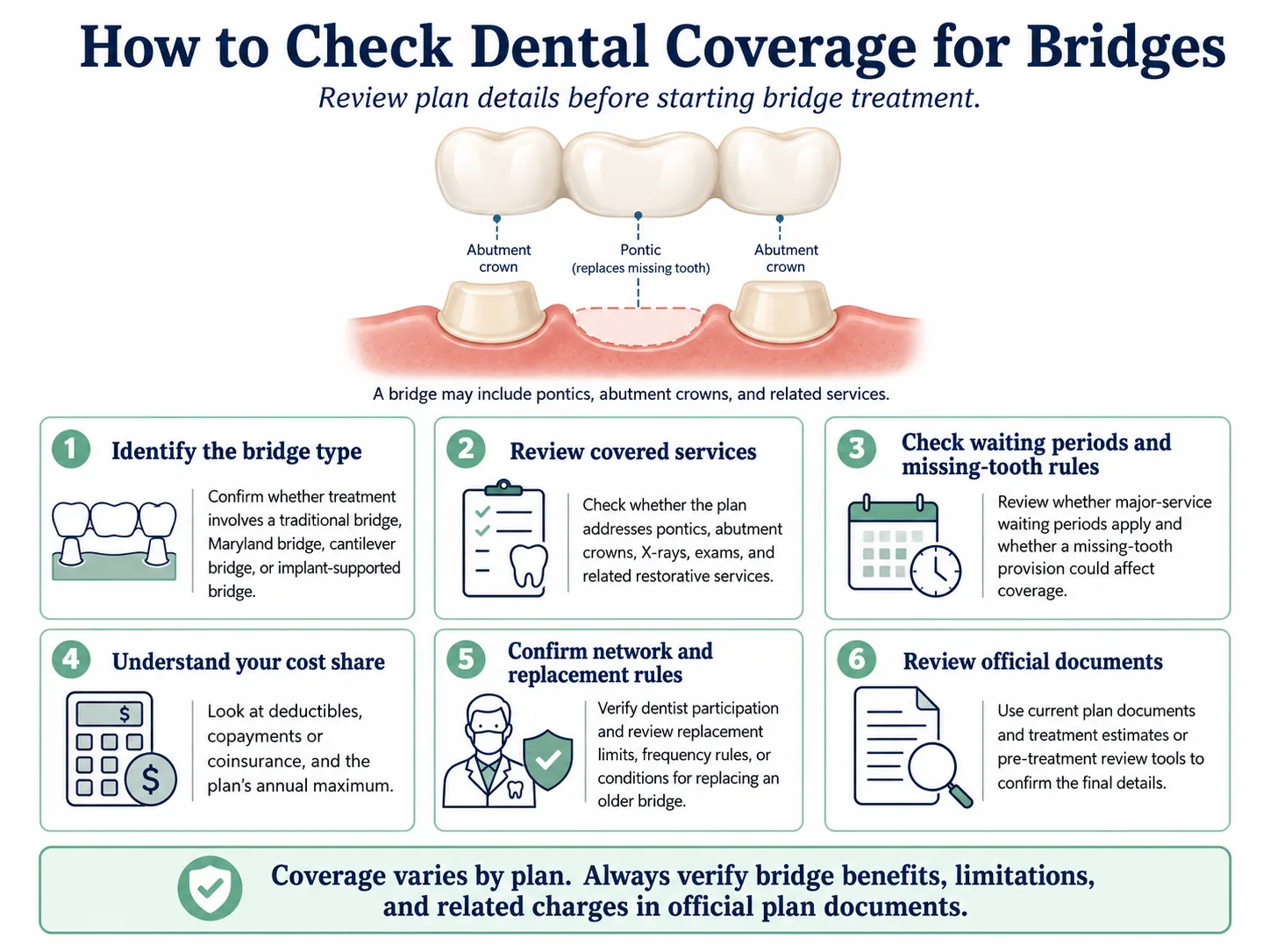
Use the following checks with the dental office’s itemized estimate and the documents for your exact plan.
1. Identify the Bridge Type and Components
Ask the dentist to identify:
- The tooth or teeth being replaced
- The proposed bridge design and material
- The supporting teeth or implants
- The pontics and retainers included
- Whether this is an initial bridge or a replacement
A resin-bonded or Maryland bridge uses a different attachment design from a conventional bridge with supporting crowns. An implant-supported bridge also involves a different treatment arrangement.
For implant-supported treatment, review the dental implant coverage guide alongside the bridge provisions.
2. Separate Included Services From Additional Charges
Request an itemized treatment plan identifying the proposed procedures, tooth numbers when applicable, and office charges.
Clarify whether the estimate includes temporary restorations, laboratory work, adjustments, and other associated services.
For any separately listed item, ask:
- Is this included in another treatment charge?
- Is it billed separately by the office?
- Does the plan consider a separate benefit?
- Could the charge become patient responsibility?
A separate procedure code or charge does not guarantee a separate insurance payment.
If the plan treats an item as included in another service, ask the office to explain any proposed patient charge under the applicable provider agreement and plan rules.
3. Check Missing-Tooth Provisions and Waiting Periods
If the tooth was missing before coverage began, ask whether the plan has a provision affecting its replacement.
Confirm whether the tooth-loss date, prior coverage, or supporting records matter under that specific provision. Do not assume prior insurance automatically removes a restriction.
Check any waiting period separately, including which services it affects and when those benefits become available.
Record an unresolved answer as not yet confirmed.
4. Review Replacement and Alternate-Benefit Rules
For an existing bridge, confirm its placement date and the reason replacement is being recommended.
Ask whether the plan requires records showing its condition, whether a replacement interval applies, and whether any exception can be considered.
Also ask whether the plan will calculate benefits using the proposed bridge or an alternative treatment or material.
These questions affect the estimate even when the plan generally includes bridge benefits.
5. Confirm Providers and Treatment Dates
Verify participation for the exact dentist, office location, plan, and network.
If several providers are involved, check each one. A referral does not establish that another provider participates in the same network.
Ask which treatment date or stage the plan uses to determine benefits. This is particularly important when preparation and placement occur in different benefit periods or when coverage may change.
Use the treatment-in-progress guide if bridge treatment will overlap a change in dental coverage.
6. Review the Estimate and Required Plan Review
Ask whether preauthorization is required and whether a predetermination or other advance benefit estimate is available.
Match the response to the actual bridge components and related services. Check:
- The allowance or applicable copayment
- Any deductible still to be satisfied
- Estimated plan payment and patient responsibility
- Benefits remaining, where a maximum applies
- Excluded, combined, or alternate-benefited items
- Missing information and conditions that remain unresolved
Keep the treatment plan, benefit response, and office estimate together. Mark uncertain amounts as estimates, not confirmed payments.
Missing-Tooth Provisions vs Waiting Periods
These provisions can affect the same treatment, but they address different issues.
| Provision | Main question |
|---|---|
| Waiting period | Has enough time passed for an otherwise eligible benefit to become available? |
| Missing-tooth provision | Is replacement of a tooth that was already missing when coverage began eligible under this plan? |
A plan may contain either provision, both, or neither.
No waiting period does not automatically mean no missing-tooth restriction.
Likewise, finishing a waiting period does not necessarily make a previously missing tooth eligible for replacement benefits.
If the tooth was removed after coverage began, still verify the bridge benefit and other limitations. Payment for the extraction does not establish payment for the later bridge.
For the broader rules, review Missing Tooth Clauses in Dental Insurance and How Waiting Periods Work in Dental Coverage.
Check Related Treatment Without Assuming It Is Required
Some patients need other services before or during bridge treatment. These should be identified in the estimate without treating them as mandatory steps for everyone.
| Related service | What to clarify |
|---|---|
| Examinations and imaging | Which services are proposed and whether separate benefits apply |
| Treatment of a supporting tooth | Whether restorative or endodontic care has its own benefit requirements |
| Tooth extraction | How removal is evaluated separately from replacing the tooth |
| Periodontal treatment | Whether care for the supporting tissues is included in the proposed plan |
| Temporary restorations | Whether charges are included, separately billed, or subject to separate benefit rules |
A crown used as a bridge retainer should be identified correctly on the treatment plan. Do not assume it will be evaluated exactly like a standalone crown.
Use the relevant guides for crown coverage, root canal coverage, or tooth extraction coverage when those services are part of your proposed care.
Could an Alternate Benefit Change the Payment?
An applicable alternate-benefit provision may allow the plan to calculate its contribution using another treatment or material.
For example, if the plan’s written response uses a removable replacement as the benefit basis, ask how that calculation affects the proposed fixed bridge and your estimated cost.
Separate these questions:
- What treatment does the dentist recommend?
- What treatment have you agreed to receive?
- What treatment or material is the plan using to calculate benefits?
An alternate benefit does not, by itself, require you to choose the alternative. It can, however, change the amount you may need to pay.
Ask for the calculation and the applicable provision in writing. If the alternative involves a removable prosthesis, the denture coverage guide explains the separate benefit questions.
Does Dental Insurance Cover Replacement Bridges?
A replacement bridge may qualify for benefits, but the existing bridge’s age alone does not settle the question.
The plan may also consider the reason for replacement, supporting documentation, applicable exclusions, and available benefits.
Ask the office to distinguish replacement from a repair or recementation. These are different services and should not be assumed to follow identical benefit rules.
A replacement interval is an insurance limitation. It is not a clinical instruction to keep a failing bridge or replace a functioning one.
Replacement mainly for appearance may also be affected by cosmetic exclusions.
For a fuller explanation, review Dental Insurance Replacement Rules.
Understand the Estimated Patient Cost
A major-service percentage alone cannot tell you what the bridge will cost.
First determine whether the proposed treatment qualifies. Then review the amount on which the benefit is calculated, applicable cost sharing, limitations, and included charges.
Depending on the plan, the estimate may use an allowed amount and coinsurance or a schedule of copayments. Do not apply one plan’s calculation method to another.
Where an annual maximum applies, check benefits already used and any pending claims. If several procedures share that maximum, do not count the same remaining benefit more than once.
For example, separate estimates for a root canal and a bridge may each show benefits based on the balance available when the estimate was prepared. Adding those estimates together may overstate the amount available for the complete treatment.
Review Dental Insurance Annual Maximums Explained for the broader calculation framework.
Use Advance Benefit Information Carefully
Ask whether the plan requires authorization before treatment or offers an optional advance estimate. Follow the specific procedure that applies to your coverage.
The response should identify the treatment reviewed, relevant limitations, missing records, and any conditions affecting the estimate.
Advance review does not necessarily guarantee final payment or reserve benefits for the bridge.
Eligibility, benefits used by other claims, treatment changes, and applicable service dates can affect the final result.
If the response does not clearly address a missing-tooth restriction or replacement requirement, ask for clarification before relying on the estimate.
Read Dental Insurance Predetermination vs Preauthorization: What’s the Difference?
How to Interpret Your Bridge Coverage
| Information received | What it does not establish | Useful next step |
|---|---|---|
| Bridges are covered | That your specific treatment qualifies or will be paid in full | Match the proposed procedures to the detailed provisions |
| No waiting period | That a previously missing tooth is eligible | Check missing-tooth rules separately |
| The dentist participates | That every service or provider qualifies | Confirm the exact network and proposed care |
| Several components are listed | That each receives separate payment | Clarify included services and benefit treatment |
| The old bridge needs replacement | That a replacement benefit is currently available | Review placement history and documentation requirements |
| An advance estimate was issued | That benefits cannot change | Check conditions, dates, and remaining benefits |
| A claim line shows no payment | That you automatically owe the entire charge | Read the explanation and compare it with the office statement |
After treatment, compare the dental-office statement with the Explanation of Benefits.
If the result differs from the estimate, identify whether the issue involves missing information, a claim correction, an applied limitation, or a decision you may wish to challenge. Use the claim review and appeal guide for the next step.
If You Are Comparing Plans Before Bridge Treatment
Use the same itemized bridge proposal for every option.
Compare eligibility for the missing tooth, coverage dates, provider participation, bridge provisions, and estimated total costs. A lower premium or a larger advertised benefit does not answer those treatment-specific questions.
The guide to comparing plans for expected treatment explains how to organize that comparison.
Discuss the clinical choice and timing with your dentist. Insurance benefits help explain financial contributions; they do not establish which bridge design or tooth-replacement treatment is appropriate for you.
Helpful Resources
Frequently Asked Questions
Does dental insurance for bridges include the supporting crowns?
It may. Ask the office to identify the supporting crowns or retainers as part of the bridge treatment plan. Their benefit treatment should not be assumed to match that of standalone crowns or the pontic.
Are bridges considered major dental services?
They may appear under major restorative services, prosthodontics, or another plan-defined category. The category name does not establish a universal payment percentage, waiting period, or patient cost.
Can I receive bridge benefits for a tooth missing before enrollment?
Possibly, depending on the plan. Check whether a missing-tooth provision applies and whether the plan requires information about the tooth-loss date or prior coverage.
Does completing a waiting period remove a missing-tooth restriction?
Not automatically. These are separate provisions. Verify eligibility for the missing tooth even after the waiting period has ended.
Is an implant-supported bridge covered like a traditional bridge?
Not necessarily. Implant placement, implant components, the bridge restoration, and related procedures can involve different provisions. Review the implant and bridge benefits together.
Does insurance cover replacing an old bridge?
It may, subject to the plan’s replacement requirements. Confirm the original placement date, reason for replacement, required records, and any applicable limitations.
Can the plan calculate benefits using a different treatment?
Yes, if an applicable alternate-benefit provision permits it. Ask which alternative is being used and how the calculation changes the estimated plan payment and patient cost.
Does a bridge predetermination guarantee payment?
Not necessarily. It provides advance benefit information based on the submitted proposal and applicable conditions. Eligibility, treatment details, service dates, and benefits remaining can affect the final claim.
Sources
- American Dental Association — Glossary of Dental Terms
- American Dental Association — Pre-Authorizations
- American Dental Association — Least Expensive Alternative Treatment Clause
- American Dental Association — Explanation of Benefits Statement
- Delta Dental of New Jersey — Missing Tooth Clause and Missing Tooth Exclusions
About the Author
Maria Dumitru is the Founder and Content Editor of Dental Coverage Hub. She researches and edits educational content designed to help U.S. consumers understand dental insurance terms, procedure-specific benefit rules, and the information they may need to verify before dental treatment.
Learn more about our standards in the Editorial Policy and How We Review Dental Plans.
Disclaimer
This article provides general educational information and is not personalized dental, medical, legal, financial, or insurance advice. Benefits, exclusions, provider arrangements, authorization requirements, and patient costs vary by plan and circumstances. Official documents for your specific coverage govern benefit eligibility and payment.
Examples and illustrations do not establish coverage or prescribe a treatment sequence. Discuss clinical decisions with a qualified dental professional and verify benefit questions with your dental plan or plan administrator. Estimates and advance reviews do not necessarily guarantee payment.

Review the Complete Bridge Treatment Plan
Before relying on a bridge benefit, identify the proposed components, verify eligibility and limitations, and clarify the estimated patient cost.