
Does Dental Insurance Cover Dental Anesthesia or Sedation? What to Check Before Treatment
Learn how dental anesthesia and sedation benefits may work, what can affect coverage, and what to verify before treatment begins.
Written and researched by Maria Dumitru.
Founder and Content Editor at Dental Coverage Hub
Last reviewed: October 2026
Does dental insurance cover dental anesthesia or sedation? Dental insurance may provide benefits for certain anesthesia or sedation services, but coverage depends on the specific service, the dental treatment being performed, the provider, and the terms of the plan.
Local anesthesia, nitrous oxide, sedation, and general anesthesia should not automatically be treated as the same insurance benefit.
The dental procedure itself and the anesthesia or sedation used with it may also be evaluated separately.
A covered dental procedure does not automatically establish coverage for anesthesia or sedation used during that procedure.
What You’ll Learn
This guide explains:
- How dental insurance may cover anesthesia or sedation
- Why the exact anesthesia or sedation service matters
- Why IV sedation should not be treated as one universal insurance category
- How the underlying dental procedure can affect the coverage question
- Why the anesthesia provider and network status may matter
- How treatment setting and separately billed services can affect benefit verification
- When medical insurance may also be worth checking
- What to verify before treatment begins
Quick Answer
Dental insurance may provide benefits for anesthesia or sedation, but there is no universal coverage rule that applies to every plan or every dental procedure.
The plan may consider:
- The exact anesthesia or sedation service
- The underlying dental procedure
- Clinical circumstances and supporting information
- Who provides the anesthesia or sedation
- Provider network status
- Treatment setting
- Whether the service is billed separately
- Deductible or other cost-sharing
- Available annual benefits
- Exclusions or limitations
- Advance-review requirements
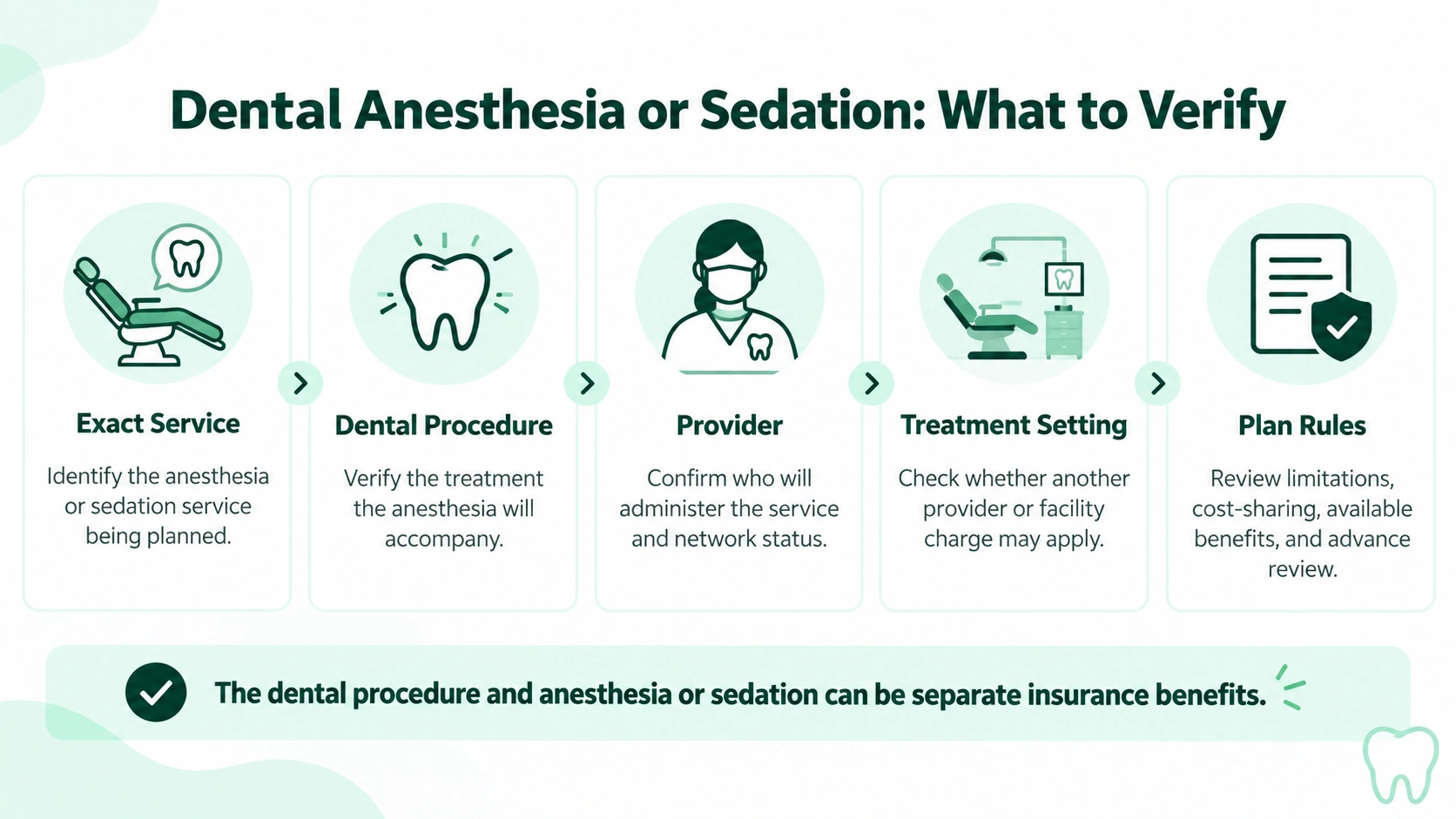
The most reliable approach is to verify the dental procedure and the anesthesia or sedation service as separate benefit questions.
Key Takeaways
- Dental anesthesia and sedation are not one single insurance service.
- Local anesthesia is different from sedation.
- Nitrous oxide, sedation, and general anesthesia may be evaluated differently.
- IV describes a route of administration and does not by itself determine the sedation level or insurance benefit.
- Coverage for a dental procedure does not automatically establish coverage for anesthesia or sedation.
- A clinical recommendation does not automatically guarantee insurance payment.
- A separate anesthesia provider can create another network and billing question.
- Treatment setting and facility-related services may create additional coverage questions.
- Predetermination or preauthorization can provide useful advance information without guaranteeing final payment.
In This Guide
Does Dental Insurance Cover Dental Anesthesia or Sedation?
It may.
Dental plans can provide benefits for certain anesthesia or sedation services, but coverage varies by plan and treatment circumstances.
The plan may evaluate:
- The service being provided
- The procedure it accompanies
- Why the service is being used
- Supporting documentation
- Provider and network status
- Treatment setting
- Cost-sharing
- Other plan limitations
That means a general statement that anesthesia or sedation is covered does not establish what will happen with every dental procedure.
Verify the exact anesthesia or sedation service rather than relying only on a broad sedation benefit description.
Why the Exact Anesthesia or Sedation Service Matters
Different forms of anesthesia and sedation can create different insurance questions.
Local Anesthesia
Local anesthesia numbs a specific treatment area.
For insurance purposes, determine whether the plan treats the service as part of the dental procedure or evaluates it separately when applicable.
Nitrous Oxide
Nitrous oxide may be used during dental treatment, but it should not automatically be assumed to be covered or excluded.
Verify whether the plan provides a benefit for the service in the circumstances of the proposed treatment.
Minimal or Moderate Sedation
Sedation services can be distinct from the underlying dental procedure.
Check the exact service, how it will be billed, who will provide it, and whether the plan has documentation or advance-review requirements.
IV Sedation, Deep Sedation, or General Anesthesia
IV describes how medication is administered. It does not by itself identify a single level of sedation or insurance benefit.
If IV sedation is discussed, ask which actual sedation or anesthesia service will be provided.
Deep sedation and general anesthesia may also have separate provider, documentation, setting, or benefit requirements.
The insurance question should be based on the actual service being provided, not only the route used to administer medication.
Dental Procedure Coverage and Anesthesia Coverage Are Separate Questions
Anesthesia or sedation is generally provided in connection with another dental service.
That may include:
- Tooth extraction
- Wisdom tooth removal
- Oral surgery
- Implant treatment
- Periodontal treatment
- Restorative treatment
- Several procedures performed during one appointment
The underlying dental procedure and the anesthesia service can have different benefit provisions.
A plan may provide a benefit for the treatment while applying a separate limitation or exclusion to sedation.
The reverse is also true: knowing how the anesthesia benefit is handled does not determine how the underlying dental procedure will be covered.
Verify both services when anesthesia or sedation is separately reported or subject to separate plan provisions.
What Can Affect Anesthesia or Sedation Coverage?
Several factors can affect the benefit.
Exact Anesthesia or Sedation Service
Start with the service the provider expects to perform and submit.
Do not rely only on broad terms such as sedation dentistry.
Underlying Dental Procedure
The procedure accompanying the anesthesia may matter under the plan.
For example, anesthesia associated with an oral-surgery treatment plan may create different benefit questions from anesthesia used with another type of dental procedure.
Clinical Circumstances and Supporting Documentation
The provider may recommend anesthesia or sedation based on the dental procedure, treatment complexity, patient circumstances, or other clinical considerations.
Depending on the plan, supporting information may be requested.
The exact requirements can vary.
A clinical reason for sedation can support the treatment recommendation without automatically guaranteeing an insurance benefit.
Provider and Network Status
The provider administering anesthesia or sedation may be the treating dentist, oral surgeon, or another qualified professional.
If another provider is involved, verify that provider separately.
An in-network dental office does not automatically mean every professional involved in the treatment is also in-network.
For the broader network framework, read In-Network vs Out-of-Network Dental Insurance.
Treatment Setting
Anesthesia or sedation may be provided in a dental office, oral-surgery office, or another treatment setting.
The setting can affect which providers and separately billed services are involved.
It does not by itself determine whether dental or medical insurance provides a benefit.
Deductible and Cost-Sharing
Depending on the plan, deductible, copay, coinsurance, or another form of patient responsibility may apply.
Verify how the specific anesthesia or sedation service is treated.
Annual Maximum
If anesthesia or sedation receives a dental benefit, determine whether payment can affect the same annual maximum used by other covered dental services.
For the separate mechanism, read Dental Insurance Annual Maximums Explained.
Exclusions and Limitations
Some plans may limit or exclude particular anesthesia or sedation services or apply service-specific requirements.
Review the actual plan language rather than assuming coverage from the underlying procedure.
Clinical Need and Insurance Benefit Are Different Questions
The treating professional determines whether anesthesia or sedation is clinically appropriate.
The insurance plan determines whether its contract provides a benefit for the proposed service.
These decisions answer different questions.
A provider may recommend sedation because of the procedure, treatment complexity, patient circumstances, or another clinical reason.
The plan can still apply documentation requirements, network rules, limitations, exclusions, or other provisions.
Clinical appropriateness does not automatically establish insurance payment, and an insurance payment decision does not determine whether the clinical recommendation was appropriate.
Does the Provider Performing Anesthesia Matter?
It can.
In some treatment plans, the dentist or oral surgeon provides the anesthesia or sedation.
In others, another qualified anesthesia professional may be involved.
For insurance purposes, ask:
- Who will provide the anesthesia or sedation?
- Will that provider bill separately?
- Is that provider in-network under the applicable plan?
- Does the plan have provider-specific requirements for the service?
Do not assume that every provider involved in the same appointment has the same network status.
What If Several Services Are Billed at the Same Visit?
A dental treatment plan involving anesthesia can contain several separately evaluated services.
For example:
| Treatment component | What to verify |
|---|---|
| Dental procedure | Benefit for the underlying treatment |
| Anesthesia or sedation | Separate anesthesia or sedation benefit when applicable |
| Diagnostic imaging | Imaging benefit and applicable limitations |
| Separate anesthesia provider | Professional charge and network status |
| Facility-related service | Separate coverage when applicable |
One appointment can contain several insurance benefit decisions.
Ask for a written or itemized treatment estimate when practical so you can identify which significant services need to be checked separately.
For diagnostic imaging, read Does Dental Insurance Cover Dental X-Rays? What to Check Before Your Visit.
Is Anesthesia Covered With Wisdom Teeth Removal?
It may be, but wisdom tooth removal and anesthesia are separate benefit questions.
A plan may provide a benefit for the extraction without providing the same benefit for sedation or anesthesia.
The exact extraction, anesthesia service, provider, treatment setting, and plan provisions can all matter.
For the procedure-specific framework, read Does Dental Insurance Cover Wisdom Teeth Removal? What to Check Before Treatment.
Is Anesthesia Included With Oral Surgery?
Not automatically.
Oral surgery can involve the surgical procedure itself, imaging, anesthesia or sedation, and other separately evaluated services.
The main surgical benefit should not be used to predict the anesthesia benefit.
For the broader surgical framework, read Does Dental Insurance Cover Oral Surgery? What to Check Before Treatment.
Can Dental and Medical Insurance Both Matter?
Sometimes.
Certain treatment circumstances can raise both dental and medical benefit questions.
However, the use of IV sedation, deep sedation, general anesthesia, an anesthesiologist, or a hospital setting does not automatically establish medical-insurance coverage.
The exact procedure, reason for treatment, provider, setting, and plan terms matter.
If medical insurance may be relevant, verify the proposed service directly with the applicable plan rather than assuming that the anesthesia method determines which insurer should pay.
When Advance Benefit Information May Be Useful
Advance benefit information can be particularly useful when anesthesia or sedation is billed separately, another provider is involved, several procedures are planned, or coverage requirements are unclear.
Depending on the plan, predetermination or preauthorization may help clarify:
- Whether the proposed service is an available benefit
- Whether documentation is needed
- Provider-related requirements
- Current eligibility
- Expected cost-sharing
- Available benefits
Advance benefit information can help with planning, but it should not automatically be treated as guaranteed final payment.
For the complete framework, read Dental Insurance Predetermination vs Preauthorization: What’s the Difference?
Where to Check Dental Anesthesia or Sedation Coverage
Schedule of Benefits
Look for anesthesia, sedation, nitrous oxide, or related benefit language.
Procedure-Specific Benefits
Review whether the service is covered in connection with the planned dental procedure.
Exclusions and Limitations
Check for service-specific restrictions or circumstances in which the plan does not provide a benefit.
Provider Network Information
Verify the provider performing the dental treatment and any separately involved anesthesia professional.
Advance-Review Requirements
Check whether predetermination, preauthorization, or another advance process applies.
How to Verify Benefits Before Dental Anesthesia or Sedation
Step 1: Confirm the Exact Service
Ask what anesthesia or sedation service is planned.
If the term IV sedation is used, ask what actual sedation or anesthesia service will be provided.
Step 2: Confirm the Underlying Dental Procedure
Identify the dental treatment the anesthesia or sedation will accompany.
Step 3: Ask Whether the Service Is Billed Separately
Determine whether anesthesia or sedation appears as a separate part of the treatment estimate.
Step 4: Confirm Who Will Provide the Service
Find out whether the treating dentist, oral surgeon, or another provider will administer it.
Step 5: Verify Network Status
Check any separately involved provider under the applicable plan.
Step 6: Review the Treatment Setting
Ask whether another facility or separately billed service will be involved.
Step 7: Check Plan Limitations and Cost-Sharing
Review applicable exclusions, limitations, deductible, cost-sharing, and available annual benefits.
Step 8: Ask About Advance Benefit Information
Determine whether predetermination or preauthorization would help clarify the benefit before treatment.
How to Interpret Common Anesthesia or Sedation Benefit Language
| Plan language or result | What it may mean | What not to assume |
|---|---|---|
| Anesthesia benefit available | The plan recognizes certain anesthesia services under applicable provisions | Do not assume every type of anesthesia or sedation is covered |
| Nitrous oxide benefit | The plan recognizes that specific service under certain circumstances | Do not automatically apply the benefit to other sedation services |
| Sedation limitation applies | A plan provision restricts when the service receives a benefit | Do not assume the underlying dental procedure is also excluded |
| Separate anesthesia provider | Another professional may bill for anesthesia services | Do not assume the provider has the same network status as the dentist |
| Preauthorization required | An advance process must be completed | Do not assume approval guarantees final payment |
| No benefit available | A plan provision affected the submitted service | Do not automatically conclude that all dental anesthesia or sedation is excluded |
After Treatment: Review the EOB
After the claim is processed, review the Explanation of Benefits before deciding why an anesthesia or sedation service received reduced or no payment.
Check:
- The service submitted
- The date of service
- The provider
- The plan allowance
- Any deductible or cost-sharing
- The plan payment
- Patient responsibility
- Any explanation or remark associated with the benefit decision
If several services were submitted during the same appointment, review them separately.
For the complete EOB framework, read How to Read a Dental Insurance EOB: Payments, Adjustments, and Patient Responsibility.
Common Dental Anesthesia and Sedation Coverage Mistakes
Treating All Sedation as One Benefit
Nitrous oxide, sedation, and general anesthesia should not automatically be treated as interchangeable insurance services.
Treating IV as a Coverage Category
IV describes a route of administration and does not by itself identify the actual sedation or anesthesia service.
Assuming the Dental Procedure Includes Sedation
The underlying treatment and anesthesia service can be evaluated separately.
Assuming Clinical Need Guarantees Payment
The provider’s treatment recommendation and the plan’s benefit determination answer different questions.
Ignoring a Separate Anesthesia Provider
Another provider can create a separate charge and network question.
Assuming the Treatment Setting Determines the Insurer
A hospital or surgical setting does not automatically establish medical coverage.
Treating Advance Review as Guaranteed Payment
Predetermination or preauthorization can provide useful information without guaranteeing the final claim result.
Our Recommendation
Before dental anesthesia or sedation, confirm:
- The exact service being planned
- The dental procedure it accompanies
- Whether anesthesia or sedation is billed separately
- Who will provide the service
- Whether the provider is in-network
- Where treatment will occur
- Whether other separately billed services are expected
- Which cost-sharing, annual-benefit, limitation, or advance-review provisions apply
Dental anesthesia or sedation is best understood as a separate benefit question that may accompany another dental procedure.
Coverage for the dental treatment does not automatically establish coverage for the anesthesia or sedation used with it.
Helpful Resources
- Dental Insurance Coverage for Common Procedures
- Does Dental Insurance Cover Oral Surgery? What to Check Before Treatment
- Does Dental Insurance Cover Wisdom Teeth Removal? What to Check Before Treatment
- Does Dental Insurance Cover Dental X-Rays? What to Check Before Your Visit
- In-Network vs Out-of-Network Dental Insurance
- Dental Insurance Annual Maximums Explained
- How to Read a Dental Insurance EOB: Payments, Adjustments, and Patient Responsibility
Frequently Asked Questions
Does Dental Insurance Cover Anesthesia for Dental Work?
It may. Coverage depends on the exact anesthesia service, the underlying dental procedure, provider, treatment setting, supporting information, and the terms of the dental plan.
Does Dental Insurance Cover Sedation Dentistry?
Some dental plans may provide benefits for certain sedation services, while others may apply limitations or exclusions. Verify the actual service being planned rather than relying only on the broad term sedation dentistry.
Is Anesthesia Covered Separately From the Dental Procedure?
It can be. The underlying dental procedure and the anesthesia or sedation service may be separate benefit determinations.
Does Dental Insurance Cover Nitrous Oxide?
It may, depending on the dental plan and treatment circumstances. Check whether the plan provides a benefit for nitrous oxide with the proposed dental procedure.
Does Dental Insurance Cover IV Sedation?
It may. IV describes the route used to administer medication rather than one universal insurance service. Verify the actual sedation or anesthesia service being provided.
Is Anesthesia Covered for Wisdom Teeth Removal?
It may be, but the extraction and anesthesia should be verified separately. Coverage for wisdom tooth removal does not automatically establish coverage for sedation or anesthesia.
Can Medical Insurance Cover Dental Anesthesia?
Medical insurance may be relevant in some circumstances, but the anesthesia method or treatment setting alone does not establish medical coverage. Verify the specific procedure and services under the applicable plans.
Why Might Dental Insurance Not Pay for Anesthesia or Sedation?
Possible reasons can include the exact service, an exclusion or limitation, provider network, documentation requirements, advance-review requirements, available benefits, cost-sharing, or another plan provision. Review the EOB for the specific explanation.
Sources
- American Dental Association — Anesthesia and Sedation
- American Dental Association — Guidelines for the Use of Sedation and General Anesthesia by Dentists
- American Dental Association — Typical Dental Plan Benefits and Limitations
- American Dental Association — Pre-Authorizations
- American Dental Association — Explanation of Benefits Statement
About the Author
Maria Dumitru is the founder and content editor of DentalCoverageHub. She creates consumer-focused educational content designed to help readers understand dental insurance benefits, limitations, and plan rules before making coverage decisions.
Learn more about our standards in the Editorial Policy and How We Review Dental Plans.
This article is for general educational purposes. Dental anesthesia and sedation benefits, provider requirements, network provisions, treatment-setting rules, documentation requirements, cost-sharing, and other coverage terms can vary by plan. Clinical anesthesia and sedation decisions should be made by the treating dental or medical professional.

Explore Dental Coverage for Common Procedures
Anesthesia or sedation may accompany different types of dental treatment, and its benefit can be evaluated separately from the procedure itself. Use our broader procedure coverage guide to understand what to verify when researching other types of dental care.