
Does Dental Insurance Cover Emergency Dental Care? What to Check Before Treatment
Learn how dental insurance may apply during an urgent visit, why each service matters, and what to verify before follow-up treatment.
Written and researched by Maria Dumitru.
Founder and Content Editor at Dental Coverage Hub
Last reviewed: October 2026
Does dental insurance cover emergency dental care? Dental insurance may provide benefits for services received during an urgent dental visit, but emergency dental care is not one universal insurance benefit.
An urgent appointment can involve several different services, such as an examination, diagnostic imaging, temporary treatment, and a definitive dental procedure.
The dental plan may evaluate each service separately.
The most useful approach is to identify what was done during the emergency visit, determine whether the care was temporary or definitive, and then check the benefit for each significant service.
If a dental problem may be life-threatening or involves serious breathing or swallowing difficulty, uncontrolled bleeding, major facial trauma, or severe swelling that could affect the airway, seek appropriate emergency medical care rather than delaying care to verify dental benefits.
What You’ll Learn
This guide explains:
- How dental insurance may apply during an emergency dental visit
- Why one urgent appointment can contain several separate benefit questions
- How emergency examinations and diagnostic imaging may be evaluated
- Why temporary care is different from definitive treatment
- What happens when the urgent visit leads to another dental procedure
- Why network status and normal plan rules may still matter
- When advance benefit information may be useful for follow-up treatment
- What to review after the claim is processed
Quick Answer
Dental insurance may provide benefits for emergency dental care, but the plan generally evaluates the actual services performed rather than treating the entire visit as one emergency benefit.
An urgent appointment may include:
- A problem-focused dental examination
- Diagnostic imaging
- Temporary or palliative care
- A same-day definitive procedure
- Follow-up treatment
- Specialist care
Coverage for the emergency examination does not automatically establish coverage for the X-rays, temporary treatment, or definitive procedure performed during or after the visit.
Waiting periods, network rules, cost-sharing, available annual benefits, exclusions, and other plan provisions may still apply.
Key Takeaways
- Emergency dental care is not one universal insurance benefit.
- An urgent visit can contain several separately evaluated services.
- The examination and diagnostic imaging may have different benefit rules.
- Temporary or palliative care may not complete the final treatment.
- A later filling, root canal, crown, extraction, or other procedure should be checked separately.
- Clinical urgency does not automatically override waiting periods or other plan provisions.
- Network status can still affect patient responsibility during urgent care.
- Advance benefit information may be useful for follow-up treatment when waiting for review is clinically appropriate.
In This Guide
Does Dental Insurance Cover Emergency Dental Care?
It may.
Dental insurance can provide benefits for services performed during an emergency dental visit, but coverage depends on the actual services and the terms of the dental plan.
A plan may evaluate:
- The examination
- Diagnostic imaging
- Temporary treatment
- The definitive dental procedure
- Provider and network status
- Waiting periods
- Deductible and other cost-sharing
- Available annual benefits
- Exclusions or limitations
The fact that treatment was urgent does not automatically change the benefit rules that apply to each service.
The treating dental professional determines what care is clinically appropriate and how urgently it should be provided.
The dental plan separately determines what financial benefit applies to the service performed.
Why Emergency Dental Care Is Not One Insurance Benefit
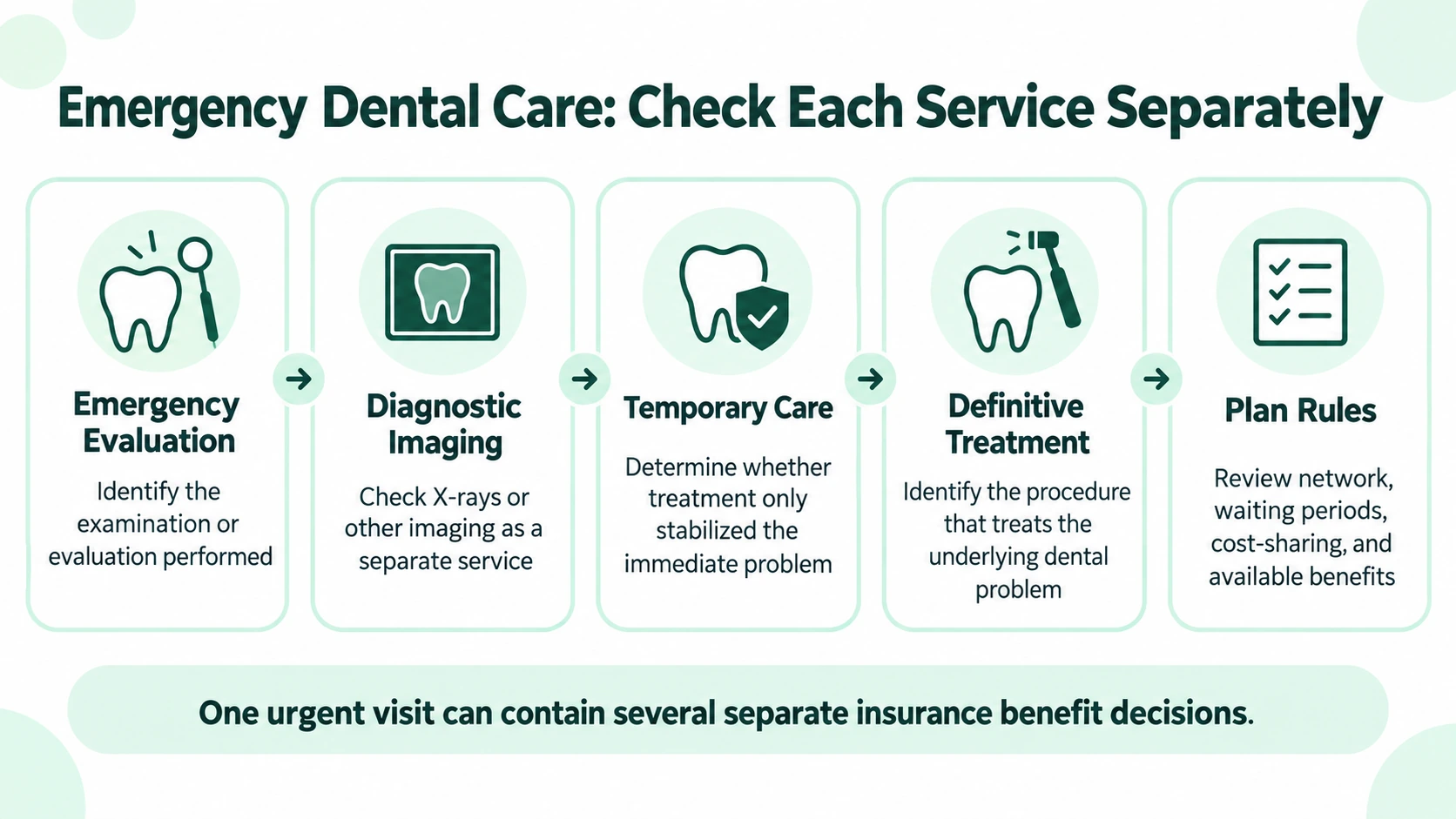
One urgent appointment can contain several distinct services.
Emergency Examination or Evaluation
The visit may begin with an examination focused on the immediate dental problem.
The exam can be one service, while diagnostic imaging or treatment performed during the same visit may be reported separately.
Diagnostic Imaging
Dental X-rays or other diagnostic imaging may be needed to evaluate the problem and plan treatment.
Imaging can have separate benefit provisions from the examination.
For the dedicated imaging framework, read Does Dental Insurance Cover Dental X-Rays? What to Check Before Your Visit.
Temporary or Palliative Care
Sometimes the immediate goal is to relieve discomfort or stabilize the problem without completing the final treatment.
Temporary care can therefore create a different insurance question from the procedure that will ultimately treat the underlying dental problem.
Definitive Dental Treatment
In other cases, definitive treatment may occur during the same visit or at a later appointment.
Once that procedure is identified, check its procedure-specific benefit rather than relying on the emergency-visit benefit.
One urgent appointment can contain several separate insurance benefit decisions.
What If the Emergency Visit Leads to Another Dental Procedure?
Emergency dental care often identifies the problem, but the procedure needed to treat it belongs to its own coverage framework.
Filling
If restorative treatment involves a filling, verify the filling benefit separately.
Read Does Dental Insurance Cover Fillings? What to Check Before Treatment.
Root Canal
If endodontic treatment is needed, check the root-canal benefit rather than assuming emergency coverage controls the later procedure.
Read Does Dental Insurance Cover Root Canals?
Tooth Extraction
If the tooth needs to be removed, the extraction creates its own procedure-specific benefit question.
Read Does Dental Insurance Cover Tooth Extraction? What to Check Before Treatment.
Crown or Other Restorative Treatment
If the treatment plan includes a crown, check the crown benefit separately.
Read Does Dental Insurance Cover Crowns?
If treatment becomes surgical, use the broader surgical framework in Does Dental Insurance Cover Oral Surgery? What to Check Before Treatment.
What If Treatment Is Only Temporary?
Temporary treatment and definitive treatment should not be treated as the same insurance question.
An urgent visit may:
- Relieve immediate discomfort
- Stabilize a tooth
- Protect the treatment area temporarily
- Provide time for another procedure to be completed later
The next appointment may involve a filling, root canal, crown, extraction, oral surgery, or another service.
Coverage for temporary care does not automatically establish coverage for the definitive procedure that follows.
Whenever the procedure changes, check the benefit again.
Does the Dentist Have to Be In-Network?
Not necessarily, but network status can affect how the dental plan processes the claim and what the patient may owe.
During an emergency, your usual dentist may not be available.
You may receive care from:
- Another general dentist
- An emergency dental office
- A specialist
- An out-of-network provider
- A provider outside your usual service area
Urgency does not automatically remove network provisions.
If circumstances allow, verify the provider under your exact dental plan.
If immediate treatment makes that impractical, confirm the network status as soon as reasonably possible afterward.
For the complete framework, read In-Network vs Out-of-Network Dental Insurance.
What If Your Regular Dentist Is Unavailable?
When another provider is needed, several separate insurance questions can arise.
Out-of-Network or Out-of-Area Care
Check whether your plan has provisions that apply when urgent dental treatment is received from another provider or outside the usual service area.
Do not assume ordinary network rules disappear because the problem is urgent.
Specialist Care
The emergency dentist may refer you to an endodontist, oral surgeon, or another specialist.
The specialist’s network status and the procedure performed should be checked separately.
After-Hours Charges
If the dental office identifies a separate after-hours or emergency-related charge, ask how the plan treats that specific service.
Coverage for the dental procedure does not automatically establish coverage for a separate after-hours charge.
Can Waiting Periods Still Apply to Emergency Dental Treatment?
They can.
An urgent need for treatment does not automatically waive a waiting period.
The emergency evaluation and the definitive procedure may also be subject to different benefit provisions.
For example, the examination may qualify for a benefit while a later procedure is still affected by a waiting period.
For the complete timing framework, read How Waiting Periods Work in Dental Coverage.
Can the Annual Maximum Affect Emergency Dental Care?
Yes.
An emergency does not automatically create additional annual dental benefits.
A service may otherwise qualify for coverage while the amount of annual benefits remaining still affects plan payment.
The two questions should be kept separate:
Is the service eligible for a benefit?
How much applicable annual benefit remains?
For the complete mechanism, read Dental Insurance Annual Maximums Explained.
Can Dental and Medical Insurance Both Matter?
Sometimes.
Certain situations involving major trauma, hospital care, or other medical circumstances may raise both dental and medical insurance questions.
However, severe pain, urgent treatment, or a hospital visit does not automatically convert later dental treatment into a medical-insurance benefit.
The applicable service and plan provisions still need to be verified.
The word emergency alone does not determine which insurance applies.
When Advance Benefit Information May Be Useful
Advance benefit information is generally more useful after the immediate problem has been assessed or stabilized and another procedure is planned for later.
For example:
Emergency evaluation → temporary care → definitive procedure later
may create an opportunity to review the next treatment before it is performed.
Depending on the plan, predetermination or preauthorization may help clarify:
- The procedure being proposed
- Current eligibility
- Expected cost-sharing
- Documentation requirements
- Available benefits
- Specialist or provider requirements
Do not delay clinically necessary urgent treatment solely to wait for an insurance determination.
Advance benefit information can also change before the final claim is processed.
For the complete framework, read Dental Insurance Predetermination vs Preauthorization: What’s the Difference?
Where to Check Emergency Dental Benefits
Schedule of Benefits
Look for examination, diagnostic, restorative, endodontic, oral-surgery, and other benefits relevant to the services performed.
Provider Network
Verify the dentist or specialist under your exact dental plan.
Waiting-Period Provisions
If coverage started recently, check whether the definitive procedure is currently eligible.
Exclusions and Limitations
Review any restrictions affecting the services performed during or after the urgent visit.
Advance-Review Requirements
For treatment that can safely occur later, check whether predetermination, preauthorization, or another advance process applies.
How to Verify Coverage During or After an Emergency Visit
Step 1: Identify What Was Done
Ask what services were actually performed during the visit.
Step 2: Separate the Examination From Other Services
Determine whether imaging, temporary care, or a procedure was reported separately.
Step 3: Ask Whether Treatment Was Temporary or Definitive
Confirm whether the immediate dental problem has been fully treated or whether another procedure is still needed.
Step 4: Identify the Next Procedure
If additional treatment is planned, verify that procedure under its own benefit provisions.
Step 5: Confirm Provider and Network Status
Check the dentist and any specialist separately when applicable.
Step 6: Review Major Plan Rules
Check relevant waiting periods, cost-sharing, annual benefits, exclusions, limitations, and network provisions.
Step 7: Ask About Advance Review for Follow-Up Care
If the next procedure can safely occur later, determine whether advance benefit information would be useful.
Step 8: Keep the Treatment Estimate and Claim Information
An itemized estimate and later EOB can help you understand which services were evaluated separately.
How to Interpret Common Emergency Dental Benefit Language
| Plan language or result | What it may mean | What not to assume |
|---|---|---|
| Emergency or problem-focused examination | The dentist evaluated a specific urgent problem | Do not assume imaging or treatment is included in the same benefit |
| Diagnostic imaging | X-rays or another imaging service was performed | Do not assume exam coverage establishes imaging coverage |
| Temporary or palliative treatment | Immediate care was provided without completing definitive treatment | Do not assume no further procedure will be needed |
| Same-day definitive treatment | The underlying dental procedure was performed during the urgent visit | Do not assume every service during the appointment has identical benefits |
| Out-of-network provider | A nonparticipating dentist or specialist provided care | Do not assume emergency status removes network rules |
| No benefit available | A plan provision affected one of the submitted services | Do not automatically conclude that all emergency dental care is excluded |
After Treatment: Review the EOB
Because an emergency visit can contain several services, review the Explanation of Benefits service by service.
Check:
- Which services were submitted
- Provider information
- Plan allowance
- Deductible or other cost-sharing
- Plan payment
- Patient responsibility
- Any remarks explaining adjustments or limitations
Do not assume that reduced payment for one service means the entire emergency visit was excluded.
For the complete EOB framework, read How to Read a Dental Insurance EOB: Payments, Adjustments, and Patient Responsibility.
If the plan issues a final unfavorable decision after the reason has been identified, read Dental Insurance Claim Denied? How to Review the Decision and Appeal.
Common Emergency Dental Coverage Mistakes
Treating the Entire Emergency Visit as One Benefit
The examination, imaging, temporary care, and final procedure can be evaluated separately.
Assuming Emergency Means Fully Covered
Clinical urgency does not automatically guarantee insurance payment.
Assuming the Exam Includes Dental X-Rays
Diagnostic imaging can have separate benefit provisions.
Assuming Temporary Treatment Is the Final Treatment
Another procedure may still be required.
Assuming Urgency Waives Waiting Periods
Waiting periods and other plan provisions may still apply.
Assuming Emergency Status Removes Network Rules
Network status can still affect the benefit and patient responsibility.
Waiting for Insurance Before Addressing a Potentially Serious Condition
Necessary emergency care should not be delayed solely to obtain an insurance determination.
Our Recommendation
During a dental emergency, address the clinical problem first.
Once the immediate situation is stable, confirm:
- What services were performed
- Whether treatment was temporary or definitive
- What procedure, if any, comes next
- Which provider performed each service
- Whether network provisions apply
- Whether waiting periods or other plan rules affect follow-up treatment
- Whether advance benefit information would help with the next procedure
- How each service appears on the treatment estimate and later EOB
Emergency dental care is best understood as a care pathway that may contain several separate insurance benefit decisions.
Coverage for the urgent visit does not automatically determine coverage for the definitive procedure that follows.
Helpful Resources
- Dental Insurance Coverage for Common Procedures
- Does Dental Insurance Cover Dental X-Rays? What to Check Before Your Visit
- Does Dental Insurance Cover Tooth Extraction? What to Check Before Treatment
- Does Dental Insurance Cover Root Canals?
- How Waiting Periods Work in Dental Coverage
- In-Network vs Out-of-Network Dental Insurance
- Dental Insurance Annual Maximums Explained
Frequently Asked Questions
Does Dental Insurance Cover Emergency Dental Care?
It may. Coverage depends on the actual examination, diagnostic services, treatment, provider, and plan provisions involved in the urgent visit.
Does Dental Insurance Cover an Emergency Dental Exam?
It may. The emergency examination can have its own benefit, while imaging or treatment performed during the same appointment may be evaluated separately.
Are Dental X-Rays Covered During an Emergency Visit?
They may be. Diagnostic imaging can be a separate service from the examination, so verify the imaging benefit separately.
Does Dental Insurance Cover Emergency Tooth Extraction?
It may. If the urgent visit results in an extraction, the extraction should be checked under the procedure-specific benefit provisions that apply to tooth removal.
Does Dental Insurance Cover an Emergency Root Canal?
It may. A root canal performed urgently still has its own endodontic benefit provisions and should be checked separately from the emergency examination.
Does Dental Insurance Cover an Out-of-Network Emergency Dentist?
It depends on the plan. Network, out-of-network, and out-of-area provisions can affect how the claim is processed and what the patient owes.
Do Waiting Periods Still Apply to Emergency Dental Treatment?
They can. Emergency status does not automatically waive a waiting period, and the urgent examination and definitive procedure may have different eligibility provisions.
Why Might Dental Insurance Pay Less Than Expected for Emergency Dental Care?
Possible reasons include the exact service performed, network status, waiting periods, deductible or other cost-sharing, annual-benefit limits, exclusions, documentation, or another plan provision. Review the EOB for the explanation associated with each service.
Sources
- American Dental Association — Emergency Treatment
- American Dental Association — Guide to Palliative Treatment of Dental Pain
- American Dental Association — Typical Dental Plan Benefits and Limitations
- American Dental Association — Pre-Authorizations
- American Dental Association — Explanation of Benefits Statement
About the Author
Maria Dumitru is the founder and content editor of DentalCoverageHub. She creates consumer-focused educational content designed to help readers understand dental insurance benefits, limitations, and plan rules before making coverage decisions.
Learn more about our standards in the Editorial Policy and How We Review Dental Plans.
This article is for general educational purposes. Emergency dental benefits, service classifications, provider-network provisions, waiting periods, cost-sharing, annual-benefit limits, exclusions, and other coverage terms can vary by dental plan. Clinical urgency and treatment decisions should be determined by the treating dental or medical professional.

Explore Dental Coverage for Common Procedures
An emergency dental visit can involve an examination, diagnostic imaging, temporary care, or a definitive dental procedure, and each service may create a separate insurance question. Use our broader procedure coverage guide to understand what to verify when researching other types of dental treatment.