
Composite vs Amalgam Fillings: How Dental Insurance May Calculate Benefits
Learn why a plan may use an amalgam allowance for a composite filling, how that can affect your cost, and what to verify before treatment.
Written and researched by Maria Dumitru.
Founder and Content Editor at Dental Coverage Hub
Last reviewed: November 2026
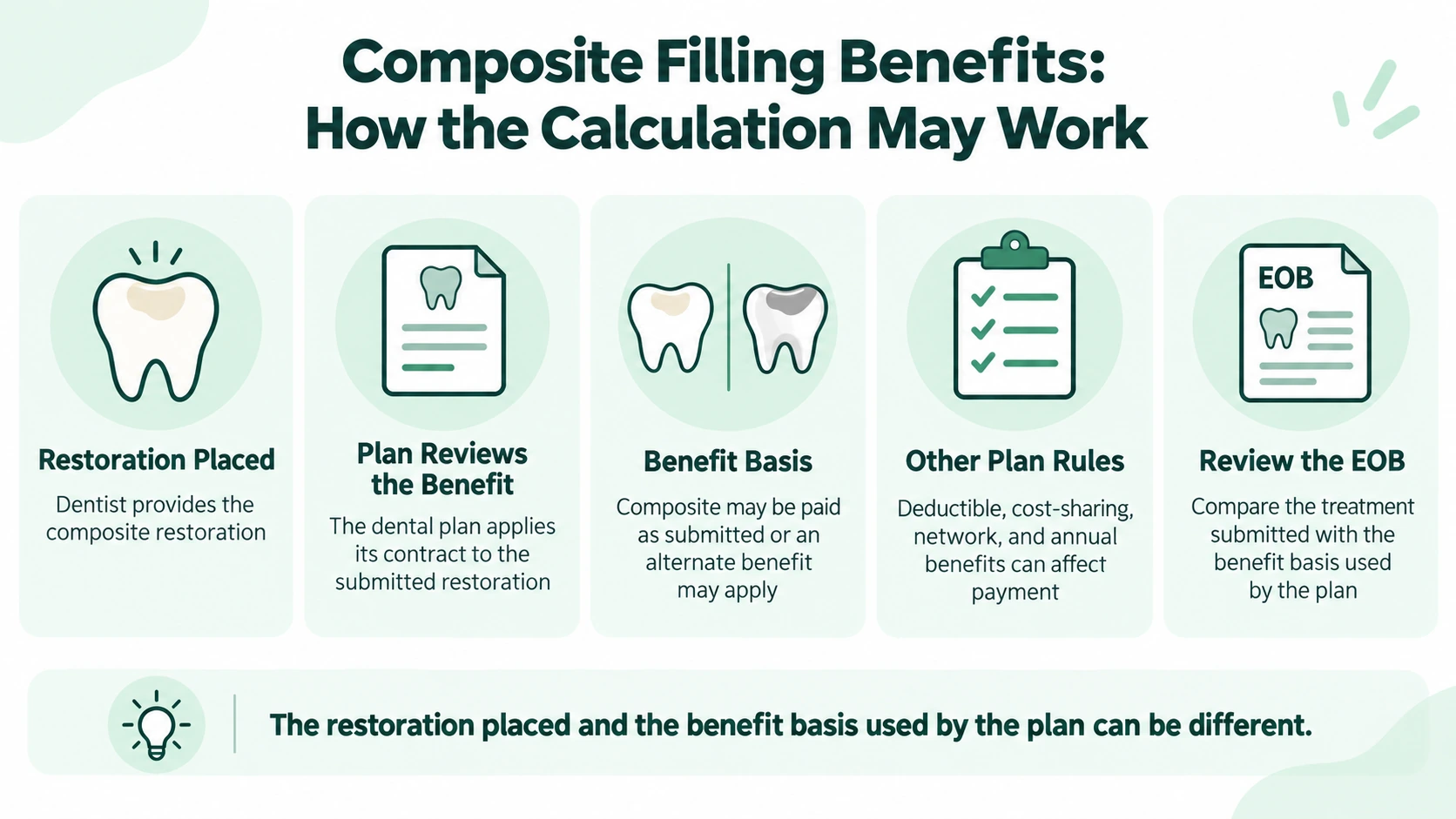
When comparing composite vs amalgam fillings for insurance purposes, separate the material placed in the tooth from the allowance used to calculate benefits.
A dentist may provide a composite filling while the dental plan calculates its contribution using an amalgam restoration as an alternative benefit basis.
The treatment performed and the insurance payment basis can be different.
This guide explains that financial distinction. It does not recommend one restorative material over another or replace a discussion with your dentist about appropriate treatment.
What You’ll Learn
- What an alternate benefit or LEAT provision means
- Why tooth location and restoration details matter
- How the benefit basis differs from the final plan payment
- Which patient charges need separate verification
- Why an EOB may reference amalgam after composite was placed
- What to ask before treatment and after claim processing
For general filling eligibility, timing, and coverage questions, start with Does Dental Insurance Cover Fillings?
Quick Answer
Some dental plans calculate benefits for a composite filling using an amalgam allowance under an alternate-benefit provision. Other plans may calculate the benefit using the composite restoration itself.
Neither approach, by itself, tells you the final payment or patient balance. Deductibles, cost-sharing, available benefits, provider agreements, and other applicable rules can still affect the result.
Before treatment, ask which allowance will be used and how the dental office calculated your expected charge.
Key Takeaways
- An alternate benefit changes the payment calculation, not the material actually placed.
- An amalgam reference on an EOB does not automatically establish a reporting error.
- A composite-based allowance does not mean the entire dentist’s charge will be paid.
- An alternate benefit and a zero final payment can occur on the same claim.
- Additional patient charges must be checked against the applicable plan and provider arrangement.
- Replacement eligibility is a separate question from the material used as the benefit basis.
In This Guide
What Is an Alternate Benefit?
An alternate benefit is a contractual provision that allows a plan to calculate a benefit using an alternative procedure, generally a less expensive one, instead of using the proposed or completed treatment as the payment basis.
A composite filling evaluated using an amalgam allowance is one example.
The dentist’s treatment record should still describe the restoration actually provided. The plan’s explanation should make clear when a different procedure or allowance was used for benefit calculation. American Dental Association
What Does LEAT Mean?
LEAT means least expensive alternative treatment. You may also encounter wording such as alternate benefit or least expensive professionally acceptable treatment.
Do not rely only on the label. Ask for the actual provision and how it applies to the proposed restoration.
The ADA describes composite-to-amalgam benefit calculations as an example of this approach. Its discussion also distinguishes the benefit decision from the clinical treatment decision. American Dental Association
Which Details Matter for Composite Filling Benefits?
Before asking for a benefit estimate, obtain the treatment information the plan needs.
| Detail | What to identify |
|---|---|
| Material | Whether the proposed restoration is composite |
| Tooth | The specific tooth receiving treatment |
| Surfaces | Which tooth surfaces are involved |
| Procedure | The restoration the office expects to report |
| Treatment history | Whether existing work is being repaired or replaced |
| Provider | The dentist, office location, and exact network |
| Coverage | The plan and benefit period being checked |
A general question about white fillings may not produce an answer specific enough for your treatment.
Ask the office to provide the proposed procedure information. You do not need to choose a dental code yourself.
Can Front and Back Teeth Be Treated Differently?
Tooth location may matter under a plan’s material-related provisions. Composite restorations on back teeth are a commonly discussed example of an amalgam alternate benefit.
However, do not assume that every posterior composite receives this calculation or that every plan treats front teeth the same way.
Ask about the specific tooth and restoration. If several fillings are planned, identify which ones the response covers.
A prior payment for a composite filling on another tooth is useful background, but it is not confirmation of the next benefit.
How Composite vs Amalgam Filling Benefits May Be Calculated
Review the calculation in separate parts:
| Part of the review | Question to ask |
|---|---|
| Treatment reported | What restoration did the dentist propose or provide? |
| Benefit basis | Is the plan using a composite allowance or an alternate allowance? |
| Applicable benefits | What deductible, cost-sharing, or benefit limit affects payment? |
| Patient charge | What amount may the office collect under the applicable arrangement? |
These are questions to resolve, not a universal formula that every plan follows.
If the Plan Uses the Composite Allowance
The plan is using the composite restoration as the basis for its benefit calculation.
That does not necessarily mean it accepts the dentist’s full submitted charge or pays that charge in full.
Ask which recognized fee applies and what member cost-sharing remains.
If the Plan Uses an Amalgam Allowance
The plan uses the contractual alternative when determining the benefit.
Ask which alternative was used, where the provision appears, and how the resulting payment was calculated.
Then ask the office to explain any additional amount associated with the selected composite restoration. Keep that amount separate from the deductible, coinsurance, or other charges.
The allowance is a calculation basis. It is not automatically the amount the plan pays.
What Can You Be Asked to Pay?
Do not assume your responsibility is simply the difference between the dentist’s advertised composite and amalgam prices.
Ask for a written explanation that separates:
- The charge for the actual composite restoration
- Any applicable contracted fee or adjustment
- The allowance used by the plan
- The expected plan payment
- Deductible or other member cost-sharing
- Any additional permitted material-related charge
- Payments already made
The ADA advises participating dentists to check the amount they may bill when a posterior composite receives an amalgam-based benefit. Provider agreements and applicable rules matter. American Dental Association
If You Are Using an In-Network Dentist
Ask the office to confirm how its participation agreement affects the composite fee and any additional charge.
Being in network does not automatically eliminate all member costs. It also does not establish that every difference between the submitted fee and the plan payment is billable to you.
If the plan and office give different answers, ask them to review the same procedure and adjustment explanation.
If You Are Using an Out-of-Network Dentist
Confirm that your plan provides an out-of-network benefit for the proposed restoration.
Ask which fee the plan will recognize, what payment the office requires, and whether the estimate includes amounts above the plan allowance.
A material-related difference may be only one part of your expected cost.
For the broader framework, read In-Network vs Out-of-Network Dental Insurance.
If Your Plan Uses a Copayment Schedule
Locate the proposed restoration in the member charge schedule and ask whether any material-related provision changes that charge.
Do not apply a percentage-based example from another plan to your own coverage.
The useful result is a procedure-specific estimate that identifies both the amount expected and the rules supporting it.
Why Your EOB May Mention Amalgam After Composite Was Placed
An Explanation of Benefits may refer to amalgam because the plan used it as the benefit basis.
That reference alone does not establish that the dentist placed amalgam or submitted the wrong restoration.
Compare three pieces of information:
- The treatment documented by the dental office
- The procedure reported on the claim
- The allowance and explanation used by the plan
Ask the office what was submitted, then ask the plan how it processed that submission.
Benefit Adjustment vs Reporting Error
A correctly reported composite restoration can receive an alternate benefit.
An incorrectly reported restoration is a different issue and may require a claim correction.
Do not ask the office to report amalgam when composite was actually provided simply to match the plan’s payment basis. The claim should accurately describe the treatment.
For document interpretation, read How to Read a Dental Insurance EOB.
Alternate Benefit, Reduced Payment, and Zero Payment
These descriptions answer different questions.
An alternate benefit identifies the basis used in the calculation. Reduced or zero payment describes the financial result.
For example, a plan might apply an alternate allowance and then determine that no payment remains because of another applicable provision. Alternatively, the plan might calculate a benefit using composite directly but issue no payment for a different reason.
Ask for both explanations:
- Which restoration or allowance was used?
- Which provisions determined the final payment?
Do not label every unpaid composite claim an alternate-benefit issue. Likewise, do not assume an alternate benefit always produces a positive payment.
The EOB’s remarks are important because the payment figure alone cannot explain the whole decision.
What Other Rules Can Affect the Result?
A material-related provision does not replace the rest of the plan.
When reviewing the estimate, ask whether it also accounts for:
| Separate issue | What to verify |
|---|---|
| Eligibility and timing | Whether coverage and the relevant benefit are active for treatment |
| Deductible | Whether an applicable amount remains |
| Cost-sharing | Which copay or coinsurance applies |
| Provider network | Which provider arrangement and fee rules were used |
| Available benefits | Whether pending claims or benefit usage could change payment |
| Previous treatment | Whether a replacement or frequency provision applies |
For plans with an annual maximum, use Dental Insurance Annual Maximums Explained to understand that separate limit.
Keep the explanation specific. If the expected patient amount increases, ask which part changed rather than attributing the whole difference to composite.
What If an Existing Filling Is Being Replaced With Composite?
Review two questions separately:
Is another restoration eligible for a benefit?
If it is, which allowance will be used for the composite restoration?
Start with the previous restoration’s history and the reason for the proposed treatment. Then ask about the material-related calculation.
Useful questions include:
- Does the plan consider this repair, replacement, or treatment of another area?
- What prior placement information is needed?
- Does the reason for replacement affect eligibility?
- If another restoration qualifies, will an alternate benefit apply?
- What remains uncertain in the estimate?
An answer confirming an amalgam allowance does not, by itself, confirm replacement eligibility.
If the old restoration is functioning and the proposed change is mainly for appearance, ask how the plan handles that circumstance. Discuss the clinical reasons and material options with your dentist.
For the detailed history and eligibility review, read Dental Insurance Replacement Rules Explained.
Can Advance Benefit Review Clarify the Calculation?
It may help, particularly when the potential material-related charge is important to your decision.
First ask whether the plan requires preauthorization. Separately, ask whether an optional predetermination can show the expected benefit for the proposed composite restoration.
These processes should not be treated as interchangeable.
Read the response for:
- The proposed procedure and tooth
- The benefit basis used
- Any alternate-benefit explanation
- The estimated payment and member cost
- Conditions, dates, or unresolved requirements
An advance response should not automatically be treated as an unconditional payment guarantee. Its effect depends on the response, applicable plan terms, and law; eligibility or available benefits may also change. American Dental Association
For the complete distinction, read Dental Insurance Predetermination vs Preauthorization: What’s the Difference?
If the Estimate Only Says Basic Services Covered
Ask for clarification about the proposed composite restoration.
Specifically request confirmation of whether the estimate uses the composite allowance or an alternate allowance. A general benefit percentage does not answer that question.
Also ask the office whether its estimate was based on a response from the plan, information in a portal, or its own calculation.
Keep any unverified assumption visible rather than treating it as confirmed coverage.
Before Treatment: Put the Answers Together
Use the same treatment information when contacting the dental office and the plan.
| Ask the dental office | Ask the dental plan |
|---|---|
| What restoration is proposed? | How will that restoration’s benefit be calculated? |
| Which tooth and surfaces are involved? | Does the provision apply to those details? |
| What material will be used? | Which allowance will be used? |
| Is this replacing existing work? | Is another restoration benefit available? |
| What will I be asked to pay? | What plan rules support the expected payment? |
| What assumptions remain in the estimate? | What requires further review or confirmation? |
Request an itemized estimate and retain the relevant response.
If a material-related amount is described as an upgrade charge, ask what that label means in this specific estimate. Request the calculation and whether the charge is permitted under the applicable arrangement.
Where to Find the Provision
Check the restorative-services section, limitations, alternate-benefit language, and schedule of benefits for your exact plan.
For employer coverage, use the materials for the employer’s benefit arrangement. A public brochure from the same insurer may describe a different product.
Ask the plan to identify the provision supporting its answer. If the summary is silent, request the more detailed document rather than interpreting silence as confirmation.
Record the contact date and reference number. If treatment, provider, or coverage changes, ask whether the earlier estimate still applies.
How to Interpret Composite Filling Benefit Language
| Wording or result | What to clarify |
|---|---|
| Composite covered | Whether the benefit uses the composite allowance or an alternative |
| Composite allowance used | What deductible, cost-sharing, or other conditions still apply |
| Amalgam allowance used | Which contractual provision supports that calculation |
| Alternate benefit applied | How the allowance and patient charge were determined |
| Replacement limitation | Whether prior treatment affects eligibility for another restoration |
| No payment | Which provisions produced that result |
| Material-related charge | What the charge represents and whether it is permitted |
Use the explanation to identify the specific issue. Avoid treating a benefit calculation as a conclusion about the quality or appropriateness of the dentist’s treatment.
After Treatment: Reconcile the EOB and Office Statement
An EOB explains claim processing; it is not the dental office’s bill.
Compare the reported treatment, allowance, adjustment remarks, deductible, plan payment, and stated patient responsibility. Then check the office statement for contractual adjustments and payments already made.
The ADA identifies these financial components and explanatory remarks as important parts of EOB review. American Dental Association
If the balance differs from the estimate, ask what changed:
- Was the actual restoration different from the proposed service?
- Was an alternate benefit omitted from the estimate?
- Did benefit usage or deductible information change?
- Was the provider’s network status different from what was expected?
- Is information missing or incorrect?
- Has the office applied the relevant adjustments?
If You Disagree With the Calculation
Ask the plan for the provision and explanation supporting the result. Ask the dental office to verify the claim information.
If a formal appeal is appropriate, address the specific issue and follow the stated procedure and deadline. Do not assume a clarification request pauses an appeal deadline.
For that process, read Dental Insurance Claim Denied? How to Review the Decision and Appeal.
Our Recommendation
Before treatment, obtain a written estimate for the actual composite restoration and confirm which allowance the plan expects to use.
Ask the office to separate ordinary cost-sharing from any additional material-related charge and explain the basis for each amount.
After treatment, compare the claim result with the estimate and office statement. An amalgam reference may explain the financial calculation, but it should not replace confirmation of the material actually provided.
Helpful Resources
- Dental Insurance Coverage for Common Procedures
- Does Dental Insurance Cover Fillings?
- Dental Insurance Replacement Rules Explained
- In-Network vs Out-of-Network Dental Insurance
- Dental Insurance Predetermination vs Preauthorization: What’s the Difference?
- How to Read a Dental Insurance EOB
Frequently Asked Questions
Does dental insurance cover composite fillings?
It may. Ask whether the proposed restoration qualifies for a benefit and whether the calculation uses a composite allowance or an alternative. These are separate questions.
Why might insurance use an amalgam allowance for composite?
The plan may apply an alternate-benefit or LEAT provision. Ask which provision applies to the specific tooth and restoration.
Does an amalgam reference on my EOB mean amalgam was placed?
Not necessarily. It may identify the payment basis. Confirm the material provided and the claim information with the dental office.
Does using the composite allowance mean the full charge is covered?
No. The recognized fee, deductible, cost-sharing, available benefits, and other rules may still affect payment.
Do I automatically owe the full composite-to-amalgam price difference?
No. Ask how any additional charge was calculated and whether it is permitted under the applicable provider agreement, plan arrangement, and rules.
Is an alternate benefit the same as a denial?
Not necessarily. It describes the basis for calculating a benefit. The final payment may be positive or zero depending on the other provisions applied.
What if an existing amalgam filling is being replaced with composite?
Verify replacement eligibility first, then ask how the new restoration’s benefit will be calculated. Discuss the reason for replacement and material selection with your dentist.
Can a predetermination show the expected alternate benefit?
It may provide advance information about the calculation. Read its conditions and confirm whether a separate approval is required. Do not assume the response guarantees payment regardless of later changes.
Sources
- American Dental Association — Glossary of Dental Terms
- American Dental Association — Least Expensive Alternative Treatment Clause
- American Dental Association — Dental Insurance Frequently Asked Questions
- American Dental Association — Explanation of Benefits Statement
- American Dental Association — Pre-Authorizations
About the Author
Maria Dumitru is the founder and content editor of DentalCoverageHub. She creates consumer-focused educational content designed to help readers understand dental insurance benefits, limitations, and plan rules before making coverage decisions.
Learn more about our standards in the Editorial Policy and How We Review Dental Plans.
Disclaimer
This article provides general educational information, not personalized dental, medical, insurance, financial, or legal advice. Alternate-benefit provisions, patient charges, provider agreements, eligibility, and other rules vary by plan and circumstances. Verify benefits with the insurer or plan administrator and discuss treatment and estimates with your dental office. Material selection should be discussed with a licensed dental professional. Dental Coverage Hub is an independent educational publisher, not an insurer, broker, agent, dental provider, or enrollment platform.

Explore Coverage for Other Dental Procedures
Different procedures can raise different benefit questions. Use our procedure guides to identify what to verify about the treatment you are considering.