
Root Canal vs Tooth Extraction: Insurance and Cost Considerations
Compare how dental insurance may apply to root canal treatment, tooth extraction, final restorations, and possible tooth replacement.
Written and researched by Maria Dumitru.
Founder and Content Editor at Dental Coverage Hub
Last reviewed: October 2026
When a dentist says a tooth may be treated with root canal therapy or removed, it is natural to compare expected cost.
But comparing only the root canal fee with the extraction fee can give an incomplete insurance picture.
A more useful comparison looks at the likely treatment pathway attached to each clinically reasonable option.
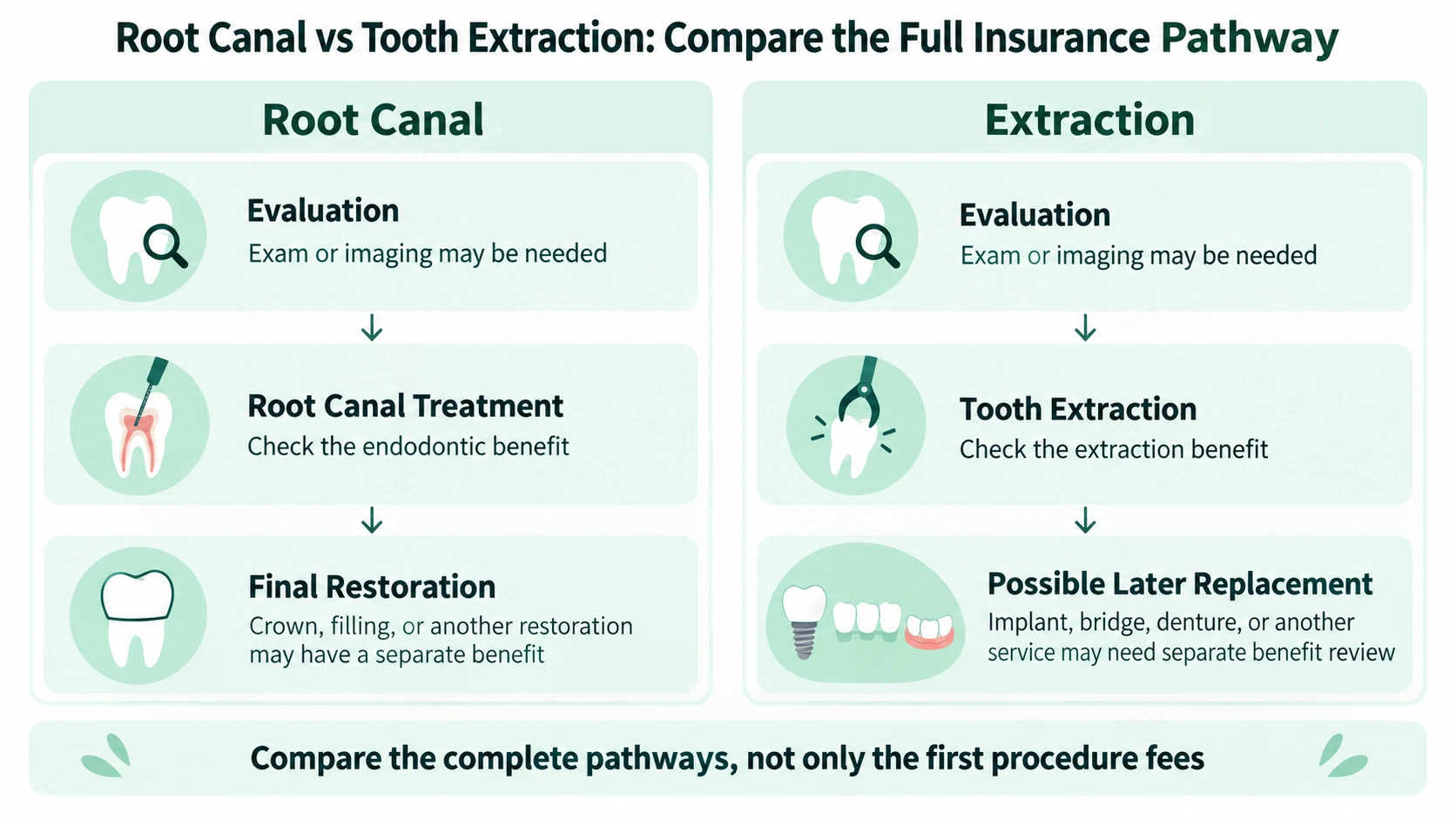
Root canal pathway → root canal treatment → final restoration when needed
Extraction pathway → tooth removal → healing → no immediate replacement or possible later tooth replacement
Dental insurance may evaluate each stage separately.
A root canal benefit does not automatically establish coverage for a crown, filling, or another final restoration.
Likewise, an extraction benefit does not automatically establish coverage for a later implant, bridge, denture, bone graft, or another replacement-related service.
The goal is to compare the likely insured treatment pathways, not just the first two procedure prices.
This article does not determine whether root canal treatment or extraction is clinically preferable.
The dental professional determines which treatment options are appropriate. The dental plan separately determines what financial benefits may apply to the services involved.
What You’ll Learn
This guide explains:
- How dental insurance may evaluate the root canal pathway
- How insurance may evaluate the extraction pathway
- Why the first procedure may not represent the full cost pathway
- Why a restoration after root canal treatment can be a separate benefit
- Why future tooth replacement after extraction creates another insurance question
- How provider network status can affect both pathways
- How waiting periods and annual benefits can affect different stages
- What to verify before comparing expected patient responsibility
Quick Answer
Root canal treatment and tooth extraction can both lead to more than one dental insurance question.
A root canal pathway may include:
evaluation → root canal treatment → final restoration when needed
An extraction pathway may include:
evaluation → extraction → healing → no immediate replacement or possible later tooth replacement
Dental insurance may evaluate each service separately.
The lowest initial procedure cost does not necessarily represent the lowest total patient responsibility.
The most useful comparison is based on the services actually expected in each clinically reasonable pathway.
Key Takeaways
- Root canal vs tooth extraction is an insurance-pathway comparison, not a clinical recommendation.
- Root canal treatment may be followed by a separately evaluated restoration.
- Extraction may end the immediate treatment or lead to later tooth replacement.
- Coverage for the root canal does not automatically determine coverage for the final restoration.
- Coverage for the extraction does not automatically determine coverage for later tooth replacement.
- Different providers can have different network status.
- Waiting periods and available annual benefits can affect different stages separately.
- Compare itemized treatment pathways rather than only the first procedure fees.
In This Guide
Root Canal vs Tooth Extraction: What Is the Real Insurance Question?
The search question often appears simple:
Which option will cost less with dental insurance?
But the plan may not evaluate either option as one complete package.
Instead, the plan may process the individual services that make up each treatment pathway.
The more useful comparison is therefore:
Root Canal Pathway
Evaluation → root canal treatment → final restoration when needed
Extraction Pathway
Evaluation → extraction → healing → no immediate replacement or possible later replacement
The financial comparison becomes more useful only after the likely next steps are identified.
The Clinical Decision Comes Before the Insurance Comparison
Insurance can help explain the financial implications of treatment options.
It does not determine whether a tooth should receive root canal treatment or be removed.
The treating dentist or endodontist determines which options are clinically reasonable.
Once those options are clear, compare the insurance implications of the services likely to follow each pathway.
Clinical suitability and insurance coverage are separate questions.
How the Root Canal Pathway May Work
Root canal treatment may be only one stage of the complete treatment pathway.
Depending on the tooth and the treatment plan, the pathway may include:
Evaluation → root canal treatment → final restoration
Root Canal Treatment
The endodontic procedure can have its own dental benefit.
The plan may apply:
- Network provisions
- Waiting periods
- Deductible or other cost-sharing
- Available annual benefits
- Procedure-specific limitations
For the complete procedure-specific framework, read Does Dental Insurance Cover Root Canals?
Final Restoration
After root canal treatment, a final restoration may be needed depending on the clinical situation.
That restoration may be:
- A crown
- A filling
- Another restorative service
For insurance purposes, the restoration should be checked separately.
Coverage for root canal treatment does not automatically establish coverage for the restoration that follows.
For crown-specific coverage, read Does Dental Insurance Cover Crowns?
For filling coverage, read Does Dental Insurance Cover Fillings? What to Check Before Treatment.
How the Extraction Pathway May Work
Extraction removes the tooth, but the insurance pathway does not necessarily end in the same place for every patient.
One pathway may be:
Evaluation → extraction → healing
Another may eventually become:
Evaluation → extraction → healing → tooth replacement
Whether replacement is planned is a clinical and treatment-planning question.
For the extraction benefit itself, read Does Dental Insurance Cover Tooth Extraction? What to Check Before Treatment.
Coverage for the extraction does not automatically establish coverage for later tooth replacement.
What If Tooth Replacement Is Considered After Extraction?
If tooth replacement is part of the proposed treatment plan, the later services create separate insurance questions.
| Possible later service | Main insurance question |
|---|---|
| Dental implant | Does the plan provide an applicable implant benefit? |
| Dental bridge | How does the plan cover the proposed bridge? |
| Partial denture | What prosthetic benefit applies? |
| Bone graft | Is the graft evaluated separately? |
For implant coverage, read Does Dental Insurance Cover Implants?
For bridge coverage, read Dental Insurance for Bridges.
For denture coverage, read Does Dental Insurance Cover Dentures?
If bone grafting is proposed, read Does Dental Insurance Cover Bone Grafts? What to Check Before Treatment.
Do not automatically add replacement costs when no replacement is currently planned.
Likewise, do not compare extraction only against a complete root canal pathway when replacement is already part of the extraction treatment plan.
How the Two Insurance Pathways Compare
| Stage | Root canal pathway | Extraction pathway |
|---|---|---|
| Evaluation | Exam or imaging may be needed | Exam or imaging may be needed |
| Primary procedure | Root canal treatment | Tooth extraction |
| Possible specialist | Endodontist | Oral surgeon, depending on the treatment |
| Possible next stage | Crown, filling, or another restoration | No immediate replacement or possible later replacement |
| Later services evaluated separately? | Often possible | Often possible |
| Main comparison question | What follows the root canal and how is it covered? | Is replacement planned and how would it be covered? |
Neither pathway should automatically be treated as one insurance benefit.
Why the First Procedure Cost May Be Incomplete
The first treatment estimate may not include every service likely to follow.
For the root canal pathway, an initial estimate may not include the final restoration.
For the extraction pathway, an initial estimate may not include later tooth replacement when replacement is being considered.
That can create an uneven comparison.
For example:
Root canal + expected restoration
should not automatically be compared with:
Extraction only
when a bridge, implant, denture, or another replacement is already part of the expected extraction pathway.
At the same time, future replacement should not be added automatically when no replacement is currently planned.
Compare the treatment pathways actually being discussed for the tooth.
Why Provider and Specialist Network Status Can Matter
Different stages can involve different providers.
A root canal pathway may involve:
- A general dentist
- An endodontist
- A dentist providing the final restoration
An extraction pathway may involve:
- A general dentist
- An oral surgeon
- A later restorative provider if tooth replacement is planned
Not every treatment requires several providers.
But when several are involved, verify each provider separately.
One in-network provider does not automatically mean every provider in the pathway is in-network.
For the complete network framework, read In-Network vs Out-of-Network Dental Insurance.
What Other Plan Rules Can Affect the Comparison?
Several plan provisions can affect individual stages.
Waiting Periods
Eligibility for one service does not automatically establish eligibility for another service later in the pathway.
A root canal can be eligible while the later restoration is affected differently.
An extraction can be eligible while later replacement is subject to separate provisions.
For the complete timing framework, read How Waiting Periods Work in Dental Coverage.
Annual Maximum
Several separately eligible services can draw on the same annual maximum.
This can matter when a treatment pathway includes multiple procedures.
Separate these questions:
Is the service eligible for a benefit?
How much applicable annual benefit remains when the service is provided?
For the complete mechanism, read Dental Insurance Annual Maximums Explained.
Deductible and Cost-Sharing
Deductibles, copays, coinsurance, or other patient-responsibility provisions may differ between services.
Do not assume every stage in either pathway has identical cost-sharing.
Can a Missing-Tooth Clause Affect the Extraction Pathway?
Possibly, but only in the appropriate circumstances.
A missing-tooth provision may become relevant when later replacement is considered and the tooth was already missing before the applicable coverage began.
That is a separate question from whether an extraction receives a benefit.
For the complete rule, read Missing Tooth Clauses in Dental Insurance.
Can Advance Benefit Review Help Compare the Pathways?
It can be useful when more than one treatment option is clinically reasonable and there is time to review expected benefits before treatment.
Instead of asking only about the root canal or extraction, identify the significant services expected in each pathway.
Root Canal Pathway
Advance benefit information may be useful for:
- Root canal treatment
- Expected final restoration
Extraction Pathway
If extraction is the entire immediate plan, the review may focus on the extraction and related services.
If replacement is already proposed, the replacement service may need a separate benefit review.
The purpose is to understand the expected insurance treatment of the services, not to ask the dental plan which clinical option to choose.
Advance benefit information should not automatically be treated as guaranteed final payment.
For the full framework, read Dental Insurance Predetermination vs Preauthorization: What’s the Difference?
What to Check Before Comparing Expected Costs
Step 1: Confirm the Clinically Reasonable Options
Ask the dental professional which treatment options are appropriate for the tooth.
Step 2: Identify What Follows the Root Canal
Determine whether a crown, filling, or another restoration is expected.
Step 3: Identify What Follows the Extraction
Determine whether extraction is the entire immediate plan or whether tooth replacement is being discussed.
Step 4: Request Itemized Treatment Estimates
When practical, compare estimates for the actual services expected in each pathway.
Step 5: Verify Provider Network Status
Check each dentist or specialist expected to participate.
Step 6: Review Major Plan Provisions
Check relevant:
- Waiting periods
- Cost-sharing
- Available annual benefits
- Procedure-specific limitations
- Replacement-related provisions
Step 7: Consider Advance Benefit Review
If treatment can safely wait and the financial difference matters, determine whether advance benefit information is available.
The goal is to compare like with like across the two proposed treatment pathways.
After Treatment: Review the EOB by Service
Treatment estimates and final claim results can differ.
If that happens, determine which service each EOB entry is addressing.
A plan may process separately:
- Root canal treatment
- Final restoration
- Extraction
- Bone graft
- Tooth replacement
- Another related service
Do not expect one EOB line representing the entire root canal pathway or extraction pathway.
For detailed interpretation, read How to Read a Dental Insurance EOB: Payments, Adjustments, and Patient Responsibility.
If a final unfavorable decision remains after the reason is identified, read Dental Insurance Claim Denied? How to Review the Decision and Appeal.
Common Root Canal vs Tooth Extraction Insurance Mistakes
Comparing Only the First Procedure
The initial procedure may not represent the complete treatment pathway.
Assuming Root Canal Coverage Includes the Final Restoration
The crown, filling, or another restoration may be evaluated separately.
Assuming Extraction Coverage Includes Future Tooth Replacement
Implants, bridges, dentures, and other replacement services have their own coverage questions.
Comparing a Complete Root Canal Pathway With Extraction Only
If replacement is already planned after extraction, include it in the financial comparison.
Assuming Replacement Must Always Follow Extraction
Do not add treatment that is not part of the current treatment plan.
Assuming Every Provider Has the Same Network Status
Verify each dentist or specialist separately.
Letting Insurance Determine the Clinical Choice
Insurance explains financial benefits. It does not determine which treatment is clinically appropriate.
Our Recommendation
Begin with the complete treatment pathways rather than the first procedure prices.
For the root canal option, determine:
Root canal → what restoration is expected afterward?
For the extraction option, determine:
Extraction → does treatment end there for now, or is later replacement being considered?
Then compare the benefits for the services that actually make up each clinically reasonable pathway.
A covered root canal does not automatically establish coverage for the final restoration.
A covered extraction does not automatically establish coverage for future tooth replacement.
The first procedure is not always the full insurance or cost picture.
The dental professional determines which treatment options are appropriate.
The dental plan determines what financial benefits apply to the services involved.
Helpful Resources
- Dental Insurance Coverage for Common Procedures
- Does Dental Insurance Cover Root Canals?
- Does Dental Insurance Cover Tooth Extraction? What to Check Before Treatment
- Does Dental Insurance Cover Crowns?
- Does Dental Insurance Cover Implants?
- Dental Insurance for Bridges
- How Waiting Periods Work in Dental Coverage
Frequently Asked Questions
Does Dental Insurance Cover Root Canals and Tooth Extractions?
It may. Each procedure can have its own benefit provisions, and additional services that follow can create separate coverage questions.
Is a Root Canal More Expensive Than an Extraction With Insurance?
There is no universal answer. Root canal treatment may be followed by a separate restoration, while extraction may or may not lead to later tooth replacement. Compare the treatment pathways actually being considered under the dental plan.
Does Root Canal Coverage Include a Crown?
Not automatically. Root canal treatment and the crown or other final restoration can be separate services with separate benefits.
Does Extraction Coverage Include a Future Implant, Bridge, or Denture?
Not automatically. The extraction and later tooth-replacement service can have separate benefit provisions.
Is Extraction Always Cheaper Than Root Canal Treatment?
No universal conclusion applies. The initial extraction fee does not establish the total financial outcome when later treatment is planned.
Can Specialist Network Status Affect the Comparison?
Yes. An endodontist, oral surgeon, or another provider may have different network status from the general dentist.
Can the Annual Maximum Affect the Two Pathways Differently?
Yes. Several separately eligible services may use the same annual maximum, so available benefits can change as treatment progresses.
Can Predetermination Help Compare Root Canal and Extraction Benefits?
It can provide useful advance information about the services expected in each pathway, but it should not automatically be treated as guaranteed final payment.
Sources
- American Association of Endodontists — Root Canal Explained
- American Dental Association — Typical Dental Plan Benefits and Limitations
- American Dental Association — Pre-Authorizations
- American Dental Association — Explanation of Benefits Statement
About the Author
Maria Dumitru is the founder and content editor of DentalCoverageHub. She creates consumer-focused educational content designed to help readers understand dental insurance benefits, limitations, and plan rules before making coverage decisions.
Learn more about our standards in the Editorial Policy and How We Review Dental Plans.
This article is for general educational purposes. Root-canal, extraction, restorative, tooth-replacement, provider-network, waiting-period, cost-sharing, annual-benefit, and other coverage provisions can vary by dental plan. Treatment decisions depend on the condition of the tooth and individual clinical circumstances. Discuss the available treatment options with your dental professional and review your official plan documents before relying on expected insurance benefits.

Explore Dental Coverage for Common Procedures
Root canal treatment and tooth extraction can lead to different treatment pathways, and each stage may create a separate insurance question. Use our broader procedure coverage guide to understand what to verify when researching other dental treatments.