
Does Dental Insurance Cover Night Guards? What to Check Before Getting One
Learn what to verify before ordering a custom night guard, including appliance benefits, previous guard history, replacement rules, and estimated costs.
Written and researched by Maria Dumitru.
Founder and Content Editor at Dental Coverage Hub
Last reviewed: November 2026
Dental insurance may provide a benefit for a custom night guard, but coverage depends on the specific appliance, its purpose, and the terms of your plan.
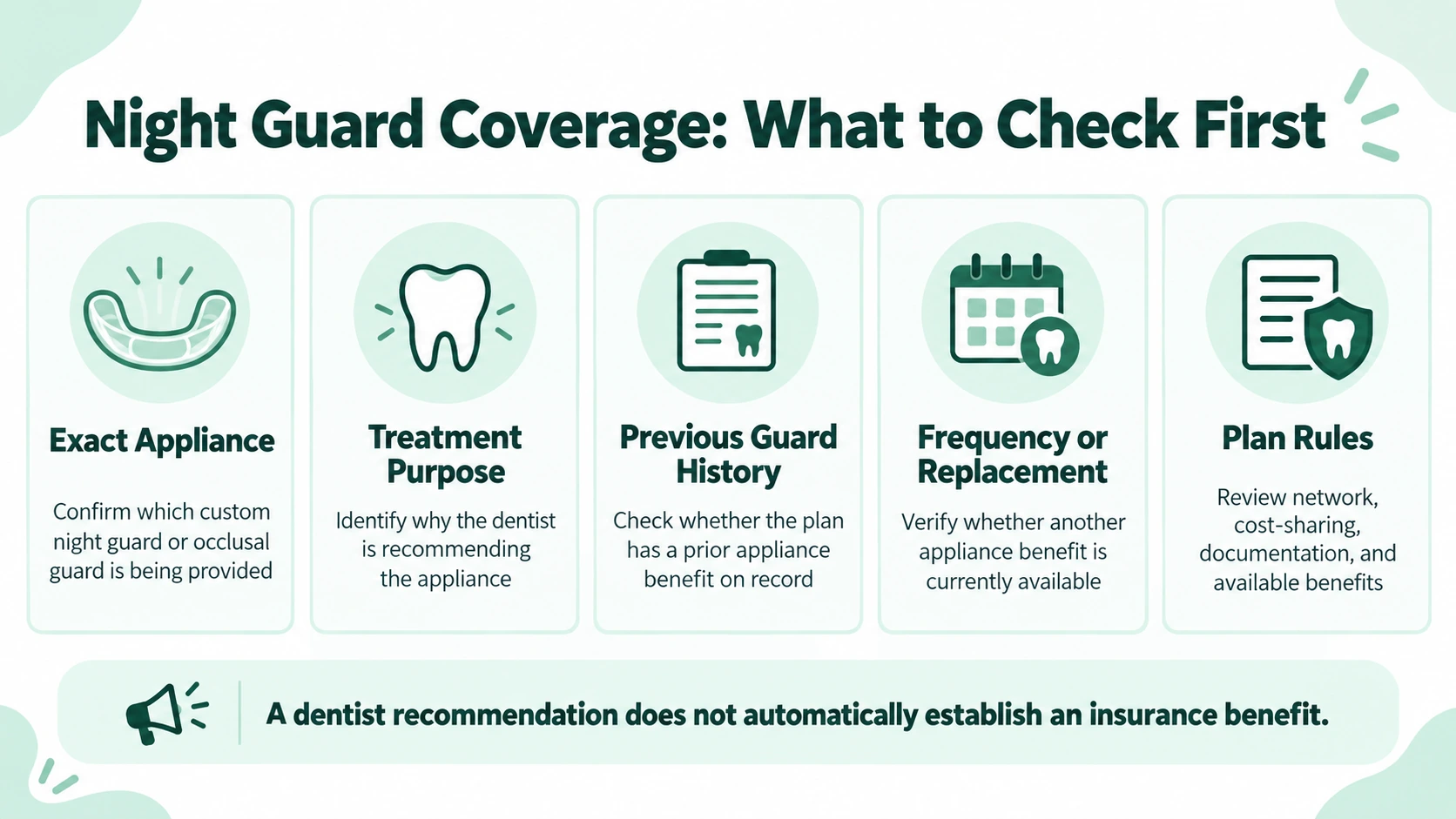
A dentist’s recommendation does not automatically establish an insurance benefit. Likewise, having coverage for other dental services does not confirm that a night guard is included.
This guide focuses on dentist-provided custom occlusal guards used to help protect teeth and restorations from grinding or clenching. Sports mouthguards, orthodontic retainers, and appliances prescribed for sleep apnea or jaw disorders require separate consideration.
Before ordering a guard, establish what is being provided, which benefit rules apply, and what you may owe.
What You’ll Learn
- How to identify the appliance being recommended
- Why the treatment purpose matters
- How previous guard history may affect a benefit review
- What to check about frequency and replacement provisions
- Which charges to clarify before fabrication
- How to interpret an estimate or claim decision
Quick Answer: Does Dental Insurance Cover Night Guards?
A night guard may qualify for benefits when the exact appliance and its purpose meet the applicable plan provisions. Other plans may exclude it or restrict payment.
Before relying on coverage, confirm:
- Whether your plan includes the proposed appliance
- Whether previous appliance history affects eligibility
- What documentation or advance approval is required
- Whether your dentist participates in the exact plan network
- What charges and estimated patient costs are involved
Do not assume that a general reference to dental appliances confirms coverage for your particular guard.
Key Takeaways
- The appliance description and treatment purpose matter more than the general term night guard.
- A recommendation for a guard does not guarantee payment.
- First-time appliances, replacements, repairs, and adjustments may require different benefit checks.
- A new benefit year does not, by itself, establish eligibility for another guard.
- An advance estimate should be reviewed for conditions and unresolved questions.
- Clarify the complete office charge before agreeing to fabrication.
In This Guide
Identify the Appliance and Its Purpose
Ask your dental office for the written appliance description and the procedure code it expects to report.
Relevant details may include:
- Whether the guard is hard, soft, or combines materials
- Whether it covers a full arch or part of an arch
- Which arch it is intended for
- Why the dentist recommends it
- Whether this is an initial appliance or a replacement
The treating professional should identify and accurately report the service. Patients should not choose a different procedure code simply because it appears more likely to receive a benefit.
A custom guard may help protect teeth from damage associated with grinding or clenching. Your dentist can explain its intended role and any follow-up care. The insurance question is whether the proposed service meets your plan’s benefit requirements.
Not All Oral Appliances Have the Same Purpose
| Appliance or purpose | What to clarify |
|---|---|
| Custom guard for grinding or clenching | Whether the plan includes the proposed occlusal guard |
| Sports mouthguard | Whether an appliance intended for impact protection has a benefit |
| Orthodontic retainer | Which retention or replacement provisions apply |
| Appliance for a jaw disorder | Which diagnosis, appliance, and benefit provisions are relevant |
| Oral appliance for sleep apnea | Which dental or medical coverage, provider requirements, and approval process apply |
Do not use the coverage answer for one appliance as confirmation for another.
Five Checks Before Ordering a Night Guard
1. Confirm the Exact Benefit
Give the plan the appliance description, proposed procedure code, treatment purpose, and provider information.
Ask whether that service is included under your current coverage and which exclusions or limitations apply. If the response refers to a broad category of appliances, request clarification about the specific guard your dentist proposes.
Record the plan provision or written explanation supporting the response.
2. Review Previous Guard History
Tell the dental office and plan whether you have received a guard before, even if it came from another dentist.
Ask what history the plan needs, such as:
- The date the previous appliance was provided
- The appliance type
- Whether benefits were previously paid
- Why a new appliance is being recommended
If you have changed plans, ask how the current plan treats earlier appliance history. Do not assume that changing insurers or dentists automatically creates a new benefit.
3. Check Frequency and Replacement Rules
Ask whether the plan limits how often it considers a guard for benefits and how it measures that interval.
For a replacement, also ask whether the reason for replacement affects the decision. Loss, damage, wear, poor fit, or changes following dental treatment should each be described accurately.
The plan’s rules may distinguish between providing a new appliance and repairing or adjusting an existing one.
4. Verify Provider and Review Requirements
Confirm participation in your exact network, rather than relying only on the insurer’s name.
Then ask whether advance review is optional or required. Determine what must be submitted, who will submit it, and whether a response is needed before the office begins fabrication.
If coverage may change while the appliance is being made, ask which service date or stage the plan uses.
5. Review the Complete Estimate
Request an itemized estimate showing:
- The total office charge
- What is included
- Any separately charged services
- The expected plan benefit
- Your estimated payment
- Any assumptions or outstanding coverage questions
Keep the estimate and the plan’s response together. Mark information that has not been verified as not yet confirmed.
Frequency Limits and Replacement Rules Are Different Questions
A frequency provision addresses how often a service may qualify for benefits. A replacement provision addresses the conditions under which another appliance may qualify.
These questions can overlap, but they should not be treated as interchangeable.
For example, an older guard may still be subject to a replacement restriction. Conversely, a guard that needs attention may be considered for adjustment or repair rather than a new appliance.
Ask the plan to identify the specific provision affecting your request.
For the broader distinctions, see Dental Insurance Frequency Limits and Dental Insurance Replacement Rules.
If a Guard Is Lost, Damaged, or No Longer Fits
Explain exactly what happened and ask your dentist what care is appropriate.
Then verify the benefit for that proposed service. A clinical reason to replace a guard does not automatically override an insurance limitation.
Also ask the dental office whether any repair, adjustment, or remake arrangement applies. An office policy and an insurance benefit are separate matters.
Clarify What the Night Guard Price Includes
An estimate should make clear whether the quoted price includes the services needed to provide and fit the appliance.
Ask about:
| Item | Question to ask |
|---|---|
| Examination | Is an examination included or charged separately? |
| Impressions or scans | Are these included in the appliance price? |
| Fabrication and delivery | Does the quote cover making and providing the guard? |
| Initial fitting | Is fitting included? |
| Follow-up adjustments | Which visits are included, and for how long? |
| Repairs or remakes | What charges or office policies apply? |
Separately listed charges do not automatically receive separate insurance payments.
Before paying a deposit, ask what amount is due, when the remaining balance is payable, and what happens if the plan pays less than estimated.
For plans using deductibles, coinsurance, or annual maximums, check how those provisions affect the estimate. Where a copayment schedule applies, confirm the amount for the exact service.
Understand the Limits of Advance Review
An optional predetermination can provide advance benefit information. Required preauthorization is a prior-approval process that must be addressed according to the plan’s instructions.
Terminology varies, so ask what the process is called, whether it is required, and what the response confirms.
A favorable response should not automatically be treated as a guarantee of final payment. Eligibility, remaining benefits, timing, and other conditions may still affect the claim.
See Dental Insurance Predetermination vs Preauthorization: What’s the Difference?
How to Interpret the Plan’s Response
| Response | What to clarify next |
|---|---|
| The appliance has a benefit | Which conditions and cost-sharing rules still apply? |
| A frequency limitation applies | Which previous date or service is being used? |
| Replacement requirements are not met | Which provision applies, and what facts were considered? |
| Prior appliance history is needed | Which records are missing, and who can provide them? |
| Clinical documentation is requested | What information should the treating dentist submit? |
| The service is excluded | Which exclusion applies to this appliance and purpose? |
A request for records may mean the review is incomplete. Incorrect history or claim information may need correction. A completed adverse decision may require a different response.
Avoid treating every unpaid or reduced benefit as the same problem.
Check the EOB Against the Office Statement
After claim processing, compare the Explanation of Benefits with the dental office’s statement.
Review the reported appliance, service date, plan allowance, payment, patient responsibility, and explanation codes. Check whether the office reported an initial appliance, replacement, repair, or adjustment consistent with the service provided.
The EOB explains claim processing; it is not the dental office’s bill. Ask about any discrepancy before assuming that the remaining balance is final.
Use How to Read a Dental Insurance EOB for a detailed walkthrough.
Helpful Resources
Frequently Asked Questions
Does dental insurance cover custom night guards?
It may, depending on the appliance and the plan provisions. Confirm the proposed procedure, purpose, provider, and applicable limitations before relying on benefits.
Does grinding my teeth automatically qualify me for coverage?
No. Grinding or clenching may explain the dentist’s recommendation, but the plan must still evaluate the proposed appliance under its benefit terms.
How often will insurance pay for a night guard?
There is no single interval that should be assumed for every plan. Ask whether a frequency limit applies, how the interval is measured, and which previous appliance date is relevant.
Will insurance replace a lost or damaged night guard?
Do not assume so. Describe what happened and ask which replacement provisions apply. Also check whether the office offers a separate repair or remake arrangement.
Does a new plan year mean I can get another guard?
Not automatically. A benefit-year reset does not by itself resolve a separate appliance frequency or replacement restriction.
Are store-bought or mail-order guards covered the same way?
Do not assume they are. Before purchasing, ask whether the particular product, supplier, and method of obtaining it qualify for reimbursement. Discuss suitability and fit with your dentist.
Is a night guard the same as a sleep apnea appliance?
No. This guide concerns guards used for grinding or clenching. An appliance prescribed for sleep apnea needs a separate review of its purpose, provider requirements, and applicable dental or medical benefits.
Does a favorable estimate guarantee that insurance will pay?
No. Review the conditions in the response and ask what could change before claim processing. Confirm any required approval separately.
Sources
- National Institute of Dental and Craniofacial Research — Bruxism
- American Dental Association — Documenting Occlusal Guards with Hard and Soft Components
- American Dental Association — Typical Dental Plan Benefits and Limitations
- American Dental Association — Pre-Authorizations
- American Dental Association — Explanation of Benefits Statement
About the Author
Maria Dumitru is the founder and content editor of DentalCoverageHub. She creates consumer-focused educational content designed to help readers understand dental insurance benefits, limitations, and plan rules before making coverage decisions.
Learn more about our standards in the Editorial Policy and How We Review Dental Plans.
Disclaimer
This article provides general educational information for U.S. consumers. It is not dental or medical advice, an insurance benefit determination, or a guarantee of payment. Coverage varies by plan, employer, state, provider, and individual circumstances. Review your current plan documents and verify benefits with your insurer or plan administrator. Discuss appliance selection, treatment, and follow-up care with your treating dental professional.

Check the Details Before Ordering Your Guard
Confirm the appliance, previous guard history, applicable plan requirements, and estimated patient costs before agreeing to fabrication. Ask the dental office and plan to clarify anything that remains unresolved.