
Dental Insurance Frequency Limits Explained: What to Check Before Treatment

Learn how dental insurance frequency limits affect when another benefit may be available, how plans count time, and what to verify before treatment.
Written and researched by Maria Dumitru.
Founder and Content Editor at Dental Coverage Hub
Last reviewed: October 2026
A dental plan can list a service as covered without providing another benefit every time that service is received.
That is where frequency limits matter.
A dental insurance frequency limit controls how often a particular service may receive a benefit under the plan. Depending on the plan, the rule may use a calendar year, benefit year, rolling period, minimum interval, prior service history, or a shared limit involving related services.
Those methods are not necessarily interchangeable.
That is why the most useful question is not simply:
Is this dental service covered?
Also ask:
What frequency rule applies, how does the plan count it, and what prior service history is being used?
Frequency limits determine benefit availability.
They do not determine how often dental care is clinically appropriate.
What You’ll Learn
This guide explains:
- What a dental insurance frequency limit is
- How dental plans may count frequency periods
- Why a yearly count and a minimum interval are not necessarily the same
- How prior service history can affect another benefit
- What shared frequency limits can mean
- How frequency limits differ from waiting periods, annual maximums, exclusions, and replacement limitations
- Why insurance benefit timing and clinical treatment timing are different questions
- What to verify before treatment or after an EOB shows a frequency limitation
For a broader introduction to plan types, costs, and benefit rules, start with Dental Insurance Basics.
Quick Answer
A dental insurance frequency limit is a plan rule that controls how often a particular dental service may receive a benefit.
The exact rule varies by plan.
A frequency provision may use:
- A calendar year
- A benefit or plan year
- A rolling period
- A minimum interval between applicable services
- Prior service history
- A shared limit involving related services
These methods should not automatically be treated as equivalent.
The practical approach is:
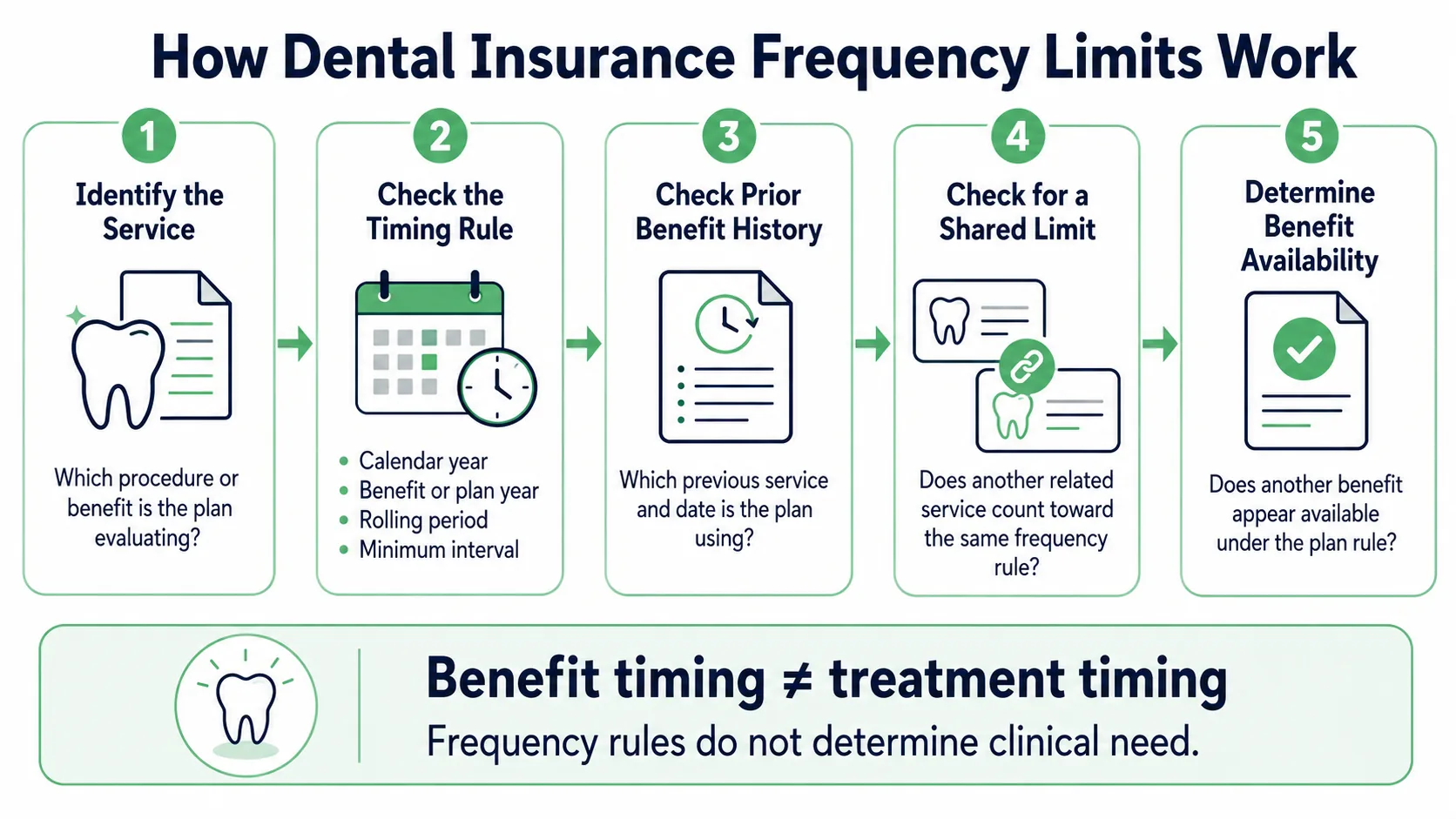
Identify the exact service → find the frequency provision → determine how the plan counts time → verify the prior service history → check whether another benefit appears available.
Also remember:
A frequency limit is a benefit rule, not a clinical treatment guideline.
Key Takeaways
- A frequency limit controls how often a dental plan may provide another benefit for a particular service
- A service can be generally covered without another benefit being currently available
- Frequency provisions can be calculated in different ways
- A yearly count and a minimum interval should not automatically be treated as the same rule
- Prior services, including applicable treatment from another dental office, may affect current benefit availability
- Related services may share the same frequency limit
- Frequency limits are different from waiting periods, annual maximums, exclusions, and replacement limitations
- Frequency rules determine benefit availability, not when dental treatment is clinically appropriate
In This Guide
How Dental Insurance Frequency Limits Work at a Glance
A frequency limit can depend on the service, the way the dental plan counts time, prior benefit history, and whether related services share the same limit. This overview shows the main details to verify before relying on another benefit being available.
What Is a Dental Insurance Frequency Limit?
A dental insurance frequency limit is a plan provision that controls how often a particular service may qualify for benefits.
The rule can apply even when:
- Dental coverage is active
- The service is generally included as a benefit
- Annual benefits remain available
- The treating dental professional recommends the service
That is because two different questions are involved.
The Clinical Question
Is this dental service appropriate for the patient now?
That is a treatment question for the patient and treating dental professional.
The Insurance Question
Does this dental plan provide another benefit for the service now?
That depends on the applicable plan terms, prior benefit history, and frequency provision.
The two questions should not be treated as interchangeable.
A frequency limitation tells you about benefit availability.
It does not establish how often dental care is clinically necessary.
How Dental Plans Can Count Frequency Limits
The exact wording of the frequency provision matters.
Do not reduce every frequency rule to:
“How long has it been since my last dental appointment?”
Dental plans can use different methods to determine whether another benefit is available.
Calendar-Year Limits
A calendar-year rule counts applicable services during the calendar year.
However, the phrase per calendar year should not automatically be interpreted as meaning that no other timing conditions apply.
Check:
- Which services count toward the limit
- Whether another timing condition applies
- How the plan defines the applicable benefit
Benefit-Year or Plan-Year Limits
Some dental plans organize benefits around a benefit year or plan year rather than January through December.
The start and end dates depend on the plan.
Do not assume that the beginning of a new calendar year resets the frequency rule.
Ask:
“What benefit period does my plan use for this service?”
Rolling-Period Limits
A rolling-period rule uses prior service timing rather than only counting services within one fixed calendar period.
A change in calendar year therefore does not necessarily reset the rule.
If the plan uses a rolling period, identify:
- Which previous service is being counted
- The date of that service
- The period defined by the plan
- How the plan determines when another benefit may become available
Minimum Intervals Between Services
Some plans require a minimum interval to pass between applicable services.
This is different from simply allowing a certain number of benefits during a defined period.
The key distinction is:
A count-based rule controls how many applicable benefits may be available during a defined period.
A minimum-interval rule controls how much time must pass between applicable services.
Do not automatically convert one type of rule into the other.
How to Interpret Frequency-Limit Wording
When reviewing plan documents or benefit information, focus on the exact wording rather than translating the provision into a rule you remember from another dental plan.
| What the plan says | What it may mean | What to check |
|---|---|---|
| Per calendar year | Applicable services are counted during the calendar year | Which services count and whether another timing condition applies |
| Per benefit or plan year | Services are counted during the plan’s defined benefit period | When that benefit period begins and ends |
| Rolling period | Prior service timing affects when another benefit may become available | Which prior service and date the plan is using |
| Minimum interval | A specified period must pass between applicable services | How the plan calculates the interval |
| Frequency exceeded | Another benefit may not currently be available under the frequency provision | Prior benefit history and the exact plan language |
| Shared frequency | Related procedures may count toward one limit | Which procedures or benefit categories are grouped together |
The most important rule is:
Interpret the plan you actually have, not the frequency rule you remember from another dental plan.
If the wording is unclear, ask the dental plan to explain which provision applies to the specific service and what prior history it is using.
“Per Year” vs a Minimum Interval: Why the Difference Matters
A rule that counts benefits during a defined year is not necessarily the same as a rule that requires a specific amount of time to pass between services.
A Count-Based Rule
A count-based rule focuses on how many applicable benefits may be available during a defined period.
That period might be:
- A calendar year
- A benefit year
- A plan year
- Another period defined by the dental plan
The rule should be interpreted according to the wording in the plan documents.
A Minimum-Interval Rule
A minimum-interval rule focuses on the amount of time that must pass between applicable services before another benefit may become available.
This type of rule depends on the date of a previous service rather than only on the number of benefits used during a defined year.
The important distinction is:
“Per year” does not automatically mean “after a minimum interval.”
And:
A minimum interval does not automatically mean the plan simply allows a certain number of benefits during a year.
Do not translate one type of rule into another.
Use the wording that actually applies to your dental coverage.
What Is a Shared Frequency Limit?
A shared frequency limit means that two or more related services may be counted under the same benefit limitation rather than evaluated completely independently.
This can matter when a service appears to have its own benefit but another related service has already counted toward the shared limit.
For example, a dental plan may group certain types of examinations or certain types of radiographic services together for frequency purposes.
That does not mean every dental plan groups those services the same way.
The exact grouping depends on the plan.
Ask:
“Does this procedure have its own frequency limit, or does it share a limit with another service?”
If the limit is shared, also ask:
- Which procedures are grouped together
- Which previous procedure counted toward the limit
- What service date the plan is using
- How the plan determines when another benefit may become available
Do not assume that two services are independent simply because they have different procedure descriptions.
Can Treatment From Another Dentist Affect the Frequency Limit?
Yes, it may.
Frequency limits generally relate to benefit history under the dental plan, not only to treatment performed at your current dental office.
You may be visiting a new dentist for the first time while the dental plan already has a previous claim for the same or a related service from another provider.
That previous service may affect whether another benefit appears available.
If the dental plan says a frequency limit has been reached, verify:
- Which previous service is being counted
- The date of that service
- Which provider submitted it
- Whether the current service shares the same frequency limit
- Whether the prior history appears accurate
- Whether the plan applied the correct frequency provision
Do not assume the plan’s prior-service history is wrong.
But do not assume it is correct without checking it either.
If an important detail cannot be verified, treat it as Not confirmed until the dental plan or relevant records clarify it.
Where Frequency Limits May Appear
Frequency limitations can appear in different parts of a dental benefit plan.
They are often associated with services that may recur over time, but the exact rules vary by plan, procedure, age, benefit category, and other plan conditions.
Examples of services that may be subject to frequency provisions include:
Dental Examinations
Some examination services may be subject to frequency rules.
Different examination types may also interact under a shared frequency provision.
Professional Cleanings
Preventive cleaning benefits may be subject to frequency restrictions.
Do not assume there is one universal cleaning schedule across dental insurance plans.
Periodontal Maintenance
Periodontal maintenance may have its own timing provisions or interact with other periodontal or preventive benefits.
The applicable plan language controls how the benefit is evaluated.
Dental Radiographs
Different types of dental radiographs may be subject to different timing or frequency rules.
Do not assume that all dental X-rays follow the same schedule.
Fluoride and Sealants
These services may also have frequency provisions in addition to other eligibility requirements.
These examples are not a universal dental insurance schedule.
A service that is subject to a frequency rule under one plan may be treated differently under another plan.
The correct question is not:
“How often is this service usually covered?”
It is:
“What frequency provision applies to this specific service under my plan?”
Frequency Limit vs Waiting Period vs Annual Maximum
These rules can all affect whether a dental plan pays toward a service, but they answer different questions.
| Plan Rule | Main Question |
|---|---|
| Frequency limit | How often may another benefit be available for this service? |
| Waiting period | Has enough time passed after coverage began for this benefit to become available? |
| Annual maximum | How much plan benefit remains available during the applicable benefit period? |
A person can satisfy one rule while still being affected by another.
For example:
- A waiting period may be satisfied while a frequency limit still prevents another benefit for a repeat service.
- A frequency requirement may be satisfied while little or no annual benefit remains available.
- Remaining annual benefits do not override a frequency restriction.
The key distinction is:
Frequency = how often. Waiting period = when after coverage begins. Annual maximum = how much the plan may pay during the benefit period.
For the separate timing framework, read How Waiting Periods Work in Dental Coverage.
For the separate benefit-limit framework, read Dental Insurance Annual Maximums Explained.
Frequency Limit vs a Non-Covered Service
A frequency-limited service and a service excluded by the dental plan are not the same thing.
A frequency limitation generally means the plan recognizes the service as a benefit but may not provide another benefit at the current time because the applicable frequency rule has been reached.
A non-covered or excluded service generally means the plan does not provide a benefit for that service or circumstance under the applicable plan terms.
The key distinction is:
Frequency limitation = the benefit may exist, but another benefit is not currently available under the frequency rule. Exclusion = the plan does not provide the benefit under the applicable exclusion.
This distinction is especially important when an EOB shows little or no plan payment.
No plan payment does not automatically mean the service is excluded.
Identify the actual provision the plan applied before deciding why the benefit was unavailable.
For the broader distinction between exclusions, limitations, and other dental plan provisions, read Dental Insurance Exclusions and Limitations: What to Check Before Enrolling.
Frequency Limit vs Replacement Limitation
Frequency limits and replacement limitations can both involve prior treatment and timing, but they answer different benefit questions.
A routine frequency limit generally asks:
How often may this recurring or repeat service receive another benefit?
A replacement limitation generally asks:
Does dental work that already exists qualify for another replacement benefit under the current plan?
Replacement provisions may consider the history of an existing restoration, prosthesis, appliance, or other dental work, including prior placement information and other plan-specific conditions.
The key distinction is:
Frequency limit = how often a service may receive a benefit. Replacement limitation = whether existing dental work qualifies for another replacement benefit.
Do not treat a replacement provision as a routine frequency rule simply because both involve timing.
If existing dental work is being replaced, use Dental Insurance Replacement Rules Explained: What to Check Before Replacing Dental Work for the separate replacement framework.
For a procedure-specific example involving a custom dental appliance, read Does Dental Insurance Cover Night Guards? What to Check Before Getting One.
Frequency Limits and Clinical Treatment Are Different Questions
A dental insurance frequency limit is a benefit rule.
It is not a clinical treatment guideline.
The dental plan determines whether another benefit appears available under the applicable contract.
The treating dental professional determines what care is clinically appropriate.
Those answers may not always align.
A dental professional may recommend care even when another insurance benefit is not currently available.
Likewise, a plan may provide another benefit without determining whether treatment is clinically necessary for a particular patient.
Keep the questions separate:
Clinical question: What care is appropriate now?
Insurance question: Is another benefit available now under this plan?
If those timelines do not match, understand both before deciding how to proceed.
Frequency limits tell you when another insurance benefit may be available. They do not tell you when dental treatment is clinically appropriate.
What to Check Before Treatment
When frequency could affect a planned dental service, verify the applicable rule before relying on a general statement that the service is “covered.”
1. Confirm the Exact Service
Identify the procedure or benefit category the dental plan will evaluate.
A broad description such as preventive care may not tell you which frequency provision applies.
2. Ask What Frequency Rule Applies
Do not stop at:
“Is this service covered?”
Ask:
“What frequency limitation applies to this specific service?”
3. Ask How the Period Is Counted
Determine whether the plan uses:
- A calendar year
- A benefit or plan year
- A rolling period
- A minimum interval
- Another plan-specific method
Do not translate one type of rule into another.
4. Verify the Prior Service History
Ask which previous service and date the dental plan is using when evaluating current benefit eligibility.
If the history does not match what you expect, ask for clarification.
5. Ask Whether the Service Shares a Frequency Limit
Determine whether another related service may already have counted toward the same frequency provision.
A service may appear separately on a benefit summary while still sharing a limit with another service.
6. Check for a Separate Replacement Rule When Relevant
If existing dental work is being replaced, determine whether a separate replacement provision applies.
Do not assume that a routine frequency rule answers the replacement question simply because both provisions involve timing.
The key distinction is:
Frequency asks how often a recurring service may receive another benefit. Replacement rules ask whether dental work that already exists qualifies for another replacement benefit.
For the separate replacement framework, read Dental Insurance Replacement Rules Explained: What to Check Before Replacing Dental Work.
7. Keep Pretreatment Information in Context
Pretreatment benefit information may help clarify whether the plan currently expects another frequency benefit to be available.
However, it should not automatically be treated as a guarantee of final claim payment.
The key point is:
Pretreatment information can reduce uncertainty, but the applicable frequency provision and final claim processing still control the benefit decision.
For the full pretreatment-review framework, read Dental Insurance Predetermination vs Preauthorization: What’s the Difference?
What If Your EOB Shows a Frequency Limit?
If an EOB shows reduced or no plan payment because of a frequency limitation, start by identifying the exact rule the dental plan applied.
Check:
- Which dental service was affected
- Which frequency provision was applied
- Which prior service or date the plan counted
- Whether a related service shared the same frequency limit
- Whether the prior service history matches your records
- Whether the plan appears to have applied the frequency wording to the correct history
The key question is:
Did the plan apply the correct frequency provision to the correct prior service history?
If you need help understanding the EOB itself, read How to Read a Dental Insurance EOB: Payments, Adjustments, and Patient Responsibility.
If the history appears incorrect or you believe the plan applied its frequency provision incorrectly, use Dental Insurance Claim Denied? How to Review the Decision and Appeal for the separate review and appeal framework.
A frequency provision may be one of several rules applied when a dental claim is processed. For the broader process, see How Dental Insurance Claims Work: From Treatment to Your EOB.
Questions to Ask Your Dental Plan About Frequency Limits
Specific questions are more useful than simply asking:
“Am I covered?”
Ask:
- Does this specific dental service have a frequency limitation?
- What exact frequency provision applies?
- How does the plan count the applicable period?
- Does the service have its own frequency limit or share one with another service?
- Which previous service and date are being used to determine current benefit availability?
- Can applicable treatment from another dental provider count toward the frequency limit?
- Does another benefit currently appear available under the frequency rule?
- If existing dental work is being replaced, does a separate replacement provision apply?
- Are there any conditions or exceptions stated in the frequency provision that are relevant to this service?
The most useful question is:
What exact frequency rule applies to this service, and what prior service history is the plan using to determine whether another benefit is available now?
Do not rely only on a general statement that the service is “covered.”
Coverage for the service and current availability of another benefit under its frequency rule are different questions.
Common Frequency-Limit Mistakes
Avoid several common assumptions:
- Assuming every dental plan uses the same schedule. Frequency rules can vary by plan.
- Assuming a new calendar year resets every frequency limit. That depends on how the plan defines the applicable period.
- Treating “per year” as a minimum interval. A count-based rule and an interval rule are not automatically the same.
- Ignoring prior services from another dental provider. The plan may consider earlier benefit history across providers.
- Confusing frequency limits with other dental plan rules. Waiting periods, annual maximums, exclusions, and replacement limitations answer different benefit questions.
- Using a frequency limit as a treatment recommendation. A benefit rule does not determine when dental care is clinically appropriate.
How to Check a Dental Insurance Frequency Limit Before Treatment
When a dental service may be affected by a frequency limit, do not rely on a generic schedule or a general statement that the service is “covered.”
Use a plan-specific process.
1. Identify the Exact Service
Determine which procedure or benefit category the dental plan will evaluate.
2. Find the Frequency Provision
Review the applicable plan language and identify the rule that applies to that service.
3. Determine How the Plan Counts Time
Find out whether the rule uses:
- Calendar year
- Benefit or plan year
- Rolling period
- Minimum interval
- Another plan-specific method
4. Verify Prior Benefit History
Identify the previous service and date the dental plan is using.
If the information does not match your records, ask for clarification.
5. Check for Shared Frequency Rules
Determine whether another related service may already have counted toward the same limitation.
6. Check for Separate Timing Rules
A frequency limit is not the only timing rule that may affect a dental benefit.
For example, a waiting period can determine when a benefit first becomes available after coverage begins, while a frequency limit determines when another benefit may be available based on prior use.
The key distinction is:
Waiting period = when a benefit first becomes available after coverage begins. Frequency limit = when another benefit may be available based on prior service history.
For the separate timing framework, read How Waiting Periods Work in Dental Coverage.
7. Keep Other Benefit Rules Separate
Do not assume that every benefit restriction involving time or prior treatment is a frequency limit.
A service may also be affected by a separate replacement provision, exclusion, eligibility requirement, or other plan rule.
Identify the provision that actually applies before deciding why another benefit is or is not available.
The key principle is:
Use the frequency provision to answer the frequency question. Evaluate other plan rules separately.
If existing dental work is being replaced, use Dental Insurance Replacement Rules Explained: What to Check Before Replacing Dental Work.
For the broader distinction between exclusions and limitations, read Dental Insurance Exclusions and Limitations: What to Check Before Enrolling.
8. Separate Benefit Timing from Treatment Timing
A frequency limit determines when the dental plan may provide another benefit under its terms.
It does not determine when dental care is clinically appropriate.
If treatment is recommended before another insurance benefit appears available, consider the clinical decision separately from the insurance consequence of receiving treatment at that time.
The key distinction is:
Benefit timing is an insurance question. Treatment timing is a clinical question.
Do not delay or schedule dental care solely because of a frequency limitation without discussing the clinical implications with the treating dental professional.
Helpful Resources
- Dental Insurance Basics
- Dental Insurance Exclusions and Limitations: What to Check Before Enrolling
- How Waiting Periods Work in Dental Coverage
- Dental Insurance Annual Maximums Explained
- Dental Insurance Replacement Rules Explained: What to Check Before Replacing Dental Work
- How to Read a Dental Insurance EOB
Frequently Asked Questions
What Is a Dental Insurance Frequency Limit?
A dental insurance frequency limit is a plan rule that controls how often a particular dental service may receive a benefit.
The exact rule depends on the dental plan and the service being evaluated.
Do All Dental Insurance Plans Use the Same Frequency Limits?
No.
Frequency provisions can vary by plan, service, benefit period, prior service history, and the way the plan counts time.
Do not rely on a universal schedule from another dental plan.
Does “Per Year” Mean the Same as a Minimum Interval Between Services?
Not necessarily.
A plan that allows a certain number of benefits during a defined year is not automatically using the same rule as a plan that requires a minimum interval between applicable services.
Use the exact wording in the plan rather than translating one type of frequency rule into another.
Can Treatment From Another Dentist Affect My Frequency Limit?
Yes, it may.
A dental plan may consider applicable prior service history even when the earlier treatment was provided by another dental office.
If a frequency limit appears to have been reached, verify which prior service and date the plan is using.
What Is a Shared Frequency Limit?
A shared frequency limit means that two or more related services may count toward the same benefit limitation.
A service may therefore appear to have its own benefit while prior use of a related service affects whether another benefit is currently available.
Ask which services or benefit categories share the frequency provision under your specific plan.
Is a Frequency Limit the Same as a Waiting Period or Annual Maximum?
No.
A frequency limit generally determines how often another benefit may be available for a particular service.
A waiting period generally determines when a benefit first becomes available after coverage begins.
An annual maximum limits how much the dental plan may pay toward applicable benefits during the relevant benefit period.
For the separate timing framework, read How Waiting Periods Work in Dental Coverage.
For the separate benefit-limit framework, read Dental Insurance Annual Maximums Explained.
Is a Frequency Limit the Same as a Replacement Limitation?
No.
A routine frequency limit generally concerns how often a recurring or repeat service may receive another benefit.
A replacement limitation concerns dental work that already exists and whether another benefit may be available to replace it.
For the separate replacement framework, read Dental Insurance Replacement Rules Explained: What to Check Before Replacing Dental Work.
What Should I Do If My EOB Shows a Frequency Limit?
Identify the service affected, the frequency provision the plan applied, and the prior service or date being counted.
Then verify whether that history matches your records and whether the plan appears to have applied the correct frequency rule.
For help interpreting the document itself, read How to Read a Dental Insurance EOB: Payments, Adjustments, and Patient Responsibility.
If you believe incorrect history or an incorrect application of the plan provision affected the result, use Dental Insurance Claim Denied? How to Review the Decision and Appeal for the separate review framework.
Sources
About the Author
Maria Dumitru is the Founder and Content Editor of Dental Coverage Hub. She researches and edits educational content designed to help U.S. consumers understand dental insurance benefit rules, frequency limitations, coverage timing, claims, and the plan information they may need to verify before treatment.
Learn more about our standards in the Editorial Policy and How We Review Dental Plans.
This article provides general educational information and is not dental, medical, legal, financial, or personalized insurance advice. Dental frequency limits, benefit periods, prior-service rules, shared frequency provisions, replacement limitations, waiting periods, annual maximums, exclusions, provider networks, claim decisions, and other coverage provisions can vary by plan, procedure, age, provider, service date, state, and individual circumstances. Review the controlling plan documents and contact the applicable dental plan or plan administrator for information about the benefit rules that apply to a specific service.
Dental insurance frequency rules determine benefit availability under a plan. They do not determine how often dental treatment is clinically appropriate. Questions about diagnosis, treatment timing, treatment options, or clinical care should be discussed with a qualified dental professional.

Understand the Frequency Rule Before Treatment
A dental service can be covered without another benefit being available every time it is provided. Verify the exact frequency provision, how the plan counts the applicable period, and which prior service history it uses before relying on another benefit.