
💼 Employer Dental Benefits
🇺🇸 Built for U.S. Consumers
✓ Coverage Guidance

Dental Insurance for Small Business Owners: What to Compare Before Offering Coverage
Compare employee eligibility, employer and employee costs, provider networks, participation rules, covered services, plan limits, enrollment support, and administrative responsibilities.
Written and researched by Maria Dumitru.
Founder and Content Editor at Dental Coverage Hub
Last reviewed: October 2026
What You’ll Learn
Dental coverage offered by a small employer is an employee benefit arrangement, not simply a personal dental policy purchased by the business owner.
A business with eligible employees may compare insured group dental plans offered through SHOP or outside SHOP, different provider-network structures, and different employer-contribution arrangements.
These categories should be evaluated separately:
- The dental product and benefit structure.
- The insurer and provider network.
- The enrollment channel.
- Employee and dependent eligibility.
- The amount paid by the employer.
- The amount paid by employees.
- Participation requirements.
- Plan administration and employee communication.
- Applicable plan documents and compliance responsibilities.
A voluntary dental benefit does not necessarily identify a separate plan type. It commonly means that employees elect the benefit and pay most or all of the premium, although the exact arrangement depends on the plan.
A solo owner without eligible employees generally needs to compare personal or family coverage rather than an employer group benefit.
For guidance focused on coverage for a business owner without employees, review Dental Insurance for Self-Employed.
Quick Answer
A small employer with eligible employees may compare dental coverage offered through SHOP, an insurer, or a licensed agent or broker.
Before offering a benefit, the employer should identify:
- The exact insurance product or other arrangement.
- The insurer and plan administrator.
- The employees who may enroll.
- Dependent eligibility.
- The employer contribution.
- Employee payroll deductions.
- Any participation requirement.
- The provider network.
- Deductibles and member cost sharing.
- Annual and lifetime benefit limits.
- Waiting periods.
- Covered services and exclusions.
- New-hire enrollment procedures.
- Renewal and termination procedures.
- Required employee documents and notices.
- The complete business and employee costs.
SHOP is an enrollment option for qualifying small employers, not a dental-plan structure. An eligible employer may offer health coverage, dental coverage, or both through SHOP.
A plan obtained outside SHOP may still be a small-group dental plan, but its eligibility, contribution, participation, network, and administrative rules must be confirmed with the insurer or licensed professional.
Dental discount programs and office membership arrangements are not dental insurance and should not be presented as though they provide identical benefits or protections.
Key Takeaways
- A small employer dental benefit is different from coverage purchased personally by a solo business owner.
- PPO, DHMO, indemnity, and discount arrangements describe different product or provider structures.
- SHOP, direct insurer enrollment, and broker-assisted enrollment describe ways of accessing a plan, not the benefit structure itself.
- Employer-paid, shared-contribution, and employee-paid arrangements describe how premiums are funded.
- A voluntary benefit is not automatically a separate type of dental insurance.
- SHOP eligibility, contribution rules, participation requirements, and available plans must be verified for the business, state, and insurer.
- Neither PPO nor DHMO is automatically more suitable for every workforce.
- Provider access should be checked across the locations where employees and enrolled dependents live or work.
- A listed procedure may still be affected by deductibles, cost sharing, annual maximums, waiting periods, exclusions, and network rules.
- The Small Business Health Care Tax Credit is not automatic and should not be assumed before reviewing current IRS requirements.
- Dental discount programs are not insurance and do not pay claims.
- Administrative responsibilities and employee plan information should be included in the comparison before offering coverage.
In This Guide
Who This Guide Is For
Small Employers With Eligible Employees
This guide primarily addresses small employers considering a dental benefit for employees.
The employer may need to determine:
- Which employees are eligible.
- Whether dependents may enroll.
- Which plan or plan options will be offered.
- How much the business will contribute.
- How employee premiums will be collected.
- Which participation requirements apply.
- How employees will receive plan information.
- Who will manage enrollment changes, billing, renewals, and terminations.
The employer should not assume that all employees need the same dentists, specialists, dependent benefits, or treatment categories.
Solo Owners Without Eligible Employees
A business owner without eligible employees generally has a personal or household coverage question rather than an employee-benefit question.
Possible options may include:
- Directly purchased individual dental insurance.
- Family dental coverage.
- Marketplace dental options when applicable.
- Coverage through a spouse or another eligible source.
- Association-related arrangements.
- Dental savings plans.
- Dental office membership programs.
- Direct payment or financing.
For a detailed personal-coverage comparison, review Dental Insurance for Self-Employed.
Clarify the Employer’s Goal Before Comparing Plans
A small employer may consider dental coverage as one component of its employee benefits package.
Before requesting proposals, identify what the business intends to make available.
Possible goals may include:
- Giving eligible employees access to workplace dental coverage.
- Allowing employees to pay premiums through payroll deductions.
- Contributing toward employee-only coverage.
- Offering dependent enrollment.
- Providing more than one plan option.
- Maintaining access to dentists in the locations where employees live or work.
- Adding a benefit that the business can explain and administer consistently.
These goals do not establish that a particular plan will improve recruitment, retention, productivity, or employee health.
The comparison should focus on the written benefit, employee access, complete costs, administration, and applicable responsibilities rather than relying on sales claims.
How a Small Employer Dental Benefit Is Structured
A visual summary of plan structure, enrollment channel, employer contributions, employee eligibility, provider networks, benefit rules, and ongoing administration.
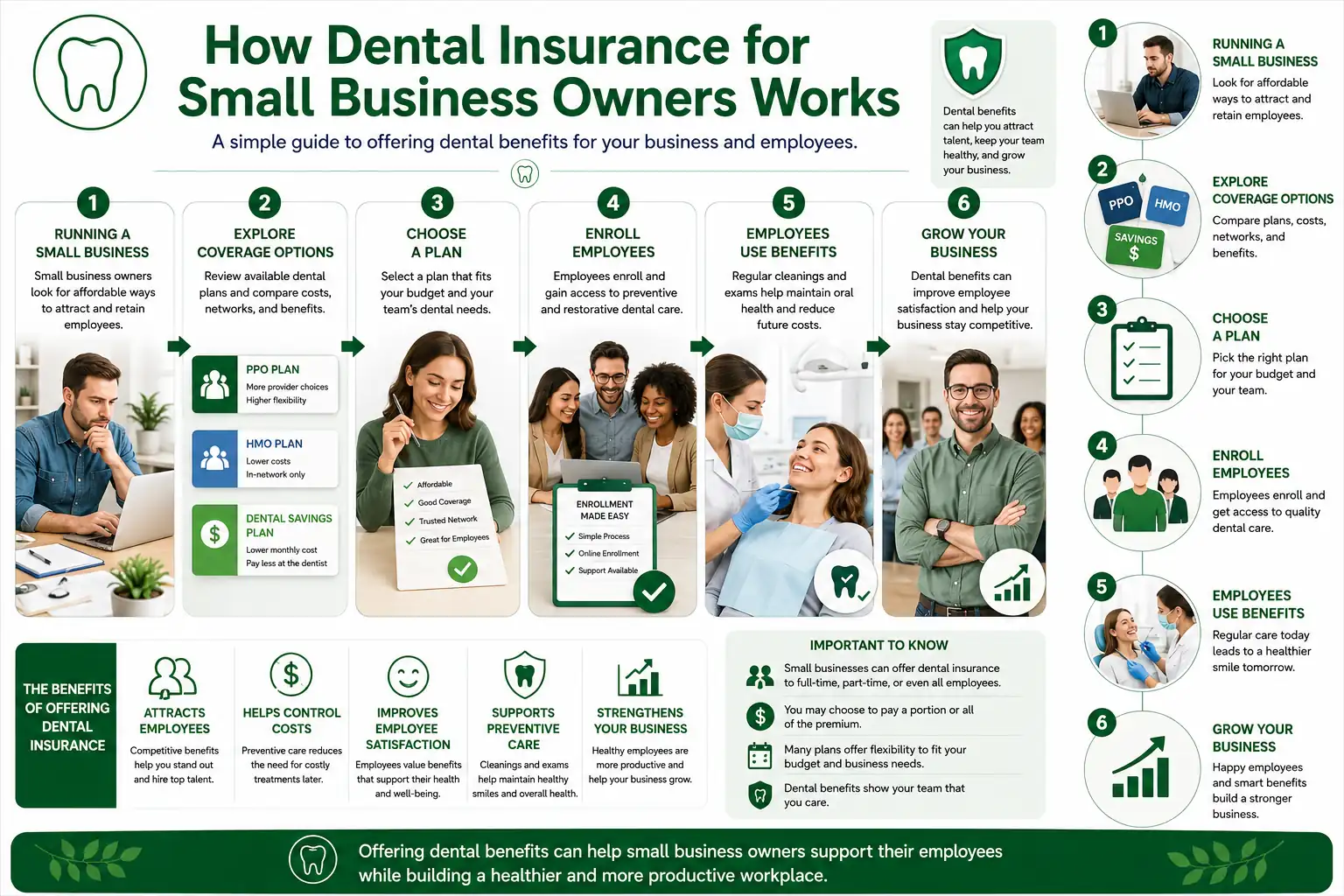
Important to Know:
- The plan structure, enrollment channel, and funding arrangement are separate decisions.
- SHOP is an enrollment option, not a dental-plan type.
- A voluntary benefit does not automatically identify the underlying network or benefit structure.
- Dental discount programs are not insurance.
- Confirm employee eligibility, providers, costs, limits, documents, and administration before offering coverage.
Separate the Plan Structure, Enrollment Channel, and Funding Arrangement
Dental Plan or Product Structure
The underlying product may use a structure such as:
- PPO.
- DHMO or capitation.
- Indemnity.
- Point of service.
- Another insured or employer-sponsored arrangement.
- A discount program that is not insurance.
Each structure can use different provider, payment, referral, out-of-network, and claim rules.
For a detailed comparison of common network structures, review PPO vs HMO Dental Plans.
Enrollment Channel
A small employer may obtain or review coverage through:
- SHOP.
- An insurance company.
- A licensed insurance agent.
- A licensed broker.
- Another authorized group-benefit channel.
The channel does not by itself establish the plan’s network, covered services, premium, contribution requirement, or administrative responsibilities.
Confirm:
- Who issues the policy.
- Who administers the benefit.
- Who receives compensation.
- Who supports enrollment.
- Who handles billing.
- Who provides employee documents.
- Who answers claims and provider questions.
Funding Arrangement
The premium may be:
- Paid primarily by the employer.
- Shared between employer and employee.
- Paid primarily or entirely by employees through a voluntary arrangement.
- Structured differently for employee-only and dependent coverage.
Confirm any minimum employer contribution imposed by the insurer, SHOP arrangement, tax-credit rules, or applicable plan terms.
SHOP Dental Coverage
SHOP may allow an eligible small employer to offer:
- Health coverage only.
- Dental coverage only.
- Health and dental coverage.
Dental coverage may be included with some SHOP health plans or offered through a separate SHOP dental plan.
SHOP eligibility and participation requirements must be confirmed for the business and state.
Dental Discount Programs
A dental discount program is not dental insurance.
The program generally does not pay dental claims. Employees pay participating providers according to the program’s written fee arrangement.
Before offering or endorsing a program, confirm:
- The exact product type.
- Participating providers and locations.
- Written procedure fees.
- Specialist participation.
- Activation rules.
- Employer and employee charges.
- Renewal and cancellation terms.
- How the program will be described to employees.
For a detailed distinction, review Dental Insurance vs Dental Savings Plans.
PPO and DHMO Structures for Employee Dental Benefits
PPO and DHMO describe different provider and payment structures. They do not determine whether the employer pays the premium or whether the plan is offered through SHOP.
PPO Structure
A PPO generally uses a network of contracted dentists and plan allowances.
Depending on the contract, employees may have access to out-of-network benefits, but this should not be assumed.
Confirm:
- The exact network.
- Current dentist participation.
- Out-of-network eligibility.
- Plan allowances.
- Deductibles and coinsurance.
- Specialist access.
- Geographic coverage.
DHMO Structure
A DHMO generally requires members to obtain covered care through participating dental offices.
The plan may require selection of a primary dental office and may use scheduled member charges, referrals, or specialist authorization.
Confirm:
- Participating primary dental offices.
- Specialist availability.
- Referral rules.
- The member-charge schedule.
- Emergency and out-of-area rules.
- Whether any out-of-network benefit exists.
Compare the Actual Workforce Access
Neither structure is automatically more suitable for a local, remote, or multistate workforce.
Compare:
- Employee locations.
- Dentist and specialist availability.
- Dependent locations.
- Provider-selection requirements.
- Out-of-network rules.
- Member costs.
- Administrative procedures.
How to Compare Employee Dental Benefits
A small employer should compare the complete employee-benefit arrangement rather than only the advertised premium or plan label.
Step 1: Confirm the Exact Product and Responsible Parties
Identify:
- The insurance company issuing the policy
- The plan administrator
- The exact plan name
- The provider network
- The enrollment channel
- The agent or broker, when applicable
- The organization responsible for billing
- The organization responsible for claims and employee questions
Do not assume that the broker, enrollment platform, insurer, and plan administrator perform the same role.
Step 2: Define Employee Eligibility
Confirm:
- Which employees are eligible
- How full-time status is defined
- Whether part-time or seasonal employees may enroll
- Whether owners or partners may enroll
- Whether different employee classes are used
- When a new employee becomes eligible
- What happens after a reduction in hours
- What happens when employment ends
- Whether the eligibility rules must be applied consistently across a defined employee class
Document the eligibility rules before employees receive enrollment materials.
Step 3: Review Dependent Eligibility
Confirm whether employees may enroll:
- A spouse
- A domestic partner
- Children
- Stepchildren
- Other eligible dependents recognized by the plan
Review:
- Age limits
- Relationship definitions
- Required documentation
- Dependent effective dates
- Dependent premiums
- Pediatric dental benefits
- Orthodontic eligibility
- What happens when dependent eligibility ends
Do not assume that every plan uses the same definition of an eligible dependent.
For a broader household comparison, review Individual vs Family Dental Plans.
Step 4: Calculate the Complete Fixed Cost
Include:
- Employee-only premiums
- Employee-plus-spouse premiums
- Employee-plus-children premiums
- Family premiums
- Employer contributions
- Employee payroll deductions
- Enrollment or administrative charges
- Broker or platform fees when applicable
- The expected cost at renewal
- The complete cost for the same plan period
Separate:
- The business’s cost
- The employee’s cost
- The dependent cost
- Any optional buy-up cost
A low employee-only premium does not establish that dependent coverage or the complete employer arrangement is inexpensive.
For a complete explanation of dental-plan expenses, review Dental Insurance Costs Explained.
Step 5: Review the Employer Contribution
Confirm:
- Whether the employer must contribute
- The minimum contribution, when applicable
- Whether the contribution applies only to employee coverage
- Whether the employer contributes toward dependents
- Whether every enrolled employee receives the same contribution method
- Whether different employee classes may receive different contributions
- How the contribution affects the complete benefits budget
- Whether the contribution can be maintained at renewal
An employer contribution can reduce the amount paid by employees. It does not establish that the plan has suitable providers, useful benefits, or lower total treatment costs.
Step 6: Confirm Participation Requirements
Ask:
- How many eligible employees must enroll
- What percentage must participate
- Whether employees with other qualifying coverage are excluded from the calculation
- Whether state-specific requirements apply
- Whether participation is measured at initial enrollment or renewal
- What happens if participation later falls below the requirement
- Whether a special annual enrollment period changes the participation rule
For SHOP, HealthCare.gov currently states that employers generally must enroll at least 70% of the employees offered coverage, although some states use different rules and a yearly exception applies during the designated November enrollment period.
Do not apply the SHOP participation rule automatically to every private small-group dental plan.
Step 7: Verify Provider Access for the Workforce
Review employee and dependent access by location.
Confirm:
- General dentists
- Pediatric dentists
- Orthodontists
- Periodontists
- Endodontists
- Oral surgeons
- Prosthodontists
- Denture and implant providers
- Providers near employee homes and work locations
- Access for remote or multistate employees
For each provider, verify:
- The provider’s name
- The exact office location
- The exact plan and network
- Current participation
- New-patient availability
- Referral or authorization requirements
- Out-of-network eligibility
A dental office may accept insurance from a company without participating in every plan or network offered by that company.
For more detail, review In-Network vs Out-of-Network Dental Insurance.
Step 8: Compare Covered Services and Member Costs
Review how the plan evaluates:
- Examinations and cleanings
- X-rays
- Fillings
- Extractions
- Root canal treatment
- Periodontal care
- Crowns
- Bridges
- Dentures
- Dental implants
- Oral surgery
- Pediatric care
- Orthodontic treatment
- Emergency services
For important procedures, confirm:
- Benefit classification
- Deductible
- Copay or coinsurance
- Scheduled member charge
- Plan allowance
- Annual maximum
- Frequency limit
- Replacement limit
- Provider requirement
- Waiting period
- Exclusion
- Authorization requirement
A procedure being listed as covered does not necessarily mean the plan will pay the entire cost. Review the applicable deductible, copayment or coinsurance, annual maximum, network rules, frequency limits and exclusions for each important service category.
Dental plans may classify the same procedure differently, so employers and employees should not rely only on broad labels such as basic or major care. When a particular treatment matters, the employee should verify the exact procedure, provider requirements, waiting periods, cost-sharing, annual maximum, and other applicable plan limitations.
For a broader treatment-by-treatment overview, see Dental Insurance Coverage for Common Procedures.
Step 9: Review Deductibles and Benefit Limits
Confirm:
- The individual deductible
- Any family deductible
- Which services are subject to the deductible
- The annual maximum for each covered person
- Whether any family-level limit applies
- Which services reduce the maximum
- Whether preventive services are treated differently
- Whether orthodontics uses a separate lifetime maximum
- When each limit resets
- How remaining benefits are communicated to members
The annual maximum limits what the plan may pay. It does not limit the dental office’s complete charge.
Step 10: Separate Employee Eligibility Waiting From Service Waiting Periods
An employee eligibility waiting period determines when a new employee may enroll.
A dental-service waiting period determines when the plan begins providing benefits for a particular category of care.
Confirm both separately:
- New-hire eligibility date
- Maximum permitted employee waiting period
- Policy effective date
- Waiting periods for basic services
- Waiting periods for major services
- Waiting periods for orthodontics
- Prior-coverage rules
- Required documentation
- Whether changing plans restarts a service waiting period
For SHOP coverage, HealthCare.gov states that a new-hire waiting period cannot exceed 90 days. Non-SHOP arrangements should be checked under their applicable plan and legal rules.
For a detailed explanation of service waiting periods, review How Waiting Periods Work in Dental Coverage.
Step 11: Review Enrollment and Ongoing Administration
Confirm who will manage:
- Initial enrollment
- Employee elections
- Dependent enrollment
- New hires
- Qualifying events
- Changes in employee status
- Premium deductions
- Employer contributions
- Billing reconciliation
- Employee terminations
- Continuation information when applicable
- Claims questions
- Provider questions
- Annual renewal
- Plan-document distribution
Ask how errors are corrected and how quickly eligibility or billing changes take effect.
Step 12: Review the Official Documents
Obtain the applicable:
- Group policy or contract
- Certificate of coverage
- Schedule of benefits
- Provider directory
- Exclusions and limitations
- Employee eligibility rules
- Member-charge or copay schedule
- Orthodontic benefit schedule
- Enrollment materials
- Summary Plan Description when applicable
- Claims and appeal procedures
- Renewal information
- Employer administrative agreement
Marketing summaries and proposal slides may omit important provider, eligibility, benefit, claims, and termination rules.
HealthCare.gov confirms the general SHOP participation rule, the yearly participation exception, employer choice over dental contributions and the distinction between enrollment timing and plan selection.
SHOP, Tax, and Benefit-Administration Considerations
This section provides general educational information and is not legal, tax, accounting, payroll, or employee-benefits advice.
Confirm SHOP Eligibility
HealthCare.gov currently lists four general SHOP requirements:
- The organization generally has between one and fifty full-time-equivalent employees
- At least one eligible employee is not an owner, partner, owner’s spouse, or owner’s family member
- Coverage is offered to all full-time employees
- The employer satisfies the applicable participation requirement
- The business has a qualifying work location in the state whose SHOP coverage it uses
State rules and plan availability can differ.
A business should complete the current SHOP eligibility process and preserve the determination before relying on SHOP status.
Confirm Whether SHOP Dental Plans Are Available
An eligible employer may be able to offer:
- SHOP health coverage
- SHOP dental coverage
- Health and dental coverage together
- Dental coverage without a SHOP health plan
Availability depends on the state, insurer, and current plan market.
Enrollment is generally completed through the insurance company or with a SHOP-registered agent or broker rather than through an ordinary HealthCare.gov account.
Do Not Assume the Tax Credit Applies
The Small Business Health Care Tax Credit has separate eligibility and calculation rules.
Current IRS instructions state that a stand-alone dental plan offered through SHOP may be treated as a qualified health plan for purposes of this credit.
That statement does not mean every small employer qualifies.
Relevant factors can include:
- The number of full-time-equivalent employees
- Average employee wages
- Coverage through SHOP
- The employer’s contribution arrangement
- Which employees are included in the calculation
- The amount of premiums paid by the employer
- The applicable credit period
- Other current IRS limitations
The IRS currently uses Form 8941 to calculate the credit, and the credit is generally limited to a two-consecutive-tax-year period.
Do not advertise or select a dental benefit based on an assumed tax credit.
Review the current IRS instructions and consult a qualified tax professional before claiming or estimating the credit.
Dental Benefits and ERISA
Many private-sector employer dental plans may be employee welfare benefit plans subject to ERISA, although exceptions exist for certain governmental, church, and other arrangements.
Limited-scope dental benefits may qualify as excepted benefits from selected HIPAA and Affordable Care Act requirements when the applicable conditions are met.
The term “excepted benefit” does not automatically mean that:
- ERISA never applies
- Plan documents are unnecessary
- Claims procedures are unnecessary
- Employee disclosures are unnecessary
- Every federal or state requirement is removed
The Department of Labor states that dental benefits can remain subject to group-health-plan claims-procedure rules whether provided separately or within a larger plan.
Confirm the plan’s status and required documents with qualified benefits counsel or another appropriate professional.
Payroll Deductions and Tax Treatment
Before collecting employee premiums through payroll, confirm:
- Whether deductions are pre-tax or after-tax
- Whether a Section 125 arrangement is involved
- Which written plan documents are required
- How elections and changes are handled
- How deductions appear on payroll records
- How employer contributions are recorded
- How errors or missed deductions are corrected
Do not describe payroll deductions as tax-free without confirming the applicable arrangement and current rules.
Claims, Appeals, and Employee Information
Employees should receive clear information about:
- Eligibility
- Effective dates
- Premiums
- Provider networks
- Covered services
- Benefit limits
- Claims
- Adverse benefit decisions
- Appeals
- Continuation or termination rules
- Where to obtain assistance
The employer should know which organization is responsible for each question.
IRS instructions confirm the special treatment of a SHOP stand-alone dental plan for Form 8941, the qualifying-contribution conditions and the two-consecutive-year credit period. Department of Labor guidance confirms that limited-scope dental coverage may be excepted from certain requirements without eliminating every ERISA or claims obligation.
How to Implement the Dental Benefit
Confirm the Final Terms
Before announcing the benefit, confirm:
- The policy and network
- Eligible employee classes
- Dependent eligibility
- Employer contributions
- Employee premiums
- Effective dates
- Participation requirements
- New-hire procedures
- Plan documents
- Billing procedures
- Employee-support contacts
Do not announce provisional terms as final.
Prepare the Enrollment Information
Provide employees with:
- The exact plan name
- The provider-network name
- Premiums by enrollment tier
- The employer contribution
- The employee payroll deduction
- The coverage effective date
- Instructions for finding participating dentists
- A summary of deductibles and member charges
- Annual and lifetime benefit limits
- Waiting-period information
- Dependent rules
- Enrollment deadlines
- Claims and contact information
- Official plan documents
Give Employees Time to Verify Providers
Employees should be able to check:
- Their current dentist
- The exact office location
- Pediatric dentists
- Orthodontists
- Other specialists
- Providers near their home or workplace
Employees should confirm participation with both the plan and dental office before receiving treatment.
Collect and Document Elections
Record:
- Employees who accept coverage
- Employees who decline coverage
- Dependent elections
- Required eligibility documents
- Payroll deduction authorization
- Effective dates
- Any late or special enrollment request
Store benefit information according to the business’s applicable privacy, recordkeeping, and security procedures.
Reconcile Enrollment and Billing
After enrollment, compare:
- Employee elections
- Insurer enrollment records
- Payroll deductions
- Employer contributions
- The first invoice
- Coverage effective dates
- Dependent enrollment
Correct discrepancies before they continue across multiple payroll or billing periods.
Establish Procedures for Employment Changes
Document what happens when an employee:
- Is newly hired
- Changes hours
- Adds or loses a dependent
- Takes leave
- Moves to another location
- Terminates employment
- Requests a qualifying-event change
- Questions a payroll deduction
- Reports a claims or enrollment problem
Review the Benefit at Renewal
At renewal, compare:
- Premium changes
- Employer and employee costs
- Provider-network changes
- Participation
- Employee questions
- Claims or administration problems
- Benefit changes
- Waiting-period treatment
- Annual maximums
- Enrollment-system performance
- The time required to administer the plan
Do not renew automatically based only on the previous year’s plan name.
Comparison and Administration Errors to Avoid
Treating SHOP, a Broker, or an Insurer as the Plan Type
These terms describe an enrollment program or responsible organization.
Confirm the underlying dental product, network, benefits, and funding arrangement.
Treating a Voluntary Benefit as a Separate Network Structure
“Voluntary” commonly describes employee election or premium funding.
The underlying product may still be a PPO, DHMO, indemnity plan, or another arrangement.
Comparing Only Employee-Only Premiums
Dependent premiums, employer contributions, fees, renewal costs, and employee member charges can materially change the comparison.
Assuming One Network Works for the Entire Workforce
Verify providers in every employee and dependent location, especially for remote or multistate teams.
Confusing Employee Eligibility With Dental-Service Eligibility
An employee may be enrolled while selected procedures remain subject to service waiting periods or other limitations.
Assuming Listed Services Are Fully Paid
Deductibles, copays, coinsurance, plan allowances, annual maximums, frequency limits, exclusions, and out-of-network charges may still apply.
Assuming SHOP or the Tax Credit Is Available
Confirm current business eligibility, state availability, insurer participation, employer contributions, employee participation, and IRS requirements.
Describing a Discount Program as Insurance
A dental discount program does not pay insurance claims.
Use clear written language explaining the product type and employee payment responsibility.
Announcing the Benefit Before Confirming the Terms
Incorrect premiums, networks, effective dates, or eligibility information can create employee confusion and administrative corrections.
Ignoring Renewal and Termination Procedures
Review how premiums, providers, contributions, employee elections, continuation information, and plan documents change at renewal or when employment ends.
Solo Owners Without Eligible Employees
A solo owner without an eligible employee generally has a personal or household dental-coverage question rather than an employee-benefit question.
The owner may compare:
- Directly purchased individual dental insurance
- Family dental coverage
- Marketplace dental options when applicable
- Coverage through a spouse or another eligible source
- Association-related arrangements
- Dental savings plans
- Dental office membership programs
- Direct payment or financing
Do not establish an employee dental-benefit workflow when no eligible employee group exists.
For the appropriate personal-coverage process, review Dental Insurance for Self-Employed.
HealthCare.gov currently states that a business generally cannot qualify for SHOP when its only worker is the owner, a partner, the owner’s spouse, or another owner family member.
How to Interpret the Employee Dental Benefit Comparison
A small employer should evaluate dental coverage as a complete employee-benefit arrangement rather than as a single insurance product.
No plan structure, enrollment channel, or funding arrangement is automatically suitable for every business or workforce.
A plan may deserve closer consideration when:
- Employee and dependent eligibility rules are clear
- The employer contribution can be maintained
- Employee payroll deductions are understood
- Participation requirements can be satisfied
- Dentists and specialists are reasonably available where employees and dependents live
- The plan explains deductibles, copays, coinsurance, scheduled charges, and plan allowances clearly
- Annual and lifetime benefit limits are understood
- Waiting periods and treatment-in-progress rules are acceptable
- Important procedures are addressed in the written benefit documents
- Enrollment, billing, claims, renewals, and terminations can be administered consistently
- Employees receive complete plan documents and accurate support information
A plan may deserve less consideration when:
- The provider network does not serve important employee locations
- Dependent premiums are difficult for employees to evaluate or afford
- Participation rules are unlikely to be satisfied
- Important services are excluded or subject to limits that are not communicated clearly
- The benefit is difficult to administer accurately
- The employer contribution cannot reasonably be maintained
- Employees cannot obtain reliable answers about providers, claims, or eligibility
- The plan is promoted mainly through unsupported recruitment, retention, productivity, or tax-credit claims
A SHOP option should be compared with non-SHOP group dental options using the same employee, provider, benefit, cost, and administration criteria.
A dental discount program should be evaluated separately from insurance because it does not pay insurance claims.
The final comparison should identify:
- What the business pays
- What employees pay
- What enrolled dependents pay
- Which providers employees can use
- Which procedures may receive benefits
- Which limits and exclusions apply
- Which administrative tasks remain with the employer
- Which organization handles enrollment, billing, claims, and employee support
When you are ready, compare dental plans using the same workforce, contribution, provider, benefit, and administration criteria for every option.
Questions to Ask Before Offering Coverage
| Question | Why It Matters |
|---|---|
| Am I creating an employee benefit or purchasing personal coverage for an owner? | Group employee benefits and personal dental policies follow different eligibility and administration rules |
| What is the exact product type? | PPO, DHMO, indemnity, insurance, and discount arrangements operate differently |
| Who issues the policy? | The insurer, broker, enrollment platform, and administrator may perform different roles |
| Which employees are eligible? | Eligibility rules affect enrollment, payroll, billing, and plan administration |
| Can part-time or seasonal employees enroll? | Optional employee classes must be confirmed and administered consistently |
| Can spouses, domestic partners, or children enroll? | Dependent definitions, documentation, premiums, and age limits can vary |
| What will the employer contribute? | The contribution affects the business budget and employee payroll deductions |
| What will employees pay for each enrollment tier? | Employee-only, spouse, children, and family premiums may differ substantially |
| Does a minimum contribution apply? | SHOP, insurers, tax-credit rules, or particular contracts may impose contribution requirements |
| Does a participation requirement apply? | The group may be unable to enroll or renew if the applicable participation rule is not met |
| Is the business eligible for SHOP? | SHOP eligibility depends on business size, employee composition, participation, and work location |
| Are employees’ dentists in the exact network? | Accepting an insurer does not mean participating in every plan offered by that insurer |
| Does the network serve remote or multistate employees? | One local network may not provide reasonable access for the entire workforce |
| What deductibles and member charges apply? | Premiums do not show what employees may owe when they receive care |
| What annual maximum applies to each person? | The plan may stop paying after the applicable individual limit is reached |
| Which services have waiting periods? | An enrolled employee may not immediately qualify for every procedure |
| Is the new-hire eligibility period separate from service waiting periods? | Employee enrollment timing and procedure eligibility are different rules |
| Which dental procedures and service categories are covered? | Employees may need fillings, extractions, root canal treatment, crowns, bridges, dentures, or other restorative care |
| Are preauthorization or predetermination processes available or required? | Advance reviews may clarify potential benefits but do not necessarily guarantee payment |
| Who handles enrollment changes and billing corrections? | Administrative errors can affect coverage dates, deductions, and employee access |
| Which plan documents will employees receive? | Employees need official eligibility, benefits, exclusions, claims, and appeal information |
| How are claims and appeals handled? | Dental employee benefit plans may be subject to formal claims-procedure requirements |
| Could the Small Business Health Care Tax Credit apply? | Eligibility and calculation must be verified under current IRS requirements |
| What happens at renewal or when employment ends? | Premiums, networks, benefits, continuation information, and eligibility can change |
| What is the complete annual business cost? | The employer should include contributions, fees, payroll administration, and renewal impact |
Documents to Keep Before Offering Coverage
Keep copies of:
- The final group proposal
- The SHOP eligibility determination when applicable
- The complete policy or group contract
- The certificate of coverage
- The schedule of benefits
- The provider-network information
- The exclusions and limitations
- Employee eligibility rules
- Dependent eligibility rules
- Employer-contribution terms
- Participation requirements
- Waiting-period provisions
- Annual and lifetime benefit limits
- Orthodontic benefit information
- Member-charge or copay schedules
- Claims and appeal procedures
- Enrollment and termination procedures
- Summary Plan Description when applicable
- Employee enrollment materials
- Employee election and waiver records
- Payroll-deduction authorizations
- Broker or agent service agreements
- Compensation and fee disclosures
- Billing and reconciliation procedures
- Renewal notices
- Tax-credit calculations and supporting documents when applicable
- Written answers received from the insurer, administrator, broker, payroll provider, accountant, or benefits counsel
Record the date, representative, organization, contact method, and source of every important eligibility, contribution, provider, benefit, tax, or administration clarification.
Helpful Resources
Frequently Asked Questions
Can a small business offer dental insurance without health insurance?
Possibly.
An eligible small employer may be able to offer stand-alone dental coverage, including a separate SHOP dental plan where available.
Availability, eligibility, participation requirements, contribution rules, insurers, and plans depend on the state and market.
Does a one-person business qualify for SHOP dental coverage?
Generally, a business does not qualify for SHOP when its only workers are owners, partners, spouses, or other owner family members.
SHOP generally requires at least one eligible employee who is not an owner, partner, owner’s spouse, or owner family member.
A solo owner should usually compare personal or family dental coverage instead.
Is a voluntary dental benefit a separate type of dental plan?
Not necessarily.
“Voluntary” generally describes employee election or premium funding. The underlying product may still be a PPO, DHMO, indemnity plan, or another arrangement.
Confirm the actual product, insurer, network, and benefit terms.
Must every employee enroll in SHOP dental coverage?
Not necessarily.
SHOP generally uses a minimum participation requirement rather than requiring every offered employee to enroll. Employees with other qualifying coverage may be treated differently in the participation calculation.
Some states use different participation percentages, and an annual exception applies during the designated enrollment period.
Does SHOP guarantee eligibility for the small-business tax credit?
No.
SHOP enrollment alone does not guarantee the Small Business Health Care Tax Credit.
Business size, average wages, employer contributions, qualifying coverage, the credit period, and other IRS requirements affect eligibility and calculation.
Is a PPO automatically better for a remote workforce?
No.
A PPO may provide out-of-network benefits under some contracts, but the employer must verify the exact provider network, employee locations, plan allowances, specialist access, and out-of-network rules.
A plan label does not establish reasonable workforce access.
Are employee dental plans subject to ERISA?
Many private-sector employer dental plans may be employee welfare benefit plans under ERISA, although exceptions exist.
Limited-scope dental benefits may be excepted from selected HIPAA and Affordable Care Act requirements when the applicable conditions are satisfied. This does not automatically remove every ERISA, claims, disclosure, or administrative obligation.
The business should obtain advice appropriate to its particular plan and circumstances.
What should a small employer compare first?
Begin with:
Whether the business is creating an employee benefit or purchasing personal owner coverage
The exact product and insurer
Employee and dependent eligibility
Employer contributions and employee payroll deductions
Participation requirements
Provider access
Covered procedures
Deductibles and benefit limits
Waiting periods
Plan administration
Official documents
Complete business and employee costs
Then compare each available option using the same workforce and benefit period.
Sources
- HealthCare.gov — Find Out If Your Small Business Qualifies for SHOP
- HealthCare.gov — How to Offer SHOP Insurance to Your Employees
- HealthCare.gov — SHOP Marketplace Overview
- HealthCare.gov — SHOP Dental Plan Research Information
- Internal Revenue Service — Instructions for Form 8941
- Internal Revenue Service — About Form 8941
- U.S. Department of Labor — Benefit Claims Procedure Regulation FAQs
- U.S. Department of Labor — FAQs About Affordable Care Act Implementation Part 72
- U.S. Department of Labor — Field Assistance Bulletin No. 2021-03
- U.S. Department of Labor — Employee Retirement Income Security Act
- American Dental Association — Types of Dental Plans
About the Author
Maria Dumitru is the Founder and Content Editor of Dental Coverage Hub. She researches and edits educational content designed to help U.S. consumers understand dental insurance terms, compare plan features, and verify important information before enrolling.
Learn more about our standards in the Editorial Policy and How We Review Dental Plans.
This article provides general educational information and is not legal, tax, accounting, payroll, human-resources, employee-benefits, financial, or personalized insurance advice. SHOP eligibility, employee participation, employer contributions, tax-credit eligibility, provider networks, premiums, covered services, deductibles, waiting periods, annual maximums, plan documents, ERISA status, payroll treatment, claims procedures, renewal rules, and administrative responsibilities can vary by employer, plan, insurer, state, workforce, and current law. Review the official documents and consult the appropriate insurer, licensed agent or broker, benefits administrator, payroll provider, accountant, tax professional, or qualified benefits attorney for information specific to the business.

Compare Employee Dental Benefits With Clear Criteria
A small employer should compare the plan structure, enrollment channel, employee eligibility, employer contributions, payroll deductions, provider access, covered services, waiting periods, benefit limits, official documents, and administrative responsibilities before offering coverage. Use the same workforce information and cost period for every proposal.