
Dental Insurance When Changing Jobs: What to Check Between Employer Plans
Confirm the transition dates, recheck your dentist and expected treatment, and understand which benefits need verification under your new employer dental plan.
Written and researched by Maria Dumitru.
Founder and Content Editor at Dental Coverage Hub
Last reviewed: October 2026
Dental insurance when changing jobs involves more than replacing an insurance card.
Your old employer’s coverage may end just before the new plan begins, leaving little or no calendar gap. Even so, the transition can change your dentist network, deductible, available benefits, waiting periods, and how unfinished treatment is handled.
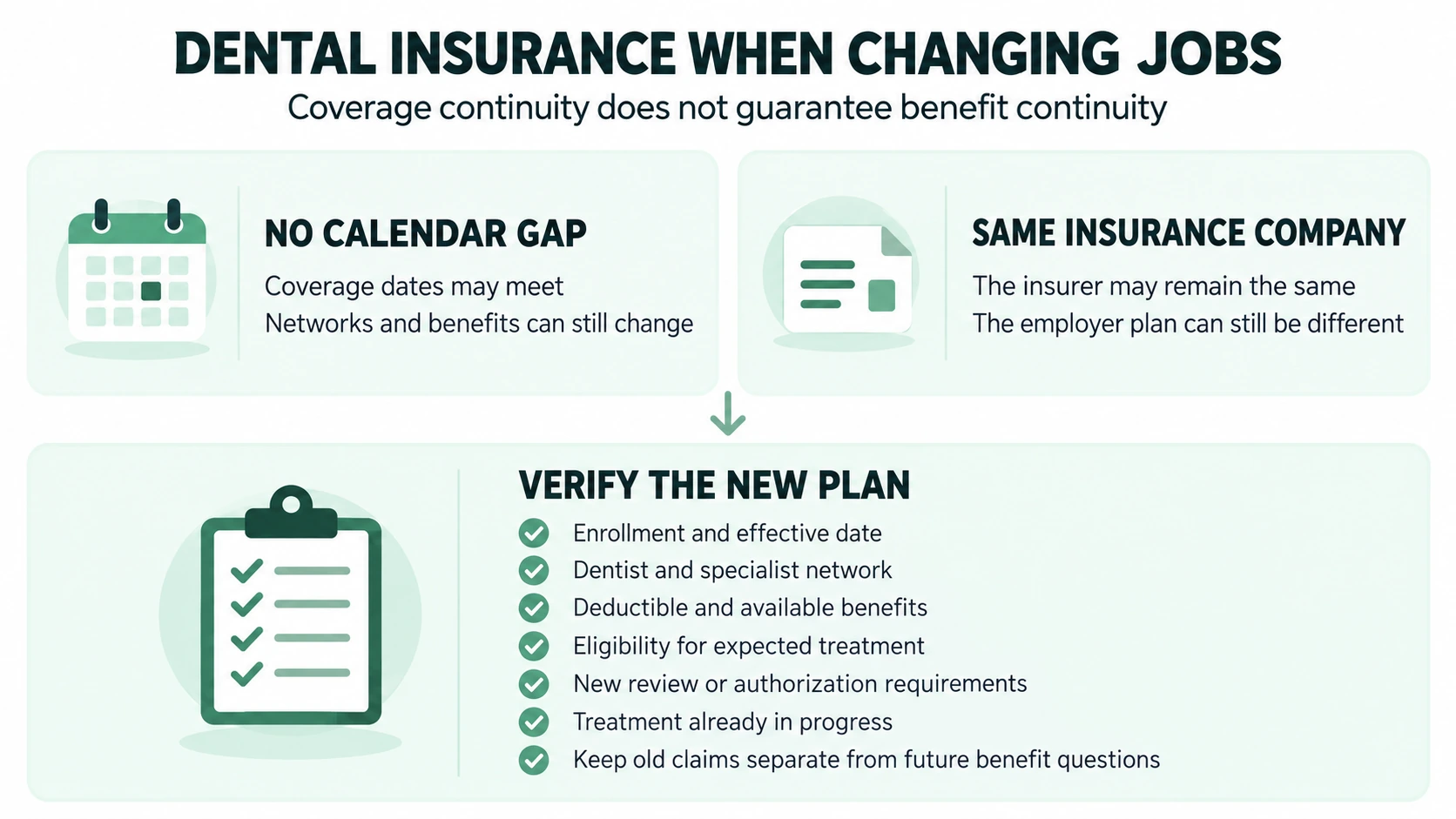
The same insurance company may also administer different plans for different employers. A familiar insurer name does not establish that your previous benefits will continue.
Treat the transition as a change between separate benefit arrangements. Verify the new plan before relying on old network information, treatment estimates, advance reviews, or benefit balances.
What You’ll Learn
- Which coverage and enrollment dates to confirm
- Why the same insurer can still mean a different dental plan
- How to verify your dentist and specialists again
- What to ask about deductibles and annual benefits
- How to handle previously reviewed or unfinished treatment
- Which questions belong with the plan and which belong with the dental office
- How to keep old claims separate from future benefits
Quick Answer
When moving between employer dental plans, confirm when the old coverage ends, whether you must enroll in the new plan, and when the new coverage becomes effective.
Then verify the exact new network, benefits for expected treatment, deductible requirements, annual-benefit availability, and treatment-in-progress provisions.
Do not assume old benefits automatically transfer. Do not assume changing jobs creates a fresh entitlement to every service either.
No calendar gap between plans does not guarantee continuity of benefits. The new plan’s terms must be checked separately.
Key Takeaways
- Your job start date may differ from your dental coverage effective date.
- Starting work does not necessarily enroll you automatically in dental benefits.
- The same insurer can administer different networks and benefit designs.
- Dentist participation must be checked under the exact new plan.
- Old deductible progress and benefit balances should not be treated as transferable without confirmation.
- An earlier advance review does not establish benefits under a different plan.
- Treatment already underway requires procedure-specific verification.
- Pending old-plan claims remain separate from questions about future care.
In This Guide
What Changes When You Move Between Employer Dental Plans?
Your former employer selected one dental benefit arrangement. Your new employer may offer a different plan, even when the insurer remains the same.
Differences can include:
- Provider networks and plan structure
- Deductibles and member cost sharing
- Annual and other benefit limits
- Waiting periods and service eligibility
- Frequency and replacement provisions
- Advance-review requirements
- Treatment-in-progress rules
The first task is to identify the exact new plan and obtain its current documents.
If the new employer offers several options, check which one you are electing. Information about another workplace option may not apply to your selection.
Also confirm that the documents describe dental coverage specifically. Medical and dental benefits may have different enrollment requirements and coverage terms.
Dates to Confirm Before Relying on the New Coverage
Keep the coverage termination date, enrollment deadline, and effective date separate.
Old Dental Coverage End Date
Ask the former employer or benefits administrator for the exact final date of dental eligibility.
Do not infer it from your last working day, final paycheck, or the end of the month.
Keep the confirmation with your old plan documents. If treatment is scheduled near that date, ask the plan which procedure date it uses to determine eligibility.
An appointment occurring before coverage ends does not, by itself, establish eligibility for every stage of a multi-stage procedure.
New-Employer Enrollment Deadline
Confirm whether you must actively elect dental coverage and when the election must be completed.
Ask:
- Which dental options you can select
- Whether dependents must be added separately
- What documentation is required
- What happens if you miss the enrollment deadline
- How you can confirm that your election was accepted
Do not rely only on having completed general onboarding. Verify the dental election itself.
New Dental Coverage Effective Date
Obtain the exact effective date from the employer or plan.
Your employment start date and dental coverage start date may differ. An enrollment submission date also does not establish when coverage becomes active.
Before an upcoming appointment, confirm eligibility with the plan if the effective date or enrollment status is unclear.
For the distinction between enrollment, the coverage start date, and benefit eligibility, read Dental Insurance Effective Date: When Does Coverage Start?
Service Eligibility After the Effective Date
An active plan does not necessarily make every dental benefit immediately available.
For the services you expect to receive, check whether a waiting period or another provision affects eligibility. Ask whether any prior-coverage documentation is relevant under the new plan’s terms.
For the detailed timing mechanism, read How Waiting Periods Work in Dental Coverage.
Same Insurance Company Does Not Mean the Same Dental Plan
Seeing a familiar insurer on your new benefits materials can make the transition appear simpler than it is.
Different employers can select different networks, benefit schedules, cost-sharing arrangements, and limitations through the same company.
Record the new:
- Employer group or plan identifier
- Plan option or product name
- Network name
- Member information
- Effective date
Use these details when speaking with the plan and dental office.
An old insurance card or saved provider search may identify your previous arrangement rather than the new one. Update your information before asking whether a dentist participates or a procedure is eligible.
Compare the Old and New Employer Plans
Use the current documents for both arrangements to identify transition questions.
| Transition detail | Old employer plan | New employer plan |
|---|---|---|
| Coverage dates | Confirm the final date of eligibility | Confirm enrollment acceptance and effective date |
| Provider participation | Identify the dentist and specialists currently used | Verify each provider under the exact new network |
| Deductible | Keep a record of amounts applied under the old plan | Ask what deductible applies and whether any credit is recognized |
| Annual benefits | Record paid benefits and unresolved claims | Confirm the benefit period, applicable maximum, and available benefits |
| Previously reviewed treatment | Keep the old review and its conditions | Ask whether a new submission or authorization is needed |
| Treatment underway | Identify completed procedures and submitted claims | Verify how remaining treatment will be evaluated |
| Claims administration | Keep old contact details and filing requirements | Use the new information for services assigned to the new coverage |
The purpose is to identify what needs confirmation before care continues.
For a broader review of the new plan’s features, use How to Compare Dental Plans Online.
Deductibles and Annual Benefits: What Needs Confirmation?
Your old plan’s benefit information describes that arrangement. It does not automatically establish the starting position under the new employer plan.
Deductible Progress
If you have already paid toward a deductible, ask the new plan whether it recognizes any deductible credit.
If a credit is available, confirm:
- Which amounts qualify
- What documents are required
- Whether the credit has been applied
- Which services it affects
Until the new plan confirms the result, avoid using the old deductible status in a treatment-cost estimate.
Annual Maximum and Available Benefits
Ask what annual maximum applies and which benefit period the new plan uses.
Also confirm whether any transition credit, adjustment, or other provision affects the benefits available to you. Do not calculate the new balance simply by carrying over the old plan’s figures.
Changing plans does not automatically remove frequency limits, replacement provisions, or treatment-history requirements.
A benefit balance and eligibility for a particular procedure are separate questions.
For the complete mechanism, read Dental Insurance Annual Maximums Explained.
Pending Claims Can Affect the Information You See
A benefit summary may not yet reflect every submitted or unresolved claim.
When reviewing the old plan, ask whether pending claims could change its remaining benefits or your responsibility for completed care.
Keep that information separate from the new plan’s benefit confirmation.
Verify Your Dentist and Specialists Again
Your dentist’s participation under the old plan does not establish participation under the new one.
Verify the exact dentist, practice location, and network. Check any specialist separately, particularly when an existing treatment plan involves more than one provider.
Ask the office about participation in the specific new plan rather than only whether it accepts the insurer.
Check the plan’s current directory and contact the plan when the information is unclear or conflicts with the office’s response.
Update Your Insurance Information Before the Appointment
Provide the new member and plan details to the office, together with the effective date.
If the office has an estimate based on your former coverage, ask whether it needs to be revised.
If a provider is out-of-network under the new arrangement, determine whether out-of-network benefits exist and how that affects your expenses.
For the detailed network comparison, read In-Network vs Out-of-Network Dental Insurance.
Recheck Dental Treatment You Already Expect to Need
A procedure included under both plans can still be handled differently.
For recommended treatment, ask the new plan about the specific procedure rather than relying only on a category such as basic or major services.
Confirm:
- Whether it is an included benefit
- Whether it is eligible on the expected treatment date
- Which deductible or member cost sharing applies
- Which benefit limits affect it
- Whether documentation or advance review is required
Give the dental office the updated information so it can revise the estimate where appropriate.
Previous Treatment Can Still Matter
If the proposed care repeats a service or replaces existing dental work, review the new plan’s frequency and replacement provisions.
A change of employer does not automatically make another benefit available.
If a missing tooth is relevant, check any applicable provision in the new coverage. The detailed explanation is in Missing Tooth Clauses in Dental Insurance: What to Check Before Enrolling.
What Happens to an Old Predetermination or Preauthorization?
Do not treat an advance review from the old plan as confirmation of benefits under the new plan.
The previous review used the old arrangement’s eligibility, benefit rules, provider information, and available benefits.
Predetermination and preauthorization are distinct processes. Ask the new plan which process applies to your proposed treatment and whether a new submission is required.
For the distinction between these processes, read Dental Insurance Predetermination vs Preauthorization guide.
If the new plan requires authorization, confirm that requirement before proceeding with the affected service. Do not assume the old plan’s response satisfies it.
An advance review may also contain conditions relating to eligibility, timing, or remaining benefits. Ask what it establishes and what still needs verification when the service is provided.
Keep both the previous response and any new review with your treatment records.
What If Dental Treatment Is Already in Progress?
Treatment can cross a coverage transition even when there is no calendar gap.
Examples include:
- Root canal treatment followed by a separate crown
- Crown preparation followed by final placement
- Different stages of implant treatment
- Bridge or denture fabrication and delivery
- Orthodontic treatment continuing across the change
These examples identify transition questions; they do not establish which plan must pay.
Identify Completed and Remaining Treatment
Ask the dental office for a written summary showing:
- What has been completed
- The relevant procedure dates
- What has been submitted to the old plan
- What treatment remains
- Which providers are involved
- The anticipated schedule for remaining care
Then ask the plans how their terms apply.
For multi-stage procedures, confirm the date each plan uses for benefit eligibility and any applicable treatment-in-progress or extension-of-benefits provision.
Do not assume the completion date alone assigns responsibility to the new plan.
For the detailed framework, read Dental Insurance and Treatment Already in Progress.
Keep Clinical Timing Separate From Benefit Timing
Discuss the timing and sequence of care with your dentist.
Insurance information helps you understand potential financial consequences. Your dental professional explains which care is time-sensitive and whether a proposed scheduling change is clinically appropriate.
If insurance questions remain unresolved, identify those uncertainties before relying on an estimate for the next treatment stage.
What to Ask the Plan and the Dental Office
The employer or benefits administrator confirms enrollment and employment-related eligibility information. The dental plan explains the applicable coverage terms. The dental office supplies treatment details and helps with estimates, provider information, and claim submissions.
| Ask the employer or dental plan | Ask the dental office |
|---|---|
| What are the old termination and new effective dates? | Do you have my updated plan and member information? |
| Has my dental enrollment been accepted? | Are the dentist and practice location in the exact new network? |
| What deductible and annual benefits apply? | Which treatment has been completed and which remains? |
| Is the planned procedure currently eligible? | Which procedure dates and codes have been submitted? |
| Is a new authorization or benefit review required? | Does the estimate need revision or a new benefit submission? |
| How do treatment-in-progress provisions apply? | Are other providers involved who need separate verification? |
| Which filing or documentation requirements apply? | Are any old claims or requested documents still outstanding? |
Keep a dated record of important answers, including the source and any reference number.
Use written confirmation or the relevant document when available, particularly when a response affects treatment timing or expected expenses.
What If There Is a Gap Between Employer Dental Plans?
Compare the confirmed old-plan termination date with the new-plan effective date.
If the dates leave an uncovered period, ask whether continuation coverage or another temporary arrangement is available.
COBRA may be relevant when the plan and circumstances qualify. Do not assume it applies automatically or that election requirements can be ignored.
For continuation and replacement options during the gap, use Dental Insurance After Losing a Job: COBRA and Other Coverage Options.
If the dates meet without a gap, continue the other checks. Calendar continuity does not establish that the network, benefits, or unfinished-treatment rules remain the same.
Keep Old Claims Separate From Future Benefits
A claim can remain unresolved after your employment and coverage have ended.
Ending employment does not, by itself, move an old claim to the new plan. Follow up with the plan responsible under the applicable procedure-date and coverage rules.
Keep:
- Old claim reference numbers
- Explanations of Benefits
- Relevant procedure dates
- Requests for additional documentation
- Filing and appeal information
- Dental-office statements
For remaining treatment, establish which plan’s rules apply before assuming it belongs entirely to the new coverage.
Multi-stage treatment may require clarification from both plans. Ask about any provision that affects services started before termination and completed afterward.
An old Explanation of Benefits records how a claim was processed under that coverage. It does not establish how the new plan will handle a future procedure.
For help interpreting the old claim’s payments, adjustments, and patient responsibility, read How to Read a Dental Insurance EOB guide.
How to Interpret Your Job-Change Review
The Coverage Dates Meet
There may be no calendar gap. You still need to verify the new plan’s providers, service eligibility, and benefit rules.
The Insurer Remains the Same
The administrator may be familiar, but the employer group, network, and benefit arrangement can differ. Use the new identifiers and documents.
The Old Deductible Was Satisfied
That describes the old plan. Ask whether the new arrangement recognizes any credit before using it in a cost estimate.
Treatment Was Previously Reviewed
The old response remains useful as a record. It does not establish the new plan’s decision or satisfy a new authorization requirement automatically.
Treatment Has Already Started
Separate completed procedures from remaining care. Obtain the relevant dates and ask how both plans handle the transition.
Some Answers Are Still Missing
List the unanswered questions and the source needed to resolve each one. Ask the plan about benefits, the employer about enrollment, and the dental office about treatment and submissions.
Common Mistakes When Changing Employer Dental Plans
- Assuming onboarding automatically includes dental enrollment
- Using the employment start date as the dental effective date
- Checking only whether there is a coverage gap
- Assuming the same insurer means the same network and benefits
- Relying on an old treatment estimate without updating coverage
- Assuming deductible progress or benefit balances automatically transfer
- Treating a job change as a reset of every service limitation
- Relying on an old authorization under a different plan
- Assigning unfinished treatment to the new plan without checking its rules
- Losing access to old claim records before pending issues are resolved
Our Recommendation
Before your next appointment, bring together the confirmed transition dates, exact new plan information, provider verification, and benefit questions for expected or unfinished treatment.
Resolve the assumptions most likely to affect your care: enrollment acceptance, network participation, service eligibility, benefit availability, and any required review.
Use the Dental Plan Comparison Checklist for the broader review after these transition questions are addressed.
Helpful Resources
- Dental Insurance by Life Stage and Work Situation
- Dental Insurance and Treatment Already in Progress
- In-Network vs Out-of-Network Dental Insurance
- How Waiting Periods Work in Dental Coverage
- Dental Insurance Annual Maximums Explained
- Dental Insurance After Losing a Job: COBRA and Other Coverage Options
Frequently Asked Questions
Does Dental Insurance Automatically Transfer When I Change Jobs?
Do not assume it transfers. Your new employer offers its own benefit arrangement, and you may need to elect coverage. Verify enrollment, the effective date, and the specific plan terms.
Does My Dental Coverage Start on My First Day at the New Job?
Not necessarily. The employment start date, enrollment deadline, and dental effective date can differ. Confirm the actual date with the employer or benefits administrator.
Can I Keep the Same Dentist?
Possibly. Verify the dentist and practice location under the exact new plan and network. Participation under your previous coverage does not establish participation under the new arrangement.
Does My Old Dental Deductible Carry Over?
Do not assume it does. Ask whether the new plan recognizes any deductible credit, what documentation is required, and whether the credit has been applied.
Do I Get a Fresh Annual Maximum When I Change Jobs?
The new plan has its own benefit period and maximum rules. Confirm the available benefits and any transition provisions. A new benefit balance does not automatically remove waiting periods or treatment-history limitations.
Does an Old Predetermination or Preauthorization Still Apply?
Do not rely on it as confirmation under the new plan. Ask whether a new review or authorization is needed and which conditions apply to the proposed procedure.
What Happens to Treatment That Started Under the Old Plan?
Identify completed and remaining procedures, then ask how the relevant dates and treatment-in-progress provisions apply. The plan responsible for unfinished care cannot be established from the job-change date alone.
What If There Is a Gap Between the Employer Plans?
Confirm the exact termination and effective dates, then review any available continuation or temporary coverage arrangement. COBRA may apply depending on the plan and circumstances.
Sources
- U.S. Department of Labor — Changing Jobs and Job Loss.
- American Dental Association — Typical Dental Plan Benefits and Limitations.
- American Dental Association — Pre-Authorizations.
- American Dental Association — Explanation of Benefits Statement.
- U.S. Department of Labor — A Worker’s Guide to Health Benefits Under COBRA.
About the Author
Maria Dumitru is the founder and content editor of DentalCoverageHub. She creates consumer-focused educational content designed to help readers understand dental insurance benefits, limitations, and plan rules before making coverage decisions.
Learn more about our standards in the Editorial Policy and How We Review Dental Plans.
This guide provides general educational information. Enrollment, coverage dates, benefits, networks, and transition provisions vary by employer and plan. Review the official documents and confirm the terms that apply to your own coverage.

Compare Your New Employer Dental Plan
Confirm the transition dates, verify your providers, and recheck expected or unfinished treatment. Then review the complete terms of the new plan.