
Root Canal vs Tooth Extraction: Insurance and Cost Considerations
Compare the complete proposed treatment, including final restoration, possible tooth replacement, provider networks, benefit limits, and estimated patient costs.
Written and researched by Maria Dumitru.
Founder and Content Editor at Dental Coverage Hub
Last reviewed: November 2026
What You’ll Learn
A root canal vs tooth extraction cost comparison can be misleading when one estimate includes the complete treatment and the other includes only the first procedure.
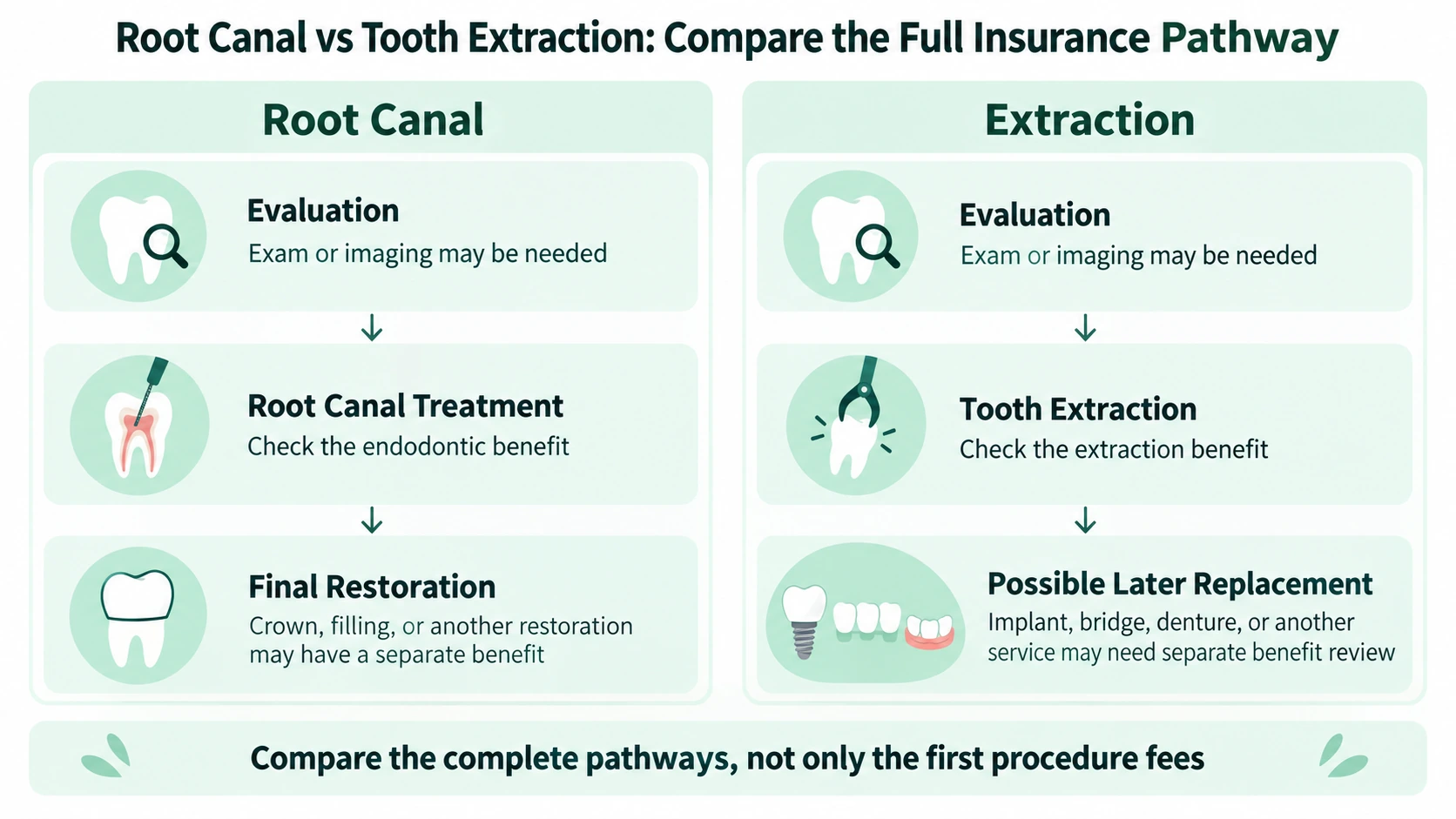
Root canal treatment involves preserving and restoring the tooth. Extraction removes it, and the proposed treatment may or may not include replacement.
This guide explains how to:
- Identify the services expected with each clinically appropriate option
- Include the final restoration in the root canal estimate
- Distinguish planned tooth replacement from an undecided possibility
- Compare provider participation, benefit rules, and patient costs
- Recognize what an estimate confirms and what remains uncertain
For an overview of procedure-specific benefits, start with our Dental Insurance Coverage for Common Procedures guide.
Quick Answer
Dental insurance may provide benefits for root canal treatment or extraction, but neither procedure’s benefit automatically covers everything that follows.
For root canal treatment, identify the final restoration and any other proposed services.
For extraction, establish whether the current plan includes removal only, removal with additional care, or removal followed by tooth replacement.
Compare the estimated patient costs for the services actually proposed in each option.
The initial fee, advertised coverage percentage, or first insurance payment does not establish the complete financial result.
Key Takeaways
- Compare clinically appropriate options for the same tooth
- Include the planned restoration after root canal treatment
- Include tooth replacement after extraction when it is part of the proposed plan
- Keep undecided future treatment separate from confirmed treatment
- Verify each provider and the benefit rules for each service
- Treat unresolved costs or benefits as unknown rather than zero
In This Guide
Start With the Options Your Dentist Considers Appropriate
Root canal treatment and extraction are not interchangeable choices for every tooth.
Ask your dentist or endodontist which options are clinically reasonable, what each option involves, and what the expected benefits, limitations, and follow-up needs are.
The treatment decision should reflect that discussion and your preferences. Insurance information helps explain the financial consequences; it does not determine whether a tooth can or should be retained.
Before comparing estimates, clarify:
- Whether both options are appropriate for this tooth
- What would complete treatment under each option
- Whether additional evaluation could change the plan
- How much time is available to consider the options safely
Do not postpone necessary assessment or treatment solely to obtain an insurance estimate. Ask the treating professional about timing.
What Belongs in the Root Canal Estimate?
Root canal treatment addresses the inside of the tooth. The treatment plan also needs to account for how the tooth will be restored afterward.
Ask which final restoration is planned, whether it is included in the estimate, and who will provide it. Not every tooth requires a crown, but the need to complete the restoration should not be overlooked.
Depending on the proposed care, the estimate may include:
- Examination and imaging
- Root canal treatment
- A crown, filling, or another final restoration
- Supporting procedures when specifically recommended
- Follow-up services that carry a separate charge
These are items to verify, not a list of procedures every patient requires.
If the endodontist’s estimate covers only the root canal, obtain the restorative dentist’s estimate before treating that amount as the total cost.
For the endodontic benefit, read Does Dental Insurance Cover Root Canals?
For the planned restoration, use the guides to dental crown coverage or dental filling coverage.
What Belongs in the Extraction Estimate?
An extraction estimate should identify the proposed removal procedure and any associated services.
Ask whether it includes the examination, imaging, anesthesia or sedation if proposed, and follow-up care. Confirm which items have separate charges.
Then establish what the treatment plan says about the space left by the tooth.
No Replacement Currently Planned
If replacement is not part of the current plan, do not automatically add the price of an implant, bridge, or denture.
Record the scope clearly as extraction and the associated care currently proposed. Ask the dentist about the implications and follow-up needs of that plan.
Replacement Already Planned
If replacement is proposed, include its expected stages and fees in the comparison.
The initial extraction estimate may not include treatment from a later restorative provider. Request that information separately.
Replacement Still Undecided
Keep the immediate extraction estimate separate from the possible future replacement.
Label the replacement cost and benefit as unconfirmed. Do not treat an unknown future expense as zero or assume the current policy will pay for treatment at an unspecified later date.
For the removal procedure itself, read Does Dental Insurance Cover Tooth Extraction?
Root Canal vs Tooth Extraction: Compare the Same Information
Use the same questions for both treatment options.
| Comparison point | Root canal option | Extraction option |
|---|---|---|
| Treatment scope | Root canal and planned final restoration | Extraction, related care, and replacement if planned |
| Providers | Identify the endodontic and restorative providers involved | Identify the extraction and replacement providers involved |
| Itemized fees | Check whether the restoration is included | Check whether later replacement is included |
| Benefit review | Verify each proposed service | Verify each proposed service |
| Timing | Record treatment and restoration dates | Record removal and any planned replacement stages |
| Uncertainty | Identify unresolved restorative or benefit questions | Identify unresolved replacement or benefit questions |
The comparison is useful only when the scope of each estimate is clear.
Separate procedures can have different benefit decisions. However, separate reporting does not automatically mean that every item receives a separate payment. Ask which services are included in another fee or allowance before adding charges together.
If Tooth Replacement Is Planned, Check It Separately
Coverage for extraction does not establish coverage for an implant, bridge, or denture.
Use the proposed replacement plan to identify what must be checked:
| Proposed treatment | What to clarify |
|---|---|
| Implant-supported replacement | Which surgical, supporting, and restorative components are proposed and included in the estimate? |
| Dental bridge | Does the estimate cover the complete proposed bridge and related work? |
| Partial denture | Which appliance and related services are included? |
| Bone grafting | Is it actually proposed, when would it occur, and how is it evaluated? |
The sequence depends on the clinical plan. Do not assume every patient follows the same order or that grafting is always a separate later stage.
For detailed coverage questions, use the relevant guide:
If several replacement options are under consideration, keep their estimates separate. Combining parts of different options can create a total that does not correspond to any actual treatment plan.
Compare Estimated Patient Costs, Not Only Procedure Fees
Request itemized estimates for both clinically appropriate options.
For each proposed service, ask the office and plan to clarify the following:
| Information to record | Why it matters |
|---|---|
| Tooth, procedure, and CDT code | Identifies what the estimate and benefit response address |
| Treating provider and location | Helps confirm the correct network and fee arrangements |
| Proposed fee and applicable allowance | Shows the basis used for the benefit calculation |
| Deductible and cost sharing | Identifies the member’s expected contribution |
| Available benefits | Helps account for limits already used or affected by pending claims |
| Estimated plan payment | Shows the expected contribution for that service |
| Estimated patient responsibility | Provides the amount to compare across the complete option |
| Conditions or unknowns | Shows where the estimate could change |
A benefit percentage does not necessarily apply to the dentist’s full submitted charge. Read it alongside the applicable allowance and other plan provisions.
Ask the office to explain any amount it expects you to pay beyond the estimated benefit. A service receiving no separate plan payment does not, by itself, establish that its full charge is payable by the patient.
For the comparison, keep three amounts distinct:
- What you expect to owe for the immediate care
- What you expect to owe for additional treatment already planned
- What remains unknown for treatment not yet decided or priced
Also note when payments would be due. The total expected cost and the amount required at the first appointment answer different budgeting questions.
Check the Rules That Could Change the Result
Provider and Specialist Participation
Check the exact dentist or specialist, office location, plan, and network for each stage.
An in-network general dentist’s referral does not establish that the referred specialist participates in the same network. A separate restorative provider also needs verification.
Ask for an updated estimate if the provider or treatment location changes.
For the broader framework, read In-Network vs Out-of-Network Dental Insurance.
Waiting Periods and Service Eligibility
Do not carry eligibility from one service over to another.
The root canal, crown, extraction, and proposed replacement may be subject to different provisions. Check the exact procedures and planned dates, including whether any applicable waiting period has ended.
See How Waiting Periods Work in Dental Coverage.
Annual Maximums and Other Available Benefits
When an annual maximum applies, several eligible procedures may draw on the same remaining benefit.
Request an estimate for the complete option. Do not add together isolated procedure estimates that each assume the full remaining maximum is available.
Also ask whether pending claims or other planned dental care could change the available amount.
For the separate mechanism, read Dental Insurance Annual Maximums Explained.
Procedure-Specific Restrictions
Ask whether exclusions, material provisions, replacement requirements, or an alternate-benefit calculation affect any proposed service.
For example, the crown following a root canal and a bridge following extraction need their own benefit review. A general statement that restorative treatment is covered does not resolve either question.
If a restriction applies, record the affected service and the plan’s explanation rather than describing the entire treatment option as uncovered.
What If Treatment Extends Into Another Coverage Period?
A later treatment stage may occur after a benefit-year reset or a change of insurance.
Ask which date or treatment stage the plan uses to determine benefits. Do not assume that moving an appointment automatically provides a fresh allowance for the entire treatment.
If coverage will change, clarify what has already started, what remains, and how each policy treats unfinished care. Use Dental Insurance and Treatment Already in Progress for that separate review.
If a tooth is removed before new coverage begins, a missing-tooth provision may become relevant to replacement under the new plan. This concerns the replacement benefit, not simply the earlier extraction.
Read Missing Tooth Clauses in Dental Insurance for the specific rule.
A current benefit estimate should not be treated as confirmation of future coverage under a different policy.
Use Advance Benefit Review for Clearly Identified Options
Ask the dental office and plan whether advance benefit information is available and whether prior approval is required for any proposed service.
When comparing alternatives, identify them clearly as alternative treatment plans. Avoid an ambiguous submission that appears to request both root canal treatment and extraction for the same tooth as one planned course of care.
Check that the response addresses the relevant services, including the restoration or replacement already proposed.
Review what the response confirms, what information is missing, and which conditions may affect final payment. Eligibility and remaining benefits may change before the actual claim is processed.
For the full explanation, read Dental Insurance Predetermination vs Preauthorization: What’s the Difference?
How to Interpret the Comparison
Before deciding that one option costs less, identify what the available information actually supports.
| What the estimates show | How to interpret it |
|---|---|
| Extraction has a lower initial charge | This compares the first procedure, not necessarily all planned treatment |
| Root canal and restoration are fully itemized | The estimate has a clearer scope, but benefit conditions still need review |
| Replacement after extraction is planned but unpriced | The financial comparison is incomplete |
| Replacement is not currently planned | Do not add an assumed replacement; record the clinical plan’s scope |
| A specialist’s participation is unconfirmed | The provider-related cost remains uncertain |
| Both estimates use the same full annual benefit separately | Request calculations for each complete alternative |
| Future treatment would occur under unknown coverage | Keep the future benefit unconfirmed |
Once the scope and benefit assumptions are clear, compare the estimated patient totals alongside the clinical discussion.
If a major unknown remains, ask for clarification rather than assigning it the most favorable possible result. The useful outcome is an understandable comparison, even when an exact final amount cannot yet be established.
After Treatment, Review the Actual Services on the EOB
The final claim result may differ from a preliminary estimate.
Compare the services reported, plan payment, adjustments, and patient responsibility with the dental office’s statement. Read the explanation for a reduced or unpaid benefit before assuming the entire treatment was denied.
An EOB explains claim processing; it is not the office’s bill.
For detailed guidance, read How to Read a Dental Insurance EOB.
Helpful Resources
Frequently Asked Questions
Does dental insurance cover root canals and tooth extractions?
It may provide benefits for either procedure, subject to the plan’s terms. Related restorations, replacement treatment, and other proposed services need their own review.
Is extraction always cheaper than root canal treatment with insurance?
No universal conclusion applies. Compare the complete proposed care, expected plan payments, and patient responsibility. An initial extraction estimate may exclude replacement that is already planned.
Does root canal coverage include the final crown or filling?
Not automatically. Ask which restoration is planned, who will provide it, and whether its fee and benefit are included in the estimate.
Should I include an implant, bridge, or denture in the extraction estimate?
Include replacement when it is part of the proposed treatment plan. If it remains undecided, show it separately as an unconfirmed future option.
Can specialist network status change the comparison?
Yes. Verify each provider independently. The endodontist, oral surgeon, or restorative dentist may have different participation and fee arrangements.
Can the annual maximum affect the two options differently?
Yes. The proposed services and their timing may use available benefits differently. Compare estimates for each complete option rather than adding isolated estimates that assume the same benefits remain unused.
Can I assume a new plan will cover replacement after extraction?
No. Check the new policy’s effective date, applicable missing-tooth provisions, waiting periods, and other requirements before relying on a replacement benefit.
Can predetermination tell me which treatment to choose?
It may help explain expected benefits for the proposed options. It does not establish clinical suitability or provide an unconditional guarantee of final payment. Discuss the treatment decision with your dental professional.
Sources
- American Association of Endodontists — Root Canal Explained
- American Dental Association, MouthHealthy — Extractions
- American Dental Association — Typical Dental Plan Benefits and Limitations
- American Dental Association — Pre-Authorizations
- American Dental Association — Explanation of Benefits Statement
About the Author
Maria Dumitru is the founder and content editor of DentalCoverageHub. She creates consumer-focused educational content designed to help readers understand dental insurance benefits, limitations, and plan rules before making coverage decisions.
Learn more about our standards in the Editorial Policy and How We Review Dental Plans.
Disclaimer
This article provides general educational information for U.S. consumers and is not personalized dental, medical, legal, or insurance advice. Treatment suitability depends on the tooth and individual clinical circumstances. Coverage, costs, provider requirements, and limitations vary by plan. Discuss treatment options and timing with your dental professional and verify benefits with the insurer or plan administrator. Estimates and pretreatment responses do not by themselves establish final claim payment.

Explore Coverage for the Treatment Being Proposed
Use our procedure guides to check the individual services within your treatment plan, including root canals, extractions, crowns, and tooth replacement.