
Composite vs Amalgam Fillings: How Dental Insurance May Calculate Benefits
Learn how alternate benefits may affect composite filling payments, why an EOB may reference amalgam, and what to verify before treatment.
Written and researched by Maria Dumitru.
Founder and Content Editor at Dental Coverage Hub
Last reviewed: October 2026
When a dentist places a composite filling, dental insurance does not always calculate the benefit using that exact restoration as the payment basis.
A dental plan may recognize that composite was performed while calculating its financial benefit using an amalgam restoration or another contractual alternative.
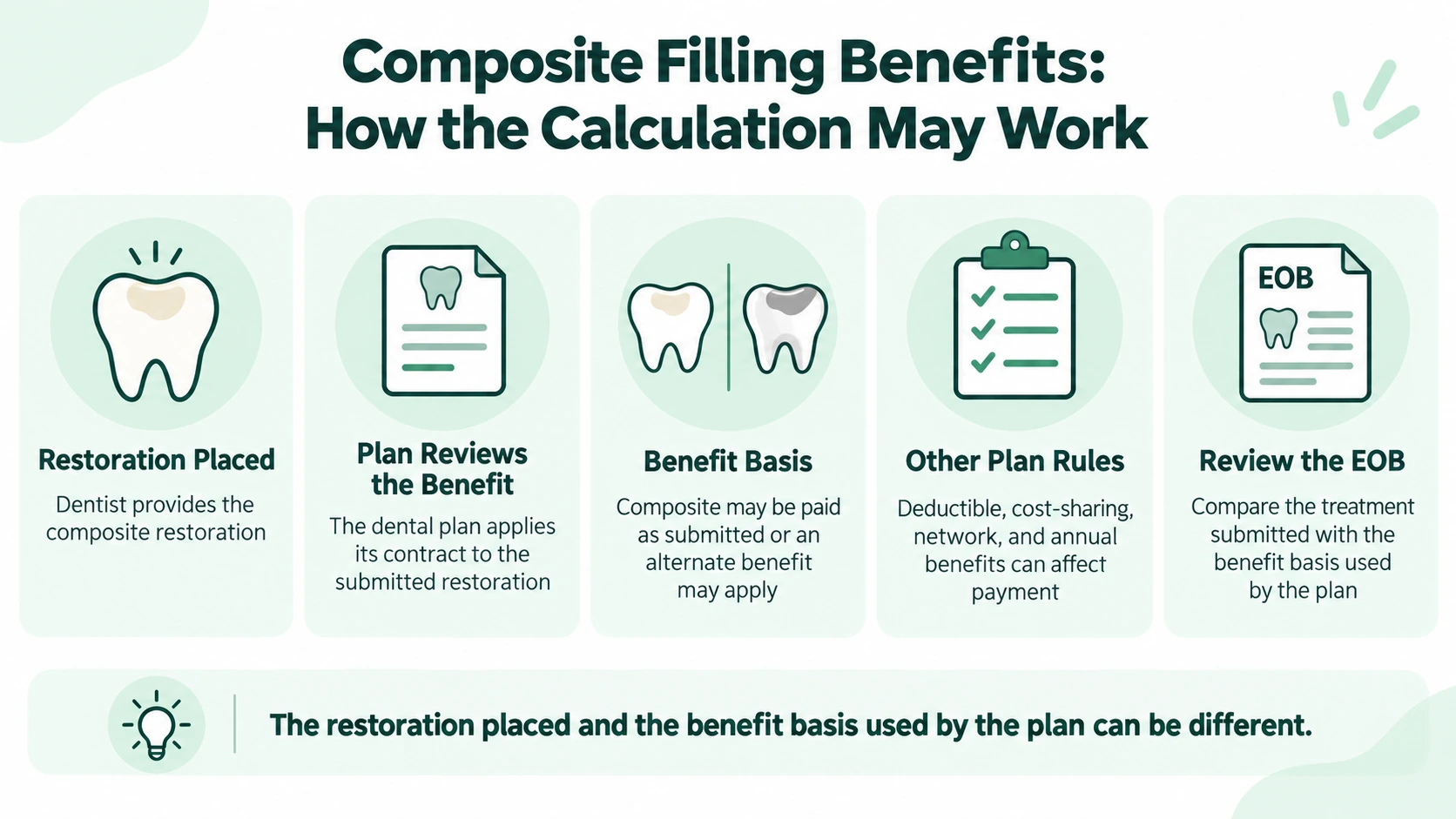
The restoration placed by the dentist and the benefit basis used by the dental plan can be different.
This article focuses on that insurance calculation. It does not compare composite and amalgam clinically or determine which material is appropriate for a particular tooth.
The treating dental professional determines the restorative treatment. The dental plan separately determines what financial benefit is available under the contract.
What You’ll Learn
This guide explains:
- How dental insurance may handle composite fillings
- What an alternate benefit means
- What LEAT means in dental insurance
- Why a composite filling can receive a benefit without being paid as submitted
- Why tooth location may matter
- Why an EOB may mention amalgam after composite was placed
- How other plan rules can affect the final amount
- What to verify before treatment
Quick Answer
Dental insurance may provide a benefit for a composite filling while calculating that benefit using an amalgam restoration or another contractual alternative.
This may occur under an alternate-benefit or least expensive alternative treatment provision.
Composite covered does not necessarily mean composite paid as submitted.
The plan may first determine the benefit basis and then apply other provisions such as:
- Deductible
- Copay or coinsurance
- Provider network
- Available annual benefits
- Other applicable limitations
The practical question is:
Will the plan calculate the benefit using the composite restoration itself, or will an alternate benefit apply?
Key Takeaways
- Composite fillings may receive dental benefits without necessarily being paid as submitted.
- Some plans may calculate certain composite benefits using an amalgam or other contractual alternative.
- An alternate benefit does not automatically mean the composite filling was completely denied.
- An amalgam reference on an EOB does not automatically mean amalgam was placed.
- Tooth location can matter under some plan provisions.
- Clinical material selection and insurance benefit calculation are separate decisions.
- Replacement eligibility and alternate-benefit calculation are separate insurance questions.
- Predetermination may help identify an expected alternate benefit before treatment without guaranteeing final payment.
In This Guide
Composite vs Amalgam Fillings: What Matters for Insurance?
Composite and amalgam are different restorative materials.
For this article, the important insurance question is not which material is clinically preferable.
It is:
How will the dental plan calculate the financial benefit for the restoration the dentist provides?
A dentist may recommend and place composite while the dental plan calculates its contribution using another covered restoration as the contractual benefit basis.
For the broader filling-coverage framework, read Does Dental Insurance Cover Fillings? What to Check Before Treatment.
Does Dental Insurance Cover Composite Fillings?
It may.
A plan may provide a benefit for a composite restoration, but that does not by itself establish how the financial benefit will be calculated.
Two questions should therefore be separated:
Is the composite restoration eligible for a benefit?
What benefit basis will the plan use when calculating payment?
Depending on the plan, the restoration may be calculated:
- As the composite restoration submitted
- Using an amalgam restoration as an alternate benefit
- Under another applicable plan provision
That is why a general statement that composite fillings are covered may not provide enough information to estimate patient responsibility.
What Is an Alternate Benefit?
An alternate benefit is a plan provision that bases the financial benefit on another covered treatment or procedure rather than on the treatment actually provided.
For example:
Composite restoration performed → plan uses an amalgam restoration as the contractual benefit basis
The treatment performed remains composite.
The alternative is being used to calculate the plan contribution.
An alternate benefit changes the financial calculation. It does not change what treatment the dentist actually performed.
What Does LEAT Mean?
LEAT stands for least expensive alternative treatment.
Under a LEAT-type provision, a plan may limit its financial contribution to the benefit available for a less expensive covered alternative when the contract allows that approach.
A composite-to-amalgam calculation can be one example.
However, plan language varies.
Do not assume every alternate-benefit provision uses the term LEAT or that every dental plan applies the same rules.
The most important information is the actual provision your plan applies to the specific restoration.
Can Tooth Location Affect Composite Filling Benefits?
It can under some dental plans.
Composite restorations on back teeth are one situation in which an amalgam alternate benefit may appear.
That does not mean:
- Every plan uses an amalgam alternative
- Every posterior composite receives the same calculation
- Composite restorations on back teeth are automatically excluded
Instead, ask how the plan handles the composite restoration planned for the specific tooth.
Tooth location can be relevant, but the actual dental plan provision controls the benefit calculation.
How Dental Insurance May Calculate the Benefit
A simple way to understand the process is to separate it into three stages.
| Stage | What happens | What to check |
|---|---|---|
| Restoration submitted | The dentist reports the restoration actually provided | What material and restoration were submitted |
| Benefit basis established | The plan applies its contract | Whether composite is calculated as submitted or an alternate benefit applies |
| Other plan rules applied | Additional provisions affect the final amount | Deductible, cost-sharing, network status, and available annual benefits |
An alternate benefit is therefore only one part of the final calculation.
The patient balance should not automatically be attributed entirely to the composite-to-amalgam difference.
Other plan rules may also contribute.
Why Your EOB May Mention Amalgam After a Composite Filling
A patient may receive a composite filling and later see amalgam referenced on the Explanation of Benefits.
That does not automatically mean:
- The dentist placed amalgam
- The dental office reported the wrong material
- The composite restoration received no benefit
The reference may indicate that the dental plan used an amalgam restoration as the contractual basis for calculating the benefit.
The EOB can describe the insurance calculation rather than the restorative material actually placed.
If the explanation is unclear, compare:
- The restoration reported by the dental office
- The procedure or allowance the plan used
- The explanation associated with the adjustment
- The resulting patient responsibility
For the complete document-reading framework, read How to Read a Dental Insurance EOB: Payments, Adjustments, and Patient Responsibility.
Alternate Benefit vs No Benefit
These results should not automatically be treated as the same thing.
Alternate Benefit
The plan recognizes the submitted treatment but calculates its financial contribution using another covered alternative.
A plan benefit may still be payable.
No Benefit
The plan provides no payment for the service under the provision it applied.
An alternate benefit can reduce the benefit basis without eliminating the dental benefit entirely.
Review the EOB before concluding that the composite restoration was denied.
Other Plan Rules Can Still Affect the Final Amount
An alternate benefit answers one specific question:
What basis is the plan using to calculate the benefit?
Other plan mechanisms answer different questions.
Deductible and Cost-Sharing
A deductible, copay, coinsurance, or another form of patient responsibility may still apply after the plan determines the applicable benefit basis.
Provider Network
Network status can affect allowed amounts and potential patient responsibility.
For the broader framework, read In-Network vs Out-of-Network Dental Insurance.
Annual Maximum
Available annual benefits can also affect how much the dental plan ultimately pays.
For the separate mechanism, read Dental Insurance Annual Maximums Explained.
An alternate benefit should therefore not be viewed in isolation from the other plan provisions affecting the claim.
Clinical Material Choice and Insurance Benefit Calculation Are Different Questions
The clinical decision about restorative material belongs to the treating dental professional and patient.
The insurance plan answers a separate financial question.
A plan using an amalgam alternate benefit does not automatically mean amalgam was clinically preferable for the tooth.
Likewise, a dentist choosing composite does not automatically require the plan to use composite as its contractual payment benchmark.
The distinction is:
Clinical question: Which restoration is appropriate for the tooth?
Insurance question: What financial benefit does the plan provide for the restoration selected?
Keeping those questions separate helps prevent an insurance calculation from being mistaken for a clinical recommendation.
What If an Existing Filling Is Being Replaced With Composite?
Replacing an existing restoration can create two different insurance questions.
First:
Is another restoration benefit currently available?
Second:
If composite is placed, how will the new restoration benefit be calculated?
Those are not the same issue.
A replacement provision may affect eligibility for another restoration.
An alternate-benefit provision may separately affect the payment basis for the new composite restoration.
Before treatment, determine:
- Why another restoration is being proposed
- Whether the plan considers it a replacement
- Whether another restoration benefit is available
- Whether an alternate benefit will apply to the new composite restoration
For the separate replacement framework, read Dental Insurance Replacement Rules Explained: What to Check Before Replacing Dental Work.
Can Advance Benefit Review Help?
It can be especially useful when an alternate benefit could materially change expected patient responsibility.
Depending on the plan, predetermination or preauthorization may help clarify:
- Whether the proposed composite restoration is an available benefit
- Whether an alternate benefit is expected
- What benefit basis the plan expects to use
- Applicable cost-sharing
- Other relevant plan provisions
Advance benefit information can help with planning, but it should not automatically be treated as guaranteed final payment.
For the complete pretreatment-review framework, read Dental Insurance Predetermination vs Preauthorization: What’s the Difference?
Where to Check Composite Filling Benefit Rules
Schedule of Benefits
Look for restorative benefits and any material-specific provisions.
Limitations and Exclusions
Review language addressing composite restorations, alternate treatments, or other applicable restrictions.
Alternate-Benefit or LEAT Language
Check whether the plan describes how benefits are calculated when another covered alternative exists.
Provider Network Information
Verify the dentist under your exact plan if you expect in-network benefits.
Predetermination or Preauthorization Information
Check whether advance benefit review is available or required.
How to Verify Benefits Before a Composite Filling
Step 1: Confirm the Restoration
Ask which restorative material the dentist plans to use.
Step 2: Confirm the Tooth Being Treated
Identify which tooth will receive the restoration because material-related provisions may depend on the treatment context.
Step 3: Ask How the Benefit Will Be Calculated
Determine whether the composite will be calculated as submitted or whether an alternate benefit may apply.
Step 4: Review the Applicable Plan Language
Look for alternate-benefit, LEAT, material-specific, or other relevant provisions.
Step 5: Check Replacement Eligibility When Relevant
If an existing filling is being replaced, verify whether another restoration benefit is currently available.
Step 6: Review Other Financial Provisions
Check provider network, deductible, cost-sharing, and available annual benefits.
Step 7: Ask About Advance Benefit Information
When the potential difference matters to your expected cost, determine whether the proposed restoration can be reviewed before treatment.
How to Interpret Common Composite Filling Benefit Language
| Plan language or result | What it may mean | What not to assume |
|---|---|---|
| Composite benefit available | The plan recognizes an applicable composite restoration benefit | Do not assume it will always be paid exactly as submitted |
| Alternate benefit applied | Another covered restoration or allowance was used as the benefit basis | Do not assume the composite restoration received no benefit |
| Amalgam allowance | Amalgam may have been used as the contractual payment benchmark | Do not assume amalgam was placed |
| LEAT provision | The plan may limit its contribution to a less expensive covered alternative | Do not treat the provision as a clinical recommendation |
| Replacement limitation | Eligibility for another restoration may depend on prior treatment history | Do not confuse replacement eligibility with alternate-benefit calculation |
| No benefit available | Another plan provision prevented payment | Do not automatically label the result an alternate benefit |
After Treatment: Review the EOB
If the claim is processed differently from what you expected, first identify what happened.
Check:
- What restoration the dentist submitted
- Whether the plan used another restoration as the benefit basis
- The plan allowance
- Deductible or other cost-sharing
- Plan payment
- Patient responsibility
- Any explanation associated with the adjustment
Do not assume an amalgam reference means the dental office placed or submitted an amalgam filling.
For detailed EOB interpretation, read How to Read a Dental Insurance EOB: Payments, Adjustments, and Patient Responsibility.
If the plan issues a final unfavorable decision after the reason has been identified, read Dental Insurance Claim Denied? How to Review the Decision and Appeal.
Common Composite vs Amalgam Coverage Mistakes
Assuming Composite Covered Means Composite Paid as Submitted
Coverage and benefit calculation are related but different questions.
Assuming Every Plan Uses an Amalgam Alternate Benefit
Plan provisions vary.
Assuming an Amalgam Reference Means Amalgam Was Placed
The EOB may be describing the insurance calculation.
Treating an Alternate Benefit as a Complete Denial
A dental benefit may still be payable using the contractual alternative.
Treating the Insurance Calculation as a Clinical Recommendation
The plan benefit does not determine which restorative material is clinically appropriate.
Ignoring Replacement Rules
When an existing restoration is being replaced, eligibility for another filling can be a separate issue.
Blaming the Entire Patient Balance on the Alternate Benefit
Deductible, cost-sharing, network, annual benefits, and other provisions can also affect responsibility.
Our Recommendation
Before a composite filling is placed, confirm:
- What restoration the dentist intends to provide
- Which tooth is being treated
- Whether the composite is an available benefit
- Whether an alternate benefit may apply
- What benefit basis the plan expects to use
- Whether replacement provisions apply
- What other cost-sharing or network rules may affect payment
- Whether advance benefit information would be useful
Composite covered does not necessarily mean composite paid as submitted.
An amalgam reference on an EOB may describe the financial benchmark used by the dental plan rather than the material placed in the tooth.
Understanding the difference between treatment performed and benefit basis makes the final insurance calculation much easier to interpret.
Helpful Resources
- Dental Insurance Coverage for Common Procedures
- Does Dental Insurance Cover Fillings? What to Check Before Treatment
- Dental Insurance Replacement Rules Explained: What to Check Before Replacing Dental Work
- Dental Insurance Annual Maximums Explained
- In-Network vs Out-of-Network Dental Insurance
- How to Read a Dental Insurance EOB: Payments, Adjustments, and Patient Responsibility
Frequently Asked Questions
Does Dental Insurance Cover Composite Fillings?
It may. However, coverage does not necessarily tell you how the benefit will be calculated. Ask whether the composite restoration will be calculated as submitted or whether an alternate benefit may apply.
Why Is My Insurance Paying an Amalgam Benefit for a Composite Filling?
The dental plan may be applying an alternate-benefit provision that uses an amalgam restoration as the contractual basis for calculating the benefit even though composite was placed.
What Is an Alternate Benefit for a Composite Filling?
An alternate benefit means the plan calculates its financial contribution using another covered restoration or treatment rather than using the submitted composite restoration as the benefit basis.
What Does LEAT Mean in Dental Insurance?
LEAT means least expensive alternative treatment. Under this type of provision, a dental plan may limit its contribution to the benefit available for a less expensive covered alternative when the contract allows it.
Is an Amalgam Alternate Benefit the Same as a Denial?
Not necessarily. The plan may still provide a benefit while calculating payment using the alternative restoration.
Does an Amalgam Reference on My EOB Mean Amalgam Was Placed?
No. It may describe the restoration or allowance used by the dental plan to calculate the benefit. Confirm the material actually placed with the dental office.
What If an Existing Filling Is Being Replaced With Composite?
Replacement eligibility and alternate-benefit calculation are separate questions. Verify whether another restoration benefit is available and how the new composite restoration will be calculated.
Can Predetermination Show Whether an Alternate Benefit Will Apply?
It can provide useful advance information about how the plan currently expects to evaluate the restoration, but it should not automatically be treated as guaranteed final payment.
Sources
- American Dental Association — Least Expensive Alternative Treatment Clause
- American Dental Association — Explanation of Benefits Statement
- American Dental Association — Materials for Direct Restorations
- American Dental Association — Pre-Authorizations
About the Author
Maria Dumitru is the founder and content editor of DentalCoverageHub. She creates consumer-focused educational content designed to help readers understand dental insurance benefits, limitations, and plan rules before making coverage decisions.
Learn more about our standards in the Editorial Policy and How We Review Dental Plans.
This article is for general educational purposes. Composite-filling benefits, alternate-benefit and LEAT provisions, plan allowances, replacement rules, provider-network provisions, cost-sharing, available annual benefits, and other coverage terms can vary by dental plan. Restorative treatment and material selection should be discussed with the treating dental professional.

Explore Dental Coverage for Common Procedures
Composite and amalgam fillings can create different insurance-calculation questions, especially when an alternate-benefit provision applies. Use our broader procedure coverage guide to understand what to verify when researching other types of dental treatment.