
Dental Insurance Exclusions and Limitations: What to Check Before Enrolling
Learn how dental insurance exclusions and limitations can restrict benefits—and what to verify in the official plan documents before you enroll.
Written and researched by Maria Dumitru.
Founder and Content Editor at Dental Coverage Hub
Last reviewed: August 2026
What You’ll Learn
This guide explains:
- What dental insurance exclusions are
- How limitations differ from exclusions
- Why little or no plan payment does not automatically mean a service is excluded
- Which common types of limitations to look for before enrolling
- How other plan requirements can affect a benefit without excluding the underlying service
- How existing dental circumstances may involve separate plan provisions
- Where to find exclusions and limitations in official plan documents
- What questions to ask before relying on a listed dental benefit
Quick Answer
A dental insurance exclusion generally means the plan does not provide a benefit for the service or circumstance described by the exclusion.
A limitation can allow the benefit to exist while restricting when, how often, or under what conditions it is available.
That means:
“Covered” does not always mean “available without restrictions.”
And:
“The plan paid $0” does not automatically mean the service was excluded.
Waiting periods, frequency limits, replacement limitations, eligibility rules, existing dental circumstances, provider requirements, or other plan provisions can affect a benefit for different reasons.
Before enrolling, identify both:
What benefits does the plan provide?
and:
What exclusions or limitations could restrict those benefits in the situations that matter to you?
Key Takeaways
- An exclusion and a limitation are not the same thing
- An excluded service or circumstance generally does not receive a benefit under the applicable plan terms
- A limited service may still be covered but subject to specific conditions
- A plan paying little or nothing does not automatically mean the underlying service is excluded
- Waiting periods, frequency limits, replacement limitations, and other provisions should be interpreted according to the rule that actually applies
- Existing dental circumstances may involve separate provisions rather than a general exclusion
- Cost-sharing, network, or pretreatment requirements can affect a benefit without necessarily excluding the service
- Official plan documents are more reliable than broad statements such as “major services covered”
In This Guide
What Are Dental Insurance Exclusions?
The American Dental Association Glossary of Dental Terms describes exclusions as dental services that are not covered under a dental benefit program.
In practical terms, an exclusion tells you that the plan does not provide a benefit for the service or circumstance described by that exclusion.
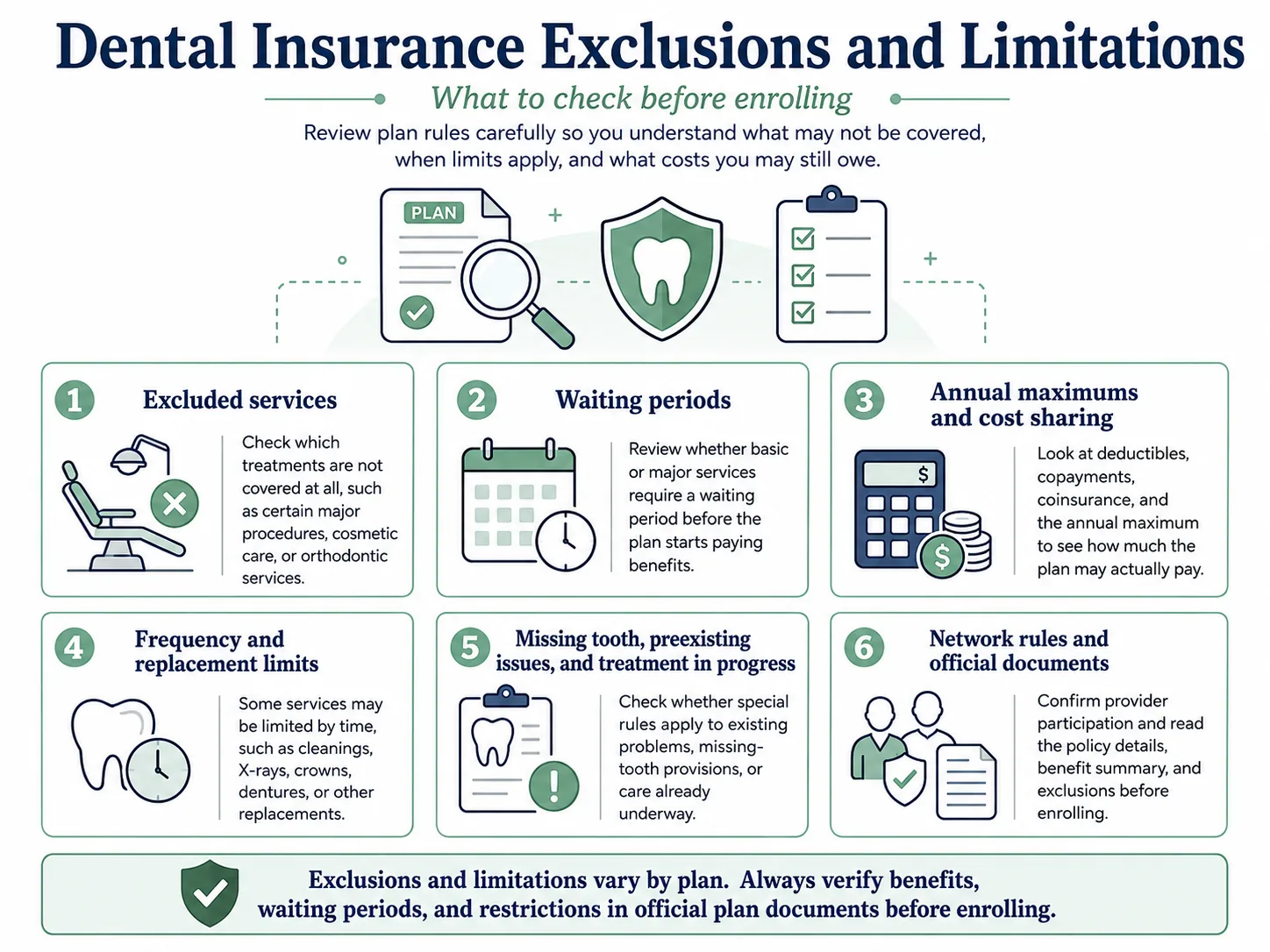
A dental plan might exclude or restrict benefits for situations involving:
- Certain services performed primarily for cosmetic purposes
- Specific procedures or categories of treatment
- Services that do not meet plan eligibility requirements
- Certain circumstances specifically identified in the contract
These are examples, not universal rules.
There is no single exclusion list that applies to every dental plan.
The American Dental Association’s guidance on typical dental plan benefits and limitations explains that dental benefit designs can differ in the procedures they cover and the restrictions they apply.
That is why statements such as “dental insurance never covers this” should be treated cautiously.
The specific plan controls.
What Are Dental Insurance Limitations?
A limitation restricts a benefit without necessarily removing the service from coverage completely.
A limitation may affect:
- When a benefit becomes available
- How often a service qualifies for another benefit
- When an existing restoration can qualify for replacement
- How much the plan will pay during a benefit period
- Whether the member meets an age or eligibility requirement
- Whether care that began before the effective date is eligible
For example, a service might be covered by the plan but unavailable during an applicable waiting period.
Or a restoration may be covered in general but not yet qualify for replacement under the plan’s replacement rules.
The important distinction is:
The service can still be part of the plan even when a limitation prevents a benefit in a particular situation.
Exclusion vs Limitation: Why the Difference Matters
Consider two different situations.
The Procedure Is Excluded
The plan specifically does not provide a benefit for the service under the applicable contract terms.
Even if:
- Your deductible has been satisfied
- Your annual benefit is still available
- You use an in-network provider
- You have been enrolled for a long time
the plan may still provide no benefit because the service itself is excluded.
The Procedure Is Covered but Limited
The plan recognizes the service, but another provision affects whether a benefit is available at that time.
For example:
- A waiting period has not ended
- The annual maximum has already been reached
- A frequency requirement has not been satisfied
- A replacement rule applies
- The member does not meet an eligibility requirement
The result may still be little or no plan payment.
But the reason is different.
“The plan paid nothing” and “the service is excluded” are not always equivalent statements.
That distinction is one of the most important things to understand when reading dental benefits.
Does “Plan Paid $0” Mean the Service Is Excluded?
Not necessarily.
A dental plan may make no payment because:
- The service is truly excluded
- A waiting period is still active
- The deductible has not yet been satisfied
- The annual maximum has been reached
- A frequency limitation applies
- A replacement condition has not been met
- Network requirements were not followed
- Eligibility requirements were not met
- Additional information is required before the claim can be processed
These situations can produce similar financial outcomes while having very different explanations.
The ADA’s guidance on Explanation of Benefits statements explains that plan payment, deductible, patient responsibility, covered services, and other claim information can appear separately on an EOB.
If an EOB shows no plan payment, review the explanation or claim remark before assuming the procedure itself is excluded.
How to Interpret Exclusions, Limitations, and Other Plan Rules
The wording used in a benefit summary or policy can tell you what type of rule requires further review.
| Wording you see | Type of rule | What it may mean | What to check next |
|---|---|---|---|
| Excluded / not covered | Exclusion | The plan may provide no benefit for the service | Exact exclusion language and any exceptions |
| Waiting period applies | Limitation | The benefit may exist but not yet be available | Effective date and eligibility date |
| Annual maximum reached | Benefit limitation | Additional plan payments may not be available during the current benefit period | Benefits already used and reset rules |
| Frequency limitation | Limitation | Another benefit may not yet be available | Prior treatment and required interval |
| Replacement limitation | Limitation | An existing restoration may not yet qualify for replacement | Placement date and replacement conditions |
| Age or eligibility requirement | Eligibility limitation | Benefit availability may depend on the member | Applicable eligibility criteria |
| Deductible applies | Cost-sharing rule | Part of an eligible cost may remain your responsibility | Deductible amount and status |
| Coinsurance or copay applies | Cost-sharing rule | You share part of the eligible cost | Plan cost-sharing terms |
| Alternate benefit applies | Benefit-calculation provision | The plan may calculate payment using another covered treatment | Which alternative treatment is being used |
| In-network benefit only | Network rule | Benefits may depend on provider participation | Exact dentist, specialist, location, and network |
| Referral required | Provider-access rule | Specialist benefits may depend on following the referral process | Referral requirements |
| Preauthorization required | Approval process | Prior plan approval may be required | What must be submitted and when |
| Predetermination available | Pre-treatment benefit estimate | The plan may estimate expected benefits before care | What the estimate includes and what can change |
| Treatment-in-progress provision | Eligibility provision | Care started before coverage may follow special rules | Effective date and plan definition of treatment start |
| Missing-tooth provision | Plan-specific eligibility provision | Tooth-replacement benefits may depend on when the tooth became missing | Tooth-loss date and plan language |
Do not interpret a single phrase in isolation.
Read it together with the rest of the plan documents.
Common Limitations to Check Before Enrolling
Several limitations appear frequently enough that they deserve specific attention when you compare plans.
The goal here is not to explain each one in depth. It is to understand why it is different from a true exclusion.
Waiting Periods
A waiting period generally delays when a benefit becomes available after coverage begins.
The service may still be included in the plan.
You simply may not yet be eligible for the benefit.
HealthCare.gov advises consumers comparing stand-alone dental plans to check for waiting periods because some plans delay benefits for certain adult services.
If timing is important, read How Waiting Periods Work in Dental Coverage.
Also review No Waiting Period Dental Insurance: What to Verify Before Enrolling before assuming that no waiting period means every treatment is immediately eligible.
Annual Maximums
An annual maximum limits how much the dental plan will pay toward benefits subject to that maximum during the applicable benefit period.
Reaching the annual maximum does not automatically convert every later procedure into an excluded service.
The service may remain covered even though no additional benefit is available under the annual maximum.
For more detail, read Dental Insurance Annual Maximums Explained.
Frequency Limitations
A frequency limitation is a type of dental plan limitation that can restrict how often a particular service receives a benefit.
The service itself may still be covered under the plan. The limitation affects whether another benefit is available based on the plan’s repeat-service rules.
That is different from an exclusion, where the plan does not provide a benefit for the service or circumstance described by the exclusion.
The key distinction is:
A frequency limitation restricts how often a benefit may be available. It does not necessarily exclude the underlying service.
For the detailed framework, read Dental Insurance Frequency Limits Explained: What to Check Before Treatment.
Replacement Limitations
A replacement limitation can affect whether existing dental work qualifies for another replacement benefit.
Unlike an exclusion, the limitation does not necessarily mean that the type of dental treatment is outside the plan.
Instead, the plan may consider the history of the existing restoration or prosthesis and apply its replacement provision before another benefit is available.
The key distinction is:
A replacement limitation affects when existing dental work may qualify for another benefit. It does not automatically mean the treatment category is excluded.
Do not rely on a universal replacement timetable.
For the detailed framework on initial placement, prior placement history, and current-plan replacement provisions, read Dental Insurance Replacement Rules Explained: What to Check Before Replacing Dental Work.
Cost-Sharing and Other Payment Rules Are Not the Same as Exclusions
Not every rule that increases your out-of-pocket cost should be described as an exclusion.
This distinction makes dental plan documents easier to interpret.
Deductibles, Copays, and Coinsurance
Deductibles, copays, and coinsurance can increase your out-of-pocket responsibility even when a dental service is eligible for a benefit.
These are cost-sharing rules, not exclusions of the underlying procedure.
That means:
A covered service can leave you with significant patient responsibility without being excluded from the dental plan.
When reviewing an unexpected cost, first determine whether the issue is an exclusion or simply the way the plan shares eligible costs with you.
For the detailed cost framework, read Dental Insurance Costs Explained.
Alternate-Benefit Provisions
An alternate-benefit provision can affect how a dental plan calculates its benefit without necessarily excluding the treatment selected by the dentist and patient.
Under this type of provision, the plan may base its benefit on another covered treatment option identified in the contract.
That creates an important distinction:
The treatment you receive may not be excluded, even when the plan calculates its contribution using a different covered treatment.
If an alternate-benefit provision applies, check:
- Which treatment the plan is using to calculate the benefit
- Whether you may be responsible for additional cost when choosing a different treatment
Do not interpret a lower plan payment by itself as evidence that the treatment was excluded.
Review the exact alternate-benefit language in the plan documents.
Existing Dental Circumstances That May Affect Benefits
Some dental plan limitations depend not only on the procedure being proposed, but also on dental circumstances that existed before the current coverage or treatment.
Examples may include:
- A natural tooth that was already missing
- Existing dental work that may need repair or replacement
- Dental treatment that was already recommended
- Treatment that began before the current coverage became effective
These situations do not all involve the same insurance rule.
A tooth that was already missing may involve a missing-tooth provision. Existing dental work that needs replacement may involve a replacement limitation. Treatment that has already begun may involve a treatment-in-progress provision.
The important distinction is:
An existing dental circumstance does not automatically tell you that treatment is covered or excluded. The relevant plan provision has to be identified first.
For the detailed frameworks, read Dental Insurance and Existing Dental Problems: What to Check Before Enrolling, Missing Tooth Clauses in Dental Insurance: What to Check Before Enrolling, and Dental Insurance Replacement Rules Explained: What to Check Before Replacing Dental Work.
If treatment has already begun, see Dental Insurance and Treatment Already in Progress.
Network, Referral, and Provider Requirements
A dental service can be covered under the plan while still being subject to network, provider, or referral requirements.
These requirements are not the same as an exclusion.
For example, a plan may provide a benefit for a particular service but apply different rules depending on which dentist or specialist provides the treatment or whether a required referral process is followed.
The key distinction is:
A provider or network requirement can affect how a covered service is accessed or paid without making the underlying service an excluded benefit.
When reviewing this type of limitation, check:
- Whether the dentist or specialist participates in the applicable network
- Whether the plan requires use of a particular provider type
- Whether a referral or other plan process applies before specialist care
- How the plan treats services received outside the applicable network
For the detailed network framework, read In-Network vs Out-of-Network Dental Insurance.
For the broader plan-type comparison, read PPO vs HMO Dental Plans: Key Differences, Costs, and How to Choose.
Predetermination, Preauthorization, and Documentation Requirements
A dental service can be covered under a plan while still being subject to pretreatment review or documentation requirements.
These requirements are not automatically exclusions.
A predetermination may provide information about how the plan currently expects to apply benefits to proposed treatment.
A preauthorization may involve a separate prior-approval requirement under the plan.
The plan may also request clinical or administrative documentation before determining whether a service satisfies its benefit rules.
The key distinction is:
A request for pretreatment review or documentation does not automatically mean the dental service is excluded.
Check the plan documents to determine:
- Whether pretreatment review is required or optional
- Which services are affected
- What documentation is requested
- Whether any approval or estimate has conditions or limitations
Do not automatically treat a predetermination, preauthorization, or other pretreatment response as a guarantee of final claim payment.
For the detailed framework, read Dental Insurance Predetermination vs Preauthorization: What’s the Difference?
Cosmetic and Other Specifically Excluded Services
Some dental plans may exclude services performed primarily for cosmetic purposes.
But the term cosmetic should not be interpreted as a universal category that every dental plan defines in the same way.
A plan may distinguish between:
- Treatment performed primarily to change appearance
- Restorative treatment with a functional purpose
- Specific materials
- Specific procedures or circumstances
The important distinction is:
A service should not be assumed to be excluded simply because it has a cosmetic component. The actual plan language determines how the benefit is treated.
Review the specific exclusion and any related definitions in the official plan documents.
Where to Find Dental Insurance Exclusions and Limitations
A short benefits summary may not show every rule that can affect dental benefits.
Before enrolling, review the official plan documents and look for the sections that describe:
- Covered services and benefit categories
- Exclusions and limitations
- Eligibility or timing requirements
- Frequency or replacement provisions
- Provider or network requirements
- Pretreatment-review or documentation requirements
- Definitions used by the plan
Depending on the type of coverage, relevant documents may include a certificate of coverage, policy, Evidence of Coverage, Summary Plan Description, schedule of benefits, or other official plan materials.
The goal is not to read every section as if every rule applies to you.
Instead, identify the provision that answers the specific question you have about the service or circumstance you are reviewing.
A useful question is:
Where in the official plan documents is this exclusion, limitation, or requirement explained?
General dental-benefit glossaries can help clarify terminology, but the wording in your own plan documents determines how the benefit applies.
Questions to Ask Before Enrolling
When reviewing dental insurance exclusions and limitations, focus on questions that clarify what can restrict a benefit—not on rebuilding the entire plan comparison.
Ask:
- Which dental services or circumstances are specifically excluded?
- Which covered services are subject to limitations?
- Are waiting periods, frequency limits, or replacement limitations relevant to services I may need?
- Does the plan contain any missing-tooth, treatment-in-progress, age, or eligibility provisions that may apply to my situation?
- Does the plan use alternate-benefit provisions that could affect how a benefit is calculated?
- Are any provider, referral, pretreatment-review, or documentation requirements tied to the benefit?
- Where in the official plan documents are these exclusions or limitations explained?
The most useful question is:
What rule could prevent or restrict a benefit for the specific dental service or circumstance I am reviewing?
For premiums, deductibles, networks, annual maximums, and the rest of the plan-comparison process, use the Dental Plan Comparison Checklist or Compare Dental Plans.
How Exclusions and Limitations Fit Into a Dental Plan Comparison
Exclusions and limitations are only one part of a dental plan comparison.
A plan may list a service as covered while still applying rules that affect when, how often, or under what conditions a benefit is available.
That is why exclusions and limitations should be reviewed separately from other plan features.
When comparing plans, first ask:
What dental benefits does the plan provide?
Then ask:
What exclusions or limitations could restrict those benefits in the situations that matter to me?
Do not assume that a plan with fewer obvious restrictions is automatically the better overall option.
Premiums, cost sharing, networks, annual maximums, and other plan features should be compared separately as part of the broader plan review.
For the complete comparison framework, use the Dental Plan Comparison Checklist or Compare Dental Plans.
Does Where You Get Dental Coverage Matter?
Yes, because the documents and enrollment context can differ depending on how you obtain dental coverage.
But the core exclusions-and-limitations questions remain similar.
Whether coverage is purchased individually, obtained through the Marketplace, or provided through an employer, check:
- Which services or circumstances are excluded
- Which benefits are subject to limitations
- Which timing, eligibility, or provider requirements may apply
- Where those rules appear in the official plan documents
For individually purchased or Marketplace coverage, review the policy, Evidence of Coverage, benefit schedule, and other official plan materials provided for the specific plan.
For employer-sponsored coverage, review the documents for the specific employer plan rather than relying on general information about the insurance company. When applicable, the Summary Plan Description can be an important source for understanding how the plan operates.
The key point is:
The source of coverage may change which documents you review, but it does not replace the need to read the exclusions and limitations for the actual plan you have or are considering.
How to Review Dental Insurance Exclusions and Limitations Before Enrolling
Use a two-stage review.
First, Ask What the Plan Covers
Identify the dental services or benefit categories that matter to you.
If you already expect a particular treatment, verify the specific procedure rather than relying only on broad descriptions such as basic care or major services.
For procedure-specific questions, use the Dental Procedure Coverage hub.
Then, Ask Under What Conditions the Benefit Is Available
Once you identify a benefit, check whether an exclusion or limitation could restrict it.
Depending on the service or circumstance, this may involve:
- A waiting period
- A frequency limitation
- A replacement limitation
- A missing-tooth or other existing-dental-circumstance provision
- An age or eligibility requirement
- A provider or referral requirement
- Another exclusion or limitation stated in the plan
Do not assume that every rule applies to every service.
The goal is to identify the provision that actually affects the benefit you are reviewing.
The key distinction is:
“Covered” tells you that a benefit exists. Exclusions and limitations tell you when or under what conditions that benefit may not be available.
For the broader framework behind dental plan benefits, costs, networks, and other features, continue with the Dental Plans Guide.
Helpful Resources
- Dental Plans Guide
- How Waiting Periods Work in Dental Coverage
- Dental Insurance Frequency Limits Explained: What to Check Before Treatment
- Dental Insurance Replacement Rules Explained: What to Check Before Replacing Dental Work
- Dental Insurance and Existing Dental Problems: What to Check Before Enrolling
- Dental Insurance Predetermination vs Preauthorization: What’s the Difference?
Frequently Asked Questions
What Are Dental Insurance Exclusions?
Dental insurance exclusions are services or circumstances for which the plan does not provide a benefit under the applicable contract terms.
The exact exclusions vary by dental plan.
What Is the Difference Between an Exclusion and a Limitation?
An exclusion generally means the plan does not provide a benefit for the service or circumstance described by the exclusion.
A limitation may allow the benefit to exist while restricting when, how often, or under what conditions it is available.
Does a Dental Plan Paying Nothing Mean the Service Is Excluded?
Not necessarily.
A plan may pay nothing because of an exclusion, but the result can also involve a waiting period, frequency or replacement limitation, eligibility rule, cost-sharing requirement, network rule, or another plan provision.
Review the EOB or plan explanation to identify the actual reason before assuming that the service itself is excluded.
Is a Waiting Period the Same as an Exclusion?
No.
A waiting period generally delays when a benefit may become available. The underlying service may still be part of the dental plan.
For the detailed framework, read How Waiting Periods Work in Dental Coverage.
Are Frequency and Replacement Rules Exclusions?
Not necessarily.
Frequency and replacement rules are generally limitations that can affect when another benefit becomes available.
A frequency limitation concerns repeat services, while a replacement limitation can affect existing dental work that is being replaced.
For the detailed frameworks, read Dental Insurance Frequency Limits Explained: What to Check Before Treatment and Dental Insurance Replacement Rules Explained: What to Check Before Replacing Dental Work.
Can Existing Dental Circumstances Affect Benefits Without Being a General Exclusion?
Yes.
A missing tooth, existing dental work, recommended treatment, or treatment already in progress may involve a separate plan provision rather than a broad exclusion of the dental service itself.
The relevant provision depends on the specific situation.
For the detailed framework, read Dental Insurance and Existing Dental Problems: What to Check Before Enrolling.
Where Should I Look for Exclusions and Limitations Before Enrolling?
Review the official plan documents rather than relying only on a short benefit summary.
Relevant sections may include covered services, exclusions and limitations, eligibility or timing requirements, replacement or frequency provisions, provider requirements, and definitions used by the plan.
The most useful question is:
Where in the official plan documents is the rule that affects the dental service or circumstance I am reviewing?
Sources
- American Dental Association — Glossary of Dental Terms
- American Dental Association — Typical Dental Plan Benefits and Limitations
- American Dental Association — Explanation of Benefits Statement
- American Dental Association — Pre-Authorizations
- ADA News — Dear ADA: Noncovered Services
- HealthCare.gov — Dental Coverage in the Marketplace
- U.S. Department of Labor — Plan Information
About the Author
Maria Dumitru is the Founder and Content Editor of Dental Coverage Hub. She researches and edits educational content designed to help U.S. consumers understand dental insurance terms, compare plan features, and verify important information before enrolling.
Learn more about our standards in the Editorial Policy and How We Review Dental Plans.
This article is for general educational purposes and does not provide dental, medical, insurance, financial, or legal advice. Dental benefits, exclusions, limitations, eligibility requirements, costs, provider-network rules, and other plan provisions vary by plan. Always review the official plan documents or contact the dental plan for information about your specific coverage. Questions about diagnosis, treatment, treatment timing, or clinical care should be discussed with a licensed dental professional.
Dental Coverage Hub is an independent educational publisher and is not an insurance company, broker, agent, dental provider, medical provider, or enrollment platform.

Understand the Dental Plan Before You Enroll
Exclusions and limitations are only one part of dental coverage. Use the Dental Plans Guide to understand how benefits, timing rules, costs, networks, and other plan provisions fit together before you compare your options.