
Dental Insurance for Young Adults: What to Check When Choosing Coverage on Your Own
Identify your available coverage options, compare the benefits that matter to you, and confirm the details before enrolling.
Written and researched by Maria Dumitru.
Founder and Content Editor at Dental Coverage Hub
Last reviewed: October 2026
Choosing dental insurance for young adults starts with understanding what coverage is already available and what you need from it.
Making the decision yourself does not automatically mean buying an individual policy. You may still have access to a parent’s plan, workplace benefits, school-sponsored coverage, or another eligible arrangement.
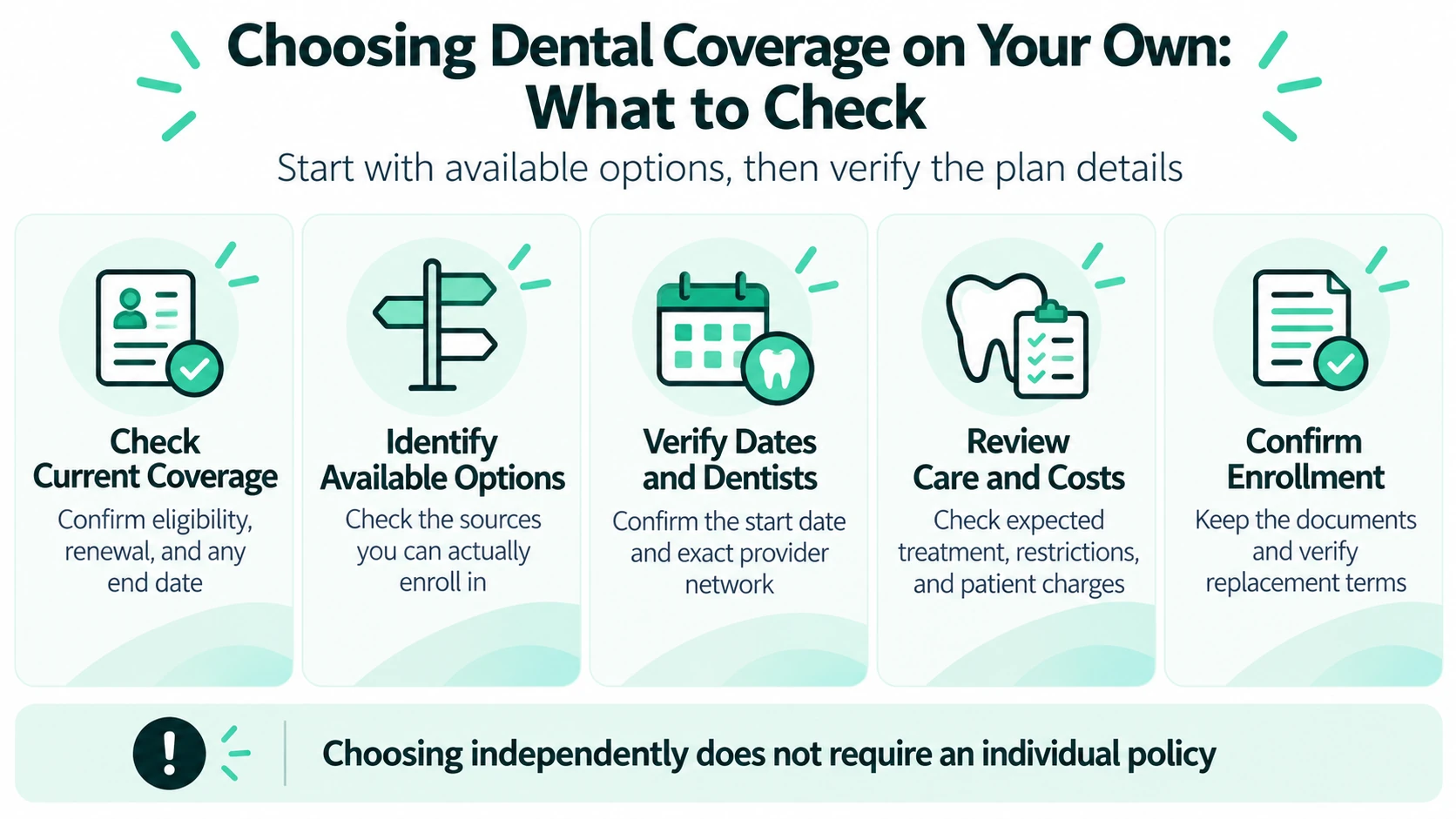
First confirm your current coverage and available enrollment options. Then compare the actual plans using your dentist, expected care, coverage dates, costs, and relevant restrictions.
This guide helps you organize that decision before relying on a new dental arrangement.
What You’ll Learn
- How to confirm coverage you may already have
- Which coverage sources to investigate
- What to compare beyond the premium
- How enrollment dates and service restrictions affect the decision
- What to check for recommended or unfinished treatment
- Which documents to keep when managing coverage yourself
Quick Answer
Start by confirming whether you already have active dental coverage and when it ends or renews. Identify the other arrangements you can enroll in, including eligible employer, dependent, school, individual, or public coverage.
Then compare the actual plans for effective date, dentist access, waiting periods, benefit limits, patient costs, and restrictions relevant to expected treatment.
Choosing coverage on your own means taking responsibility for the decision. It does not require a particular coverage source.
Before replacing an existing arrangement, confirm the new enrollment acceptance and effective date, along with any rules for ending the old coverage.
Key Takeaways
- Age alone does not determine which dental arrangement fits your needs
- Check existing benefits before purchasing another policy
- Coverage source and plan design are separate comparison questions
- An active policy does not make every service immediately eligible
- Known treatment deserves attention before enrollment
- Keep the official documents and review coverage when your circumstances change
In This Guide
Start With the Dental Coverage You Already Have
You may already receive dental benefits through a parent, employer, spouse or partner, school, individual policy, or public program.
Identify the exact arrangement and confirm:
- Whether you remain eligible
- Whether enrollment is active
- The current effective date
- Any upcoming termination or renewal date
- Whether an election, payment, or other action is required
Verify dental benefits separately from medical coverage.
An insurance card or an old enrollment confirmation may not reflect a later eligibility change. Ask the insurer or administrator if your current status is unclear.
Is the Existing Coverage Still Practical?
Coverage can remain active while becoming less useful after a move, job change, or change in dental needs.
Check whether you can reach participating dentists, obtain appointments, and access any specialist you already need.
If you are considering another policy while keeping existing coverage, ask both plans about coordination of benefits. Paying another premium does not automatically double benefits or eliminate patient costs.
Which Dental Coverage Sources Can You Check?
Use eligibility and enrollment availability to create a realistic shortlist.
| Possible source | First checks |
|---|---|
| Parent dental plan | Continued dependent eligibility, cost, and usable provider access |
| Own employer plan | Eligibility, enrollment opportunity, contribution, and effective date |
| Spouse or partner employer plan | Dependent eligibility, documentation, and required contribution |
| School-sponsored dental option | What is offered, enrollment requirements, and coverage period |
| Individual dental insurance | Availability, enrollment terms, provider access, and start date |
| Marketplace-related dental coverage | Applicable health enrollment and dental purchase rules |
| Medicaid | Program eligibility, dental benefits, and participating providers |
A source that is available to a friend or family member may not be available to you.
Parent or Other Dependent Coverage
Confirm the dental arrangement’s dependent rules directly. Do not use medical eligibility as the complete answer for a separate dental benefit.
If age-related parent eligibility is ending, read Dental Insurance When Turning 26: What to Check Before Parent Coverage Ends.
For coverage through a spouse or partner, check which dependents qualify, what documentation is needed, and when enrollment is allowed.
Employer Dental Coverage
Ask what dental benefits your employee classification can access and what you would personally pay.
An employer contribution can reduce your premium responsibility, but the available network and benefits still need review.
If part-time eligibility is the main issue, read Dental Insurance for Part-Time Workers: What to Check If Employer Benefits Are Limited or Unavailable.
If workplace and individually purchased plans are both available, read Employer Dental Insurance vs Individual Dental Insurance: What to Compare.
School-Sponsored Coverage
Determine whether the school offers dental insurance, limited dental benefits, or simply access to a clinic.
Check the coverage period and how enrollment changes affect eligibility.
For that comparison, read Dental Insurance for College Students: What Coverage Options Should You Check?
Individual Dental Insurance
An individual policy is one possible route when other arrangements are unavailable or unsuitable.
Confirm that the policy is available for your circumstances and location. Review its enrollment requirements, payment conditions, effective date, and benefit provisions.
Do not assume that a plan advertised for young adults has a distinct benefit structure or is suitable because of that label.
Marketplace-Related Dental Coverage
On HealthCare.gov, dental benefits may be included in a health plan or offered through a separate dental plan.
A separate federal Marketplace dental plan must be purchased together with a Marketplace health plan. Do not assume that you can purchase dental coverage alone through that route.
If Marketplace health enrollment is relevant, check the applicable enrollment rules and examine the dental benefits separately. Adult dental benefits are not automatically included in every health plan.
Medicaid
Check the applicable state program if you may qualify.
Eligibility and dental benefits are separate questions. Adult dental benefits vary by state, and younger eligible enrollees may have different benefit requirements.
Confirm the services available to your age group and whether participating dentists can provide the care you need.
Dental Insurance and Non-Insurance Options
A dental savings or discount plan is not dental insurance. It generally offers specified fees or discounts through participating providers rather than paying an insurance claim benefit.
Check membership charges, participating dentists, relevant procedure fees, activation terms, and cancellation rules.
Dental-office membership programs and reduced-fee clinics should also be evaluated according to their actual services and charges.
These options may help with access or costs, but a membership, clinic appointment, or discount does not establish insurance coverage.
If limited income affects your ability to obtain dental care, read Dental Coverage Options for Low-Income Adults: What to Check to review potential coverage sources and reduced-cost care resources alongside benefit and provider-access checks.
How to Compare Dental Insurance for Young Adults
Compare plans using the same person, expected care, and coverage period.
Begin with timing and provider access, then review benefits and estimated patient costs.
Confirm the Effective Date
Obtain the date on which coverage becomes active.
The application date, enrollment submission, and first payment do not automatically establish the effective date unless the plan confirms that they do.
If current coverage is ending, compare its final covered date with the new start date.
Read Dental Insurance Effective Date: When Does Coverage Start?
Verify the Exact Dentist and Network
Confirm the individual dentist, office location, plan, and network.
An office accepting insurance information or submitting claims does not necessarily participate in the plan’s network.
If you do not have a dentist, check whether available offices accept new patients and have practical appointment times.
Also review specialist access and out-of-network provisions when relevant.
Read In-Network vs Out-of-Network Dental Insurance guide.
Check Waiting Periods
An active policy may still have a waiting period for particular services.
Ask whether a waiting period applies to care you expect. If prior coverage could qualify for a waiver or credit, confirm the conditions and required proof.
Read How Waiting Periods Work in Dental Coverage.
Review Benefit Limits and Patient Costs
Check the premium, deductible, copays or coinsurance, benefit limits, and relevant exclusions.
An annual maximum generally limits the plan’s payment under its terms. It should not be treated as a cap on everything you might owe.
Read Dental Insurance Annual Maximums Explained.
A benefit percentage alone does not establish your bill. Ask which fee or allowance the plan uses and what patient charges may remain.
For the broader payment framework, read Dental Insurance Costs Explained.
Check Frequency, Replacement, and Other Restrictions
Coverage for a category of care does not establish eligibility for every procedure.
Ask about restrictions relevant to your treatment, including previous services or appliances.
If a tooth was missing before enrollment and replacement is planned, check whether a missing-tooth provision applies.
Read Missing Tooth Clauses in Dental Insurance.
Compare Expected Costs Without Guessing Future Treatment
Use information you already have rather than inventing a treatment forecast.
Consider routine care you expect to use and procedures your dentist has recommended. Compare the premium commitment and estimated patient charges under each available arrangement.
| Comparison question | What to record |
|---|---|
| What must I pay to maintain coverage? | Premium or required contribution for the same period |
| Which providers can I use? | Confirmed dentist and specialist access |
| When can relevant benefits apply? | Effective date and service-specific timing |
| What care is eligible? | Relevant procedure rules and exclusions |
| What costs may remain? | Available estimates and unresolved payment questions |
| How can coverage change? | Renewal, termination, and enrollment conditions |
If an important benefit or estimated charge cannot be confirmed, record it as unconfirmed. Do not treat an unclear answer as a guaranteed payment.
For the full comparison process, read How to Compare Dental Plans Online.
What If You Already Have Dental Treatment Planned or in Progress?
Recommended care and unfinished treatment require different questions.
Treatment Has Been Recommended but Has Not Started
Identify the procedure and proposed timing. Ask the prospective plan about eligibility, waiting periods, provider participation, and applicable restrictions.
A general statement that crowns, root canals, or orthodontics are covered does not answer every question about your proposed service.
Ask the dental office for a treatment plan and procedure information when available.
Treatment Is Already Underway
Document completed procedures, remaining stages, and relevant dates.
Ask each plan which procedure date or treatment stage it recognizes and how treatment-in-progress provisions apply.
Do not assume the old plan covers everything because treatment began there, or that the new plan takes over the entire course of care.
Read Dental Insurance and Treatment Already in Progress: What to Check When Coverage Changes.
An Advance Review Already Exists
A predetermination or preauthorization from another arrangement does not establish benefits under the new plan.
Ask which process applies and whether a new submission is required. If authorization is required for a service, confirm it before proceeding.
Keep the responses with your treatment records. Discuss clinical timing with your dental professional.
Before You Enroll or Replace Coverage
Complete a final review:
- Confirm that you are eligible and enrollment is permitted
- Obtain the effective date
- Verify the required payment and payment schedule
- Confirm your dentist and relevant specialists
- Review restrictions affecting known treatment
- Check any cancellation or renewal conditions
- Confirm how current coverage can end, if replacement is intended
Do not assume every employer election or policy can be changed immediately.
Keep current coverage documents, enrollment confirmation, important written responses, and the plan’s contact information.
Managing coverage yourself also means monitoring renewal notices and reporting relevant eligibility changes.
How to Interpret Your Options
| Your situation | Priority |
|---|---|
| Current coverage remains available and usable | Compare it before purchasing another arrangement |
| Several coverage sources are available | Compare the actual plans using the same needs |
| A low premium is the main attraction | Check access, restrictions, and expected patient costs |
| Important treatment is expected soon | Confirm procedure-specific eligibility and timing |
| Current coverage is ending | Verify termination and replacement dates |
| A move or work change is likely | Review geographic access and continued eligibility |
Age does not answer these questions. The useful comparison connects the plan’s terms with your current circumstances.
Common Mistakes to Avoid
- Buying a policy before confirming existing benefits
- Assuming a young-adult label establishes suitable coverage
- Comparing only the premium
- Treating eligibility, enrollment, and effective date as the same event
- Checking the insurer’s name instead of the exact network
- Assuming every covered service is immediately payable
- Ignoring recommended or unfinished treatment
- Ending current coverage before verifying replacement terms
Our Recommendation
Start with existing benefits and the other arrangements you can actually enroll in.
Then compare timing, dentist access, relevant services, and expected costs. Give known treatment particular attention, and keep the documents supporting important answers.
If a specific event is driving the change, use its dedicated guide. The broader decision remains the same: choose from the actual options available, based on how their terms fit your needs.
Helpful Resources
- Dental Insurance by Life Stage and Work Situation
- Dental Insurance When Turning 26: What to Check Before Parent Coverage Ends
- Dental Insurance for College Students: What Coverage Options Should You Check?
- Dental Insurance for Part-Time Workers: What to Check If Employer Benefits Are Limited or Unavailable
- How to Compare Dental Plans Online
- Dental Plan Comparison Checklist
Frequently Asked Questions
Do Young Adults Need a Special Dental Insurance Plan?
No particular plan type is required because you are a young adult. Compare available arrangements using eligibility, providers, expected care, timing, and costs.
Does Choosing Coverage Myself Mean Buying an Individual Policy?
No. You can make your own decision while using eligible employer, dependent, school, or public coverage. An individual policy is one possible source.
Should I Keep Parent Dental Coverage or Choose Another Plan?
Confirm that parent coverage remains available, then compare its costs, access, and benefits with your alternatives. If dependent eligibility is ending, review the actual termination date first.
Is Employer Dental Coverage Always the Most Suitable Option?
No. An employer contribution can help with premiums, but the exact network, benefits, and restrictions still matter. Compare the available plans.
Can I Buy Only Dental Insurance Through HealthCare.gov?
A separate dental plan on HealthCare.gov must be purchased together with a Marketplace health plan. Individually purchased dental insurance outside that route may offer another option.
Does Active Coverage Mean Treatment Is Immediately Covered?
Not necessarily. Waiting periods, exclusions, frequency limits, and other provisions may affect a service after the policy becomes active.
What If Treatment Has Already Started?
Ask the old and prospective plans how they evaluate the relevant procedure dates, remaining stages, and treatment-in-progress provisions. Do not assume benefits transfer.
What Documents Should I Keep When Enrolling?
Keep the policy or applicable coverage documents, benefit schedule, enrollment confirmation, payment information, and important written responses about providers or treatment.
Sources
- HealthCare.gov: Dental Coverage in the Marketplace
- Medicaid.gov: Dental Care
- American Dental Association: Types of Dental Plans
- American Dental Association: Typical Dental Plan Benefits and Limitations
- American Dental Association: Pre-Authorizations
About the Author
Maria Dumitru is the founder and content editor of DentalCoverageHub. She creates consumer-focused educational content designed to help readers understand dental insurance benefits, limitations, and plan rules before making coverage decisions.
Learn more about our standards in the Editorial Policy and How We Review Dental Plans.
This article provides general educational information about dental coverage in the United States. It does not provide medical, legal, or individualized insurance advice. Eligibility, enrollment rules, coverage dates, benefits, networks, and costs vary by arrangement and circumstances. Confirm details with the insurer, benefits administrator, employer, school, Marketplace, or relevant program. Discuss treatment decisions with your dental professional. Dental Coverage Hub does not sell insurance or determine eligibility or claim payments.

Choose Your Coverage With the Details in Front of You
Confirm your available options, compare the actual benefits, and verify the enrollment terms before relying on coverage.