Dental Insurance and Treatment Already in Progress: What to Check When Coverage Changes
Dental insurance and treatment already in progress can raise important coverage questions. Learn what to verify about procedure dates, eligibility, unfinished care, and plan rules.
Written and researched by Maria Dumitru.
Founder and Content Editor at Dental Coverage Hub
Last reviewed: August 2026
Changing dental insurance while dental treatment is already underway creates a different question from simply enrolling with an existing dental problem.
The central issue is:
How should unfinished dental treatment be evaluated when one coverage period ends and another begins?
Do not assume that the old dental plan remains responsible simply because treatment started while that coverage was active.
And do not assume that the new plan automatically takes over because treatment continues after its effective date.
Start by identifying:
- What treatment actually began
- What has already been completed
- What remains unfinished
- When the old coverage ends
- When the new coverage becomes effective
- Which procedure date or treatment stage each applicable plan uses
- What treatment-in-progress or related provisions apply
Multi-stage dental care can make this especially important because clinically related treatment may involve separate procedures with different dates and benefit determinations.
The reliable approach is:
Establish the treatment timeline first. Apply the relevant plan provisions second. Evaluate payment only after eligibility has been clarified.
What You’ll Learn
This guide explains:
- What treatment already in progress means for dental insurance
- Why treatment that was only recommended is a different situation
- Why the relevant procedure date or treatment stage can matter when coverage changes
- Why unfinished treatment should not automatically be assigned to the old or new dental plan
- What to verify before old coverage ends and when new coverage begins
- How multi-stage dental treatment can cross a coverage change
- What can happen to an earlier predetermination or preauthorization
- Why orthodontic treatment may require a separate treatment-in-progress review
- What to ask your old plan, new plan, and dental office
- How to separate confirmed facts from information that is still uncertain
Quick Answer
If dental treatment has already started and your insurance is changing, do not assume that either the old plan or the new plan will automatically pay for the unfinished treatment.
Start with four questions:
- What treatment has already happened?
- What treatment remains unfinished?
- Which procedure date or treatment stage does each applicable plan use?
- What treatment-in-progress or related provision applies to each unfinished procedure?
Then compare those facts with:
- The old coverage end date
- The new coverage effective date
- The eligibility rules under each applicable plan
The key principle is:
Treatment history + coverage dates + the relevant procedure date + actual plan language determine the treatment-in-progress analysis.
Only after eligibility has been clarified should you evaluate waiting periods, exclusions or limitations, provider requirements, available benefits, and cost-sharing.
An earlier predetermination or preauthorization should not automatically be treated as a guarantee that unfinished treatment will receive the same benefit after coverage changes.
Key Takeaways
- Treatment that was recommended but never started is different from treatment already in progress
- Neither the old plan nor the new plan should automatically be assumed responsible for unfinished treatment
- Multi-stage dental care can involve different procedures, treatment stages, and relevant dates
- There is no single procedure date that should be assumed to control every type of dental treatment
- The old coverage end date and new coverage effective date are important, but neither date alone resolves the treatment-in-progress question
- Clinically related procedures can still have separate insurance dates and benefit determinations
- An earlier predetermination or preauthorization does not automatically transfer to new coverage or guarantee final payment
- Orthodontic treatment may involve separate treatment-in-progress or takeover provisions
- If old and new coverage overlap, coordination of benefits is a separate question
- Establish eligibility before using annual benefits, cost-sharing, or other payment rules to estimate what a plan may pay
- When an important fact cannot be verified, mark it as not confirmed rather than assuming the more favorable result
In This Guide
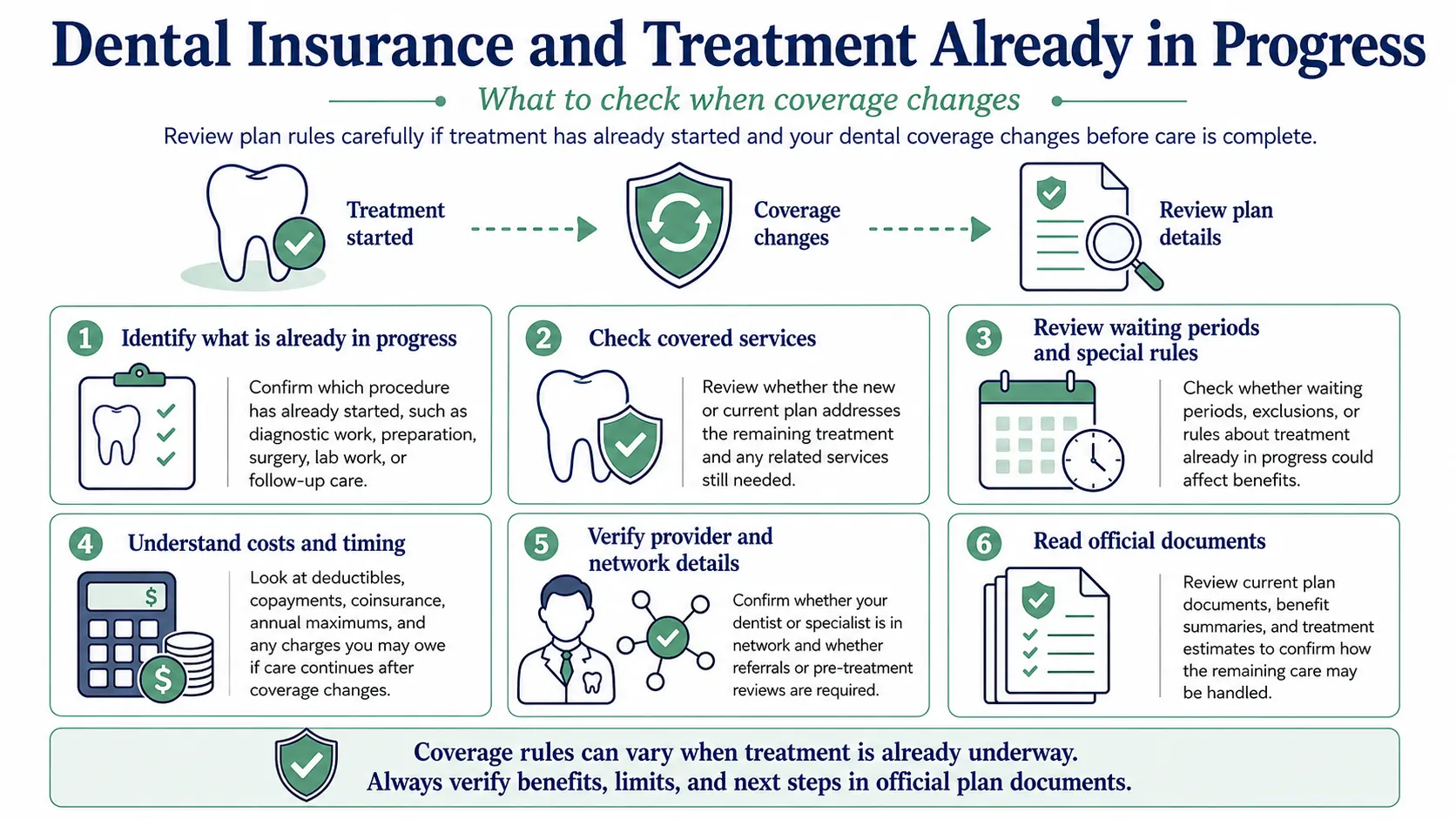
What to Check When Treatment Is Already in Progress
When dental treatment has already started and coverage changes, review what has been completed, what remains, which plan rules apply, and which provider and benefit details still need to be confirmed.
What Does Treatment Already in Progress Mean?
For purposes of this guide, treatment already in progress means that dental care has actually begun before the coverage change and some part of the planned treatment remains unfinished.
This is different from simply knowing that dental treatment is needed.
The distinction matters because a plan may evaluate:
- Treatment that was only recommended
- Treatment that had already started
- A completed procedure
- A separate procedure that has not yet begun
differently.
Do not assume that an entire treatment plan becomes one insurance event simply because the procedures are clinically related.
Recommended Treatment vs Treatment Already Started
Before reviewing the insurance change, identify which situation applies.
Treatment Recommended but Not Started
Treatment that has been recommended but has not actually begun is different from treatment already in progress.
A dentist may have identified a problem or recommended a crown, root canal, bridge, denture, implant, extraction, orthodontic treatment, or another procedure before new coverage begins.
That situation can raise pre-enrollment benefit questions, but it is not automatically a treatment-in-progress situation.
The key distinction is:
Recommended treatment = the need for care is already known. Treatment in progress = some part of the dental care has actually begun.
If treatment has only been recommended, identify which plan provision may apply to the existing dental circumstance rather than assuming that treatment-in-progress rules control.
For the broader pre-enrollment framework, read Dental Insurance and Existing Dental Problems: What to Check Before Enrolling.
Treatment Already Started
Treatment-in-progress questions arise when some part of the care has already occurred before the coverage change.
Examples can include:
- A tooth has already been prepared for a crown
- Bridge or denture treatment is underway
- Endodontic treatment has begun but is not complete
- One stage of implant treatment has been performed
- Orthodontic treatment is already active
Once treatment has actually begun, an additional insurance question appears:
Which plan provisions apply to the unfinished treatment after coverage changes?
Dental Insurance and Treatment Already in Progress: Key Coverage Questions
When dental treatment has already started and coverage changes before the treatment is completed, several separate questions may need to be answered.
Start with:
- What treatment has actually begun?
- Which parts of the treatment were completed before the coverage change?
- Which parts remain unfinished?
- When did the previous dental coverage end?
- When did the new dental coverage become effective?
- Which date or treatment stage does the applicable plan use when evaluating the procedure?
- Does either plan contain treatment-in-progress or related language that applies to the situation?
Do not assume that the date of the final appointment alone determines which dental plan applies.
Likewise, do not assume that treatment starting under one plan automatically makes that plan responsible for every later stage, or that new coverage automatically assumes responsibility for unfinished treatment.
The key principle is:
Treatment history, coverage dates, the relevant procedure date, and the actual plan language must be reviewed together.
If the treatment had only been recommended but had not actually started before the coverage change, use the broader framework in Dental Insurance and Existing Dental Problems: What to Check Before Enrolling.
For the separate question of when new coverage itself begins, read Dental Insurance Effective Date: When Does Coverage Start?
Why the Relevant Procedure Date Matters
When dental treatment takes place over more than one appointment, the date treatment first began may not be the only date that matters for insurance purposes.
A dental plan may use a particular procedure date or treatment stage when determining eligibility or benefits.
Depending on the procedure and the plan, potentially relevant dates can include:
- Preparation date
- Procedure start date
- Final impression date
- Completion date
- Placement or insertion date
- Delivery date
- Another date defined by the plan
There is no single date that should be assumed to control every type of dental treatment.
That becomes especially important when:
- One dental plan ends while treatment is underway
- A new dental plan becomes effective before treatment is completed
- Different stages of the same course of care occur under different coverage
- Several separately reported dental procedures are part of the same overall treatment plan
For example, a patient may think of a root canal followed by a crown as one course of treatment.
For benefit purposes, however, the root canal and the final restoration may be evaluated as separate procedures with different relevant dates.
The same principle can apply to other multi-stage dental care.
The key question for each unfinished procedure is:
What date or treatment stage does this specific dental plan use when determining eligibility and benefits for this procedure?
Do not assume:
“Treatment started under the old plan, so the old plan must pay.”
And do not assume:
“Treatment finishes after the new plan begins, so the new plan must pay.”
Instead, identify the procedure, establish its treatment timeline, and verify the date rule used by each applicable plan.
How to Interpret Treatment in Progress When Coverage Changes
| Your situation | Do not automatically assume | What to verify |
|---|---|---|
| Treatment was recommended but nothing started | Treatment is already in progress | Whether treatment actually began, the new plan effective date, and the rules that apply to the proposed procedure |
| A crown or other multi-stage procedure has begun | Either plan automatically pays based only on the first or last appointment | The procedure date or treatment stage recognized by each plan and any treatment-in-progress provisions |
| Root canal treatment has started | The root canal and any later restoration automatically belong to the same plan | The completion status and the benefit treatment of the root canal and restoration as separate procedures |
| Bridge or denture treatment is underway | Every stage automatically belongs to one dental plan | Which stages have been completed, which remain unfinished, and the date recognized by each applicable plan |
| Implant treatment has begun | The entire implant case is automatically treated as one insurance event | Completed and remaining surgical and restorative procedures separately, along with the dates and provisions that apply to each |
| Orthodontic treatment is active | The new plan automatically continues the benefit provided under the previous coverage | Any treatment-in-progress or takeover provisions, prior payments, current eligibility, and any remaining benefit calculation |
| An earlier predetermination exists | The earlier response guarantees payment after coverage changes | Current eligibility, current benefits, procedure timing, and the plan that will process the applicable claim |
| New coverage provides a new benefit period or annual maximum | Unfinished treatment automatically becomes payable under the new coverage | Eligibility for the unfinished procedure first, then any applicable benefit limits and other plan provisions |
The central principle is:
Do not assign the entire course of treatment automatically to the old plan or the new plan. Identify the individual procedures or treatment stages and verify the provisions that apply under each coverage period.
If a key date, treatment stage, or plan provision cannot be verified, record it as not confirmed rather than filling the gap with an assumption.
The purpose of this review is not to predict which plan will pay. It is to identify the facts and plan language needed to determine how unfinished treatment should be evaluated.
What Happens to an Earlier Predetermination or Preauthorization?
An earlier predetermination or preauthorization should not automatically be treated as a guarantee that unfinished treatment will receive the same benefit after dental coverage changes.
A pretreatment response generally reflects the information and coverage circumstances considered when that response was issued.
If coverage changes before treatment is completed, verify:
- Which dental plan issued the earlier response
- Which procedure or treatment stage the response addressed
- Whether that procedure has already been completed
- Which plan will evaluate the unfinished procedure
- Whether current eligibility and benefits have changed
- Whether the new plan requires its own pretreatment review
The key distinction is:
An earlier pretreatment response and current benefit eligibility are separate questions.
Do not assume that a predetermination or preauthorization issued under previous coverage automatically transfers to a new dental plan.
Likewise, do not assume that an earlier response determines which plan is responsible for treatment that remains unfinished.
First identify the procedure and relevant treatment date. Then verify the applicable coverage and current plan requirements.
For the full distinction between these pretreatment-review processes, read Dental Insurance Predetermination vs Preauthorization: What’s the Difference?
What to Check Before Your Old Coverage Ends
If you know that your dental coverage is going to change while treatment is underway, document the treatment status before the old coverage terminates.
Confirm the Last Day of Eligibility
Confirm the last date on which the existing dental coverage remains active.
Do not assume that the last day of employment, the date a new plan is selected, or another administrative date is automatically the final day of dental eligibility.
Record the date confirmed by the plan or employer benefits administrator.
The key question is:
When does the old dental coverage actually end?
That date should then be compared with the relevant procedure dates for treatment that is already underway.
If your employer-sponsored dental coverage is ending because you lost your job, you may also need to compare continuation and replacement coverage options. See Dental Insurance After Losing a Job: COBRA and Other Coverage Options for what to check when employment-based dental coverage ends.
If you have dental coverage through a parent and are approaching age 26, confirm whether dependent eligibility is ending and obtain the actual termination date before comparing it with your treatment timeline. Read Dental Insurance When Turning 26: What to Check Before Parent Coverage Ends for the eligibility and replacement coverage checks to complete.
If divorce may end dental coverage through a spouse while treatment is underway, confirm the final covered date before comparing it with the relevant procedure dates. Read Dental Insurance After Divorce: What Happens to Your Coverage? for the spouse eligibility, continuation, and replacement coverage checks to complete.
Identify What Has Been Completed
Create a clear treatment timeline before the old coverage ends.
Separate:
- Procedures already completed
- Treatment stages already completed
- Procedures that have started but remain unfinished
- Treatment that has only been planned or recommended
Do not treat the entire course of care as one insurance event simply because the procedures are clinically related.
The key question is:
What dental work is actually complete, and what remains unfinished when the old coverage ends?
Identify What Has Already Been Submitted to Insurance
Confirm which completed procedures or treatment stages have already been submitted to the old dental plan.
Also identify anything that has been completed but not yet submitted.
This helps separate:
- Treatment already completed and submitted
- Treatment completed but not yet submitted
- Treatment that remains unfinished
Submission status does not by itself determine which plan should provide a benefit, but it can help clarify where each procedure stands when coverage changes.
For the full claims process, read How Dental Insurance Claims Work: From Treatment to Your EOB.
Confirm the Procedure Date Used by the Old Plan
For treatment that spans multiple appointments, confirm which procedure date or treatment stage the old dental plan uses when evaluating the benefit.
Do not assume that the first appointment, final appointment, preparation date, completion date, or delivery date automatically controls every procedure.
Ask:
What date does this plan recognize for benefit purposes for this specific procedure?
Record the answer together with the treatment timeline and the last day of eligibility.
This is especially important when the recognized procedure date may fall close to the end of the old coverage.
Check Available Benefits Separately From Eligibility
First determine whether the old dental plan still considers the procedure eligible under its terms.
Then evaluate how much benefit, if any, remains available.
These are separate questions.
For example, remaining annual benefits may matter only after the procedure is determined to be eligible under the old coverage.
The key distinction is:
Eligibility asks whether the procedure can receive a benefit. Available benefits help determine how much the plan may still pay.
Do not assume that unused annual benefits make unfinished treatment eligible.
Likewise, do not assume that an eligible procedure will necessarily receive the full expected benefit.
Keep Copies of Important Information
Before the old coverage ends, keep copies of information that may help document the treatment timeline and the plan’s position.
Useful records can include:
- Relevant treatment dates
- Treatment plans
- Claim submissions
- EOBs
- Predetermination or preauthorization responses
- Written benefit information
- Relevant correspondence with the dental plan
- Records showing which procedures or treatment stages were completed
The goal is not to collect every document available.
Focus on records that help establish:
What treatment occurred, when it occurred, what was submitted, and how the old plan evaluated it.
Keep these records even after the coverage change, especially when unfinished treatment may later need to be evaluated under a new plan.
What to Check When Your New Coverage Begins
A new dental plan operates under its own contract.
Do not assume that rules, estimates, provider participation, or treatment decisions from the previous plan automatically carry over.
Confirm the Effective Date
Confirm the date on which the new dental coverage actually becomes effective.
Do not substitute the application date, enrollment date, plan-selection date, or another administrative date unless the plan identifies it as the coverage effective date.
Then compare that effective date with the treatment timeline.
Ask:
Which procedures or treatment stages occurred before the new coverage began, and which occur after it became effective?
The effective date establishes when the new coverage begins.
It does not by itself determine whether unfinished treatment will receive a benefit under the new plan.
The new plan may still need to evaluate the relevant procedure date, treatment-in-progress provisions, eligibility requirements, and other applicable plan terms.
The key distinction is:
Effective date tells you when the new coverage starts. Treatment-in-progress analysis determines how unfinished treatment is evaluated after that coverage change.
For the full coverage-start framework, read Dental Insurance Effective Date: When Does Coverage Start?
Ask Specifically About Treatment Already Underway
Do not ask only whether the new dental plan covers the type of treatment you are receiving.
Ask specifically how the plan treats care that began before the new coverage became effective.
Provide enough information to identify:
- The procedure or course of treatment
- What had already been completed before the effective date
- What remains unfinished
- The relevant treatment dates
The key question is:
How does this plan evaluate the unfinished portion of treatment that began before my coverage became effective?
A general statement that a procedure is “covered” does not answer the treatment-in-progress question.
Check Waiting Periods Only for the Remaining Procedures
If the new plan has waiting periods, determine whether they apply to any unfinished procedure that may otherwise be eligible under the new coverage.
Do not use the waiting period to answer the treatment-in-progress question itself.
These are separate issues:
Treatment-in-progress rules help determine how unfinished care is evaluated after a coverage change. Waiting periods determine when an otherwise applicable benefit may become available under the new plan.
Evaluate treatment-in-progress eligibility first, then check any waiting period that applies to the remaining procedure.
For the full timing framework, read How Waiting Periods Work in Dental Coverage.
Review Exclusions and Limitations
Even if unfinished treatment can be evaluated under the new coverage, other plan provisions may still restrict the benefit.
Review only the exclusions or limitations relevant to the remaining procedure or circumstance.
Do not assume that treatment-in-progress eligibility overrides other plan terms.
The key distinction is:
Determining which coverage may evaluate unfinished treatment does not eliminate exclusions or limitations that otherwise apply to the procedure.
For the broader restriction framework, read Dental Insurance Exclusions and Limitations: What to Check Before Enrolling.
Verify the Provider Again
A dentist who participated in the old dental plan’s network may not have the same status under the new plan.
If treatment will continue with the same dentist or specialist, verify the provider’s status under the new coverage rather than assuming that prior network participation carries over.
The key question is:
How will the new plan treat the remaining procedure if it is completed by this provider?
Provider status and treatment-in-progress eligibility are separate questions.
For the full network framework, read In-Network vs Out-of-Network Dental Insurance.
Review Costs Only After Eligibility Is Established
First determine whether the unfinished procedure may receive a benefit under the new coverage.
Then evaluate how the applicable benefit would be calculated.
Depending on the plan, that later review may involve deductibles, copays, coinsurance, annual benefit limits, network status, or other payment provisions.
The key distinction is:
Eligibility asks whether a benefit may apply. Cost-sharing and benefit limits help determine what the plan may pay after eligibility is established.
Do not use an available annual maximum or favorable cost-sharing percentage as evidence that unfinished treatment is eligible.
For the broader cost framework, read Dental Insurance Costs Explained.
How Multi-Stage Dental Procedures Can Cross a Coverage Change
Multi-stage dental treatment can create additional insurance questions when coverage changes before all treatment stages are completed.
The important point is not to assume that the entire course of care has one universal insurance date.
Depending on the procedure and the dental plan, different stages may have different relevant dates or may be evaluated separately.
For each unfinished procedure, ask:
What has already been completed, what remains unfinished, and what date or treatment stage does each applicable plan recognize for benefit purposes?
The examples below illustrate the questions to verify. They are not universal rules for assigning a procedure to the old or new dental plan.
Crowns
Crown treatment can involve more than one appointment or treatment stage.
If coverage changes while the crown is underway, identify:
- When preparation occurred
- Whether impressions or digital records were completed
- Whether the final crown has been completed or delivered
- Which procedure date the old and new plans recognize for benefit purposes
Do not assume that the preparation date or delivery date automatically controls under every dental plan.
The key question is:
Which date or treatment stage does each applicable plan use when evaluating this crown?
Bridges
Fixed bridge treatment can also extend across multiple appointments.
When coverage changes before the bridge is completed, separate the treatment timeline into the stages that occurred before and after the change.
Verify:
- What work was completed under the old coverage
- What remains unfinished
- Which date or stage each plan recognizes for the bridge
- Whether either plan contains treatment-in-progress provisions relevant to the case
Do not assume that every stage automatically belongs to the plan that covered the first appointment.
Likewise, do not assume that final delivery under new coverage automatically makes the new plan responsible for the entire treatment.
Dentures
Denture treatment may involve impressions, records, fabrication steps, adjustments, and final delivery over multiple appointments.
If coverage changes during that process, identify which stages were completed before the change and which remain unfinished.
Then verify the date or treatment stage each applicable dental plan uses when evaluating the denture benefit.
The key point is:
Do not use the first appointment or final delivery date as a universal rule without checking the plan language.
The treatment timeline and the applicable benefit provisions should be reviewed together.
Root Canal Treatment and the Final Restoration
A root canal and the restoration that follows it may be part of the same clinical course of care, but they should not automatically be treated as one insurance procedure.
If coverage changes during treatment, identify separately:
- Whether the root canal has been completed
- Whether a final restoration has begun
- The relevant date for each procedure
- Which dental plan evaluates each procedure
The key distinction is:
Clinically related procedures can still have separate insurance dates and separate benefit determinations.
Do not assume that the plan responsible for the root canal automatically determines the benefit for the final restoration.
Implant Treatment
Implant treatment can involve multiple surgical and restorative procedures over an extended period.
When coverage changes during that process, do not treat the entire implant case automatically as one insurance event.
Identify separately:
- Which procedures have already been completed
- Which procedures remain unfinished
- The relevant date for each procedure
- Which coverage was active for those dates
- Which plan provisions apply to each remaining stage
The key principle is:
Evaluate completed and remaining implant procedures separately rather than assuming that the entire treatment belongs automatically to one dental plan.
The clinical treatment plan may connect the stages, but the dental plan may evaluate individual procedures separately for benefit purposes.
If the treatment plan includes several procedures that need to be reviewed together, read Does Dental Insurance Cover Major Dental Work? What to Check When Several Procedures Are Needed to see how individual services, providers, timing, and plan rules may interact across one treatment plan.
Changing Coverage During Orthodontic Treatment
Orthodontic treatment can continue across many months, which makes a change in dental coverage different from a single completed procedure.
If orthodontic treatment is already active when new coverage begins, do not assume that the new dental plan automatically continues the benefit available under the previous coverage.
Verify:
- Whether the new plan provides orthodontic benefits
- Whether active treatment that began before the effective date can qualify
- Whether the plan has a treatment-in-progress, takeover, or similar provision
- What treatment start date the plan uses
- Whether benefits already paid under prior coverage are considered
- How any remaining benefit is determined
- What documentation the new plan requires
The key distinction is:
Having orthodontic coverage under a new plan does not automatically mean that ongoing orthodontic treatment will receive the same benefit as treatment started under that plan.
Likewise, do not assume that a remaining balance from the orthodontist equals the amount the new dental plan may pay.
The new plan’s own eligibility rules, treatment-in-progress provisions, prior-payment treatment, and benefit terms must be reviewed.
If a pretreatment estimate or authorization was issued under the previous coverage, do not assume that it transfers automatically to the new plan.
If Old and New Coverage Temporarily Overlap
In some situations, the old dental coverage and the new dental coverage may both be active during part of the same period.
That creates two separate insurance questions.
First:
Which plan’s rules apply to each procedure or unfinished treatment stage?
Then, if both plans may provide benefits for the same eligible procedure:
How do the two plans coordinate benefits?
Do not assume that overlapping coverage means:
- Both plans will automatically pay
- Each plan will pay the same amount
- The new plan automatically becomes secondary
- The entire unfinished treatment can be submitted to both plans in the same way
Treatment-in-progress rules and coordination of benefits address different issues.
The key distinction is:
Treatment-in-progress analysis helps determine how unfinished treatment is evaluated when coverage changes. Coordination of benefits determines how benefits may interact when more than one plan applies to the same eligible claim.
First identify the relevant procedure, treatment date, and applicable coverage.
Then, if two plans are active and both may apply, review the coordination rules separately.
For the full dual-coverage framework, read Can You Have Two Dental Insurance Plans? Coordination of Benefits Explained.
What to Ask Your Old Dental Plan
When treatment is already underway and your existing dental coverage is ending, ask the old dental plan questions that clarify how it will evaluate the procedures already started or completed.
Ask:
- What is my final day of dental eligibility?
- Which procedures or treatment stages have already been processed under this plan?
- Which submitted claims are still pending?
- What procedure date does the plan use for each unfinished multi-stage procedure?
- Does the plan have a treatment-in-progress or related provision that may apply?
- Can a procedure completed after coverage ends still be evaluated under any applicable plan provision?
- What information or documentation is needed for treatment that began before coverage ended?
- Does an earlier predetermination or preauthorization remain relevant after eligibility ends?
- Where in the official plan documents are the applicable rules explained?
The most useful question is:
How will this plan evaluate each procedure that began before my coverage ended but was not yet complete on my final day of eligibility?
Record the answer for each procedure separately.
Do not rely only on a general statement such as “treatment started while you were covered.” The relevant procedure date and the plan’s actual treatment-in-progress provisions may still matter.
What to Ask Your New Dental Plan
When new dental coverage begins while treatment is already underway, ask questions that clarify how the new plan evaluates the unfinished procedures.
Ask:
- What is the effective date of my new dental coverage?
- How does this plan treat dental treatment that began before the effective date?
- Does the plan have a treatment-in-progress, takeover, or related provision that may apply?
- What procedure date or treatment stage does the plan use for each unfinished procedure?
- Which parts of the treatment, if any, may be evaluated under the new coverage?
- Does the plan require documentation showing when treatment began and what has already been completed?
- Does any waiting period apply to a remaining procedure that is otherwise eligible?
- Does the provider need to meet specific network or referral requirements under the new plan?
- Does the plan require a new predetermination, preauthorization, or other pretreatment review?
- Where in the official plan documents are the applicable rules explained?
The most useful question is:
How will this plan evaluate each unfinished procedure that began before my new coverage became effective?
Do not rely only on a general statement that the procedure is “covered.”
The proposed treatment can be generally covered while treatment that began before the effective date is still subject to separate eligibility or treatment-in-progress provisions.
First establish whether the unfinished procedure may qualify under the new coverage.
Then review waiting periods, provider requirements, costs, and other benefit rules separately.
What to Ask Your Dental Office
Your dental office can help document the treatment timeline and clarify what has already been completed.
Ask:
- What procedures have already been completed?
- Which procedures or treatment stages remain unfinished?
- What dates are recorded for each completed or planned stage?
- Which procedures have already been submitted to the old dental plan?
- Are any claims still pending?
- Was a predetermination or preauthorization submitted under the old coverage?
- What treatment records, radiographs, narratives, or other documentation are available if either plan requests them?
- For multi-stage treatment, how is each procedure documented in the clinical and billing records?
The most useful request is:
Please help me create a clear timeline showing what treatment was completed, when it occurred, what was submitted to insurance, and what remains unfinished.
The dental office can provide clinical and billing information, but it should not be treated as the final authority on how a dental plan will apply its coverage provisions.
The dental plan determines how its own contract applies.
Use the dental office to establish the treatment facts, then verify the insurance rules directly with the applicable plan.
How to Interpret the Information You Found
When dental insurance and treatment already in progress overlap with a coverage change, begin with the treatment timeline rather than assuming either plan will automatically pay.
After speaking with the dental office and both dental plans, separate what has been confirmed from what remains uncertain.
Do not try to answer the entire coverage question with one statement such as:
“The treatment started under my old insurance.”
or:
“My new plan covers this procedure.”
Instead, review each unfinished procedure separately.
For example:
- Treatment started under the old plan does not mean the old plan automatically pays for every remaining stage
- The procedure will be completed after the new plan begins does not mean the new plan automatically pays
- A procedure is listed as covered does not establish that treatment started before the effective date is eligible
- An old predetermination exists does not guarantee final payment after eligibility changes
- The dentist was in network before does not establish participation in the new plan’s network
- The new plan has an annual maximum available does not establish that unfinished treatment qualifies
- A waiting period has ended does not remove another treatment-in-progress or procedure-specific limitation
- Several procedures belong to one clinical treatment plan does not mean they must be processed as one insurance event
- Two plans temporarily overlap does not mean both automatically pay toward the same procedure
A practical review should answer four questions.
1. What Has Already Happened?
Start with facts that can be documented.
Identify:
- Which procedures have already been completed
- Which treatment stages have already occurred
- The dates associated with those procedures or stages
- Which claims have already been submitted
- Which claims, if any, have already been processed
- Which dental coverage was active at the relevant times
Do not begin by deciding which plan “should” pay.
First establish the treatment history.
The key question is:
What treatment actually occurred before the coverage change, and when did it occur?
If an important fact cannot be verified, record it as not confirmed rather than filling the gap with an assumption.
2. What Treatment Remains?
Next, identify what is still unfinished.
Separate:
- Procedures that have not yet started
- Procedures that started but are not complete
- Remaining stages of multi-stage treatment
- Separate procedures that are clinically related but have not yet been performed
Do not treat an entire course of dental care as one insurance event simply because the procedures are connected clinically.
The key question is:
Which specific procedures or treatment stages still need to occur after the coverage change?
This distinction is especially important when treatment involves crowns, bridges, dentures, implants, root canal treatment followed by a restoration, or orthodontic care.
3. Which Plan Rule Applies to Each Procedure?
Once the completed and unfinished treatment has been separated, evaluate each relevant procedure under the plan language that applies to it.
Verify:
- The relevant procedure date or treatment stage
- Which coverage was active for that date
- Whether a treatment-in-progress or related provision applies
- Whether the procedure is otherwise eligible under that coverage
- Whether another plan rule must then be evaluated separately
Do not assign the entire treatment automatically to the old plan or the new plan.
The key question is:
Which plan provision applies to this specific procedure, based on its treatment history and relevant date?
First determine eligibility under the applicable plan.
Then evaluate waiting periods, exclusions or limitations, provider requirements, available benefits, and cost-sharing only as separate follow-up questions when relevant.
4. What Is Still Not Confirmed?
After reviewing the treatment timeline and the applicable plan provisions, identify any important detail that still cannot be verified.
Examples may include:
- An uncertain treatment or procedure date
- An unclear coverage end or effective date
- A treatment stage that cannot be confirmed from the available records
- An unanswered question about which procedure date a plan uses
- Unclear treatment-in-progress language
- Missing information about a prior claim or pretreatment response
Mark unresolved information as Not confirmed rather than choosing the interpretation that appears more favorable.
Then identify who can provide the missing information:
- Dental office → treatment dates, stages, records, and claim-submission history
- Old dental plan → prior eligibility, claim status, and applicable plan provisions
- New dental plan → current eligibility and treatment-in-progress rules
- Employer benefits administrator, when applicable → coverage start or end information
The key principle is:
Separate what is documented from what is assumed.
A reliable treatment-in-progress review should show clearly:
what happened → what remains → which rule applies → what is still not confirmed
Do not predict which dental plan will pay until the relevant facts and plan provisions have been established.
Helpful Resources
- Dental Plans Guide
- Dental Insurance Effective Date: When Does Coverage Start?
- Dental Insurance and Existing Dental Problems: What to Check Before Enrolling
- Dental Insurance Predetermination vs Preauthorization: What’s the Difference?
- How Waiting Periods Work in Dental Coverage
- Can You Have Two Dental Insurance Plans? Coordination of Benefits Explained
- How Dental Insurance Claims Work: From Treatment to Your EOB
Frequently Asked Questions
What Does Treatment Already in Progress Mean for Dental Insurance?
Treatment already in progress generally refers to dental care that has actually begun but has not been completed when coverage changes.
Treatment that has only been recommended or planned is a different situation.
The key distinction is:
Recommended treatment = the need for care is known. Treatment in progress = some part of the dental care has actually begun.
For the broader pre-enrollment framework when treatment has not started, read Dental Insurance and Existing Dental Problems: What to Check Before Enrolling.
Which Dental Plan Pays If Treatment Started Under One Plan and Finishes Under Another?
Do not assume that either plan automatically pays simply because treatment started or finished while that coverage was active.
The answer may depend on:
The specific procedure
The treatment stages already completed
The relevant procedure date
When the old coverage ended
When the new coverage became effective
Treatment-in-progress or related provisions in the applicable plans
Review each unfinished procedure separately rather than assigning the entire course of treatment automatically to the old or new plan.
Does the First Treatment Date Determine Which Dental Plan Applies?
Not necessarily.
Multi-stage treatment can involve several relevant dates or treatment stages.
Depending on the procedure and the dental plan, preparation, completion, insertion, delivery, or another date may be relevant for benefit purposes.
Do not assume that the first or last appointment controls every procedure.
The most useful question is:
What date or treatment stage does this specific dental plan use when evaluating this procedure?
Can Different Parts of the Same Dental Treatment Be Evaluated Separately?
Yes, they may be.
Clinically related treatment can involve separate dental procedures with different dates and separate benefit determinations.
For example, a root canal and a later final restoration may be part of the same clinical course of care but should not automatically be treated as one insurance procedure.
The same principle can matter with other multi-stage treatment.
Does an Earlier Predetermination or Preauthorization Still Apply After Coverage Changes?
Do not assume that it does.
An earlier pretreatment response reflects the coverage circumstances and information considered when it was issued.
If coverage changes before treatment is completed, verify current eligibility, the unfinished procedure, the relevant treatment date, and whether the applicable plan requires a new review.
For the full pretreatment-review framework, read Dental Insurance Predetermination vs Preauthorization: What’s the Difference?
What Happens If Orthodontic Treatment Is Already Underway When Coverage Changes?
Do not assume that a new dental plan automatically continues the orthodontic benefit available under previous coverage.
Verify whether the new plan covers active orthodontic treatment, whether treatment-in-progress or takeover provisions apply, how prior payments are treated, and how any remaining benefit is determined.
The plan’s actual orthodontic and treatment-in-progress provisions control.
What Should I Verify When Dental Coverage Changes During Ongoing Treatment?
Start with four questions:
What treatment has already happened?
What treatment remains unfinished?
Which plan provision applies to each procedure?
What important information is still not confirmed?
Then verify the relevant treatment dates, old and new coverage dates, treatment-in-progress provisions, and any other rules that apply to the individual procedure.
The central principle is:
Establish the treatment facts first. Apply the plan rules second. Evaluate payment only after eligibility has been clarified.
Sources
- American Dental Association — ADA Dental Claim Form and Completion Instructions
- American Dental Association — Eligibility Verification
- American Dental Association — Pre-Authorizations
- American Dental Association — Typical Dental Plan Benefits and Limitations
- American Dental Association — Dental Plans: Coordination of Benefits
About the Author
Maria Dumitru is the Founder and Content Editor of Dental Coverage Hub. She researches and edits educational content designed to help U.S. consumers understand dental insurance terms, coverage transitions, benefit limitations, and the information they may need to verify when dental treatment and insurance timing overlap.
Learn more about our standards in the Editorial Policy and How We Review Dental Plans.
This article is for general educational purposes only. Treatment-in-progress provisions, eligibility rules, procedure-date requirements, pretreatment-review rules, and other dental benefit terms can vary by plan. Review the official documents for the applicable coverage and contact the dental plan for information about how its provisions apply to specific unfinished treatment.

Understand the Plan Rules When Treatment Is Already Underway
When dental coverage changes during unfinished treatment, start with the treatment timeline rather than assuming that either the old plan or the new plan will pay. Identify what has already happened, what remains unfinished, which procedure dates matter, and what the applicable plan provisions say before relying on a benefit.