
Dental Insurance for Bridges: What to Check Before Treatment

Learn how dental insurance may apply to bridges, including bridge components, missing-tooth provisions, waiting periods, replacement rules, alternate benefits, and related dental services.
Written and researched by Maria Dumitru.
Founder and Content Editor at Dental Coverage Hub
Last reviewed: September 2026
What You’ll Learn
Dental insurance may provide benefits for a dental bridge, but seeing “bridges covered” in a plan summary does not explain how a specific bridge treatment will be evaluated.
A bridge can involve several components and related procedures, and the plan may evaluate those items separately.
Important details may include:
- The tooth or teeth being replaced
- The type of bridge being proposed
- The pontic or pontics
- The teeth or implants supporting the bridge
- Supporting crowns or retainers
- Related dental procedures
- Whether the tooth was already missing when coverage began
- Any applicable waiting period
- Replacement or frequency limitations
- Alternate-benefit provisions
- The dentist’s provider-network status
- The annual benefit remaining
This guide focuses specifically on dental bridge benefits and the plan provisions that can affect the proposed treatment.
For a broader explanation of insurance coverage for common dental procedures, review Dental Insurance Coverage for Common Procedures.
Quick Answer
Dental insurance may provide benefits for a dental bridge, but the exact benefit depends on the plan and treatment being proposed.
A bridge can contain several components, and the plan may evaluate items such as the replacement tooth, supporting restorations, and related procedures separately.
The available benefit can also be affected by:
- A deductible
- Copay or coinsurance
- The plan allowance
- Provider-network rules
- A waiting period
- The annual maximum
- A missing-tooth provision
- Replacement or frequency limitations
- Alternate-benefit provisions
- Other procedure-specific exclusions or requirements
If the tooth was already missing when coverage began, review the plan carefully for any missing-tooth, prior-missing-tooth, pre-existing-condition, or similar provision that may affect replacement benefits.
A waiting period and a missing-tooth provision are not the same rule.
And:
“Bridge covered” does not necessarily mean every component or related service is paid in full.
Key Takeaways
- Dental insurance may provide benefits for bridges, but the exact rules vary by plan
- A dental bridge may involve several separately identified procedures or components
- A pontic replaces a missing tooth, while abutment teeth or implants support the fixed prosthesis
- Supporting crowns, retainers, and related dental services should not automatically be assumed to receive the same benefit as the pontic
- A missing-tooth provision and a waiting period are different coverage issues
- A tooth that was already missing when coverage began may be affected by a plan-specific limitation
- Tooth-supported and implant-supported bridge treatment can involve different benefits
- Alternate-benefit provisions can affect how a plan calculates its contribution
- Replacement bridges can be subject to frequency, replacement, or documentation requirements
- Provider-network status, deductible, cost sharing, and remaining annual benefits can affect patient responsibility
- Advance benefit information may help clarify expected benefits but does not necessarily guarantee final payment
- Insurance benefit rules do not determine which tooth-replacement treatment is clinically appropriate
In This Guide
Does Dental Insurance Cover Bridges?
Dental insurance may provide benefits for a dental bridge when the proposed treatment is eligible under the specific plan.
There is no universal bridge benefit that applies to every dental plan.
Instead of relying only on a statement that bridges or major services are covered, confirm:
- The exact bridge being proposed
- The tooth or teeth being replaced
- Which teeth or implants will support the bridge
- Which components appear separately on the treatment estimate
- Whether the missing tooth is eligible for replacement
- Whether a waiting period applies
- The deductible and cost sharing
- Provider-network status
- The annual benefit remaining
- Replacement or frequency limitations
- Any alternate-benefit provision
- Other procedure-specific exclusions or requirements
Two plans can both list bridges as covered while applying different rules to the same proposed treatment.
The detailed plan documents are therefore more useful than the general word covered.
How Dental Plans May Classify Bridge Treatment
Dental bridges may appear within a major restorative, prosthodontic, fixed-prosthetic, or other plan-defined benefit category.
The exact terminology varies.
Plan documents may use terms such as:
- Bridge
- Fixed partial denture
- Pontic
- Abutment
- Abutment crown
- Retainer
- Prosthodontics
- Major restorative services
Do not assume that the category name establishes:
- A particular coverage percentage
- A standard deductible
- A particular patient cost
- The same waiting period
- Eligibility for a tooth already missing before enrollment
- Coverage for every bridge component
- The same benefit under every dental plan
The exact procedure and plan provision are more useful than relying only on a broad category such as major dental work.
What Is a Dental Bridge?
A dental bridge is a fixed prosthetic treatment used to replace one or more missing teeth.
For insurance purposes, the important point is that a bridge treatment may contain several components rather than one single procedure labeled simply as a bridge.
Depending on the bridge design, treatment may involve:
- One or more artificial replacement teeth
- Natural teeth or implants used for support
- Crowns or other retainers
- Temporary restorations
- Additional dental procedures needed before or during treatment
Different bridge designs can also involve different procedures.
That means the most useful coverage question is:
Which components and related services appear on the treatment plan, and how will the dental plan evaluate each one?
How a Dental Bridge Works
A dental bridge replaces a missing tooth using support from nearby teeth. This infographic shows the main treatment steps, from preparing the support teeth to placing the final bridge.
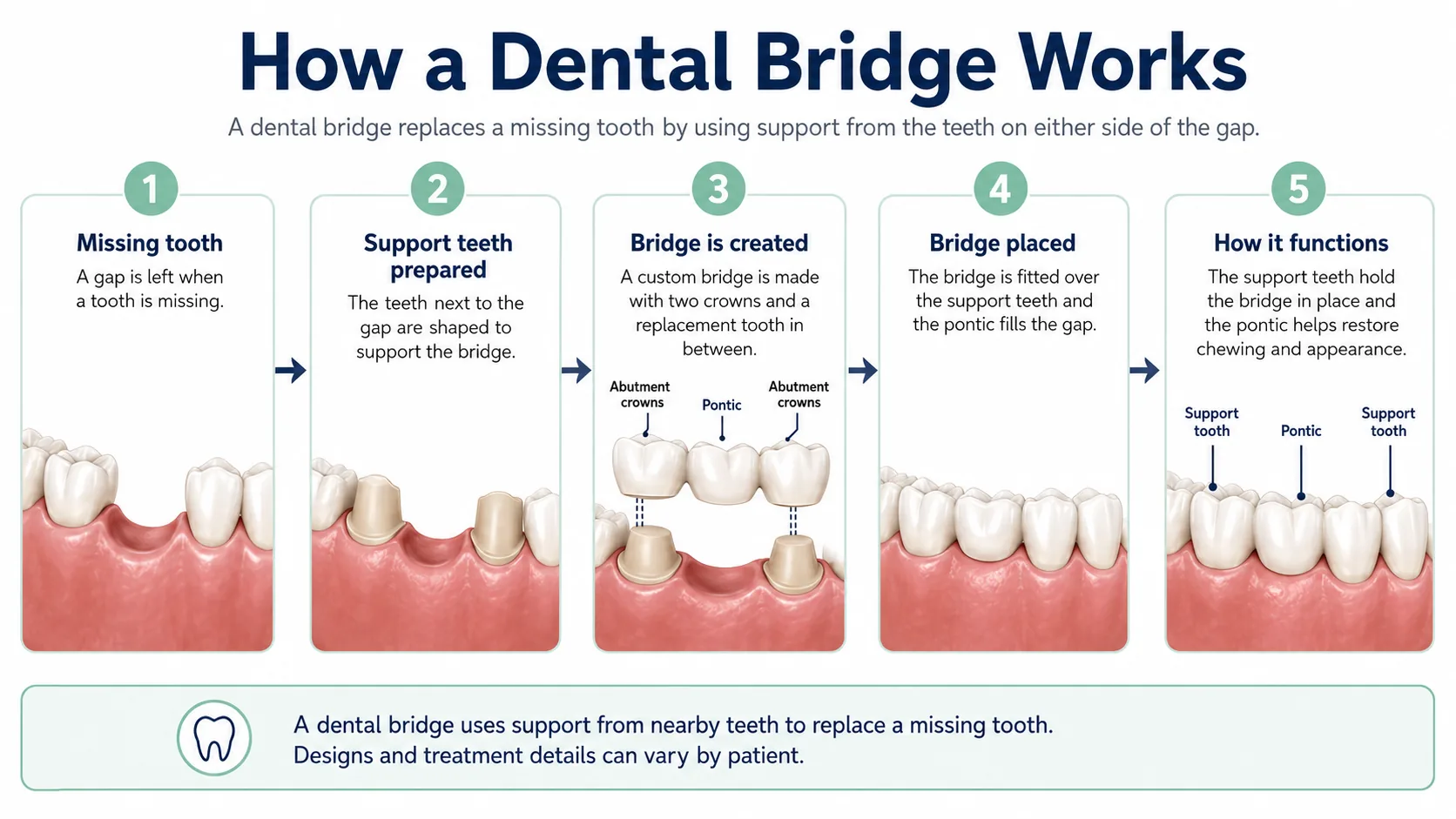
A Dental Bridge Can Include Several Insurance Components
Understanding the individual parts of the proposed bridge can make the insurance benefit easier to review.
Pontic
A pontic is the artificial tooth that replaces a missing tooth within a fixed bridge.
A bridge may contain one or more pontics depending on the number of teeth being replaced.
Confirm:
- Which tooth or teeth are being replaced
- How many pontics are planned
- Which procedures appear for those replacement teeth
- Whether the missing tooth or teeth are eligible for replacement benefits
Abutment Teeth and Supporting Restorations
Abutment teeth or implants provide support for the fixed prosthesis.
Depending on the bridge design, supporting crowns, retainers, or other restorations may appear separately on the treatment plan.
Ask the dental office to identify:
- Which teeth or implants will support the bridge
- Which supporting restorations are proposed
- Which procedures are reported separately
- Whether treatment of a supporting tooth is also needed
Coverage for the pontic does not automatically establish the benefit for every supporting restoration.
For crown-specific coverage information, review Does Dental Insurance Cover Crowns?
Related Dental Services
Other dental services may be needed before or during bridge treatment.
Depending on the individual treatment plan, these can include:
- Examination
- Diagnostic imaging
- Treatment of supporting teeth
- Core buildup
- Root canal treatment
- Tooth extraction
- Periodontal treatment
- Temporary restorations
- Other related procedures
Not every bridge requires these services.
The insurance point is:
Coverage for the bridge does not automatically establish coverage for every related procedure.
If a supporting tooth needs endodontic treatment before or during bridge care, review the root canal benefit separately. Coverage for the bridge does not automatically establish coverage for root canal treatment or for other treatment needed on the supporting tooth.
For root-canal-specific coverage information, read Does Dental Insurance Cover Root Canals?
Ask the dental office for an itemized treatment plan showing which services are being proposed separately.
If a tooth must be removed before bridge treatment, review the extraction benefit separately in Does Dental Insurance Cover Tooth Extraction?
How to Read an Itemized Bridge Treatment Plan
A bridge treatment estimate may contain several procedures rather than one charge or claim line labeled simply as a dental bridge.
Before estimating the insurance benefit, identify what is actually included.
For each item, record:
- Tooth number when applicable
- Procedure or restoration
- Pontic
- Supporting crown or retainer
- Abutment tooth or implant
- Temporary restoration
- Related dental service
- Dental office charge
- Plan allowance when available
- Applicable deductible
- Copay or coinsurance
- Estimated plan payment
- Estimated patient responsibility
- Any applicable limitation
- Information that remains unconfirmed
Then ask whether the dental plan evaluates each component separately.
Do not assume that:
- Every bridge component uses the same benefit rule
- Every related service uses the same cost sharing
- Coverage for one component establishes coverage for another
- A general percentage shown for major services predicts the final patient responsibility
The itemized treatment plan is most useful when it can be matched to the exact provisions in the dental plan.
Missing-Tooth Provisions: What to Check
A missing-tooth provision can be especially important when a bridge is being considered for a tooth that was already missing before dental coverage began.
Some dental plans may contain a missing-tooth, prior-missing-tooth, pre-existing-condition, or similar limitation that affects replacement benefits.
The exact plan language controls.
Do not assume that a plan will provide a bridge benefit simply because its summary lists bridges, prosthodontics, or major services as covered.
If the Tooth Was Already Missing Before Coverage Began
Review the plan for language concerning:
- Missing teeth
- Teeth lost before the effective date
- Pre-existing conditions
- Initial placement of a prosthesis
- Prosthetic treatment for previously missing teeth
- Prior dental coverage
- Documentation of when the tooth was lost
- Other eligibility requirements for tooth replacement
Ask:
- Does this plan contain a missing-tooth or similar provision?
- Does the provision apply to fixed bridges?
- Does the date the tooth was lost matter?
- Does prior dental coverage affect the rule?
- What documentation is required?
- Does the provision also affect dentures or implant-supported treatment?
- Where is the exact rule explained in the controlling plan documents?
If the answer is unclear, record the issue as Not confirmed rather than assuming that the bridge will be eligible.
If the Tooth Was Lost After Coverage Began
The coverage question may be different when the tooth was present on the coverage effective date and was removed later.
Even then, bridge benefits can still depend on:
- The bridge benefit itself
- Any applicable waiting period
- The effective date
- The timing of the extraction and later replacement
- Provider-network rules
- The annual benefit remaining
- Other plan-specific limitations
Coverage for removing the tooth and coverage for replacing it with a bridge are separate benefit questions.
The dental professional determines when replacement treatment is clinically appropriate.
The dental plan determines which benefits may be available under the contract.
For the separate missing-tooth framework, read Missing Tooth Clauses in Dental Insurance: What to Check Before Enrolling.
Missing-Tooth Provision vs Waiting Period
A missing-tooth provision and a waiting period are different coverage issues.
They should be checked separately.
Waiting Period
A waiting period addresses when an otherwise eligible benefit may become available after coverage begins.
For bridge treatment, confirm:
- Whether a waiting period applies
- Which bridge or prosthodontic services are affected
- When the waiting period begins
- When the applicable benefit becomes available
- Whether related procedures follow the same timing rule
The end of a waiting period does not remove deductibles, cost sharing, provider requirements, annual maximums, replacement rules, or other limitations.
Missing-Tooth Provision
A missing-tooth provision focuses on whether replacement of a tooth that was already missing when coverage began is eligible for benefits.
The question is therefore not simply how long the person has been enrolled.
The timing of the tooth loss in relation to the coverage effective date may matter under the specific plan.
Why the Difference Matters
Depending on the plan, a person may encounter:
- A waiting period
- A missing-tooth or similar limitation
- Both
- Neither
That means:
No waiting period does not automatically mean no missing-tooth limitation.
Likewise:
The end of a waiting period does not automatically establish that a previously missing tooth is eligible for bridge benefits.
Review the two provisions independently.
For the complete explanation of waiting-period rules, review How Waiting Periods Work in Dental Coverage.
How to Interpret Common Bridge Coverage Language
Short plan summaries can make bridge coverage appear simpler than it is.
Use the following wording as a starting point rather than as a complete benefit determination.
| Plan wording | What it may indicate | What still needs to be verified |
|---|---|---|
| Bridge covered | Qualifying bridge treatment may receive benefits | Exact bridge, components, missing-tooth rules, cost sharing, benefit limits |
| Major services covered | Some bridge procedures may fall within that category | Which bridge procedures are included and how they are evaluated |
| Waiting period applies | The bridge benefit may not yet be available | Which procedures are affected and when eligibility begins |
| Missing-tooth provision | Replacement of a tooth missing before coverage began may be affected | Exact policy language and whether the provision applies |
| Annual maximum | Plan payments may be limited during the benefit period | Benefits already used, pending claims, and amount remaining |
| In-network benefit | Participating-provider rules apply | Exact dentist, office location, plan, and network |
| Alternate benefit | The plan may calculate its contribution using another covered treatment | Which alternative is used and how patient responsibility may change |
| Predetermination available | Advance benefit information may be requested | Which procedures are reviewed and what can still change before claim processing |
No single phrase provides the complete answer.
Read the terms together with the itemized treatment plan.
Does the Type of Dental Bridge Affect Coverage?
It can.
Different bridge designs can involve different procedures, supporting structures, and plan provisions.
Confirm the exact treatment being recommended rather than assuming that all fixed bridges are evaluated identically.
Traditional Tooth-Supported Bridge
A traditional fixed bridge commonly uses natural teeth to support one or more replacement teeth.
The treatment plan may include:
- One or more pontics
- Abutment teeth
- Supporting crowns or retainers
- Temporary restorations
- Related treatment for supporting teeth
Verify:
- Whether the missing tooth is eligible for replacement
- Which bridge components are covered
- How supporting restorations are evaluated
- Whether a waiting period applies
- Whether an alternate-benefit provision applies
- Whether the annual maximum affects the available benefit
Resin-Bonded or Maryland Bridge
A resin-bonded bridge uses a different support design from a conventional bridge with full-coverage supporting crowns.
The exact procedures on the treatment plan may therefore differ.
Do not assume that because one fixed bridge design receives benefits, every other bridge design will be processed in the same way.
Ask:
- What bridge design is being proposed?
- Which retainers or supporting components are included?
- Which procedures will be submitted?
- How does the plan evaluate those procedures?
- Does an alternate-benefit provision apply?
The plan should be checked for the exact restoration being recommended.
Implant-Supported Bridge
An implant-supported bridge relies on dental implants rather than only on natural abutment teeth.
The treatment can involve separately evaluated services such as:
- Implant placement
- Implant components
- The prosthetic bridge
- Related surgical procedures
- Imaging
- Bone-related procedures
- Other restorative components
Ordinary bridge coverage does not automatically establish implant coverage.
For implant-specific benefit information, review Does Dental Insurance Cover Implants?
Could an Alternate Benefit Affect Bridge Coverage?
Possibly.
Some dental plans contain alternate-benefit provisions that allow the plan to calculate its contribution using another eligible treatment when more than one treatment option is available.
If an alternate benefit applies, separate:
- The treatment recommended by the dentist
- The treatment selected by the patient
- The treatment the plan uses for benefit-calculation purposes
These do not always have to be the same.
An alternate-benefit provision may affect:
- The plan allowance
- Estimated plan payment
- Estimated patient responsibility
- The way the treatment appears on a predetermination or claim explanation
The provision does not, by itself, determine which treatment the dentist must provide.
Clinical treatment decisions remain part of the dentist-patient discussion.
Before treatment, ask:
- Does the plan contain an alternate-benefit provision?
- Can it apply to this bridge?
- Which alternative treatment would be used for benefit purposes?
- Which bridge components are affected?
- How would the provision change the estimated plan payment?
- How would estimated patient responsibility change?
If the plan uses an alternate benefit, ask for a clear explanation of both the selected treatment and the treatment used for benefit calculation.
Are Replacement Bridges Covered?
Dental insurance may provide benefits for replacement of an existing bridge, but a replacement can be subject to additional rules.
Do not assume that an existing bridge automatically becomes eligible for another benefit simply because replacement is clinically recommended.
Confirm:
- When the existing bridge was placed
- Whether a replacement interval applies
- Whether a frequency limitation applies
- Why replacement is being recommended
- Whether documentation is required
- Whether the supporting teeth or implants have changed
- Whether another bridge design is being proposed
- Whether an alternate-benefit provision applies
- Whether sufficient annual benefit remains
Replacing a Damaged or Failing Bridge
A dentist may recommend replacement because an existing bridge is damaged, fractured, no longer functioning adequately, or affected by changes involving the supporting teeth or structures.
The plan then determines whether another bridge benefit is available under its replacement and frequency provisions.
Ask:
- Is replacement currently eligible?
- Does the age of the existing bridge matter?
- What documentation is required?
- Does the reason for replacement affect the benefit?
- Are supporting restorations evaluated separately?
Replacing a Functional Bridge Mainly for Appearance
A different benefit result may apply when an existing bridge remains functional but replacement is requested mainly for cosmetic reasons.
Review:
- Cosmetic exclusions
- Replacement provisions
- Frequency limitations
- Documentation requirements
Do not assume that cosmetic replacement receives the same benefit as replacement of a failing prosthesis.
Insurance Replacement Rules Are Not Clinical Rules
A replacement or frequency limitation determines when the plan may provide another benefit.
It does not determine whether the bridge clinically needs repair or replacement.
A dentist may recommend treatment even when the plan provides little or no additional payment.
Insurance benefit rules and clinical treatment decisions should therefore be considered separately.
For the separate replacement-benefit framework, read Dental Insurance Replacement Rules Explained: What to Check Before Replacing Dental Work.
Other Plan Rules That Can Affect a Dental Bridge
Bridge-specific provisions should be reviewed together with several general dental-plan rules.
These broader rules are summarized here only as they relate to the proposed bridge.
Provider Network
Verify:
- The individual dentist
- Exact office location
- Complete plan name
- Exact provider-network name
- Current participation
- Proposed service date
Do not rely only on the dental office saying that it “accepts” the insurance company.
For the complete explanation of network rules, review In-Network vs Out-of-Network Dental Insurance.
Deductible, Cost Sharing, and Plan Allowance
The dental office’s complete charge is not necessarily the amount used by the plan to calculate benefits.
The bridge treatment may involve:
- A plan allowance
- Deductible
- Copay or coinsurance
- Estimated plan payment
- Estimated patient responsibility
Do not apply a general major-services percentage automatically to the dental office’s complete charge or to every component of the bridge.
For the complete explanation of dental-plan costs, review Dental Insurance Costs Explained.
Annual Maximum
When bridge-related plan payments are subject to an annual maximum, those payments can reduce the benefit remaining during the same benefit period.
Before significant bridge treatment, confirm:
- Benefits already paid
- Claims still pending
- Amount currently remaining
- Which bridge components are subject to the maximum
- Whether related procedures use the same maximum
For the complete explanation of annual benefit limits, review Dental Insurance Annual Maximums Explained.
Where to Check Bridge Coverage in Your Plan Documents
A short benefits summary may show that bridges or major services can receive benefits, but additional documents may be needed to understand how the treatment will actually be evaluated.
Review the documents applicable to the exact plan, which may include:
- Schedule or Summary of Benefits
- Policy
- Certificate of coverage
- Evidence of Coverage
- Controlling plan document
- Prosthodontic or major-restorative provisions
- Missing-tooth provisions
- Waiting-period provisions
- Replacement or frequency limitations
- Alternate-benefit provisions
- Provider-network information
- Preauthorization requirements
- Predetermination information
- Claims and appeal procedures
Look specifically for terminology such as:
- Bridge
- Fixed partial denture
- Pontic
- Abutment
- Abutment crown
- Retainer
- Prosthodontics
- Missing tooth
- Initial placement
- Replacement
- Alternate benefit
A short summary may indicate that bridge treatment can receive benefits.
The detailed documents help explain which bridge, which components, which limitations, and which benefit rules apply.
For the complete explanation of exclusions and limitations, review Dental Insurance Exclusions and Limitations: What to Check Before Enrolling.
When Advance Benefit Information May Be Useful
Advance benefit information can be particularly useful for bridge treatment because the treatment plan may contain several components and related procedures.
It may be worth requesting when:
- The tooth was already missing before coverage began
- Several bridge components appear separately
- A missing-tooth provision may apply
- A waiting period is unclear
- An alternate-benefit provision may apply
- A replacement bridge is proposed
- The remaining annual benefit is uncertain
- An implant-supported bridge is being considered
- Estimated patient responsibility is unclear
Dental plans may use processes such as preauthorization or predetermination.
For the complete explanation, review Dental Insurance Predetermination vs Preauthorization: What’s the Difference?
These terms should not automatically be treated as interchangeable.
Ask:
- Is preauthorization required?
- Is predetermination available?
- Which bridge components are being reviewed?
- Which related procedures are included?
- Is the missing-tooth issue being evaluated?
- Is an alternate benefit being applied?
- Which provider and location are being reviewed?
- What documentation is required?
- What estimated plan allowance or payment is shown?
- What limitations are identified?
- How long is the response valid?
- What could change before final claim processing?
Advance benefit information can improve the treatment-cost estimate.
It does not necessarily guarantee final payment.
Eligibility, provider participation, service dates, benefits remaining, treatment changes, documentation, and other plan provisions can affect the final claim.
What to Check Before Getting a Dental Bridge
Once a bridge has been recommended, focus on the exact treatment plan.
Ask the Dental Office
Confirm:
- What type of bridge is being recommended
- Which tooth or teeth are being replaced
- Which teeth or implants will support the bridge
- How many pontics are included
- Which supporting crowns or retainers are proposed
- Whether treatment of supporting teeth is required
- Whether tooth extraction is needed first
- Whether temporary restorations are included
- Which services will be billed separately
- Whether the office can submit advance benefit information when appropriate
Ask the Dental Plan
Confirm:
- Whether the specific bridge treatment is eligible
- Whether the missing tooth qualifies for replacement benefits
- Whether a missing-tooth or similar provision applies
- Whether a waiting period applies
- Whether the deductible applies
- What copay or coinsurance applies
- Which plan allowance applies
- Whether the dentist participates in the exact network
- Whether supporting restorations are evaluated separately
- Whether an alternate benefit applies
- Whether a replacement limitation applies
- How much annual benefit remains
- Whether preauthorization is required
- Whether predetermination is available
Review the Estimate by Component
When available, separate:
- Pontic
- Supporting crown or retainer
- Abutment treatment
- Temporary restoration
- Related procedure
- Dental office charge
- Plan allowance
- Deductible
- Copay or coinsurance
- Estimated plan payment
- Estimated patient responsibility
- Limitation or exclusion
- Information that remains unconfirmed
Do not rely only on a statement such as:
“The plan pays a percentage of major services.”
A percentage alone does not establish:
- Whether the missing tooth is eligible
- Which bridge components qualify
- Which amount the percentage is applied to
- Whether an alternate benefit applies
- Whether sufficient annual benefit remains
- What the final patient responsibility will be
How to Check Dental Coverage for a Bridge
Before bridge treatment, review the exact bridge, covered components, waiting periods, missing-tooth rules, cost sharing, provider network, and replacement limitations. Use the current plan documents and treatment estimate to confirm the details that apply to your case.
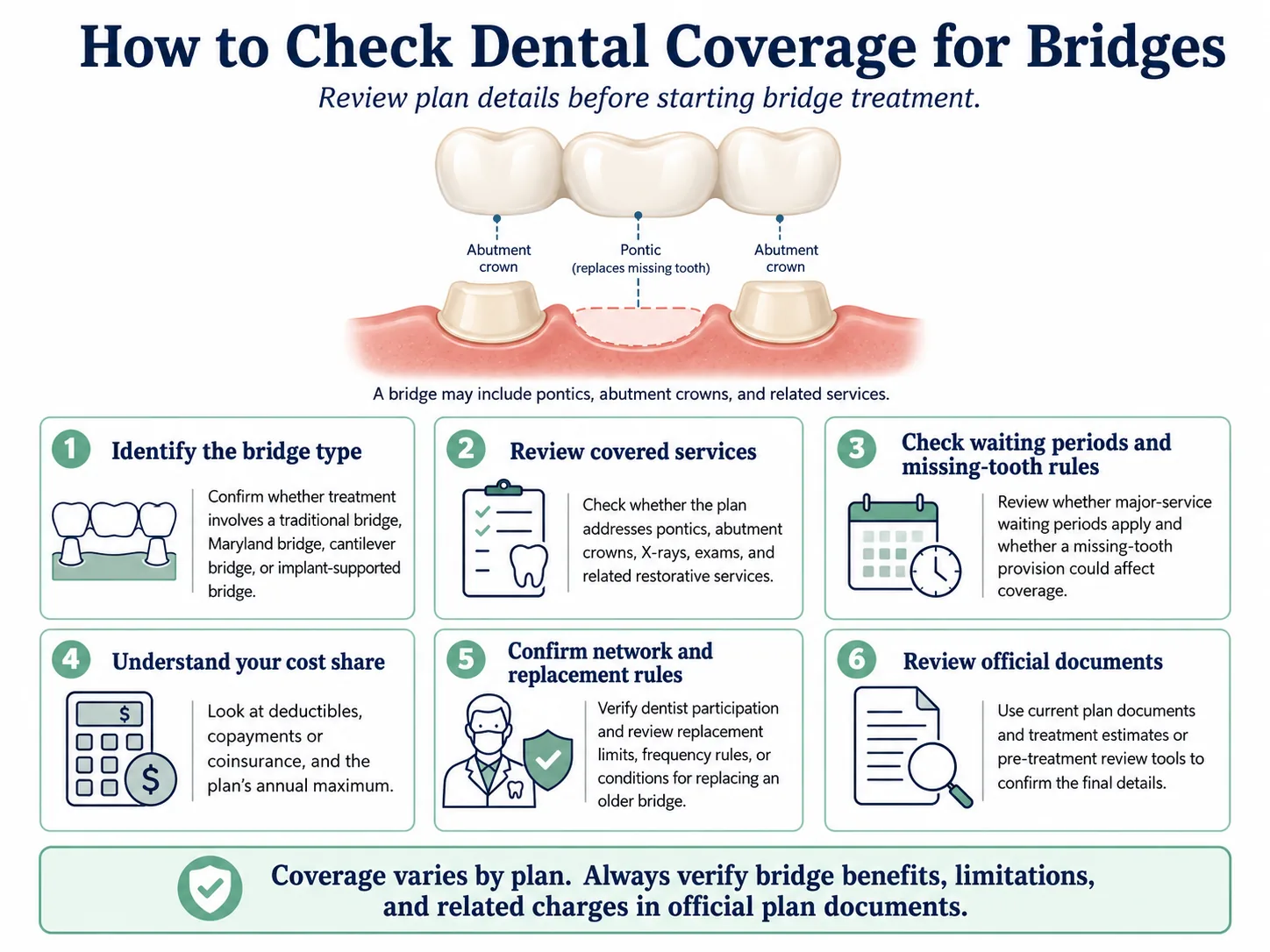
Bridge Coverage vs Other Tooth-Replacement Benefits
A dental bridge is one possible way to replace one or more missing teeth.
Coverage for another tooth-replacement treatment should be reviewed separately rather than inferred from the bridge benefit.
Bridge vs Dental Implant
A traditional tooth-supported bridge and an implant-supported restoration involve different procedures.
A plan may provide a benefit for a traditional bridge without providing the same benefit for:
- Implant placement
- Implant components
- Implant-supported prosthetic treatment
- Related surgical procedures
Likewise, implant eligibility does not establish how a traditional bridge will be evaluated.
For the separate implant coverage framework, read Does Dental Insurance Cover Implants? What to Verify Before Treatment.
Bridge vs Denture
A fixed bridge and a removable denture are different prosthetic treatments.
They may be subject to different:
- Eligibility rules
- Waiting periods
- Missing-tooth provisions
- Replacement limitations
- Cost-sharing rules
- Other plan provisions
For the separate denture coverage framework, read Does Dental Insurance Cover Dentures? What to Verify Before Treatment.
Extraction and Bridge Coverage Are Separate
When a tooth must be removed before it can be replaced, the extraction and the later bridge should be reviewed as separate benefit questions.
Coverage for the extraction does not automatically establish:
- Eligibility for replacement of the missing tooth
- Coverage for the bridge
- Coverage for supporting restorations
- The same waiting-period rule
- The same cost sharing
- The same provider requirements
If an extraction is part of the treatment plan, review Does Dental Insurance Cover Tooth Extraction?
The practical rule is:
Do not use the benefit for one stage of treatment to predict the benefit for another stage.
How to Interpret Your Dental Bridge Coverage
After reviewing the treatment estimate and plan documents, separate what has been confirmed from what remains uncertain.
A useful bridge-coverage review should identify:
- The exact bridge being proposed
- Which tooth or teeth are being replaced
- Which pontics are included
- Which teeth or implants support the bridge
- Which crowns or retainers are included
- Which related procedures are listed separately
- Whether the missing tooth is eligible for replacement benefits
- Whether a waiting period applies
- Whether a replacement or frequency limitation applies
- Whether an alternate-benefit provision applies
- The dentist’s provider-network status
- The deductible and cost sharing
- The annual benefit remaining
- Whether preauthorization is required or predetermination is available
Then interpret each statement in context.
For example:
- Bridge covered does not mean the treatment will be paid in full
- Major services covered does not mean every bridge component receives the same benefit
- No waiting period does not mean there is no missing-tooth limitation
- Missing-tooth provision does not apply does not remove other plan limitations
- Dentist in network does not establish that every related service receives the same benefit
- Predetermination received does not guarantee final claim payment
- Traditional bridge eligible does not establish implant-supported bridge eligibility
- Existing bridge needs replacement does not automatically mean another replacement benefit is available
If an important detail cannot be verified, record it as Not confirmed rather than assuming that the more favorable rule applies.
The goal is not to predict the claim from one phrase such as “bridges covered” or from one coverage percentage.
The goal is to understand:
- Which parts of the proposed treatment may receive benefits
- Which limitations may apply
- Which amounts are estimates
- Which services are evaluated separately
- Which questions still require clarification before treatment
Dental Coverage and Clinical Treatment Are Different Questions
Dental insurance determines benefits according to the terms of a plan.
It does not determine which tooth-replacement treatment is clinically appropriate.
A dental plan may calculate a smaller benefit for one treatment without establishing that another treatment is clinically preferable.
Likewise, a treatment receiving a larger insurance benefit does not automatically make it the appropriate option for a particular patient.
Clinical decisions about:
- Whether a tooth should be replaced
- Which bridge design is appropriate
- Whether supporting teeth can be used
- Whether implants are appropriate
- Whether another restorative option should be considered
- When treatment should occur
belong in the dentist-patient discussion.
Insurance determines how the applicable plan may contribute financially.
Helpful Resources
- Dental Insurance Coverage for Common Procedures
- Does Dental Insurance Cover Crowns?
- Does Dental Insurance Cover Root Canals?
- Does Dental Insurance Cover Tooth Extraction?
- Does Dental Insurance Cover Implants?
- Does Dental Insurance Cover Dentures?
- How Waiting Periods Work in Dental Coverage
- Dental Insurance Costs Explained
- Dental Insurance Annual Maximums Explained
- Compare Dental Plans
- Dental Insurance Learning Center
Frequently Asked Questions
-
Does dental insurance cover bridges?
Dental insurance may provide benefits for a dental bridge, but the exact benefit depends on the plan and treatment being proposed.
The result can be affected by:The bridge design
The individual components
Whether the missing tooth is eligible for replacement
A waiting period
The deductible and cost sharing
Provider-network rules
The annual maximum
Replacement limitations
Alternate-benefit provisions
Other plan-specific requirementsA statement that bridges are covered does not establish how much the plan will pay.
-
Are dental bridges considered major dental work?
Many dental plans may place bridge treatment within a major restorative, prosthodontic, or similar benefit category.
However, plan classifications vary.
The category name does not establish:A standard coverage percentage
A standard deductible
The same waiting period
Eligibility for a previously missing tooth
Coverage for every bridge componentReview the exact procedures and applicable plan provisions.
-
Can a missing-tooth provision affect bridge coverage?
Yes.
Some plans may contain a missing-tooth, prior-missing-tooth, pre-existing-condition, or similar limitation that affects benefits for replacement of a tooth that was already missing when coverage began.
The exact policy language controls.
If the tooth was already missing before the effective date, verify the rule before assuming that a bridge benefit will be available. -
Is a missing-tooth provision the same as a waiting period?
No.
A waiting period addresses when an otherwise eligible benefit may become available after coverage begins.
A missing-tooth provision addresses whether replacement of a tooth that was already missing when coverage began is eligible under the plan.
A plan may have:A waiting period
A missing-tooth limitation
Both
NeitherChecking one does not answer the other.
-
Does dental insurance cover the crowns that support a bridge?
It may, but supporting crowns or retainers should be reviewed as part of the exact treatment plan.
A bridge can contain several separately identified components.
Coverage for a pontic does not automatically establish the same benefit for:An abutment crown
Another retainer
Treatment of a supporting tooth
A temporary restoration
Another related procedureAsk the dental office for an itemized treatment plan and verify the components individually.
-
Can an alternate-benefit provision affect bridge coverage?
Yes, when the dental plan contains an applicable alternate-benefit provision.
The plan may calculate its contribution using another eligible treatment even when the dentist and patient select a different treatment.
This can affect estimated plan payment and patient responsibility.
An alternate benefit does not, by itself, determine which treatment the dentist must provide. -
Does dental insurance cover replacing an old bridge?
It may.
Replacement bridges can be subject to:Replacement intervals
Frequency limitations
Documentation requirements
Cosmetic exclusions
Other plan provisionsConfirm when the existing bridge was placed, why replacement is being recommended, and whether another bridge benefit is currently available.
A plan’s replacement rule determines benefit eligibility, not whether the bridge clinically needs treatment. -
Is an implant-supported bridge covered the same way as a traditional bridge?
Not necessarily.
Implant-supported treatment can involve separate procedures for:Implant placement
Implant components
The prosthetic bridge
Related surgery
Other associated treatmentOrdinary bridge coverage does not automatically establish benefits for implant-supported treatment.
Review the bridge and implant provisions separately.
Sources
- American Dental Association — Glossary of Dental Terms
- American Dental Association — Dental Plan Benefits & Limitations
- American Dental Association — An Introduction to Dental Benefits
- American Dental Association — Pre-Authorizations
- American Dental Association — Least Expensive Alternative Treatment Clause
- American Dental Association — How to Read Your Explanation of Benefits Statement
- HealthCare.gov — Dental Coverage in the Marketplace
About the Author
Maria Dumitru is the Founder and Content Editor of Dental Coverage Hub. She researches and edits educational content designed to help U.S. consumers understand dental insurance terms, procedure-specific benefit rules, and the information they may need to verify before dental treatment.
Learn more about our standards in the Editorial Policy and How We Review Dental Plans.
This article provides general educational information and is not dental, medical, legal, financial, or personalized insurance advice. Dental benefits, covered procedures, missing-tooth provisions, waiting periods, deductibles, copays, coinsurance, plan allowances, provider networks, annual maximums, replacement limitations, alternate-benefit provisions, authorization requirements, claim decisions, and expected patient costs can vary by plan, provider, procedure, service date, state, and individual circumstances. Review the controlling plan documents and consult the appropriate dentist, dental plan, plan administrator, licensed insurance professional, or other qualified professional for information specific to your situation.
This article does not determine whether a dental bridge is clinically appropriate, which bridge design should be used, whether supporting teeth are suitable, or whether another tooth-replacement treatment should be selected. Clinical treatment decisions should be discussed with a qualified dental professional.

Explore Dental Coverage for Common Procedures
Bridge treatment can involve the replacement tooth, supporting restorations, related dental services, and plan provisions that may be evaluated separately. Use our broader procedure coverage guide to understand how dental insurance may evaluate common types of treatment and what to verify before care begins.