
Does Dental Insurance Cover Night Guards? What to Check Before Getting One
Learn how night-guard benefits may work, why prior appliance history matters, and what to verify before a custom guard is made.
Written and researched by Maria Dumitru.
Founder and Content Editor at Dental Coverage Hub
Last reviewed: October 2026
Does dental insurance cover night guards? Dental insurance may provide a benefit for a dentist-provided custom night guard, but coverage depends on the exact appliance, why it is being provided, and the terms of the dental plan.
For this guide, night guard refers primarily to a custom occlusal guard recommended to help protect the teeth or restorations from grinding or clenching.
Other oral appliances can serve different purposes and should not automatically be treated as the same insurance benefit.
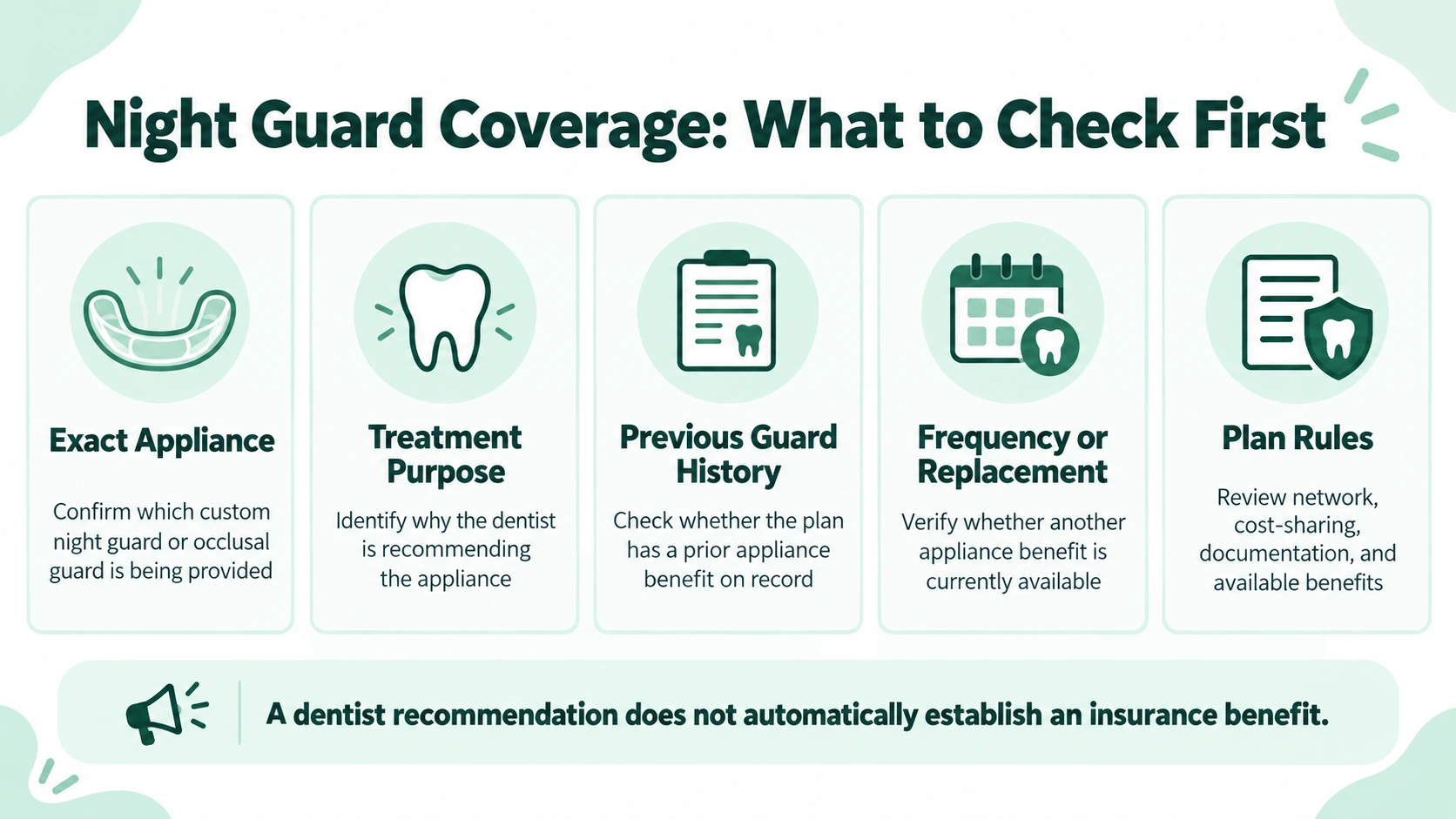
A dentist recommending a night guard does not automatically establish dental insurance coverage for the appliance.
What You’ll Learn
This guide explains:
- How dental insurance may cover a custom night guard
- Why the exact appliance and treatment purpose matter
- How previous night-guard history can affect another benefit
- Why frequency limits may matter
- What to check when a night guard needs replacement
- How network status and cost-sharing can affect benefits
- When advance benefit information may be useful
- What to verify before the appliance is made
Quick Answer
Dental insurance may provide a benefit for a custom night guard or occlusal guard, but coverage is plan-specific.
Before the appliance is made, verify:
- The exact appliance being provided
- How the dental plan identifies that appliance
- Why the appliance is being recommended
- Whether a previous night guard affects eligibility
- Whether frequency or replacement provisions apply
- Whether the dentist is in-network
- What deductible or other cost-sharing applies
- Whether advance benefit information is available
The most useful approach is to identify the exact appliance first and then check whether a benefit is currently available under your plan.
Key Takeaways
- Dental insurance may provide a benefit for some dentist-provided night guards.
- The exact appliance matters more than the general phrase night guard.
- A clinical recommendation does not automatically guarantee insurance payment.
- Previous night-guard history can affect another benefit.
- Frequency limits and replacement provisions are different insurance questions.
- A lost, damaged, or worn guard does not automatically establish eligibility for a replacement.
- Provider network, cost-sharing, annual benefits, and other plan provisions may affect payment.
- Predetermination or preauthorization can provide useful advance information without guaranteeing final payment.
In This Guide
Does Dental Insurance Cover Night Guards?
It may.
Dental plans can provide benefits for certain custom occlusal guards, but there is no universal rule that applies to every plan.
A plan may consider:
- Whether the appliance is an included benefit
- The exact appliance being provided
- The treatment purpose
- Supporting documentation
- Previous appliance history
- Frequency or replacement provisions
- Provider network status
- Deductible and cost-sharing
- Available annual benefits
- Other exclusions or limitations
Do not rely only on the general question of whether night guards are covered. Verify the specific appliance your dentist intends to provide.
What Type of Night Guard Is the Plan Evaluating?
Consumers may hear terms such as:
- Night guard
- Occlusal guard
- Bite guard
- Occlusal appliance
- Bruxism appliance
The terminology used by your dentist and the terminology used by the dental plan may not be identical.
For insurance purposes, determine:
- What appliance the dentist is providing
- What the appliance is intended to do
- How the dental plan identifies that appliance
- Which benefit provisions apply
You do not need to identify dental procedure codes yourself.
The goal is to connect the appliance your dentist recommends with the benefit your dental plan actually evaluates.
Why the Reason for the Night Guard Matters
A dentist-provided night guard may be recommended to help protect teeth or dental restorations from the effects of grinding or clenching.
The treating dental professional determines whether the appliance is clinically appropriate.
The dental plan makes a separate decision about whether the appliance qualifies for a benefit.
Clinical information may help explain why the appliance is recommended, but it does not automatically override exclusions, limitations, prior-benefit history, or other plan provisions.
Clinical appropriateness and insurance benefit eligibility are separate questions.
Is a Night Guard the Same as Other Oral Appliances?
Not necessarily.
Different oral appliances can have different purposes and different insurance questions.
Dentist-Provided Night Guard
This article focuses on a custom occlusal appliance provided primarily for grinding or clenching.
Sports Mouthguard
A sports mouthguard is intended primarily to protect against athletic impact and should not automatically be treated as the same insurance service.
Orthodontic Retainer
A retainer is used in an orthodontic treatment context and has a different purpose.
TMD-Related Appliance
An appliance used as part of TMD care can involve a different treatment purpose and benefit framework.
Sleep Apnea Oral Appliance
An oral appliance used for sleep-related breathing treatment is a different clinical and insurance question.
Similar-looking appliances should not automatically be assumed to have the same dental insurance benefit.
What Can Affect Night Guard Coverage?
Several plan provisions may affect the final benefit.
Exact Appliance
Start with the appliance that will actually be fabricated and provided.
Do not assume every product described as a night guard represents the same insurance service.
Clinical Documentation
A dental plan may request information supporting the treatment recommendation.
Requirements vary by plan.
Documentation can support benefit review without guaranteeing payment.
Previous Appliance History
If you have already received a night guard, prior benefit history can become important.
The plan may consider when the earlier appliance was provided and whether another appliance benefit is currently available.
Provider and Network Status
If you expect in-network benefits, verify that the dentist providing the appliance participates in your exact dental plan.
Accepting an insurance plan is not necessarily the same as participating in its network.
For the broader framework, read In-Network vs Out-of-Network Dental Insurance.
Deductible and Cost-Sharing
Depending on the plan, a deductible, copay, coinsurance, or another form of patient responsibility may apply.
Do not assume a night guard has no cost-sharing simply because it is intended to protect the teeth.
Annual Maximum
An eligible night-guard benefit may still be affected by the amount of annual benefits remaining.
For the separate mechanism, read Dental Insurance Annual Maximums Explained.
Exclusions and Limitations
Review whether the plan contains an exclusion, frequency provision, replacement provision, documentation requirement, or another limitation affecting the appliance.
Can Dental Insurance Limit How Often It Covers a Night Guard?
Yes, a dental plan may limit how often a benefit is available for a particular service or appliance.
If you previously received a night guard, determine:
- The date the plan associates with the previous appliance
- Whether that service appears in the benefit history
- Whether another benefit is currently available
- Which frequency provision applies
Do not rely on a universal replacement interval found online.
The relevant question is which frequency rule your specific plan applies to the appliance and prior benefit history.
For the full mechanism, read Dental Insurance Frequency Limits Explained: What to Check Before Treatment.
What If You Need a Replacement Night Guard?
Needing another night guard does not automatically mean another insurance benefit is available.
A plan may have separate provisions governing replacement of previously provided dental work or appliances.
Before another guard is made, determine:
- Whether the service is considered a new appliance or replacement
- When the previous appliance was provided
- Whether a replacement provision applies
- Whether another benefit is currently available
- What documentation may be required
For the separate framework, read Dental Insurance Replacement Rules.
What If the Previous Night Guard Was Lost, Damaged, or Worn Out?
The reason another appliance is needed can be relevant, but it should not automatically be treated as proof that dental insurance will pay again.
A guard may need attention because it is:
- Lost
- Damaged
- Worn
- No longer fitting properly
- No longer appropriate after dental changes
The dentist determines what clinical solution is appropriate.
The dental plan determines whether the proposed service receives a benefit.
Lost, damaged, or worn does not automatically mean replacement is covered.
Does a Previous Night Guard Affect Current Coverage?
It can.
Previous benefit history can matter even if the current appliance is being provided by a different dentist or under changing treatment circumstances.
Verify:
- What prior appliance date the plan is using
- Whether a prior benefit is recorded
- Whether a frequency limit applies
- Whether a replacement provision applies
- Whether another appliance benefit is currently available
Frequency limits and replacement rules are related but different concepts.
The first asks how often a benefit may be available.
The second asks whether a new benefit may be available when an existing appliance is being replaced.
When Advance Benefit Information May Be Useful
Advance benefit information can be useful when:
- Night-guard coverage is unclear
- You previously received another guard
- A replacement provision may apply
- Supporting documentation may be needed
- You want to understand current expected cost-sharing before fabrication
Depending on the plan, predetermination or preauthorization may provide information about:
- Current eligibility
- How the appliance is classified
- Prior benefit history
- Documentation requirements
- Expected cost-sharing
- Available benefits
Advance benefit information can help with planning, but it should not automatically be treated as guaranteed final payment.
For the complete framework, read Dental Insurance Predetermination vs Preauthorization: What’s the Difference?
Where to Check Night Guard Coverage in Your Plan
Schedule of Benefits
Look for language related to occlusal guards, bite guards, occlusal appliances, or similar dental appliances.
Exclusions and Limitations
Review any frequency, replacement, documentation, or service-specific provisions.
Prior Benefit History
If you received a guard before, confirm which prior service date the plan is using.
Provider Network Information
Verify the dentist under your exact dental plan if you intend to use in-network benefits.
Advance-Review Requirements
Check whether predetermination, preauthorization, or another pretreatment process applies.
How to Verify Benefits Before Getting a Night Guard
Step 1: Confirm the Appliance
Ask what custom appliance the dentist plans to provide.
Step 2: Confirm the Purpose
Determine whether the appliance is being recommended primarily for grinding or clenching or for another treatment purpose.
Step 3: Check the Plan Terminology
Ask how the dental plan identifies the appliance and which benefit applies.
Step 4: Review Previous Appliance History
If you previously received a night guard, confirm the prior service date in the plan records.
Step 5: Check Frequency and Replacement Provisions
Determine whether another benefit is currently available and whether a replacement rule applies.
Step 6: Verify the Dentist and Network
Confirm provider participation if you expect in-network benefits.
Step 7: Review Cost-Sharing and Other Limitations
Check deductible, copay or coinsurance, available annual benefits, documentation requirements, exclusions, and other applicable provisions.
Step 8: Ask About Advance Benefit Information
If coverage is unclear, determine whether the proposed appliance can be reviewed before it is fabricated.
How to Interpret Common Night Guard Benefit Language
| Plan language or result | What it may mean | What not to assume |
|---|---|---|
| Occlusal guard benefit available | The plan recognizes an applicable appliance benefit | Do not assume every type of oral appliance is included |
| Frequency limitation | Another benefit may depend on prior service history and timing | Do not assume the same interval applies to every plan |
| Replacement provision | Another appliance may be subject to specific replacement rules | Do not assume damage or loss automatically qualifies |
| Prior appliance on record | Previous benefit history may affect current eligibility | Do not assume a new dentist resets the plan rule |
| Documentation required | Additional information is needed to evaluate the proposed appliance | Do not assume documentation guarantees payment |
| No benefit available | A plan provision affected the proposed or submitted appliance | Do not automatically conclude that all night guards are excluded |
After Treatment: Review the EOB
After the claim is processed, review the Explanation of Benefits before deciding why the plan paid a particular amount.
Check:
- The appliance or service submitted
- Provider information
- Plan allowance
- Deductible or other cost-sharing
- Plan payment
- Patient responsibility
- Any remarks explaining a limitation or nonpayment
If the claim relates to a replacement, repair, adjustment, or another oral appliance, confirm exactly which service the plan evaluated.
For the complete framework, read How to Read a Dental Insurance EOB: Payments, Adjustments, and Patient Responsibility.
Common Night Guard Coverage Mistakes
Asking Only Whether Night Guards Are Covered
Identify the exact appliance and treatment purpose first.
Treating Every Oral Appliance as the Same Benefit
Sports mouthguards, retainers, sleep-related appliances, and other intraoral appliances can involve different treatment purposes.
Assuming Bruxism Automatically Guarantees Coverage
The clinical reason for the appliance does not override the terms of the plan.
Ignoring Previous Night-Guard History
A prior appliance can affect current benefit eligibility.
Assuming a Lost or Damaged Guard Is Automatically Covered Again
Replacement provisions may still apply.
Using Frequency Rules and Replacement Rules Interchangeably
They answer related but different insurance questions.
Treating Advance Benefit Information as Guaranteed Payment
Predetermination or preauthorization can provide useful information without guaranteeing the final claim.
Our Recommendation
Before a custom night guard is made, confirm:
- What appliance is being provided
- Why it is being recommended
- How the dental plan identifies the appliance
- Whether previous benefit history exists
- Whether frequency or replacement provisions apply
- Whether the dentist is in-network
- What cost-sharing and annual-benefit provisions may apply
- Whether advance benefit information would be useful
A custom night guard is best understood as an appliance-specific benefit question rather than a general promise that all night guards are covered.
If you previously had a night guard, prior benefit history, frequency limits, and replacement provisions become especially important.
Helpful Resources
- Dental Insurance Coverage for Common Procedures
- Dental Insurance Frequency Limits Explained: What to Check Before Treatment
- Dental Insurance Replacement Rules
- In-Network vs Out-of-Network Dental Insurance
- Dental Insurance Annual Maximums Explained
Frequently Asked Questions
Does Dental Insurance Cover Night Guards?
It may. Coverage depends on the exact appliance, treatment purpose, prior benefit history, and the provisions of the dental plan.
Does Dental Insurance Cover a Custom Night Guard From the Dentist?
It may. Verify whether the custom occlusal guard is an included benefit, how the plan classifies it, and what limitations or cost-sharing apply.
Does Dental Insurance Cover Night Guards for Teeth Grinding?
It may. Grinding or clenching can explain the clinical reason for the appliance, but the plan still determines whether the proposed night guard qualifies for a benefit.
How Often Will Dental Insurance Cover a Night Guard?
There is no universal interval. The plan may use a frequency limit based on prior benefit history and the specific service. Check the rule in your dental plan.
Will Dental Insurance Pay to Replace a Night Guard?
It may, depending on the plan. Replacement provisions, prior appliance history, timing, and the circumstances of the replacement can affect the benefit.
Does Insurance Cover a Night Guard If Mine Was Lost or Damaged?
Not automatically. Loss or damage can explain why another appliance is needed, but the plan may still apply frequency or replacement provisions.
Is a Night Guard the Same as a Sports Mouthguard for Insurance?
No assumption should be made that they are the same benefit. A bruxism night guard and a sports mouthguard have different treatment purposes and may be treated differently by a dental plan.
Why Might Dental Insurance Not Pay for a Night Guard?
Possible reasons can include an exclusion, appliance classification, prior benefit history, frequency or replacement provisions, documentation requirements, provider network, cost-sharing, available annual benefits, or another plan limitation. Review the EOB for the specific explanation.
Sources
- National Institute of Dental and Craniofacial Research — Bruxism
- American Dental Association — Coding Education
- American Dental Association — Documenting Occlusal Guards with Hard and Soft Components
- American Dental Association — Typical Dental Plan Benefits and Limitations
- American Dental Association — Pre-Authorizations
- American Dental Association — Explanation of Benefits Statement
About the Author
Maria Dumitru is the founder and content editor of DentalCoverageHub. She creates consumer-focused educational content designed to help readers understand dental insurance benefits, limitations, and plan rules before making coverage decisions.
Learn more about our standards in the Editorial Policy and How We Review Dental Plans.
This article is for general educational purposes. Night-guard and occlusal-guard benefits, appliance classifications, documentation requirements, frequency limits, replacement provisions, network status, cost-sharing, annual-benefit limits, and other coverage terms can vary by dental plan. Clinical decisions about whether an appliance is appropriate should be made by the treating dental professional.

Explore Dental Coverage for Common Procedures
A night guard is one type of dental appliance, and its benefit can depend on the exact appliance, treatment purpose, prior benefit history, and other plan provisions. Use our broader procedure coverage guide to learn what to verify when researching other types of dental treatment.