
Can You Have Two Dental Insurance Plans? Coordination of Benefits Explained
Learn how primary and secondary dental plans interact, how Coordination of Benefits may affect payment, and what to verify before relying on dual dental coverage.
Written and researched by Maria Dumitru.
Founder and Content Editor at Dental Coverage Hub
Last reviewed: October 2026
Yes, you can be covered by two dental insurance plans at the same time when you are eligible for both.
This is often called dual dental coverage.
It can happen when you have dental coverage through your own employer and are also covered as a dependent under a spouse’s plan, when you qualify for coverage through more than one employer, or when a child is enrolled under both parents’ dental plans.
You may also have an employer dental plan and a separately purchased individual dental policy, although you should not assume that every combination of plans coordinates benefits in the same way.
The most important point is:
Having two dental plans does not mean your benefits automatically double.
When Coordination of Benefits, or COB, applies, one plan generally processes the claim first as the primary plan. Another plan then considers the claim as the secondary plan under its own coordination rules.
And:
The secondary dental plan does not automatically pay whatever the primary plan leaves behind.
The secondary plan may provide an additional benefit, provide little or no additional payment, or process the claim differently depending on its COB method and other plan provisions.
To understand dual dental coverage, you need to know three things:
- Which plan processes first
- How the secondary plan coordinates with the primary plan
- Which rules each plan continues to apply separately
What You’ll Learn
This guide explains:
- What dual dental coverage and Coordination of Benefits mean
- How primary and secondary claim-processing order is determined
- Which order-of-benefits rules to verify, including the birthday rule when applicable
- How coordination methods can affect the secondary plan’s payment
- Which benefit limits and requirements each plan applies separately
- How claims move between plans and what to confirm before relying on additional benefits
For a broader introduction to plan types, costs, and benefit rules, start with Dental Insurance Basics.
Quick Answer
You can have two dental insurance plans when you are eligible for both.
When Coordination of Benefits applies, one plan is generally designated primary and processes the claim first. The other plan is secondary and considers the claim after the primary plan has processed it.
But secondary insurance does not simply pay the remaining dental bill.
Depending on its terms, the secondary plan may use a coordination method such as:
- Traditional Coordination of Benefits
- Maintenance of Benefits
- Carve-out
- Nonduplication of benefits
- Another plan-specific coordination method
The secondary plan also continues to apply its own coverage provisions and limitations.
The key distinction is:
Primary and secondary describe claim-processing order. The secondary plan’s COB method determines how the primary payment is considered when the secondary benefit is calculated.
Before relying on dual dental coverage, ask:
Do these plans coordinate benefits, which plan is primary, and exactly how does the secondary plan calculate its benefit?
Do not assume that the secondary plan will pay the amount left after the primary plan processes the claim.
Key Takeaways
- Two plans do not automatically provide double benefits. Confirm whether and how the specific plans coordinate
- Primary and secondary describe processing order. Verify the applicable rules rather than assuming you can choose which plan pays first
- Secondary coverage does not automatically pay the remaining bill. Its coordination method and benefit provisions determine any additional payment
- Each plan applies its own terms. Deductibles, annual maximums, frequency limits, exclusions, and provider networks still need separate review
- The secondary plan may need the primary plan’s results. Confirm which EOB and claim details must be submitted and who handles that step
- Compare additional benefits with additional costs. A second premium does not guarantee a useful increase in payment for the care you expect
Two dental plans can provide two sources of coverage, but they do not combine into one larger dental plan.
In This Guide
Can You Have Two Dental Insurance Plans?
Yes.
You can have coverage under more than one dental plan when you are eligible for both.
This is commonly called dual dental coverage.
The important question is not only whether you can hold both plans.
You also need to determine:
- Whether the plans coordinate benefits
- Which plan processes first
- Which plan processes second
- How the secondary plan calculates any additional benefit
Having two active dental policies does not, by itself, tell you how the policies interact.
Your Own Employer Plan Plus a Spouse’s Plan
You may have dental coverage through your own employer and also be enrolled as a dependent under your spouse’s employer dental plan.
When both plans coordinate benefits, the applicable order-of-benefits rules determine which plan processes your claims first.
Do not assume that the plan with better benefits or the lower deductible automatically becomes primary.
Dental Coverage Through More Than One Employer
You may qualify for dental benefits through more than one job.
When both employer plans cover the same person, their Coordination of Benefits provisions may determine which plan is primary.
The order should be confirmed with the plans rather than chosen based on which coverage appears more generous.
A Child Covered Under Both Parents’ Dental Plans
A dependent child may be enrolled under both parents’ dental plans.
When Coordination of Benefits applies, the plans may use a dependent-coverage rule, such as the birthday rule, to determine which plan processes the child’s claims first.
Other family circumstances or controlling provisions can affect the result, so the birthday rule should not be assumed to apply in every situation.
Employer Coverage Plus an Individual Dental Policy
You may have employer-sponsored dental coverage and also purchase a separate individual dental policy.
But this combination requires additional verification.
Do not assume that an individual dental policy coordinates benefits in the same way as two employer group plans.
Review the individual policy for language such as:
- Coordination of Benefits
- Other insurance
- Other coverage
- Duplicate benefits
- Other plan payments
Ask the individual plan how it treats benefits when another active dental plan also covers you.
What Is Traditional Coordination of Benefits?
Under a traditional Coordination of Benefits approach, the secondary dental plan may provide an additional benefit after the primary plan has processed the claim.
The secondary plan generally reviews:
- The benefit calculated under its own terms
- The amount paid by the primary plan
- Its Coordination of Benefits provision
- Any applicable benefit limitations
The combined benefit may be limited under the plan’s COB rules so that the plans do not provide duplicate reimbursement beyond the amount recognized under the applicable coordination provisions.
The key distinction is:
Traditional COB may allow an additional secondary benefit, but it does not mean the secondary plan automatically pays the entire remaining balance.
The secondary plan still applies its own:
- Covered-service provisions
- Deductible or cost sharing when applicable
- Annual maximum
- Frequency or replacement provisions
- Exclusions and limitations
- Other benefit rules
When reviewing the secondary EOB, focus on how the plan calculated its benefit rather than comparing only the primary payment with the provider’s remaining balance.
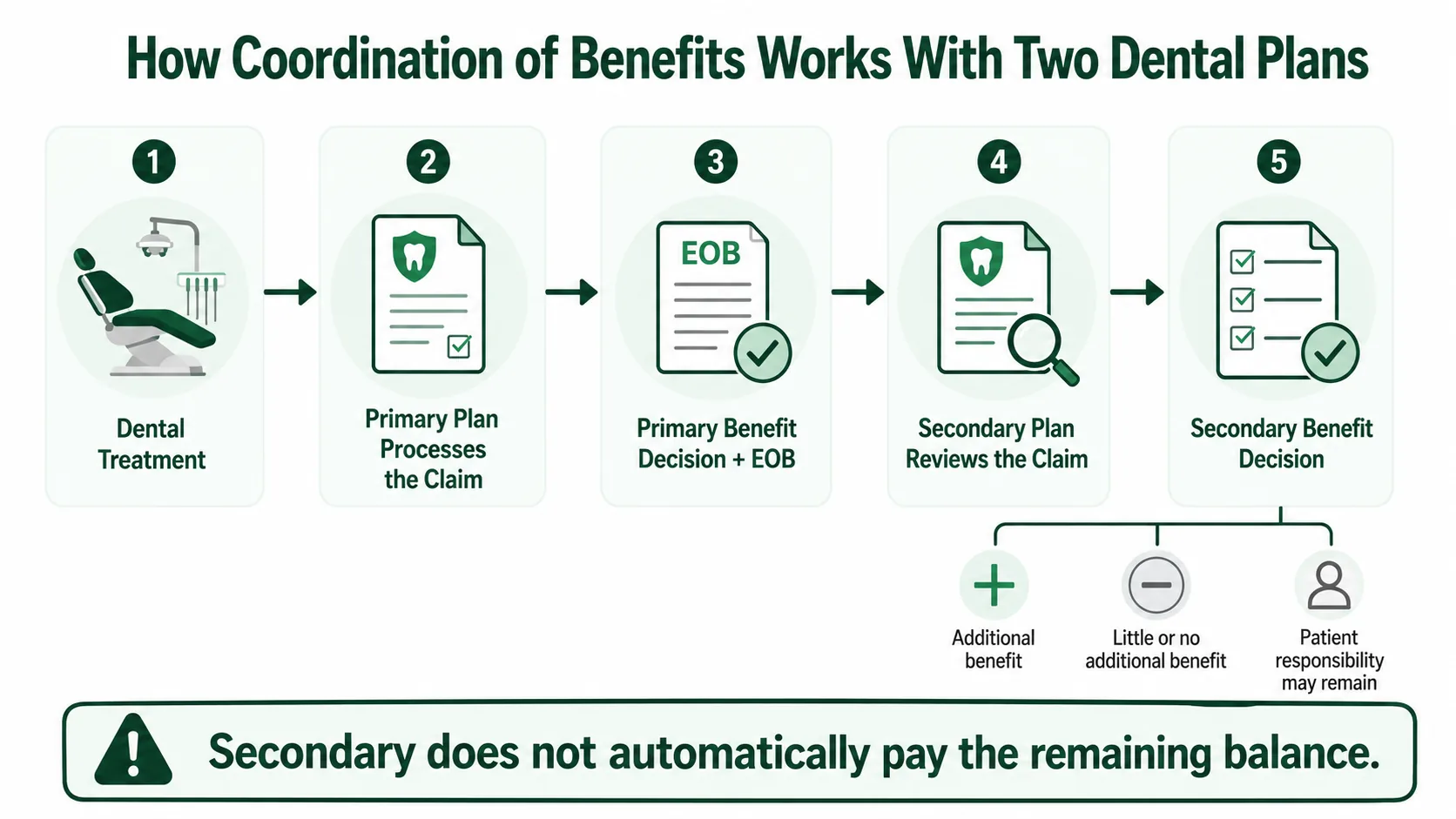
How Coordination of Benefits Works With Two Dental Plans
Primary vs Secondary Dental Insurance
When Coordination of Benefits applies, primary and secondary describe claim-processing order.
They do not describe which plan has better coverage, a larger annual maximum, a better network, or more generous benefits.
The key distinction is:
Primary tells you which plan processes first. Secondary tells you which plan considers the claim afterward. Neither term tells you how much either plan will ultimately pay.
Primary Dental Plan
The primary dental plan processes the claim first under its own coverage and benefit provisions.
It determines its benefit without assuming that another dental plan will pay afterward.
The primary plan may apply its own:
- Covered-service provisions
- Deductible or cost sharing
- Annual maximum
- Frequency or replacement provisions
- Network rules
- Exclusions or limitations
- Other applicable benefit terms
After processing, the primary plan generally provides claim information or an EOB that may be needed for secondary review.
Secondary Dental Plan
The secondary dental plan considers the claim after the primary plan has processed it.
Depending on its terms, the secondary plan may consider:
- What the primary plan paid
- What benefit the secondary plan would otherwise provide
- Its Coordination of Benefits provision
- Its own coverage and benefit limitations
- Information from the primary EOB or claim result
The secondary plan then determines whether any additional benefit is available.
The key distinction is:
Secondary does not mean “pays the rest.”
The unpaid provider balance is not automatically the amount the secondary plan uses when calculating its benefit.
Can You Choose Which Dental Plan Is Primary?
Generally, you should not assume that you can choose which dental plan is primary.
When Coordination of Benefits applies, the order is determined by the applicable order-of-benefits provisions in the plans.
You normally cannot decide:
“This plan has better benefits, so I want it to pay first.”
A plan being primary does not mean that it has better coverage, a larger annual maximum, a lower deductible, or a better provider network.
It means that, under the applicable coordination rules, that plan processes the claim first.
The key distinction is:
Primary status is determined by the applicable COB rules, not by which plan appears more generous.
If you are unsure which plan is primary, confirm the order with both dental plans before relying on a particular claim sequence.
Ask each plan:
- Do you consider this plan primary or secondary?
- Which order-of-benefits rule are you applying?
- What information do you need about the other coverage?
If the two plans give different answers, do not simply choose an order yourself. Ask each plan to explain the provision it is using.
How Is the Primary Dental Plan Determined?
Different circumstances can lead to different order-of-benefits rules.
The examples below describe common approaches that may appear in Coordination of Benefits provisions, but they should not be treated as universal rules for every dental plan.
Always confirm the order under the actual plans involved.
The key question is:
Which order-of-benefits provision applies to this specific combination of coverage?
Your Own Employee Coverage vs Dependent Coverage
When the applicable COB provisions distinguish between coverage as an employee or principal covered person and coverage as a dependent, the plan covering you in your own right is generally processed before the plan covering you as a dependent.
For example, if you have dental coverage through your own employer and are also enrolled as a dependent under your spouse’s employer plan, your own employee coverage may be primary under that rule.
The key distinction is:
Employee-versus-dependent status can determine processing order; benefit generosity does not.
Confirm the order with both dental plans rather than relying only on the general rule.
Dental Coverage Through Two Employers
If you have dental coverage through more than one employer, the applicable COB provisions may use the length of coverage or another order-of-benefits rule to determine which plan processes first.
One plan may be primary because it has covered you for the longer applicable period.
However, do not assume that the rule works identically under every plan.
Also, a change in the insurance company administering an employer benefit does not necessarily mean that the underlying period of coverage automatically starts over for COB purposes.
Ask both plans:
- Which coverage period are you using?
- Which rule determines primary status?
- Does a change in carrier affect the length-of-coverage calculation?
The plan documents should control the answer.
Active Employee Coverage vs Retiree or Continuation Coverage
When the applicable COB provisions distinguish active employment coverage from retiree or continuation coverage, coverage connected to active employment may be processed before retiree or COBRA coverage.
These situations can be more complicated than ordinary employee-versus-dependent coverage.
Review:
- Whether the person is covered as an active employee
- Whether the other coverage is retiree coverage
- Whether continuation coverage such as COBRA is involved
- Which order-of-benefits provision each plan applies
The key principle is:
Do not assume that the plan you have had the longest is automatically primary when active, retiree, or continuation coverage overlaps.
Confirm the order with the plans or employer benefits administrator.
A Child Covered Under Both Parents’ Plans
When a dependent child is covered under both parents’ dental plans, the plans may use a dependent-coverage rule to determine which plan processes first.
A commonly used method is the birthday rule.
But the birthday rule should not be treated as universal.
The order can be affected by:
- The language of the dental plans
- Family circumstances
- A court order
- Other applicable dependent-coverage provisions
The key question is:
Which dependent-coverage rule do these two plans apply to this child?
Confirm the answer with both dental plans.
How Does the Birthday Rule Work?
When a dental plan uses the birthday rule for a dependent child covered under both parents’ plans, the plan of the parent whose birthday occurs earlier in the calendar year is generally primary.
The comparison uses the month and day of each parent’s birthday.
It is not based on:
- Which parent is older
- Which parent enrolled the child first
- Which parent has the higher income
- Which dental plan has more generous benefits
- Which parent wants a particular plan to process first
For example, the parent whose birthday falls earlier in the calendar year may have the primary plan even if that parent is younger.
The key distinction is:
The birthday rule compares calendar position, not the parents’ ages.
However, do not assume that the birthday rule controls every dependent-child situation.
Other plan provisions, family circumstances, or a court order may change the order of benefits.
Always verify which rule both dental plans are applying.
What If the Parents Are Divorced or Separated?
If a dependent child is covered under dental plans associated with divorced or separated parents, do not automatically apply the birthday rule.
The order of benefits may be affected by:
- A court order
- Custody or dependent-coverage provisions
- The language of the dental plans
- Other applicable Coordination of Benefits rules
If a court order addresses responsibility for the child’s health or dental coverage, the dental plans may need information from that order before determining which plan processes first.
Ask both dental plans:
Which plan do you recognize as primary for this dependent, and which provision are you applying?
Also ask:
- Does a court order affect the COB determination?
- What documentation do you need?
- Which plan should receive the claim first?
The key principle is:
Do not rely on a generic birthday-rule example when the parents are divorced or separated.
The actual plan provisions and any controlling legal documentation should guide the order of benefits.
How Secondary Dental Benefits May Be Calculated
After the primary dental plan processes the claim, the secondary plan evaluates the claim under its own Coordination of Benefits provisions.
The secondary plan does not simply look at the amount still owed to the dental provider and pay that balance.
Instead, it may consider:
- What the primary plan paid
- What benefit the secondary plan would otherwise provide
- The secondary plan’s Coordination of Benefits method
- Its own coverage provisions and limitations
The exact calculation depends on the secondary plan.
The key distinction is:
The remaining provider balance and the secondary plan’s calculated benefit are not necessarily the same amount.
A secondary plan may provide an additional benefit, a smaller benefit than expected, or no additional payment depending on its COB method and other applicable plan provisions.
The next section shows why different coordination methods can produce different results.
How Different Coordination of Benefits Methods May Affect Secondary Payment
| Coordination method | What it may mean | What not to assume |
|---|---|---|
| Traditional COB | The secondary plan may provide an additional benefit after the primary plan processes the claim, subject to the secondary plan’s own COB and benefit rules | Do not assume the secondary plan pays every dollar the primary plan leaves unpaid |
| Maintenance of Benefits | The secondary plan may take the primary plan’s payment into account when determining whether any additional benefit is available | Do not assume the remaining provider balance determines the secondary payment |
| Carve-out | The secondary plan may compare or offset its calculated benefit against the amount paid by the primary plan | Do not assume all carve-out methods use the same calculation |
| Nonduplication of benefits | The secondary plan may provide little or no additional benefit when the primary payment meets or exceeds the amount the secondary plan would otherwise provide | Do not assume zero secondary payment means the claim was processed incorrectly |
The exact calculation depends on the wording of the secondary dental plan.
When reviewing dual coverage, ask:
Which Coordination of Benefits method does the secondary plan use, and how does it take the primary plan’s payment into account?
Do not rely only on the labels “primary” and “secondary.” Those labels establish processing order, not the secondary benefit calculation.
Why Might Secondary Dental Insurance Pay Little or Nothing?
A small or zero secondary payment does not have one universal explanation.
Before assuming that something went wrong, identify whether the result came from the Coordination of Benefits calculation, another rule in the secondary plan, missing primary-plan information, or a difference in how the two plans treat the service.
The key principle is:
Zero secondary payment is a result. The explanation tells you why that result occurred.
The Coordination of Benefits Calculation
The secondary plan’s COB method may produce little or no additional benefit after the primary plan’s payment is taken into account.
This can occur even when the secondary plan recognizes the submitted service.
The key question is:
How did the secondary plan’s COB method use the primary plan’s payment when calculating the secondary benefit?
Do not compare only the unpaid dental-office balance with the secondary payment.
The Secondary Plan’s Own Benefit Rules
The secondary dental plan remains a separate contract and continues to apply its own benefit provisions.
Depending on the coverage, these may include:
- Exclusions or limitations
- Annual maximums
- Frequency or replacement provisions
- Deductibles or cost sharing
- Provider-network rules
- Other applicable benefit conditions
Having another dental plan does not remove these provisions.
The Secondary Plan Still Needs Primary Information
The secondary plan may need information showing how the primary plan processed the claim before it can complete its own review.
This may include the primary EOB or other claim information required by the secondary plan.
The key distinction is:
Incomplete secondary processing is not the same as a final determination that no secondary benefit is available.
If the secondary claim is still pending, identify exactly what information is missing.
The Service May Be Treated Differently Under the Two Plans
One dental plan’s benefit decision does not automatically control how the other plan evaluates the same service.
The two plans may have different:
- Covered-service provisions
- Limitations
- Benefit levels
- Network rules
- Coordination provisions
The key principle is:
The primary plan’s result is information the secondary plan may consider; it is not automatically the secondary plan’s result.
Likewise, a primary plan providing no benefit does not automatically mean that the secondary plan will pay—or that it will provide no benefit.
Review the secondary plan’s own explanation.
What Plan Rules Still Apply Under Dual Coverage?
Having two dental plans does not remove the benefit rules contained in either contract.
Each plan continues to apply its own provisions when it processes the claim.
Depending on the coverage, these may include:
- Covered-service provisions
- Deductibles and cost sharing
- Annual maximums
- Frequency limitations
- Waiting periods
- Exclusions and limitations
- Replacement provisions
- Provider-network rules
- Other plan-specific conditions
The key principle is:
Two dental plans remain two separate benefit contracts. Coordination of Benefits determines how they interact; it does not merge their rules.
Therefore, do not automatically:
- Combine the two annual maximums into one shared benefit pool
- Assume dual coverage doubles the number of times a recurring service can receive benefits
- Assume satisfying a rule under one plan satisfies the same rule under the other
- Assume a dentist who is in-network with one plan is also in-network with the second plan
Each plan should first be understood under its own terms. The secondary plan can then apply its Coordination of Benefits provision to the claim.
For the separate annual-benefit mechanism, read Dental Insurance Annual Maximums Explained.
For recurring-service rules, read Dental Insurance Frequency Limits Explained: What to Check Before Treatment.
For provider-network differences, read In-Network vs Out-of-Network Dental Insurance.
What If Only One Dental Plan Covers the Service?
One dental plan’s benefit decision does not automatically determine what the other dental plan will do.
If the primary plan provides no benefit for a service, that does not automatically mean:
The secondary plan will pay the service.
But it also does not automatically mean:
The secondary plan will provide no benefit.
The secondary dental plan evaluates the service under its own contract and Coordination of Benefits provisions.
It may consider:
- Its own covered-service provisions
- Its exclusions and limitations
- Its applicable benefit rules
- The reason for the primary plan’s result
- Its Coordination of Benefits method
- Other claim information it requires
The reason the primary plan provided no benefit can matter.
For example, a zero primary payment caused by incomplete information is different from a final result based on a contractual exclusion.
The key question is:
How does the secondary plan treat this service under its own terms after considering the primary plan’s claim result?
Do not assume that secondary coverage automatically fills every gap left by the primary plan.
Employer Dental Plan Plus an Individual Dental Policy
Having employer-sponsored dental coverage and a separately purchased individual dental policy does not, by itself, establish how the two policies will interact.
Do not assume that this combination coordinates in the same way as two employer-sponsored group dental plans.
Review the individual policy for language such as:
- Coordination of Benefits
- Other insurance
- Other coverage
- Duplicate benefits
- Other plan payments
- Similar provisions addressing overlapping coverage
Then verify with the individual dental plan:
- Whether it coordinates with the employer plan
- Whether it considers itself primary or secondary
- Which provision determines that status
- How another plan’s payment affects its own benefit calculation
- What claim information it requires from the other plan
Also confirm how the employer plan treats the individual coverage.
The key distinction is:
Two active dental policies do not automatically create a predictable primary-secondary relationship or secondary payment.
Use the provisions of the actual policies involved rather than assuming that general COB examples apply to this combination.
How Claims Move Through Two Dental Plans
When Coordination of Benefits applies, claim processing generally follows an order rather than having both dental plans independently process the claim at the same time.
A simplified sequence may look like this:
Dental treatment → Primary claim → Primary benefit decision → Primary EOB → Secondary review → Secondary benefit decision
The primary dental plan processes the claim first under its own terms.
The secondary plan may then need information showing how the primary plan processed the same treatment before it can complete its review.
Depending on the secondary plan, this may include:
- The primary EOB
- Primary claim information
- Information about the primary payment
- Other coverage information
- Additional documentation required for secondary processing
The secondary plan then applies its own benefit provisions and Coordination of Benefits method.
The key distinction is:
The primary EOB gives the secondary plan information about the first benefit decision. It does not tell the secondary plan what benefit it must provide.
For the broader claim-processing framework, read How Dental Insurance Claims Work: From Treatment to Your EOB.
What to Check on the Primary and Secondary EOBs
When both dental plans have processed the same treatment, compare the claim information carefully rather than looking only at the two payment amounts.
The goal is to confirm that both plans reviewed the same service and to understand how the secondary plan used the primary plan’s result when applying its own Coordination of Benefits provisions.
Review the documents in a consistent order.
The Service
Confirm that both dental plans are reviewing the same procedure or treatment.
Compare:
- The procedure description
- The CDT code when shown
- Tooth or surface information when applicable
- Any related claim-line information
The first step is to make sure both EOBs refer to the same dental service.
The Date of Service
Verify that the service dates correspond on the primary and secondary EOBs.
This is especially important when several procedures were performed on different dates or when a course of treatment involved multiple claim submissions.
If the dates do not match, clarify which claim or treatment stage each plan processed before comparing the benefit results.
The Primary Plan’s Decision
Review how the primary plan processed the claim before interpreting the secondary result.
Check:
- The service processed
- The primary plan payment
- Patient responsibility
- Adjustments
- Any remarks or explanations
- Whether the primary claim was fully processed
The secondary plan may rely on information from the primary claim or EOB when applying its own COB provisions.
The Secondary COB Explanation
Next, identify how the secondary dental plan explains its result.
Look for language related to:
- Coordination of Benefits
- Other insurance
- Primary plan payment
- Maintenance of Benefits
- Nonduplication
- Carve-out
- Another coordination or benefit provision
The secondary payment should be interpreted together with the explanation of how the plan coordinated benefits.
A small or zero secondary payment does not, by itself, explain why that result occurred.
The Final Dental-Office Statement
After both dental plans have completed processing, compare the insurance information with the statement from the dental office.
Review:
- Primary plan payment
- Secondary plan payment
- Adjustments
- Amounts already paid by the patient
- Any remaining balance shown by the dental office
Do not assume that adding the two insurance payments by itself explains the final amount owed.
For detailed interpretation of EOB amounts, adjustments, remarks, and patient responsibility, read How to Read a Dental Insurance EOB: Payments, Adjustments, and Patient Responsibility.
What If the Two Plans Disagree About Which Is Primary?
If the two dental plans initially identify different processing orders, do not choose the primary plan yourself.
Ask each dental plan:
- Which plan do you consider primary?
- Which order-of-benefits provision are you applying?
- What information are you using about the other coverage?
- Does employee, dependent, retiree, continuation, or other coverage status affect the order?
- Do you need documentation from the other plan or employer?
If employer-sponsored coverage is involved, the employer benefits administrator or plan administrator may also help identify the governing plan information.
Keep the discussion focused on the applicable order-of-benefits provision rather than on which plan appears to have better benefits.
A general COB example should not override the provisions that apply to the actual plans involved.
If the order cannot yet be confirmed, treat it as not confirmed rather than submitting claims in an assumed sequence.
Does Having Two Dental Plans Always Reduce What You Pay?
No.
A second dental plan may provide an additional benefit, a smaller additional benefit than expected, or no additional payment.
The financial result can depend on:
- The Coordination of Benefits method
- What the primary plan paid
- What the secondary plan would otherwise provide
- The secondary plan’s own exclusions or limitations
- Deductibles or cost sharing
- Annual maximums or other benefit limits
- Provider-network status
- Other applicable plan provisions
If the second dental plan requires an additional premium, that cost is separate from the claim calculation.
Keep two questions separate:
Can I have two dental plans?
What financial effect will these two specific plans have for me?
The first question can often be answered generally.
The second depends on the actual contracts, premiums, treatment, provider, and claim results.
Dual dental coverage may reduce out-of-pocket costs in some situations, but it should not be treated as a guarantee of lower total cost.
For the broader framework behind premiums, deductibles, cost sharing, and other dental insurance costs, read Dental Insurance Costs Explained.
What to Check Before Relying on Dual Dental Coverage
If you have or are considering two dental plans, verify how the coverage interacts before assuming that additional benefits will be available.
The most useful approach is to review the two plans in a consistent order.
1. Confirm That Both Coverages Are Active
Verify that you are eligible and enrolled under both dental plans for the period relevant to the treatment or claim.
Check the effective dates and any eligibility information that could affect either plan.
Two policies can coordinate only if the applicable coverage is actually in effect.
2. Confirm Whether Coordination of Benefits Applies
Do not assume that every combination of dental policies coordinates benefits in the same way.
Review both plans for language such as:
- Coordination of Benefits
- Other insurance
- Other coverage
- Duplicate benefits
- Other plan payments
Determine whether each plan recognizes the other coverage and how overlapping benefits are addressed.
3. Determine Which Plan Is Primary
Identify the order-of-benefits provision that determines which plan processes first.
Do not choose the primary plan based on:
- Better benefits
- Lower deductible
- Larger annual maximum
- Preferred provider network
- Expected payment
Primary status is determined by the applicable coordination rules, not by which plan appears more generous.
4. Confirm the Secondary Plan Recognizes the Same Order
Both plans should be working from consistent information about the other coverage.
Ask the secondary plan whether it agrees with the identified processing order.
If the plans identify different primary-secondary status, ask each one which order-of-benefits provision it is applying.
Do not proceed on an assumed order when the plans disagree.
5. Identify How the Secondary Plan Coordinates Benefits
Determine how the secondary plan takes the primary plan’s benefit decision into account.
Look for terms such as:
- Traditional Coordination of Benefits
- Maintenance of Benefits
- Carve-out
- Nonduplication of benefits
- Other plan-specific coordination language
The method name alone does not tell you what the secondary plan will pay.
Review the actual provision and ask how it applies to the claim.
6. Review Each Plan as a Separate Contract
Each plan may continue to apply its own:
- Covered-service provisions
- Exclusions and limitations
- Annual maximum
- Frequency provisions
- Replacement provisions
- Deductibles and cost sharing
- Provider-network rules
- Other benefit conditions
Dual coverage does not combine the two contracts into one set of benefits.
7. Verify Provider Participation Separately
A dental provider may participate in one plan’s network but not the other.
When network status matters, verify:
- The exact provider
- The office or service location
- The specific dental plan
- The applicable network
For the separate network framework, read In-Network vs Out-of-Network Dental Insurance.
8. Ask What the Secondary Plan Needs
Confirm what information the secondary plan requires before it can complete processing.
This may include:
- The primary EOB
- Primary claim information
- Other-coverage information
- Primary payment information
- Additional documentation
How will these two specific plans coordinate this claim?
That is the question to answer before relying on the secondary plan.
Do not begin with the assumption that secondary insurance will pay whatever remains.
Questions to Ask Both Dental Plans
Specific questions can help you confirm how the two dental plans interact before treatment or secondary claim processing.
Ask both plans about the same coverage situation so you can compare their answers.
About Coordination
Ask each plan:
- Does this plan coordinate benefits with my other dental coverage?
- Which Coordination of Benefits provision applies?
- Does the plan use traditional COB, maintenance of benefits, nonduplication, carve-out, or another method?
- Where can I find the applicable provision in the plan documents?
- Does the type of my other coverage affect whether COB applies?
About Primary and Secondary Status
Ask:
- Do you consider this plan primary or secondary?
- Which order-of-benefits rule determines that status?
- What information about my other coverage are you using?
- Do you need additional information to confirm the processing order?
- What should I do if the other dental plan identifies a different order?
About Secondary Processing
Ask the secondary plan:
- Does the primary claim need to complete processing first?
- Do you need the primary EOB?
- What other claim information or documentation is required?
- How do you calculate the secondary benefit?
- How does the primary plan’s payment affect your calculation?
- What happens if the primary plan provides no benefit?
- How will I know whether secondary processing is complete?
About Other Plan Rules
Ask:
- Which coverage limitations still apply when this plan is secondary?
- Does the annual maximum apply separately?
- Do frequency or replacement provisions still apply?
- Does provider-network status affect the secondary calculation?
- Are exclusions or other plan provisions still applied separately?
- Are there other provisions that could reduce or eliminate an additional benefit?
These questions are more useful than asking whether secondary insurance will simply pay the remaining balance.
Common Dual-Coverage Mistakes
Dual dental coverage becomes much easier to understand when you avoid assumptions about how the two plans interact.
The following mistakes can lead to unrealistic expectations about processing order and secondary benefits.
Assuming Two Plans Mean Double Benefits
Two dental plans remain separate contracts.
Having both does not automatically double:
- Annual maximums
- Service availability
- Frequency allowances
- Covered benefits
- Plan payments
Two sources of coverage do not automatically create twice the benefit.
Assuming Secondary Insurance Pays the Rest
The secondary plan applies its own Coordination of Benefits method and benefit provisions.
The unpaid provider balance does not, by itself, determine the secondary payment.
Secondary means processes after the primary plan. It does not mean pays the remaining bill.
Assuming You Can Choose Which Plan Is Primary
Applicable order-of-benefits provisions generally determine processing order.
You should not choose the primary plan based on which one appears more favorable.
If the order is unclear, confirm it with both plans.
Assuming Primary Means Better
Primary and secondary are processing-order terms.
They do not indicate:
- Better coverage
- Lower costs
- Larger benefits
- Better network
- Higher plan quality
Primary means first in the applicable claim sequence, not better.
Assuming the Birthday Rule Always Applies
The birthday rule may be used in some dependent-child COB situations.
However, other plan provisions, family circumstances, or legal documentation may affect the order.
Do not apply the birthday rule automatically without confirming that the plans actually use it for the situation involved.
Assuming an Individual Policy Coordinates Like an Employer Plan
An individually purchased dental policy may use different COB, other-insurance, or overlapping-coverage provisions.
Do not assume that employer coverage plus an individual policy works like two employer-sponsored plans.
Review the actual individual policy and confirm how it treats the other dental coverage.
Assuming One Plan’s Decision Controls the Other Plan
The secondary plan applies its own contract.
A primary plan providing a benefit does not guarantee that the secondary plan will calculate the service the same way.
Likewise, a primary plan providing no benefit does not automatically determine the secondary result.
The primary decision is part of the secondary review, not a substitute for the secondary plan’s own benefit rules.
Assuming Zero Secondary Payment Means an Error
A zero secondary payment may result from:
- The COB calculation
- A nonduplication or other coordination provision
- Another benefit limitation
- The secondary plan’s own coverage rules
- Missing primary information
- Incomplete secondary processing
Read the secondary EOB or claim explanation before deciding what happened.
Zero payment tells you the result. The plan’s explanation tells you the reason.
How to Check How Two Dental Plans Coordinate
When the same person has two dental plans, review the coverage in a consistent order.
The goal is to separate three questions:
- Which plan processes first?
- How does the secondary plan calculate its benefit?
- Which rules does each plan continue to apply separately?
1. Identify Both Active Plans
Confirm the exact dental plans and the type of coverage you have under each.
Verify that both coverages are active for the relevant treatment or claim period.
Record whether each coverage is:
- Employer-sponsored
- Dependent coverage
- Retiree or continuation coverage
- Individually purchased
- Another type of dental coverage
Start with the actual coverage involved rather than assuming that two active policies automatically coordinate in the same way.
2. Find the Coordination Provisions
Review both plan documents for language related to:
- Coordination of Benefits
- Other insurance
- Other coverage
- Duplicate benefits
- Nonduplication
- Other plan payments
- Similar overlapping-coverage provisions
Determine whether the plans coordinate and which provisions govern their interaction.
3. Determine the Processing Order
Verify which plan is primary and which is secondary under the applicable order-of-benefits provisions.
Confirm the order with both plans.
Primary and secondary describe processing order, not plan quality or benefit generosity.
If the plans disagree about the order, resolve that issue before relying on a particular claim sequence.
4. Identify the Secondary Plan’s Calculation Method
Determine how the secondary plan accounts for the primary plan’s benefit decision.
The provision may involve:
- Traditional Coordination of Benefits
- Maintenance of Benefits
- Carve-out
- Nonduplication of benefits
- Another plan-specific method
Ask how the primary payment affects the secondary calculation.
Do not predict the secondary benefit from the remaining dental-office balance.
5. Review Each Plan Separately
Keep each plan’s provisions separate, including:
- Covered services
- Exclusions and limitations
- Annual maximums
- Frequency provisions
- Replacement provisions
- Networks
- Deductibles and cost sharing
- Other benefit conditions
Coordination of Benefits determines how the plans interact. It does not merge their benefit rules.
6. Confirm What Information Must Move Between the Plans
Ask whether the secondary plan requires:
- The primary EOB
- Primary claim information
- Primary payment information
- Other-coverage information
- Additional documentation
Confirm what must be submitted and whether secondary processing can begin only after the primary claim is complete.
7. Review the Secondary Result Under the Secondary Plan’s Rules
After secondary processing is complete, review:
- The secondary benefit decision
- The COB explanation
- Other plan provisions applied
- The primary payment considered
- Any remaining patient responsibility
- The final dental-office statement
Do not compare only the unpaid provider balance with the secondary payment.
Identify which COB provision and benefit rules produced the result.
Having two dental plans does not automatically mean double benefits.
Primary and secondary describe processing order, not plan quality.
Secondary dental insurance does not automatically pay whatever the primary plan leaves behind.
Helpful Resources
- Dental Insurance Basics
- How Dental Insurance Claims Work: From Treatment to Your EOB
- How to Read a Dental Insurance EOB: Payments, Adjustments, and Patient Responsibility
- Dental Insurance Costs Explained
- Dental Insurance Annual Maximums Explained
- In-Network vs Out-of-Network Dental Insurance
Frequently Asked Questions
Can you have two dental insurance plans?
Yes.
You can be covered by two dental plans when you are eligible for both.
This is commonly called dual dental coverage.
How the two plans interact depends on their Coordination of Benefits, other-insurance, and other applicable plan provisions.
What is Coordination of Benefits in dental insurance?
Coordination of Benefits, or COB, is the process used when more than one plan covers the same person and the plans need to determine how their benefits interact.
When COB applies, it can determine which plan processes first and how another plan considers the primary plan’s benefit decision.
Does secondary dental insurance pay whatever primary insurance does not?
Not necessarily.
The secondary dental plan applies its own Coordination of Benefits method and other benefit provisions.
It may provide an additional benefit, a smaller additional benefit than expected, or no additional payment.
The amount left unpaid by the primary plan is not automatically the amount the secondary plan will pay.
Which dental insurance plan is primary?
The answer depends on the applicable order-of-benefits provisions.
Depending on the coverage, those rules may consider employee versus dependent status, multiple employer coverages, dependent-child rules, or other circumstances.
Confirm the order with both dental plans.
Can I choose which dental plan is primary?
Do not assume that you can.
When Coordination of Benefits applies, the applicable order-of-benefits provisions generally determine which plan processes first.
A plan with more generous benefits does not automatically become primary.
How does the birthday rule work for dental insurance?
When an applicable Coordination of Benefits provision uses the birthday rule for a dependent child, the plan of the parent whose birthday occurs earlier in the calendar year is commonly primary.
The comparison generally uses the month and day of the parents’ birthdays.
However, the birthday rule should not be treated as universal, and other provisions or circumstances may affect the order.
Why might my secondary dental insurance pay nothing?
A zero secondary payment may result from:
The secondary plan’s COB calculation
Its own benefit provisions
A nonduplication or other coordination method
Missing primary-plan information
Incomplete secondary processing
Zero secondary payment does not automatically mean the claim was processed incorrectly.
Review the secondary EOB or claim explanation to identify the reason.
Can I have an employer dental plan and an individual dental plan at the same time?
Yes, when you are eligible for both.
However, an individually purchased dental policy should not automatically be assumed to coordinate in the same way as two employer-sponsored group plans.
Review the individual policy’s Coordination of Benefits, other-insurance, or similar provisions and confirm how both plans treat the overlapping coverage.
Sources
About the Author
Maria Dumitru is the Founder and Content Editor of Dental Coverage Hub. She researches and edits educational content designed to help U.S. consumers understand dental insurance Coordination of Benefits, primary and secondary coverage, claims, plan limitations, and the information they may need to verify when more than one dental plan is involved.
Learn more about our standards in the Editorial Policy and How We Review Dental Plans.
This article provides general educational information and is not dental, medical, legal, financial, employment-benefits, or personalized insurance advice. Coordination of Benefits provisions, order-of-benefits rules, primary and secondary status, dependent-coverage rules, secondary-benefit calculations, provider networks, annual maximums, frequency limitations, cost sharing, exclusions, claim procedures, and other dental benefits can vary by plan, coverage type, employer arrangement, policy, state, and individual circumstances. Review the controlling documents for both dental plans and contact the applicable dental plans or plan administrators for information about how the coverage coordinates.
General Coordination of Benefits examples should not be treated as substitutes for the provisions or applicable requirements governing your specific coverage.

Understand Your Dental Plan Before You Rely on Dual Coverage
Dual dental coverage can sometimes provide an additional benefit, but the result depends on how the plans coordinate. Review the broader rules behind dental plan costs, benefits, networks, limitations, and claims before relying on two plans.