

Missing Tooth Clauses in Dental Insurance: What to Check Before Enrolling
Learn what to check when a natural tooth is already missing before new dental coverage begins, including tooth history, the coverage effective date, and the exact plan language that may affect replacement benefits.
Written and researched by Maria Dumitru.
Founder and Content Editor at Dental Coverage Hub
Last reviewed: October 2026
Understanding missing-tooth provisions is especially important when a natural tooth is already missing before new dental coverage begins.
A dental plan may list bridges, dentures, implants, or other tooth-replacement services among its benefits while separately applying plan language to teeth that were already missing before the applicable coverage became effective.
That is why the procedure itself and the history of the missing tooth should be reviewed as separate benefit questions.
Start with three facts:
- When did the natural tooth become missing?
- When does the new dental coverage become effective?
- What does the plan actually say about replacing teeth that were already missing?
The exact plan language matters more than the label “missing tooth clause.”
And even when no applicable missing-tooth restriction is found, that does not by itself confirm coverage for the proposed replacement treatment.
What You’ll Learn
This guide explains:
- What a missing-tooth provision can mean in dental insurance
- Why the tooth history and coverage effective date matter
- Why the exact plan wording controls the analysis
- How a tooth missing before coverage differs from one lost after coverage begins
- How congenital absence and prior dental coverage may affect the review
- Why initial tooth replacement differs from replacement of existing dental work
- What to verify before enrolling if you already have a missing tooth
For a broader introduction to plan types, costs, and benefit rules, start with Dental Insurance Basics.
Quick Answer
A missing-tooth provision is dental plan language that may affect benefits for replacing a natural tooth that was already missing before the applicable coverage began.
Do not assume that every missing-tooth provision works the same way or automatically means permanent no coverage.
Start with three questions:
- When did the natural tooth become missing?
- When did the dental coverage become effective?
- What does the actual plan provision say?
Then determine whether the proposed treatment is an initial replacement of the missing tooth or replacement of dental work that already exists.
The key distinction is:
The history of the missing tooth and coverage for the proposed replacement procedure are separate benefit questions.
A plan listing implants, bridges, dentures, or other replacement services does not by itself confirm that a benefit is available for a tooth that was already missing before coverage began.
Key Takeaways
- A missing-tooth provision may affect benefits when a natural tooth was already missing before the applicable coverage began
- The exact plan language determines how the provision applies
- Tooth history should be compared with the actual coverage effective date
- Do not assume that every missing-tooth provision creates the same restriction
- A tooth missing before coverage can raise a different benefit question from a tooth lost after coverage begins
- Initial replacement of a missing tooth and replacement of existing dental work can involve different provisions
- Prior coverage and congenital absence should be evaluated according to the specific plan language
- Resolving the missing-tooth question does not by itself establish coverage for the proposed replacement treatment
In This Guide
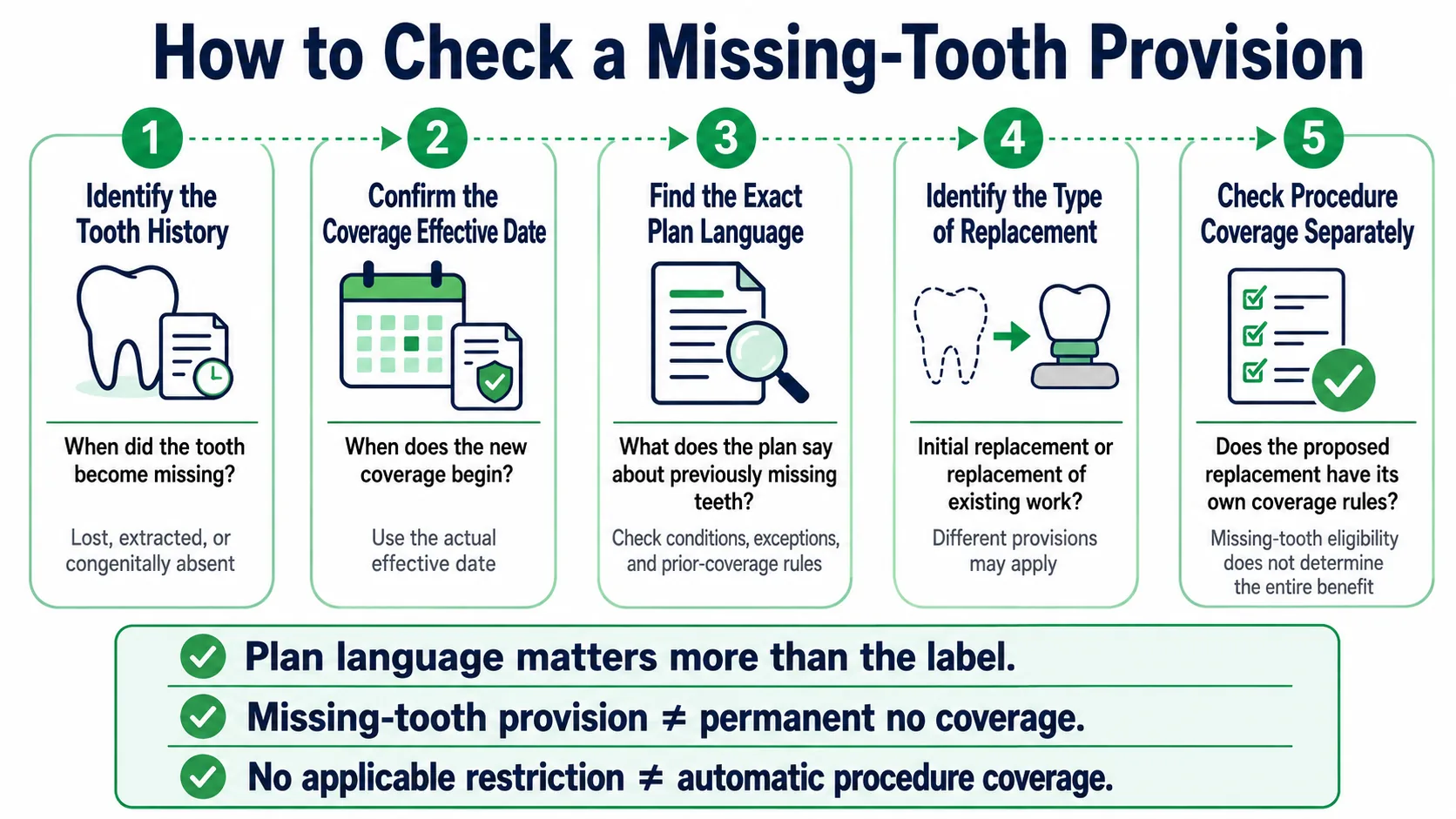
How to Check a Missing-Tooth Provision at a Glance
When a tooth is already missing before new dental coverage begins, three facts matter most: the tooth history, the coverage effective date, and the exact plan language. Then determine whether the proposed treatment is an initial replacement or replacement of existing dental work.
What Are Missing Tooth Clauses in Dental Insurance?
A missing tooth clause, or missing-tooth provision, is dental plan language that may restrict benefits for replacing a tooth that was already missing when the applicable coverage began.
The provision is part of the broader group of exclusions, limitations, and benefit conditions that can affect dental coverage.
The important distinction is:
The replacement procedure and the history of the tooth being replaced are separate benefit questions.
For example, a dental plan may generally provide benefits for implants, bridges, dentures, or other tooth-replacement treatment.
That does not necessarily mean the same benefit is available when the tooth being replaced was already absent before the coverage effective date.
The exact effect depends on the wording of the plan.
Do not assume that the phrase “missing tooth clause” has one universal meaning across dental plans.
Why the Exact Plan Language Matters
“Missing tooth clause” is useful shorthand.
It is not a substitute for reading the dental plan documents.
Relevant language may appear under terms such as:
- Missing tooth or missing teeth
- Teeth missing before the effective date
- Teeth lost before coverage
- Replacement of previously missing teeth
- Initial placement of a prosthesis
- Pre-existing dental conditions
- Congenitally missing teeth
- Prosthodontic exclusions or limitations
The wording may determine:
- Which teeth are affected
- Which replacement services are affected
- Whether the provision applies to initial placement
- Whether a timing condition exists
- Whether an exception applies
- Whether prior dental coverage matters
- How congenitally missing teeth are treated
- What documentation may be required
That is why asking only:
“Does this plan have a missing tooth clause?”
may not provide enough information.
A more useful question is:
“How does this plan treat replacement of a tooth that was already missing before my coverage effective date?”
If the plan uses different terminology, focus on the meaning of the provision rather than the label.
The Three Facts to Compare Before Enrolling
Missing-tooth analysis usually begins with three pieces of information.
1. When Did the Tooth Become Missing?
Determine, when possible, when the tooth was lost, extracted, or otherwise became absent.
The relevant history may be available from:
- Previous dental records
- Extraction records
- Treatment history
- Other documentation from a prior dental office
If the date could affect the plan provision and you are unsure, do not guess.
Treat the date as Not confirmed until appropriate records or the dental office can clarify it.
2. When Does the New Coverage Become Effective?
Confirm the actual effective date stated for the new dental coverage.
For a missing-tooth provision, the coverage start date may need to be compared with the history of the natural tooth.
Do not assume that the date you applied or enrolled is automatically the date the dental coverage became effective.
The key question here is:
Was the natural tooth already missing before the applicable coverage began?
For the separate coverage-start framework, read Dental Insurance Effective Date: When Does Coverage Start?
3. What Does the Plan Actually Say?
The tooth-loss date and coverage effective date do not determine the result by themselves.
You still need to understand how the dental plan applies those facts.
Two plans can treat the same dental history differently.
The contract language is therefore the third and essential part of the analysis.
How to Interpret Common Missing-Tooth Situations
Different dental histories can raise different benefit questions.
Use the following framework to identify which plan provision needs closer review.
The table is not intended to predict coverage.
| Situation | What may matter | What to verify |
|---|---|---|
| Tooth was missing before coverage began | A missing-tooth or related provision may apply | Exact exclusion, limitation, condition, timing rule, or exception |
| Tooth was present when coverage began and lost later | A pre-enrollment missing-tooth provision may not describe the situation | Other benefit rules for the proposed replacement |
| Tooth was congenitally missing | The plan may address congenital absence separately | Specific contract wording |
| Prior continuous dental coverage exists | Prior coverage may matter under some provisions | Whether and how the new plan recognizes that coverage |
| An existing prosthesis needs replacement | A replacement provision may be more relevant | Which replacement rule applies |
| Several missing teeth have different histories | One prosthesis may involve teeth with different benefit histories | How the plan applies its provision to the proposed treatment |
The purpose of this framework is to identify what needs to be verified.
It should not be used to assume that a particular replacement treatment will or will not receive a benefit.
What If the Tooth Was Missing Before Coverage Began?
This is the situation most directly associated with a missing-tooth provision.
If the tooth was already absent before the dental coverage became effective, determine exactly what the plan says about replacing teeth that were previously missing.
Check:
- Whether the plan contains a missing-tooth, initial-placement, or related provision
- Which tooth-replacement services the provision affects
- Whether the rule is an exclusion, limitation, timing condition, or another type of benefit provision
- Whether the plan describes an exception
- Whether prior dental coverage affects the rule
- Whether the provision distinguishes initial replacement from replacement of an existing prosthesis
Do not assume that every plan treats a tooth missing before enrollment the same way.
And do not assume that a missing-tooth provision always creates permanent no coverage.
The exact wording determines how the rule applies.
What If the Tooth Was Lost After Coverage Began?
If the natural tooth was present when dental coverage became effective and was later lost or extracted, a provision specifically addressing teeth that were already missing before coverage began may not describe that situation.
That distinction is important.
However, it does not automatically mean that the proposed tooth-replacement treatment will receive a benefit.
The plan may still apply other rules to the replacement treatment.
The key distinction is:
A pre-enrollment missing-tooth provision may not apply when the tooth was lost after coverage began, but the replacement procedure still has to be evaluated under the other plan rules that apply to it.
Review the proposed treatment separately rather than treating the absence of a missing-tooth restriction as a coverage guarantee.
For treatment-specific benefit questions, use the Dental Procedure Coverage hub.
What If the Tooth Is Congenitally Missing?
A congenitally missing tooth is different from a natural tooth that developed and was later lost or extracted.
Because of that difference, do not assume that a dental plan will treat congenital absence the same way as a tooth that was already missing before coverage began.
The plan may address congenital absence specifically or include it within broader missing-tooth, initial-placement, or related benefit language.
The key distinction is:
Congenital absence should be evaluated under the exact plan language rather than assumed to follow the same rule as every other missing-tooth situation.
Before enrolling, check whether the plan specifically addresses replacement of congenitally missing teeth and how that provision applies to the treatment being considered.
A useful question is:
Does this plan specifically address replacement of a congenitally missing tooth, and where is that provision stated?
If the plan language is unclear, treat the result as not confirmed until the written documents or dental plan provide clarification.
Can Prior Dental Coverage Matter?
It may, depending on the dental plan.
Some missing-tooth or related provisions may take prior or continuous dental coverage into account.
However, prior coverage should not automatically be assumed to remove a missing-tooth restriction.
If you had previous dental coverage, verify:
- Whether the new plan considers prior coverage under its missing-tooth provision
- Whether any continuity requirement applies
- What documentation the new plan requires
- How the plan describes the effect of prior coverage
The key principle is:
Prior dental coverage may matter only to the extent that the current plan’s language says it does.
Use the provision in the new dental plan rather than assuming that continuous coverage automatically preserves or creates a tooth-replacement benefit.
What If You Already Have a Bridge, Denture, or Other Prosthesis?
If a bridge, denture, or other dental prosthesis already exists and now needs replacement, the insurance question may be different from the initial replacement of a natural tooth that was already missing.
A missing-tooth provision generally focuses on the history of the natural tooth before the applicable coverage began.
Once existing dental work is being replaced, a replacement provision may become the more relevant rule.
The key distinction is:
Initial replacement of a previously missing natural tooth and replacement of an existing dental prosthesis are not necessarily the same insurance question.
Do not assume that the original missing-tooth provision determines whether an existing bridge, denture, or other prosthesis qualifies for another replacement benefit.
For the detailed framework on prior placement history and replacement provisions, read Dental Insurance Replacement Rules Explained: What to Check Before Replacing Dental Work.
What If Several Missing Teeth Have Different Histories?
When a proposed bridge, denture, or other prosthesis replaces several missing teeth, those teeth may not all have the same history.
For example:
- One tooth may have been missing before coverage began
- Another may have been lost after coverage became effective
- Another may be congenitally missing
- Another may previously have been replaced
Do not assume that one tooth’s history automatically determines how the dental plan will treat the entire proposed prosthesis.
Likewise, do not assume that the plan will evaluate every tooth independently or provide a particular partial benefit.
The important question is:
How does this dental plan apply its missing-tooth provision when one proposed treatment involves teeth with different histories?
Confirm which teeth, dates, and plan provisions are being used when the treatment is evaluated.
This is a plan-specific question and should not be resolved by applying a general rule from another dental policy.
Missing Tooth Clause vs Other Dental Plan Rules
A missing-tooth provision is only one rule that can affect tooth-replacement benefits.
Keeping related provisions separate helps avoid several common misunderstandings.
Missing Tooth Clause vs Waiting Period
A missing-tooth provision generally focuses on the history of the tooth:
Was the tooth already missing before the applicable coverage began, and what does the plan say about replacing it?
A waiting period generally focuses on time after enrollment:
Has the required period after coverage began passed before a particular benefit becomes available?
These are different rules.
A dental plan may contain both.
Do not assume that completing a waiting period automatically removes a missing-tooth restriction unless the plan language specifically supports that conclusion.
For the separate enrollment-timing mechanism, review How Waiting Periods Work in Dental Coverage.
Missing Tooth Clause vs Replacement Limitation
A missing-tooth provision generally concerns a natural tooth that was already missing before the applicable coverage began and how that history may affect an initial tooth-replacement benefit.
A replacement limitation generally concerns dental work that already exists and whether another benefit may be available to replace it.
Both can involve treatment history, but they answer different questions.
The key distinction is:
Missing tooth = history of the natural tooth before coverage. Replacement limitation = history of dental work that already exists.
If an existing restoration or prosthesis is being replaced, review the applicable replacement provision rather than assuming that the original missing-tooth rule controls the entire benefit decision.
For the detailed replacement framework, read Dental Insurance Replacement Rules Explained: What to Check Before Replacing Dental Work.
Missing Tooth Clause vs Procedure Coverage
A missing-tooth provision and procedure coverage answer different questions.
The missing-tooth question is:
Does the history of the natural tooth affect eligibility for a replacement benefit?
The procedure-coverage question is:
What benefit, if any, does the plan provide for the proposed replacement treatment?
A missing-tooth provision may not apply to a particular situation while the proposed implant, bridge, denture, or other treatment is still subject to its own coverage rules.
The key distinction is:
Resolving the missing-tooth question does not establish coverage for the replacement procedure.
For procedure-specific questions, use the Dental Procedure Coverage hub.
Missing Tooth Clause vs Alternate Benefit
A missing-tooth provision and an alternate-benefit provision address different parts of the benefit decision.
A missing-tooth provision focuses on whether the history of the natural tooth affects eligibility for a replacement benefit.
An alternate-benefit provision may affect how the plan calculates a benefit when another covered treatment option is used as the payment basis.
The key distinction is:
Missing-tooth provision = tooth history and benefit eligibility. Alternate benefit = how an available benefit may be calculated.
One provision does not automatically resolve the other.
If alternate-benefit language may affect the proposed treatment, review that provision separately in the official plan documents.
Missing Tooth Clause vs General Existing Dental Problems
A missing-tooth provision is not a general rule for every dental problem that existed before enrollment.
This guide focuses on a specific situation:
A natural tooth was already missing before the applicable dental coverage began, and the plan may contain language affecting benefits for replacing that tooth.
Other pre-enrollment situations can involve different provisions.
For example, treatment that was already recommended, dental work that already existed, or treatment that had already begun may require a different analysis.
The key distinction is:
Existing dental problem is the broader situation. A missing-tooth provision is one specific rule that may apply within that broader situation.
Identify the dental circumstance first, then determine which plan provision actually applies.
For the broader pre-enrollment framework, read Dental Insurance and Existing Dental Problems: What to Check Before Enrolling.
What to Check Before Enrolling
If a natural tooth is already missing, do not rely only on a plan’s general list of covered dental services.
Focus first on the facts that determine whether a missing-tooth provision may be relevant:
- Which natural tooth is missing
- Whether the tooth was already missing before the applicable coverage began
- The actual dental coverage effective date
- The exact missing-tooth, initial-placement, or related plan language
- Whether the plan states any relevant conditions, exceptions, or prior-coverage provisions
- Whether the proposed treatment is an initial replacement of the missing tooth or replacement of dental work that already exists
Then review the proposed replacement treatment separately under the other plan provisions that apply to it.
The key distinction is:
First determine whether the tooth’s history triggers a missing-tooth provision. Then evaluate the proposed treatment under its own coverage rules.
If the coverage start date is unclear, review Dental Insurance Effective Date: When Does Coverage Start?
If existing dental work is being replaced, use Dental Insurance Replacement Rules Explained: What to Check Before Replacing Dental Work.
For treatment-specific benefit questions, use the Dental Procedure Coverage hub.
Questions to Ask the Dental Plan Before Enrolling
If you already have a missing tooth, specific questions are more useful than asking only whether the plan “covers missing teeth.”
Ask:
- Does this plan restrict benefits for a natural tooth that was already missing before the applicable coverage effective date?
- What exact missing-tooth, initial-placement, or related provision applies?
- Which tooth history and date would the plan use when applying that provision?
- Does the provision contain any conditions, exceptions, or rules involving prior dental coverage?
- Does the plan address congenitally missing teeth separately?
- Is the proposed treatment an initial replacement of the missing tooth, or would it replace dental work that already exists?
- Where can I find the applicable provision in the official plan documents?
The most useful question is:
How does this specific plan treat replacement of this tooth based on its history and the applicable coverage effective date?
If an answer cannot be confirmed from the available plan materials, treat it as not confirmed rather than assuming that a benefit will or will not be available.
Remember that confirming the missing-tooth provision does not by itself confirm coverage for the proposed implant, bridge, denture, or other replacement treatment.
Can Predetermination Help Before Tooth-Replacement Treatment?
It may provide useful information when tooth-replacement treatment is already being considered.
A pretreatment review may help show how the dental plan currently expects to apply its missing-tooth provision to the proposed treatment and the information submitted.
However, it should not automatically be treated as a guarantee of final claim payment.
The key distinction is:
Pretreatment review can provide information about how the plan currently expects to apply its terms, but it does not replace the actual missing-tooth provision or guarantee the final benefit decision.
If a missing-tooth issue could affect proposed treatment, review the plan language first and use any pretreatment response as additional information.
For the full distinction between these processes, read Dental Insurance Predetermination vs Preauthorization: What’s the Difference?
What If the Plan Later Applies a Missing-Tooth Restriction?
If an EOB or final benefit decision refers to a missing-tooth provision, first identify exactly what the dental plan relied on.
Verify:
- Which tooth or teeth are involved
- Which missing-tooth or related provision was applied
- Which tooth-loss or extraction date the plan used
- Which coverage effective date the plan used
- Whether the dental history appears accurate
- Whether the treatment is an initial replacement or replacement of existing dental work
- Whether any relevant condition, exception, or prior-coverage provision was considered
Then compare those facts with the actual plan language.
A disagreement may involve incorrect factual information, interpretation of the plan provision, or both.
The key question is:
Did the dental plan apply the correct provision to the correct tooth history and coverage information?
If you believe a final benefit decision used incorrect information or applied the plan provision incorrectly, use Dental Insurance Claim Denied? How to Review the Decision and Appeal for the separate claim-review and appeal framework.
Missing-Tooth Benefits and Clinical Treatment Are Different Questions
A missing-tooth provision addresses how the dental plan applies its benefit terms.
It does not determine whether replacing the tooth is clinically appropriate.
The treating dental professional determines which treatment options may be appropriate based on the patient’s oral-health needs.
The dental plan answers a different question:
What benefit, if any, does the plan provide toward the proposed treatment under its terms?
These decisions should remain separate.
A dental professional may recommend treatment even when the plan provides limited or no benefit. Likewise, the availability of an insurance benefit does not determine which treatment is clinically appropriate.
The key distinction is:
Clinical question: What treatment is appropriate?
Insurance question: What benefit does the plan provide?
Common Mistakes to Avoid
When reviewing a missing-tooth provision, avoid these common assumptions:
- Looking only at a list of covered services. A plan may list implants, bridges, dentures, or other replacement services while separately applying a provision to teeth that were already missing before coverage began.
- Assuming every missing-tooth provision works the same way. The wording, conditions, exceptions, and circumstances affected can vary by plan.
- Assuming the provision always means permanent no coverage. The actual plan language determines how the provision works.
- Assuming prior dental coverage automatically changes the result. Prior or continuous coverage matters only when the current plan says that it does.
- Confusing initial tooth replacement with replacement of existing dental work. These situations can involve different plan provisions.
- Assuming that no applicable missing-tooth restriction guarantees coverage. The proposed implant, bridge, denture, or other treatment must still be reviewed under the plan rules that apply to that procedure.
The central principle is:
Do not predict the benefit from the label “missing tooth clause.” Compare the tooth history, coverage effective date, and actual plan language.
How to Check a Missing-Tooth Provision Before Enrolling
If you already have a missing tooth and are considering new dental coverage, review the issue in a consistent order.
1. Identify the Missing Tooth and Its History
Confirm:
- Which natural tooth is missing
- When it became missing
- Whether it was lost, extracted, or congenitally absent
- Whether available dental records support that history
If an important date cannot be confirmed, treat it as not confirmed rather than guessing.
2. Confirm the Coverage Effective Date
Use the effective date stated for the dental coverage.
The important comparison is whether the natural tooth was already missing before that applicable coverage began.
Do not substitute an application, enrollment, payment, or plan-selection date unless the plan identifies it as the effective date.
For the separate coverage-start framework, read Dental Insurance Effective Date: When Does Coverage Start?
3. Find the Exact Plan Provision
Review the full plan documents for language concerning:
- Missing teeth
- Teeth missing before coverage
- Initial placement
- Congenitally missing teeth
- Prosthodontic benefits
- Related exclusions, limitations, or conditions
Read the complete provision rather than relying only on the label “missing tooth clause.”
Determine what the provision actually says about the tooth history you are reviewing.
4. Determine Whether This Is Initial Replacement or Replacement of Existing Dental Work
Identify whether the proposed treatment would replace a natural tooth that has not previously been replaced or would replace dental work that already exists.
These situations can involve different provisions.
If an existing bridge, denture, implant restoration, or other prosthesis is being replaced, use Dental Insurance Replacement Rules Explained: What to Check Before Replacing Dental Work for the separate replacement framework.
5. Apply Any Conditions or Exceptions to the Actual Tooth History
Check whether the applicable provision addresses factors such as:
- Prior or continuous dental coverage
- Congenital absence
- Exceptions
- Documentation requirements
- Other conditions stated in the provision
Do not assume that a condition or exception applies unless the plan language supports it.
The question is:
How does this specific provision apply to this tooth history and this coverage effective date?
6. Review the Proposed Replacement Treatment Separately
After determining how the missing-tooth provision applies, review the proposed implant, bridge, denture, or other treatment as a separate coverage question.
The key distinction is:
Missing-tooth analysis determines how tooth history may affect the benefit. It does not by itself establish coverage for the replacement procedure.
For procedure-specific benefit questions, use the Dental Procedure Coverage hub.
The central principle is:
Tooth history + coverage effective date + actual plan language determine the missing-tooth analysis.
Do not assume that a missing-tooth provision always means permanent no coverage.
And do not assume that the absence of an applicable missing-tooth restriction guarantees coverage for the proposed replacement treatment.
Helpful Resources
- Dental Insurance Basics
- Dental Insurance Effective Date: When Does Coverage Start?
- Dental Insurance Replacement Rules Explained: What to Check Before Replacing Dental Work
- Dental Insurance and Existing Dental Problems: What to Check Before Enrolling
- Dental Insurance Exclusions and Limitations: What to Check Before Enrolling
- How Waiting Periods Work in Dental Coverage
Frequently Asked Questions
What Is a Missing Tooth Clause in Dental Insurance?
A missing tooth clause, or missing-tooth provision, is plan language that may affect benefits for replacing a natural tooth that was already missing before the applicable dental coverage began.
The exact effect depends on the wording of the specific dental plan.
Do All Dental Insurance Plans Have a Missing Tooth Clause?
No universal assumption should be made.
Dental plans can use different exclusions, limitations, conditions, terminology, and benefit rules.
Review the actual plan documents for missing-tooth, initial-placement, prosthodontic, congenital-absence, or related language rather than assuming every plan uses the same provision.
Does a Missing Tooth Clause Always Mean Permanent No Coverage?
No.
The phrase “missing tooth clause” does not describe one universal rule.
A provision may operate differently depending on its wording, conditions, exceptions, prior-coverage language, and other plan-specific terms.
The actual contract language controls.
Is a Missing Tooth Clause the Same as a Waiting Period?
No.
A missing-tooth provision generally focuses on whether a natural tooth was already missing before the applicable coverage began and how that history affects a replacement benefit.
A waiting period generally focuses on when a particular benefit becomes available after coverage begins.
A dental plan may contain both provisions.
For the separate timing framework, read How Waiting Periods Work in Dental Coverage.
Can Prior Dental Coverage Affect a Missing Tooth Provision?
It may, depending on the current dental plan.
Some provisions may take prior or continuous dental coverage into account, while others may apply different conditions.
Do not assume that previous coverage automatically removes a missing-tooth restriction.
Verify what the current plan says and what documentation, if any, it requires.
What If the Tooth Was Congenitally Missing?
A congenitally missing tooth has a different history from a natural tooth that developed and was later lost or extracted.
A dental plan may address congenital absence specifically or through broader missing-tooth, initial-placement, or related language.
Do not assume that congenital absence will be treated the same way under every dental plan.
What Should I Check Before Enrolling If I Already Have a Missing Tooth?
Start with three facts:
When the natural tooth became missing
When the new dental coverage becomes effective
What the actual plan language says about replacing teeth that were already missing
Then determine whether the proposed treatment is an initial replacement of the missing tooth or replacement of dental work that already exists.
The central question is:
How does this specific dental plan apply its provision to this tooth history and coverage effective date?
For the broader pre-enrollment framework, read Dental Plans Guide.
Sources
- American Dental Association — Typical Dental Plan Benefits and Limitations
- American Dental Association — Glossary of Dental Terms
- American Dental Association — Least Expensive Alternative Treatment Clause
- American Dental Association — Pre-Authorizations
- American Dental Association — Eligibility Verification
About the Author
Maria Dumitru is the Founder and Content Editor of Dental Coverage Hub. She researches and edits educational content designed to help U.S. consumers understand dental insurance exclusions, limitations, missing-tooth provisions, enrollment-related benefit rules, and the information they may need to verify before choosing coverage.
Learn more about our standards in the Editorial Policy and How We Review Dental Plans.
This article provides general educational information and is not dental, medical, legal, financial, or personalized insurance advice. Missing-tooth provisions, effective-date rules, prior-coverage provisions, congenital-absence rules, waiting periods, replacement limitations, alternate-benefit provisions, procedure coverage, eligibility requirements, exclusions, cost sharing, and other dental benefits can vary by plan, procedure, treatment history, service date, state, and individual circumstances. Review the controlling plan documents and contact the applicable dental plan or plan administrator for information about the provisions that apply to specific coverage.
Dental insurance benefit rules do not determine which tooth-replacement treatment is clinically appropriate. Questions about diagnosis, treatment options, treatment timing, or clinical care should be discussed with a qualified dental professional.

Understand the Missing-Tooth Rule Before You Enroll
If a tooth is already missing, a general list of covered procedures does not tell you the whole story. Compare the tooth history, coverage effective date, and exact plan language, then review the proposed replacement treatment separately.