
Does Dental Insurance Cover Dental Anesthesia or Sedation? What to Check Before Treatment
Understand how the exact service, treatment purpose, provider, billing method, and plan requirements can affect anesthesia or sedation benefits.
Written and researched by Maria Dumitru.
Founder and Content Editor at Dental Coverage Hub
Last reviewed: November 2026
What You’ll Learn
- How local anesthesia differs from separately evaluated sedation services
- Why IV sedation does not identify one universal insurance benefit
- Which treatment, provider, and documentation details to verify
- How separate charges and time-based billing can affect an estimate
- When to check dental and medical coverage
- What to review before treatment and after claim processing
Quick Answer: Does Dental Insurance Cover Dental Anesthesia or Sedation?
Dental insurance may provide benefits for certain anesthesia or sedation services, depending on the exact service, the treatment it accompanies, and the plan’s requirements.
Local anesthesia is generally considered part of a surgical procedure rather than a separately billed service. Nitrous oxide, other sedation services, and general anesthesia may be subject to different benefit provisions.
Coverage for the dental procedure does not automatically establish a separate benefit for sedation or general anesthesia.
Before treatment, identify what is planned, whether it is included or separately charged, who will provide it, and what the applicable plan requires.
Key Takeaways
- Local anesthesia, sedation, and general anesthesia are not interchangeable terms
- IV describes a route of administration, not a single sedation level or benefit
- An included service and an excluded service are different billing situations
- A separate anesthesia professional may create another network and billing question
- Required preauthorization should be distinguished from an optional benefit estimate
- Review the complete expected patient cost, including unresolved charges
In This Guide
Identify the Exact Anesthesia or Sedation Service
Start with the proposed service rather than a broad description such as sedation dentistry or being put to sleep.
Ask the dental office to identify the planned service and the procedure information it will use when requesting benefits.
| Service or term | What to clarify |
|---|---|
| Local anesthesia | Whether numbing the treatment area is included in the procedure |
| Nitrous oxide | Whether the proposed service has a benefit under the plan |
| Minimal or moderate sedation | The planned service, provider, reporting method, and applicable requirements |
| IV sedation | The actual sedation level and service; IV alone does not define them |
| Deep sedation or general anesthesia | The specific service, qualified provider, treatment setting, and review requirements |
Local anesthesia numbs an area. Sedation and general anesthesia involve different effects on consciousness and responsiveness.
These terms describe aspects of care; they are not a universal insurance classification system. Use the provider’s specific description when checking benefits.
Why IV Sedation Needs More Detail
IV describes how medication is administered. It does not, by itself, tell you which level of sedation is intended or which benefit applies.
Ask the provider what service is planned and how it will appear on the treatment estimate. Avoid assuming that every appointment described as IV sedation will be evaluated identically.
Check the Dental Procedure and Its Associated Anesthesia
The plan may consider the dental treatment being performed when evaluating a separately reported anesthesia or sedation service.
Identify:
- The underlying dental procedure
- Why the anesthesia or sedation is recommended
- Whether several procedures are planned during the appointment
- Whether anesthesia is included in another charge
- Which separate benefit provisions apply, if any
For example, a plan may recognize an extraction benefit while applying different requirements to sedation used during that extraction.
For procedure-specific questions, read Does Dental Insurance Cover Wisdom Teeth Removal? What to Check Before Treatment.
A clinical recommendation and an insurance benefit determination answer different questions. Discuss the proposed approach, alternatives, and clinical concerns with the treating professional. Ask the plan separately about benefits and documentation requirements.
Confirm What Is Included and What Is Separately Charged
A treatment estimate should distinguish included services from additional charges.
Local anesthesia is generally considered an inherent component of a surgical procedure and is not separately reported or billed. If a separate charge appears, ask the office to explain what it represents and how the plan treats it.
For other anesthesia or sedation services, ask:
- Is this included in the dental procedure fee?
- Is there a separate professional charge?
- Does another provider issue a separate bill?
- Are facility charges included in this estimate?
- Which charges remain unconfirmed?
Separate reporting does not automatically establish separate insurance payment.
Likewise, no separate payment does not automatically mean that you owe an additional fee. The service may be included in another allowance, and applicable provider agreements or billing rules may affect patient responsibility.
If the Charge Depends on Time
Ask whether the proposed anesthesia charge uses time or units, and whether the estimate is provisional.
Clarify how a change in the actual service or billable duration could affect the charge and the expected benefit. The total appointment length is not necessarily the billable anesthesia time.
You do not need to select billing codes yourself. The provider should explain the proposed estimate and accurately report the service performed.
Verify the Provider and Treatment Location
The treating dentist or oral surgeon may provide the anesthesia, or a separate qualified anesthesia professional may be involved.
Confirm the name of each billing provider and the exact location of treatment. Then verify participation with both the applicable plan and the provider’s office.
An in-network dental office does not establish the network status of every professional involved. If medical coverage is being considered, dental-network participation does not establish medical-network participation.
For the broader network framework, read In-Network vs Out-of-Network Dental Insurance.
Check for Separate Facility Charges
If treatment takes place at a hospital, surgical center, or another facility, ask whether the estimate includes the facility’s charges.
A quote from the dentist or anesthesia provider may cover only that provider’s services.
For treatment involving several providers or separate facility charges, review the broader oral surgery coverage framework.
Review the Plan Requirements That Affect Your Service
Use the current benefit schedule, exclusions, limitations, and any applicable anesthesia policy. A general statement that sedation is available is not enough to establish your benefit.
| Detail to verify | Question to ask |
|---|---|
| Eligible service | Does the plan recognize the exact proposed anesthesia or sedation service? |
| Treatment circumstances | Does eligibility depend on the accompanying dental procedure or documented circumstances? |
| Coverage timing | Will coverage be active, and does an applicable waiting period remain? |
| Supporting information | What treatment records or clinical explanation are required? |
| Provider and location | Must a particular provider type, network, referral, or setting requirement be met? |
| Cost-sharing | What deductible, copay, coinsurance, or allowance applies? |
| Benefit limits | Do remaining annual benefits or service-specific limits affect payment? |
| Advance review | Is approval required before treatment? |
If an annual maximum applies, check whether anesthesia payments use the same remaining benefits as the dental treatment. Read Dental Insurance Annual Maximums Explained for the broader explanation.
What If Sedation Is Recommended Because of Anxiety?
Tell the treating professional about your concerns and discuss the clinical options.
For insurance purposes, ask whether the plan recognizes the proposed service in your circumstances and what documentation it requires. Neither a patient’s preference nor a clinical recommendation alone establishes payment.
Avoid assuming that anxiety-related sedation is always covered or always excluded.
Could Medical Insurance Be Relevant?
Some circumstances may warrant checking medical coverage as well as dental coverage.
However, IV administration, general anesthesia, a separate anesthesiologist, or a hospital setting does not by itself establish medical benefits.
Ask the applicable plans and billing offices:
- Which proposed services should be submitted to which plan?
- What supporting information or authorization is required?
- Are the relevant professionals and facility participating providers?
- Is another plan’s decision needed before processing?
- Who will submit each claim?
Do not assume that medical insurance will pay because the dental plan declines a service. Likewise, do not add two preliminary benefit estimates together without confirming how the plans handle the services involved.
Distinguish Required Approval From an Optional Estimate
Before treatment, establish whether the plan requires preauthorization or offers an optional predetermination of benefits.
If approval is required, confirm who will request it and what the response covers. Check the identified service, provider, location, authorized scope, and applicable dates or conditions.
An optional estimate can help with financial planning, but it does not replace a required approval.
A favorable pretreatment response should not be treated as an unconditional guarantee of final payment. Eligibility, remaining benefits, and the services actually performed may affect the final claim.
For the full distinction, read Dental Insurance Predetermination vs Preauthorization: What’s the Difference?
If treatment is urgent, discuss timing with the treating professional and ask the plan how any required review should be handled.
Review One Complete Treatment Estimate
Before relying on a quoted patient cost, confirm that the estimate accounts for all expected billing parties.
| Treatment component | What the estimate should clarify |
|---|---|
| Dental procedure | The treatment and its expected patient cost |
| Anesthesia or sedation | Whether included or separately charged |
| Separate anesthesia professional | Whether that professional’s estimate is included |
| Facility | Whether a separate facility bill is expected |
| Related services | Which additional services are included or require another estimate |
For each separate charge, identify the expected plan payment, estimated patient responsibility, and anything still unresolved.
A missing estimate should be marked not yet confirmed, rather than treated as no additional cost.
Keep the written estimate and any plan response. Ask what changes would require the office to update the estimate before treatment.
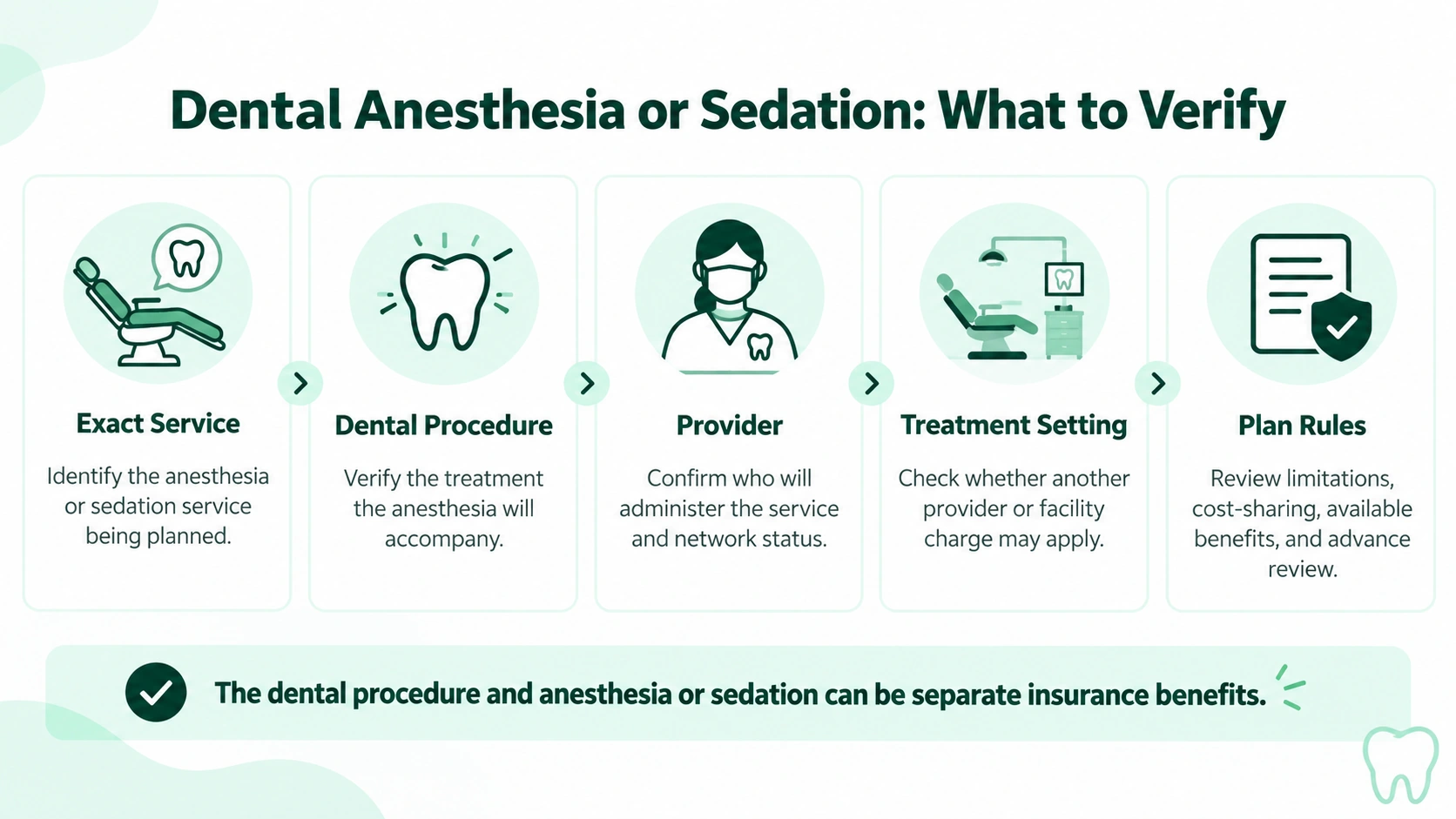
How to Interpret Anesthesia or Sedation Coverage
| Statement or result | How to interpret it |
|---|---|
| Anesthesia is included | Clarify which service is included and in which fee; this does not automatically include every sedation option |
| Sedation is covered | Verify the exact service and circumstances to which the benefit applies |
| IV sedation is planned | Ask for the actual sedation service and its proposed reporting details |
| The dental office is in-network | Verify any separate anesthesia provider and facility |
| Preauthorization was approved | Read its scope, conditions, and continuing eligibility requirements |
| No separate payment appears | Check whether the service was included, limited, excluded, or affected by another rule |
| The dental plan declined payment | Do not assume that medical coverage automatically becomes available |
After Treatment, Compare the Explanation With the Bill
If the plan issues an Explanation of Benefits, review the anesthesia entry alongside the associated dental treatment.
Check the provider, service description, any reported units, plan allowance, payment, patient responsibility, and explanatory remarks. Compare these with the correct provider’s bill.
If the service or units appear incorrect, ask the billing office to review what was submitted. If the information is accurate but you disagree with the benefit decision, identify the reason and the applicable review or appeal process.
An EOB is not a bill. For help interpreting it, read How to Read a Dental Insurance EOB: Payments, Adjustments, and Patient Responsibility.
Helpful Resources
- Dental Insurance Coverage for Common Procedures
- Does Dental Insurance Cover Oral Surgery? What to Check Before Treatment
- Does Dental Insurance Cover Wisdom Teeth Removal? What to Check Before Treatment
- In-Network vs Out-of-Network Dental Insurance
- Dental Insurance Predetermination vs Preauthorization: What’s the Difference?
- How to Read a Dental Insurance EOB
Frequently Asked Questions
Does dental insurance cover dental anesthesia or sedation?
It may cover certain services under specified conditions. Check the exact anesthesia or sedation service, accompanying treatment, provider, and plan requirements. Coverage for the dental procedure alone does not establish a separate sedation benefit.
Is local anesthesia included in dental treatment?
Local anesthesia is generally considered part of a surgical procedure rather than a separately reported or billed service. If your estimate shows an additional charge, ask what the charge represents and how it is handled.
Does dental insurance cover nitrous oxide?
Coverage depends on the plan and proposed treatment. Ask whether nitrous oxide is an eligible benefit in your circumstances and whether any limitations or member charges apply.
Does dental insurance cover IV sedation?
IV describes the route of administration, not one universal benefit. Confirm the actual sedation service, provider, proposed billing information, and applicable plan provisions.
Can sedation for dental anxiety receive a benefit?
It depends on the plan’s terms and the circumstances documented by the provider. Discuss clinical options with the treating professional, then verify coverage and documentation requirements separately.
Does coverage for wisdom teeth removal include sedation?
Not automatically. Confirm what is included in the extraction fee and whether the proposed sedation service has separate eligibility, approval, or cost-sharing requirements.
Does an in-network dentist mean the anesthesia provider is in-network?
No. A separate anesthesia professional or facility may have a different participation status. Verify each billing provider under the exact plan being used.
Can medical insurance pay for dental anesthesia?
It may be relevant in certain circumstances, but the anesthesia method or treatment location alone does not establish coverage. Ask the medical plan about the proposed services and any required documentation or approval.
Sources
- American Dental Association — Guidelines for the Use of Sedation and General Anesthesia by Dentists
- American Association of Oral and Maxillofacial Surgeons — Coding for Anesthesia Services
- American Dental Association — Typical Dental Plan Benefits and Limitations
- American Dental Association — Pre-Authorizations
- American Dental Association — Explanation of Benefits Statement
About the Author
Maria Dumitru is the founder and content editor of DentalCoverageHub. She creates consumer-focused educational content designed to help readers understand dental insurance benefits, limitations, and plan rules before making coverage decisions.
Learn more about our standards in the Editorial Policy and How We Review Dental Plans.
Disclaimer
This article provides general educational information and is not medical, dental, insurance, or legal advice. Coverage, provider requirements, billing rules, and patient costs vary by plan and circumstances. Verify current benefits with the insurer or plan administrator and discuss treatment choices, risks, and timing with the treating professional. Estimates and pretreatment responses do not establish an unconditional guarantee of payment.

Explore Coverage for the Dental Treatment You Need
Anesthesia or sedation is one part of a treatment plan. Review the underlying dental procedure as well, including its related services, limitations, and expected patient costs.