

How Dental Insurance Claims Work: From Treatment to Your EOB
Learn who submits a dental claim, how the plan reviews it, what different claim statuses mean, and how to follow the result through to your EOB.
Written and researched by Maria Dumitru.
Founder and Content Editor at Dental Coverage Hub
Last reviewed: October 2026
Understanding how dental insurance claims work helps you follow what happens after treatment and identify why a payment may differ from the estimate.
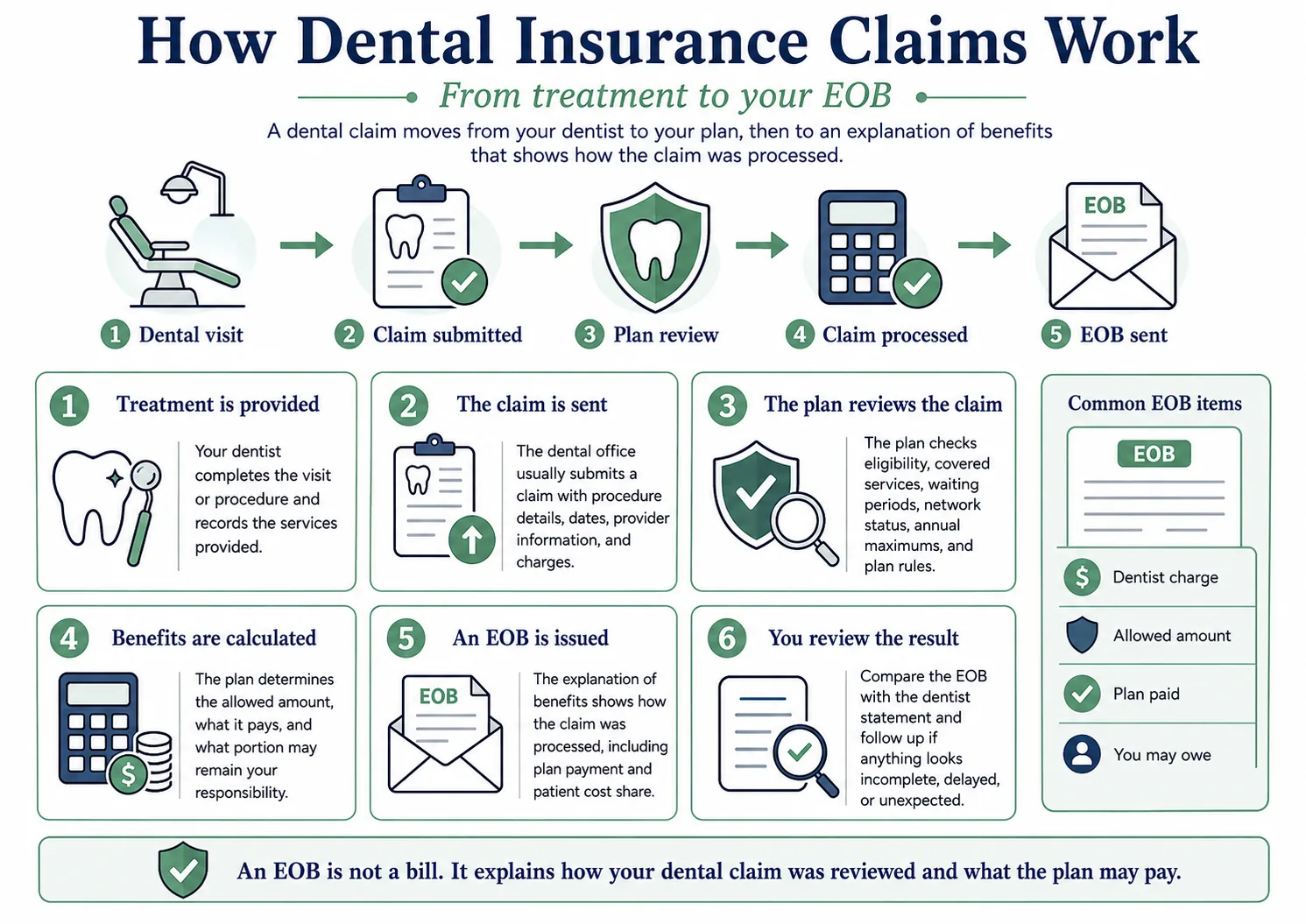
For plans that process individual service claims, the dental office or patient reports the care provided. The plan reviews that information under the applicable coverage terms and explains the result.
The basic path is:
Treatment → Claim Submission → Plan Review → Benefit Decision → EOB
Submission does not guarantee payment. A useful review starts by confirming what was submitted, whether the plan received it, and what action is needed next.
What You’ll Learn
- What a dental claim contains and who submits it
- How the plan reviews services and calculates benefits
- How received, pending, rejected, and denied statuses can differ
- What to do when information is missing or incorrect
- How payment and the EOB relate to the dental-office bill
- Which records and deadlines to track
For an introduction to coverage and benefit terms, start with Dental Insurance Basics.
Quick Answer
A dental insurance claim requests benefit processing for reported dental services.
After receiving the claim, the plan checks relevant eligibility, procedures, provider information, supporting records, and benefit provisions. This review is called adjudication.
The plan may request information, pay a benefit, apply cost sharing or limitations, or deny all or part of the request. An Explanation of Benefits, or EOB, generally explains how the services were processed.
The claim requests benefits. The plan reviews the request. The EOB explains the result. The dental office bills the patient separately.
This guide focuses on claims for care already provided. Required approval before treatment is addressed in the predetermination and preauthorization guide.
Key Takeaways
- Confirm that the plan received the claim; submission alone does not establish receipt
- Review each service separately rather than judging the entire claim by one payment
- Read notices carefully because missing information can result in either further review or a denial
- Check filing, documentation, and appeal deadlines separately
- Compare the EOB with the dental-office statement and payments already made
- Correct factual errors without assuming that a correction automatically preserves appeal rights
In This Guide
What Is a Dental Insurance Claim?
A dental claim is a request for the plan to evaluate reported services under the applicable benefits.
It supplies information about the patient, provider, treatment, dates, and charges. Some procedures also require supporting records.
The plan uses that information to determine whether the service qualifies and how any benefit should be calculated. A procedure appearing on a claim does not establish that it is covered.
This claim-based process is common in PPO and indemnity arrangements. DHMO or capitation arrangements may handle provider payment and service reporting differently, so confirm your plan’s process.
Who Submits the Claim?
The dental office often submits claims on the patient’s behalf. In some situations, the patient may need to submit the request.
Before leaving the office, confirm:
- Whether the office will submit the claim
- Which plan will receive it
- Whether you need to supply information or documents
- Whether payment is expected from you before insurance processing
- Who should follow up if the claim does not appear
If you must file it yourself, obtain the plan’s instructions and the information needed from the dental office. An ordinary receipt may not contain everything required.
Confirm the submission method and filing deadline. Keep copies and evidence of submission. If the office files for you, ask for the submission date and any available confirmation.
Who Receives the Insurance Payment?
Depending on the plan, provider arrangement, and any assignment of benefits, payment may go to the dental office or to you.
Do not assume that the office receives payment merely because it submitted the claim.
If you paid in advance, ask how any later insurance payment will be reconciled with your account, including whether a credit or refund is due.
What Information Does a Dental Claim Contain?
The exact requirements depend on the service and plan.
| Information | Why it matters |
|---|---|
| Patient and subscriber details | Identify the person receiving care and the applicable coverage |
| Provider information | Identify the treating or billing provider |
| Dates of service | Connect treatment with the relevant coverage period |
| Procedure codes and treatment areas | Describe the reported services and teeth or areas involved |
| Charges | Show the fees submitted for review |
| Other coverage information | Help determine whether coordination is needed |
| Treatment history and supporting records | Address procedure-specific requirements |
Supporting information may include clinical notes, relevant images, periodontal charting, or previous placement details.
The dental office should provide clinical documentation. Patients may need to supply enrollment information, other insurance details, or documents requested directly from them.
What Are CDT Codes?
CDT codes are standardized codes used to report dental procedures.
A code identifies the service reported; it does not establish whether the plan provides a benefit for that service.
If a code or treatment area appears incorrect, ask the dental office to check the record. Codes should reflect the treatment actually provided, rather than being changed simply to obtain a different benefit.
How the Dental Insurance Claim Process Works
1. Treatment Is Provided and Documented
The dental office records the services performed and the relevant treatment details.
If the actual care differs from an earlier treatment plan, the claim should reflect what occurred. The office may need to explain those differences or supply additional records.
One course of treatment can involve several procedures and claims. Conversely, several appointments for one procedure do not automatically create separately payable services.
2. The Claim Is Prepared and Submitted
The office or patient submits the information required by the plan.
Check that the request goes to the correct plan and that member details are current. Tell the office about other coverage and recent insurance changes.
For electronic submissions, an intermediary may transmit the claim. A transmission confirmation is not necessarily confirmation that the dental plan accepted it for review.
3. Receipt and Initial Processing Are Confirmed
The plan checks whether it can identify and process the request.
Missing identifiers, incomplete fields, or other submission problems may require correction before review can proceed.
If the claim is not visible in the member portal, ask the office and plan to confirm its status. Keep the claim number or other reference once available.
4. The Plan Adjudicates the Claim
Adjudication means reviewing the claim and applying the relevant benefit rules.
The plan may evaluate eligibility, the services reported, provider participation, documentation, and payment provisions. It may request more information before reaching a decision.
Some claims contain several service lines that receive different results.
5. The Plan Explains the Result
The plan generally issues an EOB or another claim notice showing how the submitted services were handled.
The result may include payment, adjustments, patient responsibility, or a denial of some or all requested benefits.
A document showing no payment may also identify information still needed. Read the status, explanation, and instructions together.
6. Payment and the Office Account Are Reconciled
Confirm whether payment was issued, who received it, and whether the dental office posted it.
Compare the office statement with the EOB and any amounts you already paid. If they do not agree, ask the office to explain the difference before assuming the remaining balance is correct.
More information may be requested
Submission is not approval. An EOB is not a bill.
What Does the Dental Plan Review?
Eligibility and Service Dates
The plan checks coverage for the relevant service date or other date defined for that procedure.
The date the claim is processed is not automatically the date that determines eligibility. A claim can be processed after coverage ends for a service that qualified under the earlier coverage.
Procedures and Benefit Requirements
The plan reviews how the reported services fit its benefits.
Waiting periods, exclusions, frequency limits, replacement provisions, authorization requirements, and supporting records may affect the result.
For the broader restriction framework, read Dental Insurance Exclusions and Limitations.
Provider and Network Information
The exact provider and network may affect benefit availability, recognized fees, and patient costs.
Claim submission by an office does not prove that the dentist participates in your network.
See In-Network vs Out-of-Network Dental Insurance.
Financial Provisions
For eligible services, the calculation may involve the plan allowance, deductible, copay or coinsurance, remaining annual benefits, and other payment rules.
The dentist’s submitted charge is not necessarily the amount used to calculate the benefit.
An available annual maximum does not make an otherwise ineligible service payable. For the payment framework, read Dental Insurance Costs Explained.
How to Interpret Dental Claim Statuses
Status labels vary by plan and submission system. Use the written explanation to determine what has happened.
| Status or message | What it may mean | Next check |
|---|---|---|
| Submitted | The sender transmitted the request | Did the plan receive it? |
| Received or accepted | The claim entered the processing system | Is anything needed before review? |
| Rejected or returned | A submission problem may prevent processing | What must be corrected, and how should it be resubmitted? |
| Pending or under review | A decision is still outstanding | What is causing the delay? |
| Additional information requested | Records or clarification are needed | Is the claim still pending, or has a denial been issued? |
| Processed with payment | A benefit was calculated | Which services were paid, and who receives payment? |
| Processed with reduced or no payment | Cost sharing, a limitation, or an adverse decision may apply | What does the explanation say for each service? |
Do not rely on the status label or payment amount alone.
A missing-document notice may accompany a denial. If the notice includes appeal rights or a deadline, do not disregard them because you are still gathering records.
What If the Plan Requests More Information?
Identify exactly what the plan needs and who should provide it.
The dental office may need to send treatment records or clarify a procedure. You may need to confirm subscriber information or other insurance coverage.
Ask:
- What information is missing?
- Who is responsible for sending it?
- What submission method and reference number should be used?
- What deadline applies?
- How will receipt be confirmed?
Keep copies of what was sent.
If the plan has already denied the request, determine whether the documents should accompany an appeal, corrected claim, or another permitted review process. Do not assume that sending records alone follows the required procedure.
How Long Does Claim Processing Take?
There is no single processing period that applies to every dental claim.
Timing can depend on the coverage arrangement, applicable law, completeness of the claim, and whether further information is needed.
Track these separately:
- The deadline to submit the original claim
- The plan’s time to make a decision
- The deadline to provide requested information
- The deadline to challenge an adverse decision
- The timing of payment after approval
For ERISA-covered employer plans, federal claims-procedure rules may apply. Other arrangements may follow different requirements.
If a claim remains pending, ask for the receipt date, reason for the delay, outstanding requirements, and expected next action. Check the plan documents and applicable notices rather than relying on a general online estimate.
Why Can a Claim Receive Reduced or No Payment?
A low or zero payment does not identify the reason by itself.
The result may involve:
- A deductible or other cost sharing
- An exhausted benefit limit
- An exclusion or service-specific restriction
- Incorrect eligibility or provider information
- Missing documentation
- Another plan that must process first
- A denial of the requested benefit
A claim may contain paid services and denied services at the same time.
Review each service line and its explanation. Ordinary patient cost sharing, an incomplete review, and a denial require different follow-up.
A plan may also evaluate clinical criteria for benefit purposes. That review does not replace the discussion with your dentist about diagnosis, treatment options, and clinical needs.
What If Something on the Claim Is Wrong?
Compare the submitted information with the dental-office records.
Check the patient, service date, provider, procedure, treatment area, charge, and other coverage details.
For a factual submission error, ask the office to follow the plan’s corrected-claim procedure. Simply sending the same claim again may result in a duplicate rather than a correction.
If the submitted information is accurate but you disagree with the benefit decision, review the cited provision and available appeal process.
A correction and an appeal are different actions, and sometimes both need attention. Do not assume that a corrected claim or telephone inquiry pauses an appeal deadline.
Use Dental Insurance Claim Denied? How to Review the Decision and Appeal for the detailed review framework.
How Does the EOB Fit Into the Process?
The EOB explains how the plan processed the reported services. It is not the dental office’s bill.
It may show submitted charges, recognized amounts, adjustments, plan payment, patient responsibility, and explanatory remarks.
Compare it with the office statement and previous payments. A displayed patient amount should not be read without the claim explanation and account history.
For a line-by-line guide, read How to Read a Dental Insurance EOB.
What About an Earlier Predetermination or Authorization?
A pretreatment response addresses proposed care. A claim reports services actually provided.
If the final result differs from a written approval or estimate, compare the procedures, dates, provider, and conditions. Ask why the result changed rather than assuming either document automatically settles the issue.
Read Dental Insurance Predetermination vs Preauthorization: What’s the Difference?
Special Situations That Can Affect Processing
More Than One Dental Plan
Tell the office and both plans about the coverage.
When coordination applies, confirm which plan processes first and what the other plan needs. The secondary plan may require the primary plan’s EOB, but it does not automatically pay the remaining balance.
Read Can You Have Two Dental Insurance Plans? Coordination of Benefits Explained.
Coverage Changes During Treatment
Identify completed procedures, unfinished work, and the dates each plan recognizes.
A new insurance card does not automatically move old claims or all remaining treatment to the new plan.
Use Dental Insurance and Treatment Already in Progress for those transition checks.
Our Recommendation
Keep a small record for each claim: services, submission date, plan receipt, reference number, current status, and next deadline.
Contact the dental office about treatment details and submitted records. Contact the plan about receipt, processing requirements, benefit explanations, and review rights.
Before deciding what to do next, establish what was submitted, what the plan decided, and what action the notice requires.
Helpful Resources
- Dental Insurance Basics
- How to Read a Dental Insurance EOB
- Dental Insurance Claim Denied? How to Review the Decision and Appeal
- Dental Insurance Predetermination vs Preauthorization
- Can You Have Two Dental Insurance Plans? Coordination of Benefits Explained
- Dental Insurance and Treatment Already in Progress
Frequently Asked Questions
Who submits a dental insurance claim?
The dental office often submits it, but patients may need to file in some circumstances. Confirm who will submit, what information is required, and the applicable filing deadline.
Does a submitted claim mean the plan received or approved it?
No. Confirm receipt separately, especially if the request passed through an electronic intermediary. Receipt also does not establish approval or payment.
What does dental claim adjudication mean?
It is the plan’s review of the reported services under the applicable benefit rules. The review can produce payment, adjustments, a request for information, or an adverse decision.
How long does a dental claim take to process?
Timing varies by the applicable rules and claim circumstances. Ask when the plan received the request, whether information is missing, and when a decision is expected.
Does a request for more information mean the claim is pending?
Not always. The request may relate to an ongoing review or accompany a denial. Read the notice and follow any documentation or appeal deadlines.
Why can the plan pay nothing for a covered procedure?
The result may involve a deductible, exhausted benefits, service-specific restrictions, or another issue. Check the explanation before assuming the procedure is excluded or the claim is still pending.
Is the EOB a bill?
No. It explains the plan’s processing result. Compare it with the dental-office statement and payments already made before treating a displayed amount as the remaining balance.
What should I do if the claim contains an error?
Ask the dental office to verify the records and follow the plan’s correction procedure. If an adverse decision has been issued, also check whether an appeal deadline requires action.
Sources
- American Dental Association — ADA Dental Claim Form
- American Dental Association — The CDT Code
- American Dental Association — Explanation of Benefits Statement
- American Dental Association — Responding to Claim Rejections
- U.S. Department of Labor — Filing a Claim for Your Health Benefits
The Department of Labor resource discusses rules for covered employment-based arrangements. Do not assume that every rule described applies to every dental policy.
About the Author
Maria Dumitru is the Founder and Content Editor of Dental Coverage Hub. She researches and edits educational content designed to help U.S. consumers understand dental insurance terminology, claim processes, benefit decisions, and the information they may need to review after dental treatment.
Learn more about our standards in the Editorial Policy and How We Review Dental Plans.
Disclaimer
This article provides general educational information for U.S. consumers and is not medical, legal, financial, or personalized insurance advice. Claim procedures, deadlines, benefit decisions, and patient costs vary by plan and applicable law. Review the relevant plan documents and notices, contact the insurer or administrator about benefits, and ask the dental office about treatment and billing records. This article does not confirm coverage or guarantee payment.

Follow Your Claim From Submission to Explanation
Confirm receipt, track requested information, and read the result for each reported service. Keep the EOB and office statement together so you can identify any unresolved difference.