
📚 Dental Plan Education
🇺🇸 Information for U.S. Consumers
📋 Practical Comparison Guidance

No Waiting Period Dental Insurance: What to Verify Before Enrolling
Learn what “no waiting period” actually means and how effective dates, first-year benefits, deductibles, networks, exclusions, and plan limits can affect your costs.
Written and researched by Maria Dumitru.
Founder and Content Editor at Dental Coverage Hub
Last reviewed: August 2026
What You’ll Learn
Dental insurance described as having no waiting period may allow certain eligible benefits to begin when the policy becomes effective. However, the phrase does not guarantee that every procedure is included, paid in full, or available on the date you submit an application.
A plan may make a service eligible immediately while still applying a deductible, copay or coinsurance, annual maximum, provider-network rule, frequency limit, treatment-in-progress exclusion, replacement rule, or reduced initial benefit.
This guide explains how to interpret no-waiting-period language, distinguish the application date from the effective date, verify whether a specific procedure is eligible, and estimate the amount you may still pay.
If you are still learning how dental waiting periods work, start with our How Dental Insurance Waiting Periods Work guide before comparing no-waiting-period plan options.
Quick Answer: What Is No Waiting Period Dental Insurance?
No waiting period generally means that an eligible covered service does not require an additional time-based waiting period after the policy becomes effective.
It does not mean that:
- Coverage begins on the application date.
- Every procedure is included.
- The plan pays the complete bill.
- Deductibles or cost sharing disappear.
- The dentist participates in the required network.
- Treatment started before coverage becomes effective is eligible.
- Annual maximums, frequency limits, or other restrictions do not apply.
Before enrolling, confirm the exact effective date, the procedure code and benefit category, the amount payable during the initial benefit period, the deductible, cost sharing, annual maximum, provider network, exclusions, and treatment-in-progress rules.
Use the policy, certificate of coverage, schedule of benefits, exclusions, and other official plan documents rather than relying only on the phrase “no waiting period.”
Key Takeaways
- No waiting period does not mean immediate enrollment, full payment, or coverage for every procedure.
- Benefits generally begin no earlier than the policy effective date.
- Preventive, basic, major, orthodontic, implant-related, and specialist services may follow different rules.
- A service can be eligible immediately while still being subject to deductibles, copays, coinsurance, annual maximums, network requirements, and exclusions.
- Reduced initial benefits or other first-period limits may affect how much the plan pays even when no service-specific waiting period applies.
- Treatment started before the effective date, missing-tooth provisions, replacement limits, and frequency rules may still prevent or reduce payment.
- Verify the exact procedure and obtain the official plan documents before enrolling or scheduling nonurgent treatment.
In This Guide
What Is Dental Insurance With No Waiting Period?
A dental benefit waiting period is the period between enrollment or the beginning of coverage and the date on which a person becomes eligible for a particular benefit.
A plan described as having no waiting period removes that additional time requirement for the services identified in its contract. Once the policy becomes effective, an eligible procedure may be considered under the plan’s normal benefit rules.
The phrase does not remove other conditions. Payment may still depend on:
- Whether the procedure is covered.
- How the procedure is classified.
- The dentist’s network participation.
- The plan’s allowed amount.
- The deductible.
- Copays or coinsurance.
- The annual maximum.
- Frequency and replacement limits.
- Treatment-in-progress provisions.
- Other exclusions or limitations.
A covered service is not necessarily paid in full. It means that the procedure may receive benefits according to the terms of the contract.
How No Waiting Period Dental Insurance Works
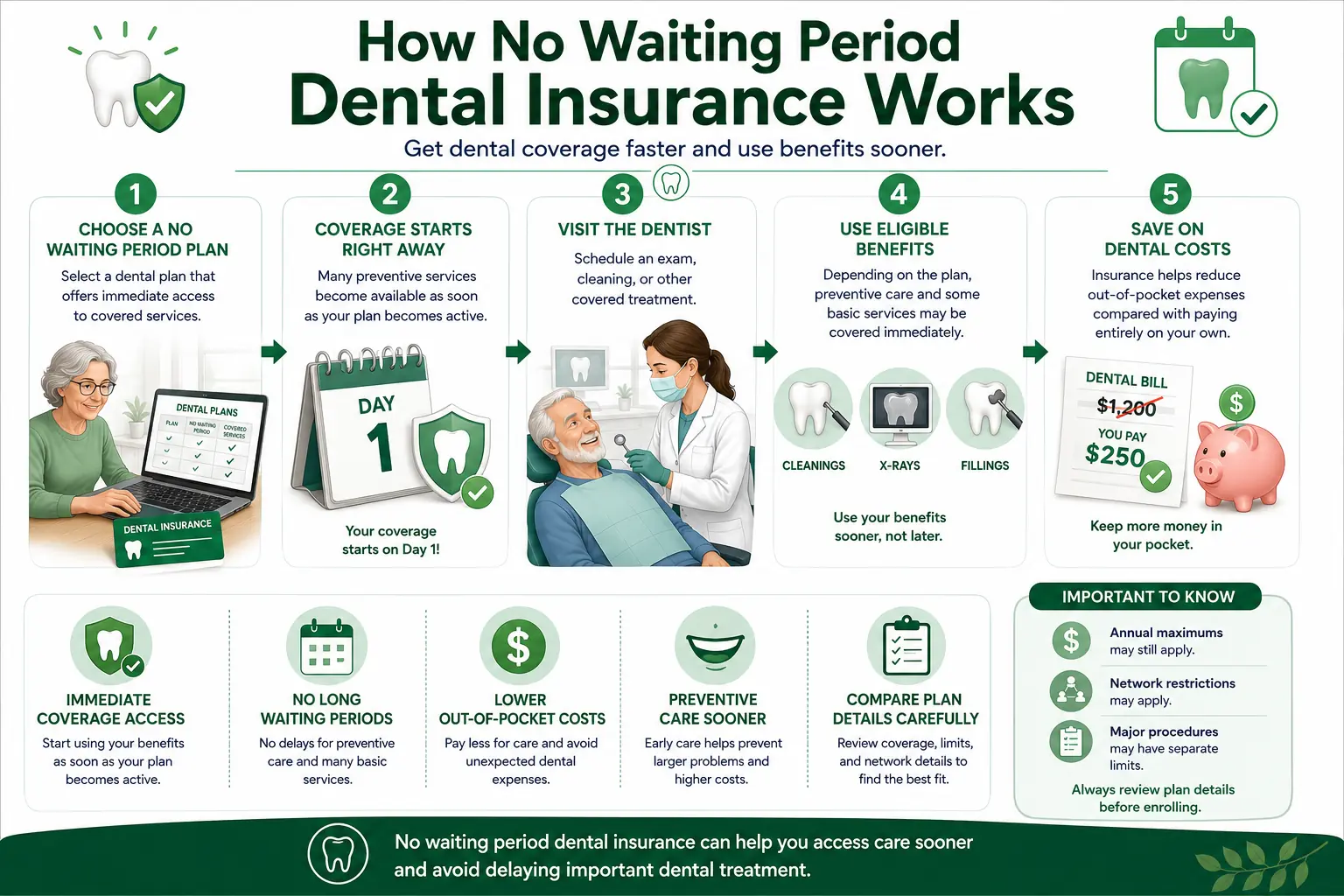
This overview summarizes how eligible benefits may begin when the policy becomes effective while deductibles, cost sharing, annual maximums, network requirements, and procedure-specific limitations may still apply.
Does No-Wait Coverage Begin Immediately?
The word “immediate” can be misleading unless the plan clearly identifies the date and services involved.
Application or Enrollment Date
This is the date you submit an application or enrollment request.
Submitting an application does not necessarily mean that coverage is active. The insurer may still need to process the enrollment, receive the required payment, or assign a future effective date.
Policy Effective Date
The effective date is the date the policy officially begins.
A plan described as having no waiting period generally makes eligible services subject to the plan’s normal benefit rules no earlier than this date.
Care received before the effective date is generally not made eligible simply because you enroll afterward.
Procedure Eligibility
The procedure must be included under the policy and satisfy the applicable benefit rules.
A policy may have no waiting period while still excluding or limiting implants, orthodontics, cosmetic treatment, replacement of missing teeth, treatment already in progress, or other services.
Benefit Determination
After confirming that the procedure is eligible, the plan applies its remaining rules. These may include:
- The deductible.
- Copays or coinsurance.
- The plan allowance.
- The annual maximum.
- Provider-network requirements.
- Frequency and replacement limits.
- Alternate-benefit provisions.
- Documentation or predetermination requirements.
In practical terms, “no waiting period” means that an additional service-specific time requirement does not apply after the policy becomes effective. It does not mean that every procedure will be approved, paid in full, or available on the application date.
Which Dental Services May Have No Waiting Period?
Dental plans commonly organize services into categories, but the classification of an individual procedure can differ between policies.
| Service category | Examples that may appear in the category | What to verify |
|---|---|---|
| Preventive and diagnostic care | Exams, cleanings, and routine X-rays | Effective date, frequency limits, age limits, deductible treatment, and network rules |
| Basic or restorative care | Fillings, some extractions, and selected periodontal or endodontic services | Exact procedure classification, deductible, cost sharing, and initial benefit level |
| Major care | Crowns, bridges, dentures, and complex restorative treatment | Coverage eligibility, annual maximum, replacement rules, alternate benefits, and treatment-in-progress provisions |
| Orthodontic care | Braces, clear aligners, and retainers | Age limits, lifetime maximums, provider requirements, treatment-in-progress rules, and separate waiting-period provisions |
| Implant-related care | Implant placement, abutments, and implant-supported restorations | Whether the service is covered, limited, classified differently, or excluded |
| Specialist services | Endodontic, periodontal, oral surgery, prosthodontic, and other specialist care | Specialist network participation, referrals, procedure classification, and applicable fee arrangements |
These are general categories only. A procedure described as basic under one plan may be classified differently by another.
Before enrolling, ask about the exact procedure code, benefit category, effective date, initial benefit level, provider network, and exclusions that apply to the treatment you expect.
If you are comparing coverage because you already expect a specific treatment, verify that procedure individually rather than assuming that a “no waiting period” statement applies to every service.
For example, check fillings, tooth extractions, root canal treatment, and dental bridges under the exact benefit rules of the plan you are reviewing. Each procedure can have its own classification, cost-sharing, provider requirements, exclusions, or other limitations even when no additional waiting period applies.
For treatment-specific guidance, review Does Dental Insurance Cover Fillings?, Does Dental Insurance Cover Tooth Extraction?, Does Dental Insurance Cover Root Canals?, and Dental Insurance for Bridges.
For other treatments, use Dental Insurance Coverage for Common Procedures.
No Waiting Period Does Not Mean No Out-of-Pocket Costs
A procedure may be eligible when the policy becomes effective while still leaving the member responsible for part or most of the cost.
Premium
The premium is the amount paid to keep the policy active.
Premiums generally remain due regardless of whether you receive dental treatment or whether the plan pays a claim during that period.
Deductible
A deductible is an amount the member may need to pay toward eligible services before plan benefits begin to apply.
The amount, timing, and services subject to the deductible depend on the policy. Some preventive services may be treated differently.
Copay or Coinsurance
A copay is generally a stated amount associated with a covered service.
Coinsurance divides the eligible cost between the plan and the member according to the policy’s benefit structure.
Neither arrangement means the plan pays the dentist’s complete charge.
Plan Allowance
The plan may calculate benefits using an approved, negotiated, scheduled, or maximum allowable amount.
This amount may differ from the dentist’s full fee. The difference can affect the final amount owed, particularly when out-of-network care is used.
Annual Maximum
Many dental insurance policies limit the total amount the plan will pay during a benefit period.
Once the applicable maximum has been reached, the member generally becomes responsible for additional treatment costs even when the procedure belongs to a covered service category.
Confirm whether preventive services reduce the amount available for other treatment and whether the maximum applies separately to each enrolled person.
Provider Network
Network participation can affect the recognized fee, cost sharing, balance billing, referrals, and whether benefits are available at all.
Confirm that the dentist and office location participate in the exact plan and network, not only that the office accepts insurance from the same company.
Reduced Initial Benefits
Some policies make a service eligible when coverage begins but provide a lower initial benefit or a lower initial plan maximum.
The benefit may increase after a specified period of continuous enrollment.
This is sometimes called a graded-benefit structure. Its practical effect is that the service may be eligible immediately while the initial plan payment remains limited.
Review the benefit schedule for each enrollment period rather than relying only on the phrase “no waiting period.”
How to Compare No-Waiting-Period Dental Plans
Do not compare plans only by the phrase used in an advertisement or online quote.
Step 1: Confirm the Effective Date
Ask for the exact calendar date on which the policy becomes active.
Do not assume that submitting an application or making the first payment activates coverage immediately.
Step 2: Identify the Exact Procedure
Ask the dental office for:
- The procedure name.
- The CDT code.
- The estimated charge.
- The proposed treatment date.
- The dentist or specialist who will provide the service.
This information makes it easier to verify the applicable benefit category.
Step 3: Check Which Services Actually Have No Waiting Period
Ask separately about preventive, basic, major, orthodontic, implant-related, and specialist services.
A plan may remove the waiting period for one category while applying different rules to another.
Step 4: Review the Initial Benefit Schedule
Confirm how benefits apply during the first benefit period and whether the benefit level or annual maximum changes after continued enrollment.
Step 5: Calculate the Remaining Costs
Review:
- Premiums.
- Deductibles.
- Copays or coinsurance.
- Plan allowances.
- Noncovered services.
- Out-of-network charges.
- Costs above the annual maximum.
Step 6: Confirm Provider Participation
Contact both the insurer and dental office.
Verify the exact dentist, office location, plan name, and network. Ask whether the office is accepting new patients through that network.
Step 7: Review Exclusions and Limitations
Check for:
- Treatment-in-progress provisions.
- Missing-tooth provisions.
- Frequency limits.
- Replacement limits.
- Age limits.
- Orthodontic restrictions.
- Implant exclusions.
- Alternate-benefit provisions.
- Referral or primary-dentist requirements.
Step 8: Review the Official Documents
Use the policy, certificate of coverage, schedule of benefits, exclusions, and provider directory.
For employer-sponsored coverage, also review the Summary Plan Description or other documents provided by the plan administrator.
Step 9: Request Written Clarification
When an important term is unclear, ask the insurer or plan administrator to identify the relevant policy provision.
Keep the response, representative’s name, date, and contact method with your comparison records.
Important Limitations to Check Before Enrolling
Initial Benefit Limits
A policy may make a service eligible immediately while limiting how much it pays during an initial enrollment period.
Compare the expected plan payment with the premium, deductible, cost sharing, and amount you would pay without the policy.
Treatment Already Started
Treatment that began before the policy effective date may be excluded or handled under separate rules.
Ask how the policy defines the start of treatment for crowns, bridges, dentures, implants, root canal treatment, oral surgery, and orthodontics.
The relevant date may depend on a specific clinical or administrative stage defined in the contract.
Missing-Tooth Provisions
A policy may restrict benefits for replacing a tooth that was already missing before coverage began.
Ask separately about bridges, partial dentures, full dentures, implants, and implant-supported restorations.
Frequency and Replacement Limits
A service may be covered but not payable again until a specified period has passed.
Review the rules for exams, cleanings, X-rays, periodontal services, crowns, bridges, dentures, retainers, and replacement appliances.
Alternate-Benefit Provisions
A plan may calculate its payment using a less costly covered treatment option, even when the patient and dentist select a different treatment.
The member may be responsible for the difference between the selected treatment and the option used to calculate the benefit.
Network and Referral Rules
A PPO may provide different benefit levels for in-network and out-of-network care.
A DHMO or other network-based arrangement may require treatment through an assigned or participating dentist and may use referrals for specialist services.
Review emergency and out-of-area provisions separately.
Predetermination and Preauthorization
No waiting period does not eliminate administrative or documentation requirements.
For planned treatment, ask whether the dental office can submit a predetermination, pretreatment estimate, preauthorization, or other benefit-verification request.
A predetermination can provide information about eligibility, covered services, deductibles, cost sharing, plan maximums, and estimated benefits. It may not guarantee the final payment because circumstances can change before the claim is processed.
What to Do When Dental Treatment Is Needed Soon
When a dentist recommends treatment, begin with the clinical information rather than searching only for a plan advertised as having no waiting period.
Obtain a Written Diagnosis and Treatment Plan
Ask the dental office for:
- The diagnosis.
- The procedure names.
- The CDT codes.
- The estimated charges.
- The proposed treatment dates.
- The dentist or specialist who will provide the care.
- Any treatment that has already begun.
The procedure code and clinical stage can affect how the insurer classifies the service and whether treatment-in-progress rules apply.
Ask About Clinical Urgency
Ask the treating dental professional which procedures require prompt care and which may safely be scheduled later.
Insurance limitations should not replace professional guidance about pain, infection, swelling, trauma, or the consequences of delaying treatment.
Confirm the Policy Effective Date
Ask for the exact date on which the policy will become active.
Do not schedule treatment based only on:
- The application date.
- The payment date.
- A statement that coverage is immediate.
- An online advertisement describing no waiting period.
Treatment received before the effective date generally does not become eligible because the person enrolls afterward.
Verify the Exact Procedure
Ask the insurer or plan administrator:
- Is this procedure covered?
- How is it classified?
- Does a waiting period apply?
- What benefit level applies during the initial enrollment period?
- Is a deductible required?
- What annual maximum applies?
- Does the dentist participate in the exact network?
- Do treatment-in-progress or missing-tooth provisions apply?
- Is a predetermination or preauthorization recommended?
Request the answer in writing or ask the representative to identify the applicable provision in the official plan documents.
If the treatment plan includes more than one procedure, verify each stage separately.
A root canal and the filling, core buildup, crown, or other restoration needed afterward may not be handled under identical benefit rules. An extraction and a later bridge, implant, or denture should also be reviewed separately.
Bridge treatment may involve supporting restorations, missing-tooth provisions, replacement limitations, or other rules that remain relevant even when the bridge itself has no additional waiting period.
No waiting period for one procedure does not automatically establish eligibility for every related procedure in the treatment plan.
Compare the Complete Initial-Period Cost
Estimate:
- Premiums.
- Deductibles.
- Copays or coinsurance.
- Noncovered charges.
- Out-of-network costs.
- Amounts above the plan maximum.
- Charges affected by replacement or frequency limits.
Then compare the expected insurance contribution with the amount you would pay under other available arrangements.
Review Payment Alternatives Carefully
A dental office may offer:
- A payment plan.
- Third-party financing.
- Phased treatment.
- A cash-payment rate.
- An office membership program.
These arrangements are not dental insurance.
Review the total cost, payment schedule, interest, fees, late-payment provisions, cancellation terms, and clinical implications before agreeing.
Do not delay urgent or necessary treatment solely because insurance benefits are limited or unavailable.
Can Previous Dental Coverage Affect a Waiting Period?
Sometimes.
Some dental plans may waive or reduce a waiting period when the applicant had recent comparable dental coverage. However, eligibility for this treatment depends entirely on the new plan’s requirements.
Ask the new insurer:
- What type of previous coverage is considered comparable?
- Is a gap between the old and new plans permitted?
- Which service categories may receive credit?
- What documents must be submitted?
- When will the waiver decision be issued?
- Will the decision be provided in writing?
Documents may include:
- A certificate or letter showing previous coverage dates.
- A termination notice.
- Employer benefit records.
- Information describing the benefits under the previous plan.
Do not assume that previous coverage automatically removes a waiting period. Proof of prior coverage does not guarantee approval, and a waiver may apply to some services but not others.
Confirm the decision before beginning treatment whenever possible.
Dental Insurance vs a Dental Savings Plan
A dental savings plan, also called a dental discount plan, is not dental insurance.
Dental insurance may pay part of the cost of eligible covered services according to the policy’s rules.
A dental savings plan generally provides access to reduced fees through participating dentists. The member pays the applicable discounted amount directly to the dental office.
A savings plan may not use insurance-style benefit waiting periods, but you should still verify:
- The membership activation date.
- Participation in the exact program.
- The written fee for the procedure.
- Specialist participation.
- Services that do not qualify for discounts.
- Enrollment or administrative fees.
- Renewal and cancellation terms.
- Whether treatment already scheduled or started is eligible for the advertised rate.
Do not assume that an insurance benefit and a savings plan discount can be combined for the same procedure.
Before joining, contact the dental office directly and confirm that it participates in the exact program. Do not rely only on an online provider directory or an advertised “up to” discount.
For a detailed comparison, read Dental Insurance vs Dental Savings Plans.
How to Interpret a No-Waiting-Period Plan
The phrase “no waiting period” describes only one part of a dental policy.
It does not establish whether the plan:
- Includes the procedure you need.
- Provides a useful initial benefit.
- Includes your dentist or specialist.
- Has a suitable annual maximum.
- Uses manageable deductibles or cost sharing.
- Covers treatment already recommended or started.
- Provides reasonable value after premiums and other costs are included.
A policy may deserve closer consideration when its effective date, eligible services, initial benefit schedule, provider network, annual maximum, and limitations align with the treatment you expect.
A policy may deserve less consideration when the necessary service is excluded, the available initial benefit is limited, the required provider does not participate, or the total insurance cost is high compared with the expected plan payment.
Do not compare only the advertisement headline. Compare the complete initial-period cost and the official terms that apply to the exact procedure.
When you are ready, compare dental plans by reviewing effective dates, service eligibility, initial benefits, provider networks, annual maximums, exclusions, and expected out-of-pocket costs.
Questions to Ask Before You Enroll
| Question | Why It Matters |
|---|---|
| What is the exact policy effective date? | Eligible benefits generally cannot begin before the policy becomes active. |
| Which service categories have no waiting period? | A plan may remove waiting periods for some services while applying different rules to others. |
| Is the exact procedure I need covered? | Broad terms such as basic or major care may not reveal how a specific procedure is classified. |
| What benefit applies during the initial enrollment period? | Immediate eligibility does not guarantee the same benefit level available after continued enrollment. |
| Does the benefit increase later? | Some policies use graded benefits or changing maximums. |
| What deductible applies? | The member may need to satisfy a deductible before plan benefits are calculated. |
| What copay or coinsurance applies? | The plan may pay only part of the eligible amount. |
| What plan allowance will be used? | The recognized amount may differ from the dentist’s full charge. |
| What is the annual maximum? | Plan payments may stop after the applicable limit has been reached. |
| Does my dentist participate in the exact network? | Accepting the insurance company is not the same as participating in every plan or network it offers. |
| Are specialist services subject to different rules? | Specialist networks, referrals, classifications, and fee arrangements may differ. |
| Does the policy include treatment-in-progress provisions? | Treatment recommended or started before the effective date may be limited or excluded. |
| Is there a missing-tooth provision? | Benefits for replacing teeth missing before enrollment may be restricted. |
| Are there frequency or replacement limits? | A covered procedure may not be payable again within a specified period. |
| Does an alternate-benefit provision apply? | The plan may calculate payment using a less costly covered treatment option. |
| Can previous coverage affect a waiting period? | A waiver may be available only when plan-specific requirements are satisfied. |
| Is a predetermination or preauthorization recommended? | It may clarify expected eligibility and benefits, although final claim payment can still depend on circumstances at the time of treatment. |
| Where can I review the complete policy documents? | Marketing pages and quote summaries may omit exclusions and limitations. |
Before enrolling, ask for the plan documents and confirm the details directly with the insurer or dental office. A plan may advertise no waiting period, but deductibles, annual maximums, exclusions and network rules can still affect your final cost.
Helpful Resources
Frequently Asked Questions
Can I buy dental insurance today and use it today?
Not necessarily.
Submitting an application does not guarantee that the policy becomes effective on the same day. Confirm the exact effective date before receiving treatment.
Does no waiting period mean every service is immediately eligible?
No.
Different rules may apply to preventive, basic, major, orthodontic, implant-related, and specialist services. Confirm the exact procedure and benefit category.
Does no waiting period mean full coverage?
No.
Deductibles, copays, coinsurance, plan allowances, annual maximums, network requirements, exclusions, and reduced initial benefits may still apply.
Does no waiting period mean there is no deductible?
No.
A waiting period and a deductible are separate plan features. A policy can remove the waiting period while still requiring the member to satisfy a deductible.
Does no waiting period mean there is no annual maximum?
No.
Many dental policies limit the total amount the plan will pay during a benefit period. Confirm whether the maximum changes after continued enrollment and which services reduce the available amount.
Can fillings be covered without a waiting period?
Possibly.
The filling must be covered by the specific plan and eligible on the treatment date. Deductibles, cost-sharing, annual maximums, provider-network rules, tooth-surface or material provisions, replacement limitations, and other plan rules may still affect the benefit.
For filling-specific coverage questions, see Does Dental Insurance Cover Fillings?
Can crowns, dentures, or root canal treatment be covered immediately?
Possibly, depending on the plan.
Having no additional waiting period does not establish that the procedure is fully covered or that every related service is eligible. Confirm the exact procedure, effective date, initial benefit level, deductible or cost-sharing, annual maximum, provider network, treatment-in-progress provisions, replacement rules, and other applicable limitations.
If root canal treatment is involved, also verify the filling, crown, or other restoration needed afterward separately. For detailed guidance, see Does Dental Insurance Cover Root Canals?
Will the policy cover a dental condition that existed before enrollment?
The answer depends on the contract.
A plan may cover treatment associated with an existing condition while separately limiting treatment that began before the effective date or replacement of teeth already missing.
Can previous dental coverage remove a waiting period?
Sometimes.
The new plan may require recent comparable coverage, a permitted coverage gap, and specific documentation. Obtain the insurer’s decision in writing.
Can I use any dentist’s services?
It depends on the plan type and network rules.
Some policies provide different benefits for out-of-network care. Other arrangements may require treatment through an assigned or participating dentist. Verify the exact dentist and office location.
Is a dental savings plan the same as no-waiting-period insurance?
No.
A dental savings plan is a discount membership program, not insurance. Members generally pay participating dentists directly at the applicable discounted rate.
Is a plan without a waiting period automatically more suitable?
No.
Compare the total cost, eligible procedures, provider access, initial benefits, annual maximum, exclusions, and expected insurance payment rather than relying only on the waiting-period language.
Sources
- HealthCare.gov — Dental Coverage in the Marketplace
- American Dental Association — Glossary of Dental Terms
- American Dental Association — Typical Dental Plan Benefits and Limitations
- American Dental Association — Pre-Authorizations
- U.S. Department of Labor — Plan Information
- Federal Trade Commission — Is It Health Insurance or a Medical Discount Plan?
- National Association of Insurance Commissioners — Understanding Your Dental Insurance
About the Author
Maria Dumitru is the Founder and Content Editor of Dental Coverage Hub. She researches and edits educational content designed to help U.S. consumers understand dental insurance terms, compare plan features, and verify important information before enrolling.
Learn more about our standards in the Editorial Policy and How We Review Dental Plans.
This article provides general educational information and is not dental, medical, legal, financial, or personalized insurance advice. Plan benefits, effective dates, provider networks, premiums, exclusions, limitations, and availability can vary by policy and location. Review the official plan documents and contact the insurer, plan administrator, and dental office before enrolling or beginning treatment.