🦷 Preventive Oral Health
🇺🇸 Information for U.S. Consumers
✓ Dental Benefit Guidance

Preventive Dental Care: What It Includes and How Insurance Covers It
Learn how routine exams, professional cleanings, diagnostic X-rays, fluoride, sealants, provider networks, frequency limits, and plan classifications can affect preventive dental benefits.
Written and researched by Maria Dumitru.
Founder and Content Editor at Dental Coverage Hub
Last reviewed: August 2026
What You’ll Learn
Preventive dental care includes professional services and daily oral-health practices intended to protect teeth and gums and identify concerns that may need further evaluation.
Professional services may include oral evaluations, routine cleanings, diagnostic X-rays when appropriate, fluoride applications, sealants, and patient education. Daily oral care includes brushing with fluoride toothpaste, cleaning between the teeth, and following recommendations based on individual oral-health needs.
Dental insurance does not necessarily classify or pay every preventive or diagnostic service in the same way. Coverage can depend on the procedure, age, frequency limit, provider network, effective date, deductible treatment, annual maximum, and other contract terms.
This guide explains the difference between professional preventive services and daily oral care, how dental plans may classify these services, and what to verify before relying on preventive benefits.
For a broader explanation of dental plan types, costs, networks, waiting periods, and benefit limitations, begin with the Dental Plans Guide.
Quick Answer
Preventive dental care includes professional services and daily habits that help protect oral health and identify changes that may require attention.
Common professional services may include dental evaluations, routine cleanings, diagnostic X-rays, fluoride applications, sealants, and oral-health guidance. The appropriate services and schedule depend on age, oral-health history, individual risk, symptoms, and the dental professional’s judgment.
Dental plans may classify exams and X-rays as diagnostic services and cleanings, fluoride, or sealants as preventive services. Some plans combine them under a diagnostic and preventive benefit category.
These services may receive a higher benefit level than restorative or major treatment, but coverage is not automatically unlimited or free. Frequency limits, age limits, deductibles, annual maximum rules, network requirements, plan allowances, and exclusions may still apply.
Review the official plan documents and confirm the exact procedure, frequency rule, provider network, and expected member cost before scheduling care.
Key Takeaways
- Preventive dental care can include professional services and daily oral-health practices, but only eligible professional services are considered for payment under dental benefits.
- Dental plans may distinguish between diagnostic services, such as evaluations and X-rays, and preventive services, such as routine cleanings, fluoride applications, and sealants.
- A service described as preventive is not automatically unlimited, fully paid, or available through every dentist.
- Coverage can depend on the exact procedure, provider network, frequency limit, age rule, deductible treatment, plan allowance, annual maximum, and other contract terms.
- Routine cleaning is different from periodontal treatment such as scaling and root planing or periodontal maintenance.
- The appropriate timing of exams, cleanings, X-rays, fluoride, and other services depends on individual oral-health needs and professional judgment.
- Review the official plan documents and confirm important information with the insurer and dental office before relying on preventive benefits.
In This Guide
Professional Preventive Services vs Daily Oral Care
Professional preventive services and daily oral care support the same general goal, but they are not interchangeable.
Professional Preventive and Diagnostic Services
Professional services are provided by a dentist, dental hygienist, or another qualified oral-health professional.
Depending on the patient’s needs, they may include:
- Oral evaluations.
- Routine professional cleanings.
- Diagnostic X-rays.
- Fluoride applications.
- Dental sealants.
- Examination of the teeth, gums, bite, existing dental work, and oral tissues.
- Guidance on brushing, interdental cleaning, fluoride use, diet, dry mouth, tobacco use, or other risk factors.
A dental plan may not classify every item in this list as preventive. Some services may be diagnostic, separately coded, subject to age or frequency limits, or included as part of another service.
Daily Oral Care
Daily oral care may include:
- Brushing with fluoride toothpaste.
- Cleaning between the teeth.
- Limiting frequent exposure to added sugars.
- Cleaning dentures or other removable appliances as instructed.
- Following individualized recommendations from the dental professional.
Daily oral care is important, but it does not replace professional evaluation or treatment.
Most home-care products and habits are not dental insurance benefits. This distinction matters because daily oral-care habits support oral health, while dental benefits generally apply only to eligible professional services described in the plan documents.
How Preventive Dental Care Protects Your Smile
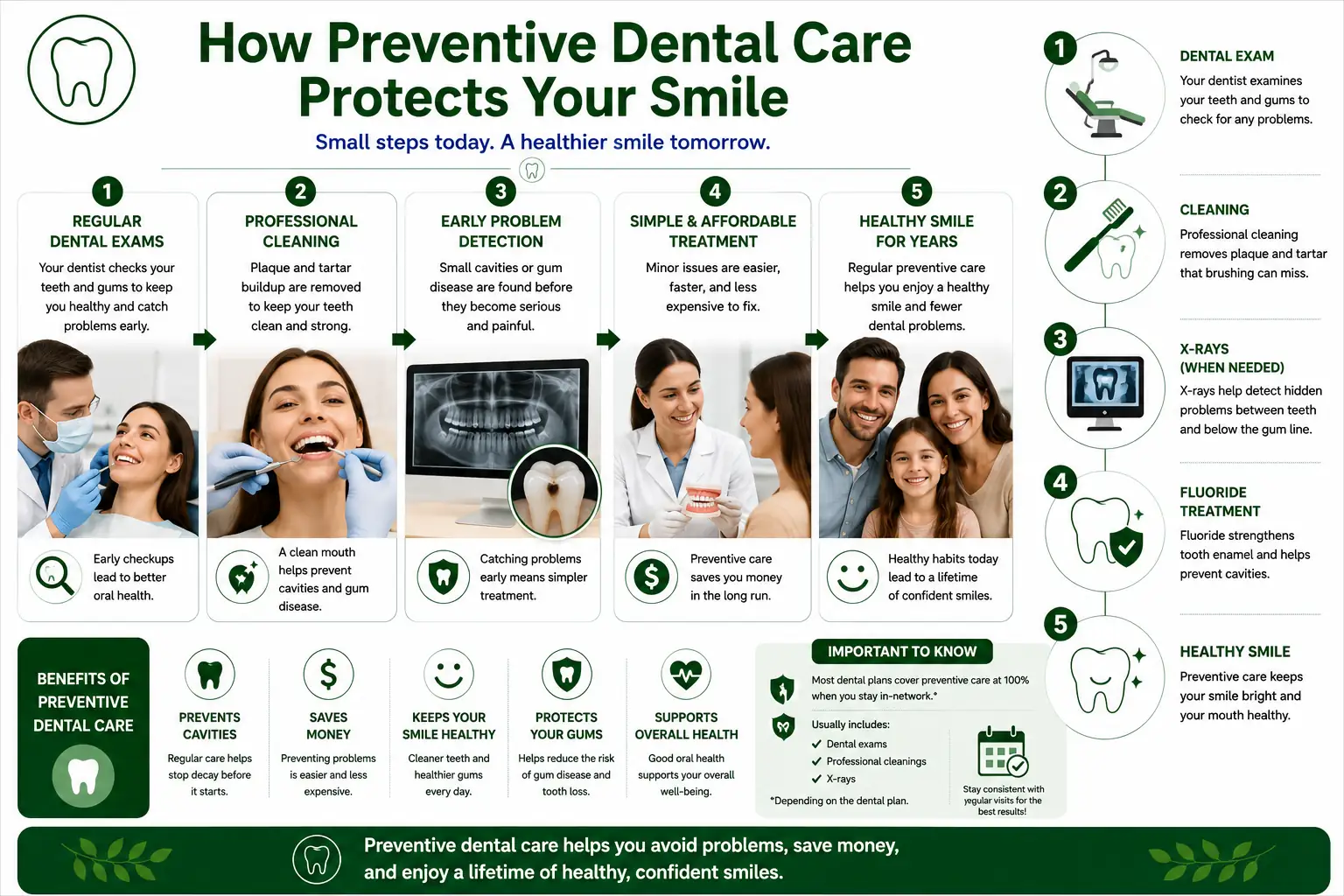
This infographic summarizes how professional evaluations, routine cleanings, diagnostic imaging when appropriate, fluoride, sealants, and daily oral care can support oral health. The services and timing recommended for an individual depend on age, oral-health history, symptoms, risk factors, and professional judgment.
Common Professional Preventive and Diagnostic Services
The services recommended during a dental visit depend on the individual’s oral health and clinical needs.
Dental plans may classify the same visit under several procedure categories. An oral evaluation or X-ray may be classified as diagnostic, while a routine cleaning, fluoride application, or sealant may be classified as preventive.
Oral Evaluations
A dental professional may evaluate:
- Teeth and existing dental restorations.
- Gums and supporting tissues.
- Bite and jaw function.
- Areas of pain, sensitivity, swelling, or infection.
- Oral and facial tissues.
- Changes that may require further examination or treatment.
The type of evaluation and the frequency allowed by a dental plan can vary. A comprehensive evaluation, periodic evaluation, limited problem-focused examination, and specialist consultation may follow different benefit rules.
Routine Professional Cleanings
A routine professional cleaning removes plaque, tartar, and surface deposits from the teeth.
A routine cleaning is not the same as periodontal treatment.
Scaling and root planing, periodontal maintenance, treatment of active gum disease, and other periodontal procedures may be classified and paid differently from a routine preventive cleaning.
Ask the dental office for the exact procedure code when the type of cleaning is unclear.
Diagnostic X-Rays
Dental X-rays can provide information that is not visible during a clinical examination.
The decision to obtain X-rays should be based on factors such as:
- Current oral health.
- Age and dental development.
- History of cavities or gum disease.
- Symptoms and clinical findings.
- Previous available images.
- The area or treatment being evaluated.
X-rays should not be treated as an automatic requirement at every preventive visit. The dental professional determines when imaging is clinically appropriate.
A dental plan may also use separate frequency limits for bitewing, panoramic, full-mouth, periapical, or other images.
Fluoride Applications
Professional fluoride may be applied as a varnish, gel, foam, or another clinically appropriate product.
Fluoride applications may be recommended for children or adults based on cavity risk, dry mouth, exposed root surfaces, orthodontic appliances, previous decay, or other clinical factors.
Dental benefits may limit fluoride coverage by age, frequency, risk category, or procedure code. A clinical recommendation does not guarantee insurance payment.
Dental Sealants
Sealants are protective materials placed in the pits and grooves of selected teeth, commonly permanent molars.
They are frequently associated with children and adolescents, but clinical need and dental-plan eligibility are separate questions.
A plan may restrict sealant benefits according to:
- Age.
- Tooth type.
- Whether the tooth has already been restored.
- Frequency or replacement rules.
- Provider network.
- Procedure code.
Examination of Oral Tissues
A dental evaluation may include examination of the lips, cheeks, tongue, gums, palate, throat, and other oral or facial tissues.
This examination may be included within the dental evaluation rather than listed as a separate preventive insurance benefit.
Unusual findings may require additional diagnostic procedures, referral, monitoring, or treatment that is classified separately.
Oral-Health Guidance
A dentist or dental hygienist may provide individualized guidance about:
- Brushing technique.
- Cleaning between the teeth.
- Fluoride use.
- Denture or appliance care.
- Dry-mouth management.
- Diet and frequent sugar exposure.
- Tobacco use.
- Care around crowns, bridges, implants, or orthodontic appliances.
This guidance may be part of the visit rather than a separately payable insurance service.
How Dental Plans May Classify Services
| Plan category | General purpose | Examples that may appear in the category | What to verify |
|---|---|---|---|
| Diagnostic | Evaluates oral health and identifies conditions | Oral evaluations and diagnostic X-rays | Procedure code, frequency limit, age rule, network, and plan classification |
| Preventive | Helps reduce risk or maintain oral health | Routine cleanings, fluoride applications, and sealants | Eligibility, frequency, age limits, deductible treatment, and annual maximum rules |
| Basic or restorative | Treats selected existing conditions | Fillings, some extractions, and certain periodontal or endodontic services | Exact classification, deductible, cost sharing, and waiting period |
| Major | Addresses more complex restorative or prosthetic needs | Crowns, bridges, dentures, and selected complex procedures | Coverage eligibility, annual maximum, replacement rules, alternate benefits, and exclusions |
These are general patterns only. The same procedure may be classified differently by different plans. The official policy, certificate of coverage, schedule of benefits, exclusions, and procedure code determine how the plan evaluates a service.
How Preventive Needs and Visit Timing Can Vary
Preventive and diagnostic visits allow a dental professional to evaluate oral health, monitor changes, remove deposits through an appropriate professional cleaning, and identify findings that may require further attention.
However, preventive care does not guarantee that every dental condition will be avoided or that future treatment will be unnecessary.
The Visit Schedule Is Individual
There is no single examination, cleaning, or X-ray schedule that is appropriate for every person.
The timing may depend on:
- Current oral health.
- History of cavities or periodontal disease.
- Dry mouth.
- Tobacco use.
- Pregnancy.
- Diabetes or other relevant health conditions.
- Orthodontic treatment.
- Dentures, implants, crowns, bridges, or other existing dental work.
- Ability to perform daily oral care.
- New symptoms or changes.
- The treating professional’s judgment.
A person may need additional visits when recommended by a dentist or another qualified healthcare professional.
Clinical Timing and Insurance Frequency Are Different
The dental professional’s recommended schedule is based on clinical needs.
A dental plan’s frequency limit determines how often the plan will consider paying for a particular service.
These two schedules may not be identical.
For example, a dentist may recommend an additional evaluation, cleaning, X-ray, fluoride application, or periodontal visit even when the plan’s frequency limit has already been reached. In that situation, the service may still be clinically appropriate, but the member may be responsible for part or all of the cost.
Do not postpone urgent or necessary care solely because an insurance frequency limit has been reached.
How Dental Insurance May Cover Preventive and Diagnostic Services
Dental plans often provide separate benefit rules for diagnostic, preventive, basic, and major services.
A plan may provide a higher benefit level for selected diagnostic or preventive procedures, but this does not mean that every service is unlimited, covered in full, or available through every provider.
Verify the Exact Service
Ask about the specific procedure rather than asking only whether preventive care is covered.
Confirm:
- The procedure name and code.
- Whether the plan classifies it as diagnostic, preventive, periodontal, or another category.
- The permitted frequency.
- Any age or tooth restrictions.
- Whether a deductible applies.
- Whether the service affects the annual maximum.
- The required provider network.
- The expected member responsibility.
What a Displayed Coverage Percentage Means
When a plan displays a coverage percentage, it generally applies that percentage according to the plan’s allowed or recognized amount and its contract rules.
The allowed amount may differ from the dentist’s complete charge.
The member’s final cost may also be affected by:
- The deductible.
- Copays or coinsurance.
- Network status.
- Balance billing where applicable.
- Frequency limits.
- Noncovered services.
- The remaining annual maximum.
Do not interpret a displayed percentage as a guarantee that the dental office visit will have no charge.
Frequency Limits
A dental plan may limit how often it pays for:
- Oral evaluations.
- Routine cleanings.
- Bitewing or other X-rays.
- Fluoride applications.
- Sealants.
- Periodontal evaluations or maintenance.
- Other diagnostic or preventive procedures.
The limit may be stated as a number of services during a benefit period or as a minimum interval between services.
Ask for the exact rule rather than assuming that every plan uses a calendar-year schedule.
Age and Tooth Limitations
Some plans apply age limits to fluoride applications, sealants, or other procedures.
Sealant eligibility may also depend on the tooth involved, previous restorations, and replacement rules.
Clinical appropriateness and insurance eligibility are separate determinations.
Dentist Network
Confirm that the exact dentist and office location participate in the specific plan and network.
Using an out-of-network dentist may result in:
- Reduced benefits.
- A different allowed amount.
- Higher cost sharing.
- Charges above the amount recognized by the plan.
- No benefit under a closed-network arrangement.
Contact both the insurer and the dental office before scheduling care.
For a fuller explanation, review In-Network vs Out-of-Network Dental Insurance.
Deductible Rules
Some plans treat selected diagnostic or preventive services differently from basic or major treatment when applying the deductible.
Do not assume that the deductible is automatically waived. Review the schedule of benefits and confirm how it applies to each procedure.
Annual Maximum Rules
Some dental plans count diagnostic and preventive payments toward the annual maximum, while others may treat selected services differently.
Confirm:
- Whether these services reduce the available annual maximum.
- Whether the maximum applies separately to each member.
- Which benefit period the plan uses.
- How much benefit remains before receiving additional treatment.
Learn more in Dental Insurance Annual Maximums Explained.
Effective Dates and Waiting Periods
Coverage cannot generally apply before the policy becomes effective.
A plan may also apply waiting periods to selected service categories. Confirm whether diagnostic and preventive services have the same timing rules as basic, major, orthodontic, or other care.
Do not rely only on a statement that preventive care begins immediately. Ask for the exact effective date and the eligibility date of the specific procedure.
For more detail, read How Waiting Periods Work in Dental Coverage.
Review the Explanation of Benefits
After a claim is processed, the Explanation of Benefits may show:
- The submitted procedure.
- The plan allowance.
- The amount considered eligible.
- The deductible applied.
- The plan payment.
- The member responsibility.
- The reason for a reduction or denial.
An Explanation of Benefits is not a bill, but it can help explain how the plan evaluated the claim.
Services That May Fall Outside Preventive Benefits
Preventive or diagnostic benefits generally do not represent coverage for every service performed during or after a routine visit.
Services that may be classified under another benefit category include:
- Fillings.
- Tooth extractions.
- Scaling and root planing.
- Periodontal maintenance.
- Root canal treatment.
- Crowns and bridges.
- Dentures.
- Dental implants.
- Oral surgery.
- Orthodontic treatment.
- Cosmetic procedures.
- Treatment of an existing dental condition.
The classification can vary by plan.
For example, a routine cleaning and periodontal maintenance are different procedures. An examination may be diagnostic, while treatment identified during that examination may be restorative, periodontal, endodontic, prosthetic, surgical, or excluded.
Ask the dental office for the procedure code and verify the classification through the official plan documents.
For treatment-specific information, review Dental Insurance Coverage for Common Procedures.
Preventive Needs Across Different Life Stages
Preventive and diagnostic needs can change over time.
Children and Teenagers
Depending on individual needs, professional care may involve:
- Monitoring dental development.
- Fluoride applications.
- Sealants.
- Guidance on brushing and diet.
- Evaluation during orthodontic treatment.
- Diagnostic imaging when clinically appropriate.
Insurance benefits may apply age, tooth, frequency, or network restrictions.
Adults
Preventive and diagnostic care may focus on:
- Cavities.
- Gum health.
- Dry mouth.
- Tooth wear.
- Existing fillings, crowns, bridges, or implants.
- Tobacco and alcohol-related risks.
- Changes that require further evaluation.
Older Adults
Older adults may need individualized support related to:
- Dry mouth.
- Gum disease.
- Root-surface cavities.
- Dentures or removable appliances.
- Implants and existing restorative work.
- Physical or cognitive difficulty with brushing and interdental cleaning.
- Oral-tissue changes.
People without natural teeth may still need professional evaluation of the gums, dentures, oral tissues, and other concerns.
The appropriate services and visit schedule should be based on individual needs rather than age alone.
For broader guidance based on life stage or work situation, review Dental Insurance for Different Life Stages and Work Situations.
How to Review Preventive and Diagnostic Benefits
Step 1: Identify the Services You May Need
Begin with the services recommended by the dental professional rather than relying only on a general preventive-care label.
Ask the dental office for:
- The procedure name.
- The procedure code.
- The recommended timing.
- The dentist or hygienist who will provide the service.
- The expected charge.
This information can help distinguish a routine cleaning from periodontal treatment and a routine evaluation from a problem-focused or specialist examination.
Step 2: Confirm How the Plan Classifies Each Service
Ask whether the procedure is classified as:
- Diagnostic.
- Preventive.
- Periodontal.
- Basic or restorative.
- Major.
- Another benefit category.
The category can affect the deductible, cost sharing, frequency limit, waiting period, and annual maximum.
Step 3: Compare Clinical Timing With Plan Frequency Rules
Ask the dental professional when the service is clinically appropriate.
Separately, ask the insurer how often the plan considers the service eligible for payment.
The recommended clinical schedule and the insurance frequency limit may not be the same.
Step 4: Verify Provider Participation
Confirm the exact dentist, hygienist when relevant, office location, plan name, and network.
Check both the insurer’s directory and the dental office directly. Ask whether participation is current and whether the office is accepting new patients through the plan.
Step 5: Estimate the Member Cost
Confirm:
- Whether a deductible applies.
- Whether the plan uses a copay or coinsurance.
- The plan allowance.
- Whether the service reduces the annual maximum.
- Whether age, tooth, or frequency restrictions apply.
- What happens when the service is received out of network.
Do not assume that a preventive label guarantees a zero-dollar visit.
Step 6: Review the Official Documents
Use the policy, certificate of coverage, schedule of benefits, exclusions, provider directory, and other official materials.
For employer-sponsored coverage, also review the Summary Plan Description or benefit booklet supplied by the plan administrator.
Step 7: Review the Explanation of Benefits
After the claim is processed, compare the Explanation of Benefits with the dental office statement.
Review:
- The submitted procedure.
- The plan allowance.
- The eligible amount.
- The deductible.
- The plan payment.
- The stated member responsibility.
- Any explanation or remark code.
Contact the insurer and dental office when the documents appear inconsistent. Keep copies of the relevant records and note the date and source of any clarification.
How to Interpret Preventive Dental Benefits
Preventive and diagnostic benefits are only one part of a dental plan.
A higher displayed benefit percentage may be useful, but it does not reveal:
- Which procedures qualify.
- How often the plan will pay for them.
- Whether age or tooth restrictions apply.
- Whether the dentist participates.
- Whether a deductible applies.
- Which plan allowance is used.
- Whether the services reduce the annual maximum.
- What happens when additional evaluation or treatment is needed.
A plan may deserve closer consideration when the dental professionals you intend to use participate, the services recommended for you are eligible, the frequency rules are appropriate, and the expected member costs are clear.
A plan may deserve less consideration when the required provider is unavailable, important services are excluded, the frequency limits conflict with expected needs, or the total cost is high compared with the likely benefits.
Compare preventive and diagnostic benefits together with provider access, restorative coverage, waiting periods, annual maximums, exclusions, and the treatment you may reasonably need.
When you are ready, compare dental plans using the same criteria for every option.
Questions to Ask Before Relying on Preventive Benefits
| Question | Why It Matters |
|---|---|
| Which services are classified as diagnostic? | Evaluations and X-rays may follow different benefit rules from cleanings, fluoride, and sealants. |
| Which services are classified as preventive? | The plan’s category determines which benefit rules apply. |
| What is the exact procedure code? | Similar-sounding services can be coded, classified, and paid differently. |
| How often is the service eligible? | The plan may use a service-count limit, a time interval, or another frequency rule. |
| Does the limit use a calendar year or another benefit period? | Eligibility may depend on the plan’s specific measurement period. |
| Are there age or tooth restrictions? | Fluoride and sealant benefits may be limited according to age, tooth, or previous treatment. |
| Does a deductible apply? | Preventive or diagnostic services are not automatically exempt from every deductible. |
| Does the plan use a copay or coinsurance? | The member may remain responsible for part of the eligible amount. |
| What plan allowance is used? | The amount recognized by the plan may differ from the dental office’s complete charge. |
| Do these services reduce the annual maximum? | The answer affects how much benefit may remain for later treatment. |
| Is there a waiting period or future effective date? | A service cannot generally receive benefits before it becomes eligible under the policy. |
| Is the dentist in the exact network? | Accepting the insurance company does not mean participating in every plan it offers. |
| Is the office location participating? | Network status may differ between locations within the same practice. |
| How is periodontal care classified? | Routine cleaning, scaling and root planing, and periodontal maintenance are different procedures. |
| How are additional evaluations or X-rays handled? | Problem-focused care and different imaging types may have separate rules. |
| What happens when the frequency limit has been reached? | A clinically appropriate service may leave the member responsible for more of the cost. |
| Where can I read the complete rules? | Marketing summaries may omit frequency, age, network, and benefit limitations. |
Helpful Resources
- Dental Plans Guide
- In-Network vs Out-of-Network Dental Insurance
- How Waiting Periods Work in Dental Coverage
- Dental Insurance Annual Maximums Explained
- Dental Insurance Coverage for Common Procedures
- Dental Insurance for Different Life Stages and Work Situations
- Dental Plan Comparison Checklist
- Compare Dental Plans
- Dental Insurance Learning Center
Frequently Asked Questions
What is preventive dental care?
Preventive dental care can include professional services and daily oral-care practices intended to support oral health and identify changes that may require attention.
Dental benefits generally apply only to eligible professional services listed in the plan documents.
Are dental exams considered preventive care?
Dental plans may classify oral evaluations as diagnostic services or combine them with preventive services under a diagnostic and preventive category.
Confirm the exact evaluation type, procedure code, frequency limit, and plan classification.
Is a routine dental cleaning preventive care?
A routine professional cleaning is commonly classified as preventive.
However, scaling and root planing, periodontal maintenance, and other gum-treatment procedures are different services and may follow different benefit rules.
Are dental X-rays preventive care?
Dental X-rays are generally diagnostic services.
The type and timing should be based on clinical need. Insurance eligibility may depend on the image type, frequency limit, previous images, procedure code, and other plan rules.
Does everyone need dental X-rays at the same interval?
No.
The appropriate timing depends on current oral health, age, disease risk, symptoms, previous images, clinical findings, and the treating professional’s judgment.
Does dental insurance cover preventive care in full?
Not necessarily.
A plan may provide a higher benefit level for selected diagnostic or preventive services, but deductibles, copays, coinsurance, plan allowances, frequency limits, age restrictions, annual maximum rules, and network requirements may still apply.
Does preventive dental care have a waiting period?
It depends on the plan.
Confirm the policy effective date and the eligibility date for the exact diagnostic or preventive procedure. Other service categories may follow different waiting-period rules.
Does the deductible apply to preventive care?
It depends on the policy.
Some plans treat selected diagnostic or preventive services differently from restorative treatment, but this should be confirmed through the official schedule of benefits.
Does preventive care count toward the annual maximum?
It depends on the plan.
Some plans count these payments toward the annual maximum, while others may treat selected services differently. Review the exact contract terms.
Is professional fluoride considered preventive care?
Professional fluoride applications are commonly associated with preventive care.
The clinical recommendation and insurance benefit are separate matters. Coverage may depend on age, frequency, risk, procedure code, provider network, and other limitations.
Are dental sealants preventive care?
Sealants are used to help protect susceptible tooth surfaces from cavities.
Dental-plan eligibility may depend on age, tooth type, previous restoration, frequency, replacement rules, provider network, and procedure code.
How often should preventive dental visits occur?
There is no single schedule suitable for every person.
The timing should reflect oral-health history, current findings, symptoms, risk factors, existing dental work, and professional judgment. The insurer’s frequency limit may differ from the clinically recommended schedule.
Can preventive visits guarantee that future dental treatment will not be needed?
No.
Preventive and diagnostic care can support oral health and help identify concerns, but it cannot guarantee that cavities, gum disease, tooth damage, infection, or other treatment needs will never occur.
Sources
- Centers for Disease Control and Prevention — About Oral Health
- Centers for Disease Control and Prevention — Oral Health Tips for Adults
- Centers for Disease Control and Prevention — About Dental Sealants
- Centers for Disease Control and Prevention — About Fluoride
- American Dental Association — X-Rays and Radiographs
- American Dental Association — Typical Dental Plan Benefits and Limitations
- American Dental Association — Explanation of Benefits Statement
- HealthCare.gov — Dental Coverage in the Marketplace
About the Author
Maria Dumitru is the Founder and Content Editor of Dental Coverage Hub. She researches and edits educational content designed to help U.S. consumers understand dental insurance terms, compare plan features, and verify important information before enrolling.
Learn more about our standards in the Editorial Policy and How We Review Dental Plans.
This article provides general educational information and is not dental, medical, legal, financial, or personalized insurance advice. Oral-health needs, recommended services, benefit classifications, provider networks, frequency limits, deductibles, annual maximums, exclusions, and availability can vary. Review the official plan documents and consult the appropriate dental professional, insurer, plan administrator, and dental office for information specific to your situation.
Ready to Compare Dental Plans?
Preventive and diagnostic benefits can differ by procedure, provider network, frequency limit, age rule, deductible treatment, annual maximum, and plan classification. Compare the official terms and verify how each plan applies to the services and dental professionals you expect to use before enrolling.