
💼 Self-Employed Guide
🇺🇸 Built for U.S. Consumers
💰 Cost Comparison

Dental Insurance for Self-Employed Individuals: How to Find the Right Coverage in 2026
Working for yourself comes with freedom and flexibility—but finding dental coverage can feel overwhelming. Learn how self-employed individuals can compare plans, understand benefits and choose coverage that fits their needs and budget.
🟢 What You’ll Learn
In this guide you’ll learn how dental insurance works for self-employed individuals, which coverage options are available, what costs to compare and how to choose a plan that fits your situation.
Being self-employed offers flexibility and independence, but it also means you’re responsible for finding your own benefits—including dental coverage.
Unlike traditional employees who may receive dental benefits through an employer, freelancers, independent contractors, consultants and sole proprietors often need to explore coverage options on their own.
The good news is that several dental coverage options are available. Understanding how they work can help you make a more informed decision.
For a broader look at how dental coverage priorities may change based on family, age and work situation, start with our guide to dental insurance by life stage.
Why Dental Coverage Still Matters When You’re Self-Employed
When running your own business, it can be easy to focus on immediate expenses and postpone routine appointments. Regular exams, cleanings and X-rays may help identify problems before they require more complex treatment. Learn how preventive dental care coverage may work when comparing plans.
Common preventive services often include:
- ✔ Dental exams
- ✔ Professional cleanings
- ✔ X-rays
- ✔ Preventive screenings
💡Maintaining oral health can help reduce the likelihood of more extensive treatment later.
❓Who Is Considered Self-Employed?
This guide may be helpful if you are:
- Freelancer
- Independent contractor
- Consultant
- Real estate agent
- Gig worker
- Sole proprietor or business owner without employees
- Self-employed professional
Self-Employed vs Small Business Owner Dental Coverage
A self-employed person without employees generally looks for dental coverage for themselves or their family. This may include freelancers, consultants, independent contractors, sole proprietors and other professionals who work independently.
A small business owner may also need to consider dental benefits for employees. That can introduce additional questions about employee eligibility, participation rules, employer contributions and group coverage.
Owning a business does not automatically mean that group coverage is the right option. The important distinction is whether the coverage is intended only for the owner and household or also for eligible employees.
Review our Dental Insurance for Small Business Owners guide when you are considering coverage for employees as well as yourself.
How Dental Insurance Works for Self-Employed Individuals
A simple guide to finding affordable dental coverage when you’re self-employed.
1️⃣-YOU’RE SELF-EMPLOYED
You work for yourself and don’t receive employer-sponsored dental benefits.➡️
2️⃣-COMPARE DENTAL PLANS
Review PPO, HMO and Dental Savings Plans to find the best coverage for your needs and budget.➡️
3️⃣-CHOOSE THE RIGHT COVERAGE
Select a plan based on your budget, expected dental care and preferred dentist.➡️
4️⃣-USE PREVENTIVE CARE
Schedule regular exams, cleanings and X-rays to help prevent costly dental problems.➡️
5️⃣-SAVE ON MAJOR TREATMENTS
Dental insurance may help reduce the cost of crowns, root canals, implants, dentures and other major procedures.➡️
6️⃣-PROTECT YOUR SMILE & BUSINESS
A healthy smile helps you stay confident, productive and focused on growing your business.😁
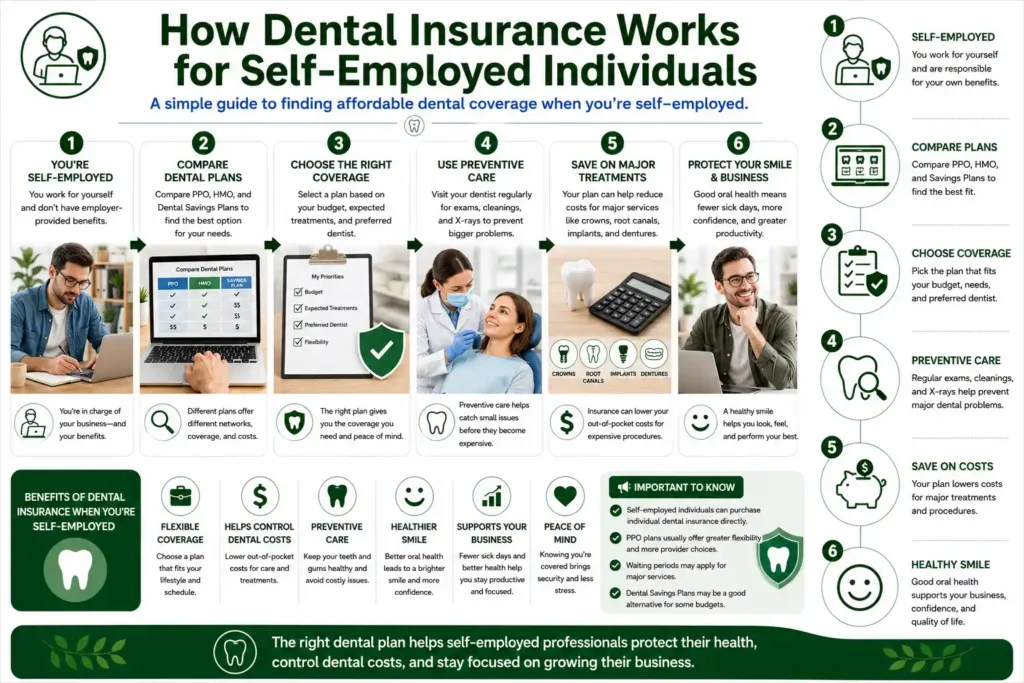
Important to Know :
- ✔ Self-employed individuals can purchase individual dental insurance directly.
- ✔ PPO plans usually offer greater flexibility.
- ✔ Waiting periods may apply for major services.
- ✔ Dental Savings Plans may be a good alternative for some budgets.
The right dental plan helps self-employed professionals protect their health, manage dental costs and stay focused on growing their business.
💼Flexible coverage 💰Helps control dental costs 🦷Preventive care 😁Healthier smile 📈Supports your business ❤️Peace of mind
Common Dental Coverage Options Available
Self-employed individuals typically explore three common options:
Individual Dental Insurance Plans
Individual dental insurance purchased directly from an insurance company, broker or other eligible enrollment source. Some Marketplace health plans may include dental benefits, and separate Marketplace dental plans may be available when someone is also purchasing Marketplace health coverage.
Dental Savings Plans
Membership-style programs that provide discounted rates for participating services.
Group Coverage Through Associations
Some professional organizations and associations may offer access to group dental benefits.
Coverage for Yourself vs Coverage for Your Family
A self-employed person may need coverage only for themselves or for a spouse and dependent children as well.
An individual plan generally covers one person, while a family plan may place several eligible household members under the same policy. Compare premiums, individual and family deductibles, annual maximums, dependent eligibility and orthodontic benefits before choosing.
Our Individual vs Family Dental Plans guide explains the main differences in more detail.
🟢Now that you know the most common coverage options, let’s compare them side by side to see which one may fit your situation best.
📚Individual Dental Insurance Plans Explained
Many self-employed individuals choose individual dental insurance plans because they provide structured coverage and predictable benefits.
When reviewing plans, consider:
- Monthly premiums
- Deductibles
- Annual maximums
- Waiting periods
- Provider networks
- Orthodontic benefits (if relevant)
⚖️PPO vs HMO Dental Plans For Self-Employed Individuals
Many dental plans fall into either PPO or HMO structures.
PPO Dental Plans
Benefits may include:
- Greater provider flexibility
- Larger networks
- Possible out-of-network benefits
- Easier specialist access, depending on the plan
HMO Dental Plans
HMO dental plans may offer:
- More structured provider networks
- Predictable copayments under some plans
- Lower monthly premiums in some cases
- In-network care generally required
🟢 Plan type can affect dentist access, specialist referrals and possible out-of-network benefits. Review our PPO vs HMO Dental Plans guide before deciding which structure better matches your provider preferences and budget.
💰What Costs Should You Compare?
When evaluating dental plans, don’t focus only on monthly premiums. Review:
- Monthly Premium
- Annual Deductible
- Annual Maximum
- Waiting Periods
- Orthodontic Benefits
- Provider Networks
- Estimated Out-of-Pocket Costs

Some dental plans may require members to wait before benefits become available for basic, major or orthodontic services. Learn how dental insurance waiting periods work before enrolling or scheduling expected treatment.

❓Questions To Ask Before Enrolling
- ✔ How often do you visit the dentist?
- ✔ Do you expect major treatment?
- ✔ Is your dentist in-network?
- ✔ Are waiting periods acceptable?
- ✔ Do you need orthodontic coverage?
- ✔ What is your annual dental budget?
✅Dental Plan Comparison Checklist
| Factor | Why It Matters |
|---|---|
| Premium | Monthly cost |
| Deductible | Amount paid before certain benefits apply |
| Annual Maximum | Coverage limit |
| Network | Available dentists |
| Waiting Periods | Access to benefits |
| Orthodontics | Relevant for families |
| Major Procedures | Coverage for complex treatment |
⚖️Dental Insurance vs Dental Savings Plans
Many self-employed individuals compare these two options.
Dental Insurance
May provide:
- Preventive coverage
- Structured benefits
- Coverage for larger procedures
Dental Savings Plans
May provide:
- Immediate discounts
- Simple membership structure
- No traditional insurance claims
💡Dental insurance and dental savings plans handle costs differently. Insurance commonly uses premiums, deductibles, covered-service rules and annual maximums, while savings plans generally provide access to reduced fees from participating dentists.
Review our Dental Insurance vs Dental Savings Plans guide before comparing coverage, discounts, provider participation and total expected costs.
Common Mistakes Self-Employed Individuals Make
Choosing Based Only On Premium Price–The lowest premium isn’t always the best value.
Ignoring Waiting Periods–Some plans may delay access to certain benefits.
Overlooking Provider Networks–A plan may not include your preferred dentist.
Forgetting About Annual Maximums–Coverage limits can affect long-term costs.
📚 HELPFUL RESOURCES
🔥Our Editorial Standards
Dental Coverage Hub is committed to providing clear, educational and regularly reviewed information about dental plans and dental insurance.
✅Quick Takeaways
✔ Self-employed individuals can purchase dental coverage directly
✔ Individual dental plans remain the most common option
✔ PPO and HMO plans offer different advantages
✔ Dental savings plans may be worth comparing
✔ Review costs beyond monthly premiums
✔ Compare provider networks carefully
💚 Our Recommendation
Self-employed individuals should compare dental plans based on total yearly value rather than monthly premiums alone. Review deductibles, annual maximums, waiting periods, provider networks, expected treatment needs and whether coverage is needed only for you or for your family.
The lowest-priced plan is not automatically the least expensive option over an entire year. Consider both recurring premiums and the costs you may pay when using dental services.
💡Taking time to compare options can help you find coverage that fits both your budget and your oral health goals.
❓Frequently Asked Questions
✅ Last reviewed: June 2026
✅ About the Author: M.D.-Content creator and researcher focused on helping consumers better understand dental plans, coverage options and dental insurance concepts.
✅ Content is reviewed regularly to help ensure information remains accurate, practical and useful for consumers exploring dental coverage options in the United States.
✅ This article is intended for educational purposes only and should not be considered insurance, financial or legal advice.

Looking For Dental Coverage That Fits Your Independent Lifestyle?
Compare dental plans based on your budget, preferred dentist, expected treatment and whether you need individual or family coverage.
© 2026 Dental Coverage Hub