
⭐ Practical Guidance
🇺🇸 Built for U.S. Consumers
💰 Cost Considerations

Does Dental Insurance Cover Dentures? What You Need to Know in 2026
Dentures remain a common tooth replacement option for many adults and retirees. Learn how dental insurance may help cover denture treatment, what limitations may apply and which plan features to compare before choosing coverage.
🟢WHAT YOU’LL LEARN
Dental insurance may cover dentures, but the answer depends on the plan.
Many dental plans treat dentures as major restorative care. That means the plan may help pay part of the cost, but coverage is usually subject to rules such as waiting periods, deductibles, coinsurance, annual maximums, provider networks, replacement limits, and exclusions.
This is why “covered” does not always mean “paid in full.”
Dentures can also mean different things. A plan may cover full dentures or partial dentures, but handle immediate dentures, replacement dentures, repairs, relines, or implant-supported dentures differently.
This guide explains how dental insurance may cover dentures, what limits to check, how Medicare and Medicaid may apply, and what to do if your plan does not cover enough.
If you are still learning how dental insurance works, start with our Dental Plans guide to understand plan types, coverage categories, waiting periods, annual maximums and common limits before comparing denture coverage.
Quick Answer
Dental insurance may cover dentures, but usually under major restorative benefits rather than preventive care.
Coverage can vary by denture type. Full and partial dentures may be handled differently from immediate dentures, replacement dentures, repairs, relines or implant-supported dentures.
Before starting treatment, check whether dentures are covered, whether a waiting period applies, how much of your annual maximum remains, whether your dentist is in network, and whether replacement limits or exclusions apply.
Key Takeaways
- Dental insurance may cover dentures, but usually as major restorative care.
- Coverage can depend on the denture type, waiting period, annual maximum, dentist network, replacement rules and exclusions.
- Full dentures and partial dentures may be handled differently from repairs, relines, immediate dentures or implant-supported dentures.
- Original Medicare generally does not cover dentures, but some Medicare Advantage plans may offer dental benefits.
- Medicaid adult denture coverage varies by state.
- If insurance does not cover enough, options may include dental savings plans, HSA or FSA funds, payment plans, dental schools, community clinics or phased treatment.
How Dental Insurance Usually Covers Dentures
Dental insurance often divides care into categories.
Preventive care usually includes services such as exams, cleanings, and X-rays. Basic care may include smaller restorative procedures. Major care usually includes more complex or higher-cost treatment.
Dentures are commonly considered major restorative care because they replace missing teeth and require planning, impressions, lab work, fitting, and follow-up adjustments.
The American Dental Association explains that denture prostheses may be complete or partial, and may be nonimplant-retained or implant-retained. The right option can depend on factors such as the number of teeth being replaced, bone loss, cost, and patient needs. (ada.org)
What “Covered” Means
If a plan says dentures are covered, that usually means the plan may help pay for eligible dentures under its rules.
It does not always mean:
- The plan pays the full cost.
- The service is covered immediately.
- Every type of denture is included.
- Your preferred dentist is in network.
- Repairs, relines, or replacements are covered the same way.
- Implant-supported dentures are covered.
A better question is:
“Are these specific dentures covered under this plan, at this dentist, at this time, and under what limits?”
Why Plan Details Matter
Two dental plans can both say they cover dentures but work very differently.
One plan may have a waiting period before major services begin. Another may cover major services sooner but have a lower annual maximum. Another may require an in-network dentist. Another may cover conventional dentures but exclude implant-supported dentures.
That is why the plan summary is not enough by itself. You should review the official benefit details before treatment begins.
Types of Dentures and How Coverage May Differ
Dentures are not one single product. Coverage can vary depending on what type of denture you need.
| Type of denture | What it means | Coverage issue to check |
|---|---|---|
| Full dentures | Replace all teeth in an upper or lower arch | Usually reviewed under major restorative benefits |
| Partial dentures | Replace some missing teeth while natural teeth remain | May have different rules from full dentures |
| Immediate dentures | Placed soon after extractions while the mouth heals | May be treated differently from final dentures |
| Replacement dentures | Replace an older denture | Often subject to replacement limits |
| Denture repairs | Fix damage to an existing denture | May be classified separately from new dentures |
| Denture relines | Adjust the fit of an existing denture | May have timing or frequency limits |
| Implant-supported dentures | Attach to dental implants for added stability | May be limited, excluded, or handled under implant rules |
Full Dentures
Full dentures replace all teeth in the upper arch, lower arch, or both.
Dental insurance may cover full dentures as major restorative care, but you should check waiting periods, annual maximums, network rules, and whether the plan covers both the denture and related procedures.
Partial Dentures
Partial dentures replace some missing teeth while other natural teeth remain.
Coverage may depend on whether the partial denture is considered medically necessary under the plan, what materials are used, and whether the plan has missing tooth clauses or replacement limits.
Immediate Dentures
Immediate dentures are placed soon after teeth are removed so the patient does not go without teeth during healing.
Some plans may treat immediate dentures as separate from final dentures. Others may limit how they cover temporary or transitional appliances.
Ask whether the plan covers the immediate denture, the final denture, or only one of them.
Replacement Dentures
If you already have dentures and need a new set, the plan may apply replacement limits.
A replacement limit means the plan may only help pay for new dentures after a certain period or under certain conditions. If you need replacement sooner because of fit, damage, or oral changes, documentation may be required.
Denture Repairs and Relines
Repairs and relines may be covered differently from new dentures.
A repair fixes a broken or damaged denture. A reline adjusts the fit of the denture base against the gums.
Even if new dentures are covered, repairs or relines may have separate rules, frequency limits, or cost-sharing.
Implant-Supported Dentures
Implant-supported dentures are connected to dental implants.
These may feel more stable than conventional dentures, but insurance coverage can be more complicated. Some plans exclude implants. Some cover parts of the implant process. Others may cover the denture but not the implant posts, or may apply separate limits.
MouthHealthy, the American Dental Association’s consumer resource, describes implants as a way to replace missing teeth and notes that implants are designed to blend with other teeth. (mouthhealthy.org) If you are considering implant-supported dentures, ask the plan about the implant, abutment, attachments, and denture separately.
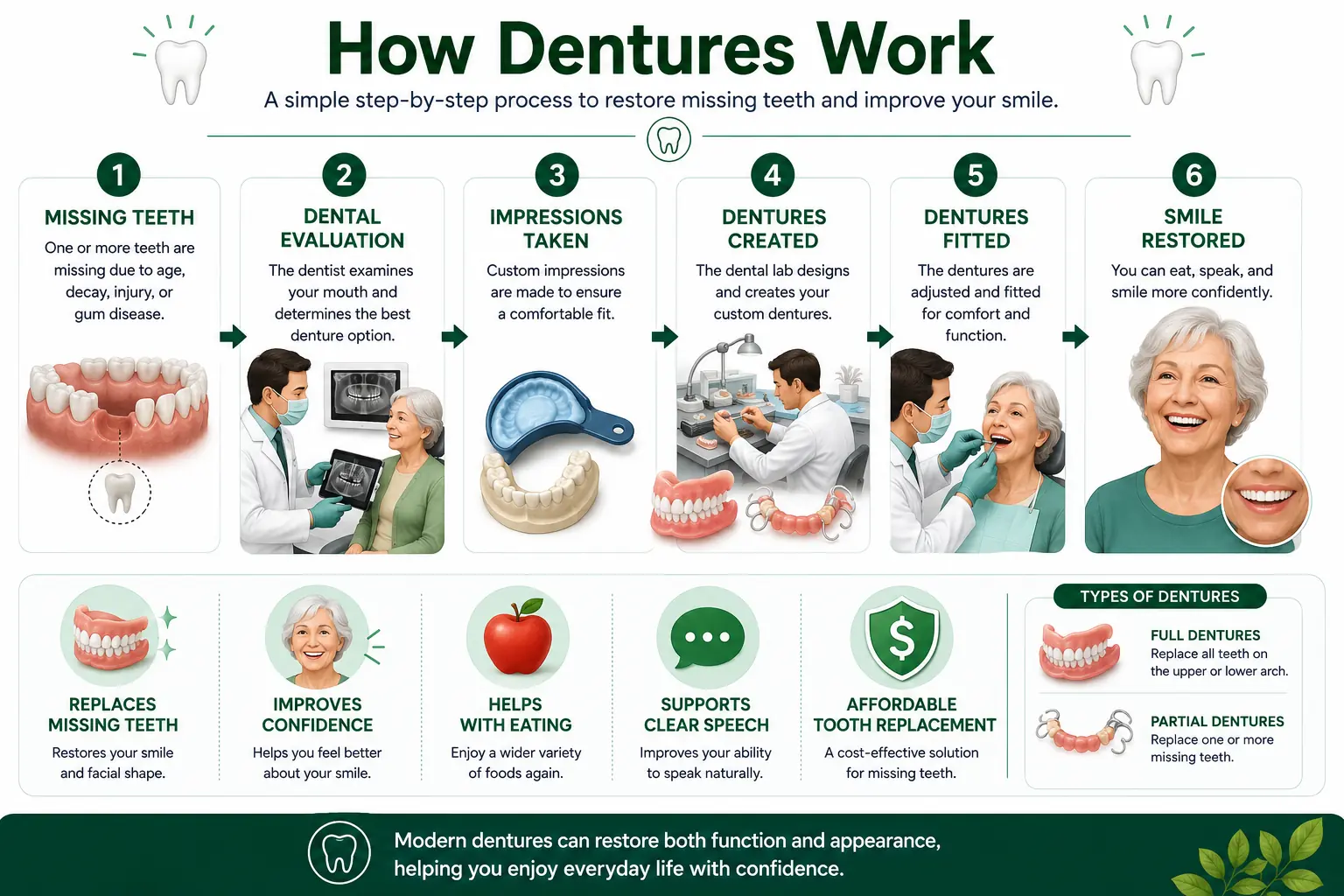
How Dentures Work
A simple step-by-step process to restore missing teeth and improve your smile.
What Costs and Rules Can Still Apply?
Even when dental insurance covers dentures, several plan rules can affect what you pay.
Deductible
A deductible is the amount you may need to pay before the plan starts sharing the cost of certain services.
Some plans apply deductibles to major care, including dentures.
Coinsurance or Copay
Coinsurance means you and the plan split the cost by percentage.
A copay is a fixed amount you pay for a covered service.
Depending on the plan type, dentures may be subject to coinsurance, a copay, or another cost-sharing structure.
Annual Maximum
An annual maximum is the most a dental plan will pay toward covered dental care during a benefit year.
This is especially important for dentures because major dental work can use a large portion of the yearly benefit. The ADA explains that many dental plans have a total annual maximum, meaning the plan may reimburse only up to a certain amount each year even if dental costs exceed that limit. (ada.org)
Waiting Period
Dentures may be subject to a waiting period because they are often classified as major care.
If you receive the denture before the waiting period ends, the plan may not pay for it.
HealthCare.gov explains that if a stand-alone dental plan has a waiting period, it will not cover affected services until the waiting period ends, even though you may still pay premiums during that time. (healthcare.gov)
Network Rules
Many plans pay more when you use an in-network dentist.
If you use an out-of-network dentist, you may owe more. Some plans may not cover out-of-network care at all except in limited situations.
Before treatment begins, confirm that the dentist and any required specialist participate in the exact plan network.
Replacement Limits
Many plans limit how often they help pay for replacement dentures.
This matters if you already have dentures and need a new set because of wear, poor fit, oral changes, damage, or changes after extractions.
Exclusions
A plan may exclude certain denture-related services.
Possible exclusions may include temporary appliances, cosmetic upgrades, implant components, treatment already in progress, or replacement of teeth missing before coverage began.
Waiting Periods for Denture Coverage
Waiting periods are one of the most important denture coverage issues.
A waiting period is the time you must wait after your plan starts before certain benefits become available.
Preventive services may be available sooner, but major services such as dentures may have a longer delay.
If you know you need dentures soon, do not enroll in a plan based only on the monthly premium. Check whether dentures are covered immediately, whether a waiting period applies, and whether a waiting-period waiver is available if you had recent comparable dental coverage.
For a broader explanation, review our How Waiting Periods Work in Dental Coverage guide.
Does Medicare Cover Dentures?
Original Medicare generally does not cover dentures. In most cases, Medicare does not cover routine dental services or items such as dentures and implants.
Some Medicare Advantage plans may offer dental benefits, but coverage varies by plan. If you have Medicare Advantage, check your plan documents before assuming dentures are covered.
Does Medicaid Cover Dentures?
Medicaid denture coverage for adults depends on the state.
Children’s dental benefits are required under Medicaid, but adult dental benefits are determined by each state. Some states may cover dentures for adults, while others may offer limited or emergency-only dental benefits.
If you have Medicaid, check your state Medicaid agency or managed care plan before assuming dentures are covered.
Seniors and retirees should be especially careful because dental coverage may come from different sources, such as Medicare Advantage, Medicaid, retiree dental benefits or a stand-alone dental plan.
For broader guidance, review our Dental Insurance for Seniors guide.
Dentures vs Dental Implants: Why Coverage May Differ
Dentures and dental implants are both tooth replacement options, but dental insurance may treat them differently.
Conventional full or partial dentures may be covered as major restorative care. Dental implants may be limited, excluded, or subject to separate rules.
Traditional Dentures
✔ Lower upfront cost
✔ Widely available
✔ Non-surgical option
Implant-Supported Dentures
✔ Improved stability
✔ Stronger chewing support
✔ May involve higher costs
A plan may cover the denture but not the implant posts, attachments, abutments or bone-related procedures.
For a deeper look at implant coverage, read our Dental Insurance Cover Implants guide.
How to Check If Your Plan Covers Dentures
Before starting denture treatment, take these steps.
Ask for a Written Treatment Plan
Ask your dentist for a written plan that lists the recommended denture type, related procedures, and procedure codes.
This helps you ask the insurance company specific questions instead of relying on general coverage language.
Request a Pre-Treatment Estimate
A pre-treatment estimate, sometimes called pre-authorization or predetermination, lets the insurer review the planned treatment before care begins.
It is not always a guarantee of payment, but it can help you understand what the plan may cover and what you may owe.
Check the Waiting Period
Ask whether dentures are classified as major care and whether a waiting period applies.
Also ask when the waiting period ends based on your plan’s effective date.
Review the Annual Maximum
Ask how much of your annual maximum is still available.
If other dental work has already used part of the benefit, your denture coverage may be lower than expected.
Confirm Network Status
Ask whether your dentist is in network for your exact plan.
If a specialist or dental lab is involved, ask how those services are handled.
Ask About Replacement Rules
If you already have dentures, ask whether the plan covers replacements and what documentation is needed.
Ask About Related Procedures
Dentures may involve more than the appliance itself.
Ask how the plan handles extractions, exams, X-rays, adjustments, relines, repairs, tissue conditioning, and follow-up visits.
What If Dental Insurance Does Not Cover Enough?
Dental insurance may reduce denture costs, but it may not fully solve the cost problem. If your plan has a waiting period, annual maximum, replacement limit, exclusion, or high out-of-pocket share, consider other options before delaying needed care.
Dental Savings Plans
A dental savings plan is not insurance. It is a membership program that gives access to discounted fees from participating dentists. It may help if your dental insurance does not cover enough or if you need care before a waiting period ends.
Payment Plans
Some dental offices offer payment plans or financing options. Before agreeing, review payment timing, fees, interest terms, and what happens if the balance is not paid on schedule.
HSA or FSA Funds
If available, Health Savings Account or Flexible Spending Account funds may help pay for eligible dental expenses with tax-advantaged dollars. These accounts do not change what insurance covers, but they may make out-of-pocket denture costs easier to manage.
Dental Schools
Dental schools may offer lower-cost care under professional supervision. Treatment may take longer, but it can be an option for people who need more affordable dental services.
Community Clinics
Community health centers or local clinics may offer dental care based on income, location, or eligibility. Services vary, so ask specifically whether dentures, denture repairs, or referrals are available.
Phased Treatment
Sometimes treatment can be planned in stages. For example, extractions, healing, temporary appliances, and final dentures may happen at different times. Ask your dentist what can safely be phased and what should not be delayed.
For a broader comparison, read our Dental Insurance vs Dental Savings Plans guide.
Questions to Ask Before Getting Dentures
| Question | Why it matters |
| Are dentures covered under this plan? | Not every plan covers major restorative care the same way |
| Are full and partial dentures both covered? | Coverage may differ by denture type |
| Are immediate dentures covered? | Temporary or transitional dentures may have special rules |
| Are repairs and relines covered? | Maintenance may be separate from new dentures |
| Are replacement dentures covered? | Plans may limit how often replacement is paid for |
| Are implant-supported dentures covered? | Implant-related treatment is often handled differently |
| Is there a waiting period? | Dentures may not be covered immediately |
| What annual maximum remains? | The plan may stop paying after the yearly benefit limit |
| Is my dentist in network? | Network status can change out-of-pocket cost |
| Should I request a pre-treatment estimate? | This can reduce surprise bills |
| Are extractions covered separately? | Related procedures may fall under different benefit categories |
| Does Medicare, Medicaid, or another plan apply? | Coverage source matters, especially for seniors |
💚Our Recommendation
Dental insurance may cover dentures, but you should not assume the coverage will be simple or complete.
Before enrolling in a plan or starting treatment, check the denture-specific rules. Ask whether the plan covers full dentures, partial dentures, immediate dentures, replacements, repairs, relines, and implant-supported dentures.
Also check waiting periods, annual maximums, deductibles, coinsurance, network rules, replacement limits, and exclusions.
For seniors and retirees, confirm whether you have Original Medicare, Medicare Advantage, Medicaid, a stand-alone dental plan, or retiree dental benefits. The rules can be very different.
The best decision is not just whether dentures are “covered.” It is whether the plan helps enough, soon enough, with a dentist you are willing to use.
📚Helpful Resources
- Dental Plans Guide
- Dental Insurance Coverage for Common Procedures
- Does Dental Insurance Cover Crowns?
- Does Dental Insurance Cover Implants?
- How Waiting Periods Work in Dental Coverage
- No Waiting Period Dental Insurance
- Dental Insurance vs Dental Savings Plans
- Dental Insurance for Seniors
- Compare Dental Plans
- Dental Insurance Learning Center
🔥Our Editorial Standards
Dental Coverage Hub is committed to providing clear, educational and regularly reviewed information about dental plans and dental insurance.
Sources
Medicare.gov — Dental Services
CMS — Medicare Dental Coverage
American Dental Association — Dentures
MouthHealthy / American Dental Association — Implants
American Dental Association — Typical Dental Plan Benefits and Limitations
HealthCare.gov — Dental Coverage in the Marketplace
MACPAC — Medicaid Coverage of Adult Dental Services
Frequently Asked Questions
Does dental insurance usually cover dentures?
Dental insurance may cover dentures, but usually as major restorative care.
Coverage depends on the plan, denture type, waiting period, annual maximum, network rules, replacement limits, and exclusions.
Are full dentures covered by dental insurance?
Full dentures may be covered by some dental insurance plans.
You should check whether they are covered as major care, whether a waiting period applies, and whether the plan has replacement or annual maximum limits.
Are partial dentures covered by dental insurance?
Partial dentures may be covered, but coverage depends on the plan.
Ask whether the plan covers removable partial dentures, what documentation is required, and whether missing tooth clauses or replacement limits apply.
Are immediate dentures covered by insurance?
Immediate dentures may be covered differently from final dentures.
Some plans may treat them as temporary appliances, while others may limit coverage if final dentures are also planned. Ask before treatment begins.
Does insurance cover denture repairs or relines?
Some plans may cover denture repairs or relines, but they may have separate rules from new dentures.
Ask about frequency limits, documentation, and whether the service is classified as basic or major care.
Does dental insurance cover replacement dentures?
Dental insurance may cover replacement dentures, but many plans limit how often they will pay for replacement.
If you need replacement because of fit, damage, or oral changes, your dentist may need to provide documentation.
Does dental insurance cover implant-supported dentures?
Coverage for implant-supported dentures varies widely.
Some plans may cover the denture but not the implants. Others may limit or exclude implant-related services. Ask about each part of the treatment separately.
What should I do if my insurance does not cover enough?
Ask for a written treatment estimate and compare your options.
You may consider dental savings plans, payment plans, HSA or FSA funds, dental schools, community clinics, or phased treatment when appropriate.
Last reviewed: June 2026
About the Author: M.D.-Content creator and researcher focused on helping consumers better understand dental plans, coverage options and dental insurance concepts.
Reviewed by Dental Coverage Hub Editorial Team. Content is reviewed regularly to help ensure information remains accurate, practical and useful for consumers exploring dental coverage options in the United States.
✅ This article is intended for educational purposes only and should not be considered insurance, financial or legal advice.

Compare Dental Plans With Confidence
Denture coverage can vary widely from one dental plan to another. Before enrolling, compare denture-specific coverage, waiting periods, annual maximums, replacement limits, network rules, exclusions and out-of-pocket costs.